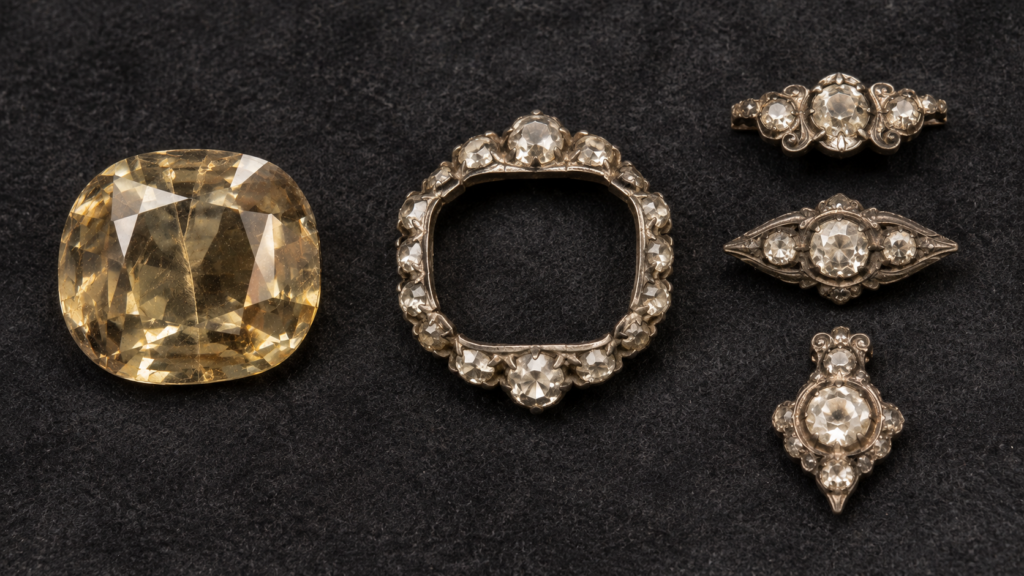
The Florentine Diamond returned to public view with an unusually tangible clue to its identity: the setting of an old hat pin. The loose diamond fitted the mount, while three surviving diamond-set pieces could be arranged to match a historical photograph. That physical comparison, made in 2025, connects the gemstone now exhibited in Québec to a jewel once kept in Vienna. Earlier evidence leads further back, to a Medici purchase in 1601 and a Florentine court where the same diamond had been worn in an entirely different setting. (1, 7, 8)
In the first episode of Extraordinary Gems & Jewels, Vittoria Valdieri follows those clues from Florence to Québec. The story brings together three kinds of evidence that rarely survive for the same historic gemstone: records of its acquisition, images of how it was worn, and parts of a setting that can still be compared with the stone. (1, 2, 7, 8)
Before the Medici purchase: what the Florentine archives record
The first useful date in the Florentine Diamond’s documented history is June 1579. Letters selected for the Palazzo Medici Riccardi exhibition record a diamond offered to Grand Duke Francesco I de’ Medici. The correspondence associates it with Asia. That provides a geographical clue to how the stone was described in trade, while the published evidence leaves its exact mine unidentified. (2)
The strongest early transaction record comes from the next Medici reign. According to the Museo dell’Opera del Duomo, a document dated 12 October 1601 records Ferdinando I de’ Medici acquiring the diamond from the Portuguese Castro-Noranha family for about 35,000 Portuguese scudi crociati. The museum identifies Orazio Rucellai, a Florentine man of letters with expertise in gemstones, as the intermediary and notes that a court diary describes the diamond as rough at the time of purchase. Modern archival research by Antonio Tarasco and Cristina Farnetti also identifies Ferdinando I and the 1601 acquisition. (1, 3)
Those details matter because they distinguish the first known offer, the documented purchase and the subsequent cutting. The price belongs to a particular court transaction in a historical currency. Its value for provenance lies in the people, date and circumstances it records.
The Florentine Diamond’s double rose cut
Florentine museum accounts credit Pompeo Studendoli, also rendered Studentoli, a Venetian lapidary working in Florence, with fashioning the stone. The Museo dell’Opera del Duomo associates the work with Cosimo II, Ferdinando’s successor, and dates the cutting to completion in 1615. A written submission published by the Italian Senate identifies an early engraving dated to approximately 1615–1619 in the Biblioteca Marucelliana, Florence, at MS A 213, folio 95r. For researchers, that shelfmark offers a way to locate evidence much closer to the cutting than later illustrations. (2, 3, 4)
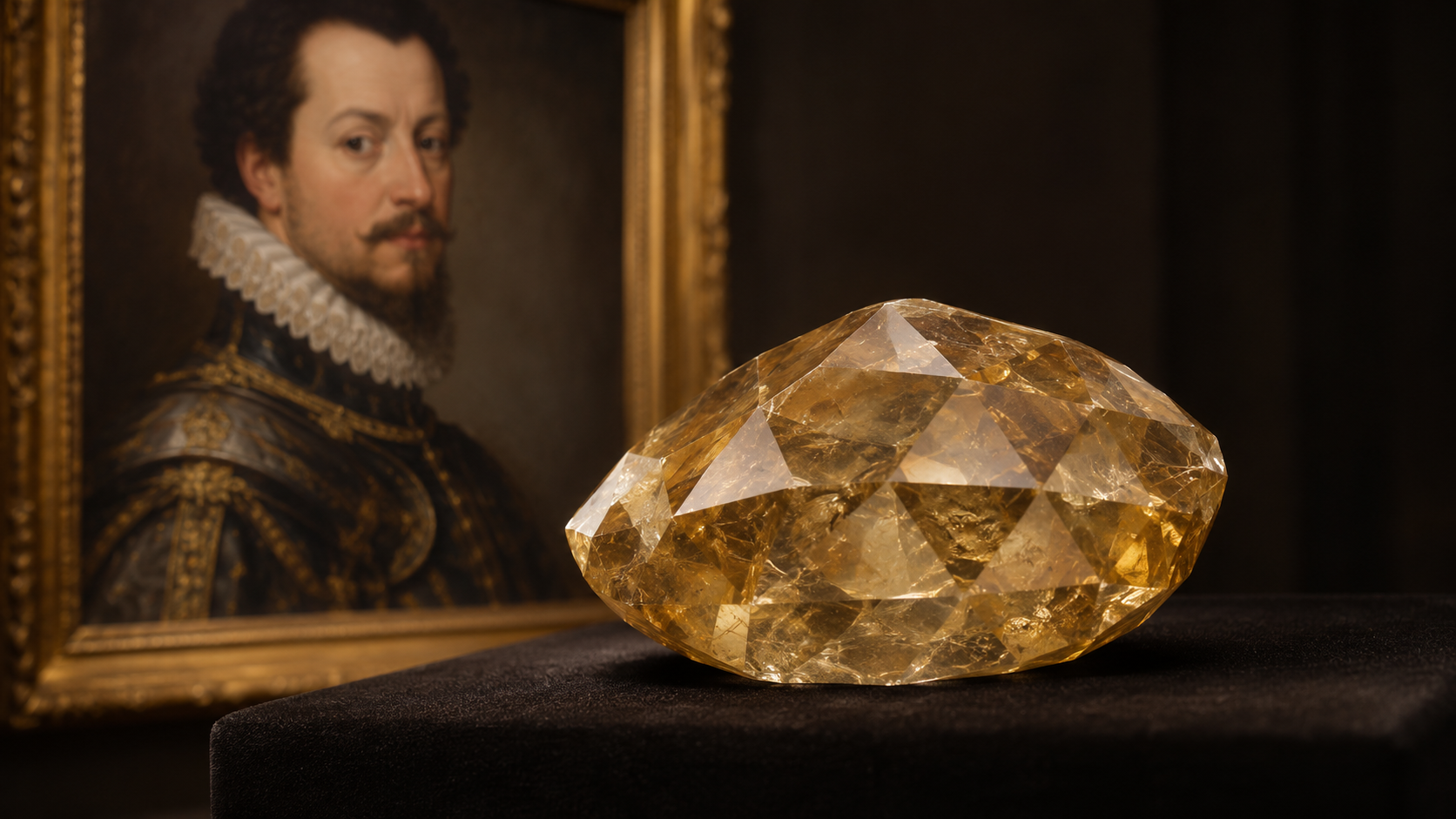
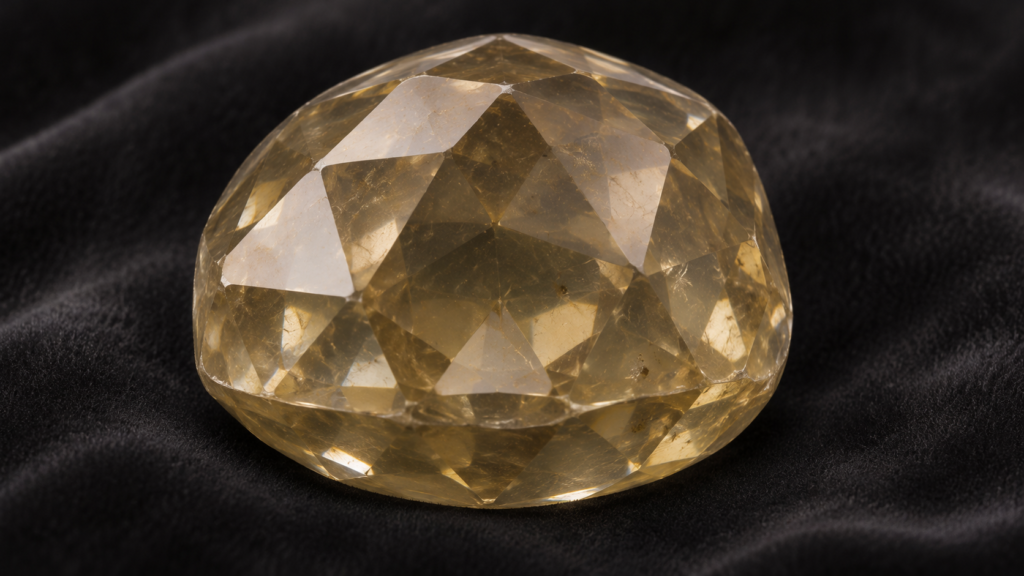
The cut is a double rose. A conventional rose cut has a faceted dome above a flat base. In the Florentine, facets extend onto the underside as well, so the arrangement of both faces contributes to the overall shape. The Florentine exhibition describes a nine-sided, almond-like outline and gives a figure of 127 facets. The Museo dell’Opera del Duomo gives 126. The public 2025 examination describes a close correspondence with historical images but supplies no new facet count. For identification, the silhouette, facet arrangement and side profile provide more information than a single reported count. (2, 3, 7, 8, 11)
Jean-Baptiste Tavernier included the jewel among the notable diamonds illustrated in his Les Six Voyages. The Palazzo Medici Riccardi exhibition cites a 1676 edition in which the Grand Duke of Tuscany’s diamond is reported at 139 carats and described as citron-yellow. An engraving from a 1677 edition can be consulted through Yale’s A&AePortal. A further image, printed in 1740 in Andrea da Verrazzano’s Sunti del Tarpato, is particularly unusual. The Florentine exhibition identifies it as showing the diamond both in the rough and after faceting, apparently based on an earlier drawing. That attribution makes the print an intriguing source for studying what the cutter retained, with the limitations of a later reproduction. (2, 5)
The Medici serpent mount and two surviving records of the shape
Royal portraits and treasury inventories help recover aspects of the jewel that a photograph of the loose diamond cannot show. A portrait of Maria Maddalena of Austria, wife of Cosimo II, reproduced for the Florentine exhibition shows the diamond in an elaborate head ornament. A written submission published by the Italian Senate cites a 1723 inventory describing a large diamond faceted on both sides and bordered by smaller diamonds. It also identifies the stone as item 2 in the inventory commissioned by Anna Maria Luisa de’ Medici, dated March 1740 in the Florentine reckoning used by the document, or 1741 in modern dating. The latter describes a narrow, diamond-set serpent surrounding the stone. (2, 3, 4)
Two Florentine objects extend the evidence beyond portraits and paper. At the Museo dell’Opera del Duomo, a large almond-shaped topaz at the summit of the Grand Duchess’s reliquary cross is identified as an imitation of the Florentine Diamond. The museum connects the cross and the original jewel to Maria Maddalena. And during preparations for the Palazzo Medici Riccardi exhibition, a historical cast surfaced in the holdings of Florence’s National Archaeological Museum. The cast, thought to be patinated plaster, was stored in a small jeweller’s box. Associated handwritten notes identify the stone and give information about its weight, colour and value. (2, 3)
The topaz shows how the diamond’s appearance was translated into another gemstone. The cast preserves a three-dimensional record that could be compared with photographs or measurements of the diamond. Each object has its own history and evidentiary value.
From the Medici collections to the Habsburg treasury
In 1737, the Grand Duchy of Tuscany passed to Francis Stephen of Lorraine, husband of Maria Theresa of Austria. The Medici Family Pact negotiated by Anna Maria Luisa addressed the future of the dynasty’s collections and their preservation in Tuscany. The Florentine Diamond subsequently appears in the Habsburg story in Vienna. This makes the diamond a particularly instructive case for provenance research. A dynastic succession explains how an object could move between courts, while inventories, agreements and the status of the object itself remain relevant to any claim about ownership. (1, 2, 4, 6)
By the time of the Habsburg treasury photographs, the diamond had a different setting. The surviving silver-and-diamond hat pin is an eighteenth-century work attributed by the Québec museum to an unidentified European jeweller. Its function and construction belong to a later chapter than the serpent ornament shown in Florence. Tracking settings separately from gems is essential in a case like this. A portrait and a treasury photograph may depict the same stone in jewellery that differs in both design and purpose. (2, 7, 8)
1918 to Québec: removal, exile and public reappearance
Austria’s culture ministry records that jewels were removed from the Hofburg treasury in 1918 on the orders of Emperor Karl I and taken to Switzerland. The Musée national des beaux-arts du Québec places the Canadian chapter in the context of the imperial family’s exile. Zita of Bourbon-Parma, Karl’s widow, found refuge in Québec in October 1940. The family made the survival of the jewels public in November 2025, and the museum’s exhibition Hidden Treasure: A Century of Mystery opened on 4 September 2026. The Florentine Diamond was the centrepiece of a display of fifteen jewels. (7, 9, 15)
The physical reappearance and the study of ownership follow different lines of evidence. In its 20 October 2026 update, the Austrian ministry said the commission investigating the history of the objects and potential Austrian claims had produced an initial internal report. The ministry expected the commission’s final findings and a recommendation in 2027. (9)
How the loose Florentine Diamond was identified in 2025
Viennese jeweller Christoph Köchert examined the loose gemstone on 21 October 2025. His published examination describes several observations. The most distinctive was the relationship between the stone and the surviving hat pin. The setting accepted the loose diamond, and the mounting and three accompanying diamond-set pieces could be arranged to correspond with the historical photograph. He also found that the cut closely matched historical representations. Together, the fit and the image comparison link the loose diamond to an identifiable mounted jewel. (8)
Köchert recorded four naturals near the girdle, in two areas. A natural is a small patch of the original rough surface retained on a polished gemstone. He also reported a small, orange, flag-shaped inclusion near one of those features, seen with a 10× loupe. Those details could be useful in a future photographic record of the stone. A high-resolution image from a repeatable angle would make the position and appearance of each feature easier to compare. (8)
The examination included a thermal diamond test. That reading served as a material screening observation. GIA research shows that thermal-only probes can also respond positively to synthetic moissanite, which is one reason the physical fit and correspondence with earlier images matter so much in this case. A laboratory study of colour origin or growth would address additional questions through methods such as spectroscopy and imaging. Köchert’s public document describes the historical identification and his observations, with no formal laboratory colour or clarity grade. (8, 13, 14)
How much does the Florentine Diamond weigh?
Köchert reported 137.17 metric carats, with a stated possible deviation of 0.02 ct on the portable scale. That is approximately 27.43 grams. A frequently published figure is 137.27 ct, while Tavernier’s historic figure appears as 139 carats in the Florentine exhibition material. The metric carat of 200 milligrams was adopted internationally in 1907, before which carat weights differed across trading centres. (2, 8, 10, 12)
The useful practice is to attach each figure to its source and period. The difference of 0.10 ct between the two modern-looking numbers exceeds the stated possible deviation of the 2025 reading. Establishing the cause would require knowing how the older figure was obtained. The discrepancy alone cannot establish a loss of material or a recut. (8, 10, 12)
Is the Florentine Diamond yellow or brown?
The Québec museum describes the diamond as light yellow. Köchert describes a warm light brown appearance. Both are published observations. For a historical gemstone, the most informative record would identify the lighting, the viewing orientation and the method of colour assessment. A bright facet seen face-up and light travelling through a thicker part of the stone can produce different impressions of the same object. Formal colour grade and colour origin are separate questions, each assessed through its own procedure. (7, 8, 16)
That distinction is part of what makes the Florentine such a good study object. A diamond can retain a recognisable shape across centuries, while the words used to describe its appearance change with the observer and the purpose of the description. The old engravings, the surviving settings and the 2025 observations can be read together because each tells us something particular about the stone.
Explore more Natural Gems Belgium documentaries in Academies & Video Series.
References & Further Reading
- Direzione generale Archivi — The Florentine Diamond between history and law. Italian Ministry of Culture summary of the archival research by Antonio Tarasco and Cristina Farnetti.
- Palazzo Medici Riccardi — Il Fiorentino. Il Gran Diamante di Toscana. Exhibition research on the early correspondence, the cutting, the portraits, the engravings and the newly located cast.
- Museo dell’Opera del Duomo — Il diamante, la croce e la Granduchessa Medici. The 1601 transaction, the court jewellers and the surviving topaz on the reliquary cross.
- Italian Senate — Il Diamante Fiorentino, written submission by Gianni Cortigiani. Background on the historical inventories, the Marucelliana engraving and the Family Pact.
- Yale A&AePortal — Tavernier’s engraving of the Florentine Diamond, 1677 edition. An early published view of the cut.
- Archivio di Stato di Firenze — Anna Maria Luisa de’ Medici and the family convention. Florentine archival context for the 1737 succession and Family Pact.
- Musée national des beaux-arts du Québec — Hidden Treasure: A Century of Mystery. Official exhibition information and photographs of the Florentine Diamond and the Habsburg hat pin.
- Christoph Köchert — Results of the examination of the Florentine Diamond, 21 October 2025. The published examination report hosted by Habsburg Heritage.
- Austrian Federal Ministry — Florentiner Commission update, 20 October 2026. The ministry’s account of the 1918 removal and the scope and timetable of its investigation.
- Gemological Institute of America — Yellow diamonds and historic examples. Includes the commonly cited 137.27 ct figure and identifies the double rose cut.
- Gemological Institute of America — Gem Cutting Styles. Definitions and illustrations of rose cuts and other faceting styles.
- Gemological Institute of America — Historical Reading List: The Cullinan Diamond. Background on historical carat weights and metric standardisation.
- Gems & Gemology — Synthetic Moissanite: A New Diamond Substitute. Research on the response of synthetic moissanite to thermal diamond probes.
- Gems & Gemology — Laboratory-Grown Diamonds: An Update on Identification. Reference for the role of spectroscopy and imaging in diamond identification.
- Habsburg Heritage — The family account and photograph of the diamond with its hat-pin components. The family’s account of the jewels’ preservation in Canada and the published group photograph.
- Gems & Gemology — Naturally Colored Yellow and Orange Gem Diamonds. Scientific background on colour in yellow and orange diamonds.