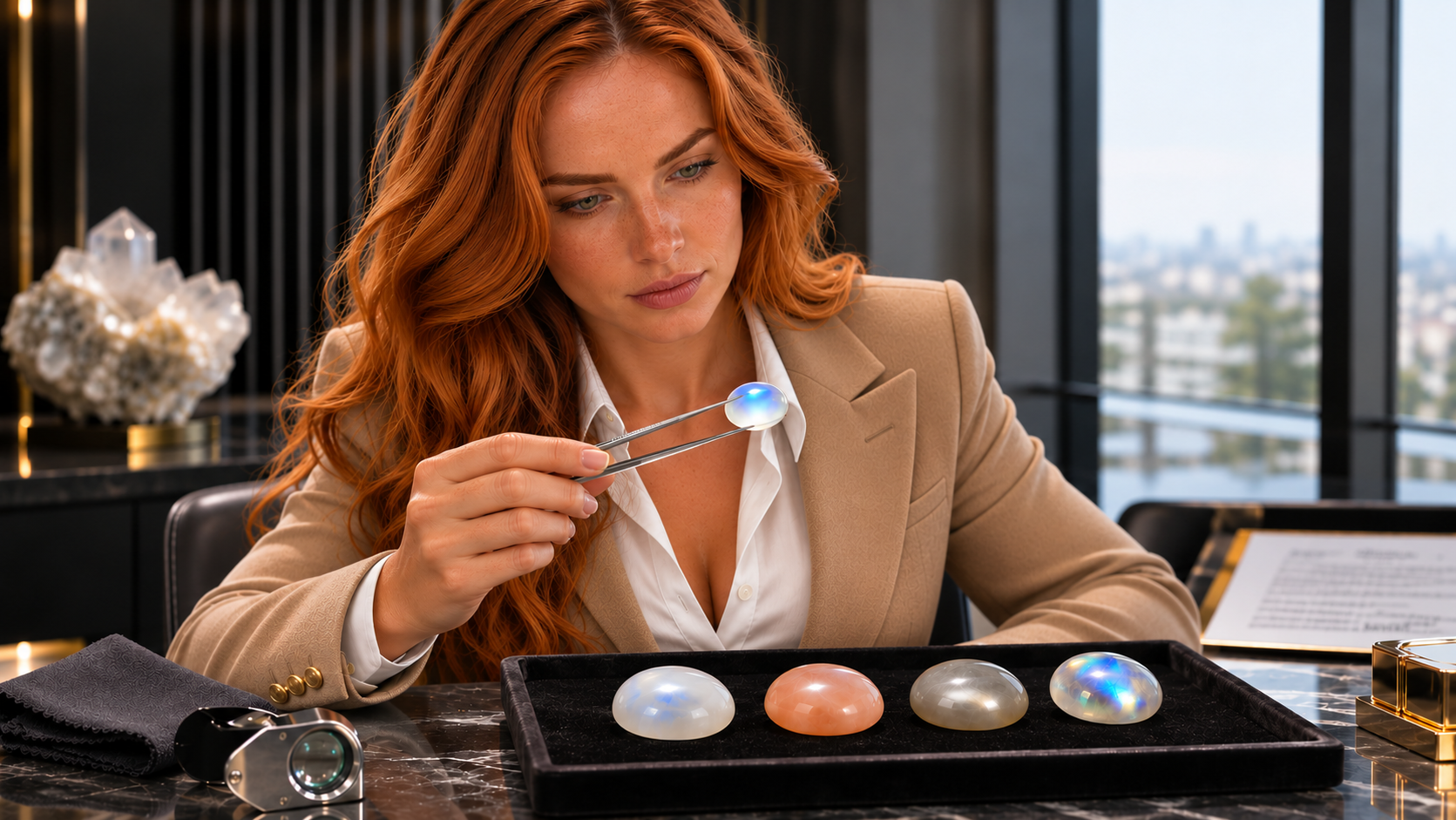
Moonstone is one of those gemstones that is difficult to judge from a still photograph.
Its defining beauty comes from movement.
As the gemstone turns, a soft veil of light can appear to float beneath its surface, travelling across the stone before disappearing again. This optical phenomenon is known as adularescence.
Yet not every moonstone displays that effect equally well.
The strength, colour, position and mobility of the sheen can differ dramatically. Transparency varies. Inclusions and fractures matter. Cutting orientation can determine whether the optical effect sits beautifully in the centre of the gemstone or appears only briefly at an awkward angle.
Even terminology requires some care: the widely used trade name rainbow moonstone normally refers to a variety of labradorite rather than traditional moonstone.
In this Moonstone Buying Guide, Lena Hoffmann explains what to look for before purchasing moonstone.
Table of Contents
1. Start With the Adularescence
When buying moonstone, begin with the phenomenon that gives the gemstone its identity.
Adularescence is the soft, billowing light that appears to float across or beneath the surface as the stone moves.
GIA explains that this effect results from light interacting with microscopic internal feldspar layers.
For the buyer, however, the geological explanation is less important than knowing how to evaluate the visual result.
Move the gemstone slowly.
Does the sheen travel attractively across the stone?
Is it obvious without searching for one very precise angle?
Does it remain visible through a useful range of viewing positions?
Does it appear where you expect it when the stone is viewed normally?
A spectacular flash that exists only for a fraction of a second at one extreme angle is not necessarily as desirable as a strong, mobile sheen that remains attractive during normal movement.
2. Blue Sheen Is Especially Prized – But It Is Not the Only Beautiful Option
Traditional fine moonstone is particularly famous for blue adularescence, often called blue sheen.
GIA describes highly prized examples as colourless to nearly colourless, semitransparent to nearly transparent stones displaying a vivid mobile blue shimmer.
This is an important market preference.
It does not mean that every beautiful moonstone must look this way.
Moonstone can also display white or silvery sheen and occur with body colours including white, grey, peach, green, yellowish or brownish tones.
A fine blue-sheen moonstone may command a premium.
But a beautiful peach or grey moonstone can still be an excellent purchase if that is the appearance you prefer.
Understand market preference without allowing it to replace personal preference.
3. Look at Where the Sheen Appears
The position of the optical effect matters.
For a well-cut cabochon, the adularescence should ideally be positioned attractively toward the top of the gemstone when it is viewed face-up.
GIA specifically notes that the sheen should ideally be centred on the top of the cabochon and visible across a relatively broad range of angles.
This is why two pieces of apparently similar moonstone rough can become very different finished gemstones.
One may show a beautifully centred blue sheen.
Another may require the viewer to tilt the stone sharply before the effect appears near an edge.
When comparing moonstones, do not simply ask:
“Does it have blue sheen?”
Ask:
“How well is that sheen positioned?”
4. Watch the Stone Move
Moonstone should rarely be purchased on the basis of one photograph alone.
A still photograph captures only one viewing angle.
That can be particularly misleading with a phenomenal gemstone whose attraction depends on movement.
A seller can photograph a moonstone at exactly the angle where its strongest blue flash appears.
The photograph may be completely genuine.
But it tells you little about what happens when the gemstone moves away from that position.
For important online purchases, video is therefore extremely valuable.
Look for footage of the actual gemstone, slowly tilted under controlled, reasonably neutral lighting.
Watch how the sheen enters the stone.
Observe where it travels.
See how quickly it disappears.
A good moonstone should be evaluated as a moving object, not merely as a photograph.
5. Transparency Matters
Transparency is another important consideration.
GIA notes that highly regarded moonstone is generally almost transparent to semitransparent and relatively free of visible inclusions. A slight degree of translucency can help emphasise the adularescent effect.
Do not interpret this as a rule that every cloudy moonstone is undesirable.
Different types and colours naturally have different visual characters.
But when comparing high-quality blue-sheen moonstones, a clean, glassy body can allow the floating blue light to appear especially striking.
Look through the stone where possible.
Does it appear pleasantly transparent or translucent?
Or is the body so cloudy that much of the optical effect becomes obscured?
Evaluate transparency together with the sheen rather than independently from it.
6. Inclusions Can Interfere With the Effect
Natural moonstone can contain inclusions.
Characteristic internal features include tiny tension cracks that gemmologists sometimes call centipede inclusions because of their appearance.
A microscopic inclusion should not automatically make you reject a natural gemstone.
The more practical question is whether inclusions interfere with the moonstone’s beauty.
Can you see them easily without magnification?
Do they interrupt the adularescence?
Do they make an otherwise transparent stone appear significantly cloudier?
Are they merely internal features, or are you looking at fractures that might also affect durability?
Visual impact matters.
Condition matters.
Microscopic perfection is not the objective.
7. Pay Particular Attention to Cracks and Fractures
Not every internal feature deserves the same level of concern.
Small internal characteristics can be perfectly acceptable.
A significant fracture is different.
Moonstone belongs to the feldspar family and possesses cleavage, meaning there are directions within its crystal structure along which it is more vulnerable to breaking after a sufficiently strong impact. GIA consequently describes moonstone as having poor toughness.
When examining a stone, look carefully for:
open fractures,
chips around the edge,
cracks extending toward the surface,
and damage near areas that will be exposed in jewellery.
This is particularly important for a moonstone intended for a ring.
The optical effect may attract you first.
Condition should be checked before purchasing.
8. Cabochon Cut Is Not an Accident
Most moonstone is cut as a cabochon – a smooth, polished form with a curved upper surface.
There is a good reason.
The cabochon shape helps display adularescence to its best advantage.
Look at the profile from the side.
GIA notes that excessively flat cabochons generally do not present the sheen as effectively.
The dome should appear intentional and balanced.
Look at symmetry.
Check the polish.
Look at the position of the sheen relative to the dome.
The best cutting is not necessarily the most complicated cutting.
With phenomenal gemstones, good cutting means revealing the natural optical effect effectively.
9. Orientation Can Matter More Than Weight
The cutter must orient moonstone correctly to display its adularescence.
That means the largest possible finished gemstone is not always the best result.
Sometimes preserving additional weight could place the sheen poorly.
A more thoughtful cut may sacrifice some rough material while producing a much stronger face-up effect.
For the buyer, this means carat weight should never be considered independently.
A larger moonstone with weak, poorly positioned sheen may be considerably less attractive than a smaller stone with exceptional adularescence.
Buy the optical performance of the gemstone — not simply the number on the scale.
10. Faceted Moonstone Exists Too
Moonstone does not have to be a cabochon.
Faceted moonstone has become increasingly available, particularly when the rough is relatively transparent. Rose cuts are also used.
Faceting changes the visual balance of the gemstone.
Brilliance from the facets begins to interact with the adularescent effect.
Some buyers love this combination.
Others prefer the uninterrupted floating sheen of a traditional cabochon.
Neither is automatically correct.
What matters is whether the cutting style displays the individual material attractively.
11. Understand What “Rainbow Moonstone” Actually Means
This is one of the most important naming issues for consumers.
The gemstone widely sold as rainbow moonstone is not generally traditional moonstone in the strict mineralogical sense.
GIA identifies rainbow moonstone as transparent labradorite, a closely related feldspar that can display blue or multicoloured iridescent effects.
CIBJO likewise lists Rainbow moonstone as a trade name for labradorite.
This does not make rainbow moonstone fake.
It is a natural feldspar gemstone and can be exceptionally beautiful.
The issue is terminology.
A responsible seller should understand and disclose what material is being offered.
For the consumer, the distinction is useful because:
traditional moonstone and rainbow moonstone are related – but they are not simply two colours of exactly the same gem material.
12. Rainbow Effects and Traditional Blue Sheen Should Not Be Confused
Traditional fine moonstone is particularly celebrated for its soft blue adularescence.
Rainbow moonstone can show a wider range of iridescent colours.
These can include blue, green, yellow and other spectral flashes.
That difference creates very different appearances.
One is not inherently better than the other.
But marketing photographs can sometimes blur the distinction.
If you are specifically searching for fine traditional blue-sheen moonstone, make sure that is actually what the seller is offering.
If you love the multicoloured appearance of rainbow moonstone, there is nothing wrong with choosing it.
Just buy it with the correct understanding of the material.
13. Do Not Assume Every White Stone With a Blue Flash Is Fine Moonstone
Blue-flashing feldspar materials can appear remarkably attractive in photographs.
A blue flash alone does not establish quality.
Look at:
the strength of the effect,
its position,
how widely it remains visible as the stone moves,
body transparency,
visible inclusions,
cut,
surface polish,
and condition.
Also establish what feldspar material is actually being sold.
The label alone should never replace examination.
14. Moonstone Comes in More Colours Than Many Buyers Realise
The popular image of moonstone is a nearly colourless gemstone with blue sheen.
But moonstone can occur with different body colours.
GIA documents examples in white, grey, green, yellow-to-brown and peach tones.
Peach moonstone in particular has become popular in jewellery.
These colours do not necessarily imitate the market position of fine transparent blue-sheen material.
They represent different appearances.
This makes price comparisons especially important.
Do not compare a fine transparent blue-sheen cabochon directly with an opaque peach moonstone simply because both share the word moonstone.
Compare like with like.
15. Treatment Is Less Routine Than With Many Other Gemstones – But It Still Deserves Disclosure
Moonstone is not normally associated with routine enhancement on the same scale as heated sapphire, heated tanzanite or clarity-enhanced emerald.
GIA has noted that moonstone is generally not treated.
That does not mean treated material cannot exist.
GIA research has documented filled moonstone material, demonstrating that fissure impregnation can occur and can be identified gemmologically.
For most ordinary purchases this need not become a source of anxiety.
Simply apply the same principle used throughout the NGB Buying Guide series:
Ask whether any treatment is known or detected.
A treatment is information.
It should not be hidden information.
16. Consider Durability Before Choosing a Ring
Moonstone makes beautiful jewellery.
But it is not as forgiving of knocks as ruby or sapphire.
GIA notes that moonstone has poor toughness and possesses cleavage, making it vulnerable to chipping or breaking after a strong impact.
This matters particularly with rings.
Hands encounter desks, door frames, tools, kitchen surfaces, gym equipment and countless other hard objects during normal life.
A moonstone ring can certainly be worn successfully.
But the setting deserves thought.
A protective bezel or design that shields vulnerable edges can be advantageous.
For someone with a very active lifestyle, earrings or pendants may offer a lower-risk way to wear moonstone frequently.
Buy the gemstone together with an understanding of how you intend to use it.
17. Do Not Wear Moonstone Jewellery for Every Activity
Jewellery durability depends partly on the owner.
GIA specifically advises against wearing moonstone rings during activities such as sport or gym use because of their vulnerability to scratching, chipping and cleavage.
Remove moonstone jewellery before:
sports,
manual work,
heavy cleaning,
gym activities,
or situations where the stone may receive sharp impacts.
This is not because moonstone is unsuitable for jewellery.
It means it benefits from informed wear.
18. Cleaning Should Be Gentle
Moonstone does not require complicated maintenance.
But aggressive cleaning equipment should be avoided.
GIA recommends warm, soapy water and specifically advises against ultrasonic and steam cleaning. High heat and sudden temperature changes can also cause damage.
This is important information to keep with the gemstone.
If moonstone jewellery is brought to a jeweller for repair, make sure the gemstone is identified before procedures involving significant heat.
Good aftercare begins with knowing what you own.
19. Be Careful With Commercial Quality Labels
You may encounter moonstone described as:
AAA,
AAAA,
premium blue flash,
top grade,
collector grade,
high grade,
or investment quality.
Such terminology may form part of a seller’s internal grading system.
But a commercial label should never prevent you from evaluating the actual gemstone.
Ask what the grade means.
Does it refer to transparency?
Blue-sheen intensity?
Orientation?
Body colour?
Clarity?
Cut?
Overall appearance?
An internal grade can be useful when its criteria are clearly explained.
It should not replace the evidence provided by the stone itself.
20. Compare Moonstones Side by Side
Comparison is one of the easiest ways to understand moonstone quality.
Place several stones together under the same lighting.
Move them at approximately the same angle.
Differences quickly become obvious.
One may show a powerful centred blue sheen.
Another may flash only briefly at its edge.
One might be significantly more transparent.
Another may contain obvious fractures.
One may have beautiful silvery character even without intense blue.
Side-by-side comparison teaches the eye far more effectively than isolated product descriptions.
21. Online Buyers Should Ask for Video
Moonstone belongs on the shortlist of gemstones for which video is especially valuable.
Ask whether the video shows the actual stone you will receive.
Look for a slow, natural movement rather than rapid rotations designed primarily to create flashes.
Ideally, the video should show:
face-up appearance,
slight movement to the left and right,
the side profile,
the reverse of the stone,
and the optical effect under reasonably neutral lighting.
The purpose is not to make the moonstone look less attractive.
It is to allow the buyer to see how it genuinely behaves.
22. Ask Why One Moonstone Costs More Than Another
Two moonstones of the same weight can occupy very different price levels.
There may be entirely legitimate reasons.
One may possess exceptionally strong blue sheen.
One may show that sheen across a broader viewing range.
One might be significantly more transparent.
One may have superior cutting and orientation.
One may be much cleaner.
One might be a fine traditional moonstone while another is a different feldspar product sold under a commercial moonstone name.
Large fine material can also become scarcer. GIA notes that high-quality moonstone is increasingly uncommon in larger sizes.
The important question remains:
Can the price difference be explained by observable or documented characteristics?
If it can, you are making a comparison.
If it cannot, you may simply be paying for terminology.
23. A Famous Origin Does Not Replace the Stone
Moonstone has been sourced from several regions.
Important sources include Sri Lanka and India, while material also comes from locations including Madagascar, Myanmar, Tanzania and elsewhere.
Origin can be interesting.
It should not distract you from evaluating the individual gemstone.
A visually mediocre moonstone does not become exceptional because it carries a prestigious locality.
Evaluate the sheen.
Evaluate transparency.
Evaluate inclusions.
Evaluate cut and condition.
Then consider provenance as additional information.
24. The Best Moonstone Is Not Necessarily the Bluest One
Market preference generally favours fine transparent material with vivid blue adularescence.
That is useful information.
But gemstone buying remains partly personal.
You may prefer:
a strong electric-blue sheen,
a softer silver-white glow,
a warm peach body colour,
a grey moonstone,
or the multicoloured appearance of rainbow moonstone.
The purpose of informed buying is not to force everyone toward the same gemstone.
It is to understand why different materials occupy different positions in the market and then make your own decision.
The NGB Buying Principle
Moonstone is a gemstone that must be seen in motion.
One photograph cannot tell its complete story.
The strength of its adularescence matters.
The colour of that sheen matters.
Its position matters.
Transparency and inclusions matter.
Cutting orientation matters.
Cracks and fractures matter.
And terminology matters – particularly when a stone is sold as rainbow moonstone.
The highest market preference may favour nearly colourless, transparent material displaying strong mobile blue sheen, but that does not mean every buyer must choose it.
A peach moonstone, grey moonstone, silver-sheen stone or beautiful rainbow moonstone may be exactly the gemstone you prefer.
The important thing is knowing what it is and understanding what makes it different.
Buy the stone you love – but understand the stone you buy.
References & Further Reading
Gemological Institute of America (GIA) – Moonstone Buyer’s Guide
Consumer guidance covering moonstone appearance, adularescence, rainbow moonstone terminology, faceted material and jewellery considerations.
https://origin.prod.gia.edu/moonstone/buyers-guide
Gemological Institute of America (GIA) – Moonstone Quality Factors
Detailed guidance on body colour, blue sheen, transparency, inclusions, cutting and the correct positioning of adularescence.
https://www.gia.edu/moonstone-quality-factor
Gemological Institute of America (GIA) – Moonstone Gem Overview
Authoritative overview of moonstone and the origin of its characteristic adularescence.
https://www.gia.edu/moonstone
Gemological Institute of America (GIA) – Is Rainbow Moonstone Really Moonstone?
GIA explains that material sold as rainbow moonstone is transparent labradorite, a closely related feldspar rather than traditional moonstone.
https://my.gia.edu/FAQ/gia-faq-rainbow-moonstone-really-moonstone
Gemological Institute of America (GIA) – Moonstone Care and Cleaning Guide
Practical information about cleavage, poor toughness, heat sensitivity and why steam and ultrasonic cleaning are not recommended.
https://www.gia.edu/moonstone-care-cleaning
GIA Gems & Gemology – Infrared Spectroscopic Study of Filled Moonstone
Scientific research documenting fissure-filling treatment in moonstone and how laboratory examination can identify it.
https://www.gia.edu/gems-gemology/spring-2013-jianjun-spectroscopic-study-filled-moonstone
Gemological Institute of America (GIA) – June Birthstones: Moonstone
Additional information on important moonstone sources, jewellery use and appropriate cleaning.
https://www.gia.edu/birthstones/june-birthstones
CIBJO – The World Jewellery Confederation – The Blue Books
International gem and jewellery standards covering gemstone nomenclature, disclosure and responsible trade terminology.
https://cibjo.org/the-blue-books/