
Exploring the relationship between Islamic faith, gemstone jewellery, historical traditions, spiritual beliefs and the natural beauty of precious stones.
Table of Contents
Introduction: Can Muslims Wear Birthstones?
Gemstones have fascinated humanity for thousands of years.
Across different civilisations, precious stones have been valued for their beauty, rarity, cultural significance and symbolic meanings.
Some have been associated with protection, prosperity, wisdom or spiritual devotion. Others have become treasured family heirlooms or meaningful gifts.
One of the most familiar modern gemstone traditions is the birthstone: a gemstone associated with a particular month of the year.
For many people, birthstone jewellery is simply a beautiful way to celebrate a birthday or personal identity.
For others, birthstones carry deeper spiritual or astrological meanings.
This raises an important question for Muslims:
Is wearing a birthstone permissible in Islam, or can certain beliefs associated with birthstones conflict with Islamic teachings?
The answer requires an understanding of several distinct subjects.
Islamic teachings address jewellery and adornment, the oneness of God, the attribution of supernatural powers and the importance of intention.
Islamic societies also have rich histories of gemstone jewellery, engraved rings, carnelian ornaments and objects associated with personal protection.
Understanding these traditions helps distinguish the beauty of gemstones from the beliefs sometimes attached to them.
This article explores the subject respectfully through Islamic scripture, historical evidence, scholarly interpretations and a brief scientific perspective.
It does not issue a religious ruling. Individual questions of Islamic law should be discussed with a qualified scholar familiar with the person’s circumstances and school of thought.
1. What Are Birthstones?
Birthstones are gemstones traditionally associated with the twelve months of the year.
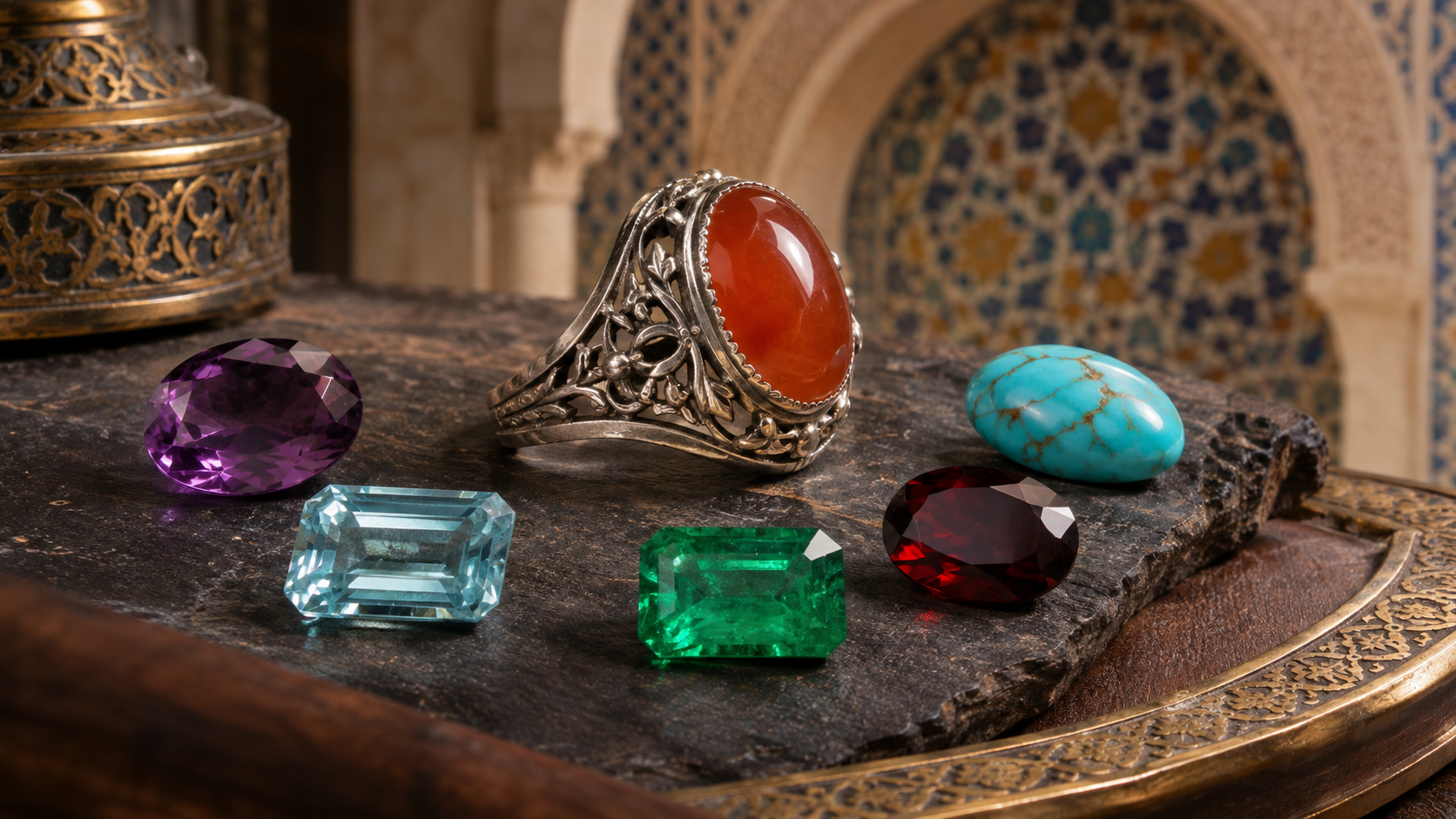
The modern birthstone calendar includes garnet for January, amethyst for February, aquamarine and bloodstone for March, diamond for April and emerald for May.
Other months have multiple recognised stones.
For example, June is associated with pearl, moonstone and alexandrite, while August includes peridot, spinel and sardonyx.
The modern birthstone system developed through several historical traditions and was standardised in the jewellery industry during the early twentieth century.
Birthstones as personal jewellery
A person may choose a birthstone because it represents the month in which they were born.
The gemstone may be incorporated into a ring, pendant, bracelet or another decorative object.
For many people, this practice is primarily sentimental.
A birthstone can commemorate a birthday, represent a family member or serve as a personal keepsake.
Birthstones as spiritual objects
In some contemporary traditions, birthstones are believed to possess particular energies or to influence personality, emotions or destiny.
These interpretations may draw upon astrology, crystal spirituality or other systems of symbolic belief.
It is important to distinguish this spiritual interpretation from the simple act of wearing a gemstone as jewellery.
That distinction is central to understanding Islamic perspectives on birthstones.
2. Gemstones and Beauty in Islamic Culture
Gemstones have a long history in societies shaped by Islamic religion and culture.
Precious stones were used in jewellery, decorative arts, engraved seals and objects associated with wealth, authority and personal identity.
Islamic art from different regions demonstrates remarkable craftsmanship in metalwork, stone carving and jewellery design.
The appreciation of natural beauty
The Quran refers to precious materials, including pearls and coral, in descriptions of creation and divine blessings.
Surah Ar-Rahman, verses 55:19–22, mentions pearls and coral in the context of the seas.
Such references form part of a broader religious appreciation of the natural world.
They do not establish a calendar-based birthstone system or assign specific supernatural powers to particular gemstones.
Nevertheless, they show that precious materials have a place within Islamic religious language and cultural imagination.
Gemstones as adornment
Islamic jurisprudence discusses jewellery as a form of adornment.
The permissibility of particular items can depend on the material, the wearer and the legal interpretation being followed.
Many scholars permit women to wear gemstone jewellery, subject to broader principles concerning modesty and appropriate adornment.
Rules concerning men’s jewellery are more specific and differ among legal schools, particularly regarding rings, metals and ornamental styles.
Therefore, a general statement that all gemstone jewellery is either universally permitted or universally prohibited would be misleading.
3. The Prophet Muhammad and the Tradition of Rings
Rings have an important place in the historical discussion of Islamic jewellery.
Several hadith reports describe the Prophet Muhammad, peace be upon him, wearing a silver ring.
In Sahih Muslim 2094a and 2094b, reports attributed to Anas ibn Malik describe a silver ring with an Abyssinian stone or setting.
Other narrations describe the Prophet’s silver signet ring and its inscription.
What do these reports establish?
These narrations are important evidence for the historical use of rings within the Prophetic tradition.
They also contribute to later legal discussions about jewellery and adornment.
However, the precise mineralogical identity of the stone described in some reports is not established with certainty.
It would therefore be inaccurate to claim that these narrations conclusively identify a specific modern gemstone species.
The reports also do not establish that gemstones should be selected according to the month of birth.
The difference between a ring and a talisman
A ring may be worn for practical purposes, identification, adornment or cultural tradition.
A talisman, by contrast, is generally understood as an object believed to provide protection or influence events through a particular spiritual power.
These uses are not necessarily equivalent in Islamic theological interpretation.
The belief attached to an object can therefore be as important as the object itself.
4. Aqeeq: Carnelian and Agate in Islamic Gemstone Traditions
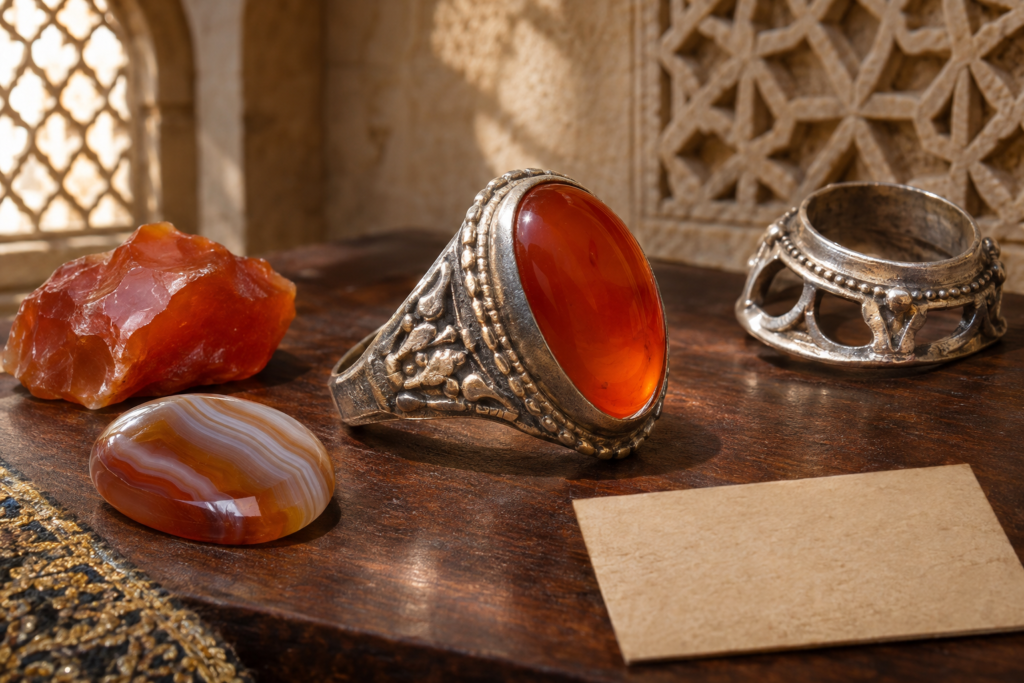
One of the most recognisable gemstones in Islamic cultural traditions is aqeeq, also written aqiq or akeek.
The term is commonly associated with agate and carnelian, varieties of chalcedony.
Carnelian is particularly admired for its orange, reddish-orange and reddish-brown colours.
Aqeeq rings in Islamic culture
Aqeeq rings have been worn in different Muslim communities for centuries.
They are especially prominent in some Shia devotional and cultural traditions, although their use is not confined to one community.
In certain traditions, wearing an aqeeq ring is associated with blessings, protection or religious devotion.
The authority and interpretation of narrations concerning particular benefits differ between Islamic traditions and scholarly approaches.
It is therefore important not to present every popular claim about aqeeq as an uncontested teaching of Islam.
Historical evidence
An important example survives in the collection of the Metropolitan Museum of Art.
A silver ring set with carnelian, excavated at Nishapur in Iran and dated to approximately the ninth to eleventh century, demonstrates the historical use of carnelian jewellery in the Islamic world.
The museum also discusses medieval beliefs concerning the stone’s protective and medicinal qualities.
This provides valuable evidence of historical gemstone symbolism.
It does not independently establish that the attributed supernatural or medical effects actually occur.
Aqeeq is not a birthstone system
Although aqeeq has a distinctive place in some Islamic gemstone traditions, its significance is not based on the modern Western calendar of birthstones.
A person may therefore encounter aqeeq jewellery in a religious or cultural context without any connection to their birth month.
5. Tawhid: The Oneness of God
One of the central principles of Islam is tawhid, the belief in the absolute oneness of Allah.
Surah Al-Baqarah 2:163 affirms the oneness of God.
This principle shapes Islamic understandings of worship, divine authority and the relationship between the Creator and creation.
What does tawhid mean for gemstones?
A gemstone is part of the created natural world.
It may possess beauty, rarity and measurable physical properties.
However, attributing independent divine power or ultimate control over destiny to a gemstone raises serious theological concerns within Islamic thought.
Birthstones and personal meaning
Choosing an emerald because it represents a person’s birth month is different from believing that the emerald independently controls their future.
Likewise, wearing a sapphire because it was a gift from a loved one is different from worshipping the stone or treating it as a divine being.
The distinction between appreciation and attribution of supernatural authority is important.
When does the concept of shirk become relevant?
Shirk refers to associating partners with Allah.
Islamic scholars discuss shirk in relation to worship, divine attributes and certain beliefs about supernatural power.
A belief that an object possesses independent divine authority can raise concerns relating to shirk.
However, it would be inappropriate to declare that every person who wears a birthstone is committing shirk.
The theological evaluation depends on what the individual actually believes and does.
Questions involving accusations of shirk require particular care and qualified religious guidance.
6. Astrology, Birth Months and Islamic Belief
Modern birthstone calendars are sometimes connected with zodiac signs and astrological personality systems.
Astrology assigns symbolic or predictive meanings to the positions of celestial bodies.
Some people choose gemstones according to zodiac signs because they believe the stones correspond to planetary influences.
The distinction between astronomy and astrology
Astronomy is the scientific study of celestial objects and physical processes.
Astrology is a system of interpreting celestial positions as meaningful for human character or events.
The two should not be confused.
Islamic perspectives on astrological prediction
Many Islamic scholars reject the use of astrology to predict destiny or claim knowledge of the unseen.
Such concerns relate to Islamic teachings about divine knowledge, human responsibility and reliance upon Allah.
A Muslim who selects a gemstone merely because it is conventionally associated with their birthday may be acting for reasons very different from someone who believes the gemstone controls their destiny through planetary forces.
This distinction matters.
Does Islam recognise a religious birthstone for every month?
The Quran and widely recognised foundational hadith collections do not establish the modern twelve-month birthstone chart as an Islamic religious requirement.
The familiar calendar assigning garnet to January, amethyst to February and other gemstones to subsequent months is a later cultural system.
It should not be presented as a religious obligation or as a list revealed in Islamic scripture.
7. Spiritual Energy and the Question of Gemstone Powers
In contemporary crystal spirituality, gemstones are sometimes described as possessing unique energies.
Birthstones may be believed to promote emotional harmony, protection, prosperity or personal transformation.
Some individuals understand these claims symbolically.
Others interpret them as literal supernatural effects.
Gemstones as reminders and symbols
A gemstone may remind a person of patience, gratitude, family or personal values.
Such symbolic use does not necessarily involve a claim that the gemstone independently controls events.
A treasured ring can also carry emotional meaning because it belonged to a parent or commemorates an important occasion.
Gemstones as independent sources of power
A different question arises when a gemstone is believed to possess an inherent supernatural ability to prevent harm, determine destiny or guarantee prosperity.
Many Islamic scholars reject such claims when they attribute powers to an object without an accepted religious or demonstrable causal basis.
An important contemporary scholarly distinction
In a published 2026 ruling, Jordan’s General Iftaa Department distinguished between ordinary gemstone adornment and the use of so-called energy stones for treatment.
The ruling permitted customary gemstone adornment for women and stated that therapeutic claims must be assessed through experimentation and scientific evidence.
It also emphasised that, within Islamic belief, a gemstone should not be regarded as the independent source of benefit or harm.
This provides a useful example of how religious reasoning and scientific evaluation can be considered together.
It is one scholarly ruling, not a declaration that every Islamic legal school reaches identical conclusions on every related question.
8. Are Birthstones Halal or Haram?
The most useful way to approach this question is to distinguish the purpose of wearing the gemstone from the beliefs attached to it.
Wearing a birthstone as ordinary jewellery
A person may wear a birthstone simply because they appreciate its colour, appearance or sentimental meaning.
Several Islamic scholarly sources distinguish permissible adornment from unsupported beliefs about gemstone powers.
The specific rules governing jewellery may still vary according to the wearer, material and legal school.
Wearing a birthstone as a birthday keepsake
A gemstone chosen to commemorate a birthday does not automatically imply belief in astrology.
The association may be cultural or personal rather than religious.
The permissibility of a particular jewellery item should therefore not be determined solely by its birthstone label.
Wearing a birthstone for astrological influence
A different issue arises when someone believes that celestial positions or gemstones independently determine their fate.
Many Islamic scholars consider such beliefs incompatible with Islamic teachings concerning divine knowledge and authority.
Wearing a gemstone for supernatural protection
Claims that a gemstone independently prevents misfortune or guarantees protection raise additional theological concerns.
Scholarly assessments may consider the nature of the claimed power, the evidence for it and the individual’s belief.
A practical comparison
| Situation | Relevant Islamic consideration |
|---|---|
| Wearing a gemstone because it is beautiful | Ordinary adornment; applicable jewellery rules remain relevant |
| Giving a birthstone as a personal gift | Sentimental meaning does not by itself establish an astrological belief |
| Choosing a gemstone by birth month | The calendar association alone does not determine the religious ruling |
| Believing a stone independently controls destiny | Raises serious concerns relating to tawhid |
| Using a stone to predict future events | Raises concerns associated with divination and astrology |
| Wearing an aqeeq ring as a religious or cultural practice | Interpretation depends on tradition, narrations and scholarly authority |
| Claiming a gemstone cures disease | Requires reliable evidence and consideration of religious principles |
These distinctions are educational rather than a personalised legal ruling.
9. Modesty, Moderation and Responsible Jewellery Choices
Islamic teachings also address moderation and appropriate conduct.
Surah Al-A’raf 7:31 encourages proper adornment while warning against excess.
This verse is part of a broader religious framework concerning moderation.
Jewellery and extravagance
A gemstone’s price does not automatically determine whether a purchase is extravagant.
Context, intention, financial circumstances and cultural expectations may influence scholarly discussions.
A modest silver ring may be appropriate in one situation, while an expensive luxury item may raise questions about wastefulness or ostentation in another.
Gold, silver and the wearer
Islamic legal discussions often distinguish between men’s and women’s jewellery.
Gold jewellery for men is prohibited in mainstream Sunni jurisprudence, while silver rings are generally treated differently.
Other details vary between schools and traditions.
For this reason, gemstone buyers seeking religious guidance should consider not only the stone but also the jewellery’s metal, design and intended use.
Respecting individual practice
Muslims differ in their cultural backgrounds, schools of jurisprudence and approaches to personal adornment.
An educational discussion should acknowledge this diversity rather than assume that every Muslim follows identical jewellery customs.
10. Gemstones in Islamic Art and Cultural Heritage
The significance of gemstones in Muslim societies extends far beyond legal discussions.
Jewellery and engraved stones have played important roles in artistic production and cultural identity.
Engraved rings and seals
Historically, rings could function as personal seals or symbols of authority.
Engraved gemstones and metal settings were used to identify their owners or authenticate documents.
Carnelian and other decorative stones
Carnelian, agate and other stones appear in surviving examples of jewellery from different regions of the Islamic world.
Their popularity reflected a combination of availability, craftsmanship, colour and cultural significance.
Gemstones as family heirlooms
Jewellery can also carry memories across generations.
A ring inherited from a grandparent may be valued for its personal history rather than any claim of supernatural influence.
Such objects demonstrate how gemstones can preserve cultural identity and emotional connections.
11. A Brief Scientific Perspective: What Can Gemstones Actually Do?
Gemmology studies the physical and chemical properties of gemstones.
Different gemstones have distinct compositions, crystal structures and optical characteristics.
For example:
- Amethyst is the purple variety of quartz.
- Emerald is the green variety of beryl.
- Ruby is the red variety of corundum.
- Carnelian and agate belong to the chalcedony family.
- Peridot is the gem-quality variety of olivine.
These identities can be investigated using established scientific methods.
Can gemstones emit energy?
Gemstones interact with light, heat and other physical phenomena.
Some minerals possess particular electrical, optical or magnetic properties.
However, the existence of measurable physical properties does not establish that gemstones control destiny, prevent supernatural harm or transmit astrological information.
Can gemstones heal medical conditions?
Claims that gemstones treat illnesses require reliable clinical evidence.
A traditional belief or personal testimonial is not sufficient to establish medical effectiveness.
Scientific assessment should distinguish effects attributable to a gemstone from expectation, relaxation or other contextual influences.
Where religion and science address different questions
Religious traditions address matters of faith, worship, ethics and spiritual meaning.
Gemmology addresses mineral identity, formation, composition and measurable physical properties.
The two fields do not answer every question in the same way.
A gemstone may hold cultural or religious significance while also being studied as a natural mineral.
Recognising the difference helps avoid both unsupported scientific claims and oversimplified interpretations of religious traditions.
12. Choosing Gemstone Jewellery with Respect for Islamic Beliefs
For a Muslim interested in gemstone jewellery, several considerations may be useful.
Consider the reason for choosing the stone
A gemstone may be selected for beauty, sentimental meaning, cultural heritage or personal preference.
A birthday association need not imply belief in supernatural forces.
Understand the traditions attached to the gemstone
Some gemstones have specific cultural or devotional associations.
Learning about their history can help distinguish documented traditions from modern commercial claims.
Consider the jewellery itself
The metal, setting, design and wearer may be relevant to Islamic legal interpretations.
Avoid unsupported promises
Claims that a gemstone guarantees prosperity, prevents illness or controls destiny should be approached critically.
Seek qualified religious guidance
Individuals who wish to follow a particular Islamic legal school should consult a qualified scholar familiar with that tradition.
An educational gemstone article cannot replace personalised religious guidance.
13. Conclusion: Faith, Tradition and the Beauty of Gemstones
The question of birthstones in Islam cannot be answered responsibly by treating every gemstone and every associated belief as identical.
Gemstones have been appreciated throughout Islamic history for their beauty, craftsmanship and cultural significance.
Rings and precious stones appear in historical sources, while aqeeq and other gemstones have developed distinctive associations in various Muslim communities.
At the same time, Islamic teachings concerning tawhid, divine knowledge and appropriate adornment raise important questions about claims of independent supernatural power.
A gemstone worn as a beautiful or sentimental object is not necessarily equivalent to a gemstone treated as a source of divine authority or astrological control.
The modern birthstone calendar is a cultural tradition rather than an Islamic religious requirement.
For Muslims interested in birthstones, the relevant considerations include personal belief, intended use, jewellery materials and the scholarly interpretation they follow.
A gemstone can be appreciated for its natural beauty, historical heritage and personal meaning without attributing independent supernatural authority to it.
This distinction provides a respectful starting point for understanding how gemstone traditions and Islamic beliefs may intersect.
Natural Gems Belgium – Our Perspective
At Natural Gems Belgium, we recognise that gemstones carry different meanings across cultures, religions and personal traditions.
Our Learning Center explores these meanings with respect for the communities from which they originate.
We do not assign religious rulings to individual customers or suggest that gemstones possess scientifically unproven supernatural powers.
Instead, we provide information about gemstone history, cultural symbolism, mineralogical properties and relevant scholarly perspectives.
We believe that responsible gemstone education should respect faith, preserve historical context and distinguish traditional interpretations from measurable scientific facts.
References & Further Reading
The following sources include primary Islamic texts, published scholarly interpretations, museum collections and scientific gemstone references. They are informational resources rather than gemstone retail pages.
1. The Quran – Surah Al-Baqarah 2:163
Primary Islamic text concerning the oneness of God.
2. The Quran – Surah Al-Isra 17:36
Primary Islamic text concerning knowledge and responsibility.
3. The Quran – Surah Al-A’raf 7:31
Primary Islamic text concerning adornment and moderation.
4. The Quran – Surah Ar-Rahman 55:19–22
Verses referring to the seas, pearls and coral.
5. Sahih Muslim – Hadith 2094a
Narration describing the Prophet Muhammad’s silver ring and its Abyssinian stone or setting.
https://sunnah.com/muslim:2094a
6. Sahih Muslim – Hadith 2094b
Additional narration concerning the Prophet’s silver ring.
https://sunnah.com/muslim:2094b
7. Jordan General Iftaa Department – Ruling on Wearing Energy Stones (Fatwa 4429, 2026)
Contemporary scholarly discussion distinguishing gemstone adornment from therapeutic claims and independent supernatural powers.
https://www.aliftaa.jo/QuestionPrintEn.aspx?QuestionId=4429
8. SeekersGuidance – Is It Permissible for Someone to Wear a Bracelet with Their Birthstone in It?
Hanafi scholarly discussion of birthstone jewellery, aqeeq and differences concerning men’s adornment.
9. SeekersGuidance – Is It Permissible to Wear Gemstones?
Further Hanafi discussion of gemstone adornment and the attribution of independent powers to stones.
https://islamqa.org/hanafi/seekersguidance-hanafi/241634/is-it-permissible-to-wear-gemstones
10. The Metropolitan Museum of Art – Ring, Nishapur, Iran, 9th–11th Century
Museum record of a historical silver ring set with carnelian, including discussion of medieval gemstone beliefs.
https://www.metmuseum.org/art/collection/search/449886
11. Gemological Institute of America (GIA) – Birthstones
Educational overview of the modern birthstone calendar and gemstone traditions.
https://www.gia.edu/birthstones
12. Gemological Institute of America (GIA) – Gem Encyclopedia
Scientific reference covering gemstone identification, composition, geological origin and physical characteristics.
https://www.gia.edu/gem-encyclopedia
Religious and educational disclaimer: This article presents historical information and selected Islamic scholarly perspectives. It does not constitute a fatwa or personalised religious advice. Islamic interpretations may differ between scholars, legal schools and communities. Readers seeking a religious ruling should consult a qualified Islamic scholar.
Scientific disclaimer: Traditional claims concerning gemstone energy, supernatural protection and healing are not presented as established scientific effects.
© Natural Gems Belgium — NGB 2.0 Learning Center
Related Posts
The Complete Birthstone Guide: Gemstones for Every Month, Their Spiritual Meanings and Timeless Traditions
Peridot: The August Birthstone – Spiritual Energy, Ancient Traditions and the Science Behind Its Green Glow