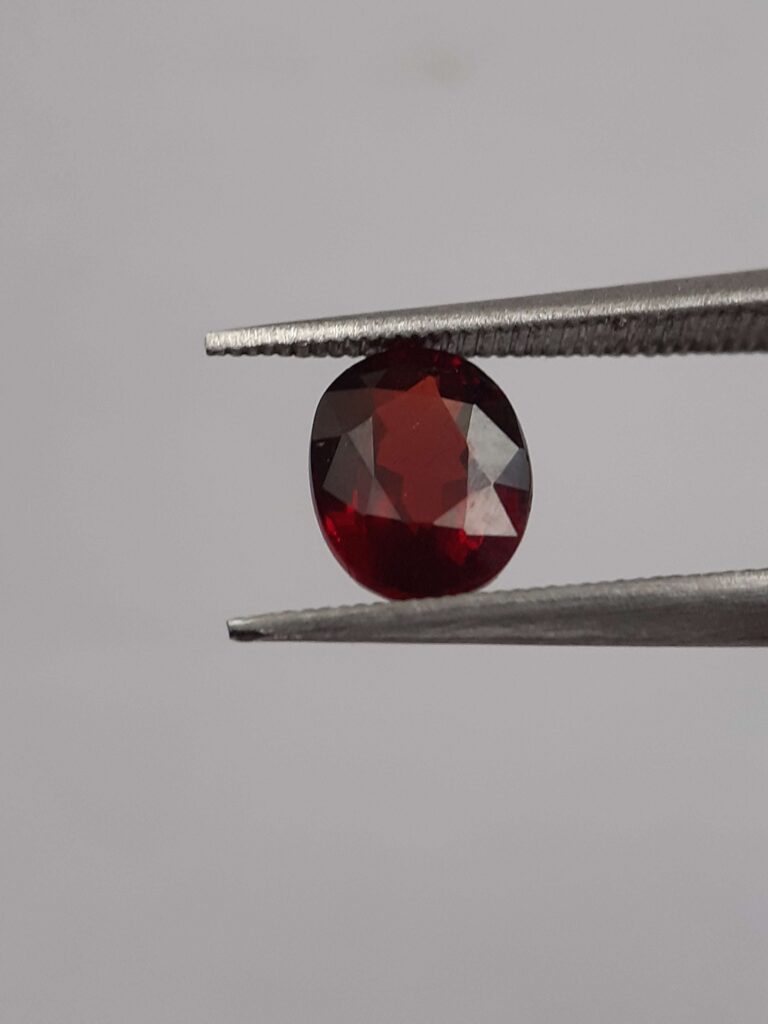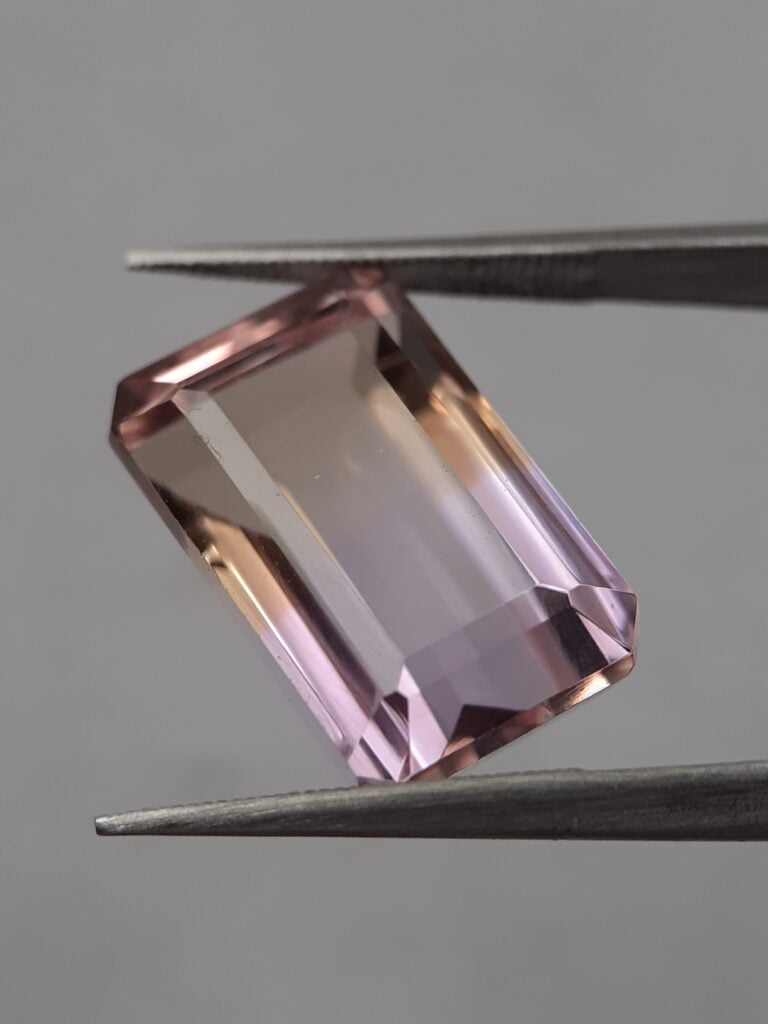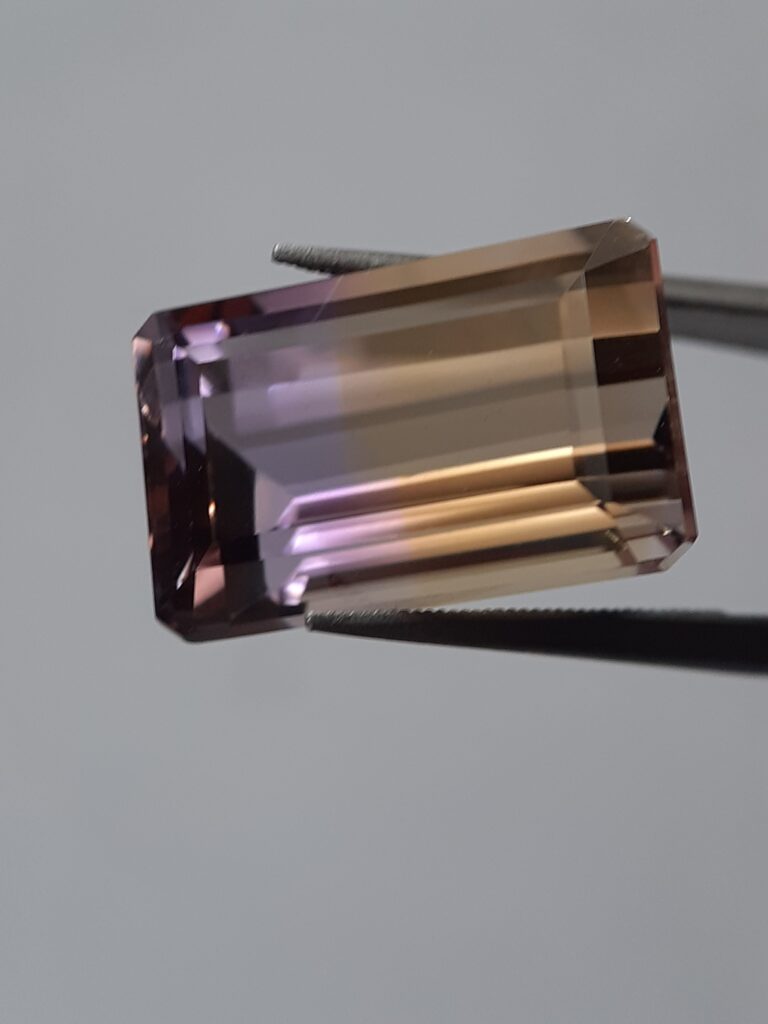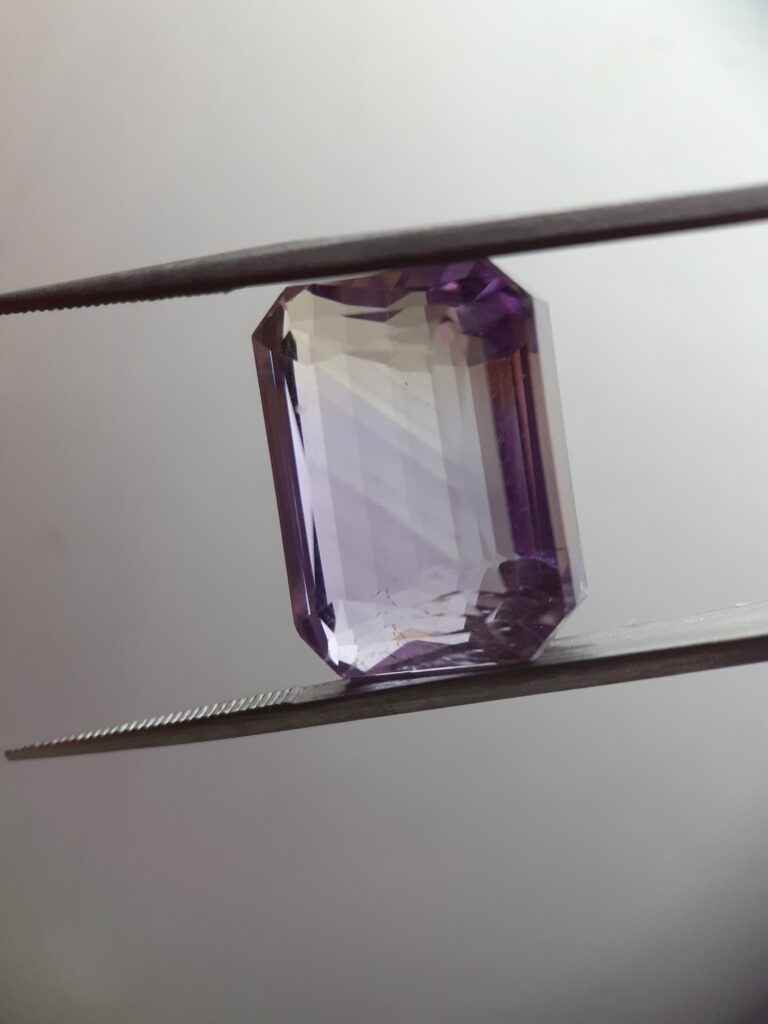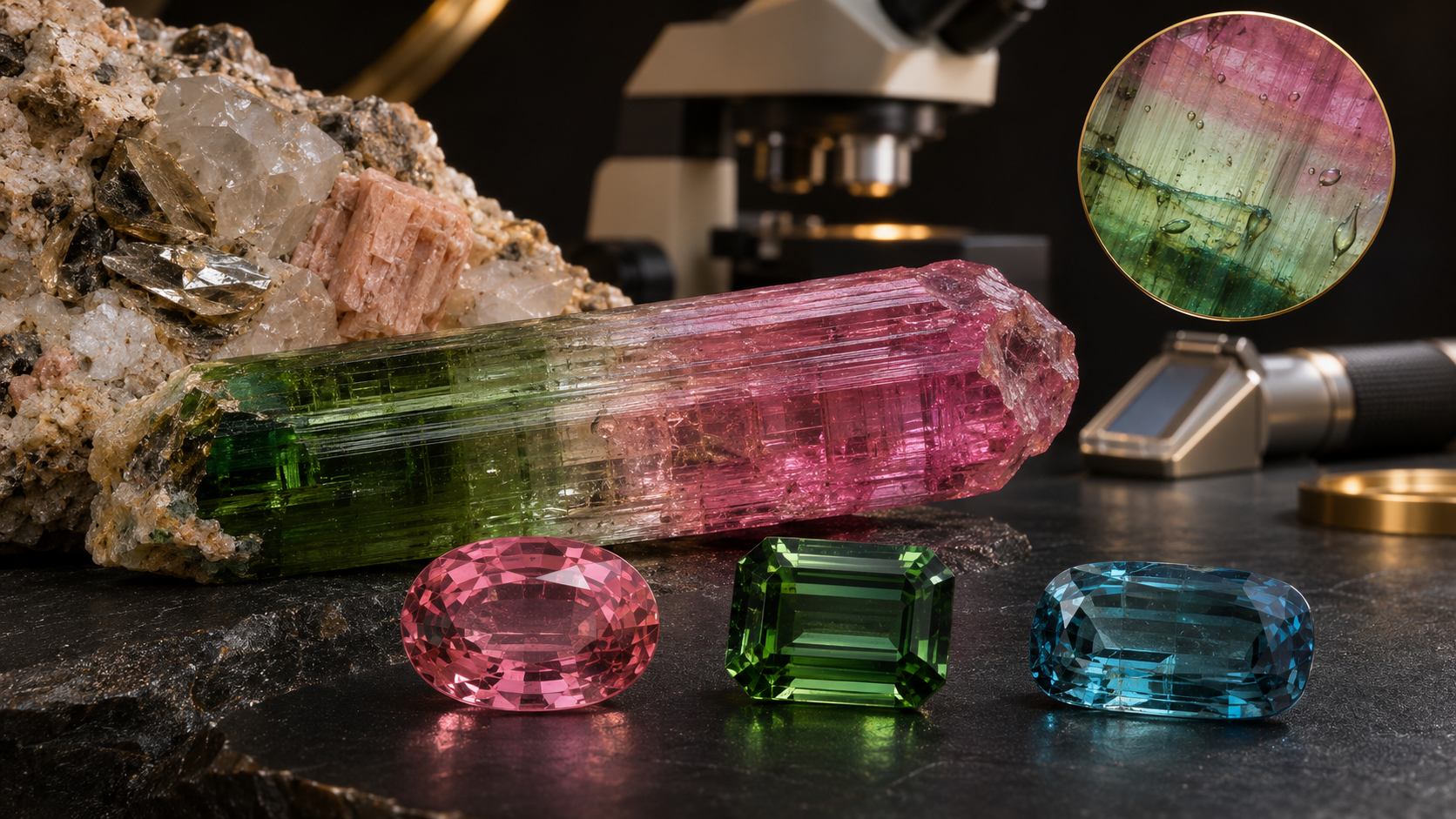
Elbaite is one of the most scientifically fascinating gemstone species within the tourmaline supergroup. Its complex borosilicate crystal structure accommodates numerous chemical substitutions, producing an extraordinary spectrum of colours, from delicate pink and intense red to vivid green, deep blue and multicoloured combinations within a single crystal.
Named after the Italian island of Elba, the species is particularly associated with lithium-rich granitic pegmatites, where prolonged magmatic differentiation concentrates boron, lithium and other elements essential to its formation.
Unlike gemstone species characterised by relatively restricted chemical compositions, elbaite demonstrates how substitutions within a flexible mineral structure can influence colour, refractive index, density, absorption spectra and growth patterns.
Its trigonal crystallography, strong directional colour absorption and frequent internal zoning make it an especially rewarding subject for professional gemmological investigation.
Elbaite also introduces important questions of mineral nomenclature. Familiar gemstone names such as rubellite, indicolite and watermelon tourmaline describe colour or appearance rather than defining independent mineral species. Likewise, the internationally recognised Paraíba tourmaline designation is associated with specific copper-related colour characteristics and is not restricted to one mineral species or geographic origin.
Identification requires more than visual inspection. Refractive-index measurements, optic character, pleochroism, microscopy and absorption spectroscopy provide important evidence, while advanced chemical analysis may be required to distinguish elbaite from closely related tourmaline species.
In this episode of the Nadia Gemstone Academy, we examine elbaite from its geological formation and crystal chemistry to its optical properties, microscopic inclusions, colour mechanisms, treatments, imitations and advanced laboratory identification.
The central objective is to understand how a single mineral species can produce such extraordinary visual diversity—and why accurate gemmological identification must distinguish colour appearance, mineral species, treatment status and geographic provenance.
Table of Contents
Elbaite Tourmaline: A Complete Gemmological Reference Guide
Introduction
Elbaite is a lithium-bearing mineral species within the tourmaline supergroup, a complex family of borosilicate minerals distinguished by extensive chemical substitution, trigonal crystallography and remarkable diversity of colour.
Gem-quality elbaite occurs in an exceptionally broad range of appearances, including pink, red, green, blue, purple and multicoloured crystals. Its diversity reflects variations in trace-element chemistry, crystallographic orientation and growth conditions.
The species is particularly associated with evolved granitic pegmatites, where boron, lithium and other elements become concentrated during magmatic differentiation.
Elbaite is also important because many familiar commercial gemstone names refer to colours or optical appearances rather than distinct mineral species.
Professional identification therefore requires a clear distinction between mineral species, descriptive gemstone terminology, treatment status and geographic origin.
1. Mineralogical Classification
Elbaite belongs to the tourmaline supergroup and the cyclosilicate mineral class.
Its representative ideal formula is:
Na(Li₁.₅Al₁.₅)Al₆Si₆O₁₈(BO₃)₃(OH)₄
This formula represents an idealised composition.
Natural elbaite exhibits considerable chemical variability through substitutions involving aluminium, lithium, sodium, iron, manganese and other elements.
The tourmaline structure contains several crystallographic sites that can accommodate different ions.
These substitutions are central to understanding both species classification and gemstone colour.
The term tourmaline refers to a mineral supergroup rather than one chemically uniform mineral species.
Elbaite, dravite, schorl and liddicoatite are separate mineral species within that supergroup.
2. The Origin of the Name
Elbaite takes its name from the island of Elba, Italy.
The island is historically important for its pegmatite mineralogy and the occurrence of coloured tourmaline crystals.
Tourmaline itself became well known in European mineral collections during the eighteenth century, although the material had been used and traded much earlier.
The recognition of different tourmaline species developed alongside advances in crystallography and chemical mineralogy.
Modern mineralogical classification depends on the dominant ions occupying particular crystallographic sites, rather than gemstone colour alone.
3. Crystal Structure
Elbaite crystallises in the trigonal system.
Its structure contains rings of silicon-oxygen tetrahedra, borate groups and additional coordination sites occupied by aluminium, lithium and other cations.
Tourmaline crystals commonly develop elongated prismatic habits.
The prisms frequently display longitudinal striations and approximately triangular cross-sections with curved faces.
Tourmaline is also hemimorphic: the two ends of a crystal can develop different crystallographic terminations.
These features can provide valuable evidence during examination of rough crystals.
However, external morphology alone cannot always distinguish elbaite from other tourmaline species.
4. Geological Formation
Elbaite is especially associated with lithium-rich granitic pegmatites.
Pegmatites form during the late stages of evolution of certain granitic magmatic systems.
As crystallisation proceeds, the residual melt may become enriched in elements that are less readily incorporated into the major rock-forming minerals.
These can include lithium, boron, fluorine and various rare elements.
Boron is essential to tourmaline formation.
Lithium-rich environments are particularly favourable for elbaite crystallisation.
The precise mineral assemblage depends on the chemical composition, temperature, pressure, fluid activity and geological evolution of the pegmatite.
5. Pegmatite Zoning
Many granitic pegmatites display internal mineralogical zoning.
Different parts of the body may contain varying proportions of quartz, feldspar, mica and accessory minerals.
Gem-quality elbaite may crystallise in pockets or cavities where suitable chemical and physical conditions allow relatively well-developed crystals to grow.
Crystal growth can occur in stages.
Changes in fluid or melt composition during growth may produce visible colour zoning.
The resulting crystals can preserve a partial record of the evolving geological environment.
6. Chemical Zoning
Elbaite frequently displays compositional zoning.
Different growth regions within a single crystal may contain different concentrations of manganese, iron, copper or other elements.
These changes can produce abrupt or gradual colour boundaries.
Zoning may follow crystallographic growth sectors or successive growth surfaces.
A polished slice may reveal concentric or approximately triangular colour patterns.
Such structures are scientifically important because they record changes in the chemical environment during crystal formation.
7. Watermelon Tourmaline
Watermelon tourmaline is a descriptive term for material with a pink or red interior and a green outer region.
It is not a separate mineral species.
The colour distribution commonly reflects changes in trace-element chemistry during successive stages of crystal growth.
Although watermelon patterns are often associated with elbaite, species identification should not be assumed from colour zoning alone.
The geometry of the colour boundaries can provide information about growth direction and changing crystallisation conditions.
8. Brazil
Brazil is one of the world’s major tourmaline-producing countries.
Minas Gerais is especially important for gem-quality pegmatitic tourmaline.
Brazilian deposits have produced pink, green, blue and multicoloured material.
The discovery of vivid copper-bearing tourmaline in Paraíba State during the late 1980s was particularly significant.
Related material was subsequently identified in Rio Grande do Norte.
These discoveries transformed scientific understanding of copper-related colour in gem tourmaline.
9. Mozambique
Mozambique is an important producer of copper-bearing tourmaline and other gem-quality tourmalines.
Some deposits are associated with pegmatitic geological environments.
Research has demonstrated that vivid blue-to-green copper-bearing material from Mozambique can overlap strongly in appearance with Brazilian stones.
Consequently, geographic origin cannot be established from colour alone.
Advanced quantitative chemical analysis may be required.
10. Nigeria
Nigeria contains important pegmatite-related gemstone deposits.
Copper-bearing blue-to-green tourmalines have been recovered from Nigerian sources.
These stones have contributed to the development of modern geographic-origin research.
Studies comparing Brazilian, Nigerian and Mozambican material have demonstrated that combinations of trace elements can be more informative than conventional optical measurements.
Nevertheless, chemical fields may overlap, and geographic-origin conclusions require carefully constructed reference datasets.
11. Afghanistan and Pakistan
Pegmatite districts in Afghanistan and northern Pakistan have produced attractive gem-quality tourmalines.
The region is known for complex granitic pegmatites containing a variety of rare-element minerals.
Elbaite may occur in several colours, depending on the chemistry of the individual deposit.
The geological setting can include lithium-bearing pegmatite assemblages associated with quartz, feldspar and mica.
12. Madagascar
Madagascar has produced numerous coloured tourmalines from pegmatitic environments.
Some crystals display complex colour zoning.
However, the island also produces other tourmaline species, including liddicoatite.
Therefore, a gemstone’s Malagasy origin does not automatically establish that it belongs to the elbaite species.
Detailed chemical analysis may be necessary for accurate classification.
13. Physical Properties
Elbaite has a Mohs hardness of approximately 7–7.5.
Its lustre is vitreous.
Transparent and translucent gem material is common, although opaque material also occurs.
Cleavage is generally poor or indistinct, while fracture is commonly uneven to conchoidal.
The mineral is brittle.
These properties provide good practical durability for many jewellery applications, but fractures and included zones can reduce resistance to impact.
14. Refractive Index
Gem-quality elbaite commonly displays refractive indices approximately within the following ranges:
nε: 1.615–1.630
nω: 1.635–1.655
The exact values vary with chemical composition.
Because tourmaline is chemically diverse, broader values may occur in other species.
A refractometer is useful for identifying the mineral group.
However, optical measurements alone may not establish the precise tourmaline species.
15. Birefringence
Elbaite is doubly refractive.
Typical birefringence in many gem-quality specimens is approximately 0.018–0.025.
The value represents the difference between the ordinary and extraordinary refractive indices.
Tourmaline’s birefringence may produce visible doubling under favourable examination conditions.
Nevertheless, strongly coloured material can make optical observations more difficult.
16. Optical Character
Elbaite is optically uniaxial negative.
Its ordinary refractive index is greater than its extraordinary refractive index.
This property is consistent with its trigonal crystallographic symmetry.
A polariscope and appropriate optical testing can assist in confirming anisotropic behaviour.
However, internal strain, inclusions and cutting orientation may complicate observations.
17. Pleochroism
Pleochroism is one of tourmaline’s important diagnostic characteristics.
Because coloured tourmaline absorbs light differently according to its crystallographic direction, the observed colour or intensity may change when viewed along different orientations.
Elbaite commonly displays moderate to strong dichroism.
The exact colours depend on the chromophores present.
A dichroscope can reveal these directional differences.
Strong pleochroism is also important in gemstone cutting.
Cutters must consider the orientation of the optic axis to avoid excessively dark face-up appearances.
18. Colour Mechanisms
Elbaite’s colours result from several different mechanisms.
Manganese is important in many pink and red specimens.
Iron influences certain blue and green colours.
Copper can produce vivid blue-to-green colours in selected material.
Chromium and vanadium can contribute to green colour in some tourmalines.
Colour may also be influenced by charge-transfer processes, oxidation state and interactions between multiple chromophores.
A visible colour is therefore not a unique chemical fingerprint.
19. Rubellite
Rubellite is a traditional gemstone name for pink to red tourmaline.
The boundaries of the term are not universally defined by a strict mineralogical criterion.
Many rubellites belong to the elbaite species.
However, the name itself is descriptive and should not replace formal mineral-species identification.
Manganese-related absorption is important in many pink and red stones.
The presence of inclusions and fractures varies considerably between deposits.
20. Indicolite
Indicolite is a descriptive name for blue tourmaline.
Many indicolites are elbaite.
Iron-related absorption contributes to the colour of numerous blue tourmalines.
The term should not be confused with the Paraíba designation.
Not every blue tourmaline contains sufficient copper to qualify as Paraíba-type material.
The two names describe different aspects of gem appearance and chemistry.
21. Paraíba Tourmaline
Paraíba tourmaline is a commercially important designation for certain vivid blue-to-green copper-bearing tourmalines.
The name originated from discoveries in northeastern Brazil.
However, accepted gemmological usage does not restrict the designation exclusively to Brazilian material.
Copper-bearing tourmalines with qualifying colours and chemistry have also been recovered from Nigeria and Mozambique.
Most early studied material belonged to the elbaite species.
Subsequent research demonstrated that copper-bearing liddicoatite can also occur.
Therefore, Paraíba is not a mineral species.
It is a gemstone designation associated with colour and chemical characteristics.
22. Copper and Manganese
Copper is a major contributor to the vivid blue-green colour of Paraíba-type tourmaline.
Manganese may influence pink, purple and other colour components.
Heat treatment can alter the oxidation state of manganese and reduce unwanted purple or pink absorption in selected specimens.
The resulting appearance may become more strongly blue or green.
However, the response to heating depends on the starting material.
Not every copper-bearing tourmaline responds identically.
23. Absorption Spectroscopy
UV-Vis-NIR spectroscopy is important in determining tourmaline colour mechanisms.
Iron, manganese and copper can produce characteristic absorption features.
Their exact spectral positions and intensities vary with composition, crystal orientation and instrumental conditions.
Copper-bearing material commonly displays broad absorption associated with copper ions.
Spectroscopy should be interpreted as a complete pattern rather than relying on a single absorption feature.
The presence of a particular band may support identification of a chromophore without independently establishing geographic origin.
24. Fluorescence
Elbaite’s fluorescence varies considerably.
Many specimens are inert or weakly fluorescent under standard ultraviolet examination.
Some compositions may display stronger responses.
Fluorescence can be influenced by activator elements and quenching impurities.
It is not a reliable standalone test for determining elbaite species identity, treatment status or geographic origin.
25. Microscopic Inclusions
Elbaite may contain a variety of internal features.
Commonly reported observations include growth tubes, fluid inclusions, healed fissures, fingerprint-like structures and mineral inclusions.
Some copper-bearing tourmalines contain distinctive trichite-like features.
Colour zoning and growth zoning can also be observed.
The inclusion assemblage varies by geological source.
No single inclusion should automatically be treated as proof of natural origin or a particular deposit.
26. Chatoyancy
Some tourmalines display a cat’s-eye effect.
Chatoyancy may arise from numerous parallel growth tubes or oriented inclusions.
When a suitable crystal is cut as a cabochon, these internal structures can produce a moving luminous band.
The sharpness of the eye depends on the orientation and concentration of the structures, the geometry of the cabochon and the illumination.
GIA has documented unusual copper-bearing cat’s-eye tourmaline in which oriented native copper inclusions contributed to the optical effect.
This demonstrates that the physical cause of chatoyancy can vary between specimens.
27. Treatments
Heat treatment is used for selected tourmalines.
The purpose may be to modify colour by changing the oxidation state or optical influence of certain elements.
Irradiation has also been used to modify the colour of some tourmalines.
Fracture filling and surface coating are additional possible enhancements.
Treatment prevalence varies by colour category and market.
Importantly, heating is not always detectable.
The absence of obvious heat-related inclusions does not prove that a gemstone is untreated.
Professional disclosure should distinguish confirmed findings from unresolved treatment status.
28. Synthetic Material
Tourmaline has been synthesised experimentally.
However, commercially available gem-quality synthetic elbaite is not a routine product category comparable with synthetic corundum or synthetic spinel.
The more common commercial concerns involve imitation materials, misleading colour names, treatments and confusion between tourmaline species.
A claim of synthetic tourmaline should be assessed through reliable laboratory evidence.
A gemstone should not be classified as synthetic merely because it is unusually clean or strongly coloured.
29. Imitations and Similar Gemstones
Elbaite can resemble several other gemstones.
Green tourmaline may be confused with peridot, beryl or garnet.
Pink and red material can resemble spinel, corundum or garnet.
Blue tourmaline can resemble aquamarine or other blue gemstones.
Glass and manufactured materials may also imitate tourmaline.
Refractive index, optic character, pleochroism, density and microscopic features provide useful evidence.
Raman spectroscopy can confirm mineral identity when classical observations are inconclusive.
30. Distinguishing Tourmaline Species
A critical professional distinction is the difference between identifying tourmaline and identifying its precise species.
Elbaite, liddicoatite, dravite and schorl share the tourmaline structural framework.
Their optical properties may overlap.
The formal mineral species depends on chemical occupancy at specific crystallographic sites.
Consequently, quantitative chemical analysis may be required.
GIA research on copper-bearing liddicoatite demonstrated that material previously resembling ordinary copper-bearing elbaite could belong to a different tourmaline species.
This finding illustrates why gemstone trade names cannot replace mineralogical classification.
31. Geographic-Origin Determination
Geographic-origin determination requires careful scientific comparison.
Standard gemmological measurements cannot reliably distinguish all copper-bearing tourmalines from Brazil, Nigeria and Mozambique.
GIA’s 2019 research established quantitative trace-element criteria using large reference populations.
Elements including copper, zinc, gallium, strontium, tin and lead were used in comparative analysis.
LA-ICP-MS provides precise elemental measurements.
However, compositional zoning and overlapping chemical populations can complicate interpretation.
Origin determination is therefore a probabilistic scientific assessment based on multiple observations, not a simple visual judgement.
32. Durability and Care
Elbaite has good resistance to ordinary scratching but is not immune to impact damage.
Existing fractures and inclusions may influence toughness.
Sudden temperature changes should be avoided, particularly in heavily included or fracture-filled stones.
Lukewarm water, mild soap and a soft brush are generally suitable for cleaning.
Ultrasonic and steam cleaning should be avoided when fractures, fillers or treatment uncertainties are present.
Gemstones should be stored separately to reduce abrasion.
33. Scientific Significance
Elbaite provides a particularly valuable example of the relationship between mineral structure and chemical substitution.
Its crystal structure permits numerous elemental combinations.
These influence optical absorption, colour zoning, refractive indices and other measurable properties.
Its geological occurrence demonstrates the importance of magmatic differentiation and pegmatite evolution.
Its inclusions preserve evidence of growth conditions.
Its colour mechanisms connect crystal chemistry with optical physics.
Finally, the complexity of its species classification illustrates the limits of traditional gemmological testing.
Conclusion
Elbaite is far more than a colourful gemstone.
It is a chemically complex mineral species whose appearance reflects the interaction of geology, crystallography, trace elements and optical behaviour.
Its study demonstrates why gemstone colour, mineral species, treatment status and geographic provenance must be considered separately.
For professional gemmology, elbaite offers a particularly rich field of investigation, connecting classical optical identification with modern spectroscopy and quantitative chemical analysis.
References & Further Reading
1. Gemological Institute of America – Tourmaline Gem Encyclopedia
Reference information on tourmaline chemistry, optical properties, hardness, colour, crystal structure and gemstone classification.
https://www.gia.edu/tourmaline
2. Katsurada, Y., Sun, Z., Breeding, C. M. & Dutrow, B. L. – Geographic Origin Determination of Paraíba Tourmaline
Gems & Gemology, Winter 2019.
Detailed research on copper-bearing tourmaline from Brazil, Nigeria and Mozambique, including quantitative trace-element analysis and the limitations of geographic-origin determination.
https://www.gia.edu/gems-gemology/winter-2019-paraiba-tourmaline-geographic-origin-determination
3. Abduriyim, A., Kitawaki, H., Furuya, M. & Schwarz, D. – “Paraíba”-Type Copper-Bearing Tourmaline from Brazil, Nigeria, and Mozambique: Chemical Fingerprinting by LA-ICP-MS
Gems & Gemology, Spring 2006.
Scientific investigation of trace-element chemistry and the distinction between geographically different copper-bearing tourmalines.
4. Katsurada, Y. & Sun, Z. – Cuprian Liddicoatite Tourmaline
Gems & Gemology, Spring 2017.
Research demonstrating that copper-bearing Paraíba-type material may belong to the liddicoatite species rather than elbaite.
https://archive.gia.edu/gems-gemology/spring-2017-cuprian-liddicoatite-tourmaline
5. Weeramongkhonlert, V. – Cat’s-Eye Brazilian Paraíba Tourmaline
Gems & Gemology, Winter 2018.
Laboratory examination of copper-bearing tourmaline displaying chatoyancy associated with parallel internal growth tubes.
https://www.gia.edu/gems-gemology/winter-2018-labnotes-cats-eye-brazilian-paraiba-tourmaline
6. Saruwatari, K. – Paraíba Tourmaline with Unusual Coating
Gems & Gemology, Spring 2017.
Laboratory documentation of a coated copper-bearing tourmaline and its microscopic and spectroscopic identification.
https://my.gia.edu/gems-gemology/spring-2017-labnotes-paraiba-tourmaline-unusual-coating
7. Gemological Institute of America – Tourmaline Gemmological Research, Fall 1990
Gems & Gemology archival issue.
Research containing refractive-index measurements, birefringence, density, pleochroism and fluorescence observations in studied elbaite samples.