

Table of Contents
Introduction: When Heat Transforms a Natural Gemstone
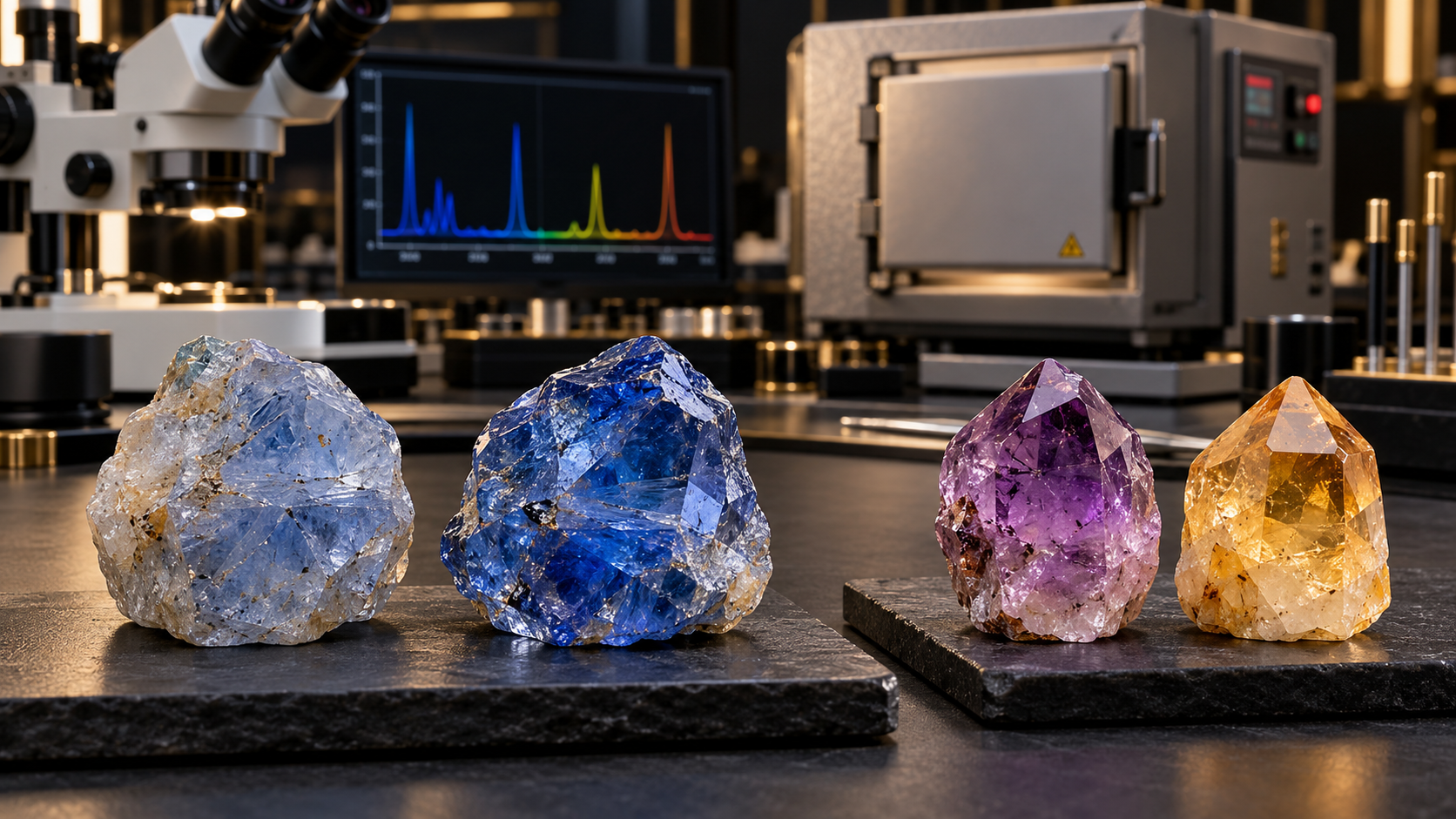
Imagine two natural sapphires lying beside one another.
Both originated within the Earth.
Both possess the same fundamental mineral composition.
Both developed through natural geological processes over immense periods of time.
Yet one displays a relatively pale, uneven blue colour, while the other possesses a rich and attractive blue appearance.
The difference may be the result of heat treatment.
Under carefully controlled conditions, certain natural gemstones can undergo remarkable changes when exposed to elevated temperatures.
A pale sapphire may develop stronger colour.
A dark sapphire may become lighter.
A ruby containing purplish or bluish areas may develop a more uniform red appearance.
A greenish-blue aquamarine may become a purer blue.
Purple amethyst may transform into yellow or orange citrine.
Brown zircon may develop an intense blue colour.
These transformations are not examples of ordinary polishing or cutting.
They involve changes within the gemstone’s internal structure, trace-element environment, inclusions or colour-producing mechanisms.
Yet the original mineral may remain fundamentally the same.
A heated natural sapphire is still natural corundum.
A heated natural aquamarine remains beryl.
A piece of amethyst transformed into citrine remains quartz.
This creates an important distinction between a gemstone’s geological origin and the treatments applied after mining.
It also raises several questions.
What actually happens inside a gemstone when it is heated?
Why do some stones change colour while others remain almost unaffected?
Can heating improve transparency?
Does heating make a gemstone less natural?
Can gemmologists determine whether a stone has been treated?
And why can two visually similar gemstones have substantially different market values depending on their treatment histories?
Understanding these questions requires examining the relationship between mineral chemistry, crystallography, optical properties and modern gemmological identification.
Heat treatment is not simply a process of making gemstones more attractive. It is a controlled modification of physical and chemical conditions within natural mineral material.
1. What Is Gemstone Heat Treatment?
Gemstone heat treatment involves exposing a gemstone to elevated temperatures under conditions intended to modify its appearance or other characteristics.
The treatment may be performed on rough material, partially prepared stones or finished gemstones.
The desired result depends on the mineral species and the characteristics of the individual specimen.
In some gemstones, heating changes colour.
In others, it alters the visibility of inclusions.
Certain treatments affect both colour and transparency.
Heating can also produce undesirable results.
A gemstone may become too dark.
Its colour may change in an unexpected direction.
Internal fractures may expand.
Inclusions may react unfavourably.
Under unsuitable conditions, the material may crack or break.
Consequently, heat treatment is not a universally beneficial procedure.
It requires an understanding of the material’s chemistry, crystal structure and internal characteristics.
The Gemological Institute of America identifies heat treatment as one of the most widespread methods used to modify gemstone appearance.
However, the term covers a broad range of processes.
Heating a piece of aquamarine to reduce its greenish component is not scientifically identical to heating sapphire at temperatures sufficient to dissolve microscopic rutile inclusions.
Likewise, heating corundum while deliberately introducing foreign colouring elements involves additional processes beyond conventional thermal modification.
These distinctions are fundamental to accurate gemmological terminology.
2. Natural Gemstones and Treated Gemstones Are Not Opposites
A common misunderstanding is that a gemstone must be either natural or treated.
This is incorrect.
The terms describe different characteristics.
Natural origin concerns how the mineral formed.
Treatment concerns what happened to the material after its formation and extraction.
A sapphire that crystallised naturally within the Earth remains natural corundum after conventional heat treatment.
Its geological origin has not changed.
However, its appearance may have been modified through human intervention.
The appropriate description is therefore a natural, heat-treated sapphire.
A laboratory-grown sapphire presents a different situation.
Its corundum structure was produced through an artificial growth process rather than natural geological crystallisation.
It may possess essentially the same fundamental chemical composition and crystal structure as natural corundum.
Nevertheless, its origin is different.
A synthetic sapphire can also be heat treated.
Consequently, the following questions must be considered separately:
Was the gemstone formed naturally or manufactured?
Has the gemstone undergone treatment?
What type of treatment was applied?
Can that treatment be identified?
These distinctions are essential for accurate product descriptions.
The expression natural gemstone does not automatically mean untreated gemstone.
Similarly, the presence of heat treatment does not automatically make a natural gemstone synthetic.
3. Why Gemstones Have Colour
To understand heat treatment, it is first necessary to understand why gemstones display colour.
Visible light consists of electromagnetic radiation covering a range of wavelengths.
When light enters a gemstone, some wavelengths may be absorbed more strongly than others.
The remaining transmitted or reflected light contributes to the colour perceived by an observer.
Different mechanisms can produce selective absorption.
Some gemstones owe their colour to trace elements incorporated into their crystal structures.
Others contain structural defects that interact with light.
Certain colour mechanisms involve interactions between neighbouring ions.
A gemstone’s colour can also be influenced by microscopic inclusions, scattering or optical phenomena.
For example, chromium contributes to the red colour of ruby.
Iron and titanium interactions are important in many blue sapphires.
Iron-related defects influence the colour of amethyst.
The blue colour of many heat-treated zircons is associated with electronic absorption mechanisms involving uranium in the crystal structure.
These mechanisms are not interchangeable.
A treatment that changes one type of colour-producing defect may have little effect on another.
This explains why different gemstone species respond differently to heating.
4. Colour Centres and Electronic Defects
One important mechanism involves colour centres.
A colour centre is a defect or electronic configuration within a crystal that produces absorption in particular regions of the electromagnetic spectrum.
Such defects can arise through several processes.
They may involve impurities, vacancies in the crystal lattice or electrons and electronic holes associated with specific atomic sites.
An electronic hole can be understood as the absence of an electron in a state where one would otherwise be present.
This absence can participate in optical absorption processes.
Heating may alter the concentration or stability of certain defects.
It may also change how charge is distributed within the crystal.
The resulting absorption spectrum can change.
This can produce a visible difference in colour.
However, heating does not simply remove colour centres in every gemstone.
Depending on the material and conditions, heating can create, destroy or redistribute colour-producing configurations.
Research published in Gems & Gemology in 2023 demonstrates the complexity of yellow sapphire coloration.
The researchers identified different yellow colour mechanisms involving ferric iron and iron-associated trapped holes.
They showed that heating can modify the internal chemistry responsible for these mechanisms.
The resulting colour changes depend on the original composition and defect chemistry of the sapphire.
This provides an important scientific lesson.
A gemstone’s response to heat depends on its existing internal chemistry, not merely on the temperature reached.
5. Oxidation and Reduction: Why the Heating Atmosphere Matters
Temperature is only one variable in gemstone heat treatment.
The atmosphere surrounding the gemstone can also influence the result.
An oxidising environment and a reducing environment can favour different chemical and electronic conditions.
An oxidising atmosphere generally promotes conditions associated with the removal of electrons from susceptible species.
A reducing atmosphere generally favours conditions associated with electron gain.
However, the actual changes within a gemstone depend on its chemistry, temperature, available oxygen and other environmental factors.
The behaviour of trace elements and defects may therefore differ between atmospheres.
For some materials, an oxidising environment can produce the desired colour.
For others, a reducing environment is more effective.
Zircon provides an instructive example.
Research published by GIA describes the production of intense blue zircon through heating suitable material in reducing conditions.
Other heating conditions can produce different results, including near-colourless material.
These differences demonstrate why the term heat treated does not describe one universal physical process.
The heating atmosphere can be as important as the temperature itself.
6. Low-Temperature and High-Temperature Heat Treatment
Gemstone treatments are sometimes described as low-temperature or high-temperature heating.
These expressions require careful interpretation.
There is no single temperature that separates low and high heat treatment for every gemstone species.
The relevant distinction depends on the material and the physical changes involved.
In corundum, one useful scientific distinction concerns the dissolution of microscopic secondary mineral inclusions.
Rutile is particularly important.
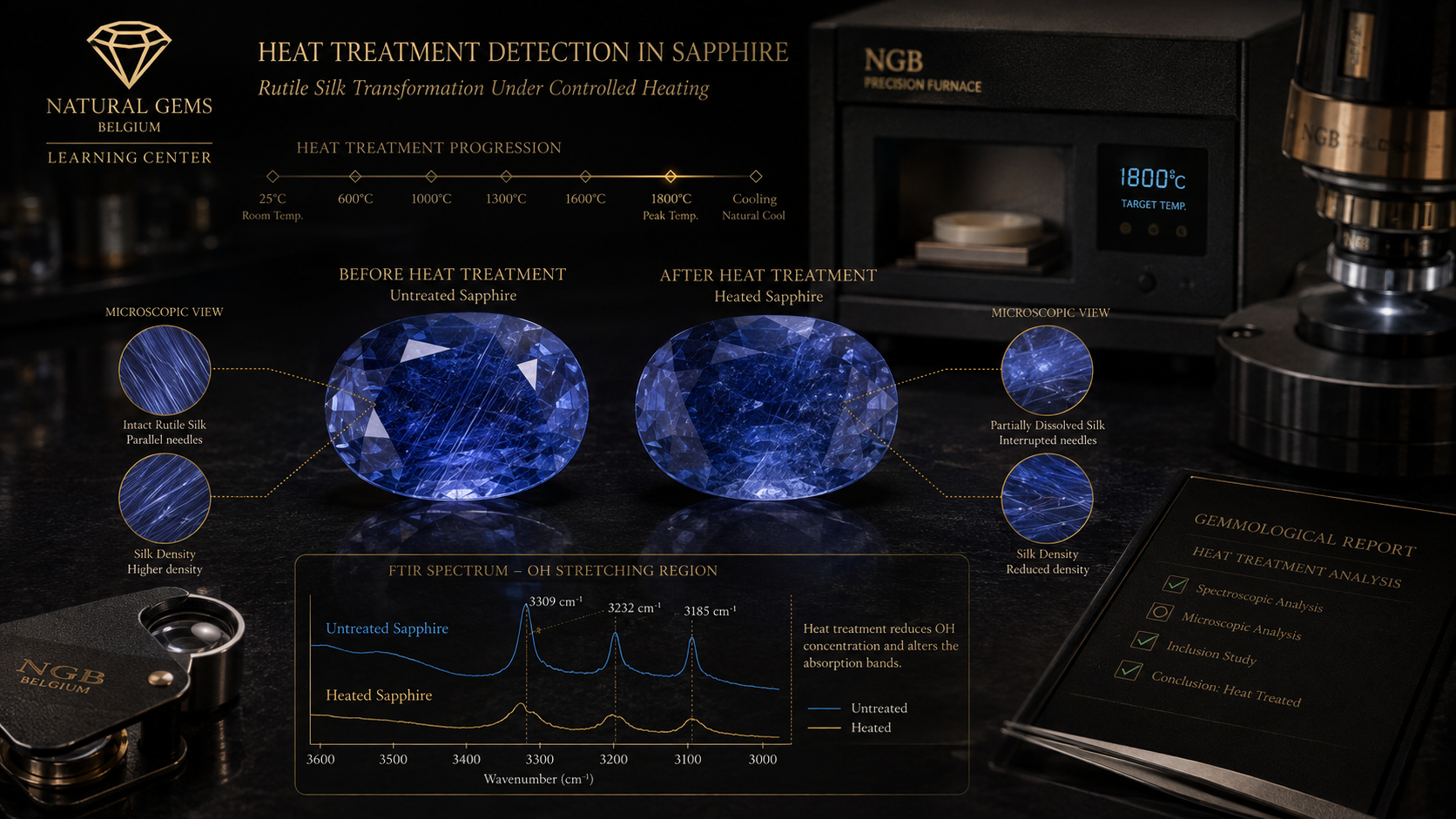
Research on sapphire and ruby commonly identifies approximately 1200–1350°C as a transitional range associated with the dissolution of rutile silk under suitable conditions.
This is not a universal threshold applicable to every corundum specimen.
The exact behaviour depends on the material and treatment environment.
Below this approximate range, certain colour changes and inclusion reactions may occur without extensive rutile dissolution.
At higher temperatures, microscopic rutile particles may begin to dissolve into the corundum structure.
This can influence both colour and transparency.
GIA research on Madagascar sapphire demonstrated that heating between 800°C and 1100°C in air could lighten the blue colour of some specimens.
Higher-temperature treatment produced different results.
In certain cases, dissolution of rutile contributed to a deeper and more saturated blue appearance.
This finding illustrates why increasing temperature does not necessarily produce a simple progression toward stronger colour.
A gemstone can become lighter at one stage and darker at another.
7. Sapphire: One of the Most Important Examples
Sapphire is a variety of corundum.
Its chemical composition is Al₂O₃.
The corundum structure can incorporate trace elements that influence colour.
Blue sapphire is commonly associated with interactions involving iron and titanium.
However, not every blue sapphire possesses the same trace-element concentrations or geological history.
Consequently, sapphires can respond differently to heating.
Some become more intensely blue.
Others become lighter.
Certain stones develop improved transparency.
Some may acquire less desirable colours.
The original distribution of inclusions and trace elements strongly influences the result.
In a major 2019 study, researchers E. Billie Hughes and Rosey Perkins examined the effects of controlled heating on Madagascar sapphire.
Their experiments documented changes in colour, inclusions, fluorescence and absorption spectra.
The results demonstrated that relatively low-temperature heating could produce significant colour modifications.
The researchers also observed that some internal characteristics changed before the high temperatures associated with extensive rutile dissolution were reached.
This has important consequences for gemmological identification.
A sapphire may have undergone meaningful heat treatment without displaying the most familiar high-temperature inclusion features.
Therefore, the absence of strongly altered rutile silk does not automatically establish that a sapphire is unheated.
8. Rutile Silk: How Heating Changes Transparency
Many natural sapphires contain extremely fine needle-like inclusions of rutile.
Rutile is a titanium dioxide mineral with the chemical composition TiO₂.
When these needles occur in sufficiently fine and abundant arrangements, gemmologists commonly refer to them as silk.
Rutile silk can scatter light.
This scattering may contribute to a cloudy or hazy appearance.
Under suitable high-temperature conditions, some rutile can dissolve into the surrounding corundum.
As the population of scattering particles decreases, the gemstone may become more transparent.
The optical effect can be significant.
A sapphire that originally appeared slightly cloudy may become clearer.
However, the consequences extend beyond transparency.
Dissolving rutile can alter the distribution of titanium within the crystal.
This may influence colour-producing interactions.
A 2023 GIA study of Montana sapphire documented an example in which heating dissolved part of the rutile silk.
The researchers observed a reduction in light scattering and an increase in the apparent blue coloration.
This example demonstrates that colour enhancement may result from several interacting effects.
Changes in electronic absorption and changes in light scattering can both influence the finished appearance.
Nevertheless, rutile dissolution does not always produce an attractive result.
The original inclusion distribution and chemistry determine the outcome.
9. Heating Can Also Improve or Create Optical Phenomena
Rutile inclusions are not always undesirable.
In some corundum gemstones, oriented microscopic inclusions produce asterism.
Asterism is the star-like optical phenomenon displayed by certain cabochons.
The effect occurs when light interacts with appropriately oriented internal features.
Depending on the material and treatment conditions, heating may reduce the visibility of such inclusions.
This can weaken or eliminate a star.
However, certain thermal processes can also encourage the formation or reorganisation of inclusions that contribute to asterism.
GIA’s historical research on corundum heat treatment describes several distinct thermal processes capable of modifying colour, silk and star effects.
This provides an important distinction between conventional faceted gemstones and phenomenal gemstones.
For a transparent faceted sapphire, reducing silk may improve visual clarity.
For a star sapphire, the presence of suitably oriented inclusions may be essential.
The desirable treatment result therefore depends on the intended gemstone appearance.
10. Ruby: Heat Treatment and the Complexity of Red Colour
Ruby is the red variety of corundum.
Like sapphire, it has the chemical composition Al₂O₃.
Its characteristic red colour is primarily associated with chromium.
However, ruby colour can also be influenced by other trace elements, crystal orientation and internal characteristics.
Some natural rubies display purplish or bluish components.
Heating may reduce certain undesirable colour components.
It may also modify the visibility of rutile silk.
The result can be a clearer or more attractive red appearance.
However, ruby heat treatment is not always straightforward.
Some rubies contain inclusions that react strongly to elevated temperatures.
Internal fractures may expand.
Mineral inclusions may undergo phase changes.
Certain stones may develop additional clarity problems.
GIA research published in 2022 examined low-temperature heat treatment of ruby from Mogok, Myanmar.
The researchers studied changes in internal characteristics at different temperatures.
They found that several mineral inclusions could display detectable reactions even when heating temperatures were below those commonly associated with extensive rutile dissolution.
The study also documented cases in which gemstones fractured during heating.
These observations demonstrate that thermal treatment carries risks.
Heating does not guarantee an improvement in appearance or durability.
11. When Heat Treatment Becomes More Than Heating
One of the most important distinctions in gemstone treatment concerns the use of additional substances.
Conventional heat treatment modifies the gemstone through thermal processes.
Other procedures involve heating combined with the introduction of foreign elements or materials.
These should not automatically be grouped together under the simple description heated.
Consider ruby.
Some rubies contain fractures that reduce their apparent transparency.
During certain high-temperature treatments, flux materials may be introduced.
These substances can interact with fractures and contribute to their partial healing.
Residual foreign material may remain within the gemstone.
GIA documented such features in a 2025 study of a flux-healed ruby from Mong Hsu, Myanmar.
The specimen contained fissures associated with residual flux.
The researchers identified these features through microscopic examination.
This type of treatment differs from heating alone.
A ruby described simply as heated may therefore require more precise disclosure if foreign material was deliberately introduced and remains within the stone.
Similarly, glass-filled ruby represents a distinct treatment category.
Glass filling can improve the apparent transparency of fractured material.
It should not be confused with conventional heat treatment.
The presence, nature and extent of foreign filling material can affect durability, care requirements and value.
Accurate terminology is essential.
12. Beryllium Diffusion: A Different Treatment Category
Beryllium diffusion provides another important example.
This process involves heating corundum under conditions that allow beryllium to enter the crystal structure.
The introduced element can alter the chemical environment responsible for colour.
The resulting changes may be substantial.
Research published in Gems & Gemology in 2003 documented the use of beryllium diffusion to modify ruby and sapphire.
The treatment can produce or alter several colours.
These include orange, yellow and other colour appearances.
The process may involve temperatures above 1800°C.
However, the essential distinction is not simply the high temperature.
It is the deliberate introduction of beryllium into the gemstone.
This makes the process different from conventional heating without added colouring elements.
Detection may require advanced laboratory methods.
In some cases, specialised chemical analysis is necessary to establish the presence and distribution of beryllium.
The correct disclosure should therefore identify the diffusion treatment rather than describing the gemstone only as heated.
This distinction is especially important for buyers comparing natural-colour, conventionally heated and diffusion-treated corundum.
13. Yellow Sapphire: A Case Study in Colour Chemistry
Yellow sapphire illustrates how different colour mechanisms can produce similar visual appearances.
GIA research published in 2023 examined natural, heat-treated, beryllium-diffused and synthetic yellow sapphires.
The researchers identified two important colour-producing mechanisms in natural yellow sapphire.
One involves ferric iron.
Another involves an iron-associated trapped hole.
These mechanisms can contribute individually or together.
Heating may modify the concentration of colour-producing configurations.
Consequently, some naturally pale sapphires can develop stronger yellow coloration.
Beryllium diffusion can also influence the chemistry responsible for yellow colour.
However, the resulting treatment history is different.
Two sapphires may display similar yellow appearances while possessing different geological and treatment histories.
One may have developed its colour naturally.
Another may have been conventionally heated.
A third may have undergone beryllium diffusion.
Visual colour alone cannot reliably establish which process occurred.
This is why gemmological identification must consider more than appearance.
14. Aquamarine: From Greenish Blue to Purer Blue
Aquamarine is the blue to greenish-blue variety of beryl.
Its chemical composition is Be₃Al₂Si₆O₁₈.
Iron-related mechanisms are responsible for its characteristic colour.
Many natural aquamarines display a greenish component.
Controlled heating can reduce this component and produce a purer blue appearance.
The Gemological Institute of America identifies this as a common commercial treatment.
Importantly, heating does not transform aquamarine into a different mineral species.
The material remains beryl.
Its fundamental mineral identity is preserved.
The treatment modifies the optical characteristics responsible for the observed colour.
However, not every aquamarine requires heating to display an attractive blue.
Naturally blue material also occurs.
Furthermore, the detection of heating in aquamarine can be difficult.
In many cases, a gemmologist cannot establish with certainty whether a particular aquamarine has been heated.
This creates an important distinction between a treatment being commercially common and a treatment being demonstrable in an individual gemstone.
A statement that a particular aquamarine is unheated should not be made solely because routine examination reveals no evidence of heating.
15. Tanzanite: The Role of Pleochroism
Tanzanite is the blue-to-violet gem variety of zoisite.
Its colour is associated with vanadium-related mechanisms.
Tanzanite is also strongly pleochroic.
This means that different colours may be observed along different crystallographic directions.
Some natural tanzanite material contains a brownish component.
Controlled heating can reduce this component and produce a more desirable blue or violet appearance.
The treatment is widely encountered in the gemstone trade.
However, heat treatment does not eliminate the mineral’s fundamental optical anisotropy.
Crystal orientation remains important.
A cutter must still consider pleochroism when selecting the finished gemstone’s orientation.
This illustrates an important principle.
Heat treatment can modify the relative appearance of colours without eliminating the crystallographic properties responsible for directional optical behaviour.
The finished appearance therefore reflects both treatment and cutting decisions.
16. Amethyst and Citrine: A Transformation Within Quartz
Amethyst and citrine belong to the quartz family.
Both have the chemical composition SiO₂.
Amethyst is the purple variety.
Citrine displays yellow to orange and brownish-orange colours.
Natural citrine occurs, but much of the citrine available commercially is produced by heating suitable amethyst.
GIA identifies heat-treated amethyst as a major source of commercial citrine.
The transformation occurs because heating can modify the iron-related colour-producing configurations within quartz.
However, not every amethyst crystal will produce attractive citrine when heated.
The response depends on the original material.
Some specimens may become pale.
Others may develop brownish or uneven colours.
The final result can depend on the distribution and nature of the original colour-producing defects.
An important identification distinction follows.
Heat-treated amethyst sold as citrine remains natural quartz.
It is not automatically synthetic.
However, its colour history differs from that of naturally yellow citrine.
The fact that both materials are quartz does not make their treatment histories identical.
This distinction should be communicated accurately when treatment information is known.
17. Zircon: A Dramatic Example of Thermal Colour Modification
Zircon is zirconium silicate.
Its chemical composition is ZrSiO₄.
Natural zircon occurs in several colours.
Brownish material is particularly relevant to the production of commercial blue zircon.
Under suitable heating conditions, some brown zircon can develop an intense blue appearance.
GIA research describes the production of vivid blue zircon through heating suitable material in reducing conditions.
The treatment can involve temperatures around 1000°C.
However, the result depends on the original zircon’s chemistry and structural condition.
Zircon can also contain naturally occurring radioactive elements such as uranium and thorium.
Over geological time, radiation damage may disrupt its crystal structure.
This process is known as metamictisation.
Heating can influence the structural order of some zircon material.
The relationship between radiation damage, colour and thermal response is complex.
Not every brown zircon can be transformed into an attractive blue gemstone.
The starting material is critical.
Zircon also provides an important warning about colour stability.
Research published in Gems & Gemology in 2016 demonstrated that some blue zircons could develop a brownish appearance following exposure to long-wave ultraviolet radiation.
The researchers also documented reversible colour changes under controlled conditions.
This finding demonstrates that treatment stability should not always be described in absolute terms.
A gemstone may be stable under ordinary use yet respond to particular environmental conditions.
18. Topaz: Heat Treatment and Combined Processes
Topaz provides another example of thermal colour modification.
Certain naturally coloured topaz specimens can change appearance when heated.
For example, heating may reduce a yellowish component in some pinkish topaz.
The result can be a stronger pink appearance.
However, blue topaz introduces an additional distinction.
Much commercial blue topaz is produced through irradiation followed by heating.
The irradiation creates or modifies colour-producing defects.
Subsequent heating helps establish the desired final colour.
This is not equivalent to conventional heating alone.
The correct treatment description should reflect the actual processes involved.
A gemstone that has been irradiated and heated should not automatically be described as merely heat treated.
The distinction matters because treatment history can affect consumer understanding, identification and commercial value.
It also demonstrates that several physical processes may be combined to produce a desired gemstone appearance.
19. Can Heat Treatment Change Gemstone Clarity?
Heat treatment is often associated with colour modification.
However, clarity changes can be equally important.
Certain inclusions scatter light.
Others create visible clouds or internal reflections.
Heating may alter these features.
For example, dissolution of rutile silk in sapphire can reduce scattering and improve transparency.
However, other inclusions may react unfavourably.
Mineral crystals can expand or change structure.
Fractures may develop around inclusions.
Previously inconspicuous internal features may become more visible.
Some fractures may partially heal under suitable conditions.
Consequently, clarity changes are not necessarily improvements.
A gemstone can become clearer in one region and more fractured in another.
Research on heated ruby has documented both beneficial and detrimental changes.
This is why treatment results should be evaluated individually.
The presence of heat treatment does not guarantee that a gemstone has better clarity than it possessed before treatment.
20. How Gemmologists Detect Heat Treatment
Determining whether a gemstone has been heated can be challenging.
The available evidence depends on the mineral species, treatment conditions and internal characteristics.
Professional gemmologists may use several complementary methods.
Microscopic Examination
Microscopy is particularly important for ruby and sapphire.
Heat can alter the appearance of inclusions.
Possible indicators include modified rutile silk, tension fractures around mineral crystals, partially healed fissures and changes in the appearance of included minerals.
However, no single microscopic feature should automatically be treated as conclusive in every case.
Some features may have natural geological explanations.
Others may be absent even when heating occurred.
Interpretation requires experience and comparison with established reference material.
Infrared Spectroscopy
Fourier-transform infrared spectroscopy, commonly abbreviated FTIR, can provide information about certain defects and hydrogen-related features.
These may be relevant to heat-treatment investigations.
However, the diagnostic value depends on the gemstone species and the treatment process.
UV-Visible-Near-Infrared Spectroscopy
UV-Vis-NIR spectroscopy measures absorption across selected wavelength ranges.
It can reveal information about colour-producing mechanisms.
Changes in absorption bands may support conclusions about heating.
Nevertheless, a particular absorption feature should not automatically be interpreted as proof of treatment without considering other evidence.
Ultraviolet Fluorescence
Some heat-treated sapphires display fluorescence characteristics associated with changes in rutile-related features.
GIA research has demonstrated the value of fluorescence imaging in selected treatment investigations.
However, fluorescence behaviour depends on composition and other variables.
Raman Spectroscopy
Raman spectroscopy can identify mineral inclusions and certain structural changes.
It may be useful when examining inclusions that have reacted to heating.
Trace-Element Analysis
Advanced chemical methods may be required when investigating treatments involving foreign elements.
Laser ablation–inductively coupled plasma–mass spectrometry, or LA-ICP-MS, can provide detailed trace-element information.
Such methods are particularly relevant to some diffusion-treatment investigations.
The strongest laboratory conclusions generally arise from combining appropriate observations and analytical methods.
21. Why Heat Treatment Cannot Always Be Detected
An important limitation must be recognised.
Not every heat treatment leaves a diagnostic feature that can be identified with current methods.
Some gemstones undergo colour changes without developing obvious microscopic evidence.
Other treatments produce changes that overlap with naturally occurring characteristics.
Aquamarine, tanzanite and certain other gemstones can be particularly challenging.
Even in corundum, low-temperature heating may leave subtle evidence.
GIA research on ruby and sapphire demonstrates that treatment identification can require advanced examination and carefully interpreted inclusion evidence.
Therefore, three statements must be distinguished.
The first is that heat treatment has been detected.
The second is that no evidence of heat treatment was observed.
The third is that the gemstone has never been heated.
These statements are not equivalent.
The absence of detectable evidence does not always establish the complete absence of treatment.
Professional laboratory conclusions should be interpreted according to their precise wording and the methods available.
22. Heated Versus Unheated: Does It Affect Value?
Treatment history can influence gemstone value.
However, the relationship is not identical for every gemstone species.
In fine ruby and sapphire, documented unheated status can contribute to a substantial market premium.
This is particularly relevant when the gemstone also possesses exceptional colour, clarity, size and other desirable characteristics.
Nevertheless, unheated status does not automatically make a gemstone valuable.
A poorly coloured unheated sapphire may be less desirable than an attractive heated sapphire.
Likewise, a heavily included unheated ruby may have lower market value than a transparent heated specimen.
Treatment status is one factor within a broader valuation process.
In aquamarine, tanzanite and citrine, heating is widely encountered in the trade.
The commercial significance of treatment may therefore differ from that associated with fine ruby or sapphire.
Diffusion treatments and filling procedures can introduce additional valuation considerations.
The type and extent of treatment matter.
A simple comparison between heated and unheated is therefore insufficient for every gemstone.
Professional valuation should consider species, variety, colour, transparency, cut, size, durability, treatment history and market conditions.
23. Treatment Disclosure: An Essential Part of Gemstone Transparency
Accurate treatment disclosure is fundamental to responsible gemstone trading.
A buyer should be able to understand whether a gemstone’s appearance has been modified.
This information can influence value, durability, care requirements and purchasing decisions.
The World Jewellery Confederation, known as CIBJO, identifies treatment disclosure as an important component of professional jewellery-industry ethics.
Its Code of Ethics states that failure to disclose treatments is contrary to consumer interests.
The United States Federal Trade Commission also provides detailed guidance concerning gemstone-treatment disclosure.
Its Jewelry Guides address treatments that are not permanent, require special care or significantly affect value.
These American guidelines are not a substitute for the laws applicable in every jurisdiction.
However, they illustrate the broader principle that gemstone descriptions should not mislead buyers.
For international gemstone businesses, clear and consistent disclosure is particularly important.
The description natural sapphire should not be used to imply untreated sapphire when heating is known.
Similarly, conventional heating should not be used as a vague description for a treatment that also involved diffusion or filling.
When treatment information is uncertain, that uncertainty should not be concealed through an unsupported claim.
Transparency requires distinguishing established facts from assumptions.
24. What Should a Buyer Look for in a Gemstone Report?
A professional gemstone report can provide important information about material identity and treatment.
However, reports differ in scope.
Some establish whether a gemstone is natural or laboratory-grown.
Others include treatment findings.
Certain reports may provide geographical origin opinions.
Not every report includes all these services.
When reviewing a report, the buyer should examine the exact wording.
A statement indicating no indications of heating should not automatically be interpreted as a guarantee that the gemstone has never been exposed to elevated temperatures.
Similarly, a report identifying heat treatment does not necessarily establish every detail of the treatment process.
For certain gemstones, treatment identification may be limited by current analytical methods.
Buyers should also consider the laboratory’s expertise and the type of examination performed.
A report should be interpreted as a professional assessment based on available evidence.
It is not a universal guarantee of every aspect of a gemstone’s history.
25. Practical Guide: Comparing Two Similar Gemstones
Consider two hypothetical natural blue sapphires.
Both weigh approximately 2 carats.
Both display attractive blue colour.
Both possess similar cutting proportions.
However, their documented treatment histories differ.
The first sapphire has been identified as heat treated.
The second has a laboratory report stating that no indications of heating were observed.
The second sapphire may command a higher market price if its other characteristics are comparable.
However, the price difference cannot be determined from treatment status alone.
Colour quality remains important.
So does clarity.
Cutting quality, transparency and overall visual appeal also influence value.
Now consider a different comparison.
The first sapphire is a beautifully coloured heated specimen.
The second is an unheated sapphire with weak colour and poor transparency.
The heated sapphire may be more attractive and commercially desirable.
This illustrates why treatment history and gemstone quality should be evaluated separately before considering their combined effect on value.
A well-informed buyer should understand both.
26. Common Misconceptions About Heat-Treated Gemstones
Several misunderstandings frequently appear in gemstone discussions.
Heat-treated gemstones are synthetic.
Incorrect.
Natural gemstones can undergo heat treatment while retaining their natural geological origin.
Heating always improves colour.
Incorrect.
Some gemstones become lighter, darker or less attractive.
Heating always improves clarity.
Incorrect.
Heating can alter inclusions in ways that improve or reduce transparency.
Every heated gemstone can be identified under a microscope.
Incorrect.
Some treatments produce subtle or undetectable evidence.
All gemstones are heated at the same temperature.
Incorrect.
Treatment conditions vary according to mineral species and desired result.
Heat treatment and diffusion treatment are identical.
Incorrect.
Diffusion involves the introduction or redistribution of elements under specific conditions and may constitute a distinct treatment category.
Unheated gemstones are always more valuable.
Incorrect.
Value depends on several interacting factors, including appearance, rarity, size and market preferences.
A gemstone without visible treatment evidence must be unheated.
Incorrect.
The absence of detectable evidence does not necessarily establish an untreated history.
A natural gemstone cannot have undergone human modification.
Incorrect.
Natural origin and treatment history are separate characteristics.
Treatment disclosure is unnecessary when heating is common.
Incorrect as a general principle.
Disclosure requirements depend on applicable rules and the nature of the treatment, while transparent communication remains essential to responsible gemstone trading.
27. The Relationship Between Treatment and Gemstone Grading
Gemstone grading evaluates the quality of a particular specimen.
Treatment history provides additional information about how its appearance was achieved.
These subjects are related but should not be confused.
A heat-treated sapphire may possess excellent colour, clarity and optical performance.
An unheated sapphire may display less attractive characteristics.
The physical appearance of the finished gemstone should therefore be evaluated on its own merits.
Treatment information should then be considered separately when assessing rarity, disclosure requirements and commercial value.
This distinction is especially important when comparing rough and finished gemstones.
A rough gemstone may possess promising natural characteristics.
However, its final appearance can depend on cutting decisions and possible treatments.
The quality of the original material and the quality of the finished gemstone are therefore not identical concepts.
A transparent grading methodology should make these distinctions understandable to the buyer.
28. Why Heating Is Not a Suitable Home Experiment
The scientific principles described in this article should not be interpreted as instructions for attempting gemstone heat treatment.
Professional thermal modification can involve extremely high temperatures.
Some processes require controlled atmospheres.
Others involve specialised equipment and carefully selected materials.
Gemstones can fracture or break during heating.
Internal inclusions may expand.
Certain minerals or associated substances can present additional hazards when heated.
Uncontrolled heating can permanently damage valuable specimens.
Furthermore, achieving a visible colour change does not establish that a treatment has been performed successfully or safely.
Professional treatment requires specialised knowledge and appropriate equipment.
The purpose of this article is to explain the science and identification of treated gemstones, not to provide operational instructions for conducting thermal treatments.
29. The Scientific Importance of Gemstone Treatments
Heat treatment research has significance beyond the jewellery industry.
It provides information about crystal chemistry.
It helps researchers understand trace-element behaviour.
It reveals how inclusions respond to changing physical conditions.
It contributes to the study of defects and electronic absorption.
It also improves the ability of gemmological laboratories to distinguish natural features from treatment-related changes.
Controlled experiments are particularly valuable.
Researchers can document a gemstone before treatment.
They can then examine it after heating under known conditions.
Changes in colour, inclusions, fluorescence and absorption spectra can be compared.
These observations help establish diagnostic criteria.
However, scientific interpretation remains dependent on the available evidence.
Not every experimental result can be applied universally to all gemstones of the same species.
Differences in geological origin, chemistry and inclusion content may produce different responses.
This is why ongoing research remains important.
30. What Heat Treatment Teaches Us About Natural Gemstones
Perhaps the most fascinating aspect of gemstone heat treatment is what it reveals about the complexity of natural minerals.
Two crystals of the same species can respond differently to identical heating conditions.
One may develop stronger colour.
Another may become lighter.
A third may show little visible change.
These differences reflect variations in trace-element concentrations, structural defects, inclusions and geological history.
The treatment does not create an entirely new geological origin.
Instead, it interacts with characteristics already present in the material.
This demonstrates that a gemstone’s appearance is not determined solely by its chemical formula.
The arrangement of atoms, the presence of impurities and the distribution of defects can be equally important.
Heat treatment therefore provides a practical demonstration of the relationship between crystal chemistry and optical behaviour.
Conclusion: Natural Origin, Human Intervention and Scientific Transparency
Heat treatment occupies an important place in modern gemmology.
It can improve the appearance of natural gemstones.
It can modify colour.
It can alter transparency.
It can influence inclusions and optical phenomena.
However, the results depend on the gemstone’s mineralogical characteristics and the treatment conditions applied.
Heating does not automatically improve a gemstone.
Nor does it automatically make a natural gemstone synthetic.
A natural sapphire remains natural corundum after conventional heating.
A natural aquamarine remains beryl.
Heat-treated amethyst transformed into citrine remains quartz.
Nevertheless, the treatment history remains important.
It may influence value.
It may affect care requirements.
It may require specialised identification.
It should be communicated accurately.
The distinction between conventional heating, diffusion, fracture healing and filling is particularly significant.
These processes should not be presented as interchangeable.
For collectors, the most important lesson is that gemstone beauty and gemstone history are different dimensions of evaluation.
An attractive heated gemstone can be an excellent natural gemstone.
A documented unheated gemstone may possess additional rarity and market appeal.
Neither characteristic should replace a careful examination of the specimen’s actual quality.
Modern gemmology provides the scientific methods needed to investigate these differences.
Responsible gemstone trading provides the transparency needed to communicate them.
The value of a natural gemstone lies not only in its appearance, but also in understanding what the material is, how it formed and what has happened to it since leaving the Earth.
References & Further Reading
The following references have been selected from peer-reviewed gemmological research, recognised scientific institutions and official professional guidance.
They support the explanations of thermal colour modification, crystal chemistry, treatment identification, durability, valuation and disclosure.
All links lead to scientific, educational or professional information resources rather than commercial gemstone product pages.
1. Gemological Institute of America – An Introduction to Gem Treatments
Author: Robert Weldon
Institution: Gemological Institute of America
Resource: Gemmological educational reference
A comprehensive introduction to gemstone treatments, including heating, irradiation, diffusion, filling and other enhancement methods.
The publication explains common treatment applications, durability considerations and identification challenges.
https://www.gia.edu/gem-treatment
2. Hughes, E. Billie, and Perkins, Rosey – Madagascar Sapphire: Low-Temperature Heat Treatment Experiments
Publication: Gems & Gemology
Volume: 55, Number 2
Published: Summer 2019
Institution: Gemological Institute of America
A detailed experimental study examining how heating between different temperature ranges affects natural Madagascar sapphire.
The research documents changes in colour, inclusions, fluorescence and absorption spectra.
https://www.gia.edu/gems-gemology/summer-2019-madagascar-sapphire-heat-treatment-experiments
3. Hughes, E. Billie, and Vertriest, Wim – A Canary in the Ruby Mine: Low-Temperature Heat Treatment Experiments on Burmese Ruby
Publication: Gems & Gemology
Volume: 58, Number 4
Published: Winter 2022
Institution: Gemological Institute of America
An important study of low-temperature heat treatment in ruby from Mogok, Myanmar.
The researchers examined changes in mineral inclusions, fractures, fluorescence and spectroscopic characteristics.
https://www.gia.edu/gems-gemology/winter-2022-burmese-ruby
4. Emmett, John L., et al. – Yellow Sapphire: Natural, Heat-Treated, Beryllium-Diffused, and Synthetic
Publication: Gems & Gemology
Volume: 59, Number 3
Published: Fall 2023
Institution: Gemological Institute of America
A detailed scientific investigation of yellow sapphire colour mechanisms.
The study explains the roles of ferric iron, trapped holes, thermal modification and beryllium diffusion.
https://www.gia.edu/gems-gemology/fall-2023-yellow-sapphire-chromophores
5. Emmett, John L., et al. – Beryllium Diffusion of Ruby and Sapphire
Publication: Gems & Gemology
Published: Summer 2003
Institution: Gemological Institute of America
A foundational scientific study documenting beryllium diffusion in corundum.
The publication examines colour modification, treatment processes and identification challenges.
https://www.gia.edu/gems-gemology/summer-2003-beryllium-diffusion-ruby-sapphire-emmett
6. Palke, Aaron C., et al. – Gemological Characterization of Montana Sapphire from Secondary Deposits
Publication: Gems & Gemology
Published: Spring 2023
Institution: Gemological Institute of America
A comprehensive investigation of Montana sapphire.
The publication includes examples of heat-induced colour changes and the effects of rutile dissolution on transparency and optical appearance.
https://www.gia.edu/gems-gemology/spring-2023-characterization-montana-sapphire
7. Nassau, Kurt – Heat Treating Ruby and Sapphire: Technical Aspects
Publication: Gems & Gemology
Volume: 17, Number 3
Published: Fall 1981
Institution: Gemological Institute of America
A foundational technical paper explaining the different mechanisms involved in corundum heat treatment.
The article discusses changes in colour, silk, asterism and internal characteristics.
https://www.gia.edu/gems-gemology/fall-1981-asterism-ruby-sapphire-nassau
8. Atikarnsakul, Ungkhana – Evil Eye in a Flux-Healed Mong Hsu Ruby
Publication: Gems & Gemology
Published: Spring 2025
Institution: Gemological Institute of America
A documented example of a natural ruby containing flux-healed fissures.
The article demonstrates why conventional heating and treatments involving residual foreign material must be distinguished.
https://www.gia.edu/gems-gemology/spring-2025-microworld-evil-eye-in-ruby
9. Gemological Institute of America – Aquamarine Quality Factors
Institution: Gemological Institute of America
Resource: Gemstone quality reference
An educational explanation of aquamarine colour, clarity and market preferences.
The resource discusses the widespread use of heating to reduce greenish coloration.
https://www.gia.edu/aquamarine-quality-factor
10. Gemological Institute of America – Citrine
Institution: Gemological Institute of America
Resource: Gem Encyclopedia
A professional reference explaining citrine’s mineral identity, colour and treatment history.
The publication identifies heated amethyst as a major source of commercial citrine.
11. Sehgal, Akhil – Chemical Analysis of Zircon
Publication: Gems & Gemology
Published: Summer 2015
Institution: Gemological Institute of America
A gemmological investigation of zircon chemistry and structural characteristics.
The article discusses radiation damage, crystallinity and the relationship between heating conditions and zircon colour.
https://www.gia.edu/gems-gemology/summer-2015-labnotes-chemical-analysis-zircon
12. Renfro, Nathan D., et al. – Reversible Color Modification of Blue Zircon by Long-Wave Ultraviolet Radiation
Publication: Gems & Gemology
Volume: 52, Number 3
Published: Fall 2016
Institution: Gemological Institute of America
An experimental study demonstrating reversible colour changes in selected blue zircons following exposure to long-wave ultraviolet radiation.
The research provides important evidence concerning treatment stability and environmental influences on gemstone colour.
13. Federal Trade Commission – In the Loupe: Advertising Diamond, Gemstones and Pearls
Institution: United States Federal Trade Commission
Resource: Official business guidance
An authoritative explanation of gemstone advertising and treatment disclosure under United States consumer-protection guidance.
The publication discusses treatments affecting durability, permanence and value.
https://www.ftc.gov/business-guidance/resources/loupe-advertising-diamond-gemstones-pearls
14. World Jewellery Confederation – Code of Ethics
Institution: CIBJO — World Jewellery Confederation
Resource: Professional jewellery-industry ethical standards
An international professional reference addressing consumer confidence, accurate gemstone information and treatment disclosure.
The Code of Ethics identifies non-disclosure of treatments as contrary to consumer interests.
15. Gemological Institute of America – Disclosing Treated or Laboratory-Grown Gem Material to GIA
Institution: Gemological Institute of America
Resource: Laboratory disclosure policy
An explanation of why treatment information is important when submitting gemstones for professional laboratory examination.
The publication discusses treatment disclosure, laboratory identification and the distinction between natural and manufactured materials.
https://www.gia.edu/gem-lab-disclosure
Scientific Interpretation and Limitations
Gemstone heat treatment involves different physical and chemical mechanisms depending on the material.
The temperature ranges discussed in this article refer to specific published research and should not be interpreted as universal treatment conditions.
The absence of visible treatment evidence does not necessarily establish that a gemstone is unheated.
Similarly, the presence of certain inclusions or spectroscopic features does not automatically prove treatment without appropriate interpretation.
Natural origin and treatment history are separate characteristics.
The commercial value of a gemstone depends on several interacting factors, including species, variety, colour, clarity, cutting quality, size, treatment history and market conditions.
Treatment disclosure requirements vary between jurisdictions.
The references to United States regulatory guidance and international industry standards are provided for educational purposes and do not replace applicable local legal requirements.
This article is intended to explain gemstone science and responsible identification practices. It does not provide instructions for performing potentially hazardous thermal treatments.
[…] may occur in many geological environments but only occasionally develop the combination of colour, transparency, crystal size and structural integrity required for a fine faceted […]