
Introduction
Look into a natural sapphire under a gemmological microscope and an apparently flawless blue gemstone can become an entire landscape.
Fine needles cross the crystal.
Tiny minerals appear suspended inside it.
Geometric cavities contain fluids or gases.
Fractures have partially healed into intricate fingerprint-like patterns.
Colour bands trace earlier stages of crystal growth.
To the untrained eye, these features may simply look like imperfections.
To a gemmologist, they can be evidence.
Inclusions can preserve information about:
- how a sapphire crystallised;
- the geological environment in which it formed;
- minerals that existed alongside it;
- fluids present during or after growth;
- deformation and healing events;
- whether the stone has been heated;
- whether it is natural or synthetic;
- and, in favourable circumstances, its probable geographic origin.
But sapphire inclusions must be interpreted carefully.
A zircon crystal does not automatically mean “Sri Lanka.”
Rutile silk does not automatically prove that a sapphire is unheated.
A fingerprint does not identify one particular mine.
And an inclusion-free sapphire is not automatically synthetic.
Modern gemmology therefore treats inclusions not as simplistic labels but as part of an evidence system.
Microscopy is combined, where necessary, with Raman spectroscopy, FTIR, UV-Vis-NIR spectroscopy, trace-element chemistry and carefully documented reference collections.
The microscopic world inside sapphire is extraordinarily informative.
But its language must be read correctly.
Table of Contents
1. What Is an Inclusion?
In gemmology, an inclusion is a feature enclosed within a gemstone or extending into it from the surface.
The word encompasses much more than solid mineral crystals.
Sapphire inclusions can include:
- solid minerals;
- fluids;
- gases;
- combinations of several phases;
- microscopic cavities;
- exsolved particles;
- partially healed fractures;
- growth structures;
- twinning;
- internal strain-related features.
Some formed while the sapphire crystal itself was growing.
Others developed after crystallisation.
Some were modified millions of years later by geological processes.
Still others may have been altered recently by human treatment.
An inclusion is therefore best understood as a physical record of an event in the gemstone’s history.
2. Not All Inclusions Form at the Same Time
A useful mineralogical framework divides inclusions according to their relationship with the host crystal.
Protogenetic Inclusions
These existed before the sapphire grew around them.
A pre-existing mineral crystal can become engulfed by growing corundum.
Syngenetic Inclusions
These formed approximately at the same time as the sapphire.
They can provide particularly valuable evidence about the geological environment of crystallisation.
Epigenetic Features
These formed after the sapphire had already crystallised.
Examples can include material deposited into later fractures or alteration products associated with subsequent geological events.
The timing distinction matters because an inclusion’s meaning depends on when it entered the sapphire’s history.
3. Why Sapphire Is Particularly Rich in Gemmological Evidence
Corundum is aluminium oxide:
Al₂O₃
It can form in several geological environments, including metamorphic and magmatic-related settings.
As sapphire grows, it may encounter:
- other minerals;
- fluids;
- melts;
- changing trace-element concentrations;
- changing temperature and pressure.
Some of these become preserved within the crystal.
Sapphire’s high hardness and durability can then protect those microscopic features for geological timescales.
A faceted sapphire may therefore contain evidence considerably older than the human civilisation that eventually mined it.
4. Microscopy Is More Than Looking for “Flaws”
Professional gemmological microscopy is not primarily an exercise in counting inclusions.
The objective is to understand:
- morphology;
- orientation;
- spatial relationships;
- association with other features;
- reaction to illumination;
- evidence of alteration.
Different lighting techniques can reveal different information.
These may include:
- darkfield illumination;
- brightfield illumination;
- transmitted light;
- reflected light;
- fibre-optic illumination;
- polarised light;
- diffused illumination.
A feature nearly invisible under one lighting arrangement may become obvious under another.
5. Rutile Silk: One of Sapphire’s Classic Inclusions
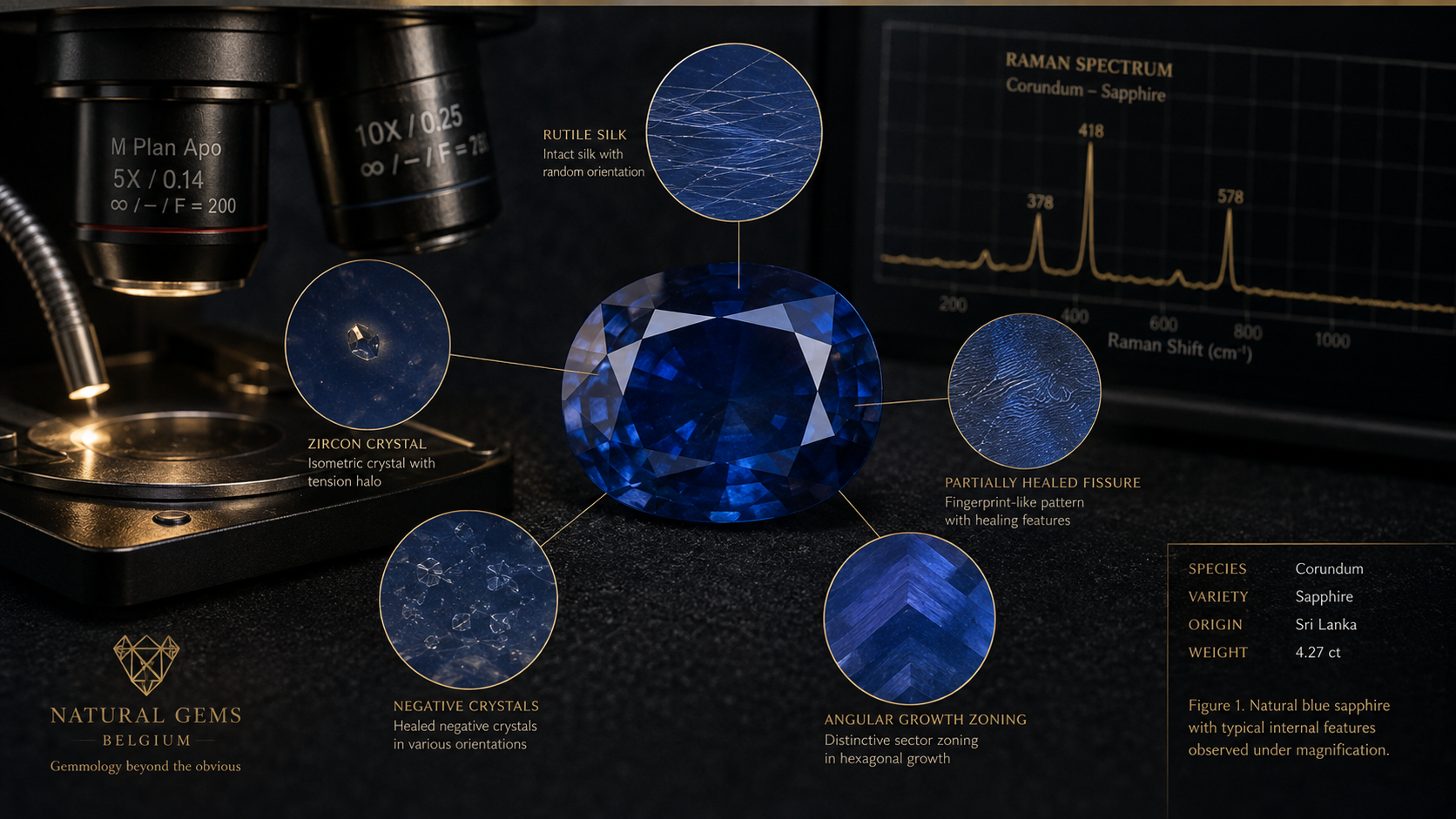
Among the most famous sapphire inclusions are extremely fine needles of rutile, TiO₂.
When present in large numbers, these needles are commonly called:
silk
Rutile can occur as:
- isolated needles;
- parallel groups;
- intersecting networks;
- dense clouds;
- short particles;
- oriented bands.
The needles are not arranged randomly.
Their orientation reflects the crystallographic structure of the corundum host.
This is why silk can form geometrically organised patterns.
6. Exsolution: How Some Rutile Silk Forms
Not every rutile inclusion existed as a separate crystal when the sapphire first formed.
Titanium may initially be incorporated into the corundum crystal lattice.
As geological conditions change, particularly during cooling, some titanium can become less soluble in corundum.
It can separate from the host and form microscopic rutile.
This process is known as:
exsolution
The resulting rutile follows crystallographically favourable directions.
That relationship between host crystal and exsolved mineral explains the highly organised silk patterns found in many sapphires.
7. Silk Can Affect Appearance
Rutile silk is not merely an identification feature.
It can influence the sapphire’s visual appearance.
Fine dispersed silk can scatter light and produce a soft, velvety appearance.
Depending on density and orientation, silk can influence:
- transparency;
- brilliance;
- apparent colour;
- visual texture.
Therefore, the simplistic idea that every inclusion lowers gemstone quality is incorrect.
In some fine sapphires, subtle silk contributes positively to their visual character.
8. Rutile and Asterism
When sufficiently dense oriented rutile or other reflective needle-like inclusions occur in corundum, they can create:
asterism
— the star effect seen in star sapphire and star ruby.
Light reflects from oriented inclusion systems.
When the material is correctly oriented and cut as a cabochon, these reflections can form intersecting rays.
A six-rayed star is common in corundum because of its crystallographic symmetry.
This phenomenon demonstrates an important principle:
An inclusion can create the gemstone’s most valuable optical feature rather than detract from it.
9. Rutile Silk and Heat Treatment
Rutile is also one of the most important inclusion types for treatment investigation.
During sufficiently high-temperature heating, rutile can begin to dissolve.
The needles may become:
- broken;
- dotted;
- interrupted;
- partially dissolved;
- irregular.
At still higher temperatures they may disappear substantially.
Titanium released from rutile can enter the surrounding corundum lattice and contribute to colour-producing reactions.
Consequently, altered silk can provide important evidence of high-temperature heat treatment.
However:
intact silk does not automatically prove that a sapphire is unheated.
Low-temperature treatment may leave rutile visually unchanged.
10. Zircon: A Tiny Mineral with a Remarkable Story
Zircon — ZrSiO₄ — is one of the most important mineral inclusions encountered in sapphire.
It can appear as:
- transparent crystals;
- rounded crystals;
- elongated crystals;
- clusters;
- groups associated with other minerals.
Zircon is particularly valuable because it can provide information about:
- geological formation;
- treatment;
- and, in specialised scientific research, geological age.
Its significance extends far beyond visual identification.
11. Zircon and Natural Radiation Damage
Natural zircon commonly contains small quantities of radioactive uranium and thorium.
Over immense geological periods, radioactive decay can damage its crystal structure.
This process is known as:
metamictisation
A zircon inclusion may therefore preserve evidence of both its own history and the history of the sapphire enclosing it.
The degree of radiation damage can also influence how zircon responds when the sapphire is subsequently heated.
12. Zircon Can Develop Tension Halos
Zircon and corundum respond differently to changes in temperature and pressure.
Stress around an included zircon may create fractures in the surrounding sapphire.
These can appear as:
- tension halos;
- discoid fractures;
- fracture systems surrounding the crystal.
Such features can be natural.
They can also be modified or expanded by heat treatment.
Therefore, the mere presence of a fracture around zircon should not automatically be interpreted as treatment.
Its morphology and surrounding evidence matter.
13. What High-Temperature Heating Does to Zircon
Controlled GIA experiments on zircon-bearing Madagascar sapphire demonstrated a progressive reaction between zircon and its corundum host at high temperatures.
Changes began in some zircon inclusions at approximately 1400°C.
Zircon can decompose into phases including:
- baddeleyite — ZrO₂;
- silica-rich material.
At approximately 1600°C and above, experiments produced melting of zircon and interaction with the surrounding sapphire.
The resulting inclusion can look dramatically different from an intact natural zircon.
This reaction sequence can provide evidence not only that heating occurred but sometimes an approximate indication of the thermal conditions involved.
14. Heat-Altered Zircon Can Become Visually Distinctive
Strongly heated zircon may develop:
- frosted surfaces;
- partially melted appearances;
- surrounding glassy material;
- expanded fractures;
- recrystallised reaction zones.
Recent GIA observations continue to document striking examples of severely altered zircon in high-temperature-treated sapphire.
These scenes can be visually spectacular.
But their scientific importance is greater than their beauty.
They preserve evidence of an artificial thermal event inside the gemstone.
15. Mica Inclusions
Mica is another inclusion encountered in natural sapphire.
Different mica-group minerals may occur depending on geological environment.
They can appear as:
- thin platelets;
- tabular crystals;
- transparent or pale-coloured flakes.
Mica inclusions have been documented in sapphires from several deposits, including Sri Lanka and Myanmar.
Their presence can contribute geological information.
But mica alone does not prove a geographic origin because similar minerals occur in sapphire from multiple localities.
16. Feldspar, Spinel, Ilmenite and Other Minerals
Natural sapphire can contain an extraordinary range of mineral inclusions.
Documented examples include:
- feldspar;
- spinel;
- ilmenite;
- hematite;
- zircon;
- apatite;
- monazite;
- calcite;
- pyrite;
- graphite;
- rutile;
- mica;
- clinozoisite.
The exact assemblage depends on the geological environment.
For gemmologists, the combination of minerals may be more informative than one inclusion considered in isolation.
This is analogous to geological fieldwork.
One mineral can occur in many environments.
An assemblage provides context.
17. Raman Spectroscopy: Giving an Inclusion a Name
Many microscopic crystals cannot be identified reliably by appearance alone.
This is where Raman spectroscopy becomes extremely valuable.
A laser is focused on the inclusion.
The scattered light contains a spectral pattern related to the mineral’s molecular or crystal vibrations.
That spectrum can be compared with reference data.
Instead of saying:
“This looks like zircon.”
a laboratory may be able to establish:
“The Raman spectrum is consistent with zircon.”
This substantially strengthens the interpretation.
18. Negative Crystals
One of the most confusing inclusion terms is:
negative crystal
A negative crystal is not a “negative gemstone.”
It is a cavity whose shape reflects the crystallographic structure of the host crystal.
The cavity may contain:
- fluid;
- gas;
- multiple phases.
Because the cavity can mimic the geometry of the surrounding sapphire, it may resemble a tiny crystal despite being a void.
Negative crystals can preserve valuable information about fluids and geological conditions.
19. Fluid Inclusions
Fluids can become trapped during crystal growth or during later healing processes.
A fluid inclusion can contain:
- liquid;
- gas;
- dissolved material;
- daughter minerals.
Some sapphire inclusions contain carbon dioxide.
CO₂-bearing negative crystals have been documented in metamorphic sapphires, including material from Sri Lanka.
Fluid inclusions can provide mineralogists with information about the environment in which the crystal or associated fracture developed.
They are microscopic samples of ancient geological fluids.
20. Fingerprints: Fractures That Healed
One of the most beautiful inclusion scenes in gemstones is the:
fingerprint
A fingerprint is generally a partially healed fracture.
A fracture once opened inside or through the sapphire.
Later geological conditions allowed parts of that fracture to heal.
Small cavities or fluid-filled structures remained behind.
The result can resemble:
- fingerprints;
- feathers;
- networks;
- geometric films;
- brush strokes.
These are not simply cracks.
They record a process:
fracture → fluid interaction → partial healing
21. Why Fingerprints Can Become Iridescent
Some partially healed fissures show vivid rainbow colours.
This can occur through thin-film interference.
When a very thin fluid-filled or open layer has the appropriate thickness, light reflecting from its boundaries interferes.
Different wavelengths reinforce or cancel one another.
The result can be:
- red;
- green;
- blue;
- violet;
- rainbow gradations.
GIA has documented spectacular examples in untreated Sri Lankan sapphire.
This optical effect is physical interference—not pigment or artificial colouring.
22. Zigzag Fingerprints
Some Sri Lankan sapphires contain particularly distinctive rectilinear or zigzag-patterned fingerprints.
These patterns reflect the relationship between fracture healing and corundum crystallography.
Such features can be suggestive of Sri Lankan origin.
But that word is essential:
suggestive
not
proof.
Origin determination requires multiple lines of evidence.
23. Growth Zoning
Not every important internal feature is a foreign inclusion.
Sapphire can preserve visible growth structures.
One of the most common is:
colour zoning
Successive growth stages may contain different concentrations of colour-producing trace elements.
This can produce:
- blue and colourless bands;
- angular zoning;
- straight zones;
- diffuse boundaries;
- hexagonal or geometric patterns.
Growth zoning records changes in the chemical environment during crystal formation.
24. Growth Zoning Can Help Separate Geological Populations
Different sapphire populations can show characteristic zoning tendencies.
For example, Sri Lankan sapphires often show straight alternating blue and colourless zones with relatively sharp boundaries.
Some Burmese sapphires can show more diffuse transitions.
Basalt-related sapphires may display other characteristic growth and particle structures.
But again, overlap exists.
Zoning contributes evidence.
It should not be converted into an absolute geographic rule.
25. Twinning
Corundum can also show:
twinning
A twin occurs when two regions of a crystal are related by a specific crystallographic orientation.
Under appropriate illumination or crossed polarisers, twin planes or sectors may become visible.
Twinning can interact with:
- growth structures;
- inclusions;
- fractures.
In some sapphire populations, characteristic twinning patterns contribute useful identification or origin information.
But twinning is not unique to one locality.
26. Particle Clouds
Very small particles can form clouds within sapphire.
These may appear:
- milky;
- hazy;
- geometric;
- banded;
- diffuse.
Particle clouds can contain rutile or other mineral phases.
Their density and arrangement can affect:
- transparency;
- light scattering;
- colour distribution.
The overall appearance of clouds and silk is particularly important in geographic-origin work on metamorphic blue sapphire.
27. Inclusion Assemblages Can Reveal Geological Environment
The mineral inclusions inside sapphire were once part of a geological system.
Their identities can therefore help reconstruct that environment.
For example, an assemblage involving certain metamorphic minerals may support formation in a metamorphic host.
Other inclusion associations may support magmatic or basalt-related geological settings.
This is why inclusion analysis belongs not only to gemmology but also to mineralogy and petrology.
The gemstone becomes a tiny geological sample.
28. Inclusions Can Even Help Date Sapphire Formation
Zircon contains uranium and can be dated using the uranium-lead system.
Researchers have analysed zircon inclusions enclosed within sapphire using U-Pb geochronology.
A study of sapphires from Ratnapura and Balangoda in Sri Lanka obtained zircon ages of approximately 549 million years from selected inclusions.
The interpretation suggested a relationship with a high-temperature geological event associated with late Precambrian metamorphism.
This is an extraordinary example of what an inclusion can preserve.
A microscopic zircon trapped inside a sapphire can function as a geological clock.
29. Inclusions and Natural-versus-Synthetic Identification
Inclusions can also help distinguish natural sapphire from laboratory-grown corundum.
Synthetic sapphire can be produced by several methods, including:
- flame fusion;
- flux growth;
- hydrothermal-related experimental methods;
- Czochralski and other crystal-growth techniques.
Each growth environment can create characteristic internal features.
For example, flame-fusion synthetic corundum may show:
- curved growth structures;
- gas bubbles.
Flux-grown synthetic corundum may contain:
- flux residues;
- characteristic growth features.
However, synthetic materials have become increasingly sophisticated.
No single simplistic visual rule should replace complete gemmological examination.
30. Natural-Looking Features Can Occur in Synthetic Corundum
This is another reason expertise matters.
Synthetic corundum can sometimes contain features that superficially resemble natural inclusions.
Manufacturing methods can also be combined or modified.
GIA has documented synthetic corundum involving both flame-fusion material and flux-grown overgrowth.
A stone can therefore present a more complicated inclusion scene than a textbook example.
Professional identification considers the entire growth environment rather than searching for one “magic inclusion.”
31. Inclusions and Heat Treatment
As explained in the NGB Learning Center article on sapphire heat treatment, heating can alter inclusions.
Possible changes include:
- rutile dissolution;
- zircon decomposition;
- fracture expansion;
- mineral recrystallisation;
- changed colour of some included minerals;
- modified residues in surface-reaching fissures.
These features can provide evidence of treatment.
But the response depends strongly on temperature.
Low-temperature heating may leave many inclusions almost unchanged. Controlled GIA experiments on Madagascar pink sapphire found that most zircon, particles, needles and several other inclusion types showed little visual alteration after treatment at 800°C for 160 minutes.
Therefore:
A natural-looking inclusion scene is not absolute proof of an unheated sapphire.
32. Inclusions and Geographic Origin
Geographic origin is one of the most commercially significant—and scientifically difficult—applications of sapphire inclusion analysis.
Laboratories may be asked whether a sapphire is consistent with origin from locations such as:
- Sri Lanka;
- Myanmar;
- Kashmir;
- Madagascar;
- Thailand;
- Cambodia;
- Australia;
- Ethiopia;
- Montana;
- other deposits.
Inclusions are an important part of this work.
But geographic origin determination is fundamentally a comparative scientific interpretation, not a visual guessing exercise.
33. Why No Single Inclusion Usually Proves Origin
Suppose a sapphire contains zircon.
Zircon occurs in sapphire from many regions.
Suppose it contains rutile silk.
Rutile occurs in sapphire from many regions.
Suppose it contains mica.
Again, mica occurs in several deposits.
The important evidence may lie in:
- morphology;
- abundance;
- association;
- orientation;
- overall inclusion scene;
- trace-element chemistry;
- spectroscopy.
A feature may be consistent with or suggestive of an origin without being diagnostic.
This language distinction is fundamental.
34. The Sri Lankan Inclusion Scene
Sri Lankan blue sapphires can show features including:
- long fine rutile silk;
- rectilinear partially healed fractures;
- CO₂-bearing negative crystals;
- mica;
- zircon;
- pyrite;
- calcite;
- spinel;
- sharp blue-to-colourless zoning.
Some Sri Lankan sapphires display exceptionally long individual rutile needles.
Rectilinear zigzag fingerprints can also be suggestive.
Yet many of these features occur elsewhere.
Professional laboratories therefore combine them with chemistry and spectroscopy.
35. Myanmar Sapphire
Blue sapphire from Myanmar’s Mogok region can contain:
- silk in several forms;
- twin planes;
- fingerprints;
- mica;
- feldspar;
- rarer mineral inclusions.
GIA research indicates that the appearance of silk, twinning and fingerprints can contribute to a Burmese interpretation.
But individual crystal inclusions are generally not conclusive by themselves.
Again, the inclusion scene matters more than a single mineral name.
36. Kashmir Sapphire and the Meaning of “Velvety”
Fine Kashmir sapphire is famous for a soft, velvety visual appearance.
Microscopic particles and silk can contribute to this light-scattering effect.
Certain inclusion features may support Kashmir origin.
But the enormous commercial premium associated with Kashmir sapphire makes careless origin attribution particularly dangerous.
A “velvety” appearance does not prove Kashmir origin.
Neither does one apparently characteristic inclusion.
High-value origin determination requires specialised laboratory comparison.
37. Basalt-Related Sapphire
Sapphires associated with alkali basalt occur in multiple parts of the world.
Examples include deposits in:
- Australia;
- Thailand;
- Cambodia;
- Nigeria;
- Ethiopia;
- other volcanic provinces.
Their inclusion scenes can include:
- particle clouds;
- rutile;
- iron-rich particles;
- characteristic zoning or twinning in some populations.
But substantial overlap occurs among basalt-related deposits.
The discovery of new deposits can also challenge older assumptions about supposedly diagnostic inclusions.
38. Ethiopia: Why New Deposits Change Gemmological Knowledge
The emergence of Ethiopian sapphire provides a valuable lesson.
Certain Ethiopian sapphires contain clusters of small euhedral zircon crystals associated with monazite.
Such zircon clusters are unusual among many other basalt-related sapphire sources and can contribute useful origin evidence.
But the broader lesson is more important.
Every newly documented deposit expands the comparison database.
A feature once considered highly unusual—or even diagnostic—may later be found somewhere else.
Gemological origin criteria must therefore evolve with new field research.
39. Montana Sapphire: A Complex Inclusion Record
Montana sapphires have been extensively studied.
Documented inclusions include:
- rutile;
- zircon;
- clinozoisite;
- mica;
- feldspar;
- negative crystals;
- glassy melt inclusions;
- other minerals.
Some Montana sapphire contains remarkable melt inclusions that preserve evidence of silicic melt and volatile exsolution.
Such inclusions contribute to scientific discussions about sapphire genesis.
Again, inclusions are not merely identification marks.
They are geological evidence.
40. Melt Inclusions
Some sapphire contains microscopic remnants of melt trapped during geological processes.
These may contain:
- silicate glass;
- gas bubbles;
- multiple phases.
GIA research on Montana sapphire has documented glassy melt inclusions with associated discoid fractures.
These microscopic structures preserve evidence of magmatic or metasomatic processes associated with the sapphire’s history.
They provide a direct connection between gemmology and experimental petrology.
41. Origin Determination Requires Three Major Evidence Families
Modern laboratory origin determination for blue sapphire typically combines three broad categories.
1. Microscopic Evidence
Including:
- mineral inclusions;
- silk;
- clouds;
- fingerprints;
- zoning;
- twinning.
2. Trace-Element Chemistry
Measured using methods such as:
LA-ICP-MS
— laser ablation inductively coupled plasma mass spectrometry.
3. Spectroscopy
Including techniques such as:
- UV-Vis-NIR;
- FTIR.
The strongest origin conclusions occur when these independent evidence sets converge.
GIA explicitly describes reliable blue-sapphire origin determination as requiring careful analysis of inclusions, trace-element chemistry and spectroscopic data.
42. Why Geographic Origin Can Remain Inconclusive
Even a sophisticated laboratory cannot always assign a sapphire to one geographic locality.
Different deposits may overlap in:
- inclusions;
- chemistry;
- spectra.
Heating can also destroy or modify some of the most useful inclusion evidence.
A responsible laboratory may therefore conclude that geographic origin is:
inconclusive
rather than force an unsupported answer.
That is not analytical failure.
It is scientifically appropriate recognition of the limits of available evidence.
43. Heating Can Make Origin Determination Harder
High-temperature treatment can alter:
- silk;
- zircon;
- other mineral inclusions;
- internal structures.
These may have provided useful geographic information before treatment.
Once modified, part of that geological record becomes more difficult to interpret.
This is one reason heated sapphire can sometimes present a greater origin-determination challenge than comparable unheated material.
Treatment can partially overwrite the microscopic archive.
44. Inclusions and Clarity Grading Are Not the Same Question
Commercial clarity assessment asks questions such as:
- How visible is the inclusion?
- Does it affect transparency?
- Does it reduce beauty?
- Does it threaten durability?
Gemological sapphire inclusions interpretation asks different questions:
- What is it?
- How did it form?
- When did it form?
- Has it been altered?
- What does it reveal about the host?
An inclusion can therefore be:
commercially undesirable but scientifically valuable
or
visually attractive and scientifically valuable.
The two evaluations should not be confused.
45. When an Inclusion Becomes a Durability Concern
Not every inclusion is structurally harmless.
Particular attention should be paid to:
- large surface-reaching fractures;
- open fissures;
- fractures around mineral inclusions;
- inclusions positioned near vulnerable girdle areas.
A small enclosed crystal may have almost no durability consequence.
A large surface-reaching fracture can be much more important.
This distinction matters for:
- faceting;
- setting;
- jewellery wear;
- ultrasonic cleaning decisions.
Inclusion type, position and structural relationship matter more than simply counting visible features.
46. Inclusions and Faceting Decisions
For the faceter, inclusions create practical decisions.
A cutter may need to decide whether to:
- retain an inclusion;
- remove it;
- place it near the girdle;
- orient it beneath the pavilion;
- divide the rough;
- change the design.
Removing every inclusion can destroy unnecessary weight.
Keeping a dangerous fracture can jeopardise the finished stone.
Professional rough evaluation therefore treats inclusions according to:
optical impact + structural risk + yield cost
rather than applying a blanket rule.
47. Photomicrography: Recording the Internal World
Modern gemmological photomicrography allows inclusions to be documented at exceptional detail.
A high-quality inclusion photograph can preserve:
- morphology;
- lighting response;
- spatial relationships;
- treatment evidence.
Photomicrography is valuable for:
- research;
- education;
- laboratory records;
- before-and-after treatment experiments.
It has also revealed that the microscopic interior of gemstones can possess extraordinary aesthetic beauty.
Scientific evidence and natural art can exist in the same image.
48. Common Misconceptions About Sapphire Inclusions
Myth 1 — “Inclusions Mean the Sapphire Is Low Quality”
Incorrect.
Their effect depends on visibility, position, type and structural significance. Fine silk can even contribute positively to appearance.
Myth 2 — “A Natural Inclusion Proves the Sapphire Is Unheated”
Incorrect.
Natural inclusions can survive heat treatment, especially at lower temperatures.
Myth 3 — “Zircon Means Sri Lanka”
Incorrect.
Zircon occurs in sapphire from numerous deposits.
Myth 4 — “A Fingerprint Proves Natural Origin”
Too simplistic.
Fingerprint-like structures must be interpreted within the complete growth and inclusion scene.
Myth 5 — “No Inclusions Means Synthetic”
Incorrect.
Some natural sapphires can be very clean.
Myth 6 — “One Special Inclusion Can Always Prove Geographic Origin”
Incorrect.
Most origin determinations require converging microscopic, chemical and spectroscopic evidence.
Myth 7 — “Every Needle in Sapphire Is Rutile”
Incorrect.
Needle-like inclusions can consist of different minerals. Analytical identification may be necessary.
49. Evidence Classification
| Statement | Classification |
|---|---|
| Natural sapphire can contain solid, fluid and multiphase inclusions | Established gemmological fact |
| Rutile silk commonly occurs in natural sapphire | Established gemmological fact |
| Oriented inclusions can produce asterism | Established optical and gemmological fact |
| Zircon is a documented inclusion in sapphire from multiple deposits | Established mineralogical fact |
| Zircon inclusions can be altered by high-temperature heat treatment | Established experimental fact |
| Some zircon inclusions in sapphire can be U-Pb dated | Established geochronological method |
| Partially healed fissures can form fingerprint-like patterns | Established gemmological fact |
| Some fingerprints can show thin-film interference colours | Established optical phenomenon |
| Inclusions can contribute to geographic-origin determination | Established laboratory practice |
| One inclusion usually proves a sapphire’s country of origin | Incorrect |
| Intact rutile proves absence of heat treatment | Incorrect |
| Every inclusion lowers gemstone quality | Incorrect |
| Absence of inclusions proves synthetic origin | Incorrect |
| Geographic origin can always be determined | Incorrect |
50. A Professional Framework for Reading Sapphire Inclusions
When examining an inclusion, ask the questions in this order.
What Is the Feature?
Mineral, fluid, cavity, fracture, growth structure or particle?
What Is Its Morphology?
Needle, crystal, plate, cloud, cavity, film or healed network?
How Is It Oriented?
Randomly or crystallographically controlled?
What Is It Associated With?
Fractures, colour zoning, other minerals, particles or growth bands?
Can It Be Identified Analytically?
Would Raman spectroscopy or another technique strengthen the identification?
Does It Show Alteration?
Is there evidence of melting, dissolution, recrystallisation or fracture expansion?
What Does It Actually Support?
Natural origin?
Treatment?
Geological environment?
Possible geographic origin?
What Does It Not Prove?
This final question is one of the most important in professional gemmology.
Good identification depends as much on recognising the limits of evidence as on recognising the evidence itself.
Conclusion
The microscopic interior of sapphire is not random debris trapped inside a beautiful crystal.
It is an archive.
Rutile silk can record exsolution and crystallographic orientation.
Zircon can preserve geological history and, in exceptional scientific studies, provide an age for events associated with sapphire formation.
Negative crystals can contain remnants of ancient fluids.
Fingerprints record fractures that opened and partially healed.
Colour zoning preserves changing conditions during crystal growth.
Mineral assemblages can reveal aspects of the geological environment.
Heat treatment can partially rewrite this archive by dissolving rutile, altering zircon and modifying other inclusions.
And professional laboratories can use the surviving evidence—together with spectroscopy and trace-element chemistry—to investigate geographic origin.
But the most important lesson is methodological.
An inclusion is evidence, not a verdict.
Rutile does not automatically mean unheated.
Zircon does not automatically mean Sri Lanka.
A fingerprint does not automatically identify a natural stone.
A beautiful velvety appearance does not automatically mean Kashmir.
Professional gemmology works by convergence.
Microscopy establishes what can be observed.
Raman spectroscopy can establish what a mineral inclusion actually is.
FTIR and UV-Vis-NIR reveal aspects of the stone’s interaction with radiation.
Trace-element analysis examines its chemistry.
Reference collections establish whether the combined evidence is consistent with known geological populations.
The best interpretation emerges when those independent observations tell the same story.
Seen this way, inclusions stop being “imperfections.”
They become what they have always been:
microscopic witnesses to the history of the sapphire.
References & Further Reading
Renfro, N. D., Koivula, J. I., Muyal, J., McClure, S. F., Schumacher, K. & Shigley, J. E. — “Chart: Inclusions in Natural, Synthetic, and Treated Sapphire.” Gems & Gemology, Summer 2017, Gemological Institute of America.
An extensive visual and gemmological reference to micro-features found in natural, synthetic and treated sapphire, and an excellent foundation for systematic inclusion study.
https://www.gia.edu/gems-gemology/summer-2017-inclusions-sapphire
Palke, A. C., Saeseaw, S., Renfro, N. D., Sun, Z. & McClure, S. F. — “Geographic Origin Determination of Blue Sapphire.” Gems & Gemology, Winter 2019, Gemological Institute of America.
A cornerstone reference explaining how professional laboratories integrate inclusion scenes, trace-element chemistry and spectroscopy, and why substantial overlap between sapphire deposits makes simplistic origin rules unreliable.
https://www.gia.edu/gems-gemology/winter-2019-blue-sapphire-geographic-origin-determination
Wang, W., Scarratt, K., Emmett, J. L., Breeding, C. M. & Douthit, T. R. — “The Effects of Heat Treatment on Zircon Inclusions in Madagascar Sapphires.” Gems & Gemology, Summer 2006, Gemological Institute of America.
Controlled experimental study documenting progressive decomposition of zircon between approximately 1400°C and 1850°C and demonstrating how altered zircon can provide evidence of sapphire heat treatment.
https://origin.prod.gia.edu/gems-gemology/summer-2006-heat-treatment-zircon-inclusions-sapphires-wang
Elmaleh, E., Schmidt, S. T., Karampelas, S., Link, K., Kiefert, L., Süssenberger, A. & Paul, A. — “U-Pb Ages of Zircon Inclusions in Sapphires from Ratnapura and Balangoda (Sri Lanka) and Implications for Geographic Origin.” Gems & Gemology, Spring 2019, Gemological Institute of America.
Research demonstrating how zircon inclusions can provide geochronological evidence; selected zircons in Sri Lankan sapphires yielded ages around 549 Ma and contributed to interpretation of their metamorphic geological history.
https://www.gia.edu/gems-gemology/spring-2019-u-pb-ages-of-zircon-inclusions-in-sapphires-from-ratnapura-and-balangoda
Zwaan, J. C., Buter, E., Mertz-Kraus, R. & Kane, R. E. — “Alluvial Sapphires from Montana: Inclusions, Geochemistry, and Indications of a Metasomatic Origin.” Gems & Gemology, Winter 2015, Gemological Institute of America.
Detailed investigation of Montana sapphire inclusions and trace-element chemistry, including rutile, negative crystals and other mineral phases, illustrating how inclusion assemblages contribute to genetic interpretation.
https://www.gia.edu/gems-gemology/winter-2015-alluvial-sapphires-montana-inclusions-geochemistry-indications-metasomatic-origin
Khowpong, C. — “Zircon Cluster in Ethiopian Sapphire.” Gems & Gemology, Winter 2018, Gemological Institute of America.
A concise example of how an unusual inclusion assemblage—clusters of euhedral zircon associated with monazite—can provide useful supporting evidence when separating sapphire populations, while remaining part of a broader analytical interpretation.
https://www.gia.edu/gems-gemology/winter-2018-microworld-zircon-cluster-in-ethiopian-sapphire
Otsuka, K. & Saruwatari, K. — “Rainbow-Colored Partially Healed Fissure in Blue Sapphire.” Gems & Gemology, Fall 2024, Gemological Institute of America.
A recent photomicrographic example of an untreated Sri Lankan sapphire containing an iridescent partially healed fissure, with an explanation of fingerprint formation and thin-film interference.
https://www.gia.edu/gems-gemology/fall-2024-microworld-rainbow-fissure-in-sapphire0
Saeseaw, S., Khowpong, C. & Vertriest, W. — “Low-Temperature Heat Treatment of Pink Sapphires from Ilakaka, Madagascar.” Gems & Gemology, Winter 2020, Gemological Institute of America.
Essential evidence for understanding why intact-looking inclusions cannot automatically prove absence of heating. Controlled experiments found that many zircon crystals, needles and particles remained visually little changed after low-temperature treatment, while analytical evidence could reveal treatment.
https://www.gia.edu/gems-gemology/winter-2020-ilakaka-pink-sapphires-heat-treatment
Okada, T. — “‘Sugar Plum’ in Titanium-Diffused Blue Sapphire.” Gems & Gemology, Summer 2025, Gemological Institute of America.
A recent example of dramatically heat-altered zircon in titanium-diffused sapphire, demonstrating how high-temperature treatment can transform an originally natural mineral inclusion into a highly distinctive microscopic reaction structure.
https://www.gia.edu/gems-gemology/summer-2025-microworld-sugar-plum-in-diffused-sapphire
Miura, M. & Katsurada, Y. — “Remarkably Large Iridescent Healed Fissures Resembling Play-of-Color in Sapphire.” Gems & Gemology, Spring 2021, Gemological Institute of America.
An excellent visual reference for healed fissures and their optical behaviour, while also documenting heat-related internal features in sapphire.
https://www.gia.edu/gems-gemology/spring-2021-microworld-iridescent-healed-fissures-resembling-play-of-color-in-sapphire