Table of Contents
When a Natural Stone Became Part of a Sacred Tradition
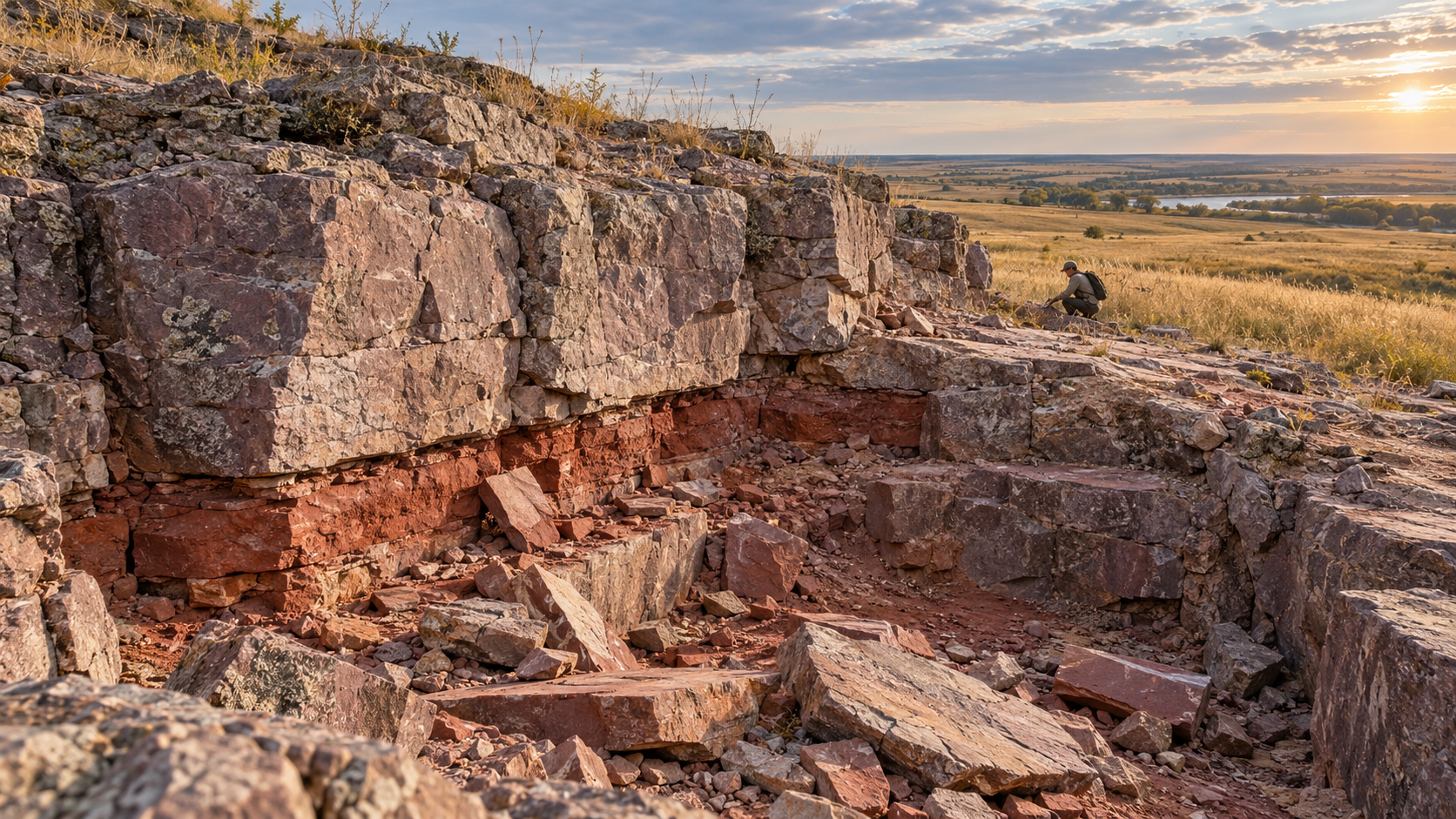
Across the prairie landscape of southwestern Minnesota lies a remarkable geological formation.
Layers of exceptionally hard quartzite surround a much softer red stone.
The contrast is extraordinary.
The surrounding rock is difficult to break.
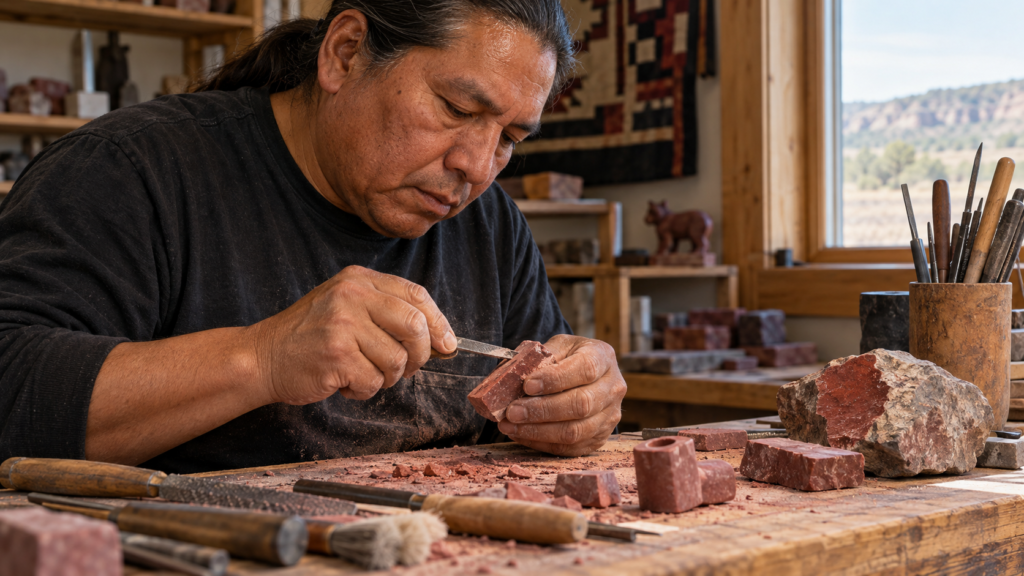
The red material can be carved using comparatively simple tools.
For thousands of years, Indigenous peoples have travelled to this landscape to obtain the stone.
They have transformed it into objects of considerable cultural and spiritual significance.
Among the most important are ceremonial pipes.
These objects participate in traditions of prayer, responsibility, relationships and sacred communication.
The stone is commonly known as pipestone.
The distinctive material from the historic Minnesota quarries is also called catlinite.
Unlike many gemstones whose ancient spiritual associations are reconstructed primarily from archaeological evidence, the significance of pipestone is documented through Indigenous oral histories and continuing cultural practices.
Its importance cannot be understood through mineralogy alone.
It requires attention to the people who have quarried it, the traditions through which it has acquired meaning and the continuing relationship between Indigenous communities and the land.
The history of sacred pipestone demonstrates that a natural stone can possess profound religious significance without its supernatural properties being scientifically measurable.
This distinction is fundamental to understanding the relationship between gemstones, minerals and human spirituality.
Pipestone National Monument: A Sacred Landscape
Pipestone National Monument is situated near the city of Pipestone in southwestern Minnesota, United States.
The landscape forms part of the Coteau des Prairies region.
It contains ancient rock formations, tallgrass prairie and historically important quarry sites.
The National Park Service identifies the quarries as a place of cultural and spiritual importance to numerous Indigenous nations.
Archaeological evidence indicates that people have used the quarries for approximately 3,000 years.
The quarrying tradition continues today.
This continuity makes the site particularly significant.
It is not simply an abandoned archaeological location.
It remains a living cultural landscape.
Indigenous people continue to visit, quarry stone and maintain traditions connected with the site.
The National Park Service works with 23 affiliated Tribal Nations through formal consultation.
Their relationships with the landscape are not identical.
Each nation possesses its own history, traditions and perspectives.
Understanding this diversity is essential.
What Is Pipestone?
Pipestone is a general term applied to relatively soft stone suitable for carving pipes.
Different geological materials have been used for this purpose in North America.
They do not necessarily share the same mineral composition.
The distinctive red material from Pipestone National Monument is known as catlinite.
Catlinite is a fine-grained claystone or argillite.
It is a rock rather than an individual mineral species.
This distinction is important.
A mineral possesses a defined chemical composition and crystal structure.
A rock may consist of several different minerals.
Catlinite contains a mixture of microscopic mineral constituents.
According to the National Park Service, its principal components include:
Pyrophyllite.
Diaspore.
Muscovite.
Kaolinite.
Small quantities of iron-bearing minerals contribute to its characteristic red colour.
Hematite is particularly important in this respect.
The mineral composition explains many of the material’s physical characteristics.
Its cultural importance, however, belongs to a different field of investigation.
Why Is Pipestone Red?
The characteristic colour of catlinite ranges from muted pinkish-red to deeper brick red.
Some material displays subtle mottling.
Other pieces appear relatively uniform.
The red colour is associated with iron-bearing mineral constituents.
Hematite, an iron oxide with the chemical formula Fe₂O₃, contributes to the coloration.
This is a scientifically established explanation.
The colour results from the material’s natural chemistry and geological history.
However, the red appearance has also acquired cultural meanings.
Some Indigenous oral traditions associate the stone with ancestral blood or the substance of the people.
These interpretations belong to specific religious and cultural frameworks.
They should not be confused with the geological explanation.
Science can explain why the stone is red. Cultural tradition explains why that redness may possess sacred meaning.
Both forms of understanding concern the same material, but they answer different questions.
The Geological Formation of Catlinite
The geology of Pipestone National Monument is remarkable.
The red stone occurs between much thicker layers of Sioux Quartzite.
The original sediments accumulated approximately 1.6 billion years ago.
Ancient river systems deposited enormous quantities of sand across the region.
At certain intervals, finer clay-rich material accumulated.
Subsequent burial, pressure and geological alteration transformed these sediments into rock.
The sand-rich layers became exceptionally hard quartzite.
The clay-rich layers became the softer material now identified as pipestone.
The resulting geological structure contains an extraordinary contrast.
Hard quartzite surrounds comparatively soft catlinite.
This relationship determined how the material could be extracted.
It also influenced the development of the quarrying tradition.
Why Is Catlinite So Easy to Carve?
The National Park Service reports that catlinite has a hardness of approximately 2.5 on the Mohs scale.
This is comparable to the hardness of a human fingernail.
By contrast, the surrounding Sioux Quartzite is much harder.
Its quartz-rich composition makes it exceptionally resistant to abrasion.
Catlinite contains relatively little quartz.
This contributes to its softness.
Its fine-grained texture also allows artisans to produce detailed carved surfaces.
These characteristics made the stone suitable for pipe bowls and other objects.
The material could be shaped using hand tools.
It could also be polished.
The combination of softness and adequate durability made it particularly attractive for specialised craftsmanship.
However, the ease of carving should not be confused with ease of extraction.
Obtaining the stone from the ground could require extraordinary physical effort.
The Difficulty of Quarrying Sacred Stone
The pipestone layer lies beneath much harder rock.
To reach it, quarriers must remove the overlying quartzite.
This work is physically demanding.
The National Park Service documents how quarrying can require weeks, months or even years of effort.
The process involves breaking and removing substantial quantities of hard rock.
Traditional hand methods remain important.
Modern quarrying within the monument continues to operate under restrictions designed to preserve the cultural and geological resource.
The work demands patience and considerable commitment.
For many Indigenous quarriers, this effort possesses significance beyond obtaining a useful material.
The National Park Service documents that quarrying itself can be understood as a spiritual activity.
The relationship with the stone begins before the finished object is created.
It begins with the landscape and the work required to obtain the material.
A Sacred Place Shared by Different Nations
The quarries have historical connections with numerous Indigenous peoples.
The National Park Service identifies traditions associated with the Dakota, Lakota, Omaha, Ponca, Otoe-Missouria, Mandan and other nations.
These communities did not necessarily share identical religious interpretations.
Some traditions emphasise the origin of the stone.
Others concern the sacred pipe.
Still others focus on relationships between peoples and the responsibilities associated with quarrying.
Historical accounts describe the quarries as a place where different groups could gather.
Certain traditions portray the location as neutral ground where weapons were set aside.
However, such accounts should not be interpreted as proof that conflict never occurred.
The history of the region also includes competition over access and political disputes.
The sacred importance of the landscape existed within a complex human history.
The Ihanktonwan Dakota and the Pipestone Quarries
The Ihanktonwan Dakota, also known as the Yankton Dakota, possess a particularly important historical relationship with the quarries.
By the eighteenth century, Dakota peoples had become prominent in the region.
The Ihanktonwan maintained strong connections with the pipestone landscape.
These relationships were recognised during nineteenth-century negotiations with the United States government.
The National Park Service documents the importance of the quarries to Ihanktonwan political leaders.
For them, access to the stone was not simply an economic matter.
It concerned the continuation of cultural and religious traditions.
This became especially important during the period of territorial dispossession and forced relocation.
The Sacred Origin of Red Pipestone
Some Indigenous oral traditions explain the red colour of pipestone through accounts involving ancestors and sacred beings.
The National Park Service preserves several historical versions of these narratives.
One account recorded by the nineteenth-century artist George Catlin describes a sacred being gathering different peoples at the quarries.
The stone is connected with the substance of the people and the importance of peaceful relationships.
Another account associated with the Ihanktonwan Dakota describes the redness of the landscape through a narrative involving buffalo and sacred creation.
These are religious and cultural narratives.
They communicate relationships between people, land, ancestry and spiritual responsibility.
They should not be treated as geological descriptions.
Nor should they be presented as the universal beliefs of every Indigenous nation.
Why Historical Accounts Require Careful Interpretation
George Catlin visited the pipestone quarries in 1836.
He produced paintings and written accounts of Indigenous peoples and their traditions.
His work preserves important historical information.
However, his descriptions were shaped by his own cultural background and the assumptions of nineteenth-century Euro-American society.
The National Park Service explicitly cautions that Catlin’s accounts cannot represent the perspectives of all Indigenous people.
Some narratives were recorded through translation.
Others were interpreted by outsiders.
Details may have been altered or misunderstood.
For this reason, historical accounts should be considered alongside Indigenous testimony, later research and living cultural knowledge.
This approach allows the traditions to be examined without presenting one historical version as universally authoritative.
The Sacred Pipe: More Than a Decorative Object
Pipestone became particularly important because of its use in ceremonial pipes.
The familiar English expression peace pipe is inadequate.
It originated partly from European observations of pipes used during diplomatic meetings and treaty ceremonies.
But ceremonial pipes possess much broader significance.
The National Park Service explains that pipes have participated in traditions concerning prayer, relationships, major life events and religious ceremonies.
Their meanings vary between nations.
A sacred pipe should therefore not be reduced to a generic symbol of peace.
Nor should it be treated simply as an antique smoking instrument.
Within particular traditions, the pipe may participate in an established religious relationship between human beings and the sacred.
The Oglala Lakota Tradition of the Sacred Pipe
One of the best-documented accounts of sacred pipe symbolism comes from the Oglala Lakota.
Black Elk, an Oglala Lakota spiritual leader, shared teachings concerning the sacred pipe.
These were recorded and edited by Joseph Epes Brown in The Sacred Pipe: Black Elk’s Account of the Seven Rites of the Oglala Sioux.
The National Park Service presents an account involving White Buffalo Calf Woman.
Within this tradition, the sacred pipe is connected with prayer and relationships among living beings.
The red stone bowl represents the earth.
The wooden stem is associated with plant life.
Other components connect the pipe with animals and the wider natural world.
The complete object therefore communicates a relationship between different aspects of existence.
This is a specific Lakota religious interpretation.
It should not automatically be attributed to every Indigenous nation that used pipestone.
The Stone Bowl and the Wooden Stem
The construction of a ceremonial pipe can carry symbolic meaning.
In the Oglala Lakota account recorded from Black Elk, the red stone bowl is associated with the earth.
The wooden stem represents growing things.
The assembled pipe connects different elements of the natural world.
Its meaning emerges through the relationship between materials.
Stone and wood are physically different.
They possess different origins and properties.
Yet they become parts of one ceremonial object.
The symbolism therefore concerns more than the red stone alone.
It involves the complete object and the religious tradition in which it is used.
This distinction is particularly important when comparing Indigenous sacred objects with modern crystal-healing practices.
The Spiritual Meaning of Prayer
In the traditions described by Black Elk, the sacred pipe participates in prayer.
The National Park Service explains that its use connects human beings with the sacred world.
This relationship belongs to an established religious framework.
It is not equivalent to the contemporary claim that holding a gemstone produces an invisible healing frequency.
The sacred meaning concerns relationships, responsibilities and religious practice.
It may involve ceremonial actions whose details are maintained within particular communities.
Some aspects of Indigenous religious practice are not intended for unrestricted public reproduction.
Respectful interpretation therefore does not require describing or reconstructing every ceremony.
Understanding the general cultural significance is sufficient for an educational discussion.
Pipestone and the Omaha Tradition
The Omaha provide another important example.
The National Park Service preserves historical accounts associated with Omaha leaders Joseph LaFlesche and Two Crows.
These accounts describe sacred pipes belonging to particular social groups.
The objects were identified through specific names and traditions.
Their significance depended on their relationship with the community.
The red stone was important.
But the completed pipe also possessed meaning through its construction, custody and ceremonial role.
This demonstrates that sacred pipestone was not simply a material believed to possess identical powers in every context.
Its significance developed within particular social and religious institutions.
Pipestone in Otoe-Missouria Traditions
The National Park Service also records an Otoe-Missouria origin narrative involving the creation of a pipe.
The account describes the discovery and combination of different materials.
Red stone becomes the bowl.
Wood provides the stem.
Tobacco forms another component.
Fire makes the completed object functional.
The narrative connects craftsmanship with cultural knowledge.
It presents the pipe as something created through the combination of materials and human understanding.
This provides a different perspective from the Lakota account.
Both traditions involve sacred pipes.
But their narratives and emphases are not identical.
Preserving these differences is essential.
Why the Stone’s Origin Matters
For many modern gemstone enthusiasts, the primary concern is the appearance or supposed energetic properties of a stone.
The history of catlinite suggests a different perspective.
Its origin can be inseparable from its meaning.
The specific quarries are important.
The journey to obtain the material may be significant.
The work of extraction can possess cultural value.
The identity of the quarrier matters.
The object created from the stone may have a particular religious purpose.
This relationship cannot be reproduced simply by purchasing an unidentified piece of red stone.
A material’s cultural significance depends on more than its chemical composition.
Catlinite Is Not Every Red Pipestone
A major gemmological distinction is necessary.
The term pipestone may refer to several relatively soft rocks used for carving.
Catlinite is a specific material associated with the Minnesota quarries.
The National Park Service explains that pipestone deposits elsewhere possess different mineral compositions.
Some contain considerably more quartz.
Others display different physical properties.
Their colours may also vary.
A red carved stone should therefore not automatically be identified as catlinite.
Precise identification may require geological provenance and appropriate analytical methods.
The cultural significance of a particular object also cannot be established solely through its colour.
The Difference Between a Mineral and a Sacred Material
Catlinite provides an excellent example of why mineralogical and cultural classifications must be distinguished.
Scientifically, catlinite is a fine-grained rock containing several mineral constituents.
Its composition can be analysed.
Its hardness can be measured.
Its geological formation can be investigated.
Within particular Indigenous traditions, the stone possesses sacred significance.
That significance is not determined by its Mohs hardness or mineral formula.
It belongs to relationships between people, ancestors, the landscape and religious practice.
These are different forms of understanding.
One does not automatically invalidate the other.
But they should not be confused.
The Nineteenth Century and the Struggle for Quarry Access
The history of pipestone also involves colonial expansion and Indigenous dispossession.
During the nineteenth century, the United States government negotiated treaties that transferred enormous areas of Indigenous land.
The Ihanktonwan Dakota sought to preserve access to the pipestone quarries.
The National Park Service documents the role of Ihanktonwan leader Struck-by-the-Ree in these negotiations.
The 1858 treaty recognised access to the quarries.
A reservation surrounding the site was established.
However, the subsequent history was marked by disputes, encroachment and government actions that undermined Indigenous control.
The protection of sacred stone therefore became part of a much larger struggle over land, sovereignty and religious continuity.
Why the 1858 Treaty Matters
The treaty demonstrates that pipestone was important enough to become a central issue in political negotiations.
For the Ihanktonwan Dakota, access to the quarries was connected with cultural survival.
The stone was not merely a commercial resource.
Its significance extended into religious and community life.
The National Park Service records that subsequent settlement and commercial activity created serious conflicts.
The history eventually involved legal disputes concerning ownership and compensation.
In 1928, the Ihanktonwan received compensation following litigation, while title to the quarry lands passed under federal control.
This history is essential to understanding the present monument.
The landscape’s spiritual importance cannot be separated from the political struggle over access.
The Establishment of Pipestone National Monument
Pipestone National Monument was established in 1937.
One of its principal purposes was to protect Indigenous access to the pipestone quarries.
The site is administered by the National Park Service.
Its management combines geological conservation, cultural heritage protection and continued Indigenous use.
The monument is not simply a museum preserving objects from the past.
Quarrying continues.
Traditional craftsmanship continues.
The landscape remains spiritually important to numerous communities.
The monument’s existence reflects an ongoing responsibility to protect both natural resources and living cultural traditions.
Quarrying Rights Today
Access to the quarries is regulated.
According to the National Park Service’s quarry permit information, only members of federally recognised Tribal Nations may apply for quarry permits.
Different permit arrangements exist.
The quarrying process remains labour-intensive.
Quarriers supply their own tools and follow established regulations.
These restrictions are important.
They recognise that the stone is not simply an unrestricted commercial mineral resource.
Its extraction occurs within a protected cultural landscape.
For visitors and collectors, this distinction deserves particular respect.
Can Sacred Pipestone Be Collected as a Gemstone?
Catlinite can be carved and polished.
Its attractive red colour may appeal to collectors of ornamental stones.
However, its cultural status requires careful consideration.
The material from Pipestone National Monument is associated with continuing Indigenous religious traditions.
Access to the quarries is specifically protected and regulated.
It would therefore be inappropriate to treat the monument as an ordinary gemstone collecting location.
Nor should objects associated with sacred pipe traditions be reduced to generic decorative souvenirs.
The responsible approach is to respect Indigenous ownership, cultural context, legal restrictions and the intentions of the people who create and use such objects.
Sacred Objects and Museum Collections
Museums preserve many Indigenous pipes and related objects.
These collections can provide valuable historical information.
However, their interpretation requires care.
Some objects entered collections through purchase or exchange.
Others were obtained under unequal colonial conditions.
Certain objects may possess continuing religious significance.
Their public display may therefore raise cultural and ethical questions.
The National Museum of the American Indian preserves examples of pipe bowls and stems made from catlinite.
Such records can help document materials, construction techniques and historical provenance.
But a museum classification does not necessarily communicate the complete spiritual significance of an object.
That understanding may remain with the originating community.
Why the Term Peace Pipe Is Misleading
The expression peace pipe remains widespread in popular culture.
However, it oversimplifies Indigenous ceremonial traditions.
European observers encountered pipes during diplomatic meetings and treaty negotiations.
They associated the objects primarily with peacemaking.
But the National Park Service explains that sacred pipes possessed many additional functions.
Their significance could involve prayer, relationships, religious responsibilities and major events in community life.
Reducing them to symbols of peace removes much of their cultural context.
It also creates the false impression that all Indigenous nations used identical ceremonial objects in identical ways.
A more accurate description identifies the specific people and tradition involved.
Pipestone and Modern Crystal Spirituality
Contemporary crystal-healing literature sometimes assigns general metaphysical properties to red stones.
These may include grounding, courage, vitality or protection.
Some modern systems associate red minerals with the Root Chakra.
However, such interpretations should not automatically be applied to sacred pipestone.
The chakra system developed within South Asian religious and philosophical traditions.
Modern Western crystal-healing practices have subsequently adapted and combined elements from several different systems.
The Indigenous traditions associated with catlinite possess their own histories.
They should not be presented as variations of modern chakra practice.
Doing so would obscure their cultural specificity.
Does Catlinite Possess Scientifically Proven Healing Energy?
Catlinite has measurable geological and physical properties.
Its mineral composition can be studied.
Its hardness can be determined.
Its density and texture can be investigated.
Its red colour can be explained through iron-bearing mineral constituents.
These are scientifically established characteristics.
There is no reliable scientific evidence that catlinite emits a supernatural energy field capable of balancing chakras or independently treating medical conditions.
The religious importance of sacred pipestone does not depend on proving such claims.
Its significance belongs to documented cultural and spiritual traditions.
The existence of a belief and the scientific verification of its proposed supernatural mechanism are different matters.
Religious Meaning Is Not the Same as Medical Efficacy
This distinction deserves particular attention.
A sacred object can be meaningful within a religious tradition.
It can participate in prayer.
It can represent relationships between people and the natural world.
It can communicate ethical responsibilities.
It can preserve ancestral memory.
None of these functions requires the object to possess medically effective supernatural properties.
Likewise, the scientific absence of evidence for crystal healing does not establish that a religious object lacks cultural or spiritual importance.
The two questions should be evaluated separately.
The Physical Material and the Living Tradition
The sacred importance of pipestone is not limited to its finished appearance.
The landscape matters.
The extraction process matters.
The identity of the people who quarry it matters.
The traditions of craftsmanship matter.
The ceremonies in which particular objects participate matter.
These relationships make the material culturally distinctive.
They also explain why sacred pipestone should not be interpreted as merely another red ornamental stone.
Its importance cannot be reproduced through colour alone.
A Stone That Connects Geology and Cultural Memory
One of the most remarkable aspects of pipestone is the difference between its geological and human timescales.
The rock formed through processes that began approximately 1.6 billion years ago.
Human use of the quarries extends back thousands of years.
Recorded Indigenous traditions preserve important aspects of its cultural meaning.
And the quarrying tradition continues into the present.
These timescales intersect in a single landscape.
Geological history produced the material.
Human communities developed relationships with it.
Religious traditions gave it meaning.
Political events affected access to it.
Contemporary Indigenous people continue to maintain connections with the site.
The stone therefore participates in several histories simultaneously.
Why Indigenous Perspectives Must Remain Central
The history of sacred pipestone is not simply a subject for external interpretation.
It concerns living Indigenous communities.
Their perspectives are essential.
Historical documents produced by outsiders can provide valuable evidence, but they may also contain misunderstandings.
Archaeological objects can reveal material practices without explaining every religious meaning.
Scientific analysis can identify mineral constituents but cannot independently reconstruct sacred traditions.
A responsible account therefore draws on multiple forms of evidence.
It also recognises that some knowledge is culturally specific or not intended for unrestricted publication.
Respecting these boundaries is part of accurate historical scholarship.
What Can We Establish with Confidence?
The available historical, archaeological and geological evidence supports several important conclusions.
Pipestone National Monument preserves an exceptionally important Indigenous quarrying landscape.
Archaeological evidence indicates human use extending back approximately 3,000 years.
The distinctive red material from the monument is known as catlinite.
Catlinite is a fine-grained rock rather than a single mineral species.
Its composition includes microscopic minerals such as pyrophyllite, diaspore, muscovite and kaolinite.
Iron-bearing minerals contribute to its red colour.
The material is considerably softer than the surrounding Sioux Quartzite.
Its physical properties make it suitable for carving.
Numerous Indigenous nations possess historical connections with the quarries.
The Ihanktonwan Dakota have a particularly important documented relationship with the site.
Specific Indigenous traditions associate red pipestone with sacred origins, ancestors and religious responsibilities.
The Oglala Lakota sacred pipe tradition includes symbolic relationships between stone, wood and the natural world.
The 1858 treaty recognised the importance of quarry access to the Ihanktonwan Dakota.
Pipestone National Monument was established in 1937.
Indigenous quarrying and ceremonial traditions continue today.
The spiritual significance of the material is culturally documented.
Its proposed supernatural effects are not scientifically established.
A Contemporary Reflection on Sacred Stone
For modern readers interested in gemstones and spirituality, pipestone offers an important lesson.
The meaning of a natural material does not necessarily begin with an individual holding it.
Meaning may develop through relationships extending across generations.
It may involve a particular landscape.
It may depend on community responsibilities.
It may be preserved through oral history.
It may require specialised knowledge and cultural authority.
These dimensions are often absent from simplified modern descriptions of gemstone energy.
The history of catlinite demonstrates that spiritual significance can be far more complex than a list of supposed metaphysical properties.
Conclusion: The Sacred Meaning of Stone and Place
The red pipestone of southwestern Minnesota is an extraordinary natural material.
Its geological formation began approximately 1.6 billion years ago.
Its softness and fine-grained texture made it suitable for intricate carving.
Its red colour results from identifiable mineral constituents.
These characteristics can be investigated scientifically.
Yet the stone’s cultural importance extends far beyond geology.
For numerous Indigenous peoples, the pipestone quarries form part of a sacred landscape.
The material has participated in traditions of prayer, responsibility, relationships and cultural continuity.
Specific oral histories connect it with ancestors and sacred origins.
The struggle to preserve access to the quarries demonstrates how deeply the material is connected with Indigenous identity.
And the continuation of quarrying traditions confirms that this history remains alive.
Sacred pipestone demonstrates that the spiritual significance of a natural stone does not exist independently of the people, places and traditions that give it meaning.
For Natural Gems Belgium, this is an important principle.
Gemstones, minerals and ornamental stones can be studied scientifically.
Their geological formation and physical properties deserve careful investigation.
But their cultural histories require a different form of attention.
They demand respect for the societies that valued them.
They require recognition of historical context.
And they benefit from a clear distinction between documented religious belief and scientifically established physical fact.
The red pipestone of Minnesota provides one of the most compelling examples.
It is a natural stone.
It is a material of extraordinary geological history.
And within specific Indigenous traditions, it remains part of a living sacred relationship between people and the land.
References & Further Reading
The following references are drawn from the United States National Park Service, its geological and cultural heritage research, and the Smithsonian National Museum of the American Indian.
All sources are informational and non-commercial.
1. National Park Service – Geologic Formations of Pipestone National Monument
https://www.nps.gov/pipe/learn/nature/geologicformations.htm
Source description: Official geological explanation of the formation and mineral composition of catlinite.
Documents the relationship between pipestone and Sioux Quartzite, the approximately 1.6-billion-year geological history, the mineral constituents of catlinite and the physical properties that make the stone suitable for carving.
Essential for the scientific sections of this article.
2. National Park Service – Pipestone National Monument
Source description: Official introduction to the monument and its continuing cultural significance.
Explains the history of Indigenous quarrying, the importance of sacred pipe traditions and the monument’s role in protecting access to the stone.
3. National Park Service – Blood and Stone: The Many Stories of the Pipestone Quarries
https://www.nps.gov/articles/blood-and-stone-the-many-stories-of-the-pipestone-quarries.htm
Source description: Extensive collection of historical and Indigenous accounts concerning the sacred quarries.
Includes traditions associated with the Dakota, Omaha, Ponca, Mandan, Otoe-Missouria and other peoples.
Importantly, the resource discusses the limitations of nineteenth-century accounts recorded by George Catlin.
A principal source for the article’s discussion of cultural diversity and sacred origin narratives.
4. National Park Service – The Gift of the Pipe
https://www.nps.gov/articles/the-gift-of-the-pipe.htm
Source description: Educational article examining the Oglala Lakota tradition of the sacred pipe as recorded from Black Elk.
Discusses White Buffalo Calf Woman and the symbolic relationship between the stone bowl, wooden stem and natural world.
Provides important evidence for the religious significance of pipe materials within a specific Lakota tradition.
5. National Park Service – The Power of the Pipe
https://www.nps.gov/articles/the-power-of-the-pipe.htm
Source description: Historical and cultural explanation of sacred pipe traditions.
Clarifies why the popular expression peace pipe is misleading and explains the wider religious and ceremonial importance of pipes among particular Indigenous nations.
6. National Park Service – Quarry History
https://www.nps.gov/articles/quarry-history.htm
Source description: Detailed historical study of pipestone quarrying.
Examines Indigenous use, the relationship with the Ihanktonwan Dakota, the 1858 treaty, nineteenth-century land disputes and the establishment of Pipestone National Monument.
Provides the principal historical evidence concerning access rights and colonial dispossession.
7. National Park Service – Quarrying: The Unbroken Legacy
https://www.nps.gov/articles/quarrying-the-unbroken-legacy.htm
Source description: Detailed examination of traditional and contemporary pipestone extraction.
Discusses the physical demands of quarrying, historical relationships between different Indigenous peoples and the continuation of carving traditions.
8. National Park Service – Affiliated Tribal Nations
https://www.nps.gov/pipe/learn/historyculture/affiliated-tribal-nations.htm
Source description: Official documentation of the monument’s relationships with 23 affiliated Tribal Nations.
Explains the importance of government-to-government consultation and Indigenous sovereignty in the management of the sacred landscape.
9. National Park Service – Pipestone National Monument Cultural Landscape
https://www.nps.gov/articles/pipestone-national-monument-501118.htm
Source description: Detailed cultural landscape study combining archaeology, Indigenous traditions, political history and contemporary management.
Documents the monument’s spiritual importance and the relationship between its geological resources and living cultural practices.
10. National Park Service – Quarry Permits
https://www.nps.gov/pipe/learn/management/quarry-permits.htm
Source description: Official explanation of contemporary quarrying regulations.
Documents eligibility requirements, permit procedures, extraction restrictions and the monument’s responsibility to protect Indigenous access to pipestone.
11. National Park Service – Geodiversity Atlas: Pipestone National Monument
https://www.nps.gov/articles/nps-geodiversity-atlas-pipestone-national-monument-minnesota.htm
Source description: Technical geological overview of the monument.
Provides additional information concerning the Sioux Quartzite, catlinite deposits, geological age and the relationship between natural resources and cultural heritage.
12. Smithsonian National Museum of the American Indian – Pipe Bowl and Pipestem
https://americanindian.si.edu/collections-search/object/NMAI_80363
Source description: Official museum catalogue for a pipe bowl and stem associated with Sioux cultural traditions.
Identifies catlinite as a principal material and documents the object’s construction and collection history.
Provides an example of the importance of material identification and provenance in museum interpretation.
13. National Park Service – John Fire Lame Deer
https://www.nps.gov/people/john-fire-lame-deer-tahca-ushte.htm
Source description: Biographical resource concerning Lakota spiritual leader John Fire Lame Deer.
Documents his teachings about the sacred pipe and its relationship with the identity, life and spirituality of the people.
Provides an additional Indigenous perspective on the significance of the stone.
Historical Evidence, Indigenous Religious Tradition and Scientific Facts
Scientifically established: Catlinite is a fine-grained rock rather than an individual mineral species.
Scientifically established: Its mineral constituents include pyrophyllite, diaspore, muscovite and kaolinite.
Scientifically established: Iron-bearing minerals, including hematite, contribute to its characteristic red colour.
Scientifically established: Catlinite is relatively soft, with a hardness of approximately 2.5 on the Mohs scale.
Scientifically established: The surrounding Sioux Quartzite is considerably harder.
Geologically established: The rock formations at Pipestone National Monument originated through processes beginning approximately 1.6 billion years ago.
Archaeologically documented: Indigenous use of the quarries extends back approximately 3,000 years.
Historically documented: Numerous Indigenous nations have maintained relationships with the pipestone quarries.
Historically documented: The Ihanktonwan Dakota possess a particularly important historical relationship with the site.
Religious tradition: Certain Dakota oral histories associate red pipestone with sacred origins and ancestral relationships.
Religious tradition: In the Oglala Lakota account recorded from Black Elk, the red stone bowl of the sacred pipe symbolises the earth.
Religious tradition: Sacred pipes participate in prayer and other ceremonial practices within specific Indigenous traditions.
Historically documented: The 1858 treaty recognised the importance of quarry access to the Ihanktonwan Dakota.
Historically documented: Pipestone National Monument was established in 1937.
Contemporary documented practice: Indigenous quarrying and ceremonial traditions continue today.
Cultural limitation: Sacred pipe traditions are not identical across all Indigenous nations.
Scientific limitation: There is no established scientific evidence that catlinite emits supernatural healing energy, balances chakras or independently treats medical conditions.
Ethical consideration: The quarrying landscape and objects associated with sacred pipe traditions possess continuing cultural significance and should be approached with respect for Indigenous sovereignty, knowledge and legal protections.
The history of sacred pipestone demonstrates that a natural material can possess profound spiritual importance within documented cultural traditions.
Its geological properties are scientifically measurable.
Its religious significance is historically and culturally established.
Its proposed supernatural effects remain matters of belief rather than scientific demonstration.
Understanding these distinctions allows both the material and the living traditions associated with it to be appreciated with greater accuracy and respect.