Table of Contents
When a Gemstone Became Part of a Sacred Building
Imagine entering an immense nineteenth-century cathedral.
High above you rises a monumental dome. Golden architectural details catch the light, while polished marble surfaces create a remarkable sense of scale.
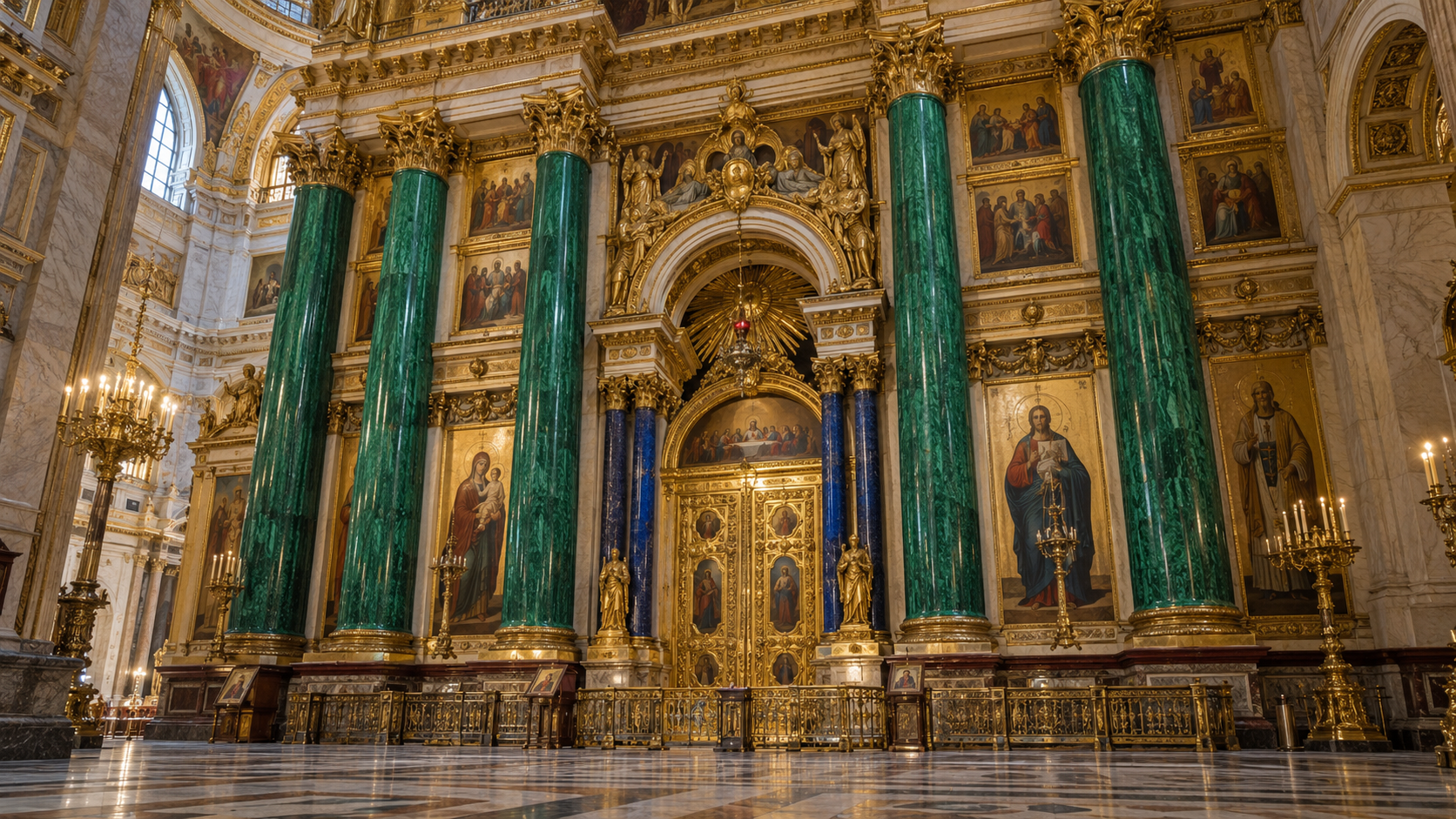
Ahead stands an elaborate iconostasis: the architectural screen that separates the main body of an Eastern Orthodox church from its sanctuary.
Religious images occupy carefully arranged positions.
Gilded details surround sacred figures.
And rising between these elements are extraordinary columns covered in deep-green stone.
Their surfaces display flowing bands of emerald green, forest green and almost black.
At first glance, the columns appear to have been carved from enormous pieces of solid malachite.
Yet the reality is considerably more sophisticated.
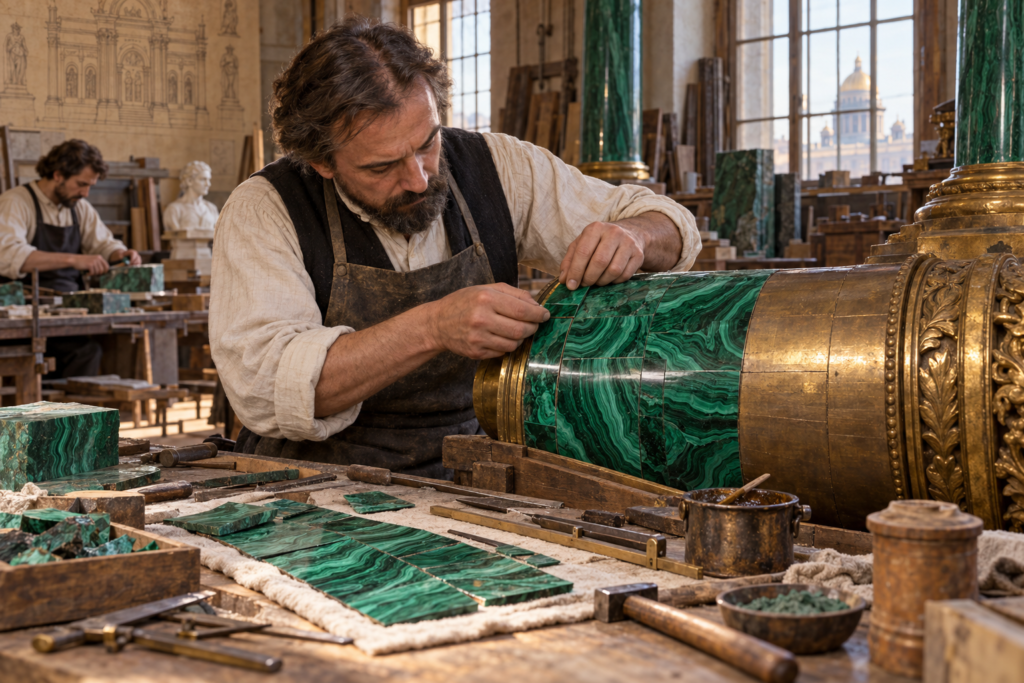
These monumental surfaces were assembled from carefully selected thin slices of natural stone.
The result represents one of the most remarkable intersections of mineralogy, decorative craftsmanship and religious architecture in nineteenth-century Europe.
The setting is Saint Isaac’s Cathedral in Saint Petersburg, Russia.
Its malachite decoration offers an important perspective on the spiritual history of gemstones.
Malachite in Russian Orthodox churches serves as a powerful symbol of artistic and spiritual legacy.
A natural mineral can become part of a sacred environment without itself being regarded as a supernatural source of spiritual energy.
Understanding this distinction reveals a fascinating relationship between religion, artistic expression, geology and political authority.
Saint Isaac’s Cathedral: A Monument of Imperial Russia
The present Saint Isaac’s Cathedral was constructed between 1818 and 1858.
Its architect was Auguste Montferrand, a French-born designer whose work became closely associated with the monumental architecture of imperial Saint Petersburg.
The cathedral was dedicated to Saint Isaac of Dalmatia.
Its dedication also possessed dynastic significance because the feast day of Saint Isaac coincided with the birthday of Peter the Great, founder of Saint Petersburg.
The present building was not the first church dedicated to this saint in the city.
It represented the culmination of several earlier building projects and changing imperial ambitions.
Construction continued for approximately forty years.
The completed cathedral became one of the most imposing religious buildings of nineteenth-century Russia.
Its enormous scale reflected more than architectural fashion.
It communicated the wealth, technical resources and political aspirations of the Russian Empire.
The interior brought together painting, sculpture, decorative stone, metalwork, stained glass and mosaic.
Among these materials, malachite occupied an exceptionally prominent position.
Why Was Malachite Used in a Christian Cathedral?
At first, the choice may seem unusual.
Malachite is commonly encountered today as a polished decorative stone, mineral specimen or jewellery material.
Its characteristic green bands make it immediately recognisable.
But malachite is relatively soft and brittle compared with many construction stones.
It is not a practical material for creating enormous solid structural columns.
Why, then, was it selected for such an important architectural project?
The answer lies in the decorative ambitions of imperial Russia and the exceptional craftsmanship developed around the country’s mineral resources.
During the eighteenth and nineteenth centuries, large malachite deposits in the Ural Mountains supplied prestigious decorative workshops.
The material became associated with luxury furnishings, monumental vessels and elaborate architectural decoration.
At Saint Isaac’s Cathedral, malachite offered an extraordinary combination of natural colour, polished brilliance and visual prestige.
Its appearance could transform a monumental religious interior.
However, the available historical evidence does not establish that the stone was selected because Orthodox Christianity attributed healing or supernatural energetic properties to malachite.
Its documented importance was architectural, artistic and material.
What Is Malachite?
Malachite is a naturally occurring copper carbonate hydroxide mineral.
Its chemical formula is:
Cu₂CO₃(OH)₂
It commonly develops in the oxidised zones of copper deposits.
When copper-bearing minerals undergo chemical weathering, circulating water and changing environmental conditions can produce secondary minerals.
Malachite is one of these minerals.
Its distinctive green colour is associated with copper in its chemical structure.
Unlike the red colour of ruby or the violet appearance of amethyst, malachite’s colour is strongly connected with its copper chemistry.
The mineral belongs to the monoclinic crystal system.
It commonly forms rounded, botryoidal, fibrous or banded aggregates.
Well-developed individual crystals occur, but the familiar polished decorative material usually consists of aggregates rather than large transparent crystals.
Its Mohs hardness is approximately 3.5–4.
This makes malachite significantly softer than quartz, which has a hardness of 7.
Malachite is therefore relatively vulnerable to scratching and surface damage.
Its softness and brittleness become particularly important when examining its historical architectural applications.
The Natural Formation of Malachite’s Green Bands
One of malachite’s most recognisable characteristics is its banding.
Polished specimens frequently display alternating zones of lighter and darker green.
These patterns may appear as:
Concentric rings.
Curving waves.
Irregular stripes.
Rounded eyes.
Or complex, overlapping forms.
The patterns reflect differences in mineral growth and deposition.
They are not painted onto the surface.
They form naturally as the mineral develops.
When a malachite aggregate is cut and polished, its internal structure becomes visible.
The resulting patterns can be extraordinarily decorative.
No two natural pieces are precisely identical.
This individuality made malachite particularly attractive to nineteenth-century stoneworkers.
But it also presented a technical challenge.
Large surfaces had to be assembled from pieces that differed naturally in colour and pattern.
The solution became one of the great achievements of Russian decorative craftsmanship.
The Ural Mountains and the Rise of Russian Malachite
The Ural Mountains contain important mineral deposits that contributed significantly to Russia’s industrial development.
Copper mining played a major role in the region’s economy.
Malachite was encountered in association with copper-bearing deposits.
During the eighteenth century, substantial discoveries made the mineral increasingly available for decorative purposes.
The Demidov industrial family became particularly associated with Ural mining enterprises and the production of luxury stone objects.
According to the Saint Isaac’s Cathedral museum, the malachite used for its monumental iconostasis came from the Mednorudyanskoye deposits associated with the Demidov enterprises.
These deposits supplied unusually large quantities of decorative material.
The museum records that the mines could produce tens of tonnes of malachite annually during the period.
This abundance helped establish Russia as an important centre for large-scale malachite craftsmanship.
The stone became a material through which industrial wealth could be transformed into cultural prestige.
Malachite and the Demidov Industrial Family
The Demidovs occupied an important position in the history of Russian mining and decorative arts.
Their industrial enterprises were connected with the extraction and processing of mineral resources.
Their wealth also supported ambitious artistic commissions.
Malachite objects associated with Russian production entered aristocratic and royal interiors across Europe.
The Metropolitan Museum of Art preserves a monumental malachite vase connected with the Demidov family.
Its decorative stonework dates to the early nineteenth century, while its gilt-bronze mounts and pedestal were completed in 1819.
The object demonstrates how Russian malachite became part of an international luxury market.
Another Metropolitan Museum object, a monumental torchère dating to approximately 1840, illustrates the use of thin malachite veneers applied over metal forms.
These objects provide an important comparison with Saint Isaac’s Cathedral.
The same material could serve very different environments.
In a palace, it communicated luxury and aristocratic taste.
In a cathedral, it contributed to the visual magnificence of a sacred architectural setting.
The mineral remained physically the same.
Its cultural function changed.
The Great Malachite Columns of Saint Isaac’s Cathedral
The cathedral’s most spectacular use of malachite occurs around its main iconostasis.
According to the cathedral museum’s specialised documentation, the ensemble includes eight large malachite-clad columns and two similarly decorated pilasters.
The columns rise approximately ten metres.
Their diameter is around one metre.
Their polished surfaces create the impression of enormous pieces of naturally patterned green stone.
Yet the columns are not solid malachite.
Their internal construction consists of metal structural components covered with carefully prepared decorative surfaces.
The museum identifies cast-iron and bronze elements within the construction.
The malachite itself forms a relatively thin external layer.
This distinction is fundamental.
The achievement was not the extraction of ten-metre monolithic malachite columns. It was the creation of convincing monumental surfaces from many smaller pieces of natural mineral material.
The Russian Mosaic Technique
The technique used to produce these surfaces is known as Russian mosaic.
Despite its name, it differs from the small-tessera mosaics commonly associated with ancient Roman floors or Byzantine religious images.
Russian mosaic involves the careful selection and arrangement of thin pieces of decorative stone.
For malachite, artisans cut the mineral into plates only a few millimetres thick.
They then selected individual pieces according to colour and natural pattern.
The objective was to create a continuous visual surface.
Adjacent pieces were matched so that the natural bands appeared to flow from one section into another.
The seams were made as inconspicuous as possible.
The pieces were attached to a prepared foundation.
The assembled surface was subsequently ground and polished.
When executed successfully, the finished object appeared to be made from a much larger piece of solid stone.
How the Cathedral’s Malachite Columns Were Constructed
The cathedral museum provides unusually detailed information about the construction process.
The stoneworkers prepared malachite plates approximately two to three millimetres thick.
These were arranged over shaped bronze components.
A heated adhesive mixture containing wax and rosin was used to secure the stone.
The surfaces were carefully finished to create a continuous polished appearance.
The bronze components were mounted around the underlying column structures.
Their joints were concealed through additional matching stonework.
The result was an architectural illusion of remarkable sophistication.
Visitors saw monumental green columns.
The actual structure combined metal engineering, natural mineral veneers and meticulous manual craftsmanship.
This method allowed artisans to create objects far larger than the naturally available malachite pieces.
The Art of Matching Natural Patterns
The most difficult aspect of Russian mosaic was not simply cutting the stone.
It was selecting the correct pieces.
Malachite displays irregular natural banding.
If adjacent pieces are arranged carelessly, the resulting surface can appear fragmented.
Skilled artisans instead studied the patterns.
They selected pieces that complemented one another.
Some arrangements created flowing ribbons.
Others produced radial forms.
Still others created symmetrical compositions resembling mirrored patterns.
The cathedral museum describes several historical arrangements, including ribbon-like, radial and symmetrical matching methods.
In some cases, the stone patterns were organised around two axes to create cross-like visual compositions.
These patterns were produced through craftsmanship.
They were not necessarily independent religious symbols.
A cross-shaped arrangement of decorative mineral plates should not automatically be interpreted as evidence of a specific spiritual belief concerning malachite.
The historical technique must be understood before symbolic meanings are assigned.
Why the Columns Appear Almost Monolithic
A polished malachite surface can be visually deceptive.
The natural banding draws the eye across the material.
When individual plates are matched carefully, their boundaries become difficult to identify.
The observer perceives a continuous surface.
This creates the impression that the object has been carved from a single enormous mineral mass.
The technique was especially effective on cylindrical architectural forms.
The curved surface allows patterns to move around the column.
Light reflections reinforce the illusion.
The result is a remarkable combination of natural mineral beauty and deliberate human design.
The cathedral’s malachite columns demonstrate that gemstone craftsmanship can operate on an architectural scale.
The Iconostasis: A Sacred Architectural Boundary
To understand the religious context, we must examine the function of the iconostasis.
In Eastern Orthodox Christianity, an iconostasis is a screen or wall containing religious icons.
It separates the nave, where the congregation gathers, from the sanctuary containing the altar.
However, describing it simply as a barrier would be incomplete.
Orthodox theological explanations present the iconostasis as both a division and a connection.
It marks the distinction between sacred and ordinary space while also communicating the relationship between the divine and human worlds.
The Orthodox Church in America describes the iconostasis as a boundary that simultaneously separates and unites these realms.
The religious significance therefore comes primarily from the theological and liturgical role of the structure.
Its material decoration contributes to the setting.
But the material itself is not the central object of worship.
Icons and Their Place in Orthodox Christianity
Icons occupy an important position in Eastern Orthodox religious practice.
They depict Christ, the Virgin Mary, saints and events from Christian sacred history.
Their arrangement follows established theological traditions.
The iconostasis commonly contains several rows of religious images.
The central doors are known as the Holy Doors or Royal Doors.
These doors have particular liturgical significance.
They are associated with the movement of clergy and sacred objects during religious services.
The icons surrounding them communicate important elements of Christian teaching.
Within this setting, architectural materials help frame the religious imagery.
Gold, marble, wood, metal and decorative stones may all contribute to the visual environment.
Their use does not imply that each material possesses a distinct supernatural energy.
Where Does Malachite Fit into This Sacred Structure?
At Saint Isaac’s Cathedral, malachite forms part of the architectural framework surrounding the icons.
Its green surfaces establish strong visual contrasts with gilded elements and pale stone.
The columns help organise the composition.
They direct attention toward the central religious imagery.
They also reinforce the monumental character of the iconostasis.
This creates a relationship between material beauty and sacred architecture.
The mineral contributes to the experience of the religious space.
But the documented religious significance of the iconostasis belongs to Orthodox theology and liturgical tradition.
There is no reliable evidence that the cathedral’s malachite was intended to activate chakras, transmit healing energy or produce supernatural protection.
Those ideas belong to different interpretive systems.
Was Green Considered a Sacred Colour?
Green can carry symbolic meanings in many religious and cultural traditions.
It may evoke vegetation, growth, renewal or life.
However, such associations are not universal.
Nor should they be automatically transferred between religions.
It would be tempting to suggest that the cathedral’s green malachite columns were selected specifically because green represented spiritual rebirth.
But the available historical documentation does not establish this as the reason for the material’s selection.
The cathedral museum emphasises the stone’s decorative beauty, rarity, technical challenges and the achievement of its craftsmen.
Those explanations are supported by the evidence.
A theological interpretation of the green colour would require additional contemporary documentation.
Sacred Beauty and Material Splendour
Religious buildings often employ extraordinary materials.
Gold.
Silver.
Marble.
Precious stones.
Decorative glass.
And elaborate textiles.
These materials can contribute to an atmosphere of solemnity and magnificence.
Within Christian architecture, visual beauty has frequently been used to express reverence and religious devotion.
The relationship between material splendour and sacred meaning is therefore historically important.
But it should not be confused with the modern claim that a mineral possesses an independent energetic frequency capable of influencing human health.
The beauty of a religious environment may influence human experience through architecture, light, colour, ritual and personal belief.
These influences are different from supernatural mineral properties.
Imperial Power and Religious Architecture
Saint Isaac’s Cathedral also belonged to the political world of the Russian Empire.
Its construction required enormous resources.
The building incorporated materials from different regions.
Its scale depended on sophisticated engineering and specialised labour.
The malachite decoration represented the transformation of Russian mineral wealth into a monumental architectural achievement.
This was not merely a private expression of religious devotion.
It was also a statement about imperial resources and technical capability.
The building’s religious and political meanings existed together.
Understanding both is necessary.
A purely spiritual interpretation would overlook the imperial context.
A purely political interpretation would overlook the religious purpose of the building.
The historical reality includes both.
The Cathedral as a Collection of Natural Materials
Malachite was only one of the materials used in Saint Isaac’s Cathedral.
The building incorporated several varieties of marble, granite and other decorative stones.
The cathedral museum documents an extensive selection of natural materials from different geological regions.
Each was chosen according to particular architectural and decorative requirements.
Some stones provided structural strength.
Others offered colour.
Some were valued for their ability to take a high polish.
Others were suitable for intricate carving.
This diversity demonstrates that stone selection involved practical and artistic considerations.
Mineralogy influenced architecture.
The properties of the materials determined how they could be used.
The Difference Between Structural Stone and Decorative Stone
A major distinction exists between materials that carry a building’s weight and those used primarily for decoration.
Granite is hard and durable.
It can be employed in large structural elements.
Malachite is comparatively soft and brittle.
It is more suitable for decorative surfaces.
The cathedral’s construction reflects this difference.
Its monumental granite elements perform structural and architectural functions.
The malachite veneers provide a distinctive visual finish.
This illustrates a fundamental principle of applied gemmology.
The suitability of a natural stone depends not only on its beauty but also on its physical properties.
Malachite and the Development of Decorative Stoneworking
The cathedral’s malachite surfaces belong to a broader tradition of decorative stone craftsmanship.
During the nineteenth century, Russian workshops produced elaborate objects from ornamental minerals.
Large vases, tables and architectural features became symbols of technical sophistication.
The Metropolitan Museum of Art preserves several examples demonstrating how Russian malachite entered European luxury interiors.
One pair of monumental torchères incorporates malachite veneer over copper, with bronze and gilt-bronze elements.
The museum explains that Russian craftsmen prepared thin malachite sheets and applied them to shaped metal forms.
This provides a direct technological comparison with the cathedral’s decorative methods.
The same general principle could be used for furniture, monumental vessels and sacred architecture.
A Mineral That Crossed Cultural Boundaries
The international popularity of Russian malachite is historically significant.
The mineral originated in geological deposits.
It was extracted through mining.
It was transported to specialised workshops.
Artisans transformed it into decorative objects.
Some of those objects remained in Russia.
Others entered European aristocratic collections.
The resulting works participated in different cultural environments.
A malachite vase in a private residence communicated wealth and artistic taste.
A malachite architectural surface in a cathedral contributed to the magnificence of a religious building.
The mineral did not possess one fixed cultural meaning.
Its significance depended on the people, institutions and settings involved.
The Religious Meaning Belongs to the Setting
This distinction is particularly important for articles about gemstone spirituality.
A mineral used inside a religious building does not automatically become a religious object in its own right.
Its significance depends on its function.
Consider the difference between an icon and the stone surrounding it.
An Orthodox icon has a recognised place within religious devotion and theology.
A decorative malachite column may frame the icon.
But this does not establish that the column itself receives religious veneration.
Likewise, the presence of a mineral within sacred architecture does not prove that believers attributed specific healing powers to it.
Historical interpretation requires evidence concerning actual religious practices.
Malachite in Modern Crystal Spirituality
Contemporary crystal traditions frequently associate malachite with transformation.
Some practitioners describe it as a stone of emotional change, personal growth or protection.
Others connect it with the Heart Chakra.
Modern metaphysical literature may also describe malachite as a material associated with releasing emotional patterns or encouraging self-reflection.
These interpretations can hold personal significance for individuals who practise contemporary crystal spirituality.
However, they should not be presented as established teachings of nineteenth-century Russian Orthodoxy.
The cathedral’s malachite columns do not provide evidence for those claims.
The historical and modern traditions belong to different contexts.
Does Malachite Possess Scientifically Proven Healing Energy?
Malachite has measurable physical properties.
Its chemical composition can be determined.
Its crystal structure can be studied.
Its hardness and density can be measured.
Its colour and banding can be explained through mineralogy.
These characteristics are scientifically established.
There is no established scientific evidence that malachite emits a supernatural energy field capable of balancing chakras, treating illness or producing emotional healing independently of psychological and contextual factors.
A person’s experience of calm or reflection while looking at a beautiful mineral may be genuine.
But such experiences do not establish the existence of a mineral-specific healing force.
The distinction between personal experience and scientifically demonstrated mechanism is essential.
The Physical Properties Behind Malachite’s Beauty
Malachite’s appearance is extraordinary because of its natural structure.
The mineral’s copper chemistry produces its green colour.
Its growth patterns create complex banding.
Polishing reveals those patterns with remarkable clarity.
When light reflects from a well-finished surface, the material can appear rich and almost luminous.
These effects are physical.
They can be investigated through mineralogy and optics.
The cathedral’s craftsmen understood how to exploit them.
Their achievement involved selecting, arranging and polishing the stone so that its natural beauty became an architectural feature.
The result is visually impressive without requiring supernatural explanations.
Why Malachite Requires Careful Handling
Malachite’s relatively low hardness makes it susceptible to scratching.
Its brittle nature also limits the types of objects that can be produced from it.
These characteristics help explain why thin veneers were preferable to large solid structural elements.
For modern collectors, polished malachite should be handled carefully.
Abrasive cleaning methods can damage its surface.
Acidic cleaning agents are unsuitable.
The mineral contains copper, and dust produced during cutting, grinding or polishing requires appropriate occupational safety precautions.
Malachite should not be used to prepare so-called crystal elixirs intended for drinking.
Its chemical composition does not make such practices safe.
These precautions concern actual material properties rather than spiritual beliefs.
Russian Mosaic as an Example of Human Ingenuity
One of the most remarkable lessons from Saint Isaac’s Cathedral concerns the relationship between natural limitations and human creativity.
Malachite is not naturally available in unlimited monolithic dimensions.
Its brittleness makes large-scale construction difficult.
Its banding is irregular.
Yet nineteenth-century artisans transformed these limitations into artistic opportunities.
By cutting thin plates and carefully matching their patterns, they created monumental surfaces.
The finished columns appear almost impossible when considered as solid mineral objects.
Their beauty depends on the collaboration between geological processes and human craftsmanship.
Nature produced the material.
Artisans transformed it.
Architecture gave it a new purpose.
Religious Art and the Meaning of Materials
Throughout history, religious communities have used valuable materials to create sacred environments.
Such choices can express devotion, prestige, patronage or artistic ambition.
However, their meanings vary.
A gemstone may appear in a ritual object.
It may decorate a religious manuscript.
It may form part of an altar.
It may be used in architecture.
Or it may be worn by religious authorities.
Each context requires separate investigation.
The malachite of Saint Isaac’s Cathedral belongs primarily to the history of sacred architectural decoration.
It should not be confused with historical gemstone amulets or contemporary crystal-healing practices.
A Cathedral Between Faith, Art and Science
Saint Isaac’s Cathedral provides an exceptional example of several fields intersecting.
Religious studies explains the function of the iconostasis.
Architectural history explains the design of the cathedral.
Political history places the building within the Russian Empire.
Art history examines the decorative programme.
Mineralogy explains the properties of malachite.
Materials science helps us understand how the stone was processed and assembled.
Together, these disciplines provide a richer interpretation than any one of them could offer independently.
This multidisciplinary approach is particularly valuable when studying the cultural history of gemstones.
What Can We Establish with Confidence?
The historical and scientific evidence supports several important conclusions.
Saint Isaac’s Cathedral was constructed between 1818 and 1858.
Its design is associated with Auguste Montferrand.
The cathedral’s main iconostasis contains monumental malachite decoration.
The specialised museum documentation identifies eight large malachite-clad columns and two pilasters.
The malachite originated from Ural deposits associated with the Demidov mining enterprises.
The surfaces were created using the Russian mosaic technique.
Thin malachite plates were attached to metal foundations and carefully polished.
The iconostasis has a recognised religious function within Eastern Orthodox Christianity.
The malachite contributed to the architectural splendour of the sacred setting.
The material also communicated the resources and craftsmanship available to imperial Russia.
There is no established evidence that the malachite was installed because it was believed to emit supernatural healing energy.
What Should Not Be Assumed?
Several interpretations require caution.
The green colour of the columns should not automatically be described as a documented symbol of spiritual rebirth.
The use of malachite in an Orthodox cathedral does not prove that the mineral itself was worshipped.
The stone’s architectural function does not establish that it was used for chakra balancing.
The presence of a valuable mineral in a religious building does not demonstrate belief in supernatural gemstone protection.
Modern spiritual interpretations should not be projected backward onto nineteenth-century Russian religious practice.
Such distinctions do not diminish the historical importance of malachite.
They make its history more accurate.
A Contemporary Reflection on Malachite
For modern readers interested in gemstones and spirituality, Saint Isaac’s Cathedral offers an interesting form of reflection.
The malachite columns demonstrate transformation in a literal sense.
Natural mineral material was extracted from the earth.
It was cut into small pieces.
The pieces were arranged into complex patterns.
The finished surfaces became part of a monumental sacred environment.
This process can serve as a contemporary metaphor for patience, craftsmanship and transformation.
But such a metaphor should be identified as a modern reflection.
It is not evidence that nineteenth-century Orthodox believers attributed transformative supernatural powers to malachite.
The distinction allows historical objects to inspire without misrepresenting their original context.
Conclusion: When the Beauty of Stone Became Sacred Architecture
The malachite of Saint Isaac’s Cathedral demonstrates that the spiritual history of gemstones extends far beyond amulets, talismans and modern crystal-healing practices.
Natural minerals have also contributed to the creation of extraordinary religious environments.
In nineteenth-century Russia, malachite became part of a monumental architectural achievement.
Its distinctive green banding transformed the appearance of the cathedral’s iconostasis.
Its extraction connected the building with the mineral wealth of the Ural Mountains.
Its preparation required exceptional craftsmanship.
Its installation reflected the resources and ambitions of imperial Russia.
And its position within an Orthodox cathedral placed it inside a religious environment of profound theological significance.
Yet the mineral itself remained malachite.
A naturally occurring copper carbonate hydroxide.
A relatively soft and brittle decorative stone.
A material whose colour and structure can be explained scientifically.
Its historical significance did not depend on supernatural energy. It emerged from the interaction between natural beauty, human craftsmanship, religious architecture and cultural meaning.
For Natural Gems Belgium, this is an essential perspective.
Gemstones are not only objects to be collected, worn or studied.
They are also materials through which societies have expressed their values.
Sometimes those values concern wealth.
Sometimes political authority.
Sometimes remembrance.
And sometimes the creation of spaces dedicated to religious devotion.
The malachite columns of Saint Isaac’s Cathedral demonstrate how a natural mineral can become part of something much larger than itself.
Not because its physical nature changes.
But because human culture gives that material a remarkable new role.
References & Further Reading
The following sources provide authoritative information on Saint Isaac’s Cathedral, Russian malachite craftsmanship, Orthodox religious architecture and the mineralogical properties of malachite.
1. State Museum of Saint Isaac’s Cathedral – Stone in the Decoration of Saint Isaac’s Cathedral
https://eng.cathedral.ru/en/isaac/stones
Source description: Official museum documentation examining the natural decorative stones used throughout the cathedral.
Includes detailed information about Ural malachite, the Demidov deposits, the procurement of material and the Russian mosaic technique used to decorate the iconostasis.
The page is hosted on the museum’s English-language website, although much of the detailed historical text is presented in Russian.
2. State Museum of Saint Isaac’s Cathedral – Malachite
https://stone.cathedral.ru/8.html
Source description: Specialised museum resource devoted to the cathedral’s malachite decoration.
Documents the eight large columns and two pilasters, their approximate dimensions, the use of bronze foundations and the application of thin malachite plates.
Also describes different historical methods of matching the stone’s natural patterns.
This is the principal technical source for the article.
3. State Museum of Saint Isaac’s Cathedral – History of Construction
https://eng.cathedral.ru/ru/isaac/building
Source description: Official historical account of the cathedral’s construction.
Explains its relationship with Peter the Great, the architectural projects preceding the present building, the selection of Auguste Montferrand and the engineering achievements involved in construction between 1818 and 1858.
4. State Museum of Saint Isaac’s Cathedral – Cathedral Architecture
https://eng.cathedral.ru/en/isaac/architecture
Source description: Official museum resource documenting the cathedral’s architectural scale, monumental design and position within nineteenth-century Russian architecture.
Provides broader architectural context for the decorative stonework.
5. Orthodox Church in America – The Iconostasis
https://wdcoca.com/article/the-iconostasis
Source description: Religious educational resource published by the Orthodox Church in America’s Archdiocese of Washington.
Explains the theological and liturgical functions of the iconostasis, including its relationship with the sanctuary, the Royal Doors and the arrangement of sacred icons.
This source is particularly important for distinguishing documented Orthodox religious tradition from modern metaphysical interpretations of gemstones.
6. Gemological Institute of America – Gems on Canvas: Pigments Historically Sourced from Gem Materials
https://www.gia.edu/gems-gemology/fall-2022-gems-on-canvas
Source description: Professional gemmological research article by Britni LeCroy, published in Gems & Gemology.
Examines the mineralogical properties of malachite and other gem materials used historically as pigments.
Provides information about malachite’s chemical composition, crystal system, hardness and long history as a decorative material.
7. The Metropolitan Museum of Art – Twelve-Light Torchère by Pierre Philippe Thomire
https://www.metmuseum.org/art/collection/search/204101
Source description: Official museum catalogue for a monumental decorative object dating to approximately 1840.
Documents the use of Russian malachite veneer over metal forms and the international movement of Russian decorative stonework into European luxury interiors.
Provides an important comparison with the techniques used at Saint Isaac’s Cathedral.
8. The Metropolitan Museum of Art – Monumental Malachite Vase
https://www.metmuseum.org/art/collection/search/199500
Source description: Official collection record for a monumental malachite vase associated with the Demidov family.
The stonework dates to the early nineteenth century, with gilt-bronze mounts and pedestal dating to 1819.
Demonstrates the prestige of Russian malachite within European aristocratic decorative arts.
9. State Museum of Saint Isaac’s Cathedral – Mosaic
https://eng.cathedral.ru/en/isaac/mosaic
Source description: Official museum study of the cathedral’s religious mosaics and their production.
Explains the development of monumental mosaic decoration, the training of Russian craftsmen and the use of coloured glass materials in religious imagery.
Provides useful context for distinguishing the cathedral’s pictorial mosaics from the decorative stone technique known as Russian mosaic.
10. Mindat – Malachite Mineral Information
https://www.mindat.org/min-2550.html
Source description: Specialist mineralogical reference providing malachite’s chemical formula, crystal system, hardness, specific gravity, colour and geological occurrence.
Useful for comparing historical decorative descriptions with modern mineralogical classification.
Historical Tradition, Mineralogical Science and Modern Metaphysical Beliefs
Scientifically established: Malachite is a copper carbonate hydroxide mineral with the chemical formula Cu₂CO₃(OH)₂.
Scientifically established: Malachite crystallises in the monoclinic system and has a Mohs hardness of approximately 3.5–4.
Scientifically established: Its characteristic green colour is associated with copper in its chemical structure.
Scientifically established: Its banded appearance reflects natural mineral growth and deposition.
Historically documented: Large malachite deposits in the Ural Mountains supported important Russian decorative stone industries.
Historically documented: The Demidov mining enterprises were associated with the malachite used at Saint Isaac’s Cathedral.
Historically documented: Saint Isaac’s Cathedral was constructed between 1818 and 1858.
Historically documented: Its main iconostasis incorporates monumental malachite-clad architectural elements.
Historically documented: The malachite surfaces were assembled from thin plates using the Russian mosaic technique.
Historically documented: The underlying columns incorporate metal structural components rather than being carved from solid malachite.
Religious tradition: In Eastern Orthodox Christianity, the iconostasis has an established theological and liturgical function.
Religious tradition: The iconostasis separates and connects the nave and sanctuary and presents sacred imagery according to Orthodox traditions.
Historically supported interpretation: The cathedral’s malachite decoration contributed to its visual magnificence and reflected the resources and craftsmanship of imperial Russia.
Historically unsupported: There is no reliable evidence that the cathedral’s malachite was selected specifically for chakra activation, supernatural healing or invisible protective energy.
Modern metaphysical belief: Contemporary crystal traditions may associate malachite with transformation, emotional growth, protection or the Heart Chakra.
Scientific limitation: There is no established scientific evidence that malachite emits supernatural energy or independently produces medical or psychological healing.
Practical mineralogical consideration: Malachite is relatively soft, brittle and copper-bearing. Its dust requires appropriate handling precautions, and it should not be used to prepare drinking-water crystal elixirs.
The malachite of Saint Isaac’s Cathedral therefore provides an exceptional example of gemstone significance within a religious environment.
Its cultural importance is documented.
Its mineralogical properties are measurable.
Its architectural craftsmanship is extraordinary.
Its modern metaphysical associations should be understood separately from the historical evidence.
This distinction allows both the religious tradition and the natural mineral to be appreciated without confusing cultural symbolism with scientific fact.