A quiet desk, an open book and a few uninterrupted minutes can become the beginning of a meaningful learning experience.
Yet studying is rarely as simple as opening a textbook and absorbing its contents. Attention fluctuates, unfamiliar ideas require effort, and information that appears clear during reading may become surprisingly difficult to remember later.
Across contemporary crystal spirituality, Fluorite has acquired a reputation as a stone of concentration, mental clarity and organised thought. Students sometimes place Fluorite on their desks, carry small polished stones during examinations or incorporate the gemstone into rituals intended to support intellectual work.
Some practitioners believe that Fluorite clears mental confusion, balances energetic influences or strengthens the mind’s ability to process information.
These are spiritual interpretations, not scientifically established properties.
There is no reliable evidence that Fluorite improves memory, increases intelligence or enhances concentration through gemstone energy.
Nevertheless, a gemstone can serve as a personally meaningful symbol. Its presence may mark the beginning of a deliberate activity, remind its owner of a chosen intention or become part of a consistent study routine.
This article explores the Fluorite Study Ritual, an original contemporary practice combining crystal symbolism with established principles of learning psychology.
Rather than presenting Fluorite as a supernatural instrument, the exercise treats it as a symbolic companion to the genuinely demanding work of learning.
Table of Contents
Fluorite in Contemporary Crystal Traditions
Within modern crystal-healing literature, Fluorite is frequently associated with mental clarity, intellectual organisation, discernment and concentration.
Some practitioners describe it as a stone that helps separate useful thoughts from distractions. Others believe it supports decision-making, clears unwanted mental energy or encourages a balanced approach to complicated situations.
These interpretations are particularly popular in contemporary spiritual practices involving education, professional development and creative problem-solving.
Different colours of Fluorite may also receive different symbolic meanings. Purple Fluorite is sometimes associated with intuition, green Fluorite with renewal or emotional harmony, and multicoloured Fluorite with balancing several aspects of personal experience.
Such associations are not universal, and they should not automatically be presented as ancient teachings.
The modern practice of placing Fluorite beside a laptop or textbook is best understood as part of contemporary crystal spirituality, rather than as a historically documented educational ritual.
For the exercise developed here, the gemstone represents a straightforward intention: to devote attention to one learning task at a time.
From Sacred Objects to Everyday Rituals
Throughout history, objects have acquired significance through their association with particular activities, beliefs and social practices.
Religious traditions may employ consecrated objects, prayer beads, ceremonial vessels or devotional images. Their meanings depend on specific theological, historical and cultural contexts.
Everyday life also contains repeated symbolic actions, although these should not be equated with religious rites.
A writer may begin each working session by opening a particular notebook. A musician may arrange an instrument before practising. A student may prepare a desk in the same order before studying.
Such actions can mark transitions between activities.
Research on habits and behavioural cues suggests that consistent contexts can become associated with repeated behaviours. However, this does not establish that any particular ritual object automatically improves performance.
A Fluorite stone may therefore serve as a personal study cue without possessing supernatural cognitive powers.
Its meaning arises from how the individual chooses to use it.
Why Concentration Is More Complicated Than It Appears
Concentration is not a single mental ability that can simply be switched on.
Learning involves several interacting processes, including attention, working memory, comprehension, retrieval and the integration of new information with existing knowledge.
The demands vary according to the material.
Reading an unfamiliar historical argument is different from solving a mathematical equation. Memorising terminology is different from learning to identify patterns or evaluate evidence.
Researchers studying cognitive load have shown that working memory has limitations, particularly when people process unfamiliar information.
This helps explain why difficult learning tasks may benefit from clear instructions, manageable stages and appropriately organised materials.
It does not mean that every distraction can be eliminated or that concentration should remain constant for hours.
Most importantly, no scientific evidence establishes that Fluorite changes working-memory capacity through energetic vibrations.
The gemstone may symbolise focus, but the cognitive work remains with the learner.
The Difference Between Feeling Focused and Learning Effectively
A study session can feel productive without producing durable learning.
Repeatedly reading familiar material may create a sense of fluency. Highlighting large passages can also feel active, even when little information is subsequently recalled.
Educational psychology distinguishes between activities that feel easy and techniques that improve longer-term retention.
Research reviewed by Dunlosky and colleagues identifies practice testing and distributed practice among the more broadly useful learning techniques.
Practice testing involves attempting to retrieve information from memory rather than merely looking at the answer.
Distributed practice involves revisiting material across separate sessions instead of concentrating all study into one prolonged period.
These methods do not guarantee success, and their effectiveness depends on how they are implemented.
Nevertheless, they provide a stronger scientific foundation for learning than claims about gemstone energy.
A Fluorite study ritual can incorporate these techniques while keeping the gemstone’s role explicitly symbolic.
Introducing the Fluorite Study Ritual
The following practice is an original contemporary exercise.
It is not an ancient Fluorite ceremony, a traditional religious rite or a clinically validated intervention.
It combines one gemstone with a structured learning routine.
The exercise can be adapted for schoolwork, university study, professional training or independent learning.
Allow approximately twenty to thirty minutes for an initial session.
You will need a Fluorite stone, the material you intend to study, a notebook or suitable digital document, and a safe, comfortable workspace.
The ritual follows four principles:
Prepare the environment. Define the task. Retrieve what you learn. Plan your return.
Stage One – Preparing the Study Environment
Begin by choosing a place appropriate for the learning activity.
A quiet desk may be suitable, but complete silence is not essential for everyone.
Check that the lighting is comfortable, the seating is appropriate and the necessary materials are available.
Remove unnecessary distractions where practical.
For example, unrelated browser tabs may be closed and non-essential notifications silenced.
Do not assume that a gemstone can neutralise noise, improve indoor conditions or eliminate distractions through invisible energy.
The practical preparation of the environment is a separate, observable activity.
Stage Two – Placing the Fluorite
Place one Fluorite stone on a stable surface beside the study materials.
A small polished palm stone, cabochon or natural specimen may be used.
The gemstone should not obstruct books, equipment or writing space.
Some contemporary practitioners believe that placing Fluorite near study materials creates a field of mental clarity.
This claim has not been scientifically demonstrated.
For this exercise, the stone represents the decision to begin a particular task.
Its presence can be treated as a visual reminder of that intention.
Stage Three – Defining One Learning Objective
Before reading, write a specific learning objective.
Avoid a vague instruction such as “study history.”
Instead, choose something observable:
“Explain three reasons why this historical event occurred.”
Or:
“Identify the principal stages of the process described in this chapter.”
A well-defined objective makes it easier to determine what the session should accomplish.
It also reduces the temptation to move repeatedly between unrelated tasks.
The Fluorite does not determine the objective.
The learner does.
Stage Four – Beginning a Focused Learning Period
Study the chosen material for a manageable period.
Twenty minutes may be suitable for some learners, while others may prefer shorter or longer intervals.
There is no universally optimal duration.
During the session, concentrate on understanding the material rather than merely reaching the end of a page.
Pause when necessary to clarify unfamiliar terms.
Make brief notes if they support comprehension.
If attention wanders, return to the selected task without treating distraction as a personal failure.
The objective is purposeful engagement, not perfect concentration.
Stage Five – Closing the Material and Testing Recall
After the initial study period, close the book or hide the relevant notes.
Attempt to explain the principal ideas from memory.
You might write a short summary, answer several questions or describe the material aloud.
This is a form of retrieval practice.
Unlike repeatedly looking at information, retrieval requires the learner to reconstruct what has been remembered.
If an answer is incomplete, consult the material and correct it.
The purpose is to identify what has been learned and what still requires attention.
The gemstone is not responsible for successful recall.
Stage Six – Recognising Uncertainty
Consider which parts of the material remain unclear.
Perhaps a definition is difficult to remember.
A relationship between two ideas is confusing.
Or an explanation contains a gap.
Write down one or two questions requiring further work.
Within contemporary crystal spirituality, Fluorite is sometimes associated with removing confusion.
In this exercise, uncertainty is not removed by crystal energy.
It is made visible through reflection and checking.
Recognising what is not yet understood is a useful part of learning.
Stage Seven – Planning a Return Session
Before finishing, decide when to revisit the material.
The next day or another suitable interval may be appropriate, depending on the subject and learning schedule.
A later session might begin with a short retrieval exercise before introducing new material.
This incorporates the principle of distributed practice.
The exact spacing should reflect the learning objective, available time and difficulty of the content.
There is no requirement to follow a rigid timetable.
Stage Eight – Closing the Ritual
Return the Fluorite to its chosen place.
Close the notebook or save the digital document.
Consider one final question:
What can I explain now that I could not explain confidently before this session?
The answer may be modest.
Perhaps one concept is clearer.
Perhaps several questions remain unanswered.
Both outcomes provide useful information.
The session is complete.
Fluorite as a Study Desk Stone
Some contemporary crystal practitioners prefer to keep Fluorite permanently on a study desk.
They may believe the stone maintains an atmosphere of intellectual clarity or protects against confusing energy.
These interpretations have no established scientific basis.
A more practical explanation is that a familiar object can become associated with a repeated activity.
For example, the sight of Fluorite beside a notebook may remind someone to review a previous lesson before beginning a new one.
This does not mean that the stone independently causes improved concentration.
The reminder only becomes useful when it is connected with appropriate behaviour.
Fluorite Palm Stones and Short Reflection Breaks
A polished Fluorite palm stone may also be used as a symbolic object during a break.
After completing a learning task, the participant may hold the stone briefly while considering what was understood and what remains difficult.
There is no requirement to hold it against the forehead, move it through the air or perform an energetic cleansing gesture.
A short reflection can be completed without touching the gemstone at all.
The stone simply provides a consistent marker between studying and reviewing progress.
If handling a stone becomes distracting, it is better to leave it on the desk.
Fluorite and the Third Eye Chakra
Within contemporary seven-chakra spirituality, Fluorite is sometimes associated with the third eye chakra, commonly called Ajna.
Modern practitioners frequently connect this chakra with intuition, insight, perception and mental clarity.
Some believe Fluorite activates or balances the energetic qualities of this centre.
These interpretations vary between communities and modern chakra systems.
Historical South Asian chakra traditions developed within specific religious and philosophical contexts, and their meanings cannot be reduced to modern gemstone-colour charts.
There is no reliable biomedical evidence that Fluorite activates an anatomical third eye centre, improves eyesight, increases intelligence or enhances memory through chakra energy.
The study ritual does not require any chakra interpretation.
Its practical components remain unchanged whether or not the participant uses spiritual symbolism.
A Fluorite Centre Stone for a Learning Arrangement
Contemporary crystal grids often use a central gemstone surrounded by other stones in geometric patterns.
Some practitioners believe these arrangements amplify intentions or direct subtle energies.
Such claims have not been scientifically demonstrated.
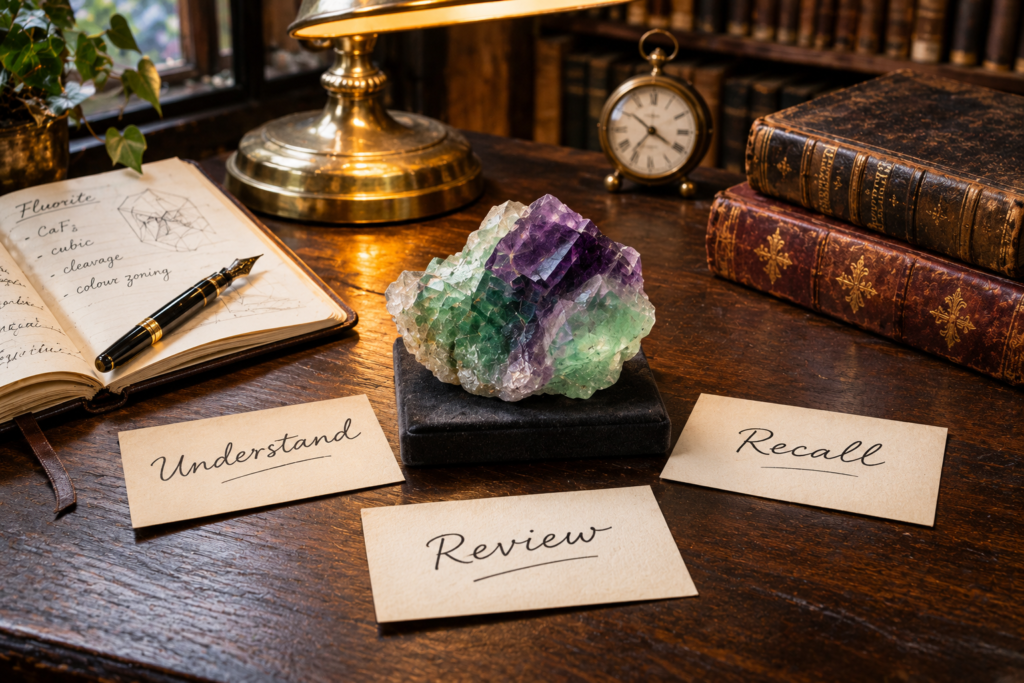
For a simpler symbolic arrangement, place one Fluorite stone in the centre of a desk tray.
Arrange three small cards around it with the following words:
Understand
Recall
Review
Each card represents a practical stage of learning.
Understanding involves making sense of the material.
Recall involves attempting to retrieve information without looking at the answer.
Review involves returning to the material later.
The arrangement is not an energetic machine.
Its purpose is to make the study sequence visible.
No additional gemstones are required.
Can Fluorite Help During Examinations?
Some students carry Fluorite during examinations because they believe it supports memory, concentration or confidence.
These beliefs are not supported by reliable evidence of supernatural gemstone effects.
Exam performance depends on numerous factors, including preparation, understanding, retrieval, the examination format and individual circumstances.
A stone cannot replace learning.
It cannot guarantee accurate answers or prevent examination anxiety.
If a student wishes to carry a gemstone as a personal symbol, examination regulations should be respected.
Some institutions restrict personal objects.
A prohibited object should never be brought into an examination room simply because it is considered spiritually meaningful.
Why a Crystal Cannot Replace Effective Study Methods
One risk associated with supernatural learning claims is the suggestion that a gemstone can compensate for inadequate preparation.
It cannot.
A student who has not understood the material will not acquire that understanding through proximity to Fluorite.
Likewise, a crystal cannot replace feedback, instruction, revision or appropriate academic support.
The ritual is most useful when the symbolic element remains secondary to the actual learning process.
The gemstone may represent commitment.
The learning methods provide the substance.
A Five-Minute Fluorite Study Ritual
For a shorter variation, place Fluorite beside the material you intend to review.
Choose one concept.
Spend two minutes attempting to explain it without consulting notes.
Check your explanation against a reliable source.
Identify one point that needs correction or further practice.
Then decide when to review it again.
The exercise is complete.
There is no need to repeat a special affirmation or recharge the gemstone.
The practical benefit, if any, comes from engaging with the material and evaluating what you know.
An Alternative Without Fluorite
The same study routine can be completed without a gemstone.
A familiar notebook, desk ornament or simple written checklist may serve as the starting cue.
No symbolic object is necessary.
The essential principles remain the same: prepare the environment, identify the task, practise retrieval and revisit the material.
Fluorite is included because of its contemporary spiritual association with clarity and concentration.
It is not a necessary educational or therapeutic instrument.
Responsible Use of Fluorite in Study Rituals
A single gemstone is sufficient.
There is no need to purchase additional crystals to improve the ritual.
Use a stone already owned if one is available.
Keep fragile specimens on stable surfaces and away from food, drinks and small children.
Do not prepare gemstone drinking water or ingest crystal powders as part of a concentration ritual.
Avoid placing gemstones where they could damage electronic equipment or obstruct work.
The exercise should remain simple, safe and appropriate to the participant’s circumstances.
What Scientific Research Establishes – and What It Does Not
Educational psychology provides substantial research on how people learn.
Studies have investigated retrieval practice, distributed learning, cognitive load and the effects of different instructional approaches.
This research can inform the practical structure of a study session.
However, it does not establish that Fluorite enhances concentration through supernatural vibrations.
It does not demonstrate that the gemstone increases intelligence, improves memory or activates a chakra centre.
Nor does it validate the Fluorite Study Ritual as a clinical or educational intervention in its entirety.
The exercise is an original combination of symbolic practice and selected evidence-informed learning techniques.
The two elements must remain clearly distinguished.
Final Reflection: The Meaning of a Stone Beside a Book
Fluorite has become a familiar symbol of mental clarity within contemporary crystal spirituality.
For some practitioners, its presence represents order, insight and the desire to learn.
These meanings may be personally significant.
They do not establish supernatural effects.
The Fluorite Study Ritual offers a practical interpretation of the symbolism.
A stone can mark the beginning of a learning session.
A written objective can define the task.
Retrieval practice can reveal what has been remembered.
And later review can provide another opportunity to strengthen understanding.
The gemstone represents the intention.
The methods support the learning.
And the intellectual achievement belongs to the person doing the work.
Clarity does not need to arrive as a mysterious force. Sometimes, it develops through patient attention, honest questioning and the willingness to return to what we have not yet understood.
References & Further Reading
The following sources provide academic, psychological, educational and historical context for learning, memory, attention, habit formation and chakra traditions. They are non-commercial educational or scholarly resources rather than gemstone retailers or crystal-healing websites.
None establishes supernatural concentration-enhancing or memory-enhancing properties of Fluorite.
1. Dunlosky et al. – Improving Students’ Learning With Effective Learning Techniques
Institution / Publication: Psychological Science in the Public Interest, Association for Psychological Science
Published: 2013
Type: Peer-reviewed educational psychology review
This influential review evaluates commonly used learning techniques, including practice testing, distributed practice, summarisation and rereading. It provides a foundation for the article’s discussion of effective study methods.
https://doi.org/10.1177/1529100612453266
2. Roediger & Karpicke – Test-Enhanced Learning: Psychological Science
Institution / Publication: Psychological Science
Published: 2006
Type: Peer-reviewed experimental psychology research
This study examines how retrieval testing can influence long-term retention compared with additional study. It supports the use of recall exercises within the practical study routine.
https://doi.org/10.1111/j.1467-9280.2006.01693.x
3. Sweller – Cognitive Load During Problem Solving: Effects on Learning
Institution / Publication: Cognitive Science
Published: 1988
Type: Peer-reviewed cognitive psychology research
This foundational paper examines the relationship between problem-solving demands, cognitive load and learning. It provides background for understanding why the organisation and difficulty of learning activities matter.
https://doi.org/10.1207/s15516709cog1202_4
4. Lally et al. – How Are Habits Formed: Modelling Habit Formation in the Real World
Institution / Publication: European Journal of Social Psychology
Published: 2010
Type: Peer-reviewed behavioural psychology research
This research investigates habit formation through repeated behaviour in consistent contexts. It offers a scientific perspective on how environmental cues and routines may become associated with particular actions.
https://doi.org/10.1002/ejsp.674
5. Encyclopaedia Britannica – Chakra
Institution: Encyclopaedia Britannica
Type: Encyclopedic religious-studies reference
This resource introduces chakra concepts within Hindu and related spiritual traditions. It provides historical and religious context while helping distinguish traditional teachings from contemporary gemstone-to-chakra correspondences.
https://www.britannica.com/topic/chakra
6. The Learning Scientists – Six Strategies for Effective Learning
Institution: The Learning Scientists
Type: Research-based educational resource
This educational resource explains practical learning strategies such as retrieval practice, spaced practice, elaboration and interleaving. It offers accessible guidance for applying principles investigated in cognitive and educational psychology.
https://www.learningscientists.org/downloadable-materials
Educational and Scientific Clarification
Fluorite’s associations with mental clarity, concentration, intuition, organised thinking and the third eye chakra belong to contemporary crystal spirituality.
These interpretations are not scientifically established therapeutic, educational or supernatural properties.
There is no reliable evidence that Fluorite improves memory, increases intelligence, enhances concentration through gemstone vibrations or balances anatomical chakra centres.
The Fluorite Study Ritual described in this article is an original contemporary symbolic exercise incorporating selected evidence-informed learning techniques.
It is not a historically documented ancient ceremony, a clinically validated intervention or a substitute for appropriate educational support.
Research supporting retrieval practice, distributed learning and habit formation does not establish additional benefits from Fluorite.
The gemstone’s role remains symbolic and optional.
Students experiencing persistent learning difficulties, attention problems or substantial examination-related distress should seek appropriate educational or professional support rather than relying on gemstone rituals.