
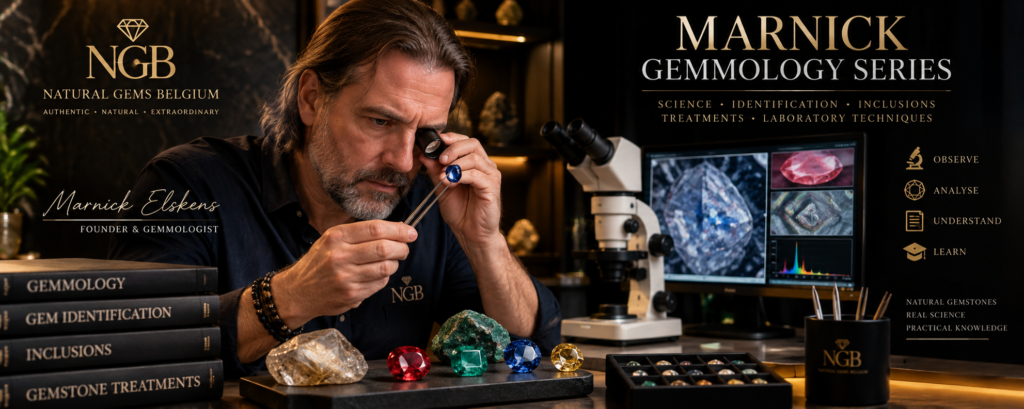
Explore the science of natural gemstones in greater depth with the Marnick Gemmology Video Series. Through detailed gemmological lessons, examine identification methods, inclusions, treatments, optical and physical properties, laboratory techniques and the scientific principles used to analyse, distinguish and understand natural gemstones.
Latest Episodes
About the Marnick Gemmology Video Series
The Marnick Gemmology Video Series explores natural gemstones through a technical and analytical approach to gemmology. Each episode focuses on a specific aspect of gemstone identification, examination or interpretation, connecting established gemmological principles with practical observation and laboratory methods. The aim is to make the science behind gemstones accessible while preserving the precision required to understand how gem materials are identified and distinguished.
Gemstone identification involves much more than recognising colour or appearance. The series examines physical, optical and structural properties that can provide valuable diagnostic information. Topics include refractive index, birefringence, optic character, specific gravity, pleochroism and fluorescence, together with the interpretation of inclusions, growth features and other internal characteristics. These observations can help build a coherent identification rather than relying on any single property in isolation.
Particular attention is also given to gemstone treatments and their detection. Heating, fracture filling, diffusion and other enhancement processes can alter the appearance or characteristics of gem materials, making correct disclosure an important part of modern gemmology. Episodes may examine the features associated with these treatments and explain how microscopic observation, optical testing and other analytical approaches contribute to their recognition.
Another important theme is the distinction between natural gemstones, synthetic materials and imitations. Similar appearances do not necessarily indicate the same origin or composition. By examining diagnostic properties and characteristic internal features, the series demonstrates why systematic testing is essential when separating visually similar materials and why the limitations of individual identification methods must always be considered.
Gemmological instruments and laboratory techniques form an integral part of this process. Depending on the subject, episodes may explore observations made with a loupe or microscope alongside measurements obtained using instruments such as the refractometer, polariscope or spectroscope. More advanced analytical methods may also be discussed where they are relevant to understanding what can — and cannot — be established through conventional gemmological examination.
Through this combination of scientific principles, practical examination and critical interpretation, the Marnick Gemmology Video Series provides a growing educational resource for anyone wishing to understand natural gemstones beyond their visual beauty. New episodes progressively expand the series, creating connections between gemstone properties, inclusions, treatments, identification methods and the broader science of gemmology.
