Table of Contents
Introduction: A Crystal That Is No Longer What It Appears to Be
Imagine finding a sharply formed cubic crystal.
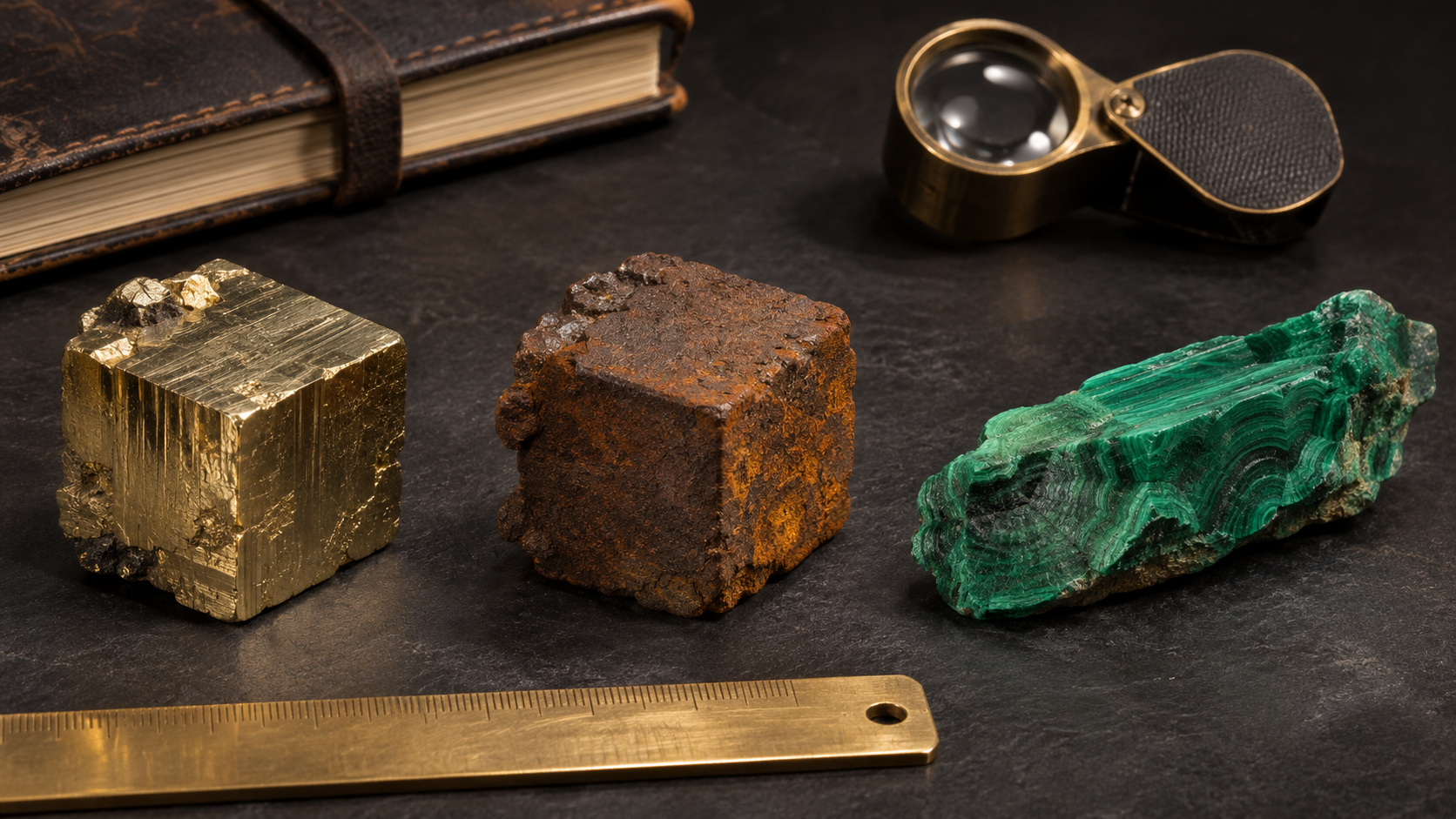
Its edges resemble those of pyrite, yet its surface is brown rather than metallic gold. Chemical and mineralogical examination reveals that the material is now composed largely of iron oxyhydroxides.
The original pyrite may have been replaced by goethite or a mixture of secondary iron minerals.
The cube remains, but the substance occupying it has changed.
This phenomenon is known as pseudomorphism.
A pseudomorph preserves an external form inherited from an earlier mineral or material, even though its present mineralogical composition or crystal structure is different.
Some pseudomorphs retain exceptionally fine details of the original crystal.
Others preserve only a general outline.
They can form during weathering, hydrothermal alteration, metamorphism or other geological processes.
For mineral collectors, pseudomorphs are fascinating natural specimens.
For geologists, they provide evidence of chemical reactions and mineral transformation.
For gemmologists, they demonstrate why external appearance alone cannot always establish mineral identity.
1. What Is a Mineral Pseudomorph?
The word pseudomorph derives from Greek roots meaning false form.
In mineralogy, it describes a mineral or mineral aggregate that retains a form inherited from an earlier phase.
The present material does not necessarily have the same composition or internal structure as the original.
A pseudomorph may form when one mineral replaces another.
It may also result from a structural transformation in which chemical composition remains the same but the crystal structure changes.
Some specimens preserve the original shape through encrustation followed by removal of the original crystal.
The essential feature is the preservation of an earlier form.
However, pseudomorphism should not be confused with an ordinary crystal that happens to possess an unusual habit.
A convincing pseudomorph interpretation requires evidence of a transformation or replacement history.
2. How Pseudomorphs Are Named
Mineralogists commonly use the expression:
New mineral after original mineral.
For example:
Goethite after pyrite means that goethite is the identified present mineral and pyrite was the earlier mineral whose form was preserved.
Malachite after azurite means that malachite occupies a form inherited from azurite.
Calcite after aragonite indicates calcite retaining a form associated with earlier aragonite.
This terminology is important because the order identifies the direction of transformation.
It is not interchangeable.
A specimen described as goethite after pyrite is not equivalent to pyrite after goethite.
If the replacement material has not been conclusively identified, the description should remain appropriately qualified.
For example, an iron-rich pseudomorph after pyrite may require additional analysis before it can be confidently assigned to goethite rather than a mixture of iron oxides and oxyhydroxides.
3. Why Do Minerals Transform?
Minerals are stable only within particular ranges of physical and chemical conditions.
Changes in temperature, pressure, fluid composition, oxidation state or chemical environment can make an existing mineral less stable.
A new mineral may then become thermodynamically favoured.
The transformation can involve several processes.
The original mineral may dissolve.
A new mineral may precipitate in the space it occupied.
Chemical components may be added or removed.
The internal crystal structure may change.
These reactions can occur over different geological timescales.
However, the external form does not always disappear during transformation.
Under favourable conditions, the new material develops while preserving the earlier outline.
This is the foundation of pseudomorphism.
4. Replacement Pseudomorphs
Replacement pseudomorphism occurs when an earlier mineral is replaced by a different mineral or mineral assemblage while its external shape remains recognisable.
Fluid-assisted replacement is particularly important.
A fluid can react with the original mineral, dissolve components and transport chemical species.
New material may precipitate close to the dissolving surface.
If dissolution and precipitation remain spatially coupled, the original shape can be preserved.
This process is more complex than a literal atom-by-atom exchange.
The original crystal lattice may be destroyed while a new crystal structure develops.
The resulting specimen can therefore retain an external form without retaining the original internal atomic arrangement.
5. Interface-Coupled Dissolution and Precipitation
Modern mineralogical research recognises interface-coupled dissolution and precipitation as an important replacement mechanism.
At a reaction interface, the original mineral dissolves while a new phase precipitates.
The reaction front may advance into the original crystal.
Fluid pathways and newly generated porosity can allow continued chemical transport.
The replacement material may consist of many small crystallites rather than one large crystal.
Nevertheless, the overall external shape can remain remarkably well preserved.
Putnis and Austrheim’s 2010 research on fluid-induced metamorphism and metasomatism discusses this mechanism in mineral replacement reactions.
The process explains how substantial chemical and structural changes can occur without completely destroying the original crystal outline.
It also demonstrates why a pseudomorph can preserve external morphology while possessing a very different internal microstructure.
6. Goethite After Pyrite: A Classic Example
Pyrite is iron disulfide, FeS₂.
It belongs to the cubic crystal system and frequently forms cubes or pyritohedra.
When pyrite is exposed to suitable oxidising conditions, chemical weathering can transform the material.
Sulfur-bearing components are removed or redistributed, while iron may become incorporated into secondary iron oxides or oxyhydroxides.
Goethite, FeO(OH), is one possible product.
Under favourable circumstances, the secondary material preserves the external form of the original pyrite.
A brown crystal may therefore retain sharp cubic faces inherited from pyrite.
The National Museum of Natural Science documents goethite after pyrite as an example of mineral pseudomorphism.
However, not every brown pyrite-shaped specimen is pure goethite.
Some consist of mixtures historically described as limonite.
Others retain an unaltered pyrite core beneath an altered surface.
Correct identification requires more than visual inspection.
7. Why the Term Limonite Requires Care
Limonite is a long-established descriptive term for naturally occurring hydrated iron-oxide and iron-oxyhydroxide materials.
It is not a single mineral species with one fixed crystal structure.
Materials described as limonite may contain goethite and other iron-bearing phases.
This matters when describing pseudomorphs.
A specimen labelled “limonite after pyrite” may preserve the shape of an earlier pyrite crystal without consisting of one precisely identified mineral species.
Mindat’s educational documentation notes that many pseudomorphs are mineral mixtures rather than pure phases.
For scientifically precise descriptions, the term should be used with an understanding of its limitations.
Where laboratory identification is unavailable, a qualified description such as “iron-oxide/oxyhydroxide pseudomorph after pyrite” may be more defensible than an unsupported species assignment.
8. Malachite After Azurite
Azurite and malachite are copper carbonate minerals.
Azurite has the formula Cu₃(CO₃)₂(OH)₂.
Malachite has the formula Cu₂CO₃(OH)₂.
Azurite is characteristically blue.
Malachite is characteristically green.
Under suitable chemical conditions, azurite may alter to malachite.
If the external form of the original azurite crystal is preserved, the resulting specimen is described as malachite after azurite.
This can produce green material retaining an external shape characteristic of the earlier blue mineral.
Some specimens show incomplete replacement.
They may contain remaining azurite alongside malachite.
Others are more extensively transformed.
The exact reaction history depends on the local chemical environment, including water and carbon dioxide activity.
The colour change is visually striking, but colour alone does not prove pseudomorphism.
A convincing interpretation requires evidence of the inherited form and mineral identity.
9. Partial Replacement: When Both Minerals Remain
Mineral transformation does not always proceed to completion.
A replacement reaction may stop because the chemical environment changes.
Fluid supply may decrease.
Reaction pathways may become blocked.
The resulting specimen can preserve both the original and replacement minerals.
For example, an altered pyrite crystal may contain an iron-oxide-rich exterior and a remaining pyrite interior.
An azurite crystal may be partly replaced by malachite.
These specimens can be especially informative because they preserve evidence of different stages of alteration.
However, the presence of two minerals does not automatically prove that one replaced the other.
They may have formed independently or during separate deposition events.
The spatial relationship and texture must be considered.
10. Paramorphs: Same Chemistry, Different Crystal Structure
Not every pseudomorph involves a change in chemical composition.
A paramorph results when a mineral transforms into another structural form of the same chemical substance while retaining the earlier external shape.
This is related to polymorphism.
Polymorphs have the same chemical composition but different crystal structures.
Calcite and aragonite are both calcium carbonate, CaCO₃.
They possess different crystal structures.
Under appropriate conditions, aragonite can transform into calcite.
If the resulting calcite retains the external form of the earlier aragonite, the specimen may be described as calcite after aragonite.
The National Museum of Natural Science identifies this as an example of pseudomorphism associated with structural transformation.
However, the precise mechanism may involve dissolution and reprecipitation rather than a simple solid-state rearrangement.
Preserved external form alone does not establish the microscopic reaction mechanism.
11. Encrustation and Hollow Pseudomorphs
Some pseudomorph-like specimens form through a different sequence.
First, a mineral crystal develops.
A second mineral subsequently forms a coating around it.
Later, the original crystal dissolves or is removed.
The coating may remain as a hollow shell preserving the earlier external shape.
This is often described as an encrustation pseudomorph.
The preserved form can be remarkably accurate.
However, a hollow shell is not equivalent to complete replacement of the original crystal volume.
The distinction matters when interpreting mineral specimens.
A hollow cast, an encrustation pseudomorph and a fully replaced crystal can look similar from the outside.
Their internal structures and formation histories differ.
12. Crystal Casts and Moulds
When a mineral dissolves, it may leave a cavity corresponding to its former shape.
This cavity is a crystal mould.
If another material subsequently fills the cavity, it can form a cast.
The cast may reproduce the original mineral’s geometry.
However, a cast is not necessarily a replacement pseudomorph in the strict mechanistic sense.
The original crystal may have disappeared before the new material was deposited.
The distinction between replacement and casting can be difficult to establish without examining internal textures.
For collectors, both can be scientifically interesting.
For mineralogical descriptions, the terminology should reflect the available evidence.
13. Quartz After Other Minerals
Quartz can occur in replacement textures that preserve earlier mineral shapes.
For example, silica-bearing fluids may participate in replacement processes involving other minerals.
A resulting quartz aggregate can retain the outline of an earlier crystal.
Such specimens demonstrate that quartz does not always grow in its familiar prismatic habit.
However, the presence of a cubic-looking silica specimen does not automatically prove replacement after fluorite.
A crystal cast, aggregate or other geological process may produce a similar appearance.
The identification of the earlier mineral requires supporting morphological, geological or analytical evidence.
This is an important lesson for mineral collectors.
Unusual shape is a clue, not a complete diagnosis.
14. Petrified Wood and Silica Replacement
Petrified wood provides a broader example of mineral replacement and preservation of earlier structures.
During silicification, silica may replace or fill portions of the original plant material.
The resulting material can preserve remarkable anatomical details.
Cellular structures, growth rings and other features may remain recognisable.
However, petrified wood does not form through one universal mechanism.
Different specimens may involve replacement, mineral infilling or combinations of processes.
Not every part of a silicified fossil must have formed through direct replacement.
Petrified wood illustrates how geological mineralisation can preserve earlier biological structures.
It also demonstrates why pseudomorphic preservation can extend beyond the external forms of individual mineral crystals.
15. Pseudomorphism and Metasomatism
Metasomatism involves chemical changes in rocks or minerals associated with the transfer of material, commonly through fluids.
Fluid-rock interaction can alter mineral assemblages.
Some minerals dissolve.
Others precipitate.
New phases may develop while preserving earlier textures.
Pseudomorphic replacement can occur during metasomatic processes.
However, metasomatism and pseudomorphism are not synonymous.
Metasomatism describes chemical alteration involving material transfer.
Pseudomorphism describes preservation of an earlier form during or after transformation.
A metasomatic reaction may completely destroy the original texture.
Conversely, some paramorphic transformations do not require a net change in bulk chemical composition.
The concepts overlap, but they describe different aspects of geological processes.
16. What Pseudomorphs Reveal About Geological History
A genuine pseudomorph demonstrates that at least two mineralogical stages occurred.
An earlier mineral or material existed.
A later transformation or replacement preserved some aspect of its form.
This establishes a relative sequence.
However, it does not automatically reveal the exact duration between the stages.
It does not independently establish the absolute geological age.
Nor does the external shape alone identify the precise temperature or pressure of replacement.
Pseudomorphs provide valuable geological evidence, but interpretation requires context.
Associated minerals, host rock, alteration textures and analytical data can help reconstruct the sequence.
The most defensible conclusion is often that a particular transformation occurred, rather than that it occurred at an exact date or temperature.
17. Can Pseudomorphs Identify a Mineral Deposit?
Pseudomorphs may provide clues about the geological processes affecting a mineral deposit.
Goethite after pyrite can indicate oxidation of earlier iron sulfide material.
Malachite after azurite can indicate alteration within a copper-bearing environment.
Silica replacement textures may reflect the movement of silica-bearing fluids.
However, these processes are not unique to one geographical locality.
Similar pseudomorphs can form in different regions.
Therefore, the presence of a particular pseudomorph does not independently establish the country, mine or deposit of origin.
Reliable provenance requires documented collection information or other appropriate evidence.
18. How Mineralogists Identify Pseudomorphs
The first step is often careful observation.
The specimen may display an external shape that is unusual for its present mineralogical composition.
Colour, lustre, surface texture and visible internal features may provide clues.
However, visual examination alone is not always conclusive.
Professional mineralogical analysis may involve X-ray diffraction to identify crystalline phases.
Raman spectroscopy may help distinguish mineral species.
Electron microscopy can reveal replacement textures and microstructures.
Chemical analysis may identify compositional changes across reaction boundaries.
These methods can help determine whether a specimen contains one mineral, several minerals or a complex alteration assemblage.
Some techniques are non-destructive or minimally invasive, while others require sampling.
The analytical approach should be appropriate to the specimen’s scientific and commercial importance.
19. Why External Crystal Shape Can Be Misleading
Crystal habit is an important mineralogical characteristic.
However, pseudomorphs demonstrate that external morphology can survive a change in mineral identity.
A cube-shaped specimen is not necessarily pyrite.
A crystal resembling azurite may now consist largely of malachite.
A form associated with aragonite may be occupied by calcite.
Therefore, external shape should be considered alongside other properties.
Hardness, density, optical characteristics, chemical composition and crystal structure may provide additional evidence.
For valuable or unusual specimens, laboratory analysis may be necessary.
A confident identification should not rest solely on inherited morphology.
20. Pseudomorphs and Collector Value
Mineral pseudomorphs can be highly attractive to collectors.
Their appeal often lies in the contrast between preserved form and transformed composition.
A sharply defined goethite pseudomorph after pyrite may preserve distinctive cubic faces.
Malachite after azurite may combine an unusual crystal form with vivid green colour.
Some pseudomorphs preserve intricate surface textures or partial replacement stages.
However, pseudomorphism alone does not guarantee high value.
Collector interest may depend on rarity, aesthetics, condition, crystal definition, locality and documentation.
A common altered specimen may have modest commercial value.
A rare, well-preserved pseudomorph with reliable provenance may be more desirable.
The market significance must be assessed individually.
21. Pseudomorphs and NGB Gemstone Evaluation
Pseudomorphic mineral specimens should be evaluated according to their intended use.
For decorative rough, the inherited crystal form may contribute to natural character and aesthetic appeal.
For mineral collectors, completeness of the pseudomorph and clarity of its replacement features may be important.
For faceting material, pseudomorphic replacement can influence transparency, internal structure and cutting suitability.
A visually attractive pseudomorph is not necessarily suitable for faceting.
Replacement textures may contain numerous small crystals, pores or internal weaknesses.
The term pseudomorph should therefore be used as a mineralogical description, not as a universal quality grade.
Where replacement is suspected but unconfirmed, the description should remain appropriately qualified.
22. Common Misconceptions About Mineral Pseudomorphs
A pseudomorph is simply a mineral with an unusual shape.
Incorrect. Pseudomorphism involves preservation of a form inherited from an earlier phase.
Every pseudomorph is formed through direct chemical replacement.
Incorrect. Structural transformations and encrustation processes can also produce pseudomorphs.
A pseudomorph always consists of one pure mineral.
Incorrect. Some contain several secondary phases.
A brown pyrite-shaped crystal must be goethite.
Incorrect. It may contain multiple iron-bearing minerals or a remaining pyrite core.
Malachite after azurite means azurite formed after malachite.
Incorrect. The present mineral is named first.
A pseudomorph proves the precise geological age of a specimen.
Incorrect. It establishes aspects of relative formation history, not an absolute age.
A pseudomorph can be identified solely by colour.
Incorrect. Colour is insufficient to establish the replacement mechanism.
Pseudomorphs are always rare and valuable.
Incorrect. Their abundance and desirability vary considerably.
23. Practical Workshop: Observing a Possible Pseudomorph
This workshop is intended for collectors and gemstone enthusiasts.
It is non-destructive and focuses on careful documentation.
Step 1 – Examine the external form
Record the crystal shape, visible faces, edges and surface markings.
Step 2 – Observe colour and lustre
Look for differences between the expected appearance of the apparent original mineral and the present material.
Step 3 – Inspect for partial replacement
If visible without damaging the specimen, note any contrasting cores, rims or exposed areas.
Step 4 – Consider possible coatings
A mineral coating does not automatically establish complete replacement.
Step 5 – Look for casts or hollow structures
Record any naturally exposed cavities without attempting to break the specimen.
Step 6 – Photograph the specimen
Use consistent lighting and include a scale reference.
Step 7 – Record the identification carefully
If the replacement mineral is uncertain, use provisional terminology.
Step 8 – Preserve the specimen
Avoid scratching, striking, acid testing or breaking the material to investigate its interior.
Step 9 – Seek professional analysis where justified
For valuable or scientifically significant specimens, laboratory identification may help establish the present mineral phases and replacement history.
The objective is to distinguish observable evidence from geological interpretation.
24. Why Pseudomorphs Matter for Scientific Transparency
Pseudomorphs illustrate why mineral identification should not rely on appearance alone.
A specimen may preserve the shape of one mineral while consisting of another.
A brown cube may record the former presence of pyrite.
A green crystal may preserve the earlier form of azurite.
A calcite specimen may retain the external morphology of aragonite.
These examples reveal the complexity of natural mineral formation.
Responsible descriptions should identify what is known and distinguish it from what is inferred.
Where the mineralogical transformation is established, the pseudomorph can be named confidently.
Where only the external shape suggests replacement, the description should acknowledge uncertainty.
This approach supports accurate scientific communication and realistic expectations for collectors.
Conclusion: Minerals Can Change While Their Shapes Survive
Mineral pseudomorphs preserve evidence of geological transformation.
They demonstrate that the external form of a crystal does not always correspond to the mineral currently occupying that form.
Replacement reactions can preserve earlier crystal outlines.
Paramorphic transformations can change crystal structure while maintaining composition.
Encrustation can preserve a form after the original mineral disappears.
Partial alteration can leave several mineral phases within one specimen.
Goethite after pyrite and malachite after azurite are particularly instructive examples.
These transformations show how minerals respond to changing chemical and geological environments.
However, pseudomorphs should not be interpreted beyond the available evidence.
Their external appearance alone does not establish exact formation conditions, absolute age or geographical provenance.
The essential scientific principle is:
A pseudomorph preserves a form inherited from an earlier material, even though the substance or structure occupying that form has changed.
For collectors, pseudomorphs are remarkable examples of natural preservation.
For geologists, they provide evidence of mineral reactions and relative geological history.
And for gemmology, they reinforce the importance of distinguishing external appearance from actual mineral identity.
References & Further Reading
The following references are educational, museum-based and scientific resources. They address pseudomorphism, mineral replacement, weathering, fluid-assisted reactions and mineralogical identification.
1. National Museum of Natural Science, Taiwan – The Truth About Mineral Pseudomorphs
A museum educational resource explaining pseudomorphs, structural transformations and replacement processes, with examples including goethite after pyrite and calcite after aragonite.
https://www.nmns.edu.tw/en/our-research/collections/01
2. Putnis, A., and Austrheim, H. (2010) – Fluid-Induced Processes: Metasomatism and Metamorphism
Geofluids, Volume 10, pages 254–269.
Peer-reviewed research discussing fluid-driven mineral reactions, interface-coupled dissolution and precipitation, porosity development and pseudomorphic replacement.
https://doi.org/10.1111/j.1468-8123.2010.00285.x
3. Mindat – Pseudomorphs & Replacements
An extensive mineralogical educational resource documenting replacement specimens, alteration mechanisms and the limitations of historical mixture names such as limonite.
https://www.mindat.org/a/best_pseudomorphs__replacements_a__b
4. Mindat – Goethite and Pyrite Specimen Documentation
A documented specimen illustrating goethite coating and partial replacement associated with pyrite crystals.
https://www.mindat.org/RRT-WMM
5. Mindat – Goethite After Pyrite, Berry-Havey Quarry
Mineral specimen documentation describing goethite pseudomorphs after pyrite from Maine, United States.
https://www.mindat.org/RWC-MJT
6. International Gem Society – Gem Formation: How Are Gemstones Created?
An educational explanation of gemstone-forming geological processes, including pseudomorphism and examples such as malachite after azurite.
https://www.gemsociety.org/article/gem-formation
Scientific Interpretation and Limitations
Pseudomorphism describes preservation of an inherited form and does not, by itself, establish the precise microscopic mechanism of transformation.
Replacement may involve dissolution and precipitation rather than direct atom-by-atom substitution.
Some pseudomorphs contain mineral mixtures rather than one pure mineral species.
External morphology alone cannot establish complete replacement, absolute geological age, formation temperature or geographical provenance.
Coatings, casts, partial replacements and paramorphs should be distinguished when sufficient evidence is available.
Mineral species identification may require crystallographic, spectroscopic or chemical analysis.
The practical workshop is intended for non-destructive observation and documentation, not definitive laboratory identification.