

Table of Contents
Introduction: When Gemstones Became Miniature Works of Art
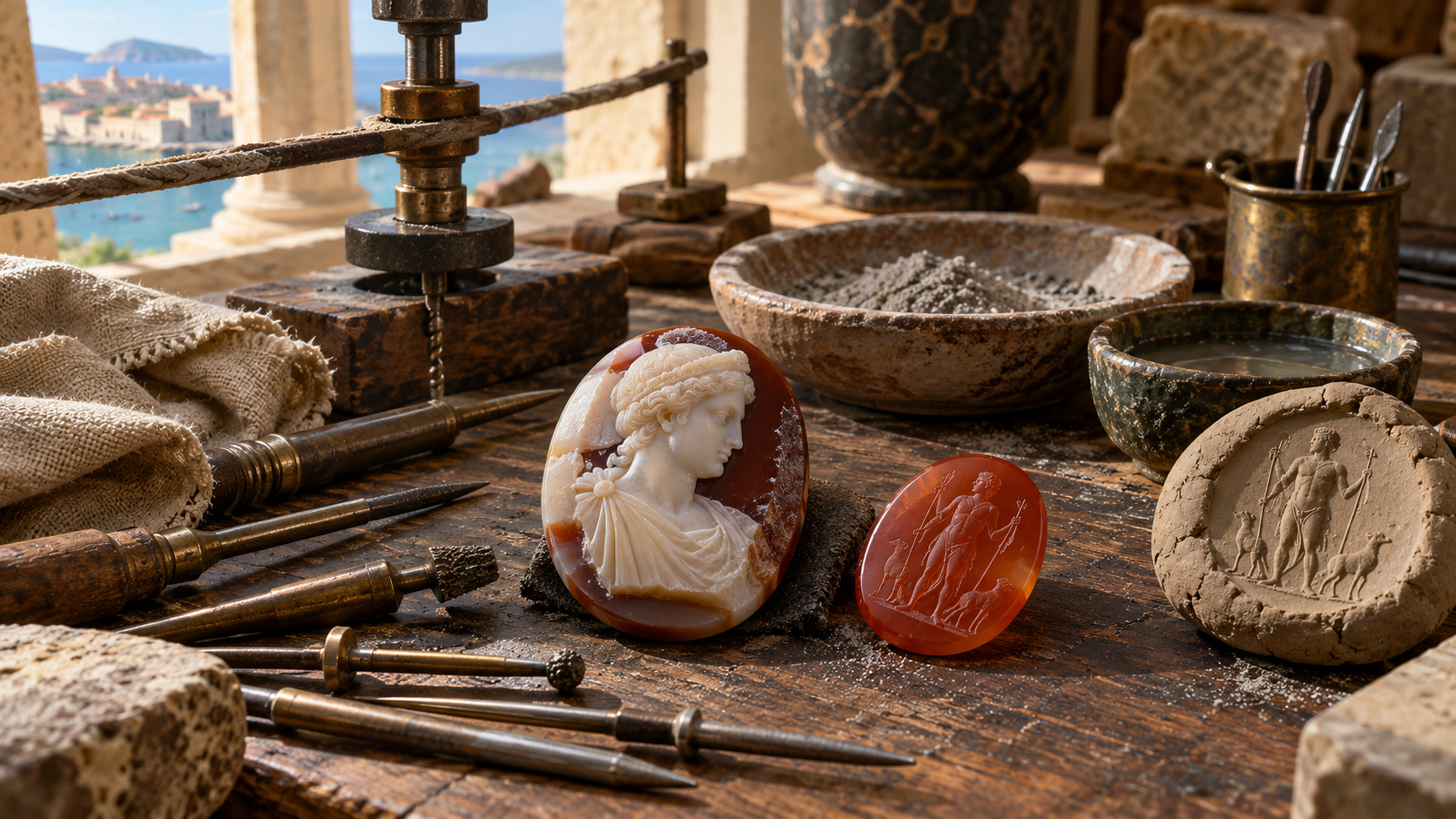
Long before modern gemstone faceting, ancient craftsmen were transforming natural minerals into miniature works of art.
A small piece of carnelian could become a personal seal.
A cylinder of rock crystal could carry an elaborate scene of people, animals and symbolic objects.
A carefully selected piece of layered sardonyx could be transformed into a portrait of an emperor.
These objects were not simply decorative.
They could communicate identity, ownership, authority, religious devotion and political allegiance.
Some were used to authenticate documents.
Others were worn as jewellery or treasured as prestigious artistic possessions.
The art of engraving gemstones developed across several ancient civilisations and continued to evolve through the Greek, Hellenistic and Roman worlds.
It required an extraordinary combination of artistic skill, knowledge of materials and mechanical precision.
Ancient engravers worked on a remarkably small scale.
Some of their surviving masterpieces measure only a few centimetres across.
Yet within those limited dimensions, artists represented human anatomy, mythology, animals, architecture and complex ceremonial scenes.
The difficulty of this work becomes even more impressive when we consider the tools available.
There were no electrically powered rotary engraving machines.
No modern diamond-coated cutting wheels.
No digital microscopes.
Instead, craftsmen relied on mechanical drills, abrasive materials, careful observation and extensive experience.
Their work gave rise to two particularly important forms of gemstone engraving: intaglios and cameos.
Although these techniques are often discussed together, they produce fundamentally different results.
Understanding their development reveals how natural gemstones became essential materials in the history of art, communication and personal identity.
Ancient engraved gemstones represent one of the most remarkable intersections between mineralogy, craftsmanship and human civilisation.
1. What Is Glyptic Art?
The term glyptic art refers to the engraving or carving of small objects, particularly gemstones and other durable materials.
The word derives from Greek terminology associated with carving and engraving.
In historical gemmology, glyptic art includes several different types of objects.
These include cylinder seals, stamp seals, engraved ring stones, intaglios and cameos.
Although their appearances differ, they share an important characteristic.
The artist modifies the surface of a material to create an image, inscription or decorative design.
In some cases, the engraving is intended to be viewed directly.
In others, the principal purpose is to create an impression in another material.
The distinction is particularly important when examining ancient seals.
An engraved seal may appear relatively difficult to interpret when viewed directly.
However, pressing it into clay or wax can produce a clear image.
This means that some ancient gemstones were designed not only as objects but also as tools for reproducing images.
The history of gemstone engraving is therefore closely connected with the development of administration, ownership and written communication.
2. The Earliest Engraved Seals of Mesopotamia
Some of the earliest important traditions of gemstone engraving developed in ancient Mesopotamia.
This region, situated principally within modern Iraq and neighbouring territories, was home to several influential early civilisations.
The development of increasingly complex societies created a need to identify individuals, authenticate transactions and secure valuable goods.
Engraved seals became important instruments for these purposes.
According to the Metropolitan Museum of Art, engraved stones were used to make impressions in clay as early as the seventh millennium BCE.
During the fourth millennium BCE, cylinder seals became particularly significant.
These cylindrical objects could be rolled across a soft clay surface.
Unlike a simple stamp, which produces a single impression, a cylinder seal creates a continuous design.
This allowed artists to develop elaborate compositions involving several figures.
A surviving Mesopotamian rock-crystal cylinder seal dated approximately 3300–2900 BCE demonstrates the sophistication of this early tradition.
The object, preserved in the Metropolitan Museum of Art, depicts three seated female figures associated with vessels.
Although the cylinder measures only approximately 2.1 centimetres, its engraved design produces a more extensive image when rolled across clay.
The object illustrates how miniature gemstone engraving became an important artistic and administrative technology thousands of years before the Roman Empire.
3. How Cylinder Seals Worked
A cylinder seal was usually a small cylindrical object engraved around its curved exterior.
The surface contained a design cut into the material.
When the cylinder was rolled across damp clay, the engraved areas produced a raised impression.
The resulting image could extend across a relatively large surface.
Cylinder seals were used in several contexts.
They could identify the authority responsible for a written document.
They could mark ownership.
They could also be impressed onto clay used to secure containers or entrances.
For example, a storage jar might be closed with a covering secured by clay.
A seal impression could identify the person responsible for the closure.
Breaking the sealing would provide evidence that the container had been opened.
This system helped establish administrative accountability.
The engraved designs could include animals, human figures, deities and ceremonial scenes.
Some seals also carried inscriptions.
The images provide valuable information about ancient religious beliefs, artistic conventions and social organisation.
An Akkadian cylinder seal dated approximately 2250–2150 BCE, now in the Metropolitan Museum of Art, illustrates a hunting scene.
Its surviving modern impression demonstrates how the complete composition becomes visible when the seal is rolled.
The same museum explains that some cylinder seals were perforated and could be worn as ornaments.
Thus, a single object might combine administrative, decorative and symbolic functions.
4. From Cylinder Seals to Personal Signets
Over time, different cultures developed various forms of engraved seals.
Some were cylindrical.
Others were designed to be pressed directly into a surface.
These are commonly called stamp seals.
The basic principle remained similar.
An engraved object created a recognisable impression.
In ancient Egypt, scarab-shaped seals became particularly important.
The scarab beetle was associated with religious symbolism, including ideas of renewal and the movement of the sun.
Scarabs could be carved from stone or other materials.
Their undersides often carried inscriptions or symbolic designs.
Other Mediterranean cultures developed engraved ring stones.
These could be mounted in metal rings and used as personal seals.
The ring provided a convenient way to carry the engraved gemstone.
Its owner could press the stone into wax or another suitable sealing material.
The impression functioned as a personal mark.
This relationship between gemstones and identity remained important throughout Greek and Roman antiquity.
It also helps explain why certain engraved gemstones were regarded as possessions of considerable personal significance.
A signet was not necessarily valuable only because of the mineral from which it was made.
Its engraved image and association with a particular individual could be equally important.
5. Intaglio: The Art of Engraving Below the Surface
An intaglio is an image carved below the surrounding surface of a gemstone.
The artist removes material to create recessed lines, shapes and figures.
The result is essentially the opposite of a raised relief.
When an intaglio is pressed into soft wax or clay, the recessed design produces a raised impression.
This makes intaglio engraving especially suitable for seals.
The technique also creates an interesting visual relationship between the original gemstone and its impression.
The image on the gemstone is reversed when transferred to another material.
Consequently, inscriptions intended to be read in the impression must be engraved in mirror image.
A skilled engraver had to understand this reversal while planning the composition.
The artist also needed to control the depth of the engraving.
Shallow grooves could represent fine details.
Deeper areas could produce stronger relief in the impression.
The resulting image depended on both the engraved gemstone and the material receiving the impression.
Intaglio engraving was particularly important in Greek and Roman jewellery.
Many engraved ring stones depict mythological figures, animals, portraits or symbolic objects.
The technique demonstrates how a gemstone could serve simultaneously as a decorative object and a practical instrument.
6. The Development of Greek Gemstone Engraving
Greek gemstone engraving developed into a highly sophisticated artistic tradition.
Early Greek engraved gems included animals, mythological scenes and human figures.
Over time, artists increasingly explored anatomy, movement and naturalistic representation.
The development of Greek sculpture influenced the miniature compositions produced by gemstone engravers.
Artists attempted to represent convincing human figures within extremely limited spaces.
They developed techniques for depicting muscles, clothing, facial expressions and movement.
The Metropolitan Museum of Art preserves a Greek steatite engraved gem dated to the late seventh through late sixth century BCE.
The object depicts the mythological hero Ajax.
Such examples demonstrate the relationship between gemstone engraving and the broader artistic traditions of ancient Greece.
By the Classical and Hellenistic periods, some engravers achieved remarkable technical refinement.
The Getty Museum identifies several important ancient master engravers, including Epimenes, Solon, Dioskourides and Gnaios.
Their surviving works, or objects attributed to them, demonstrate the exceptional artistic quality that could be achieved through miniature engraving.
However, many ancient engraved gemstones remain anonymous.
Attributing unsigned works to individual artists requires careful comparison of style, technique and historical context.
7. Cameos: Sculpture Emerging from Stone
A cameo differs fundamentally from an intaglio.
Instead of cutting the design below the surrounding surface, the engraver removes material around the subject.
The image remains raised above its background.
This creates a miniature relief sculpture.
Although early Greek relief engraving provided important precedents, elaborate hardstone cameos became particularly prominent during the Hellenistic period.
The British Museum associates the development of sophisticated cameo carving with the Hellenistic royal environment, particularly Alexandria in Egypt.
Cameos became increasingly popular during the Roman period.
Their subjects included deities, rulers, mythological scenes and portraits.
Unlike an intaglio seal, a cameo was generally intended to be viewed directly.
Its artistic effect depended on the raised composition.
The sculptural nature of cameos allowed artists to represent faces, clothing and complex figures with remarkable depth.
However, the technique required careful planning.
The engraver had to remove surrounding material without damaging the raised design.
When layered gemstones were used, the artist also had to consider the distribution of colour within the stone.
This made cameo carving an especially demanding form of lapidary craftsmanship.
8. Why Sardonyx Became an Important Cameo Material
Sardonyx is one of the most celebrated materials associated with ancient cameo carving.
It belongs to the broader family of chalcedony materials.
Chalcedony consists predominantly of microcrystalline quartz.
Its chemical composition is principally silicon dioxide, SiO₂.
Sardonyx is distinguished by its contrasting colour bands, traditionally including brownish-red and pale layers.
These natural layers create opportunities for artistic contrast.
A cameo engraver could position the design so that a pale layer formed the raised figure.
A darker underlying layer could become the background.
The result was a striking image created through the interaction of natural mineral structure and human craftsmanship.
The effect resembles a miniature sculpture emerging from differently coloured stone.
However, the layers were not simply decorative features.
They influenced the entire carving process.
The artist needed to understand their thickness, orientation and continuity.
If the pale layer was too thin, important details might break through into the darker material.
If the darker layer was removed excessively, the intended contrast could be lost.
Successful cameo carving therefore required both artistic judgement and careful observation of the gemstone.
9. The Mineralogical Properties of Ancient Engraving Materials
Ancient engravers selected materials according to several characteristics.
Colour was important.
So were durability, texture, availability and the ability to accept detailed carving.
Different gemstones offered different advantages.
Carnelian
Carnelian is a reddish-orange to reddish-brown variety of chalcedony.
Its colour is associated principally with iron-bearing compounds.
Carnelian was widely used for engraved gemstones.
Its fine-grained structure makes it suitable for detailed carving and polishing.
Agate
Agate is a banded variety of chalcedony.
Its natural patterns can create attractive decorative effects.
Certain agates are especially suitable for cameos because contrasting layers can be incorporated into the design.
Sardonyx
Sardonyx is a banded chalcedony material traditionally associated with contrasting reddish-brown and pale layers.
It became particularly important for elaborate cameos.
Jasper
Jasper is generally an opaque, fine-grained silica-rich material.
It occurs in numerous colours and patterns.
Ancient engraved objects made from jasper demonstrate its usefulness as a durable decorative material.
Rock Crystal
Rock crystal is transparent quartz.
Its clarity provides a different visual effect from opaque or translucent chalcedony.
Ancient Mesopotamian cylinder seals were sometimes made from rock crystal.
Amethyst
Amethyst is the purple variety of quartz.
Its colour and transparency made it attractive for certain engraved gemstones.
The Getty Museum preserves an ancient Roman amethyst engraving depicting Apollo.
These materials demonstrate that ancient gemstone engraving was not limited to one mineral species.
Instead, craftsmen selected stones according to the intended artistic and practical result.
10. The Importance of Hardness and Abrasives
Quartz and chalcedony have a Mohs hardness of approximately 7.
This makes them substantially harder than many common metals.
Consequently, ancient engravers could not simply carve these gemstones in the same way that a woodworker cuts timber.
They needed abrasive techniques.
The principle is relatively straightforward.
A harder abrasive material can remove particles from a softer surface through repeated mechanical action.
Ancient craftsmen used rotating tools together with abrasive powders.
The metal tool helped control the movement and location of the abrasive.
The abrasive performed much of the actual material removal.
This distinction is important.
A copper tool is softer than quartz.
Yet when combined with a sufficiently hard abrasive, it can form part of an effective gemstone engraving system.
Historical evidence indicates that emery was among the abrasives used in ancient gemstone working.
Emery is a naturally occurring abrasive material containing corundum and associated minerals.
Corundum has a Mohs hardness of 9.
The use of abrasive powders made it possible to work materials that would otherwise have been extremely difficult to shape with ordinary metal tools.
The technical achievement of ancient gem engravers therefore depended not only on the design of their tools but also on their understanding of abrasive materials.
11. How Ancient Gemstones Were Engraved
Ancient gemstone engraving involved several stages.
Although techniques varied between periods and workshops, historical research allows us to reconstruct the principal processes.
Selecting the rough material
The engraver began with a suitable piece of stone.
The material needed to be large enough for the intended design.
Its colour, transparency and internal structure influenced the choice.
For cameos, the arrangement of contrasting layers was particularly important.
Preparing the blank
The rough material was shaped into a manageable form.
This might involve grinding and smoothing.
Many engraved ring stones were prepared as small oval or rounded blanks.
Polishing the surface
The blank could be polished before the detailed engraving began.
A smooth surface made it easier to assess the developing design.
Planning the image
The artist determined the position and proportions of the composition.
For intaglio seals, the eventual reversal of the impression had to be considered.
Engraving
Rotating tools and abrasives were used to remove material.
Different tool shapes could produce grooves, rounded depressions and broader carved areas.
Refining the details
Smaller tools allowed the engraver to develop fine features.
These might include facial details, hair, clothing or inscriptions.
Final finishing
The engraved surfaces could be refined and polished according to the intended appearance.
Türkiye’s Ministry of Culture and Tourism provides a detailed historical explanation of these techniques in its educational material on ancient gems and finger rings from Asia Minor.
The publication discusses bow drills, abrasive powders and different cutting-tool shapes.
These methods demonstrate the mechanical sophistication of ancient lapidary craftsmanship.
12. Bow Drills and Rotary Engraving
One important tool associated with ancient engraving was the bow drill.
A bow drill uses a cord wrapped around a spindle.
Moving the bow backward and forward causes the spindle to rotate alternately.
This movement can drive a small cutting or grinding tool.
The system converts repeated hand movement into rotary motion.
Different attachments could produce different engraving effects.
Small rounded tools could create circular depressions.
Disc-shaped tools could produce grooves and broader cuts.
Historical evidence also indicates the use of horizontal arrangements that allowed improved control over the gemstone.
The engraver needed to manage pressure, movement and abrasive application carefully.
Excessive force could damage the stone.
Insufficient control could distort the image.
The small scale of the work made these challenges particularly demanding.
The Ministry of Culture and Tourism identifies an ancient funerary monument associated with Doros of Sardis, a gemstone engraver, as evidence relevant to the historical use of bow-drill equipment.
However, reconstructing every detail of ancient workshop practice remains difficult.
Surviving objects and tool marks provide important evidence, but not every tool or technique is documented completely.
13. Did Ancient Engravers Use Magnifying Glasses?
The precision of ancient engraved gemstones raises an obvious question.
How could craftsmen produce such fine details without modern magnification?
The answer is not completely established.
Ancient engravers certainly possessed exceptional manual skills.
They also developed specialised techniques for controlling small tools.
However, direct evidence for the routine use of magnifying lenses in ancient gemstone engraving remains uncertain.
The Metropolitan Museum of Art notes that the introduction of magnifying glasses into the craft is difficult to establish.
Türkiye’s Ministry of Culture and Tourism similarly observes that decisive evidence for their use in antiquity is lacking.
This does not prove that no ancient engraver ever experimented with optical aids.
It means that the available evidence does not justify treating magnification as a universally established workshop practice.
The surviving engravings nevertheless demonstrate remarkable precision.
Some ancient craftsmen could produce detailed figures within areas measuring only a few millimetres.
Their achievements reflect extensive training, specialised tools and highly developed artistic judgement.
14. Famous Greek and Roman Gem Engravers
Although most ancient engraved gemstones are unsigned, a small number of artists are known through surviving signatures and historical references.
The Getty Museum identifies several important masters.
Epimenes
Epimenes was active around 500 BCE.
Works associated with him demonstrate the refinement of Greek engraving during the transition toward more naturalistic artistic representation.
Solon
Solon worked during the late Roman Republican and early Augustan period.
He is associated with portraits and mythological imagery.
Several surviving gems bear his signature.
Dioskourides
Dioskourides was an important Greek engraver active during the first century BCE.
Ancient literary sources associate him with the personal seal of Emperor Augustus.
His surviving work demonstrates exceptional precision in representing human anatomy and movement.
Gnaios
Gnaios was another distinguished engraver active during the first century BCE.
His surviving signed works include portraits and mythological subjects.
These artists demonstrate that gemstone engraving could achieve a level of prestige comparable to other recognised artistic disciplines.
However, caution is necessary when discussing attribution.
Later engravers sometimes copied ancient styles.
Some also imitated or forged the signatures of famous masters.
Consequently, a signature on an engraved gemstone does not automatically establish its authenticity.
15. Roman Cameos and Imperial Political Imagery
During the Roman Empire, engraved gemstones became important vehicles for political representation.
Portraits of rulers could communicate authority, legitimacy and imperial identity.
Cameos were particularly suitable for elaborate representations.
Their raised relief allowed artists to depict idealised faces and symbolic attributes.
The emperor Augustus provides a particularly important example.
The Metropolitan Museum of Art preserves a sardonyx cameo depicting Augustus associated with a double-headed Capricorn.
The object dates to approximately 27 BCE–14 CE.
Capricorn was an important personal and political symbol associated with Augustus.
The cameo demonstrates how imperial imagery could combine portraiture, astrology and political symbolism.
Another sardonyx cameo in the museum depicts Augustus in the guise of a triumphant semidivine figure.
That object dates to approximately 41–54 CE, during the reign of Claudius.
This distinction is historically important.
A cameo depicting Augustus was not necessarily produced during Augustus’s lifetime.
Imperial portraits could continue to be created after a ruler’s death.
The date of the depicted individual and the date of the engraved object must therefore be considered separately.
16. The Blacas Cameo: A Remarkable Roman Example
One of the most celebrated surviving Roman cameos is the Blacas Cameo.
It is preserved in the British Museum.
The object is carved from layered sardonyx.
It depicts Emperor Augustus wearing a decorated headband.
The British Museum dates the cameo to approximately 14–20 CE.
Its elaborate composition demonstrates the extraordinary artistic possibilities of layered gemstone carving.
The artist used the stone’s contrasting colours to create a sophisticated portrait.
The object also has a complex later history.
The British Museum notes that elements decorating the headband were probably added during the medieval period.
This is an important reminder that historical gemstones can undergo modification long after their original creation.
A surviving ancient cameo may contain later additions, repairs or mounts.
Consequently, the present appearance of an object does not necessarily represent its original ancient condition.
The Blacas Cameo illustrates both the achievements of Roman gemstone engraving and the challenges of interpreting objects that have survived through many centuries of collecting and reuse.
17. Engraved Gemstones as Personal Jewellery
Not every ancient engraved gemstone was an imperial masterpiece.
Many were personal possessions.
Small intaglios could be mounted in rings.
Cameos could also be incorporated into jewellery.
Their imagery often reflected the interests, beliefs or identity of the wearer.
Some depicted deities.
Others showed animals, mythological heroes or symbolic objects.
Portraits were also popular.
The Getty Museum preserves a Roman cameo depicting Minerva set into a gold ring.
Minerva was the Roman goddess associated with wisdom, skilled crafts and other attributes.
The museum interprets the image as having a protective significance for its wearer.
Such objects demonstrate that jewellery could communicate religious and cultural associations.
However, these meanings must be understood within their historical context.
An ancient belief that a particular image or gemstone offered protection does not establish that the object possessed measurable supernatural properties.
The historical significance lies in what people believed, how they expressed those beliefs and how the objects functioned within their societies.
This distinction allows cultural traditions to be examined respectfully without presenting historical beliefs as scientific facts.
18. Glass Imitations and the Wider Availability of Engraved Images
Not every ancient engraved object was made from a natural gemstone.
Glass could also be used.
Ancient craftsmen developed techniques for producing decorative glass objects that resembled engraved stones.
Some glass materials imitated the colours or appearance of natural gemstones.
The Metropolitan Museum of Art preserves Roman engraved glass ring stones.
It also holds a gold ring containing a glass cameo portrait of Augustus.
The museum explains that objects bearing imperial imagery existed at different levels of luxury.
Fine sardonyx cameos were associated with elite circles.
Less expensive glass objects allowed similar imagery to circulate more widely.
This distinction is important for historical gemmology.
An object may be genuinely ancient without being made from a natural gemstone.
Likewise, an ancient glass imitation is not necessarily a modern counterfeit.
Its material may have been deliberately selected according to the technology, cost and intended use of its period.
Accurate identification therefore requires separating the object’s historical authenticity from the nature of its material.
19. The Survival of Ancient Cameos Through the Middle Ages
The history of engraved gemstones did not end with the Roman Empire.
Many ancient cameos survived into medieval Europe.
Some were reused in jewellery.
Others were incorporated into religious objects.
The Metropolitan Museum of Art documents the use of ancient cameos in reliquaries, book covers and other prestigious objects.
Their original imagery was not always interpreted in the same way by later owners.
A classical figure could acquire a different meaning when incorporated into a medieval religious setting.
This process demonstrates how gemstones could move between cultural contexts.
The material remained the same, but its function and interpretation changed.
Ancient engraved gemstones were also collected by rulers and religious institutions.
Their durability helped them survive long after other artistic materials had deteriorated.
However, their survival sometimes involved alteration.
Original mounts could be replaced.
New settings could be created.
Decorative additions could change the appearance of the object.
The historical identity of an engraved gemstone must therefore consider both its original manufacture and its subsequent history.
20. The Renaissance Revival of Gemstone Engraving
During the Renaissance, European artists and collectors developed renewed interest in classical antiquity.
Ancient engraved gemstones became highly desirable.
Collectors admired their craftsmanship and historical associations.
Artists studied their compositions.
Some engravers created new works inspired by ancient models.
The Metropolitan Museum of Art documents the importance of classical cameos to Renaissance collecting.
Lorenzo de’ Medici was among the influential collectors associated with this tradition.
Ancient gems could become prestigious objects within aristocratic collections.
Their images were also reproduced in other artistic media.
However, renewed interest created new challenges.
Some later engravers copied ancient designs so successfully that distinguishing their work from genuine antiquities became difficult.
Others deliberately produced deceptive imitations.
This problem became particularly significant during the eighteenth and nineteenth centuries.
The history of engraved gemstones therefore includes not only ancient craftsmanship but also centuries of collecting, reinterpretation and forgery.
21. Can an Ancient Engraved Gemstone Be Authenticated Scientifically?
Authenticating an engraved gemstone involves several different questions.
The first concerns the material.
Is the object made from natural carnelian, sardonyx, jasper, glass or another substance?
This question can often be investigated through gemmological examination.
The second concerns the engraving.
When was the image carved?
Who produced it?
Was the object modified during a later period?
These questions are more difficult.
A natural gemstone may be millions of years old geologically.
However, its carving may have been produced only a few years ago.
The geological age of the mineral does not establish the age of the artwork.
Likewise, identifying a genuine ancient material does not automatically authenticate the engraving.
Historical attribution may require comparison with documented objects.
Researchers may examine style, iconography, tool marks, inscriptions, archaeological context and collection history.
Scientific analysis can sometimes identify materials or modifications inconsistent with a proposed attribution.
However, no single routine gemmological test can establish the precise carving date of every engraved gemstone.
The Getty Museum emphasises the importance of stylistic comparison and historical research in evaluating ancient engraved gems.
This is especially important because later artists frequently imitated classical designs.
22. How Gemmologists and Collectors Can Examine Engraved Gemstones
Examining an engraved gemstone requires attention to both its material and its craftsmanship.
Several characteristics are particularly relevant.
Material identity
The first objective is to establish whether the object is made from the material claimed.
A gemstone described as carnelian should be examined as a mineralogical specimen.
A glass imitation should not be misidentified as natural chalcedony.
Engraving technique
The carved design should be examined carefully.
Differences in engraving depth, surface texture and tool marks may provide information about manufacturing methods.
However, these observations do not independently prove antiquity.
Surface condition
Polishing, wear, scratches and later damage can affect appearance.
Natural wear should not automatically be interpreted as evidence of great age.
Artistic quality
The precision of the carving can be evaluated.
Important characteristics include anatomical proportions, symmetry, detail and compositional balance.
However, exceptional craftsmanship does not establish that an object is ancient.
Historical documentation
Reliable archaeological provenance or a well-documented collection history can be especially valuable.
Later modifications
Settings, repairs and recutting may have occurred after the original manufacture.
These features should be distinguished from the original engraved material.
The objective is to evaluate the object through several independent forms of evidence.
23. Why Natural Gemstone Identification Matters
Historical engraved gemstones demonstrate why accurate mineral identification remains essential.
The appearance of a carved object can be influenced by several factors.
Natural colour variation is one.
Layering is another.
Transparency, polish and surface texture also contribute.
A carnelian intaglio and a glass imitation may display similar colours.
A sardonyx cameo and a layered artificial material may create comparable visual contrasts.
Consequently, appearance alone is not always sufficient for identification.
Modern gemmological examination may involve appropriate optical observations and non-destructive analytical methods.
However, historical objects require particular care.
Testing should respect their cultural significance and physical condition.
Potentially damaging procedures should not be performed simply to satisfy curiosity about mineral identity.
Museum conservation and specialist archaeological assessment may be necessary.
The relationship between mineralogical identification and historical interpretation is therefore especially important in this field.
24. Common Misconceptions About Ancient Engraved Gemstones
Misconception 1: Intaglios and cameos are the same type of carving.
Incorrect.
Intaglios contain recessed designs, while cameos display raised relief.
Misconception 2: All ancient engraved gemstones were decorative jewellery.
Incorrect.
Many served as administrative seals or personal identification devices.
Misconception 3: Ancient engravers could not carve hard gemstones without modern machinery.
Incorrect.
Rotary tools combined with abrasive materials made detailed engraving possible.
Misconception 4: Every ancient cameo was made from sardonyx.
Incorrect.
Different stones and other materials were used.
Misconception 5: All engraved gemstones are natural minerals.
Incorrect.
Glass and other manufactured materials were also employed.
Misconception 6: A gemstone’s natural origin proves that its engraving is ancient.
Incorrect.
The geological origin of the material and the historical date of carving are separate questions.
Misconception 7: A famous engraver’s signature guarantees authenticity.
Incorrect.
Signatures were sometimes copied or forged.
Misconception 8: A cameo depicting Augustus must have been made during his lifetime.
Incorrect.
Imperial portraits could be produced after the ruler’s death.
Misconception 9: All ancient gemstone engravings can be dated precisely.
Incorrect.
Many objects lack sufficient archaeological or documentary evidence for precise dating.
Misconception 10: The protective properties attributed to engraved gemstones are scientifically established.
Incorrect.
Historical beliefs are important cultural evidence but do not demonstrate measurable supernatural effects.
25. The Lasting Importance of Ancient Gemstone Engraving
Ancient engraved gemstones provide an unusually direct connection between mineralogy and human history.
Their materials reveal the properties of natural minerals.
Their techniques demonstrate the development of specialised craftsmanship.
Their images preserve religious beliefs, artistic conventions and political messages.
Their use as seals provides evidence of administrative practices.
Their later collection and reuse reveal changing cultural attitudes toward antiquity.
The same object can therefore be studied from several perspectives.
A gemmologist may investigate its mineral composition.
An archaeologist may examine its historical context.
An art historian may study its imagery and style.
A conservator may investigate its condition and later modifications.
These approaches complement one another.
Together, they provide a more complete understanding than any single discipline could offer.
For modern gemstone collectors, engraved gems also demonstrate that the significance of a gemstone cannot always be reduced to colour, clarity or weight.
In certain historical objects, craftsmanship and cultural context may be more important than the intrinsic rarity of the mineral.
A small carnelian intaglio can possess extraordinary historical significance.
A carefully executed sardonyx cameo can represent an exceptional achievement of artistic skill.
Their value as cultural objects extends far beyond the physical characteristics of the stone alone.
Conclusion: Where Mineralogy Meets Human History
Ancient gemstone engraving transformed natural minerals into objects of identity, authority, devotion and artistic expression.
From the cylinder seals of Mesopotamia to the sophisticated intaglios of Greece and the layered cameos of Rome, the craft developed through thousands of years of experimentation.
Ancient engravers learned to exploit the physical properties of different materials.
They used abrasive techniques to work hard gemstones.
They developed methods for creating detailed images on extremely small surfaces.
They understood how recessed designs could produce raised impressions.
They discovered how contrasting mineral layers could be transformed into miniature sculptures.
Their work also reveals the changing relationship between gemstones and society.
A seal could authenticate a transaction.
A ring could communicate personal identity.
A cameo could display imperial authority.
A carved image could express religious devotion.
Later generations preserved, collected and reinterpreted these objects.
Today, surviving engraved gemstones remain valuable sources of archaeological, artistic and gemmological information.
They remind us that natural gemstones have been appreciated for far more than their appearance.
Their durability, colour, structure and ability to accept fine craftsmanship allowed them to become lasting records of human civilisation.
An ancient engraved gemstone is more than a mineral transformed by an artist.
It is a meeting point between Earth’s geological materials and the history of human creativity.
References & Further Reading
The following references have been selected from recognised gemmological institutions, museum research publications, official museum collections and governmental cultural resources.
They provide historical, technical and mineralogical context for ancient gemstone engraving, intaglios, cameos, cylinder seals, engraving techniques and historical authentication.
All references lead to educational, scientific or museum information rather than commercial gemstone product pages.
1. Gemological Institute of America – Engraved Gems: A Historical Perspective
Author: F. L. Gray
Publication: Gems & Gemology
Volume: 19, Number 4
Published: Winter 1983
A substantial historical and gemmological study of engraved gemstones.
The publication examines early seals, cylinder seals, scarabs, intaglios, cameos and the development of engraving techniques.
It also discusses the evaluation of engraved gemstones and the relationship between historical craftsmanship and modern gemmological practice.
https://www.gia.edu/gems-gemology/winter-1983-history-gems-gray
2. Metropolitan Museum of Art – Cameo Appearances
Author: James David Draper
Institution: Metropolitan Museum of Art
Published: 1 August 2008
An authoritative museum essay examining the historical development of cameo engraving.
The article explains the distinction between intaglio and cameo techniques, ancient engraving methods, layered gemstone materials and the changing cultural importance of cameos.
It also discusses medieval reuse, Renaissance collecting and later artistic revivals.
https://www.metmuseum.org/essays/cameo-appearances
3. J. Paul Getty Museum – Carvers and Collectors: The Lasting Allure of Ancient Gems
Institution: J. Paul Getty Museum
Exhibition: Getty Villa, 19 March–7 September 2009
A museum research resource examining ancient engraved gemstones and the artists responsible for their creation.
The publication discusses Epimenes, Solon, Dioskourides and Gnaios.
It also addresses artistic attribution, historical collecting, forged signatures and the influence of ancient engraving on later European art.
https://www.getty.edu/art/exhibitions/gems/index.html
4. Metropolitan Museum of Art – Cylinder Seal and Modern Impression: Three “Pigtailed Ladies” with Double-Handled Vessels
Institution: Metropolitan Museum of Art
Culture: Late Uruk–Jemdet Nasr
Date: Approximately 3300–2900 BCE
Material: Rock crystal
Collection number: 1985.143
An important early Mesopotamian cylinder seal demonstrating the development of engraved stone seals.
The museum’s documentation explains the use of cylinder seals for ownership, identification and administrative transactions.
The object also illustrates the relationship between the engraved cylinder and its rolled impression.
https://www.metmuseum.org/art/collection/search/327067
5. Metropolitan Museum of Art – Cylinder Seal and Modern Impression: Hunting Scene
Institution: Metropolitan Museum of Art
Culture: Akkadian
Date: Approximately 2250–2150 BCE
Material: Chert
Collection number: 41.160.192
A documented Akkadian cylinder seal illustrating the artistic and administrative functions of engraved stones.
The accompanying museum interpretation explains how seal impressions were used to identify authority and protect containers or documents.
https://www.metmuseum.org/art/collection/search/329090
6. Ministry of Culture and Tourism of Türkiye – Methods of Engraving
Institution: Republic of Türkiye, Ministry of Culture and Tourism
Resource: Ancient Gems and Finger Rings from Asia Minor
A detailed educational resource explaining historical gemstone engraving techniques.
The publication discusses the preparation of gemstone blanks, polishing, bow drills, abrasive powders and the mechanical principles of ancient engraving.
It also examines historical evidence concerning engraving tools and the uncertainty surrounding the use of magnifying lenses.
https://www.ktb.gov.tr/EN-120291/methods-of-engraving.html
7. British Museum – Rediscovering Gems: Exhibition Guide
Institution: British Museum
Resource: Rediscovering Gems — Large Print Exhibition Guide
An educational museum publication examining ancient engraved gemstones and their cultural significance.
The guide discusses the development of cameos, layered sardonyx, Roman imperial portraiture and the historical importance of the Blacas Cameo.
It also addresses the later collection and imitation of ancient engraved gems.
https://www.britishmuseum.org/exhibitions/rediscovering-gems/large-print-guide
8. Metropolitan Museum of Art – Sardonyx Cameo of a Double Capricorn with a Portrait of Emperor Augustus
Institution: Metropolitan Museum of Art
Culture: Roman
Date: Approximately 27 BCE–14 CE
Material: Sardonyx and gold
Collection number: 29.175.4
A documented Roman cameo depicting Augustus associated with a double-headed Capricorn.
The museum explains the political and symbolic significance of Capricorn in Augustan imagery.
The object provides a valuable example of the relationship between gemstone engraving, portraiture and imperial representation.
https://www.metmuseum.org/art/collection/search/253042
9. J. Paul Getty Museum – Cameo Gem
Institution: J. Paul Getty Museum
Collection: Ancient engraved gemstones
A museum collection record examining a Roman cameo depicting marine creatures.
The accompanying interpretation discusses the development of cameo engraving and the artistic use of contrasting layers in natural gemstones.
It also explains how some cameos reverse the more familiar arrangement of pale figures against darker backgrounds.
https://www.getty.edu/art/collection/object/103VTP
10. Gemological Institute of America – Gem Cutting Styles: Definitions
Author: Al Gilbertson
Institution: Gemological Institute of America
Published: 9 August 2018
A technical gemmological publication explaining different gemstone cutting styles.
The article includes definitions of cameos and intaglios and discusses their relationship to non-faceted gemstone cutting.
It provides useful modern terminology for distinguishing raised and recessed gemstone carving.
https://www.gia.edu/gia-news-research-value-factors-gem-cutting-styles-definitions
11. J. Paul Getty Museum – Getty Museum Acquires Collection of Ancient Engraved Gems
Institution: J. Paul Getty Museum
Published: 2019
An institutional publication discussing significant ancient engraved gemstones acquired by the Getty Museum.
The article examines important examples of Roman portrait engraving, including works associated with Dioskourides.
It provides information about artistic attribution, collection history and the importance of surviving master engravings.
https://www.getty.edu/news/getty-acquires-collection-ancient-engraved-gems
12. Metropolitan Museum of Art – Gold Ring with Cameo Glass Portrait of Emperor Augustus
Institution: Metropolitan Museum of Art
Culture: Roman
Date: First half of the first century CE
Material: Gold and glass
Collection number: 1995.85.1
A documented Roman ring containing a glass cameo portrait of Augustus.
The museum explains how imperial imagery circulated through objects made from materials of different costs and levels of prestige.
This example is particularly useful for distinguishing natural gemstone engraving from ancient glass imitations.
https://www.metmuseum.org/art/collection/search/256217
Scientific and Historical Interpretation
Ancient gemstone engraving developed across different cultures and historical periods.
The techniques, materials and artistic conventions discussed in this article should not be interpreted as uniform practices followed by every ancient engraver.
Historical attributions frequently depend on stylistic comparison, archaeological context and surviving documentation.
The identification of a natural gemstone does not establish the age of its engraving.
Likewise, the presence of an ancient-style image or a historical signature does not independently prove authenticity.
The religious and protective meanings associated with certain engraved gemstones are presented as historical and cultural beliefs rather than scientifically demonstrated supernatural properties.
The distinction between mineralogical identification, artistic interpretation and historical authentication is essential for accurate gemmological education.
[…] the most distinctive ornaments of ancient East Asia is a small, curved bead known in Japanese as a […]