

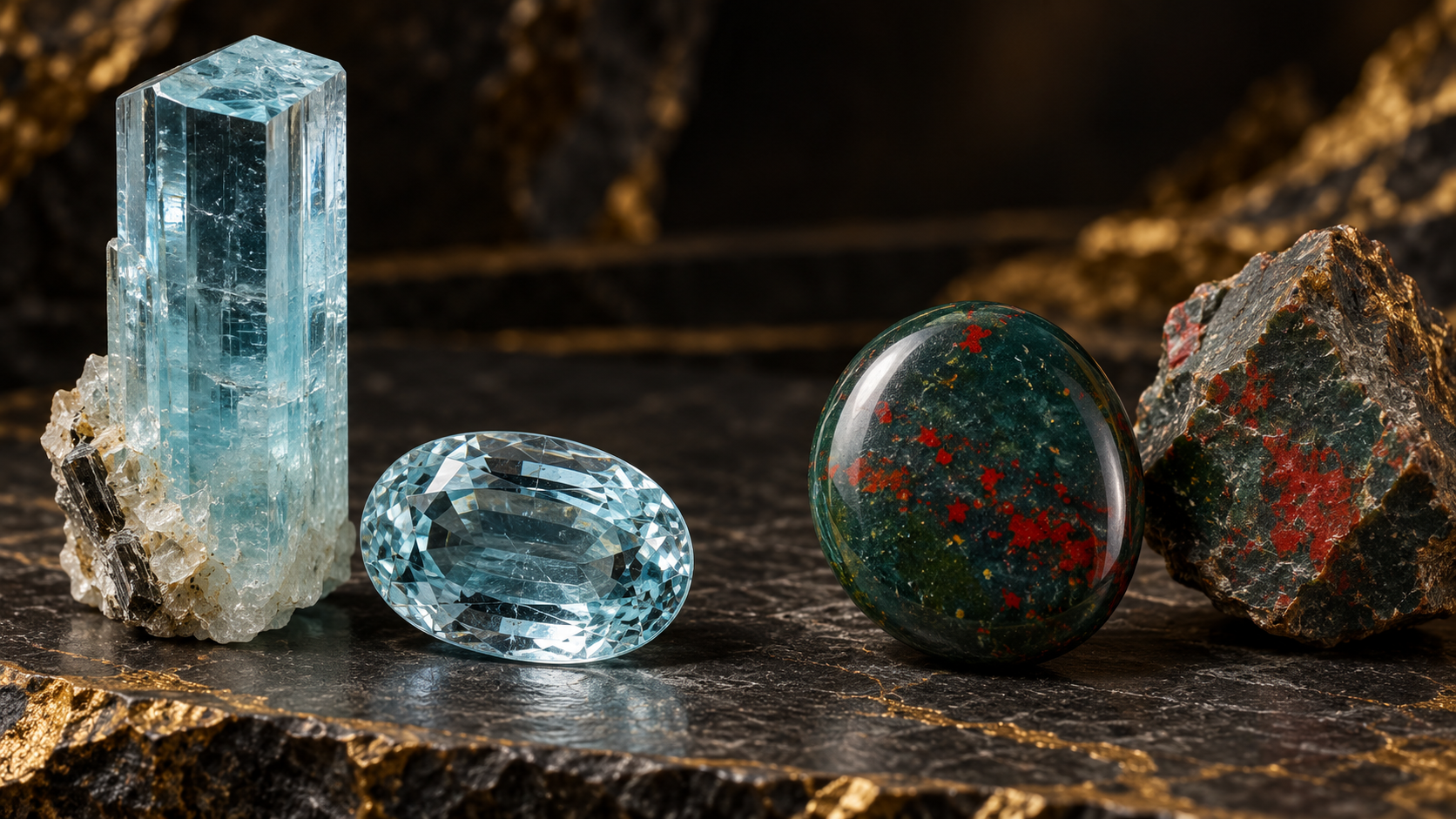
Two gemstones, two remarkable geological stories, and centuries of cultural traditions.
March is associated with two distinctive birthstones: aquamarine, admired for its transparent blue colours reminiscent of the sea, and bloodstone, recognised for its deep-green appearance decorated with contrasting red markings.
Although both gemstones share the same birth month, they are fundamentally different in their mineral composition, geological formation, optical properties and historical associations.
Aquamarine belongs to the beryl mineral family, which also includes emerald and morganite. Bloodstone, traditionally known as heliotrope, belongs to the chalcedony group within the broader quartz family.
Their contrasting appearances illustrate the extraordinary diversity of natural gemstones.
Beyond their beauty, both stones have accumulated centuries of symbolism involving protection, courage, renewal and human relationships with the natural world.
This article explores their scientifically established properties, geological origins, historical significance and traditional meanings, while distinguishing documented mineralogical facts from cultural beliefs.
Table of Contents
1. Why Does March Have Two Birthstones?
The association between gemstones and calendar months developed through several historical traditions.
Ancient and medieval gemstone symbolism frequently connected particular stones with religious imagery, celestial bodies, seasonal cycles and personal protection.
Over time, these associations evolved into birthstone lists that differed between cultures and historical periods.
Modern birthstone systems were subsequently standardised through jewellery-industry conventions, although traditional alternatives remain recognised.
For March, aquamarine is generally presented as the principal modern birthstone, while bloodstone retains its position as an important traditional alternative.
The two stones represent very different visual characteristics.
Aquamarine is associated with transparent blue colour, while bloodstone is distinguished by its predominantly opaque green body and red mineral inclusions.
Their shared association with March is therefore cultural rather than mineralogical.
2. Aquamarine: The Blue Variety of Beryl
Mineralogical identity
Aquamarine is the blue to greenish-blue variety of the mineral beryl.
Beryl is a beryllium aluminium cyclosilicate with the chemical formula:
Be₃Al₂Si₆O₁₈
Its crystal structure belongs to the hexagonal crystal system.
Aquamarine commonly forms elongated, six-sided prismatic crystals, sometimes reaching exceptional dimensions.
The mineral’s colour is primarily associated with iron incorporated into its crystal structure.
Different oxidation states of iron and their interactions with the surrounding crystal lattice influence the observed blue and greenish-blue colours.
Unlike emerald, whose characteristic green colour is primarily associated with chromium and/or vanadium, aquamarine derives its distinctive appearance mainly from iron-related absorption processes.
Gemmological properties of aquamarine
| Property | Characteristics |
|---|---|
| Mineral species | Beryl |
| Gemstone variety | Aquamarine |
| Chemical formula | Be₃Al₂Si₆O₁₈ |
| Crystal system | Hexagonal |
| Colour | Blue to greenish blue |
| Mohs hardness | 7.5–8 |
| Refractive index | Approximately 1.577–1.583 |
| Birefringence | Approximately 0.005–0.009 |
| Specific gravity | Approximately 2.72 |
| Lustre | Vitreous |
| Transparency | Transparent to translucent |
| Optical character | Uniaxial negative |
These values represent typical gemmological characteristics. Natural variation can occur between individual specimens.
Why is aquamarine blue?
The blue colour of aquamarine results from the interaction between light and iron-related colour centres within the beryl crystal structure.
As light travels through the crystal, selected wavelengths are absorbed, while others are transmitted.
This selective absorption produces the gemstone’s characteristic blue appearance.
Aquamarine may also display pleochroism, meaning that its apparent colour or colour intensity can vary depending on the direction from which the crystal is observed.
This optical behaviour is important during gemstone cutting.
An experienced lapidary considers the orientation of the crystal to achieve an attractive balance between colour, transparency and brilliance.
3. How Does Aquamarine Form?
Aquamarine commonly develops in geological environments associated with granitic pegmatites.
Pegmatites are exceptionally coarse-grained igneous rocks that can contain large crystals of quartz, feldspar, mica and accessory minerals, including beryl.
During the final stages of crystallisation of certain granitic magmas, residual melts may become enriched in elements such as beryllium, lithium and other components.
Under suitable chemical and physical conditions, beryl crystals can develop within these environments.
The presence of iron can produce the blue to greenish-blue coloration characteristic of aquamarine.
Because some pegmatitic environments permit relatively unrestricted crystal growth, aquamarine can occasionally form crystals of extraordinary size.
Important geographical sources
Aquamarine has been recovered from several regions around the world.
Brazil is historically one of the most important producers, particularly the state of Minas Gerais.
Other recognised sources include:
- Pakistan, especially mountainous pegmatite deposits
- Madagascar
- Mozambique
- Nigeria
- Zambia
- Kenya
- Afghanistan
- Selected regions of the United States
Geographical origin alone does not establish the quality or value of an aquamarine.
Colour, clarity, cutting quality and overall appearance remain central considerations.
4. Aquamarine Throughout History
The gemstone of the sea
The name aquamarine originates from the Latin words aqua, meaning water, and marina, meaning of the sea.
Its association with water is understandable given its characteristic blue-green colour.
In historical gemstone lore, aquamarine became connected with sailors, maritime journeys and the desire for safe passage.
Ancient mariners were said to regard the gemstone as a protective talisman capable of calming dangerous waters.
These stories are part of the gemstone’s cultural history rather than evidence of physical protective powers.
Historical claims about the precise use of aquamarine in antiquity should also be approached carefully, because ancient mineral names did not always correspond to modern gemmological classifications.
A gemstone described in an ancient text as beryl or another blue-green material cannot automatically be identified as aquamarine without additional evidence.
Aquamarine in historical jewellery
The transparency and relatively good durability of aquamarine have made it suitable for faceted gemstones, ornamental objects and decorative carvings.
Its capacity to form large crystals has also allowed lapidaries to create unusually large polished specimens.
One celebrated example is the Dom Pedro Aquamarine, preserved in the Smithsonian Institution’s National Museum of Natural History.
This monumental faceted aquamarine weighs approximately 10,363 carats and was fashioned by renowned gemstone artist Bernd Munsteiner.
It demonstrates both the geological potential of aquamarine and the artistic possibilities of modern gemstone cutting.
Another historically significant example is the 1,298-carat aquamarine presented to Eleanor Roosevelt by the Brazilian government in 1936.
Traditional symbolism
Aquamarine has been associated with:
- Safe travel and maritime protection
- Harmony and loyalty
- Clear communication
- Serenity and emotional balance
- Marital happiness
These meanings belong to cultural and symbolic traditions.
They should not be interpreted as scientifically demonstrated psychological or medical effects.
Aquamarine is also traditionally associated with the nineteenth wedding anniversary.
5. Aquamarine in Modern Jewellery
Aquamarine is particularly appreciated for its transparency and delicate colour.
Its Mohs hardness of 7.5–8 makes it suitable for many jewellery applications, including rings, earrings, pendants and bracelets.
However, hardness measures resistance to scratching, not complete resistance to fracture or impact.
Aquamarine can still be damaged by forceful contact or unsuitable handling.
Understanding aquamarine quality
Several factors influence the appearance and desirability of a faceted aquamarine.
Colour: Moderately strong to saturated blue colours are generally more highly valued than very pale material, assuming other quality factors are comparable.
Clarity: Many fine aquamarines are exceptionally transparent and relatively free from eye-visible inclusions.
Cut: Appropriate cutting proportions can enhance brilliance and reduce unattractive windowing, particularly in lighter-coloured stones.
Carat weight: Aquamarine occurs in relatively large crystals, but exceptionally fine colour combined with substantial size remains desirable.
Treatment: Heat treatment is commonly used to reduce greenish components and produce a more distinctly blue appearance. Such treatment should be disclosed where known.
A naturally coloured aquamarine and a heat-treated aquamarine can both be genuine natural gemstones.
Treatment status and natural geological origin are separate considerations.
6. Bloodstone: The Green and Red Gemstone of March
Bloodstone presents a striking contrast to aquamarine.
Rather than displaying transparent blue colour, bloodstone typically has a dark-green body marked by red spots, patches or irregular inclusions.
Its distinctive appearance is responsible for its familiar English name.
Mineralogical identity
Bloodstone, also known as heliotrope, is traditionally classified as a variety of chalcedony within the quartz family.
Chalcedony consists of extremely fine intergrowths of silica minerals, predominantly quartz and, in some materials, moganite.
The principal chemical composition is silicon dioxide:
SiO₂
Unlike aquamarine, which can develop as individual macroscopic crystals, chalcedony has a cryptocrystalline or microcrystalline structure.
This means its constituent crystalline domains are extremely small.
Bloodstone is generally opaque to slightly translucent and commonly displays a waxy to subdued vitreous lustre.
What causes bloodstone’s colours?
The green body colour is associated with finely dispersed mineral inclusions and pigments, commonly involving chlorite-group minerals or other green mineral constituents.
The characteristic red markings are generally produced by iron oxides, particularly hematite.
Hematite has the chemical formula:
Fe₂O₃
These red inclusions may appear as small spots, larger irregular patches or streak-like concentrations.
The distribution of these inclusions varies naturally between specimens.
Consequently, each bloodstone can display a distinctive pattern.
Gemmological properties of bloodstone
| Property | Characteristics |
|---|---|
| Gemstone name | Bloodstone / Heliotrope |
| Mineral group | Chalcedony, quartz family |
| Principal chemical composition | SiO₂ |
| Structure | Cryptocrystalline to microcrystalline |
| Colour | Dark green with red markings |
| Red colour component | Iron oxides, especially hematite |
| Mohs hardness | Approximately 6.5–7 |
| Specific gravity | Commonly around 2.6 |
| Lustre | Waxy to vitreous |
| Transparency | Usually opaque to slightly translucent |
| Common cutting styles | Cabochon, beads, carvings |
Because bloodstone is a heterogeneous aggregate, its physical and optical properties can vary according to mineral inclusions and composition.
7. How Does Bloodstone Form?
Bloodstone forms through geological processes involving silica-rich fluids and the deposition or replacement of silica within suitable rock environments.
Chalcedony may develop in cavities, fractures and other openings where dissolved silica precipitates over time.
During formation, mineral impurities and inclusions can become incorporated into the silica-rich material.
Green mineral constituents influence the background colour, while iron oxides produce the characteristic red markings.
Bloodstone can subsequently be released from its host rock through weathering and erosion.
Rounded specimens may therefore occur in river gravels and other secondary deposits.
Where is bloodstone found?
Important reported sources include:
- India
- Brazil
- Australia
- China
- United States
India has historically been an important source of bloodstone used for gemstones and ornamental carving.
The precise appearance of material varies between deposits, reflecting differences in geological formation and mineral composition.
8. Bloodstone, Heliotrope and Plasma: Understanding the Terminology
The terminology surrounding bloodstone can be confusing.
Bloodstone generally refers to green chalcedony or jasper-like material displaying distinctive red iron-oxide markings.
Heliotrope is the traditional mineralogical and historical name commonly used as a synonym for bloodstone.
The term derives from Greek words associated with the sun and turning.
Plasma is an older gemmological term for green chalcedony, typically without the conspicuous red markings that characterise bloodstone.
Although these materials may be closely related, plasma should not automatically be treated as a second formal variety of bloodstone.
Similarly, the commercial term blood jasper is sometimes encountered, but it is less precise than bloodstone or heliotrope.
The boundary between jasper and chalcedony terminology is not always consistently applied in commercial gemstone descriptions.
For accurate identification, mineralogical characteristics are more important than trade names alone.
9. The Historical Significance of Bloodstone
The meaning of heliotrope
The name heliotrope originates from Greek words associated with turning toward the sun.
Ancient accounts connected the stone with unusual visual effects involving sunlight and water.
One traditional belief suggested that placing heliotrope in water could alter the apparent colour of the sun.
Such accounts reflect historical interpretations of natural phenomena and gemstone symbolism.
They do not establish an actual ability to change sunlight or astronomical behaviour.
Bloodstone in classical antiquity
Green and red ornamental stones were used in various forms of ancient jewellery and engraved gems.
Materials identified as heliotrope or bloodstone were particularly suited to intaglios, seals and decorative carvings.
Their fine-grained structure allows detailed engraving and polishing.
Nevertheless, identifying the precise mineral material used in ancient artefacts requires caution.
Historical names, archaeological descriptions and modern mineralogical terminology do not always correspond perfectly.
Christian symbolism
During later Christian traditions, bloodstone acquired a powerful religious association.
One legend connected the gemstone’s red markings with the blood of Christ during the Crucifixion.
According to this symbolic narrative, blood falling onto green stone created the distinctive red-spotted appearance.
This is a religious and cultural legend, not a geological explanation.
Scientifically, the red markings originate from naturally occurring mineral constituents, particularly iron oxides.
The religious interpretation nevertheless became an important part of bloodstone’s historical identity.
10. Bloodstone in Traditional Beliefs
Across different periods, bloodstone has been associated with ideas of:
- Courage and perseverance
- Physical strength
- Protection during difficult circumstances
- Vitality and endurance
- Renewal and resilience
Historical traditions also attributed medicinal properties to bloodstone.
These included beliefs concerning bleeding, circulation and general health.
Such claims belong to the history of medicine and gemstone folklore.
There is no reliable clinical evidence that wearing, carrying or placing bloodstone on the body treats bleeding disorders, improves circulation or cures disease.
Likewise, aquamarine should not be presented as a clinically effective treatment for anxiety, digestive disorders or other medical conditions.
Gemstones may hold personal, spiritual or cultural significance without possessing medically demonstrated therapeutic effects.
Distinguishing symbolism from scientific evidence is essential when presenting gemstone traditions responsibly.
11. Bloodstone in Jewellery and Decorative Art
Bloodstone has traditionally been used for cabochons, beads, signet rings, engraved seals and ornamental objects.
Unlike transparent aquamarine, bloodstone is generally valued for its surface pattern rather than its internal brilliance.
The most desirable appearance depends on personal preference, but many collectors favour a rich green background with clearly visible and attractively distributed red markings.
Bloodstone is commonly cut into:
- Oval and round cabochons
- Signet-ring stones
- Polished beads
- Decorative plaques
- Small sculptures and carvings
Its hardness of approximately 6.5–7 provides reasonable resistance to scratching, although care is necessary during regular wear.
For cleaning, warm water, mild soap and a soft cloth are generally appropriate.
Harsh chemicals, strong impacts and abrupt temperature changes should be avoided.
12. Aquamarine vs Bloodstone: A Gemmological Comparison
| Characteristic | Aquamarine | Bloodstone |
|---|---|---|
| March birthstone tradition | Modern principal birthstone | Traditional alternative |
| Mineral identity | Beryl variety | Chalcedony variety |
| Chemical composition | Be₃Al₂Si₆O₁₈ | Predominantly SiO₂ |
| Crystal structure | Hexagonal | Cryptocrystalline aggregate |
| Typical colour | Blue to greenish blue | Dark green with red markings |
| Transparency | Usually transparent | Usually opaque |
| Mohs hardness | 7.5–8 | 6.5–7 |
| Typical appearance | Transparent, brilliant gemstone | Patterned ornamental gemstone |
| Common cuts | Faceted cuts | Cabochons, carvings, beads |
| Historical associations | Sea, travel, harmony | Courage, protection, religious symbolism |
Despite their contrasting properties, both gemstones demonstrate how mineral chemistry and geological processes produce remarkable natural diversity.
13. Choosing a March Birthstone
Choosing between aquamarine and bloodstone depends on the intended use, preferred appearance and personal significance of the gemstone.
Aquamarine may appeal to those who appreciate transparent gemstones, delicate blue colours and brilliant faceting.
It is particularly suitable for elegant jewellery designs where light transmission and optical performance are important.
Bloodstone offers a different aesthetic.
Its deep-green colour, red mineral inclusions and long history of engraved gemstones make it especially interesting for signet rings, cabochon jewellery and collectors of historically significant ornamental materials.
For either gemstone, buyers should consider accurate identification, natural characteristics, workmanship, durability and any known treatments.
An attractive gemstone should be evaluated on its actual properties rather than on unsupported claims concerning its origin, rarity or supposed healing abilities.
14. Two Gemstones, One Month, Different Stories
Aquamarine and bloodstone represent two remarkably different expressions of the mineral world.
Aquamarine reveals the optical beauty of transparent beryl crystals, coloured by iron and shaped by geological processes associated with pegmatite formation.
Bloodstone demonstrates how fine-grained silica and mineral inclusions can combine to create distinctive natural patterns.
Their historical associations also illustrate the many ways human societies have interpreted gemstones.
Aquamarine became connected with the sea, safe journeys and harmony.
Bloodstone acquired associations with courage, vitality and religious symbolism.
These traditions remain culturally interesting even when they cannot be explained or validated through modern science.
Together, the two March birthstones offer an opportunity to explore not only gemstone beauty, but also geology, gemmology, history and the enduring human fascination with natural minerals.
Natural Gems Belgium – Our Gemmological Perspective
At Natural Gems Belgium, gemstones are approached through a combination of scientific gemmology, transparent descriptions and appreciation for their natural characteristics.
The distinction between mineralogical properties, geological origin, treatment history and traditional symbolism is fundamental to responsible gemstone education.
A gemstone’s beauty can be appreciated alongside its history without confusing cultural beliefs with scientifically established facts.
Our Learning Center is dedicated to helping readers understand these distinctions and develop a more informed appreciation of natural gemstones.
References & Further Reading
The following references are informational resources from recognised gemmological, scientific and academic institutions. They are not retail product pages.
1. Gemological Institute of America (GIA) – March Birthstones: Aquamarine and Bloodstone
Comprehensive educational overview of the two March birthstones, including history, geological sources, gemmological properties and care.
https://www.gia.edu/birthstones/march-birthstones
2. Gemological Institute of America (GIA) – Aquamarine Gem Encyclopedia
Mineralogical characteristics, chemical composition, optical properties, quality factors and research.
https://www.gia.edu/aquamarine
3. Gemological Institute of America (GIA) – Aquamarine Description
Scientific and descriptive information concerning aquamarine colour, crystal formation and heat treatment.
https://www.gia.edu/aquamarine-description
4. Gemological Institute of America (GIA) – Aquamarine Research
Research articles addressing inclusions, crystal features and gemmological investigations.
https://my.gia.edu/aquamarine/gem-research
5. University of Nebraska–Lincoln – Traditional Birthstones: Aquamarine
Academic geological information concerning aquamarine, beryl chemistry, crystallography and optical characteristics.
https://csd.unl.edu/geology/gems/birthstones/aquamarine
6. Gemological Institute of America (GIA) – Birthstones Museum Exhibit
Educational museum-related discussion of gemstone traditions and historical birthstone associations.
https://www.gia.edu/gia-museum-exhibit-birthstones
7. Gemological Institute of America (GIA) – Gübelin Gem Project: Beryl
Reference material concerning the beryl mineral family, trace-element colouration and gemmological characteristics.
https://my.gia.edu/gia-gem-project-beryl
Educational note: Historical and spiritual associations discussed in this article are presented as cultural traditions. They do not constitute medical advice or evidence of therapeutic efficacy.
© Natural Gems Belgium — NGB 2.0 Learning Center
[…] Aquamarine, emerald and morganite are gem varieties of beryl. […]