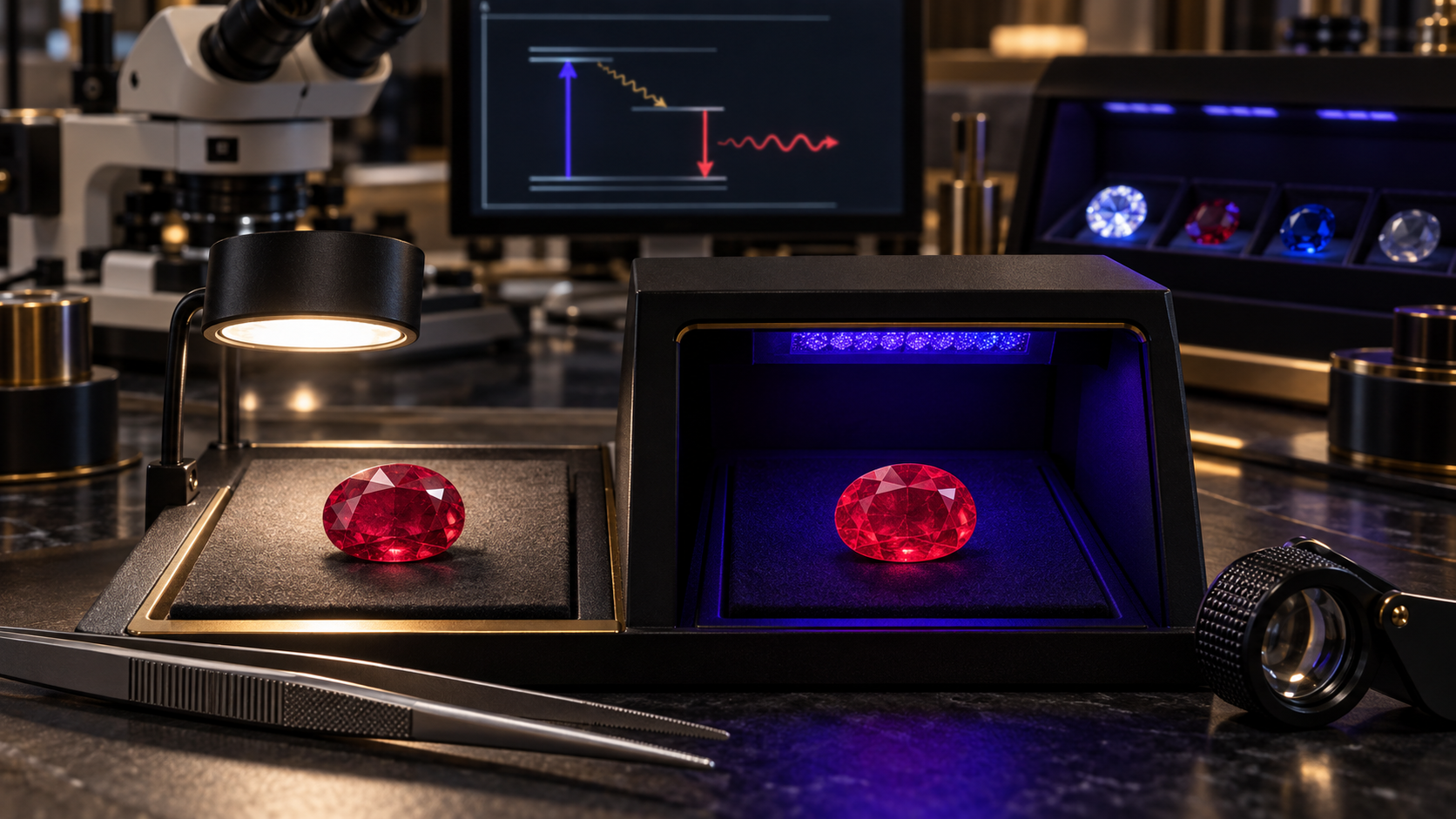
A ruby is placed under a professional ultraviolet examination lamp.
Under ordinary white light, it displays its characteristic red body colour.
Under suitable ultraviolet illumination, the gemstone may emit a vivid red glow.
The effect can appear almost mysterious.
Yet its explanation is firmly grounded in physics, mineral chemistry and the behaviour of electronic energy states.
The phenomenon is known as fluorescence.
Fluorescence is one of the most visually striking optical properties encountered in gemmology. It can provide useful information about impurities, structural defects, growth history and sometimes gemstone treatments.
But it is also frequently misunderstood.
A gemstone that fluoresces strongly is not automatically natural.
A gemstone that does not fluoresce is not automatically synthetic.
And fluorescence alone is rarely sufficient to identify a gemstone conclusively.
Understanding fluorescence requires examining not only the light emitted by the gemstone, but also the physical processes responsible for that emission.
Watch Episode 7 — Gemstone Fluorescence: Why Some Gemstones Glow Under Ultraviolet Light
In Episode 7 of the Natural Gems Belgium Gemmology Series, Marnick Elskens, Founder of Natural Gems Belgium, explores the scientific principles behind gemstone fluorescence.
The episode explains electronic excitation, ultraviolet illumination, fluorescence activators, quenching, the distinction between fluorescence and phosphorescence, and the professional applications of luminescence in gemmology.
The video provides the visual introduction. Below, we examine the science and practical implications in greater detail.
Table of Contents
What Is Fluorescence?
Fluorescence is a form of photoluminescence.
Photoluminescence occurs when a material absorbs electromagnetic radiation and subsequently emits radiation as a result of that excitation.
In gemmology, fluorescence is commonly examined using ultraviolet light.
The gemstone absorbs energy from the incident radiation.
That energy can excite electronic states associated with atoms, impurities or structural defects within the material.
When the excited system relaxes, part of the absorbed energy may be released as emitted light.
If the emitted radiation lies within the visible spectrum, the observer may see the gemstone glow.
The colour and intensity of that glow depend on the material’s electronic structure and the conditions of excitation.
Fluorescence Is Not Reflection
A fundamental distinction must be made between reflected light and fluorescence.
When white light illuminates a gemstone, some light is reflected from its surfaces and some enters the material.
The gemstone’s body colour is largely influenced by selective absorption and transmission.
Fluorescence involves a different process.
The material absorbs excitation energy and subsequently emits new radiation.
The emitted light is not simply the original ultraviolet radiation bouncing off the gemstone.
It is produced through electronic relaxation within the material.
This distinction is central to understanding luminescence.
The Physics of Electronic Excitation
At the microscopic level, atoms, ions and crystal defects possess allowed electronic energy states.
When a photon of suitable energy is absorbed, an electronic transition may occur.
The system enters a higher-energy excited state.
That excited state is generally not permanent.
The system may return toward a lower-energy state through several possible pathways.
Some energy may be dissipated without light emission.
This is known as non-radiative relaxation.
Alternatively, energy may be released through the emission of a photon.
When this radiative process occurs promptly following excitation, the phenomenon may be classified as fluorescence.
The exact transition energies determine the wavelengths of light that can be absorbed and emitted.
Excitation and Emission Spectra
Fluorescence involves two related but distinct spectral characteristics.
The excitation spectrum describes how efficiently a material can be excited at different wavelengths.
The emission spectrum describes the wavelengths of radiation produced by the material after excitation.
These spectra are not necessarily identical.
A gemstone may absorb ultraviolet radiation while emitting visible red, blue, green or another colour.
Different excitation wavelengths may also produce different emission intensities or activate different luminescence centres.
This is why the choice of UV source can influence the fluorescence observed.
The Stokes Shift
In many fluorescence processes, the emitted photon has lower energy than the absorbed photon.
Because photon energy is inversely related to wavelength, the emitted radiation often has a longer wavelength than the excitation radiation.
This difference is known as the Stokes shift.
For example, ultraviolet excitation may produce visible red fluorescence.
Part of the absorbed energy may be lost through non-radiative relaxation before emission occurs.
However, not every luminescence process follows an identical energy pathway.
The Stokes shift is a common and important concept, not a universal explanation for every possible emission mechanism.
Long-Wave and Short-Wave Ultraviolet Light
Traditional gemmological fluorescence examination commonly distinguishes two ultraviolet regions.
Long-wave ultraviolet illumination is commonly associated with approximately 365 nanometres.
Short-wave ultraviolet illumination is commonly associated with approximately 254 nanometres.
These are conventional wavelengths used in professional gemmological examination.
A gemstone may fluoresce strongly under one source and weakly under another.
Some materials may appear inert under one excitation wavelength but respond under a different wavelength.
Consequently, fluorescence observations should identify the source used.
A statement such as “the gemstone fluoresces blue” is less informative than a documented observation specifying the excitation conditions.
Why Different UV Lamps Can Produce Different Results
Ultraviolet lamps are not all identical.
Their output can vary according to:
- lamp technology;
- spectral distribution;
- filter quality;
- lamp age;
- excitation intensity;
- viewing geometry;
- and distance between the source and gemstone.
Traditional mercury-based lamps and modern UV LEDs may not produce identical excitation spectra.
Filters can also deteriorate over time.
Consequently, the same gemstone may appear to fluoresce differently when examined using different instruments.
Professional fluorescence observations therefore require attention to the equipment and methodology.
Fluorescence Activators
Many gemstones fluoresce because of particular impurities or defects within their crystal structures.
These are often described as luminescence centres.
Certain chemical elements can act as fluorescence activators.
Chromium is a particularly important example in ruby.
Other luminescence centres may involve combinations of impurities, vacancies and structural defects.
The identity of the activator helps determine the possible excitation and emission characteristics.
But the presence of an activator does not guarantee strong visible fluorescence.
Other processes may suppress the emission.
Fluorescence Quenching
Fluorescence can be reduced or suppressed by competing processes.
This is known as quenching.
Quenching may involve energy transfer, non-radiative relaxation or interactions with other impurities and defects.
Iron is an important fluorescence quencher in several gem materials.
This helps explain why two gemstones of the same mineral species can exhibit markedly different luminescence responses.
Their chemical compositions may differ subtly.
Their defect populations may differ.
Their growth environments may have produced different combinations of activators and quenchers.
The resulting fluorescence behaviour can therefore vary substantially.
Ruby: Chromium-Related Red Fluorescence
Ruby is the red variety of corundum.
Its red colour is associated primarily with chromium substituting into the aluminium oxide crystal structure.
Chromium can also produce characteristic red fluorescence.
Under suitable ultraviolet excitation, certain rubies emit a vivid red glow.
The intensity of that fluorescence depends partly on the concentrations of chromium and quenching impurities.
Iron is particularly important.
Rubies containing relatively little iron may display strong red fluorescence.
Rubies containing more iron may exhibit weaker fluorescence because of quenching.
This relationship can sometimes provide useful geological or diagnostic clues.
But it must not be oversimplified.
Does Strong Ruby Fluorescence Prove Burmese Origin?
No.
Strong red fluorescence is often associated with low-iron ruby material, including certain rubies from marble-hosted deposits.
Some famous Myanmar rubies can exhibit strong fluorescence.
However, rubies from other geological environments may also display strong red fluorescence.
Therefore, fluorescence alone cannot establish geographic origin.
Origin determination requires a combination of evidence, potentially including:
- microscopic inclusion analysis;
- spectroscopy;
- trace-element chemistry;
- geological reference data;
- and other laboratory observations.
Fluorescence can contribute to that investigation, but it cannot replace it.
Can Fluorescence Distinguish Natural and Synthetic Ruby?
Not reliably by itself.
Synthetic ruby can display strong red fluorescence.
Some synthetic rubies contain relatively little iron, allowing chromium-related fluorescence to appear particularly intense.
But some natural rubies can show similarly strong responses.
Therefore, a vivid red UV reaction is not proof of natural origin.
Professional separation of natural and synthetic ruby relies on diagnostic inclusions, growth features, spectroscopy and other appropriate evidence.
Fluorescence may support the conclusion but should not be treated as definitive.
Sapphire Fluorescence
Sapphire belongs to the same mineral species as ruby: corundum.
However, its luminescence behaviour can differ significantly depending on chemical composition, colour-causing mechanisms and defect structure.
Some sapphires fluoresce under ultraviolet illumination.
Others exhibit weak or negligible visible responses.
The fluorescence colour may also vary.
In certain cases, UV examination can reveal growth-related structures or unusual luminescence patterns.
These observations can be useful during investigations of natural versus synthetic origin.
However, the diagnostic value depends on the specific material and the examination conditions.
Fluorescence and Heat Treatment in Corundum
Heat treatment can alter certain defect populations and luminescence centres.
Consequently, fluorescence may provide clues about treatment history in some rubies and sapphires.
For example, certain heated corundum specimens can display chalky blue fluorescence under short-wave ultraviolet illumination.
But this observation is not universally diagnostic.
Some synthetic materials can display similar reactions.
Other heated gemstones may not show the expected fluorescence.
Different treatment temperatures and conditions can produce different results.
Therefore, fluorescence must be interpreted alongside microscopy, spectroscopy and other laboratory evidence.
A gemstone should not be declared heated or unheated solely because of one UV reaction.
Diamond Fluorescence
Diamond provides another important example of gemstone luminescence.
Some natural diamonds fluoresce under ultraviolet illumination.
Blue is the most commonly encountered visible fluorescence colour, although other colours are possible.
The fluorescence arises from luminescence centres associated with impurities and structural defects within the diamond lattice.
Nitrogen-related defects are particularly important in many natural diamonds.
Different defects can produce different excitation and emission characteristics.
Some diamonds show strong fluorescence.
Others exhibit weak fluorescence or appear inert under a particular UV source.
These differences can reflect aspects of the diamond’s growth and geological history.
Does Diamond Fluorescence Reduce Quality?
Not automatically.
The effect of fluorescence on diamond appearance depends on the individual specimen and the viewing conditions.
Strong blue fluorescence can influence perceived appearance under illumination containing sufficient ultraviolet radiation.
However, fluorescence does not universally reduce brilliance or transparency.
GIA research examining diamond appearance found that fluorescence strength did not produce a consistent negative visual effect for average observers across the studied diamond sets.
Consequently, fluorescence should not be treated as an automatic defect.
Its significance should be evaluated in the context of the individual diamond.
Natural Versus Laboratory-Grown Diamond
Fluorescence and phosphorescence can contribute to the separation of natural and laboratory-grown diamonds.
Different growth processes may produce characteristic defect populations and luminescence patterns.
Some laboratory-grown diamonds display strong short-wave or deep-ultraviolet fluorescence.
Certain HPHT-grown diamonds can exhibit visible phosphorescence.
However, these are tendencies rather than universal rules.
Some natural diamonds also phosphoresce.
Some laboratory-grown diamonds may not display the expected response.
Professional laboratories therefore combine fluorescence imaging with spectroscopy, growth-structure examination and other diagnostic methods.
A single UV observation cannot reliably establish diamond origin.
What Is Phosphorescence?
Phosphorescence is a related form of photoluminescence in which emission persists after the excitation source has been removed.
This persistence occurs because the excited system can occupy states from which relaxation is comparatively slow.
In practical gemmological observation, fluorescence generally disappears rapidly when the UV source is switched off.
Phosphorescence can continue for a measurable period.
Depending on the material and the underlying mechanism, the afterglow may last from fractions of a second to much longer periods.
Some diamonds and other luminescent materials display this behaviour.
The duration and colour of phosphorescence can provide additional information about the luminescence centres involved.
Fluorescence Versus Phosphorescence
The practical distinction is straightforward.
Fluorescence: Prompt emission associated with excitation, usually disappearing rapidly when excitation ends.
Phosphorescence: Delayed emission that continues after the excitation source has been removed.
At the level of photophysics, the distinction involves different electronic transitions and relaxation pathways.
The simple visual difference—glow during excitation versus afterglow following excitation—is useful for introductory gemmology.
However, sophisticated laboratory analysis may require time-resolved measurements to characterise the emission precisely.
Fluorescence Versus Colour Change
Fluorescence should not be confused with the colour-change phenomenon discussed in Episode 6.
Colour change generally results from the interaction between a gemstone’s absorption spectrum, the spectral composition of the illumination and human colour perception.
Fluorescence involves the absorption of excitation energy followed by emission of radiation.
These are different mechanisms.
A gemstone may possess both properties, but one does not automatically imply the other.
Fluorescence Versus Pleochroism
Pleochroism involves directional differences in selective absorption in anisotropic crystals.
The apparent colour can change when the gemstone is viewed along different crystallographic directions.
Fluorescence does not require that directional colour mechanism.
It is an emission process associated with excitation and relaxation.
Consequently, pleochroism and fluorescence should be examined and interpreted separately.
Fluorescence and Clarity Enhancement
Ultraviolet examination can sometimes reveal substances used in gemstone treatments.
Certain fracture-filling materials, resins, oils, coatings or dyes may fluoresce differently from the host gemstone.
For example, some emerald clarity-enhancement materials can display fluorescence that highlights filled fractures.
In certain treated rubies, glass-filled fractures may produce luminescence contrasts against the host material.
These observations can help locate or investigate treatment-related features.
However, not all fillers fluoresce.
Some natural materials can produce similar responses.
A fluorescence contrast therefore requires confirmation using appropriate additional techniques.
Deep-Ultraviolet Fluorescence Imaging
Advanced gemmological laboratories may use deep-ultraviolet excitation to investigate growth structures and luminescence patterns.
In diamond examination, specialised instruments can reveal spatial distributions of fluorescence that are not visible under conventional long-wave or short-wave UV lamps.
These patterns can provide evidence relevant to growth origin and treatment history.
However, deep-ultraviolet examination requires specialised equipment and strict safety precautions.
It should not be confused with routine handheld UV testing.
The resulting images must also be interpreted by trained professionals.
How Should Fluorescence Be Recorded?
A professional fluorescence observation should document more than the colour of the glow.
Relevant information can include:
- excitation wavelength;
- lamp type;
- fluorescence colour;
- apparent intensity;
- distribution across the gemstone;
- viewing geometry;
- presence or absence of phosphorescence;
- duration of any afterglow;
- and unusual luminescence patterns.
These details improve reproducibility.
They also help distinguish a meaningful observation from an uncontrolled visual impression.
Why UV Safety Matters
Ultraviolet radiation can damage the eyes and skin.
Short-wave UV radiation is particularly hazardous.
Professional examination equipment should use appropriate shielding, filters and safety interlocks.
Direct viewing of an operating UV source must be avoided.
Suitable protective equipment and controlled observation procedures are essential.
Where possible, enclosed UV examination systems should be used.
Safety is part of professional gemmological practice.
What Fluorescence Cannot Prove
Fluorescence is valuable, but its limitations are equally important.
A fluorescence response cannot automatically establish:
- the exact gemstone species;
- natural versus synthetic origin;
- geographic origin;
- treatment status;
- commercial quality;
- or overall value.
The same fluorescence colour may occur in different materials.
Different specimens of the same material may respond differently.
The excitation source may influence the observed result.
For these reasons, fluorescence should be treated as supporting evidence rather than a standalone identification method.
Why Fluorescence Matters in Modern Gemmology
Fluorescence reveals information that may remain invisible under ordinary illumination.
It connects mineral chemistry with electronic energy states.
It provides evidence about impurities and structural defects.
It can support the investigation of growth history, treatments and gemstone identity.
And it demonstrates that gemstone appearance involves more than reflected and transmitted light.
Some gemstones can emit light of their own when supplied with suitable excitation energy.
That emitted light may be beautiful.
But its greatest scientific value lies in what it can reveal about the material.
In gemmology, fluorescence is not merely a glow. It is an observable consequence of the microscopic structure and chemistry of a gemstone.
References & Further Reading
D’Haenens-Johansson, U. F. S., Eaton-Magaña, S., Towbin, W. H. & Myagkaya, E. — Glowing Gems: Fluorescence and Phosphorescence of Diamonds, Colored Stones, and Pearls.
Gems & Gemology, Winter 2024. Comprehensive scientific review of gemstone photoluminescence, excitation methods, defects, fluorescence, phosphorescence and gemmological applications.
https://www.gia.edu/gems-gemology/winter-2024-fluorescence-phosphorescence
Gemological Institute of America — G&G in a Flash: Glowing Gems — What Does Fluorescence Tell Us?
Accessible scientific summary explaining how fluorescence can assist gemstone examination, treatment investigation and natural-versus-synthetic screening while emphasising the limitations of the method.
https://www.gia.edu/gia-news-research/gems-gemology-summary-gem-fluorescence
Luo, Y. & Breeding, C. M. — Fluorescence Produced by Optical Defects in Diamond: Measurement, Characterization, and Challenges.
Gems & Gemology, Summer 2013. Advanced research examining diamond luminescence centres, excitation spectra, emission characteristics and the influence of UV lamp output.
https://www.gia.edu/gems-gemology/summer-2013-luo-fluorescence-optical-defects
Eaton-Magaña, S. et al. — An Introduction to Photoluminescence Spectroscopy for Diamond and Its Applications in Gemology.
Gems & Gemology, Spring 2016. Technical explanation of photoluminescence spectroscopy, electronic defects and the gemmological applications of fluorescence and phosphorescence.
https://www.gia.edu/gems-gemology/spring-2016-photoluminescence-spectroscopy-diamond-applications-gemology
Gemological Institute of America — Analysis of Gemstones at GIA Laboratories.
Gems & Gemology, Winter 2024. Professional overview of modern gemstone testing, including UV fluorescence observations, treatment-related luminescence and the use of multiple independent analytical methods.
https://www.gia.edu/gems-gemology/winter-2024-gemstone-analysis
Moses, T. M., Reinitz, I. M., Johnson, M. L., King, J. M. & Shigley, J. E. — A Contribution to Understanding the Effect of Blue Fluorescence on the Appearance of Diamonds.
Gems & Gemology, Winter 1997. Scientific investigation of how blue fluorescence influences the visual appearance of diamonds under different observation conditions.
https://www.gia.edu/gems-gemology/winter-1997-fluorescence-diamonds-moses