Table of Contents
Introduction: Why Are Precious Gemstones Found in River Gravels?
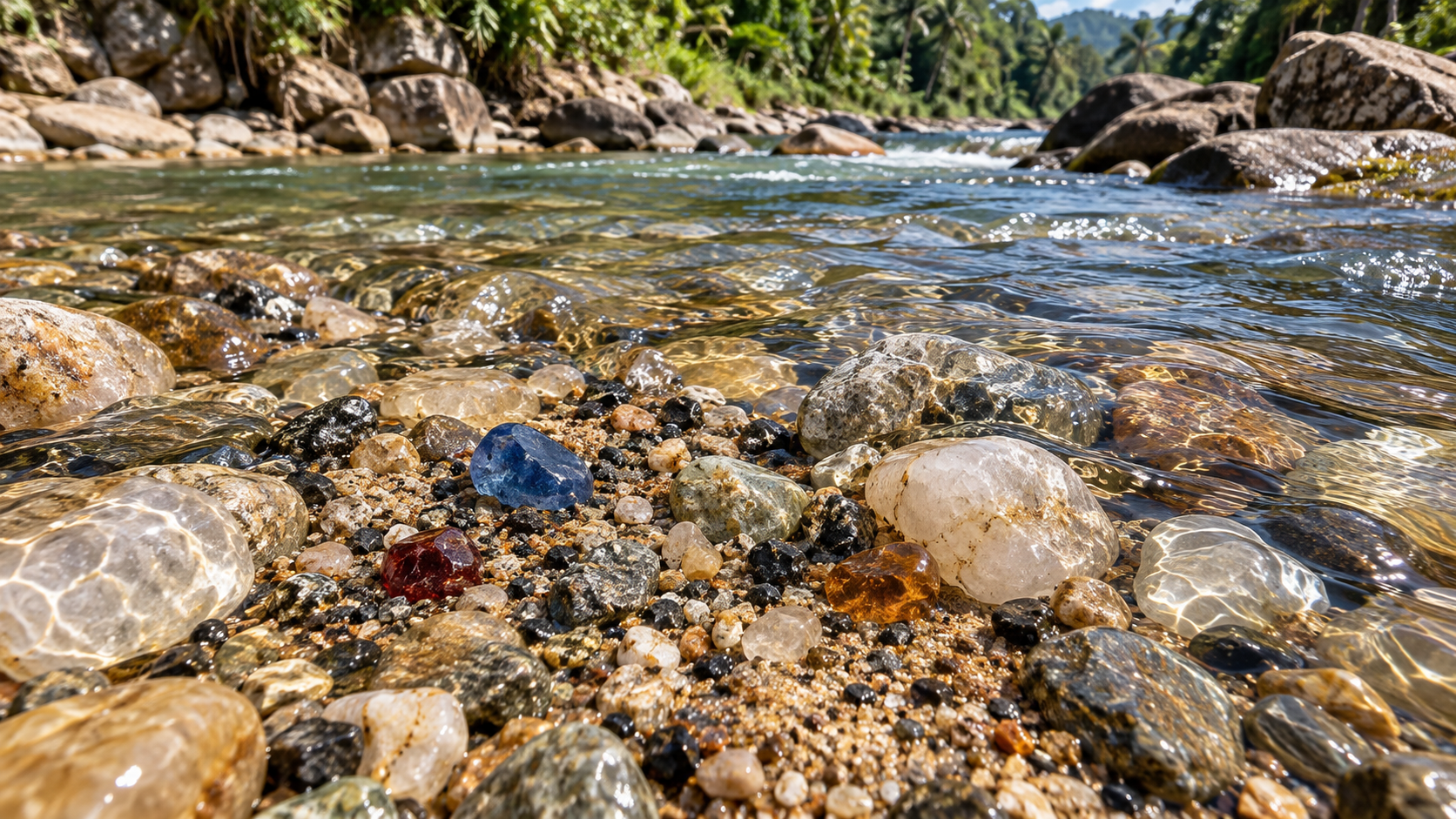
A sapphire may have crystallised deep within the Earth’s crust hundreds of millions of years ago.
Yet the same gemstone may eventually be discovered in a shallow layer of river gravel.
It may no longer be surrounded by the rock in which it originally formed.
Its crystal edges may have become rounded.
Its surface may show evidence of abrasion.
Other gemstones, originating from entirely different geological environments, may be found alongside it.
How did these materials arrive together?
The answer involves a remarkable sequence of geological processes.
Weathering gradually breaks down rocks exposed near the Earth’s surface.
Erosion releases mineral grains and fragments from their original geological surroundings.
Rivers transport these materials through landscapes.
During transport, minerals are sorted according to their physical properties and the changing conditions of flowing water.
Under suitable circumstances, resistant gemstone minerals become concentrated in particular sedimentary environments.
These concentrations are known as alluvial gemstone deposits.
They represent some of the world’s most important sources of natural gemstones.
Sapphires, rubies, spinels, garnets, zircons and diamonds may all occur in secondary deposits.
However, their presence in river gravels does not mean that they originally crystallised there.
In many cases, the river is responsible for transporting and concentrating the gemstones rather than creating them.
Understanding this distinction is fundamental to gemstone geology.
It also explains why some gemstones are recovered far from their primary source rocks, why different mineral species can occur together, and why the physical appearance of a rough gemstone may preserve evidence of its geological journey.
1. Primary and Secondary Gemstone Deposits
Gemstone deposits can be classified according to their geological origin and subsequent history.
A primary deposit contains gemstones within the geological environment in which they crystallised, or within rock that transported them from their original formation environment to the Earth’s surface.
For example, certain rubies form within metamorphic rocks.
Some sapphires occur in igneous or metamorphic geological settings.
Diamonds crystallise at considerable depths and may subsequently be transported toward the surface by kimberlitic or related magmas.
These are examples of geological processes associated with primary gemstone occurrences.
Secondary deposits develop when gemstones are released from their original geological surroundings.
Weathering, erosion, gravity and moving water can redistribute them.
The resulting concentrations may occur in soils, hillside sediments, river gravels or coastal deposits.
An alluvial deposit is one particular type of secondary deposit.
It forms through the action of flowing water.
The essential distinction is that the gemstone generally forms before the alluvial deposit develops.
The age of the gemstone and the age of the gravel containing it can therefore be dramatically different.
A mineral crystal may be hundreds of millions of years old while the sedimentary deposit in which it is found is geologically much younger.
2. The Different Types of Secondary Gemstone Deposits
Not every secondary gemstone occurrence is alluvial.
Geologists distinguish several depositional environments.
Eluvial deposits
Eluvial deposits form through weathering close to the original source rock.
The gemstone-bearing material remains largely in place.
Less resistant minerals may decompose or be removed, leaving a residual concentration of more resistant materials.
Colluvial deposits
Colluvial deposits develop when weathered material moves downslope.
Gravity, surface runoff and slope processes contribute to this movement.
Transport distances are generally limited compared with major river systems.
Alluvial deposits
Alluvial deposits are associated with flowing water.
Gemstones may be transported through streams and rivers before accumulating in favourable sedimentary traps.
Beach and coastal placer deposits
Heavy minerals may also become concentrated through wave action and coastal sedimentary processes.
Certain diamond deposits along the Atlantic coast of southern Africa provide important examples.
Paleoplacer deposits
Paleoplacers are ancient placer deposits that have been preserved within older sedimentary sequences.
They may be buried, compacted or cemented into sedimentary rock.
These categories describe different processes.
They should not be used interchangeably.
For example, a ruby recovered from a hillside colluvial deposit should not automatically be described as an alluvial ruby.
3. Stage One: The Formation of the Original Gemstone
Before a gemstone can enter a river system, it must first crystallise or form within an appropriate geological environment.
Different gemstones require different physical and chemical conditions.
Corundum, the mineral species that includes ruby and sapphire, can form in several geological settings.
These include certain metamorphic environments and specific igneous associations.
Garnets occur in numerous metamorphic and igneous rocks.
Zircon is a common accessory mineral in many igneous and metamorphic environments.
Diamonds form under conditions involving extremely high pressures and suitable carbon-bearing environments.
Their subsequent transport to the Earth’s surface is commonly associated with kimberlitic magmatism.
The geological processes responsible for producing these minerals are different.
Nevertheless, gemstones originating from these distinct environments may eventually enter the same drainage system.
This creates one of the most interesting characteristics of alluvial deposits.
Minerals that did not form together can later become concentrated together.
A river basin may collect sediment from several different rock formations.
The resulting gravel can therefore contain gemstones representing multiple geological histories.
4. Stage Two: Weathering Releases Gemstones From Their Host Rocks
Weathering is the breakdown or alteration of rocks exposed to conditions near the Earth’s surface.
It includes physical, chemical and biological processes.
Physical weathering
Physical weathering breaks rocks into smaller fragments without necessarily changing their mineral composition.
Examples include:
- Temperature-related expansion and contraction
- Freeze-thaw processes
- Mechanical fracturing
- Pressure release
- Root growth within fractures
Chemical weathering
Chemical weathering changes minerals through reactions involving water, oxygen, dissolved substances and other environmental factors.
Certain minerals dissolve or transform into secondary minerals.
Feldspars, for example, may undergo chemical alteration that produces clay minerals.
Other minerals are more resistant to chemical breakdown.
Biological influences
Plant roots, microorganisms and soil-forming processes can contribute to rock disintegration and chemical alteration.
Over long periods, these combined processes weaken gemstone-bearing rocks.
Mineral grains may become detached from their original matrix.
Some gemstones remain intact.
Others fracture or undergo alteration.
The survival of a gemstone depends partly on its mineralogical characteristics.
5. Why Some Gemstones Survive Weathering Better Than Others
Gemstone minerals differ considerably in their resistance to environmental processes.
Several characteristics influence their survival.
Hardness
Hardness affects resistance to scratching and abrasion.
A relatively hard mineral may withstand contact with sediment particles better than a softer material.
Toughness
Toughness influences resistance to fracture.
A hard gemstone with significant cleavage may still break during mechanical transport.
Chemical stability
Minerals differ in their resistance to dissolution and alteration.
Some remain relatively stable during prolonged exposure to water and weathering processes.
Others are more susceptible to chemical changes.
Crystal structure
The internal arrangement of atoms influences mechanical and chemical behaviour.
Existing fractures and inclusions
A crystal containing significant fractures may be more vulnerable to breakage.
Consequently, alluvial gemstone deposits are influenced by a process of natural selection.
More resistant mineral grains may survive repeated transport and weathering.
Less resistant fragments may break down or disappear from the sedimentary system.
However, this does not mean that every alluvial gemstone is automatically of superior quality.
The process influences which materials survive, but it does not guarantee exceptional colour, clarity or cutting potential.
6. Stage Three: Erosion Introduces Gemstones Into River Systems
Once weathering releases mineral grains, erosion can transport them away from their original location.
Rainfall and surface runoff may carry loose sediment into small channels.
These channels feed larger streams.
Streams eventually join rivers.
A gemstone may therefore move through a drainage network over an extended period.
Its journey may involve numerous episodes of transport and deposition.
During periods of relatively low water flow, the gemstone may remain stationary.
During floods, increased discharge and sediment movement may cause it to move again.
Over geological time, repeated events can transport mineral grains considerable distances.
However, not every gemstone travels far.
Some remain close to their source.
Others become trapped within sedimentary deposits relatively quickly.
Transport distance depends on the river system, sediment characteristics, geological history and the physical properties of the gemstone.
7. How Rivers Transport Mineral Particles
Rivers transport sediment through several mechanisms.
The behaviour of a particle depends on its size, shape, density and the characteristics of the flowing water.
Traction
Relatively large particles may roll or slide along the riverbed.
Saltation
Smaller particles may move through repeated short jumps.
They are temporarily lifted before returning to the bed.
Suspension
Fine particles may remain suspended within the water column.
The ability of a river to transport sediment depends on flow velocity, turbulence, channel geometry and sediment supply.
Larger or denser particles generally require different hydraulic conditions from smaller or lighter particles.
However, density alone does not determine transport behaviour.
A small dense grain may behave differently from a large grain of the same mineral.
Particle shape also matters.
A flat fragment may respond differently to flowing water from a rounded grain of comparable mass.
These relationships are central to understanding the formation of gemstone placers.
8. Hydraulic Sorting: Why Heavy Minerals Become Concentrated
Hydraulic sorting is the separation of sediment particles through the action of flowing water.
As water moves through a river channel, different particles respond differently to changing hydraulic conditions.
Some remain in motion.
Others settle.
The resulting sediment may become enriched in particular particle sizes, shapes or mineral species.
Many gemstones have relatively high specific gravity compared with common rock-forming minerals.
For example:
| Mineral | Approximate specific gravity |
|---|---|
| Quartz | 2.65 |
| Feldspar | 2.55–2.76 |
| Diamond | 3.52 |
| Corundum | 3.95–4.05 |
| Garnet | Approximately 3.5–4.3, depending on species |
| Zircon | Approximately 4.6–4.7 |
These values illustrate why certain gemstone minerals can behave as relatively dense sedimentary particles.
However, hydraulic sorting is not simply a process in which every heavy mineral immediately sinks beneath every lighter mineral.
Transport and deposition also depend on grain size, shape, turbulence, flow conditions and sediment interactions.
A small dense grain can sometimes be transported alongside a larger, less dense particle.
The important principle is that flowing water can progressively separate mineral populations.
Under suitable conditions, this produces local concentrations of dense, resistant minerals.
Such concentrations may become economically significant placer deposits.
9. Where Do Gemstones Accumulate in Rivers?
Gemstones do not accumulate uniformly throughout a river.
Certain locations are more favourable for the concentration of dense sediment.
River bends
Changes in current velocity and sediment transport can create zones of deposition.
Some heavy-mineral concentrations develop within gravel bars and other features associated with meandering channels.
Bedrock depressions
Natural hollows and irregularities in the riverbed can trap dense particles.
Fractures and crevices
Openings within exposed bedrock may provide locations where mineral grains accumulate.
Changes in channel gradient
A reduction in river gradient can alter sediment transport conditions.
Natural obstacles
Large boulders and other obstructions influence local flow patterns.
Sediment may accumulate in sheltered areas.
Waterfalls and associated channels
Changes in hydraulic energy around waterfalls and downstream environments can create local sedimentary traps.
These are examples of favourable geological settings rather than guarantees of gemstone occurrence.
A river must first receive gemstone-bearing sediment from a suitable source.
Without that source, even an excellent hydraulic trap may contain no valuable gemstones.
10. Why Gemstones Are Often Found in Gravel Layers
Alluvial gemstones are frequently associated with gravel-rich sediments.
Gravel layers may develop during periods when a river transports relatively coarse material.
These deposits can contain mixtures of:
- Quartz pebbles
- Rock fragments
- Sand
- Clay
- Heavy minerals
- Gemstone crystals and fragments
Repeated sedimentary processes may produce layers with different compositions.
A relatively coarse gravel horizon may become enriched in resistant minerals.
Fine sediment may accumulate above or between gravel layers.
Over time, the deposit may be buried beneath younger material.
Consequently, a productive gemstone-bearing layer may lie several metres below the modern ground surface.
This is particularly relevant in regions where ancient river systems have been buried or modified.
The gemstones may no longer be located within an active river channel.
They may instead occur in sediments deposited by a river that existed long before the present landscape developed.
11. The Geological Importance of Ancient River Channels
River systems change over time.
Channels migrate.
Floodplains develop.
Rivers may abandon former courses.
Changes in climate, tectonic activity and erosion can alter entire drainage networks.
When a river abandons a channel, its sediments may remain preserved.
These sediments can contain concentrations of gemstones deposited during earlier geological periods.
Such deposits are particularly important in gemstone exploration.
An area that appears dry today may contain evidence of an ancient river.
The productive gemstone-bearing sediments may be buried beneath younger soils or sedimentary layers.
Geologists investigate these environments using sedimentological observations, geological mapping and other exploration techniques.
The objective is to reconstruct the history of sediment transport and deposition.
A modern river is therefore not always necessary for the presence of an alluvial gemstone deposit.
12. How River Transport Changes the Appearance of Rough Gemstones
A gemstone recovered directly from its primary host rock may preserve well-developed crystal faces.
Its morphology may reflect the crystal system in which it formed.
However, transport through river sediments can modify its external appearance.
Repeated contact with other particles may cause abrasion.
Sharp edges may become rounded.
Crystal faces may become worn.
Small fragments may break away.
Over time, a gemstone may develop a waterworn appearance.
This is common in many alluvial gemstone deposits.
However, the degree of rounding depends on several factors.
These include:
- Transport distance
- Transport duration
- Number of transport events
- Mineral hardness
- Toughness and cleavage
- Sediment composition
- Hydraulic conditions
A strongly rounded gemstone may have experienced substantial mechanical abrasion.
Nevertheless, rounding alone cannot establish a precise transport distance.
A gemstone can undergo repeated local reworking without travelling an exceptionally long distance.
Similarly, a relatively angular gemstone may still have been transported by water.
The relationship between external shape and geological history is complex.
13. Does River Transport Improve Gemstone Quality?
River transport can influence the population of gemstone fragments that survive.
Crystals containing major weaknesses may fracture during mechanical transport.
Less resistant material may be progressively removed.
As a result, some placer deposits contain a relatively high proportion of durable surviving fragments.
This process can contribute to the concentration of usable gem material.
However, the interpretation requires caution.
Transport does not improve a gemstone’s intrinsic colour.
It does not transform a heavily included crystal into a perfectly transparent gemstone.
It does not remove internal inclusions without potentially breaking or reducing the crystal.
Likewise, abrasion may reduce the size of a gemstone.
The removal of weaker fragments can create a selection effect, but this is not equivalent to improving the quality of each surviving crystal.
Alluvial concentration can increase the relative abundance of certain durable gemstone materials without guaranteeing superior individual gemstone quality.
This distinction is important when evaluating commercial descriptions of alluvial gemstones.
14. Sri Lanka: One of the World’s Classic Alluvial Gemstone Regions
Sri Lanka provides an important example of gemstone-bearing secondary deposits.
The island contains extensive metamorphic geological formations.
These rocks have experienced complex geological histories involving high temperatures, pressures and deformation.
Over time, weathering and erosion released gemstones from different source rocks.
Many of these materials became concentrated in secondary sedimentary deposits.
The gemstone-bearing gravels are locally known as illam.
Important gemstone-producing regions include Ratnapura and Elahera.
The recovered materials include sapphire, spinel, chrysoberyl, garnet, zircon and several other gem minerals.
One of the most interesting characteristics of Sri Lankan alluvial deposits is their mineralogical diversity.
Different gemstones may originate from different geological formations within the drainage system.
Their eventual association in the same gravel deposit does not necessarily indicate that they crystallised together.
GIA’s geological field research documents the importance of alluvial gravels in Sri Lankan gemstone production.
It also demonstrates the relationship between regional metamorphic geology and secondary gemstone concentration.
15. Madagascar: The Importance of the Ilakaka Gemstone Deposits
Madagascar contains some of the world’s most significant gemstone-producing regions.
The Ilakaka area became internationally important following major sapphire discoveries during the 1990s.
The region contains extensive secondary gemstone deposits.
These include gravel-bearing sediments associated with ancient drainage systems.
Gemstones have been recovered from buried sedimentary horizons.
The deposits contain sapphire and other resistant gemstone minerals.
The geological history is complex.
The gemstones originated in suitable source rocks before weathering and erosion redistributed them.
Some of the productive gravels are associated with older sedimentary systems rather than modern active river channels.
This makes Ilakaka an important example of the relationship between gemstone geology and landscape evolution.
The discovery of a productive alluvial deposit does not necessarily reveal the precise original source of every gemstone.
Different drainage systems and sedimentary events may have contributed material over time.
GIA’s research on sedimentary gemstone deposits identifies Ilakaka as a significant example of buried gemstone-bearing paleoplacer systems.
16. Montana: Sapphires in North American Secondary Deposits
The United States also contains important secondary sapphire deposits.
Montana is particularly well known.
Gemstone-producing areas include Rock Creek, Dry Cottonwood Creek and deposits associated with the Missouri River.
These occurrences have been investigated through geological and gemmological research.
Some Montana sapphires are recovered from gravel deposits.
Others occur in different secondary geological settings.
The precise original source relationships are not equally well established for every deposit.
GIA research has investigated the inclusions and trace-element chemistry of Montana sapphires.
These studies provide evidence about their geological origins.
They also demonstrate the limitations of using a simple geographical label to describe a gemstone’s formation history.
A sapphire recovered from river gravel may preserve chemical and inclusion characteristics related to its original geological environment.
However, the surrounding gravel is not necessarily the rock in which the sapphire crystallised.
This distinction is central to understanding alluvial gemstone geology.
17. Diamonds: From Deep Geological Sources to River Deposits
Diamond provides another remarkable example of secondary gemstone concentration.
Most natural diamonds form at great depths under conditions of high pressure and suitable temperature.
They may subsequently reach the Earth’s surface through rapid volcanic transport involving kimberlitic or related magmas.
Once exposed near the surface, diamond-bearing rocks can undergo weathering.
Diamonds may be released into surrounding sediments.
Rivers can then transport them away from their original geological source.
Alluvial diamond deposits occur in several regions of the world.
Important examples include parts of southern Africa and Brazil.
The United States Geological Survey describes diamond placers in alluvial sediments, beach deposits and certain ancient sedimentary rocks.
In some geological settings, diamonds have travelled considerable distances from their original source.
However, the transport history of an individual diamond cannot be determined from distance assumptions alone.
Diamond-bearing sediment may also be reworked through multiple geological cycles.
An older sedimentary deposit may erode and release diamonds into a younger river system.
This creates the possibility of several distinct stages of transport and concentration.
18. Why Diamond Placers Can Occur Far From Kimberlite Pipes
A common assumption is that alluvial diamonds must occur close to an exposed kimberlite pipe.
This is not necessarily correct.
Diamond-bearing material may undergo extensive erosion and transport.
River systems can redistribute diamonds across large areas.
Older sedimentary deposits may also serve as intermediate sources.
Consequently, a diamond recovered from a river does not automatically indicate that a kimberlite pipe exists immediately nearby.
The original source may be distant.
It may be buried.
It may have been substantially eroded.
In some cases, the source remains unidentified.
This is one reason why geological exploration for primary diamond deposits can be challenging.
The presence of alluvial diamonds provides important information.
However, it does not by itself establish the exact location of their original formation or volcanic transport environment.
19. Garnet and Zircon: Important Minerals in Heavy-Mineral Deposits
Garnet and zircon are particularly interesting in sedimentary geology.
Both occur in a variety of geological environments.
Both can survive certain weathering and transport processes.
Their relatively high specific gravity can contribute to their concentration in heavy-mineral sediments.
Garnet
Garnet is a mineral group rather than a single mineral species.
Different garnet species possess different chemical compositions and physical properties.
Some occur in metamorphic rocks.
Others occur in igneous environments.
Garnet grains may be transported into river systems and become concentrated with other heavy minerals.
Certain garnets are valuable gemstones.
Others are used for industrial purposes.
Zircon
Zircon is zirconium silicate, ZrSiO₄.
It is an important accessory mineral in many geological environments.
Zircon is particularly valuable to geologists because its crystal structure can incorporate uranium during formation.
Under suitable analytical conditions, uranium-lead dating can provide information about geological events.
Zircon grains can survive multiple cycles of weathering, erosion and sedimentary deposition.
Consequently, zircon is important both as a gemstone and as a geological research material.
However, zircon found in a river gravel does not necessarily originate from the same geological source as neighbouring gemstones.
The drainage system may combine minerals from several different rock formations.
20. Why Different Gemstones Can Occur Together
One of the most fascinating characteristics of secondary deposits is the association of gemstones with different geological origins.
A gravel deposit may contain sapphire, garnet, zircon, spinel and quartz.
These minerals do not necessarily require the same conditions to crystallise.
Some may have formed in metamorphic rocks.
Others may have originated in igneous environments.
The river system can combine them.
This occurs because drainage networks collect sediment from broad geographic areas.
As the surrounding landscape erodes, minerals from different geological formations enter the same transport system.
The river sorts and deposits them according to sedimentary processes.
The resulting mineral assemblage therefore reflects both the geology of the drainage basin and the processes of transport and concentration.
This is an important distinction between primary and secondary gemstone deposits.
In a primary deposit, the mineral association may provide direct evidence about the original geological environment.
In an alluvial deposit, the association may instead reflect the mixing of materials from different sources.
Gemstones found together were not necessarily formed together.
21. What Can Alluvial Gemstones Reveal About Their Geological History?
An alluvial gemstone may preserve several types of geological evidence.
Its external shape can provide information about mechanical wear.
Its surface may display abrasion features.
Internal inclusions can provide information about the environment in which it crystallised.
Trace-element composition may help distinguish certain geological populations.
Some mineral inclusions can also be investigated through analytical techniques.
For example, zircon inclusions within sapphire may provide opportunities for geochronological research.
A study published in Gems & Gemology in 2019 examined zircon inclusions in sapphires from Sri Lanka.
The research investigated uranium-lead ages and their implications for gemstone formation and geographic origin.
Such studies demonstrate the importance of distinguishing between two different histories:
The history of the gemstone’s crystallisation.
The history of its later transport and deposition.
These events may be separated by immense geological timescales.
22. Can an Alluvial Gemstone’s Country of Origin Be Identified?
Determining the geographic origin of a gemstone can be difficult.
A gemstone recovered from a documented mining location has a known recovery location.
However, the original geological source may be less certain.
This distinction is particularly relevant to secondary deposits.
A river may transport gemstones away from their primary source.
It may also combine material from several different geological environments.
Modern gemmological laboratories investigate geographic origin through combinations of evidence.
These may include:
- Microscopic inclusion characteristics
- Trace-element chemistry
- Spectroscopic properties
- Geological reference collections
- Comparisons with documented gemstone populations
Nevertheless, geographic origin determination is not always conclusive.
Gemstones from different countries may possess overlapping characteristics.
The same country may also contain multiple geological deposit types.
Consequently, a rounded sapphire cannot be assigned confidently to Sri Lanka, Madagascar or Montana merely because it resembles alluvial material.
A geographic origin conclusion requires appropriate supporting evidence.
23. Does Alluvial Origin Mean a Gemstone Is Untreated?
No.
Alluvial origin describes the geological environment from which a gemstone was recovered.
Treatment status describes whether the gemstone has undergone an enhancement process.
These are separate characteristics.
A natural sapphire recovered from river gravel may subsequently be heat treated.
A natural ruby recovered from a secondary deposit may undergo clarity enhancement.
A zircon recovered from an alluvial deposit may also undergo treatment.
Conversely, an untreated gemstone may originate from either a primary or secondary deposit.
Therefore, terms such as alluvial, natural and untreated should not be treated as synonyms.
They communicate different information.
Alluvial: Describes a sedimentary recovery environment.
Natural: Describes a gemstone produced through natural geological processes rather than laboratory synthesis.
Untreated: Indicates that no gemstone enhancement treatment has been identified or disclosed, subject to the evidence available.
Clear distinctions between these terms are important for responsible gemstone descriptions.
24. How Alluvial Gemstones Are Recovered
Gemstone recovery methods depend on the geological characteristics of the deposit.
Some gemstone-bearing gravels occur close to the surface.
Others are buried beneath substantial layers of sediment.
Mining methods vary according to deposit depth, sediment composition, water conditions and local regulations.
Traditional methods may involve excavation, washing and manual sorting.
More mechanised operations may use excavation equipment, screening systems and gravity separation.
The underlying principle is often similar to the natural process that concentrated the gemstones.
Minerals with different physical properties can be separated through controlled movement of water and sediment.
However, commercial gemstone recovery is not always straightforward.
Gemstones may be sparsely distributed.
Productive gravel layers can vary considerably in thickness and composition.
A deposit may contain large quantities of ordinary sediment but relatively few gem-quality crystals.
The economic viability of mining therefore depends on several factors.
These include gemstone concentration, quality, recovery costs, access, environmental requirements and market conditions.
25. Environmental Considerations in Alluvial Gemstone Mining
Alluvial mining takes place within sedimentary environments that may be connected to active rivers, floodplains and groundwater systems.
These environments can be environmentally sensitive.
Excavation may disturb soils and sedimentary layers.
Poorly managed operations can increase erosion and sediment movement.
Water use and sediment discharge may affect local waterways.
Unprotected excavations can create safety risks.
Changes to drainage patterns may influence surrounding land.
The environmental impact varies substantially according to the mining method, location, scale and management practices.
It would be inaccurate to assume that alluvial gemstone mining is automatically environmentally harmless because the gemstones are recovered from loose sediments.
Likewise, it would be misleading to assume that every alluvial operation causes the same level of environmental disturbance.
Responsible practices can include appropriate water management, sediment control, rehabilitation planning and compliance with local environmental requirements.
The Organisation for Economic Co-operation and Development provides guidance on environmental due diligence in mineral supply chains.
This framework emphasises the identification, prevention and mitigation of environmental risks.
26. Alluvial Gemstones and Responsible Sourcing
The geological origin of a gemstone is only one part of its supply-chain history.
A gemstone may have formed naturally.
It may have been recovered from a documented alluvial deposit.
However, these facts alone do not establish that the gemstone was mined under responsible social or environmental conditions.
Responsible sourcing requires additional consideration.
Relevant subjects include:
- Mining practices
- Labour conditions
- Environmental management
- Supply-chain transparency
- Applicable regulations
- Documentation of commercial transactions
The OECD’s mineral supply-chain guidance provides an internationally recognised framework for risk-based due diligence.
It is relevant to mineral supply chains broadly, including those involving gemstones.
The distinction between geological provenance and responsible sourcing is important.
A scientifically credible statement about where a gemstone was recovered is not automatically a complete statement about how it was mined or traded.
27. The Difference Between Geological Provenance and Commercial Origin
The word origin can have several meanings in the gemstone trade.
These meanings should be distinguished.
Geological origin
The geological environment and processes responsible for forming the gemstone.
Deposit type
The environment in which the gemstone was found or recovered.
For example, a primary metamorphic deposit or a secondary alluvial deposit.
Geographic recovery location
The country, region or mine from which the gemstone was recovered.
Commercial provenance
The documented history of ownership, trading and movement through the supply chain.
These concepts may overlap.
However, they are not interchangeable.
For example, a sapphire may have crystallised in a metamorphic environment and later been recovered from an alluvial deposit in Sri Lanka.
Its geological formation environment and its recovery environment are different.
Its commercial provenance concerns the subsequent movement of the gemstone through the market.
Accurate gemstone documentation benefits from maintaining these distinctions.
28. What Alluvial Deposits Teach Us About Natural Gemstone Diversity
Alluvial gemstone deposits demonstrate that gemstone geology does not end when a crystal forms.
The original crystallisation event is only one part of the material’s history.
After formation, the gemstone may experience:
- Exposure of its host rock through geological uplift and erosion.
- Physical and chemical weathering.
- Release from its original matrix.
- Transport through a drainage system.
- Mechanical abrasion and possible fragmentation.
- Hydraulic sorting.
- Concentration within a sedimentary trap.
- Burial beneath younger sediments.
- Reworking during later geological events.
- Eventual recovery and gemmological evaluation.
Not every gemstone experiences every stage.
Some remain close to their original source.
Others undergo multiple cycles of erosion and redeposition.
The important principle is that gemstone deposits record geological processes operating over different timescales.
A single rough gemstone may preserve evidence of both its original formation and its later sedimentary history.
29. A Scientific Comparison of Gemstone Deposit Types
| Characteristic | Primary deposit | Eluvial deposit | Colluvial deposit | Alluvial deposit |
|---|---|---|---|---|
| Relationship to original source | Within original host or transporting rock | Very close to source | Generally near source | May be near or far from source |
| Principal process | Original geological formation or emplacement | In-place weathering | Downslope movement | Transport and deposition by flowing water |
| Typical material | Host rock containing gemstones | Weathered residual material | Slope debris | River sediments and gravels |
| Gemstone appearance | May preserve original crystal morphology | Often limited transport wear | Variable abrasion | May show waterworn surfaces |
| Geological information | Often closely linked to formation environment | Strong local source relationship | Usually associated with nearby geology | May contain material from several sources |
| Exploration considerations | Host-rock geology | Weathering profile | Slope and source geology | Drainage history and sedimentary traps |
This table summarises general characteristics.
Individual deposits can display transitional or more complex geological relationships.
30. Common Misconceptions About Alluvial Gemstones
Misconception 1: Gemstones found in rivers formed inside the river.
Usually incorrect.
Many alluvial gemstones crystallised in igneous or metamorphic environments before being released through weathering and erosion.
Misconception 2: Every rounded gemstone is alluvial.
Incorrect.
Rounding may result from several geological processes.
The external shape alone does not establish the exact recovery environment.
Misconception 3: Alluvial gemstones are always higher quality.
Incorrect.
Transport may preferentially preserve resistant fragments, but colour, clarity and cutting potential remain variable.
Misconception 4: Alluvial gemstones are always untreated.
Incorrect.
Treatment status is independent of deposit type.
Misconception 5: Alluvial gemstones always come from nearby source rocks.
Incorrect.
Some gemstones may be transported substantial distances.
Others may be derived from older sedimentary deposits.
Misconception 6: All gemstones in one gravel deposit formed together.
Incorrect.
A drainage system may combine minerals originating from several geological formations.
Misconception 7: A gemstone’s country of origin can be determined from its rounded shape.
Incorrect.
Geographic origin determination requires additional evidence.
Misconception 8: Alluvial mining is automatically environmentally responsible.
Incorrect.
Environmental and social impacts depend on the specific mining operation and its management.
31. The Natural Gems Belgium Perspective
At Natural Gems Belgium, understanding the geological history of natural gemstones is an important part of responsible gemmological education.
The distinction between primary and secondary deposits helps explain the diversity of rough gemstone materials.
It also provides useful context when examining crystal morphology, surface characteristics and mineral associations.
However, geological appearance alone is not sufficient to establish every aspect of a gemstone’s identity or provenance.
A waterworn appearance may support an interpretation of sedimentary transport.
It does not independently prove a particular country of origin.
Likewise, a gemstone recovered from an alluvial deposit should not automatically be considered untreated.
These distinctions are important when preparing accurate product descriptions.
Natural gemstone evaluation should remain grounded in identifiable physical properties, appropriate gemmological observations and reliable supporting documentation.
Where available, geological information can enrich the description of a gemstone.
It should not replace scientific identification or responsible treatment disclosure.
32. Why Alluvial Gemstone Geology Matters to Modern Gemmology
Alluvial deposits are important for several reasons.
They provide commercially significant sources of natural gemstones.
They reveal how minerals behave during weathering and sedimentary transport.
They help geologists reconstruct ancient drainage systems.
They provide opportunities to investigate the relationship between primary source rocks and secondary mineral concentrations.
They also demonstrate the complexity of geographic origin determination.
For gemstone collectors, alluvial deposits explain why rough stones sometimes appear rounded rather than displaying sharply defined crystal faces.
For gemmologists, they illustrate the importance of distinguishing mineral formation from later geological transport.
For buyers, they provide a more accurate understanding of terms used in gemstone descriptions.
For geologists, they offer evidence about the evolution of landscapes and sedimentary environments.
The scientific value of alluvial gemstone deposits therefore extends well beyond their commercial importance.
Conclusion: The Geological Journey of a Natural Gemstone
The discovery of a gemstone in river gravel represents the final visible stage of a potentially extraordinary geological history.
The gemstone may have formed deep within the Earth’s crust.
Its original host rock may have undergone uplift, deformation and prolonged weathering.
Erosion may have released the crystal.
Rivers may have transported it through changing landscapes.
Hydraulic processes may have concentrated it with other resistant minerals.
The gemstone may then have remained buried within sediment for thousands or millions of years before being recovered.
During this journey, its physical characteristics influenced its survival.
Hardness contributed to resistance against abrasion.
Toughness influenced its ability to withstand mechanical impacts.
Chemical stability affected its resistance to weathering.
Density, size and shape influenced its behaviour during sediment transport.
The resulting alluvial deposit is therefore not simply a collection of valuable stones.
It is a geological record of weathering, erosion, transport and concentration.
The gemstones it contains may have originated in entirely different geological environments.
Their presence together reflects the history of the drainage system rather than necessarily a shared crystallisation event.
This distinction is fundamental to understanding natural gemstone deposits.
A gemstone’s formation tells us where its mineralogical history began.
Its alluvial deposit tells us part of the story of what happened afterward.
Together, these processes demonstrate the remarkable geological complexity behind the natural gemstones we study, collect and appreciate today.
References & Further Reading
The following references are drawn from peer-reviewed gemmological research, geological publications and recognised international institutions.
They provide scientific information about sedimentary gemstone deposits, hydraulic sorting, gemstone geology, geographic origin determination and responsible mineral sourcing.
All references lead to educational, scientific or institutional resources rather than gemstone product listings.
1. Gemological Institute of America – Gems Recovered from Sedimentary Rocks
Authors: James E. Shigley, Roy Bassoo and Aaron C. Palke
Publication: Gems & Gemology, Winter 2023, Volume 59, Number 4
A comprehensive scientific overview of gemstones occurring in sedimentary environments.
Explains weathering, erosion, sediment transport, placer formation, hydraulic sorting and alluvial gemstone recovery.
Includes documented examples from Madagascar, Sri Lanka, Montana, Brazil and southern Africa.
https://www.gia.edu/gems-gemology/winter-2023-colored-stones-unearthed
2. Gemological Institute of America – The Diversity of Gemstone Deposits
Authors: Aaron C. Palke, James E. Shigley and Wim Vertriest
Publication: Gems & Gemology, Winter 2025, Volume 61, Number 4
Examines the geological diversity of gemstone deposits and explains why minerals formed in different environments may occur together in secondary deposits.
Particularly relevant to mixed gemstone assemblages in Sri Lanka and Myanmar.
https://www.gia.edu/gems-gemology/winter-2025-colored-stones-unearthed
3. Gemological Institute of America – Geology of Corundum and Emerald Gem Deposits: A Review
Authors: Gaston Giuliani and Lee A. Groat
Publication: Gems & Gemology, Winter 2019, Volume 55, Number 4
A detailed scientific review of the geological formation and occurrence of ruby, sapphire and emerald.
Explains primary and secondary deposits, including eluvial, colluvial and alluvial concentrations.
https://www.gia.edu/gems-gemology/winter-2019-geology-of-corundum-and-emerald-gem-deposits
4. Gemological Institute of America – Sri Lanka: Expedition to the Island of Jewels
Publication: Gems & Gemology, Fall 2014
A geological and gemmological field study of Sri Lankan gemstone deposits.
Documents the importance of gemstone-bearing gravels known as illam and the relationship between metamorphic source rocks and secondary deposits.
https://www.gia.edu/gems-gemology/fall-2014-sri-lanka-expedition-island-of-jewels
5. Gemological Institute of America – Alluvial Sapphires from Montana: Inclusions, Geochemistry, and Indications of a Metasomatic Origin
Publication: Gems & Gemology, Winter 2015
A scientific investigation of Montana sapphires recovered from secondary deposits.
Examines mineral inclusions, trace-element chemistry and possible geological formation environments.
6. United States Geological Survey – Descriptive Model of Diamond Placers
Author: Dennis P. Cox
Publication: USGS Bulletin 1693
A geological deposit model describing alluvial, coastal and ancient sedimentary diamond concentrations.
Discusses geological environments, associated minerals and processes controlling diamond placer formation.
https://pubs.usgs.gov/bul/b1693/html/bull2xv7.htm
7. United States Geological Survey – Natural Gemstones: Geologic Environment
Institution: United States Geological Survey
An introductory geological resource explaining the occurrence of gemstones in different geological environments.
Includes discussion of primary gemstone sources and concentrations within stream gravels.
https://pubs.usgs.gov/gip/gemstones/environment.html
8. United States Geological Survey – Alluvial Diamond Deposits
Publication: Scientific Investigations Report 2010–5045
A USGS study addressing alluvial diamond deposits in Ghana.
Provides geological information about diamond-bearing river systems and the distribution of alluvial resources.
https://pubs.usgs.gov/sir/2010/5045/pdf/sir2010-5045.pdf
9. H. G. Dill – Gems and Placers: A Genetic Relationship Par Excellence
Journal: Minerals
Year: 2018
Volume: 8, Issue 10, Article 470
A peer-reviewed mineralogical study examining the relationship between gemstone minerals, placer formation, sedimentary transport and mineral concentration.
Includes discussion of mineral density, sedimentary processes and different placer environments.
https://doi.org/10.3390/min8100470
10. Gemological Institute of America – U-Pb Ages of Zircon Inclusions in Sapphires from Ratnapura and Balangoda (Sri Lanka) and Implications for Geographic Origin
Publication: Gems & Gemology, Spring 2019
A scientific investigation using zircon inclusions and uranium-lead dating to study the geological history of sapphires recovered from Sri Lankan secondary deposits.
Demonstrates how mineral inclusions can provide information about gemstone formation long before alluvial deposition.
11. Gemological Institute of America – The Geographic Origin Dilemma
Publication: Gems & Gemology, Winter 2019
Examines the scientific limitations of geographic origin determination.
Explains why gemstone deposits in different countries may produce overlapping gemmological characteristics.
https://www.gia.edu/gems-gemology/winter-2019-geographic-origin-dilemma
12. OECD – Handbook on Environmental Due Diligence in Mineral Supply Chains
Institution: Organisation for Economic Co-operation and Development
Publication: 2023
An institutional reference addressing environmental risks and due diligence in mineral supply chains.
Relevant to understanding the environmental responsibilities associated with mineral extraction and sourcing.
13. OECD – Due Diligence Guidance for Responsible Supply Chains of Minerals from Conflict-Affected and High-Risk Areas
Institution: Organisation for Economic Co-operation and Development
Edition: Third edition
Year: 2016
An internationally recognised framework for responsible mineral supply-chain management.
Addresses risk-based due diligence and the responsibilities of businesses sourcing minerals.