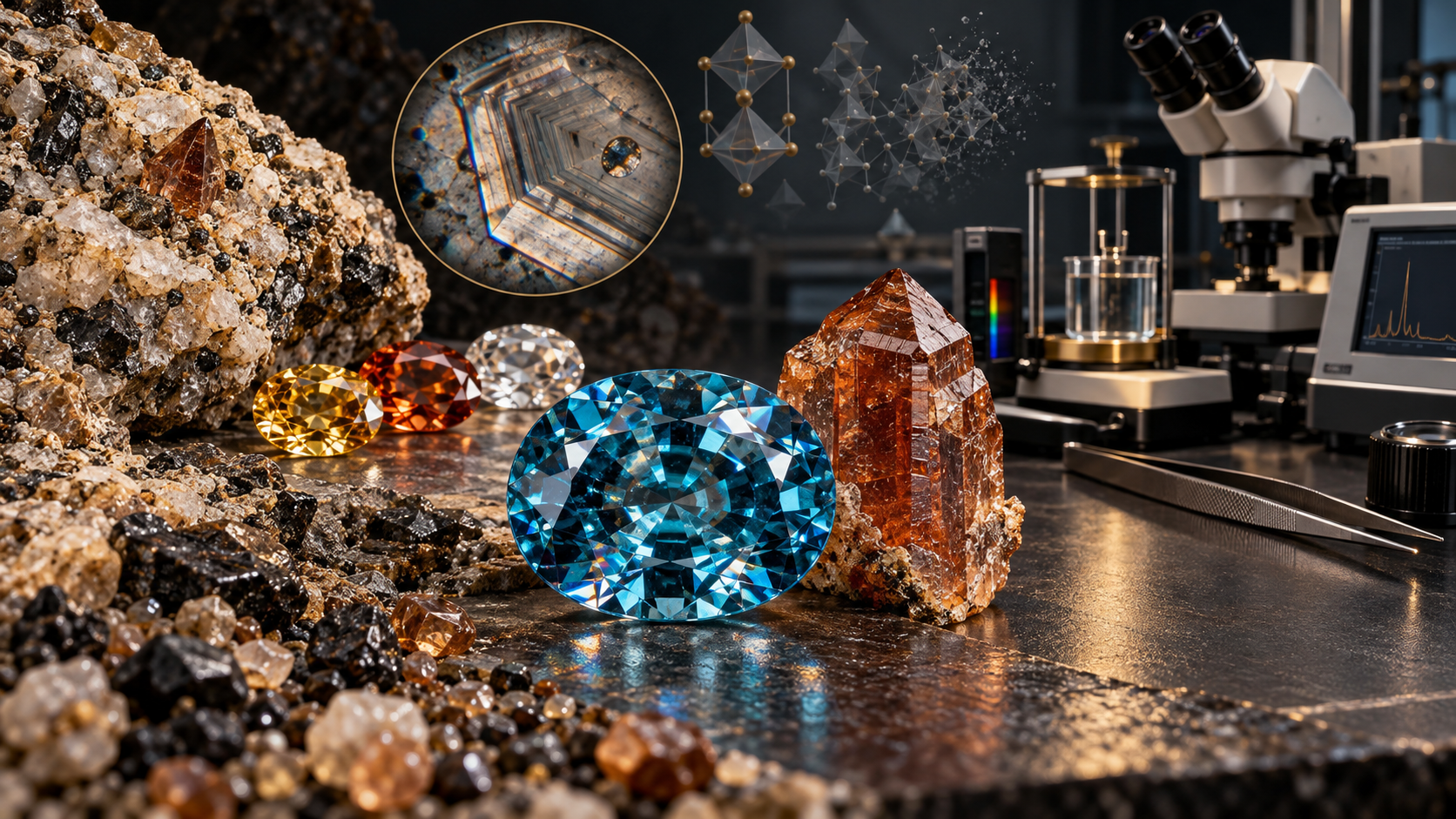
A zircon gemstone is a naturally occurring zirconium silicate mineral with the chemical formula ZrSiO₄. Its exceptional refractive index, pronounced birefringence, strong dispersion and complex geological history make it one of the most scientifically fascinating gemstones encountered in gemmology.
Unlike most familiar gemstone species, zircon can undergo a remarkable transformation over geological time. Trace amounts of uranium and thorium incorporated during crystal growth undergo radioactive decay, gradually disrupting the crystal lattice. This process, known as metamictisation, can significantly alter the gemstone’s refractive index, birefringence, specific gravity, hardness and microscopic appearance.
Gemmologists consequently distinguish between high, intermediate and low zircon according to the degree of structural preservation. These classifications describe crystallinity rather than colour, transparency or commercial quality.
Zircon is also an important geological research material. Its ability to incorporate uranium while initially excluding most lead makes it exceptionally useful for radiometric dating. Zircon crystals recovered from the Jack Hills of Western Australia have yielded ages approaching 4.4 billion years, providing evidence about the earliest stages of Earth’s geological history.
From a gemstone-identification perspective, zircon offers equally remarkable characteristics. Well-crystallised specimens can display conspicuous doubling of pavilion facet junctions, strong spectral dispersion and characteristic absorption features associated with uranium and other trace elements.
Its colour diversity, including blue, yellow, orange, red, brown, green and colourless material, is influenced by trace-element chemistry, crystal defects and heat treatment.
In this Nadia Gemstone Academy guide, we investigate zircon from its geological formation and crystal structure to its optical properties, metamictisation, spectroscopy, inclusions, treatments and laboratory identification. We also explain the fundamental mineralogical distinction between natural zircon and cubic zirconia, two materials that are frequently confused despite having entirely different compositions and crystal structures.
Table of Contents
Zircon Gemstone: A Gemmological Reference Guide
Introduction
Zircon is one of the most scientifically important minerals encountered in gemmology.
Its ideal chemical formula is ZrSiO₄, identifying it as zirconium silicate.
Although zircon is familiar to gemstone collectors because of its exceptional brilliance and remarkable range of colours, its scientific significance extends far beyond jewellery.
Zircon is a major accessory mineral in igneous and metamorphic rocks, an exceptionally useful material for geological dating, and a gemstone whose physical properties can change substantially over geological time.
Its high refractive index, pronounced birefringence and strong dispersion make well-crystallised zircon readily recognisable under appropriate gemmological examination.
However, the mineral also exhibits an unusual phenomenon known as metamictisation.
This progressive destruction of the crystal structure through natural radiation damage can significantly modify the optical and physical properties of individual specimens.
Understanding zircon therefore requires consideration of both its original mineralogical identity and the structural changes it may have experienced since crystallisation.
Mineralogical Classification
Zircon belongs to the nesosilicate, or orthosilicate, mineral class.
Its ideal chemical formula is:
ZrSiO₄
The mineral consists of isolated SiO₄ tetrahedra linked through zirconium coordination polyhedra.
Zircon crystallises in the tetragonal crystal system.
Its characteristic crystals commonly display four-sided prismatic forms terminated by tetragonal pyramidal faces.
The mineral should not be confused with cubic zirconia.
Cubic zirconia is based on zirconium dioxide, ZrO₂, and the jewellery material is generally produced synthetically with stabilising additives.
Zircon and cubic zirconia are chemically and crystallographically different substances.
Chemical Composition
The principal chemical components of zircon are zirconium, silicon and oxygen.
However, natural zircon commonly incorporates additional elements into its crystal structure.
Hafnium is particularly important because it can substitute for zirconium.
Other elements that may occur include uranium, thorium, yttrium, scandium and rare-earth elements.
These substitutions can provide valuable information about the geological environment in which a zircon crystallised.
They also influence the mineral’s colour, luminescence, radiation-damage history and spectroscopic behaviour.
Crystal Structure
Zircon has a tetragonal crystal structure.
In well-crystallised material, the atomic arrangement is highly ordered.
The mineral is optically uniaxial positive.
However, zircon possesses an important characteristic that distinguishes it from many other gem minerals.
Its crystal structure can become progressively disordered through radiation damage.
The extent of this disorder can range from minor structural disturbance to a condition approaching an amorphous state.
This process is central to understanding the gemmological differences between high, intermediate and low zircon.
Geological Formation
Zircon is a widespread accessory mineral in many geological environments.
It commonly crystallises from zirconium-bearing magmas.
Granitic and other evolved igneous systems are particularly important because zirconium can become concentrated during magmatic differentiation.
As magma cools and minerals crystallise, zircon may form when the chemical conditions permit zirconium and silica to combine within the developing crystal structure.
Zircon can also form or recrystallise during metamorphism.
Consequently, individual zircon crystals may preserve evidence of multiple geological events.
Magmatic Zircon
Magmatic zircon is particularly important in geological research.
As zircon grows within a magma, it can incorporate trace elements whose concentrations depend on the evolving melt chemistry.
Growth zoning may develop as the composition and temperature of the magma change.
These zones can sometimes be revealed through cathodoluminescence imaging or other analytical techniques.
Oscillatory zoning is common in many magmatic zircons.
However, growth zoning alone does not establish a unique geological origin.
Interpretation requires comparison with chemical and geological evidence.
Metamorphic Zircon
Zircon can also crystallise or undergo modification during metamorphism.
Changes in temperature, pressure and fluid chemistry can affect existing zircon crystals.
New zircon growth may occur along the margins of older grains.
Some crystals preserve older inherited cores surrounded by younger metamorphic rims.
These structures are particularly valuable in geological research because they can record multiple events within the history of a rock.
Secondary Deposits
Zircon is highly resistant to chemical weathering.
Its durability allows it to survive the destruction of the rock in which it originally crystallised.
Weathering releases zircon grains from their host rocks.
Rivers and sedimentary processes can then transport and concentrate the dense mineral grains into secondary deposits.
Because zircon has a relatively high specific gravity, it can accumulate within heavy-mineral concentrations.
Many gem-quality zircons are recovered from alluvial or eluvial deposits.
The geological environment in which a gemstone is mined may therefore differ substantially from the environment in which its crystal originally formed.
Basalt-Associated Gem Zircon
Several important gem-zircon deposits are associated with alkali basalt volcanic provinces.
Cambodia, Thailand and Vietnam provide important examples.
However, basalt-associated zircon should not automatically be interpreted as zircon that crystallised directly from basaltic lava.
In some geological systems, zircon crystals may originate from deeper or chemically different magmatic environments and subsequently be transported to the surface by ascending basaltic magma.
This distinction is important when interpreting geological origin.
The mineral may have crystallised before the volcanic eruption that ultimately brought it near the surface.
Cambodia — Ratanakiri
The Ratanakiri region of Cambodia is one of the world’s best-known sources of gem-quality zircon.
The area is particularly associated with brown zircon rough that can be heat treated to produce attractive blue gemstones.
The geological setting is related to alkali basalt volcanism.
The original crystallisation environment of the zircon is more complex than the volcanic transport mechanism alone.
Research suggests relationships with evolved, alkali-rich magmatic systems.
Cambodian zircon is especially important in studies of heat treatment, colour mechanisms and optical properties.
Vietnam — Central Highlands
Vietnam is another important source of gem zircon.
The Central Highlands produce brown and reddish-brown zircon associated with volcanic geological environments.
A scientific investigation summarised by Gem-A examined the gemmological properties, trace-element chemistry, inclusions and heat-treatment behaviour of zircon from this region.
The researchers investigated refractive index, specific gravity, UV-Vis-NIR spectroscopy, Raman spectroscopy and FTIR spectroscopy.
Their findings demonstrated that the studied zircons were predominantly well-crystallised high-type material.
Heat treatment under reducing conditions produced blue colour in suitable samples.
The investigation also documented natural inclusions and growth zoning.
Sri Lanka
Sri Lanka has a long history of zircon production.
Much of the material occurs within secondary gem gravels derived from ancient metamorphic rocks.
Sri Lankan zircon occurs in several colours.
Colourless zircon from the region has historically been associated with the term Matara zircon.
Sri Lanka is also important for the study of low and metamict zircon.
Some specimens exhibit extensive radiation-related crystal-structure damage and significantly reduced optical and physical properties.
Myanmar
Myanmar produces zircon in several colours.
The mineral occurs within the country’s complex geological environments and may be recovered from secondary gem deposits.
Some Myanmar zircons have been investigated for their absorption spectra and structural characteristics.
The country is particularly important in discussions of uranium-related absorption features and metamictisation.
Tanzania and Madagascar
Tanzania and Madagascar are important additional sources of gem zircon.
Both countries possess complex geological histories involving magmatism, metamorphism and the development of secondary gem deposits.
Gem zircon may occur in association with other gemstone minerals.
The chemical and spectroscopic properties of individual deposits require locality-specific investigation.
Australia
Australia is important both as a gemstone source and as a major location for geological zircon research.
Gem zircon occurs in several Australian geological provinces.
However, Australia’s greatest scientific importance lies partly in the extraordinarily ancient zircon crystals recovered from the Jack Hills of Western Australia.
These grains provide evidence about the earliest geological history of Earth.
Malawi
Malawi has also been reported as a source of gem-quality zircon suitable for heat treatment.
GIA documented blue zircon reportedly originating from southern Malawi in a Gems & Gemology report published in 2022.
The investigated material included brown starting material and heat-treated blue stones.
The study demonstrated that attractive blue zircon is not restricted to Cambodia.
Nevertheless, geographic origin cannot be established merely from the presence of blue colour.
High, Intermediate and Low Zircon
One of zircon’s most distinctive scientific characteristics is the existence of different structural states.
Gemmologists commonly distinguish:
High zircon
Intermediate zircon
Low zircon
These terms describe the preservation of the crystal structure.
They do not describe gemstone quality, clarity or commercial value.
High zircon retains a relatively well-ordered crystal lattice.
Intermediate zircon exhibits partial structural damage.
Low zircon has experienced extensive damage and may approach an amorphous condition.
The transition between these categories is gradual rather than a perfectly defined set of separate mineral species.
What Is Metamictisation?
Metamictisation is the progressive disruption of a mineral’s crystal structure through accumulated radiation damage.
Zircon commonly incorporates small quantities of uranium and thorium during crystallisation.
These elements contain naturally radioactive isotopes.
As they decay, energetic particles and recoil processes disturb the surrounding crystal lattice.
Over geological time, the accumulated damage can become substantial.
The crystal may retain its external shape while losing much of its internal structural order.
This distinction between external morphology and internal crystallinity is particularly important.
A metamict zircon crystal can still resemble a normal tetragonal zircon externally even though its internal structure has been severely altered.
Physical Consequences of Metamictisation
Metamictisation can affect several important gemmological properties.
These include:
Refractive index
Birefringence
Specific gravity
Hardness
Optical anisotropy
Raman spectral characteristics
Infrared absorption
Microscopic appearance
In well-crystallised zircon, strong birefringence is characteristic.
In extensively metamict material, birefringence may become extremely weak or effectively absent.
Similarly, the refractive index and specific gravity can decrease substantially.
This means that a single numerical reference value cannot accurately describe every natural zircon.
Refractive Index
High zircon has exceptionally high refractive indices.
Natural Gems Belgium indicates a general reference interval of approximately:
1.925–1.984
with additional variation around this range.
Intermediate zircon typically has lower refractive indices, approximately:
1.875–1.905
Low zircon may exhibit values around:
1.810–1.815
These intervals are general reference categories, not absolute boundaries.
Actual values depend on chemical composition and structural condition.
An important practical point is that the refractive index of high zircon exceeds the measuring range of most standard gemmological refractometers.
Consequently, conventional RI testing may yield an over-the-limit result.
Other gemmological methods are then required.
Birefringence
High zircon is strongly doubly refractive.
Its maximum birefringence is commonly quoted at approximately:
0.059
This is unusually high among familiar transparent gemstones.
The effect can produce conspicuous doubling of pavilion facet junctions when viewed through the crown of a faceted stone.
The apparent strength depends on the crystallographic orientation and viewing direction.
Not every faceted zircon will display identical doubling.
Low zircon may exhibit greatly reduced birefringence because of radiation-related structural damage.
Dispersion
Zircon is famous for its strong dispersion.
Dispersion is the variation of refractive index with wavelength.
In a properly cut transparent gemstone, dispersion separates white light into visible spectral colours.
This produces the flashes commonly described as fire.
Well-crystallised zircon has a dispersion of approximately:
0.038–0.039
For comparison, diamond has a commonly quoted dispersion of approximately 0.044.
The high dispersion of zircon helps explain its historical use as a diamond simulant.
However, dispersion alone is not sufficient for mineral identification.
Pleochroism
Well-crystallised zircon is optically uniaxial and may display dichroism.
The strength of pleochroism varies with colour and crystallographic orientation.
Blue zircon can show contrasting blue and much paler or nearly colourless components.
Other colours may display weaker or more subtle differences.
As metamictisation progresses and optical anisotropy decreases, pleochroism may also weaken or disappear.
Specific Gravity
Zircon has a relatively high density.
The general specific-gravity range reported by GIA is approximately:
3.90–4.73
Well-crystallised high zircon commonly has a specific gravity around 4.60–4.70.
Low zircon may be substantially less dense.
This variation results partly from structural changes associated with metamictisation.
Specific gravity is therefore useful not only for identification but also for investigating the structural condition of zircon.
Hardness and Fracture
Zircon has a Mohs hardness of approximately 6–7.5.
Well-crystallised material generally lies toward the higher end.
Extensively metamict material may be softer.
Zircon is brittle and can be vulnerable to chipping.
Facet junctions may become abraded during prolonged wear or careless storage.
This is particularly important because a gemstone can possess high brilliance while still being mechanically vulnerable.
Colour Chemistry
Ideally pure zircon is colourless.
Natural zircon occurs in numerous colours because of trace elements, structural defects and radiation-related processes.
The principal influences include uranium-related electronic transitions, radiation-induced colour centres, rare-earth elements and transition-metal impurities.
The mechanisms responsible for individual colours can be complex.
It is therefore scientifically inaccurate to attribute every zircon colour to one universal chromophore.
Blue Zircon
Blue zircon is particularly important in the modern gemstone trade.
Much commercial blue zircon is produced by heating suitable brown starting material.
Under appropriate conditions, heating changes the electronic environment of colour-causing defects and trace elements.
Research has associated the blue colour with U⁴⁺-related absorption.
The ordinary ray in certain blue zircons exhibits a broad absorption band in the red region, centred approximately around 650 nm.
The extraordinary ray may be much less strongly coloured.
This contributes to the gemstone’s pleochroic behaviour.
However, not every brown zircon can be transformed into attractive blue material.
The result depends on composition, structural state and treatment conditions.
Heat Treatment
Heat treatment is the most important commercial treatment applied to zircon.
Suitable brown zircon can be heated under controlled atmospheric conditions.
Reducing conditions may produce blue colour.
Oxidising conditions may produce near-colourless or lighter material.
The outcome depends on temperature, duration, atmosphere, chemical composition and the structural condition of the starting crystal.
A study of Vietnamese zircon documented blue colour development under reducing conditions at approximately 800–1000°C.
These temperatures describe the investigated material and should not be interpreted as a universal treatment recipe.
Heat can also influence structural disorder.
Under suitable conditions, thermal annealing can partially restore radiation-damaged crystal structures.
However, extensive metamictisation may not be completely reversible under ordinary gemstone-treatment conditions.
Colour Stability
Some heat-treated zircon exhibits colour instability.
Prolonged exposure to intense light or ultraviolet radiation can modify the appearance of certain stones.
Laboratory research has documented reversible colour modification in blue zircon.
In a 2016 Gems & Gemology study, long-wave ultraviolet exposure caused selected blue zircons to develop a brown component.
Subsequent exposure to incandescent illumination restored the original blue appearance in the investigated specimens.
A separate 2022 laboratory report documented a pronounced reversible photochromic effect in a 6.54 ct zircon.
These observations are scientifically important.
However, they do not mean that all blue zircons behave identically.
Colour stability must be assessed according to the individual material.
Absorption Spectroscopy
Zircon can display highly characteristic absorption spectra.
Uranium-related features are particularly important.
Many zircons exhibit a sharp absorption line near:
653–654 nm
Additional lines may occur elsewhere in the visible spectrum.
The exact pattern varies considerably.
Some zircons display numerous sharp absorption features.
Others show relatively weak or simplified spectra.
Heat treatment and metamictisation can modify spectral appearance.
The presence of characteristic uranium-related absorption can provide valuable supporting evidence for zircon identification.
However, absence of a strong spectrum does not automatically exclude zircon.
Raman Spectroscopy
Raman spectroscopy is particularly useful for investigating zircon crystallinity.
Well-crystallised zircon exhibits characteristic Raman bands associated with vibrations of the SiO₄ tetrahedra.
An important band occurs near approximately:
1008 cm⁻¹
In structurally damaged zircon, Raman bands may broaden, weaken or change position.
This provides information about the degree of metamictisation.
Raman spectroscopy can therefore contribute both to mineral identification and to assessment of structural preservation.
FTIR Spectroscopy
Fourier Transform Infrared Spectroscopy provides complementary information.
Well-crystallised zircon displays characteristic infrared absorption features associated with the crystal structure.
Studies of Vietnamese zircon have documented bands around 854, 609 and 430 cm⁻¹.
These features may weaken or broaden as metamictisation progresses.
FTIR and Raman spectroscopy are therefore useful together when investigating radiation-related structural damage.
Fluorescence
Zircon fluorescence is variable.
Some specimens are inert under ultraviolet radiation.
Others may display yellow, yellow-orange or orange fluorescence.
The response depends on trace elements, crystal defects and structural condition.
Certain zircons may also exhibit phosphorescence.
Fluorescence should be treated as supporting evidence rather than a definitive identification criterion.
Microscopic Inclusions
Natural zircon can contain mineral inclusions, fluid inclusions, growth structures and internal fractures.
Documented mineral inclusions include apatite, hematite, iron oxides, ilmenite and other locality-specific minerals.
Some specimens contain needle-like inclusions or partially healed fissures.
Growth zoning may appear as straight or angular structures.
Inclusions can provide evidence about the geological environment in which the zircon crystallised.
However, the absence of visible inclusions does not establish synthetic origin.
Many natural gem zircons are relatively clean.
Zircon as an Inclusion in Other Gemstones
Zircon is also important as an inclusion within other gem minerals.
Zircon crystals occur in sapphire, ruby, garnet and other materials.
Because zircon can contain uranium and thorium, radiation damage may develop around inclusions.
This can create characteristic strain halos in certain host minerals.
The age and chemistry of zircon inclusions can also provide valuable geological information.
In advanced gemmological research, zircon inclusions have been investigated to help distinguish gemstones from different geological sources.
Zircon and Geological Time
Zircon is one of the most important minerals used in radiometric dating.
The method relies on the incorporation of uranium during crystallisation and the subsequent production of lead through radioactive decay.
Uranium-lead dating allows geologists to estimate the crystallisation ages of zircon grains.
Because zircon is resistant to weathering and can survive multiple geological events, individual crystals may preserve extremely ancient geological information.
The Jack Hills Zircons
The Jack Hills of Western Australia have produced some of the oldest dated terrestrial mineral material.
Scientific investigations have identified zircon crystals approximately 4.4 billion years old.
These grains are not ordinary jewellery gemstones.
They are tiny geological research specimens recovered from ancient sedimentary rocks.
Their importance lies in the information they preserve about Earth’s earliest crust.
Research on their isotopic compositions has contributed to discussions concerning the development of continental crust and the possible presence of liquid water during the Hadean Eon.
Zircon therefore provides an extraordinary connection between gemmology and planetary science.
Historical Use
Zircon has been known and used as a gemstone for centuries.
Its name has been associated with Persian and Arabic linguistic roots referring to golden or reddish colours.
Historical terminology was not always mineralogically precise.
The names hyacinth and jacinth have been applied to reddish or orange gemstones, including zircon, although historical usage could encompass other materials.
Colourless zircon was historically used as a diamond simulant because of its high brilliance and dispersion.
Blue zircon was particularly popular in certain periods of Victorian jewellery.
The mineral’s reputation later suffered because of widespread confusion with cubic zirconia.
Modern gemmology clearly distinguishes the two materials.
Natural Zircon Versus Cubic Zirconia
This distinction is fundamental.
Natural zircon:
Chemical formula: ZrSiO₄
Crystal system: Tetragonal
Optical character: Uniaxial positive when crystalline
Strong birefringence in high-type material
Variable structural damage through metamictisation
Naturally occurring mineral species
Cubic zirconia:
Chemical composition based on ZrO₂
Crystal system: Cubic
Optically isotropic
Commonly manufactured with stabilising additives
Predominantly laboratory-produced for jewellery
Cubic zirconia is not a synthetic counterpart of natural zircon.
It is a different material that can be used as a gemstone simulant.
Synthetic Zircon
Zirconium silicate crystals can be synthesised under laboratory conditions.
However, true synthetic zircon is not a common commercial gemstone material.
Laboratory synthesis should not be confused with the large-scale production of cubic zirconia.
Where the natural or synthetic origin of a zircon specimen is uncertain, laboratory investigation may involve microscopy, spectroscopy and chemical analysis.
No single observation should be assumed sufficient in every case.
Other Look-Alikes
Zircon can resemble several other gemstones.
Colourless zircon may resemble diamond, cubic zirconia or synthetic moissanite.
Blue zircon may resemble blue topaz, aquamarine or other transparent blue gemstones.
However, their optical and physical properties differ.
High zircon’s strong birefringence is particularly useful.
Diamond and cubic zirconia are singly refractive.
Synthetic moissanite is doubly refractive, but its optical constants and spectroscopic characteristics differ substantially from zircon.
A combination of microscopic examination, specific gravity and spectroscopy generally provides effective identification.
Geographic-Origin Investigation
Geographic origin is a separate analytical question from mineral identification.
Zircon’s trace-element chemistry can preserve evidence of its geological formation.
Elements such as hafnium, uranium, thorium, yttrium and rare-earth elements may be informative.
Researchers can use multivariate chemical analysis to distinguish some geological populations.
However, the geological source of a crystal is not necessarily identical to the location where it was mined.
This is especially important for alluvial gemstones and zircon transported by volcanic processes.
Consequently, geographic-origin interpretation requires careful comparison with reliable reference material.
A blue colour or characteristic absorption line cannot independently establish Cambodian, Vietnamese or any other geographic origin.
Durability
Zircon has a hardness of approximately 6–7.5.
Its practical durability depends partly on structural condition.
Well-crystallised zircon generally offers better mechanical properties than heavily metamict material.
Nevertheless, zircon can be brittle.
Facet edges may chip or abrade during wear.
Careful setting and appropriate jewellery design are therefore important.
Cleaning and Care
Warm water, mild soap and a soft brush are generally recommended for zircon cleaning.
Ultrasonic and steam cleaning should be avoided.
Strong impact and abrasion against harder gemstones should also be avoided.
Because some heat-treated zircons can exhibit colour instability, prolonged exposure to intense ultraviolet radiation or excessive heat is undesirable.
Individual stones should be stored separately to reduce the risk of facet abrasion.
Why Zircon Matters to Gemmology
Zircon demonstrates the extraordinary amount of scientific information that can be preserved within a gemstone.
Its chemical formula establishes its mineral identity.
Its tetragonal structure explains its optical anisotropy.
Its refractive index and dispersion produce exceptional brilliance and fire.
Its trace elements influence colour and absorption spectra.
Its uranium and thorium content can progressively damage the crystal lattice.
Raman and FTIR spectroscopy reveal the resulting structural changes.
Heat treatment can modify colour and, under suitable conditions, partially restore structural order.
Its microscopic inclusions and trace-element chemistry preserve evidence of geological formation.
Finally, uranium-lead dating allows zircon crystals to reveal information about geological events extending billions of years into Earth’s past.
Few gemstones demonstrate such a direct connection between mineralogy, solid-state physics, spectroscopy, geochemistry and planetary history.
Zircon is therefore not merely a colourful gemstone with exceptional optical properties.
It is a mineral capable of recording the history of the Earth itself.
References & Further Reading
1. Gemological Institute of America — Zircon Gem Encyclopedia
Authoritative general reference covering mineral classification, optical properties, structural types, treatments and gemmological identification.
2. Gemological Institute of America — Chemical Analysis of Zircon
Sehgal, A. (2015). Gems & Gemology, Summer 2015.
Laboratory investigation of radiation damage, high and low zircon, Raman spectroscopy, FTIR spectroscopy and trace-element chemistry.
https://www.gia.edu/gems-gemology/summer-2015-labnotes-chemical-analysis-zircon
3. Gem-A — Zircon from Vietnam: Properties and Heat Treatments
Lalous, G. (2017). Summary of research published in The Journal of Gemmology.
Scientific discussion of geological occurrence, inclusions, spectroscopy, metamictisation and controlled heat-treatment experiments.
https://gem-a.com/gem-hub/gemstones-vietnam-zircon
4. Gem-A — Understanding Zircon: A Misunderstood Gemstone with Amazing Properties
Educational gemmological reference covering optical doubling, high and low zircon, spectroscopy, history and durability.
https://gem-a.com/gem-hub/understanding-zircon
5. Gemological Institute of America — Reversible Color Modification of Blue Zircon by Long-Wave Ultraviolet Radiation
Renfro, N. (2016). Gems & Gemology, Fall 2016.
Experimental investigation of ultraviolet-induced colour modification and its reversibility.
6. Gemological Institute of America — A Zircon with Strong Photochromic Effect
Lin, S.-H., Chou, Y.-S. & Huang, K.-Y. (2022). Gems & Gemology, Summer 2022.
Laboratory documentation of pronounced reversible photochromism in blue zircon.
https://www.gia.edu/gems-gemology/summer-2022-gemnews-zircon-photochromic-effect
7. Gemological Institute of America — Blue Zircon Reportedly from Malawi
Renfro, N., Sun, Z. & Palke, A. (2022). Gems & Gemology.
Gemmological investigation of blue zircon, heat treatment, inclusions, absorption spectroscopy and trace-element chemistry.
https://www.gia.edu/gems-gemology/winter-2021-gemnews-blue-zircon-reportedly-from-malawi
8. Gemological Institute of America — Zircon History and Lore
Historical discussion of zircon, its terminology and its use in jewellery.
https://www.gia.edu/zircon-history-lore
9. Gemological Institute of America — Zircon Care and Cleaning Guide
Scientific guidance concerning hardness, toughness, colour stability, heat treatment and appropriate cleaning methods.
https://www.gia.edu/zircon-care-cleaning
10. Wilde, S. A. et al. — Evidence from Detrital Zircons for the Existence of Continental Crust and Oceans on the Earth 4.4 Gyr Ago
Nature, 409, 175–178 (2001).
Landmark geological research concerning exceptionally ancient zircon crystals from Western Australia and their implications for early Earth history.
https://www.nature.com/articles/35051550
11. Swiss Gemmological Institute SSEF — Zircon Is Not Zirconia
Hänni, H. A. (1989).
Technical discussion explaining the mineralogical and gemmological differences between zircon and cubic zirconia.
https://www.ssef.ch/wp-content/uploads/2018/03/1989_Haenni_Zircon_is_not_Zirconia.pdf
12. Gemological Institute of America — The Diversity of Gemstone Deposits
Gems & Gemology, Winter 2025.
Scientific overview of gemstone-forming geological environments, including basalt-associated zircon and the Ratanakiri deposits of Cambodia.
https://www.gia.edu/gia-website/gems-gemology/winter-2025-colored-stones-unearthed