Table of Contents
Introduction: Is the Hardest Gemstone Always the Most Durable?
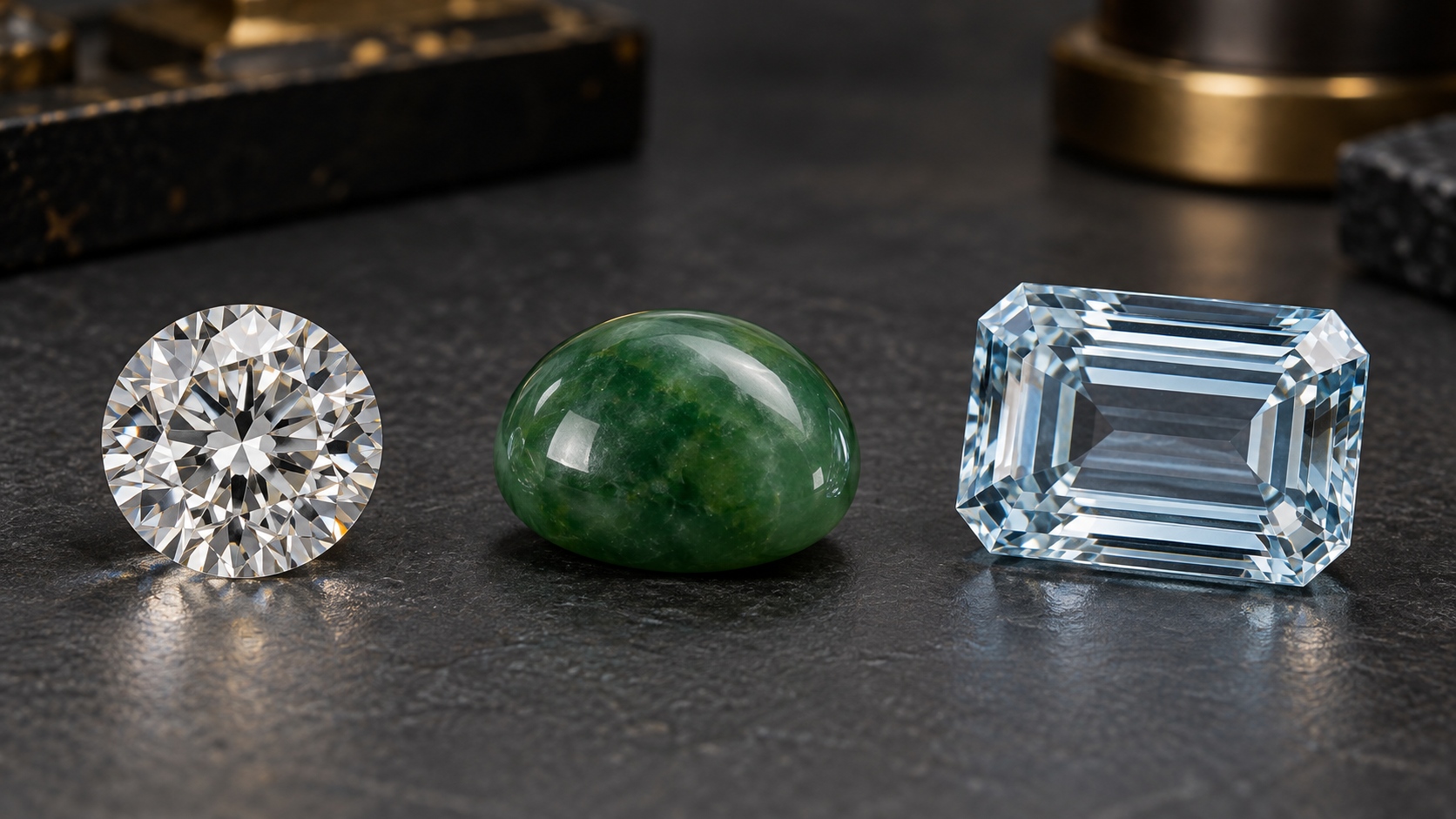
Diamond is the hardest natural mineral on the Mohs scale.
With a hardness of 10, it can scratch virtually every other naturally occurring mineral.
Yet a diamond can chip.
It can fracture.
Under certain conditions, it can even split along specific crystallographic directions.
Meanwhile, nephrite jade possesses a considerably lower Mohs hardness, generally between 6 and 6.5.
Despite being much more susceptible to scratching than diamond, nephrite is exceptionally resistant to breakage.
Topaz provides another interesting example.
It possesses a Mohs hardness of 8, making it harder than quartz.
Nevertheless, a sufficiently strong impact in the wrong direction can cause topaz to split along a natural cleavage plane.
These examples reveal an important principle:
Hardness and durability are not the same thing.
When selecting a gemstone, particularly for jewellery, understanding its resistance to scratching is only part of the evaluation.
Its resistance to breaking, its internal crystal structure and its stability under environmental conditions are equally important.
Modern gemmology therefore evaluates durability through three principal characteristics:
Hardness — resistance to scratching and abrasion.
Toughness — resistance to breaking, chipping and fracture propagation.
Stability — resistance to environmental influences such as heat, light, chemicals and humidity.
A gemstone may perform exceptionally well in one category while requiring additional care in another.
Understanding these differences allows collectors and jewellery buyers to make more informed decisions.
It also explains why certain gemstones are suitable for frequent ring wear while others are better protected in pendants, earrings or collections.
1. What Does Gemstone Durability Actually Mean?
In gemmology, durability describes a gemstone’s ability to withstand conditions encountered during handling, wear, cleaning and storage.
The Gemological Institute of America identifies three major components of durability:
- Hardness
- Toughness
- Stability
These properties describe different types of resistance.
Hardness concerns surface damage.
Toughness concerns mechanical failure.
Stability concerns changes caused by environmental exposure.
A gemstone’s practical durability depends on the interaction of all three.
For example, a gemstone may resist scratching but fracture relatively easily when struck.
Another may resist impacts exceptionally well but gradually develop surface scratches.
A third may possess reasonable mechanical properties while being sensitive to heat or chemicals.
Consequently, no single numerical value can completely describe how a gemstone will perform during everyday use.
This is particularly important because the conditions encountered by gemstones vary considerably.
A gemstone mounted in a frequently worn ring faces different risks from one mounted in earrings.
A loose gemstone stored in a protective container faces different conditions from a mineral specimen displayed near a window.
Durability must therefore be considered in relation to the material and its intended use.
2. The Mohs Hardness Scale: What It Measures
The Mohs scale is one of the most familiar concepts in mineralogy.
It was developed by Friedrich Mohs in the early nineteenth century.
The scale ranks minerals according to their relative resistance to scratching.
A harder reference mineral can scratch a softer one under suitable testing conditions.
The traditional scale contains ten reference minerals.
| Mohs hardness | Reference mineral |
|---|---|
| 1 | Talc |
| 2 | Gypsum |
| 3 | Calcite |
| 4 | Fluorite |
| 5 | Apatite |
| 6 | Orthoclase feldspar |
| 7 | Quartz |
| 8 | Topaz |
| 9 | Corundum |
| 10 | Diamond |
The scale remains useful because it provides a convenient comparative system.
However, its limitations are frequently misunderstood.
Most importantly, the Mohs scale is ordinal rather than linear.
The difference between hardness 6 and hardness 7 is not necessarily equivalent to the difference between hardness 8 and hardness 9.
Likewise, a diamond with Mohs hardness 10 is not merely ten percent harder than corundum with hardness 9.
The actual difference in resistance to indentation or abrasion can be substantially greater.
The Mohs scale therefore provides a ranking, not a direct measurement of mechanical strength.
3. Why the Mohs Scale Is Not Linear
The Mohs scale is based on relative scratch resistance.
Its numbers do not represent equal physical increments.
This distinction becomes particularly important when comparing diamond with other gemstones.
Diamond occupies position 10.
Corundum occupies position 9.
Although these minerals are separated by only one Mohs number, diamond possesses substantially greater hardness when evaluated using quantitative hardness measurements.
Modern materials science uses additional methods to investigate hardness.
These include indentation-based techniques such as Knoop and Vickers hardness testing.
Such methods measure the response of a material to a controlled indentation.
They provide quantitative information that differs from the simple ranking established by Mohs.
However, indentation hardness and scratch hardness are not identical properties.
Their results should not be treated as interchangeable without considering the testing method.
For practical gemstone evaluation, the Mohs scale remains useful.
Its purpose is to indicate relative scratch resistance.
It should not be interpreted as a complete measurement of durability.
4. Why Scratch Resistance Matters in Everyday Jewellery
Gemstones worn in jewellery may encounter abrasive materials.
These include dust, sand, hard surfaces and other gemstones.
Quartz is particularly relevant because it is common in many natural environments.
Quartz has a Mohs hardness of 7.
Consequently, quartz particles can potentially scratch gemstones with lower scratch resistance.
Repeated abrasion may gradually reduce the polish of a gemstone.
Facet edges may become less sharply defined.
Small surface scratches may accumulate.
Over time, the gemstone can appear less brilliant.
This process is particularly relevant to frequently worn rings.
A ring may come into contact with hard surfaces during ordinary activities.
By comparison, earrings and pendants generally experience fewer direct impacts and abrasive contacts.
However, their actual exposure depends on how they are worn and handled.
A gemstone with a lower Mohs hardness is not necessarily unsuitable for jewellery.
It simply requires appropriate consideration of its exposure to abrasion.
5. Toughness: A Different Kind of Mechanical Resistance
Toughness describes a material’s resistance to fracture.
In gemstone evaluation, it concerns the ability to withstand mechanical forces without breaking, chipping or cracking.
A gemstone may possess high hardness but comparatively limited resistance to impact.
This occurs because scratch resistance and fracture resistance depend on different aspects of material behaviour.
Hardness is influenced by resistance to local deformation or scratching.
Fracture resistance depends on how cracks initiate and propagate through the material.
Crystal structure, bonding, defects and internal microstructure all influence fracture behaviour.
In materials science, fracture toughness is often expressed through measurements describing resistance to crack propagation.
These measurements are more complex than the Mohs scale.
They also depend on the method used and the orientation of the material.
Gemstone care guides frequently use descriptive toughness classifications such as:
- Excellent
- Good
- Fair
- Poor
These terms are useful for practical comparisons.
However, they should not be confused with universally standardised numerical fracture-toughness measurements.
The essential distinction remains:
Hardness describes resistance to scratching. Toughness describes resistance to breaking.
6. Diamond: Extremely Hard, but Not Indestructible
Diamond provides one of the clearest demonstrations of the difference between hardness and toughness.
Its exceptional hardness results from its crystal structure and strong covalent bonding.
Each carbon atom is bonded to neighbouring carbon atoms in a three-dimensional arrangement.
This structure produces extraordinary resistance to scratching.
However, diamond also possesses perfect cleavage.
Cleavage is the tendency of a crystalline material to split along particular crystallographic planes.
Diamond has four equivalent octahedral cleavage directions.
These correspond to the {111} family of crystallographic planes.
Along these directions, the crystal can fracture more readily than in certain other orientations.
This does not mean that diamond is fragile under ordinary conditions.
Diamonds are highly durable gemstones.
Nevertheless, a sufficiently strong impact at a vulnerable location can cause damage.
Pointed corners, exposed girdle areas and existing fractures may increase the risk.
Certain cutting styles therefore require particular attention to protection.
For example, pointed corners may be protected by appropriately designed prongs.
The GIA has documented how diamonds can chip during ordinary wear and how cutting geometry and mounting design influence this risk.
Diamond is exceptionally resistant to scratching, but its hardness does not make it immune to mechanical damage.
7. Cleavage: Why Some Gemstones Split Along Specific Directions
Cleavage is an important mineralogical property.
It describes a crystal’s tendency to break along planes determined by its internal atomic arrangement.
These planes represent directions in which separation can occur comparatively easily.
Cleavage differs from irregular fracture.
A cleavage surface may appear relatively flat because it follows a crystallographically controlled direction.
Irregular fracture does not follow such a preferred cleavage plane.
The distinction is important because a gemstone with pronounced cleavage may be vulnerable to certain impacts.
A sudden force can initiate or extend a fracture along a cleavage direction.
The risk depends on several factors.
These include the orientation of the crystal, the location of the impact, existing defects and the gemstone’s shape.
Cleavage is not necessarily visible in a finished gemstone.
A perfectly polished stone may contain no obvious external indication of its cleavage directions.
Nevertheless, the crystallographic property remains present.
This is why gem cutters and jewellery manufacturers must consider cleavage during cutting, polishing and setting.
8. Topaz: A Hard Gemstone With Important Cleavage
Topaz is a particularly useful example.
It has a Mohs hardness of 8.
This makes it harder than quartz and many other commonly encountered gemstone materials.
From the perspective of scratch resistance, topaz performs relatively well.
However, topaz possesses perfect basal cleavage.
Its cleavage occurs parallel to the {001} crystallographic plane.
This property can make the gemstone vulnerable to splitting under certain mechanical conditions.
The GIA specifically identifies topaz as a gemstone requiring additional care because of its cleavage.
Gem cutters consider this property when orienting rough material.
Jewellery manufacturers must also account for it during mounting.
A strong impact or excessive pressure can damage the stone.
Sudden temperature changes may create additional risks.
Therefore, topaz is not automatically an ideal choice for every type of jewellery simply because its hardness is 8.
It can be used successfully in rings.
However, protective settings and careful wear are advisable.
Pendants and earrings generally offer lower exposure to accidental impacts.
This illustrates why a hardness number should never be the only criterion used when selecting a gemstone.
9. Jade: Why a Softer Gemstone Can Be Exceptionally Tough
Jade provides an almost opposite example.
The term jade commonly refers to two different mineral materials:
Jadeite
Nephrite
Jadeite is a pyroxene mineral.
Nephrite is a compact, interlocking aggregate of amphibole minerals belonging to the tremolite–actinolite series.
These materials possess different compositions and microstructures.
However, both are recognised for exceptional toughness.
According to GIA, jadeite generally has a Mohs hardness of approximately 6.5–7.
Nephrite generally falls around 6–6.5.
Neither approaches diamond in scratch resistance.
Nevertheless, both can be exceptionally resistant to breakage.
Their toughness is closely related to their microstructures.
Nephrite’s tightly interwoven fibrous structure is particularly effective at resisting crack propagation.
Jadeite’s compact interlocking crystalline structure also contributes to its mechanical resistance.
This helps explain why jade has historically been used for carvings, ornaments and objects requiring considerable resistance to fracture.
Jade demonstrates that hardness and toughness are fundamentally different characteristics.
A jade object may acquire surface scratches more readily than a diamond.
Yet its internal structure can make it remarkably resistant to certain forms of mechanical breakage.
10. Ruby and Sapphire: A Strong Combination of Properties
Ruby and sapphire belong to the mineral species corundum.
Their Mohs hardness is 9.
They possess excellent scratch resistance.
Corundum also has excellent toughness for jewellery applications.
Unlike diamond or topaz, corundum does not possess true crystallographic cleavage.
It may exhibit parting under particular structural conditions, but parting should not be confused with ordinary cleavage.
This combination of properties contributes to the suitability of ruby and sapphire for frequently worn jewellery.
Both can be excellent choices for rings.
However, this does not mean that every ruby or sapphire has identical durability.
Individual characteristics matter.
A gemstone containing significant fractures may be more vulnerable than one without comparable defects.
Certain treatments can also affect durability.
For example, some rubies contain glass-filled fractures.
The filler material may be less chemically stable than the surrounding corundum.
This can create additional care requirements.
Therefore, gemstone durability must be considered at both the mineral-species level and the individual-specimen level.
11. Emerald: Why Hardness Does Not Tell the Complete Story
Emerald belongs to the mineral species beryl.
It generally has a Mohs hardness between 7.5 and 8.
This provides relatively good resistance to scratching.
However, emeralds commonly contain internal characteristics.
These may include mineral inclusions, fluid inclusions and fractures.
Some fractures reach the gemstone’s surface.
The presence, orientation and extent of these features can influence mechanical durability.
Consequently, two emeralds with similar colour and hardness may behave differently under impact.
Emeralds may also undergo clarity enhancement.
Surface-reaching fractures are sometimes filled with oils, resins or other substances to reduce their visibility.
These fillers can have different stability characteristics from the emerald itself.
Heat, chemicals or inappropriate cleaning methods may alter the filler.
The GIA therefore recommends gentle cleaning methods for emerald jewellery.
Ultrasonic and steam cleaning are generally inappropriate for fracture-filled emeralds.
The important lesson is that a gemstone’s natural hardness does not describe the complete durability of a treated or heavily fractured specimen.
12. Moonstone: Optical Beauty With Additional Care Requirements
Moonstone is valued for its characteristic optical phenomenon known as adularescence.
This effect creates a soft, floating sheen that may move across the gemstone as the viewing direction changes.
Moonstone belongs to the feldspar family.
Its Mohs hardness is generally approximately 6–6.5.
It also possesses cleavage in two directions.
These characteristics contribute to its relatively poor toughness.
A strong impact may cause damage along a cleavage direction.
The gemstone can also be vulnerable to scratching.
High heat or sudden temperature changes may create additional risks.
For these reasons, moonstone is often particularly suitable for pendants and earrings.
Moonstone rings are possible, but they benefit from protective settings and careful handling.
The presence of attractive adularescence does not imply greater mechanical durability.
Optical beauty and mechanical performance are separate gemstone characteristics.
13. Opal: Durability and Environmental Stability
Opal introduces another important aspect of durability.
Unlike quartz, opal is not a crystalline mineral with a regular long-range crystal structure.
It is a hydrated form of silica.
Its composition and internal structure vary according to the material.
Opal generally has a Mohs hardness of approximately 5–6.5.
Its toughness ranges from very poor to fair.
Consequently, it can be vulnerable to scratching and mechanical damage.
However, environmental stability is also important.
Certain opals may develop fractures or crazing when exposed to unsuitable conditions.
Crazing refers to the development of a network of cracks.
Heat and abrupt temperature changes can contribute to this problem.
Water content and structural characteristics influence the behaviour of particular opals.
Not every opal responds identically.
Some are relatively stable under normal conditions.
Others require greater care.
It would therefore be misleading to suggest that all opals are inherently unstable.
Likewise, deliberately soaking an opal should not be treated as a universal method of preventing damage.
The appropriate care depends on the particular material, its structure and any treatments or composite construction.
For most opal jewellery, avoiding extreme heat, abrupt temperature changes and strong impacts is prudent.
14. Stability: The Third Essential Component of Durability
Stability describes how a gemstone responds to environmental conditions.
A gemstone may possess adequate hardness and toughness while remaining sensitive to particular exposures.
Important stability factors include:
Heat
High temperatures may alter colour, damage inclusions or create fractures.
Thermal shock
Rapid temperature changes can produce stress within a gemstone.
If the stress exceeds the material’s resistance, cracking may occur.
Light
Certain gemstones and treatments can undergo colour changes after prolonged exposure to intense light.
Chemicals
Acids, alkalis, solvents and household cleaning products can affect some gemstone materials.
Humidity
Certain organic and hydrated materials can respond to environmental moisture conditions.
Treatment stability
Fillers, dyes, coatings and other enhancement materials may behave differently from the underlying gemstone.
Stability must therefore be evaluated in relation to the actual exposure.
A gemstone may remain stable during ordinary wear but become vulnerable during jewellery repair involving high temperatures.
Another may tolerate routine cleaning but react poorly to solvents.
This is why gemstone-specific care instructions are important.
15. Kunzite: When Light Stability Matters
Kunzite is a pink-to-violet variety of spodumene.
Its Mohs hardness is approximately 6.5–7.
It also possesses pronounced cleavage.
Consequently, strong impacts can create a risk of breakage.
However, kunzite presents another important consideration.
Certain kunzite colours may fade after prolonged exposure to intense light or heat.
This is a stability issue rather than a hardness issue.
The gemstone does not need to become scratched or fractured for its appearance to change.
Its colour may be affected by environmental exposure.
This demonstrates why stability must be included in a complete durability assessment.
A gemstone can retain its shape and polish while undergoing an undesirable change in colour.
16. Fluorite: An Example of Limited Scratch Resistance
Fluorite occupies position 4 on the Mohs scale.
It is therefore considerably softer than quartz, topaz and corundum.
Fluorite also possesses perfect octahedral cleavage.
These characteristics make it relatively vulnerable to both scratching and cleavage-related breakage.
Nevertheless, fluorite can be an attractive gemstone and collector material.
Its colours and crystal forms make it particularly interesting for mineral collections.
It can also be cut and polished.
However, its durability limitations should be recognised.
For jewellery, fluorite generally requires substantial protection and careful wear.
It is often more practical in low-impact applications than in frequently worn rings.
For collectors, individual specimens should be protected from abrasion and mechanical shocks.
Fluorite illustrates why a material can be highly desirable without being especially suitable for demanding jewellery applications.
17. The Influence of Inclusions and Internal Fractures
A gemstone’s durability is not determined exclusively by its mineral species.
Individual internal characteristics can influence mechanical behaviour.
Inclusions may create local differences in physical properties.
Fractures can provide locations from which additional cracks may propagate.
Surface-reaching fractures can be particularly relevant because they may interact with external stresses.
However, not every inclusion significantly reduces durability.
Many natural gemstones contain inclusions that have little practical effect on normal handling.
The important factors include:
- Inclusion type
- Inclusion size
- Position within the gemstone
- Orientation
- Associated fractures
- Proximity to exposed edges or corners
A small enclosed crystal inclusion may be relatively unimportant mechanically.
A significant fracture extending toward an exposed corner may present a greater concern.
This is why individual gemstone evaluation remains necessary.
A general durability rating for a mineral species cannot describe every specimen.
18. Why Gemstone Shape and Cutting Style Matter
Cutting geometry influences how a gemstone responds to mechanical forces.
Certain shapes contain pointed corners or exposed edges.
These locations may be more vulnerable to chipping.
Examples include gemstones with pronounced points or sharp corners.
Rounded outlines can reduce some exposure risks.
However, shape alone does not guarantee durability.
A gemstone with internal fractures may remain vulnerable even when its outline is rounded.
The thickness of the girdle can also influence mechanical protection.
Extremely thin girdle areas may be susceptible to damage.
Cutters must balance optical performance, weight retention, appearance and mechanical considerations.
In gemstones with cleavage, the orientation of the rough material may influence cutting decisions.
Consequently, cutting is not merely an aesthetic process.
It also involves understanding the physical properties of the material.
19. Why Jewellery Settings Influence Durability
The mounting surrounding a gemstone can provide mechanical protection.
A well-designed setting may reduce the likelihood of direct impacts against vulnerable areas.
For example, a bezel setting surrounds the gemstone with a metal rim.
This can offer useful protection around the perimeter.
Prong settings expose more of the gemstone.
However, appropriately positioned prongs can protect vulnerable corners.
The most suitable setting depends on the gemstone’s shape, dimensions and physical characteristics.
The quality of the jewellery construction is also important.
A poorly secured gemstone may move within its mounting.
This can create additional wear or damage.
The durability of the gemstone and the durability of the jewellery setting should therefore be considered together.
A strong gemstone in an insecure mounting is not automatically a durable jewellery piece.
20. Choosing Gemstones for Different Types of Jewellery
Different jewellery applications expose gemstones to different conditions.
Rings
Rings frequently encounter contact with hard surfaces.
They may experience accidental impacts during everyday activities.
Scratch resistance and toughness are therefore particularly important.
Diamond, ruby and sapphire are commonly suitable choices.
Other gemstones can also be used, but their care requirements should be considered.
Earrings
Earrings generally experience less direct mechanical contact than rings.
This can make them suitable for gemstones requiring additional protection.
Pendants
Pendants usually face fewer impacts than rings.
However, they can still strike hard surfaces or become damaged during storage.
Bracelets
Bracelets may experience substantial contact with desks, furniture and other objects.
They therefore deserve careful consideration.
Collectors’ specimens
Loose gemstones and mineral specimens face different risks.
Abrasion, accidental dropping, handling and environmental exposure may be more relevant than ordinary jewellery wear.
The appropriate choice depends on the intended use rather than hardness alone.
21. A Comparative Overview of Common Gemstones
The following table provides approximate hardness values and general durability considerations.
Individual gemstones may differ because of inclusions, fractures, treatments and structural variations.
| Gemstone | Mohs hardness | Important durability consideration |
|---|---|---|
| Diamond | 10 | Exceptional scratch resistance; can chip or cleave |
| Ruby | 9 | Excellent hardness and toughness; treatments may require care |
| Sapphire | 9 | Excellent hardness and toughness |
| Alexandrite | 8.5 | Excellent toughness and no cleavage |
| Spinel | 8 | Good toughness and scratch resistance |
| Topaz | 8 | Perfect basal cleavage; vulnerable to certain impacts |
| Emerald | 7.5–8 | Fractures and clarity enhancements may influence durability |
| Aquamarine | 7.5–8 | Generally durable; fractures and inclusions require consideration |
| Garnet | 6.5–7.5 | Fair to good toughness, depending on variety |
| Jadeite | 6.5–7 | Exceptional toughness |
| Nephrite | 6–6.5 | Exceptional toughness |
| Moonstone | 6–6.5 | Cleavage and poor toughness |
| Tanzanite | 6–7 | Cleavage and fair-to-poor toughness |
| Opal | 5–6.5 | Limited toughness and possible environmental sensitivity |
| Fluorite | 4 | Low scratch resistance and pronounced cleavage |
These values are general reference ranges.
They should not be used as a substitute for examining an individual gemstone.
22. Why Treatment Information Is Relevant to Durability
Gemstone treatments may alter appearance without necessarily changing the fundamental mineral structure.
However, certain treatments introduce additional durability considerations.
For example, fracture filling introduces a material into existing fractures.
The filler may possess different thermal, optical or chemical properties from the gemstone.
Exposure to heat or chemicals may affect the filler.
Surface coatings can also be vulnerable to abrasion.
Dyes may fade or react to solvents.
Other treatments, such as some conventional heat treatments, may remain stable under normal wearing conditions.
Therefore, it would be incorrect to assume that every treated gemstone is less durable.
The effect depends on the treatment method and material.
A responsible durability evaluation considers both the natural gemstone and any known enhancement.
This is one reason why treatment disclosure is important when purchasing gemstones.
23. Why Cleaning Methods Must Be Gemstone-Specific
Cleaning presents an often-overlooked durability risk.
A method suitable for one gemstone may damage another.
Ultrasonic cleaning, for example, uses high-frequency vibrations.
These can be problematic for certain fractured or treated gemstones.
Steam cleaning exposes jewellery to heat and moisture.
This may create risks for heat-sensitive materials or treatments.
Chemical cleaning products can also affect some gemstones.
For many durable, untreated gemstones, gentle cleaning with mild soap and lukewarm water is appropriate.
However, even this general recommendation must be adapted to the material and jewellery construction.
Pearls, amber, opal composites and certain treated stones may require more specialised care.
The safest approach is to consult material-specific guidance.
When treatment status is uncertain, aggressive cleaning should be avoided.
Professional advice is particularly appropriate for valuable, antique or heavily included gemstones.
24. Why Gemstones Should Be Stored Separately
Storage conditions can influence long-term gemstone appearance.
Harder gemstones can scratch softer materials when they come into contact.
For example, a loose diamond can scratch many other gemstones.
Quartz can scratch several softer ornamental materials.
Repeated contact may gradually damage polished surfaces.
Separate compartments, soft pouches and appropriate protective containers can reduce this risk.
However, storage materials must also be suitable for the gemstone.
Some materials require consideration of temperature, humidity or chemical exposure.
Jewellery should also be inspected periodically.
Loose settings can create mechanical risks.
A gemstone that moves within its mounting may become damaged or lost.
Appropriate storage and inspection are therefore important components of gemstone care.
25. Does a Higher Mohs Hardness Mean a More Valuable Gemstone?
Hardness and market value are different concepts.
Gemstone value depends on multiple factors.
These may include rarity, colour, transparency, cutting quality, demand, origin and treatment status.
A relatively soft gemstone can be extremely valuable.
Likewise, a very hard gemstone is not automatically expensive.
For example, exceptional opals may command substantial prices despite their comparatively limited hardness.
Fine emeralds can be valuable even when they contain fractures requiring careful handling.
The same principle applies to rare collector minerals.
Their value may depend on crystallographic quality, provenance, rarity or scientific interest rather than suitability for jewellery.
Hardness is therefore a physical property.
It is not a direct measurement of quality or commercial value.
26. Durability and Gemstone Grading Are Different Evaluations
Gemstone grading and durability assessment overlap in certain areas, but they are not identical.
A faceted gemstone may be evaluated according to:
- Colour
- Clarity
- Cut
- Optical performance
- Overall appeal
These characteristics contribute to an assessment of the gemstone’s visual and qualitative attributes.
Durability introduces additional considerations.
For example, a gemstone may possess excellent colour and cutting quality while requiring careful handling because of cleavage.
Another may be exceptionally tough but possess a less desirable colour or optical appearance.
Therefore, a high quality grade should not automatically be interpreted as a guarantee of exceptional durability.
Similarly, a gemstone with moderate visual quality may possess excellent mechanical properties.
A complete product description should distinguish between these concepts.
27. A Practical Example: Choosing Between Sapphire and Topaz
Imagine selecting a blue gemstone for a ring intended for frequent wear.
Two candidates are available.
The first is a natural blue sapphire.
The second is a natural blue topaz.
Both may display attractive colour and transparency.
However, their durability profiles differ.
Sapphire has Mohs hardness 9.
Topaz has Mohs hardness 8.
The difference in scratch resistance is relevant.
However, toughness and cleavage are also important.
Corundum has excellent toughness and no true cleavage.
Topaz possesses perfect basal cleavage.
Consequently, sapphire generally offers a more favourable durability profile for demanding ring wear.
This does not mean that topaz cannot be used in a ring.
A well-designed protective setting and careful handling can make topaz jewellery practical.
The correct conclusion is not that one gemstone is universally acceptable and the other unsuitable.
Rather, the two materials have different durability characteristics that should influence the decision.
28. A Practical Example: Diamond Versus Nephrite Jade
Now consider a different comparison.
Diamond has Mohs hardness 10.
Nephrite has Mohs hardness approximately 6–6.5.
Diamond is dramatically more resistant to scratching.
However, nephrite possesses exceptional toughness.
Its interlocking fibrous microstructure can resist crack propagation very effectively.
This helps explain why nephrite has historically been suitable for durable carvings and ornamental objects.
The comparison demonstrates why a single hardness ranking cannot predict every type of mechanical performance.
Diamond performs exceptionally well against scratching.
Nephrite performs exceptionally well against certain forms of breakage.
Neither characteristic should be confused with the other.
29. Five Questions to Ask Before Choosing a Gemstone
A practical durability assessment can begin with five questions.
1. How resistant is the gemstone to scratching?
Consider its Mohs hardness and likely exposure to abrasive materials.
2. How resistant is it to impact?
Investigate toughness, cleavage and the presence of significant fractures.
3. Is it environmentally stable?
Consider heat, light, humidity and chemical sensitivity.
4. Has the gemstone been treated?
Determine whether known treatments introduce additional care requirements.
5. How will the gemstone be used?
A gemstone intended for occasional pendant wear may face very different risks from one intended for a frequently worn ring.
These questions provide a more complete framework than hardness alone.
30. The Natural Gems Belgium Approach to Durability Information
At Natural Gems Belgium, the scientific description of a gemstone is an important part of its individual presentation.
Where applicable, gemmological information may include:
- Mineral species
- Variety
- Crystal system
- Mohs hardness
- Refractive index
- Specific gravity
- Optical properties
- Natural characteristics
- Treatment information
These properties help establish the gemstone’s identity and physical characteristics.
However, hardness should not be interpreted as a complete durability rating.
A gemstone’s cleavage, internal structure, inclusions and treatment status may require additional consideration.
For finished faceted gemstones, the NGB grading framework evaluates colour, clarity, cut, optical performance and overall appeal.
This provides a structured assessment of visual and qualitative characteristics.
It does not replace a separate durability evaluation.
The objective is to present natural gemstones with sufficient information for informed purchasing decisions.
31. Common Misconceptions About Gemstone Durability
Several misconceptions deserve clarification.
Misconception: A gemstone with Mohs hardness 8 is twice as hard as one with hardness 4.
Incorrect. The Mohs scale is not linear.
Misconception: Diamond cannot break.
Incorrect. Diamond can chip or fracture under suitable mechanical conditions.
Misconception: A softer gemstone must be easier to break.
Incorrect. Scratch resistance and fracture resistance are different properties.
Misconception: All gemstones with the same hardness have the same durability.
Incorrect. Toughness, cleavage and stability can differ considerably.
Misconception: A protective setting makes a fragile gemstone indestructible.
Incorrect. Protective settings can reduce certain risks but cannot eliminate them.
Misconception: Every treated gemstone is less durable.
Incorrect. Durability effects depend on the treatment and material.
Misconception: A gemstone suitable for jewellery can be cleaned using any jewellery cleaner.
Incorrect. Cleaning methods must account for the gemstone, its treatments and its mounting.
32. The Scientific Perspective: Durability Is a Combination of Properties
From a materials-science perspective, gemstone durability is a multidimensional problem.
Scratch resistance depends on local mechanical behaviour.
Fracture resistance depends on crack initiation and propagation.
Cleavage depends on crystallographic structure.
Environmental stability depends on chemical composition, structure and exposure conditions.
The presence of inclusions, fractures and treatments introduces additional variables.
Cutting geometry and mounting design further influence practical performance.
These factors interact.
A gemstone with excellent hardness may still be vulnerable at an exposed corner.
A gemstone with exceptional toughness may gradually lose polish through abrasion.
A mechanically durable gemstone may experience colour alteration under unsuitable environmental conditions.
Therefore, durability should not be reduced to a single number.
The most useful assessment considers the material, its individual characteristics and its intended use.
Conclusion: Beyond the Hardness Number
The Mohs hardness scale remains one of the most useful introductory tools in mineralogy.
It provides a convenient way to compare resistance to scratching.
However, its simplicity can create misunderstandings when applied to gemstone durability.
Diamond demonstrates that exceptional hardness does not prevent fracture.
Topaz demonstrates that a relatively hard gemstone may possess important cleavage-related vulnerabilities.
Jade demonstrates that a softer material can possess extraordinary toughness.
Emerald illustrates the influence of fractures and clarity enhancement.
Opal demonstrates why environmental stability must also be considered.
These examples reveal that durability is not one property.
It is the combined result of hardness, toughness, stability and individual structural characteristics.
For gemstone buyers, this knowledge supports better decisions.
For collectors, it provides guidance about handling and storage.
For jewellery designers, it explains why material selection, cutting geometry and mounting construction must be considered together.
For gemmologists, it reinforces the importance of distinguishing measurable physical properties from general impressions of strength.
A gemstone’s Mohs hardness tells us how well it resists scratching.
Its toughness tells us how well it resists breaking.
Its stability tells us how well it withstands environmental influences.
Only by considering all three can we develop a meaningful understanding of gemstone durability.
A natural gemstone deserves to be appreciated for its beauty.
But understanding its physical limitations is equally important.
The objective is not to avoid gemstones that require care.
It is to select, handle and preserve them with an informed understanding of their natural properties.
References & Further Reading
The following references are drawn from authoritative scientific, mineralogical and gemmological institutions.
All sources are educational or technical resources. No gemstone product listings, retail blogs or commercial crystal-healing websites are included.
1. Gemological Institute of America — More Than the Mohs Scale: Understanding Gem Durability
Published 14 March 2016.
A foundational educational reference explaining the differences between hardness, toughness and stability.
Includes practical examples involving diamond, jade and other gemstone materials.
https://4cs.gia.edu/en-us/blog/more-than-mohs-scale-gem-durability
2. Gemological Institute of America — How to Protect Your Diamond from Chipping
Al Gilbertson.
Published 5 May 2016.
A detailed scientific and practical discussion of diamond hardness, toughness, cleavage and mechanical damage.
Explains how crystal structure, cutting geometry and mounting design influence diamond durability.
https://www.gia.edu/gia-news-research/how-protect-diamond-chipping
3. United States Geological Survey — Mineral Gemstones
USGS educational publication.
Provides mineralogical information about gemstones, including hardness, specific gravity and the Mohs scale.
Useful for understanding basic mineral properties and the relationship between gemstone species and physical characteristics.
https://pubs.usgs.gov/gip/gemstones/mineral.html
4. Gemological Institute of America — Topaz Care and Cleaning Guide
GIA educational reference.
Explains topaz hardness, basal cleavage, mechanical vulnerability and appropriate cleaning methods.
Particularly relevant to the distinction between scratch resistance and fracture resistance.
https://www.gia.edu/topaz-care-cleaning
5. Gemological Institute of America — Jade Care and Cleaning Guide
GIA educational reference.
Compares jadeite and nephrite hardness and explains their exceptional toughness.
Provides important context for the relationship between mineral microstructure and resistance to breakage.
https://my.gia.edu/jade-care-cleaning
6. Gemological Institute of America — Diamond Care and Cleaning Guide
GIA educational reference.
Discusses diamond hardness, toughness, cleavage, thermal stability and jewellery care.
https://www.gia.edu/diamond-care-cleaning
7. Gemological Institute of America — Sapphire Care and Cleaning Guide
GIA educational reference.
Explains the hardness and toughness of corundum and its suitability for frequently worn jewellery.
https://www.gia.edu/sapphire-care-cleaning
8. Gemological Institute of America — Emerald Care and Cleaning Guide
GIA educational reference.
Examines emerald hardness, toughness, fracture filling and the risks associated with inappropriate cleaning.
https://www.gia.edu/emerald-care-cleaning
9. Gemological Institute of America — Moonstone Care and Cleaning Guide
GIA educational reference.
Explains moonstone hardness, cleavage, toughness and environmental care requirements.
https://www.gia.edu/moonstone-care-cleaning
10. Gemological Institute of America — Opal Care and Cleaning Guide
GIA educational reference.
Discusses opal hardness, toughness, environmental stability and the causes of crazing.
https://www.gia.edu/opal-care-cleaning
11. Gemological Institute of America — Garnet Care and Cleaning Guide
GIA educational reference.
Provides information about hardness variation across garnet species, toughness and appropriate cleaning methods.
https://www.gia.edu/garnet-care-cleaning
12. Gemological Institute of America — Alexandrite Care and Cleaning Guide
GIA educational reference.
Explains why alexandrite combines relatively high hardness with excellent toughness and no cleavage.
https://www.gia.edu/alexandrite-care-cleaning
13. Gemological Institute of America — Kunzite Care and Cleaning Guide
GIA educational reference.
Discusses kunzite cleavage, mechanical vulnerability and possible colour fading after prolonged exposure to intense light or heat.
https://my.gia.edu/kunzite-care-cleaning
14. Gemological Institute of America — Gemstone Durability Chart
Published in Gems & Gemology, Fall 2018.
A gemmological educational presentation examining the relationship between scratch resistance, toughness and practical gemstone durability.
https://www.gia.edu/gems-gemology/fall-2018-posters-general-gemology-jewelry
15. United States Geological Survey — Mohs Hardness Scale
USGS educational resource.
Provides the traditional ten-mineral Mohs reference scale and introductory information about mineral hardness.