

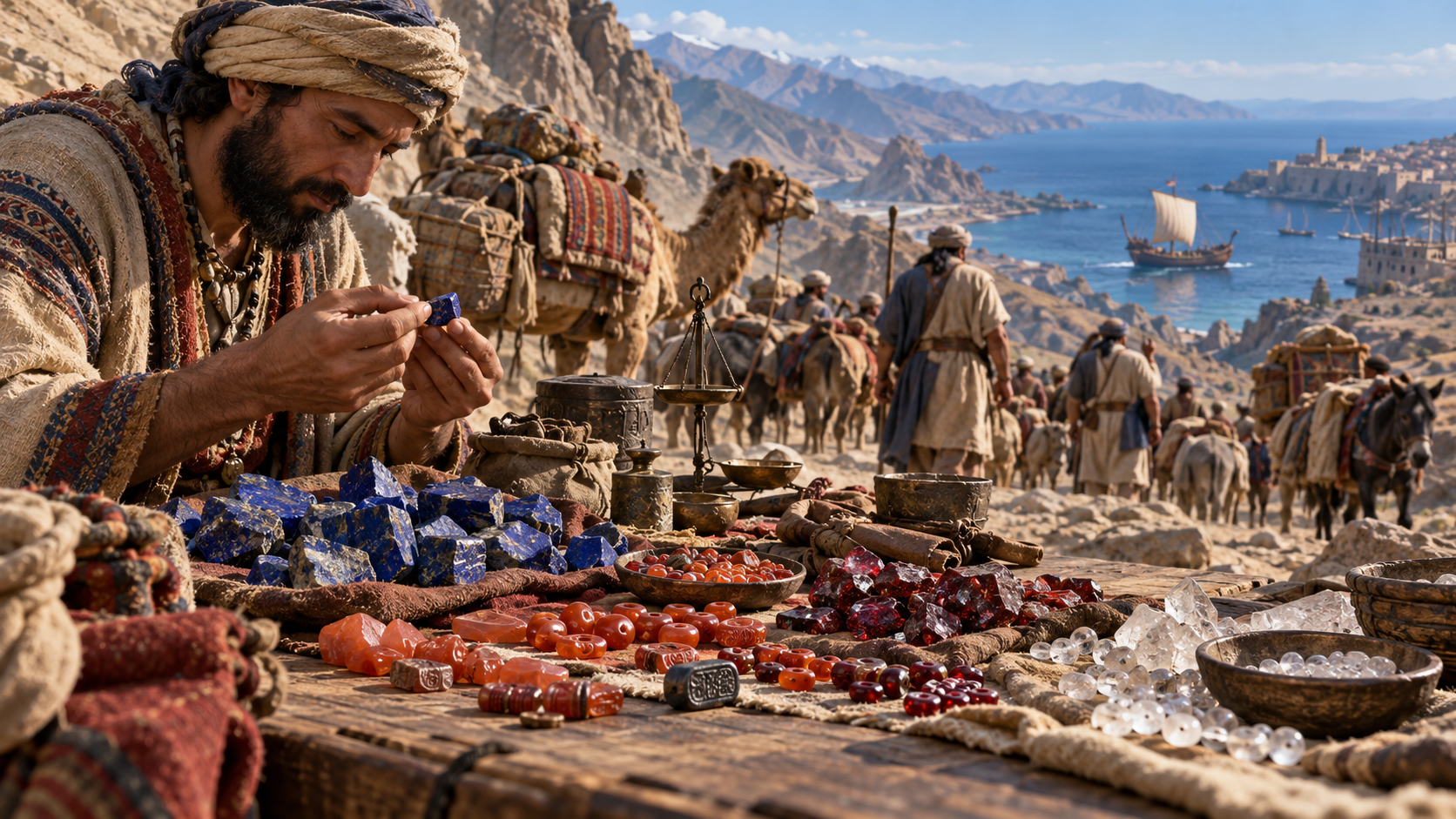
A Blue Stone That Had Already Travelled Thousands of Kilometres
Around 4,500 years ago, someone in the Mesopotamian city of Ur could hold a piece of deep-blue lapis lazuli.
That statement sounds unremarkable until we ask one question:
Where did the stone come from?
Not from southern Mesopotamia.
The famous lapis used in the Royal Cemetery at Ur is associated with sources in the Badakhshan region of what is now Afghanistan.
Before becoming jewellery in one of the great cities of ancient Mesopotamia, the material therefore had to travel across an enormous geographical distance.
There were:
- no aircraft;
- no railways;
- no container ships;
- no modern highways;
- no international courier services.
Yet the stone arrived.
And lapis was far from the only precious material moving through the ancient world.
Carnelian travelled.
Garnet travelled.
Turquoise travelled.
Diamonds travelled.
Pearls travelled.
Gold and precious metals travelled alongside them.
Gemstones passed from:
miners
to:
local traders
to:
caravans
to:
ports
to:
merchants
to:
lapidaries
to:
jewellers
and eventually to:
rulers, temples, elites and ordinary owners.
A gemstone could therefore cross languages, religions, political borders and entire civilisations before reaching its final wearer.
The history of gemstones is not only the history of beautiful minerals.
It is also:
Table of Contents
THE HISTORY OF HUMAN CONNECTION.
1. BEFORE THE “SILK ROAD”
The phrase:
Silk Road
is useful.
But it can also be misleading if we imagine a single road connecting China directly with Rome.
No such continuous gemstone motorway existed.
Instead, the ancient world contained overlapping networks of:
- caravan routes;
- river systems;
- mountain passes;
- coastal shipping;
- open-sea crossings;
- local markets;
- regional trading centres.
These networks changed repeatedly.
Empires rose and fell.
Ports prospered and disappeared.
Political borders moved.
Yet valuable portable materials continued to circulate.
Gemstones were particularly suitable for long-distance commerce.
2. WHY GEMSTONES TRAVEL SO WELL
Consider the economics.
A cartload of ordinary stone is heavy and relatively low in value.
A small parcel of fine gemstones can represent considerable value while weighing almost nothing.
Gemstones therefore have an exceptional:
VALUE-TO-WEIGHT RATIO.
This matters enormously in pre-modern trade.
Every kilometre travelled required:
- animals;
- food;
- water;
- sailors;
- guards;
- tolls;
- storage;
- time;
- risk.
Transporting low-value bulk goods over enormous distances could be uneconomic.
A handful of rare gems was different.
A merchant could carry substantial wealth in a very small package.
3. GEMS ARE ALSO DURABLE
Many gem materials possess another advantage:
they survive travel.
Corundum, garnet, quartz, spinel, diamond and many other gem minerals are durable enough to withstand handling and transport.
Unlike:
- food;
- flowers;
- many textiles;
- some dyes,
a gemstone does not normally spoil during a six-month journey.
A stone could remain tradeable:
for generations.
It could even be removed from one piece of jewellery and reused in another centuries later.
That makes gemstones unusual archaeological objects.
Their cultural setting can change while the mineral itself remains.
4. LAPIS LAZULI: ONE OF THE GREAT EARLY TRADE STONES
Few materials demonstrate prehistoric long-distance exchange more dramatically than:
LAPIS LAZULI.
Lapis lazuli is not a single mineral.
It is a rock composed principally of blue lazurite together with varying amounts of other minerals such as:
- calcite;
- pyrite;
- sodalite-related phases.
Its intense blue colour made high-quality material exceptionally distinctive.
And one region became famous above all others:
BADAKHSHAN.
The lapis deposits of northeastern Afghanistan belong among the most historically important gemstone sources in the world.
5. FROM AFGHAN MOUNTAINS TO MESOPOTAMIA
The distance between Badakhshan and southern Mesopotamia is enormous.
Yet lapis lazuli appears repeatedly in ancient Mesopotamian archaeological contexts.
At the Royal Cemetery of Ur, dating to the third millennium BCE, excavators recovered magnificent objects containing:
- lapis lazuli;
- carnelian;
- gold.
The Metropolitan Museum of Art notes that the lapis in jewellery from the so-called Great Death Pit at Ur would have originated in the Badakhshan region of Afghanistan.
This means the material had crossed a vast section of Asia before reaching:
Ur.
6. THE GEMSTONE IS EVIDENCE OF THE NETWORK
No ancient merchant left us a GPS track showing every stage of that journey.
But the gemstone itself provides evidence.
If a material occurs in:
Region A
but its geological source lies far away in:
Region B,
then human movement connected those regions somehow.
The exact route may remain debated.
There may have been:
- multiple routes;
- intermediate traders;
- changing exchange centres.
But the material proves that:
CONNECTION EXISTED.
7. TRADE DID NOT REQUIRE ONE MERCHANT TO MAKE THE WHOLE JOURNEY
This is one of the most important ideas in understanding ancient commerce.
A merchant in Mesopotamia did not necessarily travel personally to Afghanistan to purchase lapis.
Instead, a stone could move through:
RELAY TRADE.
For example:
miner
↓
local collector
↓
regional merchant
↓
caravan trader
↓
intermediate market
↓
another merchant
↓
urban workshop.
Each participant needed to know only:
the next section of the network.
The entire commercial system could therefore span thousands of kilometres without any one individual travelling the complete distance.
8. THE OXUS WORLD
Ancient Afghanistan and Central Asia were not remote empty spaces between “greater” civilisations.
They contained sophisticated communities and commercial centres.
The Metropolitan Museum describes Bronze Age northern Afghanistan as part of an extensive system of trade and cultural exchange.
The region possessed valuable natural resources including:
- gold;
- copper;
- tin;
- lapis lazuli;
- garnet;
- carnelian.
Its position helped connect regions of:
- Central Asia;
- Iran;
- Mesopotamia;
- the Indus world.
Gemstones were therefore part of a much larger flow of materials and ideas.
9. LAPIS WAS MORE THAN BLUE DECORATION
When lapis reached a distant society, it carried several forms of value simultaneously.
It was:
visually distinctive.
It was:
geographically exotic.
It was:
difficult to obtain.
And in many cultures it acquired:
symbolic significance.
This combination is powerful.
Rarity alone does not create a prized gemstone.
Beauty alone does not explain long-distance trade.
But when:
beauty + rarity + durability + symbolism
combine, a material can become extraordinarily desirable.
10. MESOPOTAMIAN JEWELLERY AS A MAP
Look closely at Sumerian jewellery from Ur.
Gold may have originated in one region.
Lapis came from Afghanistan.
Carnelian had its own geological and commercial pathways.
The finished object was assembled in Mesopotamia.
One necklace can therefore represent:
MULTIPLE GEOGRAPHIES.
A piece of jewellery becomes almost like a map of ancient exchange.
Its components reveal connections that written history alone may not preserve.
11. CUNEIFORM MAKES THE TRADE VISIBLE
Archaeology provides the stones.
Ancient texts sometimes provide the merchants.
At Kültepe in Anatolia, thousands of Old Assyrian cuneiform tablets preserve remarkable commercial records from the early second millennium BCE.
They document:
- merchants;
- investments;
- caravans;
- textiles;
- tin;
- silver;
- expenses;
- transport.
One surviving caravan account discussed by the Metropolitan Museum even records:
LAPIS LAZULI.
The tablet describes investment in lapis alongside other merchandise and records practical costs such as:
- guides;
- donkeys;
- equipment;
- fodder.
Suddenly the gemstone trade becomes very human.
Someone had to:
pay for the donkey.
12. LUXURY TRADE REQUIRED LOGISTICS
Ancient gemstone commerce was not merely glamorous exchange between kings.
Behind every luxury object lay practical infrastructure.
Caravans needed:
- animals;
- handlers;
- water;
- food;
- safe routes;
- lodging;
- political permission;
- financing.
Ships needed:
- crews;
- timber;
- sails;
- navigational knowledge;
- ports;
- favourable seasonal conditions.
Merchants needed:
- credit;
- partners;
- trustworthy agents;
- knowledge of foreign markets.
A gemstone’s beauty may attract our attention.
Its movement required:
ORGANISATION.
13. THE LAND ROUTES WERE ONLY PART OF THE STORY
When discussing ancient Eurasian trade, attention often focuses on caravans.
But maritime routes were equally important.
The:
INDIAN OCEAN
connected:
- India;
- Sri Lanka;
- Arabia;
- East Africa;
- the Red Sea;
- Persian Gulf networks;
- eventually the Mediterranean commercial world.
Ships could transport larger quantities of goods than pack animals.
Coastal ports became critical nodes connecting inland production regions to international trade.
14. INDIA AS A GEMSTONE CENTRE
The Indian subcontinent occupied an exceptional position in the history of gemstones.
It possessed or had access to important sources of:
- diamonds;
- garnets;
- agates;
- carnelians;
- rock crystal;
- other gem materials.
It also developed sophisticated traditions of:
- bead making;
- drilling;
- polishing;
- carving;
- jewellery manufacture.
India was therefore not merely a source of rough material.
It could function as:
SOURCE + MANUFACTURING CENTRE + TRADING HUB.
15. CARNELIAN AND THE INDUS WORLD
Carnelian provides another early example.
The Indus civilisation developed highly skilled bead-manufacturing traditions.
Carnelian could be:
- selected;
- heat treated to enhance colour;
- shaped;
- drilled;
- polished.
Finished beads then entered exchange networks.
This is important because ancient gemstone commerce was not always:
mine → foreign buyer.
Value could be added between extraction and export.
A stone might travel first to:
a lapidary workshop.
16. TECHNOLOGY WAS PART OF GEMSTONE TRADE
A rough stone is not the same commercial product as a finished bead.
Producing a high-quality drilled gemstone bead required:
- abrasive knowledge;
- drilling technology;
- skilled labour;
- time.
Therefore the trade in gemstones was also a trade in:
TECHNICAL KNOWLEDGE.
Regions known for lapidary expertise could become important even if the gemstone itself originated elsewhere.
This pattern remains familiar today.
Gemstones are still frequently:
mined in one country,
cut in another,
and:
sold in a third.
17. THE ANCIENT WORLD WAS ALREADY GLOBAL IN MATERIALS
Not global in the modern economic sense.
But material culture could be astonishingly international.
A high-status object might combine:
- stone from Afghanistan;
- metal from another region;
- craftsmanship from Mesopotamia;
- motifs influenced by neighbouring cultures.
Archaeologists therefore increasingly examine objects not as isolated artworks but as products of:
CONNECTED SYSTEMS.
Gemstones are particularly useful because geology can sometimes reveal where the raw material originated.
18. TURQUOISE AND EGYPT
Egypt offers another model.
Turquoise is strongly associated with ancient Egyptian visual culture, but the material was not universally abundant.
Important ancient sources existed in the:
SOUTHWEST SINAI.
The Metropolitan Museum documents ancient mining at:
- Wadi Maghara;
- Serabit el-Khadim.
Evidence includes:
- mining tools;
- installations;
- habitation sites;
- inscriptions connected with royal expeditions.
Here the state could become directly involved in obtaining gemstone material.
19. A GEMSTONE EXPEDITION WAS A POLITICAL ACT
Sending people into a mining region required resources.
An expedition might need:
- labourers;
- soldiers;
- administrators;
- supplies;
- mining specialists.
Obtaining turquoise was therefore not merely a matter of purchasing a pretty blue-green mineral.
Control over mineral resources could express:
political authority.
The gemstone becomes connected to:
- territory;
- administration;
- royal power.
20. SOURCE CONTROL AND TRADE ARE DIFFERENT MODELS
Ancient societies could obtain gemstones in different ways.
DIRECT PROCUREMENT
Control or organise extraction at the source.
TRIBUTE
Receive valuable materials from subordinate regions.
DIPLOMATIC EXCHANGE
Luxury materials pass between rulers.
COMMERCIAL TRADE
Merchants buy and sell material.
REUSE
Older stones are removed and reset.
A gemstone in an archaeological object may therefore have reached its owner through several possible mechanisms.
We should not automatically call every movement:
trade.
21. GIFTS COULD MOVE GEMS ACROSS BORDERS
Diplomacy in the ancient world frequently involved prestige goods.
Rulers exchanged:
- metals;
- luxury vessels;
- textiles;
- ivory;
- precious stones.
Such objects communicated:
- status;
- alliance;
- obligation;
- power.
A gemstone could therefore move internationally without being purchased in an ordinary marketplace.
Its journey might be:
POLITICAL.
22. STONES COULD TRAVEL MORE THAN ONCE
Imagine a garnet ring.
It is made in one century.
The owner dies.
The ring is inherited.
Later the stone is removed.
A new gold setting is created.
Centuries later, it is traded again.
The gemstone’s geological age may be hundreds of millions of years.
Its human history may also contain:
multiple lives.
This makes ancient gemstone provenance exceptionally challenging.
The date of a jewellery setting does not automatically equal:
the date the gemstone entered circulation.
23. ROME AND THE EASTERN LUXURY TRADE
As Mediterranean commercial systems expanded, increasing quantities of eastern luxury materials reached Roman markets.
Trade linked the Mediterranean with:
- Arabia;
- East Africa;
- India;
- regions farther east.
Gemstones formed part of this commerce.
Roman consumers encountered materials that had travelled extraordinary distances.
But again, there was no single uninterrupted route.
Goods moved through:
networks of ports and intermediaries.
24. THE RED SEA CONNECTION
For Mediterranean–Indian Ocean trade, the Red Sea became particularly important.
Goods could move from Mediterranean Egypt to Red Sea ports.
Ships then travelled toward:
- Arabia;
- East Africa;
- India.
The reverse journey brought eastern goods westward.
Seasonal wind systems in the Indian Ocean played an important role in maritime navigation.
Knowledge of these patterns made regular long-distance voyages possible.
25. MONSOON KNOWLEDGE CHANGED DISTANCE
The Indian Ocean monsoon reverses direction seasonally.
Mariners learned to exploit these predictable wind systems.
That allowed vessels to undertake long open-water crossings more efficiently than merely hugging coastlines for the entire voyage.
Geography did not become smaller.
But:
PRACTICAL DISTANCE DID.
A predictable wind could transform a seemingly remote gemstone source into part of a viable commercial network.
26. PORTS AS GEMSTONE CROSSROADS
A gemstone port did not need a gemstone mine beside it.
Ports mattered because they connected:
hinterland
to:
sea routes.
Gemstones could arrive from inland mines through:
- river transport;
- roads;
- caravans.
At the port they might be:
- sorted;
- sold;
- drilled;
- cut;
- repacked.
Then they left again.
This distinction remains fundamental:
SOURCE ≠ TRADING CENTRE.
27. ARIKAMEDU AND SOUTH INDIA
Archaeological sites on India’s southeastern coast provide evidence for extensive craft and commercial activity.
Arikamedu is especially important in discussions of Indo-Mediterranean exchange.
Gemstone and bead-working activity there connects the region with broader maritime networks.
This becomes particularly interesting when we turn to:
GARNET.
Because modern gemmological analysis can sometimes reconnect an ancient garnet to its geological source.
28. THE “GARNET MILLENNIUM”
Red garnets became exceptionally important gemstones across parts of Europe and the Mediterranean world from the later centuries BCE into the early medieval period.
They appeared in:
- engraved gems;
- rings;
- brooches;
- pendants;
- cloisonné jewellery.
Researchers sometimes refer to a broad:
GARNET MILLENNIUM.
But where did all those garnets originate?
For generations, archaeology could describe the objects.
Modern gemmology can sometimes go further.
29. GEMMOLOGY MEETS ARCHAEOLOGY
A gemstone contains mineralogical information.
Researchers can examine:
- chemical composition;
- trace elements;
- inclusions;
- growth zoning;
- spectroscopy.
Those properties can be compared with samples from known deposits.
The objective is not always to determine an origin with absolute certainty.
Instead, researchers can test whether an archaeological gemstone is consistent with:
a particular geological source.
This has transformed the study of ancient gem trade.
30. AN INDIAN GARNET IN THE BYZANTINE WORLD
A remarkable example was published in GIA’s Gems & Gemology.
Researchers examined an Early Byzantine engraved:
ALMANDINE GARNET.
The stone carried a Christian motif and dated approximately from the late sixth to eighth century.
Using nondestructive and minimally invasive analytical methods, researchers studied:
- chemistry;
- zoning;
- inclusions.
The evidence indicated that the garnet most likely originated from:
GARIBPET, TELANGANA, INDIA.
Think about what that means.
An Indian gemstone became an engraved object in the Byzantine cultural world.
The mineral itself records:
LONG-DISTANCE TRADE.
31. THE MARITIME SILK ROAD WAS NOT JUST ABOUT SILK
The researchers connected the garnet with ancient maritime exchange between India’s southeastern coast and the Mediterranean world.
Historical texts also refer to garnet export from southeastern Indian ports.
This is why the expression:
MARITIME SILK ROAD
must be understood broadly.
Ships carried much more than silk.
They transported:
- spices;
- textiles;
- glass;
- metals;
- ivory;
- ceramics;
- gemstones.
The gemstone trade was embedded within a much larger commercial ecosystem.
32. ONE GARNET CAN TEST A HISTORICAL TEXT
This is where the subject becomes especially powerful.
An old text may claim that a material came from a particular region.
For centuries, historians can debate the statement.
Then modern researchers examine the gemstone itself.
If:
mineral chemistry
and:
inclusion characteristics
match the proposed geological source, the physical object can provide independent evidence.
Gemology becomes a tool for:
HISTORICAL RECONSTRUCTION.
33. NOT EVERY ANCIENT GARNET CAME FROM INDIA
This is equally important.
Researchers studying European garnet jewellery have identified evidence for:
multiple source regions.
The Byzantine Garibpet garnet does not mean:
“all ancient garnets were Indian.”
Ancient supply networks changed.
Different deposits supplied different markets at different periods.
That complexity makes provenance research valuable.
It can reveal changes in:
- political access;
- commercial routes;
- fashion;
- supply.
34. A CHANGE IN GARNET SOURCE CAN SIGNAL A CHANGE IN HISTORY
Suppose archaeological jewellery from one period contains garnets from:
Source A.
Later objects predominantly contain material from:
Source B.
Why?
Possibilities include:
- Source A was exhausted;
- trade routes changed;
- political control changed;
- Source B became cheaper;
- new merchants entered the network;
- consumer preference changed.
A shift in mineral provenance can therefore point toward:
ECONOMIC HISTORY.
35. DIAMOND: INDIA’S EXTRAORDINARY ROLE
For much of recorded history, India was the world’s principal known source of diamonds.
Before major Brazilian diamond production emerged in the eighteenth century, Indian deposits supplied famous stones to markets far beyond the subcontinent.
Diamonds moved through:
- regional markets;
- overland routes;
- maritime networks.
The Metropolitan Museum notes that between roughly the eighth and sixteenth centuries, rough Indian stones reached Europe through land and maritime commerce involving centres including:
- Venice;
- Lisbon;
- the Netherlands.
Later European colonial trading companies increasingly shaped these flows.
36. DIAMONDS WERE NOT ALWAYS CUT LIKE MODERN DIAMONDS
When imagining historic diamond trade, avoid picturing parcels of modern round brilliants.
Ancient and medieval diamonds were often valued in forms very different from modern jewellery.
Cutting technology evolved gradually.
Natural crystal forms could be appreciated.
Polishing and relatively simple cuts preceded the sophisticated faceting styles familiar today.
The development of improved cutting technology later transformed:
the economics of rough diamonds.
A stone that could reveal greater brilliance after cutting became a different commercial proposition.
37. CUTTING CENTRES BECAME TRADE CENTRES
As European diamond cutting developed, cities with specialist lapidary expertise became commercially important.
Among them were:
- Venice;
- Antwerp;
- Amsterdam;
- Paris;
- London.
This demonstrates another principle:
GEMSTONE GEOGRAPHY IS NOT ONLY MINING GEOGRAPHY.
A city without a diamond mine can become central to the diamond industry because it possesses:
- skilled cutters;
- merchants;
- finance;
- market access.
Antwerp is perhaps one of the clearest historical examples of this principle.
38. ROUGH, CUT AND JEWELLERY CAN FOLLOW DIFFERENT ROUTES
A gemstone’s journey might therefore look like:
Mine
↓
Local market
↓
Export port
↓
International merchant
↓
Cutting centre
↓
Jeweller
↓
Consumer.
But it could also be:
Mine
↓
Local cutting centre
↓
Port
↓
Foreign jeweller.
Or many other combinations.
There has never been one universal gemstone supply chain.
39. THE NAME OF A STONE CAN ALSO TRAVEL
Trade moves more than physical materials.
It moves:
- terminology;
- myths;
- beliefs;
- fashions;
- technologies.
Gemstone names can change as they pass between languages.
Sometimes historical gemstone terminology does not correspond precisely with modern mineralogical classification.
An ancient text may use one term for several visually similar materials.
This creates serious challenges for historians.
40. ANCIENT “SAPPHIRE” MAY NOT MEAN MODERN SAPPHIRE
This is a crucial caution.
Modern gemmology defines sapphire mineralogically as:
corundum other than ruby.
Historical writers did not possess modern mineralogical classification.
Terms translated today as:
- sapphire;
- emerald;
- ruby;
- carbuncle
can sometimes refer to materials different from those implied by modern trade names.
Therefore:
DO NOT RETROFIT MODERN GEMMOLOGY CARELESSLY ONTO ANCIENT TEXTS.
Physical analysis of surviving objects is often necessary.
41. “CARBUNCLE” WAS NOT ONE MINERAL SPECIES
Historical European sources frequently used words related to:
carbuncle
for glowing or deep-red gemstones.
Depending on context, these could include materials we would now distinguish as:
- garnet;
- spinel;
- ruby.
Before modern mineralogy, colour and appearance often mattered more than:
chemical composition.
The modern gemologist and the ancient merchant were not necessarily describing stones using the same conceptual system.
42. THE DEVELOPMENT OF MINERALOGY CHANGED TRADE LANGUAGE
Modern gemology relies on properties such as:
- refractive index;
- crystal structure;
- chemical composition;
- spectroscopy.
Ancient traders lacked these analytical tools.
Classification was more often based on:
- colour;
- transparency;
- hardness in practical use;
- origin;
- tradition.
As scientific mineralogy developed, gemstones that had historically been grouped together could finally be separated.
For example:
RUBY AND RED SPINEL
could be recognised as different minerals.
This changed both science and commerce.
43. ORIGIN NAMES COULD BECOME COMMERCIAL IDENTITIES
A stone’s association with a famous region can increase its prestige.
This phenomenon is ancient.
A distant origin could imply:
- rarity;
- exoticism;
- status.
But origin terminology also creates risk.
A commercial name may survive long after the material begins arriving from additional sources.
Modern gemmology therefore distinguishes carefully between:
gemstone identity
and:
geographic origin.
44. GEMSTONE TRADE ALSO MOVED IMITATIONS
Where valuable gems circulate, imitations often follow.
Ancient craftspeople produced:
- coloured glass;
- glazed materials;
- composite objects;
- substitutes.
This should not automatically be interpreted as fraud.
Imitations could be legitimate decorative materials.
But their existence demonstrates that ancient consumers already valued:
THE APPEARANCE OF GEMS.
The demand for colour could be satisfied through both natural minerals and manufactured alternatives.
45. GLASS BECAME A COMPETITOR AND COMPANION
Glass technology allowed craftspeople to create:
- blue;
- green;
- red;
- translucent;
- opaque
materials.
These could imitate the visual effect of:
- turquoise;
- lapis;
- emerald-like green stones;
- other gems.
Ancient jewellery could even combine natural gemstones and glass intentionally.
The modern distinction between:
“real gemstone”
and:
“imitation”
does not always capture the full artistic logic of ancient jewellery.
46. THE VALUE OF COLOUR
Why move lapis thousands of kilometres?
Why mine turquoise in difficult desert environments?
Why send garnets across the Indian Ocean?
Part of the answer is:
COLOUR.
Before synthetic pigments and industrial materials, saturated durable colour could be extraordinarily precious.
A natural mineral offered colour that could be:
- worn;
- polished;
- carved;
- inherited.
Gemstones made colour:
portable and permanent.
47. BUT VALUE WAS CULTURAL, NOT JUST PHYSICAL
A gem does not possess a universal fixed cultural value.
Different societies valued different materials.
A gemstone’s desirability could depend on:
- religion;
- mythology;
- royal fashion;
- rarity;
- local availability;
- trade access.
A material considered extraordinary in one region might be relatively familiar near its source.
Trade transforms:
geological rarity
into:
cultural value.
48. DISTANCE COULD ADD PRESTIGE
A stone from a faraway land could carry an aura of:
the exotic.
Its owner was not merely displaying colour.
They were displaying access.
Access to:
- distant resources;
- merchants;
- political networks;
- wealth.
Luxury goods often communicate social relationships as much as monetary value.
The gemstone says:
“I possess something that came from beyond your ordinary world.”
49. TRADE ROUTES WERE ALSO INFORMATION ROUTES
Merchants carried more than goods.
They carried:
- languages;
- stories;
- religious ideas;
- artistic motifs;
- technologies;
- news.
A gemstone merchant travelling between cultural regions could therefore participate in a wider exchange of:
KNOWLEDGE.
The history of gems cannot be separated completely from the history of cultural interaction.
50. GEMSTONES COULD CROSS RELIGIOUS BOUNDARIES
A mineral has no religion.
The same material can enter completely different symbolic systems.
Lapis might appear in one culture as royal ornament.
Elsewhere it could acquire religious significance.
Garnet could be:
- engraved with classical imagery;
- incorporated into Roman jewellery;
- carved with a Christian motif;
- mounted in Germanic cloisonné.
The mineral travels.
Its:
MEANING CHANGES.
51. THE SAME STONE CAN BECOME A NEW OBJECT
This distinction is essential.
Gemstone history has at least three layers:
GEOLOGICAL BIOGRAPHY
Where and how the mineral formed.
COMMERCIAL BIOGRAPHY
How the material moved through human networks.
CULTURAL BIOGRAPHY
How different owners interpreted and used it.
A garnet may have one geological origin but several cultural identities.
52. ARCHAEOLOGY CAN RECOVER THE LAST CHAPTER
When archaeologists excavate a gemstone, they usually find it in its:
final surviving archaeological context.
That context may tell us:
- who was buried with it;
- what object it belonged to;
- approximately when it was deposited.
But it may tell us very little about:
- who mined it;
- who first traded it;
- how many owners it had;
- where it was cut.
The earlier chapters must be reconstructed.
53. GEMMOLOGY CAN RECOVER ANOTHER CHAPTER
Modern analytical methods may reveal:
- mineral identity;
- treatment;
- trace chemistry;
- inclusions;
- possible geological provenance.
This can reconnect the artefact with:
the natural world from which it came.
Archaeology tells us where humans left it.
Gemology may help tell us:
WHERE EARTH CREATED IT.
The two disciplines complement each other beautifully.
54. PROVENANCE IS NOT ALWAYS CERTAIN
Even with advanced analysis, gemstone origin determination can be difficult.
Deposits can overlap chemically.
Reference collections may be incomplete.
Ancient sources may no longer be accessible.
Trade may have mixed stones from several regions.
Therefore responsible historical interpretation uses language such as:
- consistent with;
- most likely;
- attributed to;
- probably sourced from.
Scientific uncertainty is not weakness.
It is:
ACCURACY.
55. NEVER TURN A POSSIBILITY INTO A FACT
Suppose a historical garnet chemically resembles material from India.
That does not automatically prove:
a particular merchant carried it on a particular ship in a particular year.
Science may support:
source region.
Archaeology may support:
date and context.
Historical texts may support:
known trade routes.
The strongest interpretation combines these lines of evidence without claiming more than they demonstrate.
56. THE EVIDENCE WORKS LIKE GEM IDENTIFICATION
There is an interesting parallel.
To identify a gemstone, a gemologist combines:
- optical properties;
- inclusions;
- spectroscopy;
- chemistry.
To reconstruct ancient gem trade, researchers combine:
- archaeology;
- geology;
- gemology;
- texts;
- geography;
- history.
In both cases, the goal is:
CONVERGING EVIDENCE.
No single observation should carry more certainty than it deserves.
57. A 4,500-YEAR-OLD GLOBAL SUPPLY CHAIN
Return to the lapis necklace from Ur.
To create it, someone had to:
locate lapis in Afghanistan.
Someone extracted it.
Someone transported it away from the mine.
It entered a commercial network.
It crossed multiple regions.
It reached Mesopotamia.
A craftsperson shaped it.
Someone combined it with gold.
Someone wore it.
Finally, it entered an archaeological context where it remained for millennia.
That is effectively an ancient:
GEMSTONE SUPPLY CHAIN.
58. WE SHOULD NOT ROMANTICISE THAT SUPPLY CHAIN
Ancient luxury trade could involve:
- dangerous labour;
- political coercion;
- slavery;
- warfare;
- unequal access to resources;
- hazardous travel.
A magnificent object does not prove that everyone involved in producing it benefited equally.
Our surviving evidence often reflects:
elite consumption
far more clearly than:
mining labour.
This imbalance matters.
The people who extracted gemstones are frequently the least visible individuals in the historical record.
59. THE INVISIBLE MINER
Museums preserve:
- crowns;
- necklaces;
- rings;
- royal burials.
They rarely preserve the biography of the person who dug the stone from the ground.
Yet without that person:
the gemstone trade does not begin.
This is worth remembering when discussing ancient luxury.
The history of gemstones should include not only:
who wore them
but also:
who obtained them from the Earth.
60. THEN AND NOW
Modern gemstone supply chains may seem completely different.
We have:
- aircraft;
- digital marketplaces;
- laboratories;
- international banking;
- express shipping.
Yet the fundamental structure can look surprisingly familiar.
A modern gemstone may still pass through:
mine
↓
local buyer
↓
rough dealer
↓
exporter
↓
cutting centre
↓
international dealer
↓
jeweller
↓
consumer.
The technologies changed.
The concept of an international gemstone network did not.
61. ANTWERP AS A MODERN ECHO
Natural Gems Belgium operates in a country with one of the world’s most famous historical gemstone trading cities:
ANTWERP.
Antwerp’s prominence in the diamond trade developed much later than the Bronze Age networks described here.
But the underlying principle is familiar.
A place can become important not because gemstones form there, but because it develops:
- expertise;
- commercial networks;
- finance;
- trust;
- infrastructure.
Trade geography and geological geography remain different.
62. WHAT AN ANCIENT GEM CAN TELL US
When examining an ancient gemstone, ask several separate questions.
WHAT IS IT?
Modern gemological identity.
WHERE DID THE MINERAL FORM?
Geological provenance.
WHERE WAS IT FOUND?
Archaeological provenance.
WHERE WAS IT WORKED?
Lapidary history.
HOW DID IT TRAVEL?
Commercial network.
WHAT DID IT MEAN?
Cultural context.
These questions should never be collapsed into one.
63. THE NGB HISTORICAL GEMSTONE WORKFLOW
For a responsible historical article:
STEP 1 — IDENTIFY THE MATERIAL CORRECTLY
Use modern mineralogical terminology.
↓
STEP 2 — CHECK HISTORICAL TERMINOLOGY
Did the ancient name mean the same thing?
↓
STEP 3 — IDENTIFY PLAUSIBLE GEOLOGICAL SOURCES
Do not assume a modern source was exploited historically.
↓
STEP 4 — CHECK ARCHAEOLOGICAL EVIDENCE
Where has the material actually been found?
↓
STEP 5 — CHECK TEXTUAL EVIDENCE
Do contemporary or near-contemporary records mention it?
↓
STEP 6 — EXAMINE TRADE NETWORKS
Land?
River?
Sea?
Multiple intermediaries?
↓
STEP 7 — CHECK ANALYTICAL PROVENANCE STUDIES
Can chemistry or inclusions connect objects with sources?
↓
STEP 8 — SEPARATE EVIDENCE FROM INTERPRETATION
↓
HISTORICALLY RESPONSIBLE GEMMOLOGY.
64. THE MAP WAS BIGGER THAN THE MERCHANT
One merchant did not need to understand the entire system.
A miner in Afghanistan might know a regional buyer.
That buyer knew a caravan trader.
The caravan trader knew another market.
Another merchant connected to Mesopotamia.
At each stage:
the stone moved farther.
This distributed structure is one of the reasons ancient commerce could reach astonishing distances.
The network knew more than:
ANY SINGLE PARTICIPANT.
65. GEMSTONES ARE EXCEPTIONAL HISTORICAL WITNESSES
Many traded materials disappear.
Food is consumed.
Wood decays.
Textiles deteriorate.
Liquids evaporate.
Gemstones can survive.
A lapis bead can remain recognisable after:
four thousand years.
A garnet can preserve:
- chemistry;
- inclusions;
- zoning
long after the merchant who traded it has disappeared from history.
That makes gemstones extraordinary:
MATERIAL WITNESSES.
66. FROM MINE TO MUSEUM
The biography of an ancient gem can ultimately become:
geological formation
↓
mining
↓
trade
↓
cutting
↓
ownership
↓
burial or loss
↓
archaeological discovery
↓
scientific analysis
↓
museum collection.
At every stage, its meaning changes.
At the beginning it is:
a mineral resource.
At the end it may be:
historical evidence.
67. THE DEEPEST LESSON
Ancient gemstones demonstrate something larger than luxury.
They show that human societies were connected across extraordinary distances long before the modern world.
A piece of Afghan lapis in Mesopotamia means:
people were connected.
An Indian garnet in the Byzantine world means:
people were connected.
Indian diamonds reaching European markets mean:
people were connected.
The gemstone is the surviving physical trace of those relationships.
Conclusion
A gemstone can fit in the palm of a hand.
Its history can span:
continents.
Long before modern transport, precious stones moved through networks connecting:
- Afghanistan;
- Central Asia;
- Mesopotamia;
- Egypt;
- India;
- Sri Lanka;
- Arabia;
- East Africa;
- the Mediterranean;
- eventually Europe.
Lapis lazuli travelled from the mountains of Badakhshan toward the great cities of Mesopotamia.
Turquoise was extracted from the Sinai through organised Egyptian expeditions.
Indian lapidaries transformed stone into tradeable beads.
Indian garnets crossed maritime networks and reached the Byzantine world.
Diamonds moved from Indian deposits toward markets thousands of kilometres away.
But these journeys were rarely simple lines on a map.
They were networks.
A stone could pass through:
many hands
without any one person knowing its complete journey.
And each stage could add something:
extraction
added availability.
transport
added distance.
lapidary work
added craftsmanship.
trade
added commercial value.
culture
added meaning.
Today, science adds something else:
EVIDENCE.
Trace-element chemistry, spectroscopy, microscopy and mineral inclusions can sometimes connect an ancient object with the geology from which its gemstone originated.
Archaeology can tell us where the object was found.
Historical texts can reveal how merchants operated.
Museum collections preserve the objects themselves.
Together they allow us to reconstruct parts of a supply chain that may be:
thousands of years old.
This also teaches an important lesson for modern gemology.
A gemstone has more than one origin.
It has a:
GEOLOGICAL ORIGIN
where Earth formed it;
a:
COMMERCIAL JOURNEY
through which humans moved it;
and a:
CULTURAL HISTORY
through which people gave it meaning.
A deep-blue lapis bead from ancient Ur is therefore not simply:
a piece of blue stone.
It is material from Afghanistan.
It is evidence of Bronze Age trade.
It is the work of ancient craftspeople.
It is evidence of wealth and social organisation.
And it is proof that thousands of years ago, long before anyone used the word:
globalisation,
a gemstone could already connect:
ONE END OF THE KNOWN WORLD WITH ANOTHER.
References & Further Reading
The Metropolitan Museum of Art — Necklace Beads from the Royal Cemetery at Ur, ca. 2600–2500 BCE.
The Met identifies the lapis lazuli used in these Sumerian ornaments as material originating in the Badakhshan region of Afghanistan and explicitly notes that the non-local materials demonstrate the importance of long-distance connections in the acquisition of precious resources.
https://www.metmuseum.org/art/collection/search/322910
The Metropolitan Museum of Art — Cuneiform Tablet: Caravan Account, Old Assyrian Trading Colony.
An exceptional documentary source for the practical reality of ancient luxury commerce. The tablet records investment in tin, textiles and lapis lazuli sourced from Afghanistan, alongside caravan expenses including guides, donkeys, equipment and fodder.
https://www.metmuseum.org/art/collection/search/325851
The Metropolitan Museum of Art — Afghanistan: Hidden Treasures from the National Museum, Kabul.
Useful background on Afghanistan’s Bronze Age role in international exchange. The Met describes the country’s resources—including lapis lazuli, garnet and carnelian—and the export of Badakhshan lapis to Mesopotamia and farther west toward Syria and Egypt.
https://www.metmuseum.org/exhibitions/listings/2009/afghanistan
The Metropolitan Museum of Art — Turquoise in Ancient Egypt.
Deborah Schorsch’s museum essay examines ancient Egyptian turquoise, the important mining regions of Wadi Maghara and Serabit el-Khadim in southwestern Sinai, and archaeological evidence for organised royal expeditions during the third and second millennia BCE.
https://www.metmuseum.org/essays/turquoise-in-ancient-egypt
Gilg, H. A., Schmetzer, K. & Schüssler, U. — “An Early Byzantine Engraved Almandine from the Garibpet Deposit, Telangana State, India: Evidence for Garnet Trade Along the Ancient Maritime Silk Road.” Gems & Gemology, Summer 2018, Vol. 54, No. 2. Gemological Institute of America.
A particularly important intersection of gemmology and archaeology. Chemical composition, zoning and inclusion evidence connected an Early Byzantine engraved almandine most probably with India’s Garibpet deposit, providing physical evidence for long-distance garnet movement between India and the Mediterranean cultural sphere.
https://www.gia.edu/gems-gemology/summer-2018-byzantine-engraved-almandine
The Metropolitan Museum of Art — Twelve Jewels: Indian Diamonds in History and Myth.
Museum overview of India’s historic role in the diamond trade, the movement of rough Indian diamonds toward the Middle East and Europe, and the later importance of European trading and cutting centres including Venice, Lisbon, London, Amsterdam and Antwerp.
https://www.metmuseum.org/perspectives/indian-diamonds-benjamin-zucker-family-collection
The Metropolitan Museum of Art — Necklace, Bactria-Margiana Archaeological Complex, late third–early second millennium BCE.
A surviving Bronze Age lapis-lazuli necklace from the Central Asian cultural world that provides material context for the movement, use and craftsmanship of lapis in the wider regions surrounding its principal geological sources.
https://www.metmuseum.org/art/collection/search/326756
The Metropolitan Museum of Art — Sumerian Beads from Ur, ca. 2600–2500 BCE.
Examples combining gold, lapis lazuli and carnelian from the Royal Cemetery at Ur, illustrating how one ancient jewellery assemblage could bring together precious materials obtained through extensive regional exchange networks.
https://www.metmuseum.org/art/collection/search/322912
[…] the sixth century, the Byzantine Empire stood at the intersection of Mediterranean commerce, imperial political authority and an increasingly elaborate Christian visual […]