

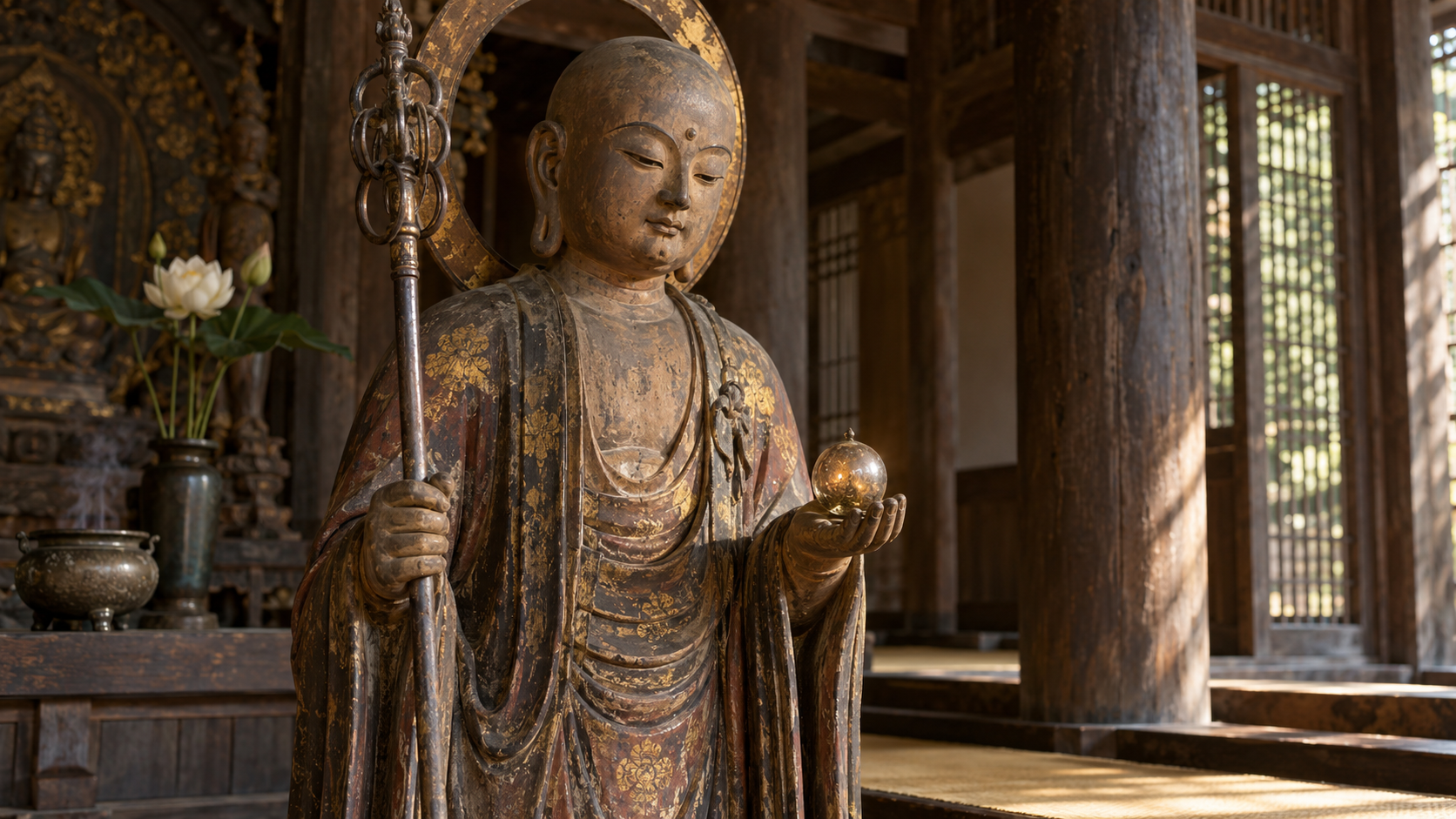
A jewel burns without being consumed.
Flames rise around it, yet there is no fire.
It may rest upon a lotus.
It may be held in the hand of a bodhisattva.
Sometimes three jewels appear together.
Sometimes the jewel crowns another Buddhist symbol.
Sometimes it is depicted so abstractly that a modern viewer might not immediately recognise it as a gem at all.
This is the cintāmaṇi—often translated as the wish-fulfilling jewel Buddhism.
It is one of the most fascinating examples of gemstone symbolism in Buddhist religious culture precisely because asking:
“Which gemstone is it?”
may be the wrong question.
The cintāmaṇi is primarily a religious and symbolic jewel, not a consistently identifiable mineral species.
It belongs to a Buddhist visual and literary world in which jewels can represent things more valuable than material wealth: teachings, merit, wisdom, compassion, enlightenment and the possibility of liberation.
This creates an important contrast with modern crystal spirituality.
Contemporary metaphysical literature sometimes attempts to identify the cintāmaṇi with a particular terrestrial stone, meteorite or mysterious high-energy crystal.
Historical Buddhist traditions are considerably more nuanced.
To understand the wish-fulfilling jewel, we must first understand why the image of a precious gem became such a powerful metaphor within Buddhism.
Understanding the wish-fulfilling jewel Buddhism requires a deep appreciation of its place in the spiritual and symbolic landscape of the religion.
Table of Contents
A Jewel Beyond Price
Precious stones are useful religious metaphors because they combine several qualities.
They are rare.
They are durable.
They can be luminous.
They may survive for generations.
They can be extraordinarily valuable.
And unlike food, cloth or many ordinary possessions, a fine gem can retain its desirability while passing from one person to another.
These characteristics made gemstones powerful symbols in numerous religious traditions.
Buddhism developed its own exceptionally rich jewel vocabulary.
One of Buddhism’s most familiar formulas is itself gemmological in metaphor.
The Buddha.
The Dharma.
The Sangha.
Together they are called the Three Jewels or Triple Gem.
The Three Jewels
To “take refuge” in Buddhism traditionally means taking refuge in:
the Buddha — the awakened one;
the Dharma — the Buddha’s teaching and the truth it communicates;
the Sangha — the community, interpreted somewhat differently among Buddhist traditions.
Calling these the Three Jewels communicates supreme value.
The metaphor does not imply that the Buddha, Dharma and Sangha are literally mineral crystals.
The jewel communicates preciousness.
Something exceptionally valuable in the material world becomes a linguistic tool for expressing something considered incomparably valuable spiritually.
This distinction provides the key to understanding many Buddhist gemstone images.
What Is the Cintāmaṇi?
The Sanskrit term cintāmaṇi combines cintā, associated with thought, wish or desire, and maṇi, jewel.
It is commonly translated as:
wish-fulfilling jewel
or
wish-granting jewel.
The concept developed within Indian religious culture and appears in Buddhist as well as non-Buddhist traditions.
In Buddhist contexts, however, the jewel acquired increasingly sophisticated symbolic meanings.
It could represent an inexhaustible treasure.
A source of benefit.
The fulfilment of legitimate spiritual aspirations.
Or the incomparable value of Buddhist teaching itself.
The image subsequently travelled with Buddhism across Asia.
India to Central Asia, China, Korea and Japan
Buddhism did not remain confined to the region where it originated.
Texts, monks, images and ritual practices travelled.
Across Central Asian trade routes, Buddhism entered China.
From China and the Korean Peninsula, Buddhist traditions reached Japan.
Other forms travelled through the Himalayan world into Nepal and Tibet.
The jewel travelled with them—not necessarily as a physical gemstone, but as a religious idea.
Its form and interpretation could change in different artistic environments.
This is why speaking of one universal Buddhist “crystal belief” would be misleading.
Buddhist traditions developed over more than two millennia across enormously diverse societies.
Jizō and the Wish-Fulfilling Jewel
One of the clearest examples appears in Japanese Buddhism.
The bodhisattva Jizō, known in Sanskrit as Kṣitigarbha, became one of Japan’s most beloved Buddhist figures.
Jizō is commonly represented as a monk.
He often carries two important attributes.
In one hand is a staff.
In the other is a jewel.
The Metropolitan Museum of Art describes a thirteenth-century Japanese sculpture of Jizō as carrying a wish-fulfilling jewel.
The combination immediately communicates identity to viewers familiar with Buddhist iconography.
The jewel is not random jewellery.
It is an attribute of the bodhisattva.
What Does Jizō’s Jewel Mean?
Jizō became particularly associated with compassionate assistance to beings moving through difficult states of existence.
Japanese traditions later developed especially strong relationships between Jizō, travellers, children and the dead.
The jewel in his hand therefore belongs within a much larger devotional system.
It can evoke the bodhisattva’s ability to respond to the needs of sentient beings.
But this should not be simplified into:
“Jizō is holding a manifestation crystal.”
That language belongs to contemporary metaphysical culture.
The historical image belongs to Buddhist soteriology—the religious problem of suffering and liberation.
The Jewel Is Not Necessarily a Ruby, Sapphire or Diamond
Artists often painted or sculpted the wish-fulfilling jewel as a rounded object.
It might be red.
Gold.
White.
Transparent-looking.
Or surrounded by flame-like forms.
Trying to identify the depicted jewel mineralogically can therefore be misleading.
A red cintāmaṇi is not automatically ruby.
A colourless one is not automatically quartz.
A blue one is not automatically sapphire.
Its colour may belong to artistic convention rather than gem identification.
The symbolic category jewel matters more than the geological species.
Why Flames?
One of the most recognisable forms is the flaming jewel.
Flame in Buddhist imagery can communicate radiance, transformation and spiritual brilliance.
The jewel appears to emit light.
This visual luminosity is important.
Precious stones interact dramatically with light.
Transparent gems transmit it.
Faceted gems reflect it.
Polished surfaces shine.
Buddhist artists could transform these familiar physical properties into metaphors for spiritual illumination.
But the artistic flame should not be interpreted as evidence that Buddhists believed gemstones literally emitted an invisible measurable energy field.
It is religious iconography.
Light and Enlightenment
The English word enlightenment itself makes light an intellectual metaphor.
Buddhist languages possess their own vocabularies for awakening, knowledge and liberation, but luminosity likewise became important in Buddhist artistic expression.
Buddhas can have halos.
Sacred bodies can radiate light.
Pure Lands can glitter with precious substances.
Jewels can shine.
Light therefore becomes a way of representing something that cannot easily be depicted:
transcendent understanding.
The jewel is particularly effective because its brilliance appears to come from a small, concentrated object.
The Jewel in Buddhist Paradise
Some Buddhist scriptures describe ideal realms using extraordinary quantities of precious substances.
Gold.
Silver.
Crystal.
Lapis-like materials.
Pearls.
Coral.
Other jewels.
Modern readers sometimes interpret these passages as mineral prescriptions.
That misses their literary function.
Descriptions of jeweled environments frequently communicate abundance, purity and transcendence.
The sacred realm exceeds ordinary material scarcity.
Everything is precious.
Nothing is mundane.
The Problem of Translating Ancient Gem Names
There is another complication.
Ancient gemstone terminology does not map neatly onto modern gemmology.
A historical word translated into English as:
“crystal,”
“ruby,”
“beryl,”
“lapis,”
or “jewel”
may cover a broader category than the modern mineralogical term.
Translations may also differ.
A Sanskrit, Pali, Chinese or Tibetan term can accumulate centuries of interpretive history before appearing in modern English.
Therefore a Buddhist scripture containing “seven precious substances” should not automatically be converted into a modern gemological shopping list.
Historical philology matters.
Seven Precious Things
Gem materials also appear physically in Buddhist archaeological contexts.
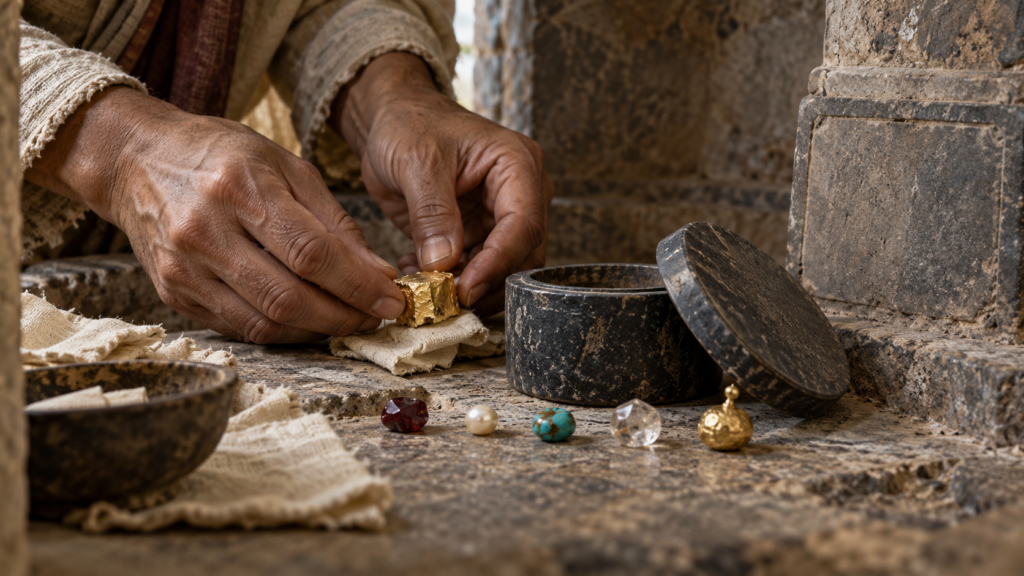
A remarkable first-century reliquary from Gandhara, in the region of present-day Pakistan, is preserved by the British Museum.
The pear-shaped container is carved from rock crystal.
When discovered, it reportedly contained a tiny bone fragment wrapped in gold leaf together with objects including pearl, turquoise, garnet and quartz.
The excavator interpreted the deposit in relation to the sapta-ratna, or seven precious things.
Whatever the precise historical classification of each material, the assemblage demonstrates something important:
precious substances could be physically deposited in Buddhist sacred contexts.
Relics and Jewels
Buddhist relic worship developed very early.
According to Buddhist traditions, remains associated with the historical Buddha were divided and placed within stupas.
Later relic traditions expanded enormously.
Bodily relics.
Ash.
Textual relics.
Objects associated with revered teachers.
Precious materials could accompany them.
The Metropolitan Museum’s Ramaka Casket, from ancient Gandhara, is particularly informative.
Its inscription states that it originally contained relics of the Buddha.
The Met explains that such deposits could also include glittering substances such as glass beads, crystal and gold.
Why?
Because the Buddha’s enlightened remains were associated with light.
Shimmering materials could therefore become appropriate offerings.
Gemstones as Offerings, Not Crystal Therapy
This is an essential distinction.
A garnet placed beside a Buddhist relic is not necessarily there because garnet was believed to “activate the Root Chakra.”
A crystal bead is not necessarily evidence of ancient crystal healing.
The precious substance may instead have functioned as an offering.
Its beauty.
Its rarity.
Its brilliance.
Its economic value.
All could make it appropriate for sacred deposition.
Giving something precious is itself meaningful.
Merit and Precious Materials
The Ramaka Casket’s inscription also records the generation of merit.
Merit is a central concept in many Buddhist traditions.
Generous and virtuous actions can produce beneficial karmic consequences.
Donating to monasteries.
Commissioning sacred images.
Supporting monks.
Constructing stupas.
Offering valuable materials.
These acts can become religiously significant because of the intention and action of the donor.
The gemstone does not need to emit energy.
Its value can make the act of giving meaningful.
The Wish-Fulfilling Jewel and Generosity
This produces an interesting paradox.
A literal gemstone is valuable because people want to possess it.
Buddhist ethics repeatedly question attachment and craving.
How, then, can jewels become sacred symbols?
Because symbolic value can reverse ordinary economic logic.
A jewel offered away becomes generosity.
A jewel used to adorn a Buddha becomes devotion.
A jewel imagined as inexhaustible abundance can represent spiritual benefit rather than personal accumulation.
The object of desire becomes a metaphor for liberation from desire.
The Mani Jewel
The Sanskrit word maṇi simply means jewel or precious stone in many contexts.
It appears famously in the Tibetan Buddhist mantra:
Om mani padme hum.
The mantra is associated especially with Avalokiteśvara, the bodhisattva of compassion.
It is often translated approximately as involving a “jewel” and a “lotus,” although reducing the mantra to a literal English sentence can be misleading.
Centuries of Buddhist interpretation surround it.
What matters here is that the jewel again appears in a devotional context connected with compassion and Buddhist practice.
The Jewel and the Lotus
Jewel and lotus form a particularly powerful symbolic pairing.
The lotus grows from muddy water yet produces a clean and beautiful flower.
It became one of Buddhism’s most widespread images of purity and spiritual development.
The jewel represents incomparable preciousness.
Together, jewel and lotus can operate within a symbolic vocabulary of awakened qualities.
Again, this is not mineralogy.
It is religious metaphor.
Jewels in Tibetan Buddhist Art
In Tibetan and Himalayan Buddhist art, actual gemstones can also be incorporated into sacred objects.
Turquoise.
Coral.
Pearls.
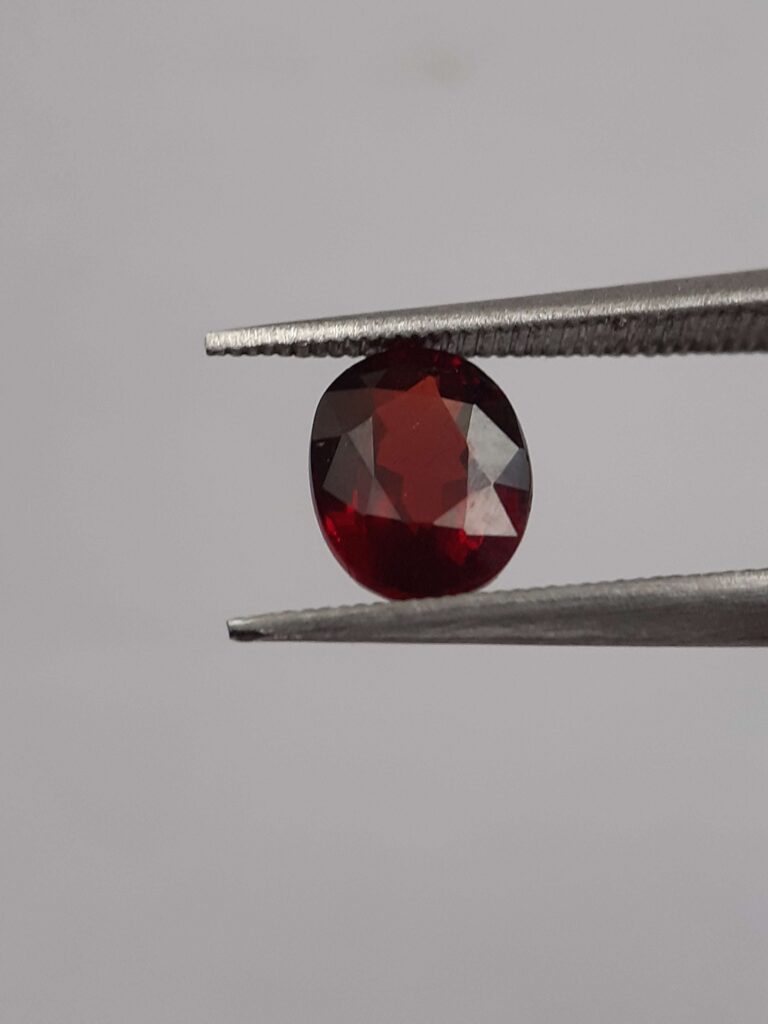
Garnets.
Sapphires.
Emeralds.
Lapis lazuli.
Amber.
These materials appear in sculpture ornaments, ritual implements and jewellery made for sacred images.
The Metropolitan Museum preserves a fifteenth-century Tibetan image of Vajradhara containing surviving turquoise and other semiprecious stone inlays.
The museum interprets these components as communicating divine status and evoking the crystalline character of the heavenly realm associated with the Buddha.
The stones are therefore doing symbolic work.
Dressing the Divine
An especially revealing practice is the donation of jewellery for Buddhist sculptures.
The Metropolitan Museum preserves elaborate crown ornaments produced by Newari artisans for the Tibetan market between the seventeenth and nineteenth centuries.
They contain an extraordinary range of precious materials:
emeralds,
sapphires,
rubies,
garnets,
pearls,
lapis lazuli,
coral,
shell,
mother-of-pearl,
amber,
and turquoise.
The Met notes that pious donors gave such elaborate jewellery to adorn important devotional sculptures.
This is not equivalent to decorating a statue simply because it looks beautiful.
Offering precious objects can itself be an act of devotion.
When a Diamond Marks the Axis of the Universe
Another extraordinary object in The Metropolitan Museum of Art is a Nepalese armlet created for a sacred image.
At its centre are crossed vajras.
A diamond marks the central axis.
The Met interprets this point as the stable centre of the universe associated with the place where the Buddha attained enlightenment.
Around it, gems, semiprecious stones and coral create a celestial mosaic.
This is sophisticated gemstone symbolism.
But notice what creates the meaning.
Not simply:
diamond = spiritual power.
Rather:
diamond + position + vajra symbolism + Buddhist cosmology + sacred image.
Context creates the religious object.
The Vajra and Diamond Imagery
The Sanskrit word vajra can evoke both thunderbolt and diamond-like indestructibility.
In Buddhist traditions, particularly Vajrayana Buddhism, the vajra became one of the most important ritual symbols.
Its imagery communicates qualities such as indestructibility and irresistible spiritual insight.
This does not mean every diamond was considered a vajra.
Nor does it mean modern diamond jewellery automatically possesses Vajrayana significance.
Once again, material, word and ritual symbol must be kept distinct.
The Eight Auspicious Symbols
Another Buddhist symbolic system frequently encountered in Asian decorative art is the Eight Auspicious Symbols.
Their precise forms include:
the parasol,
golden fishes,
treasure vase,
lotus,
conch shell,
endless knot,
victory banner,
and Dharma wheel.
These appear in textiles, metalwork, ceramics and ritual objects.
The Metropolitan Museum preserves an eighteenth-century Chinese Buddhist sutra cover showing the Eight Auspicious Emblems, with flaming jewels crowning several of them.
Here the jewel is part of an entire visual grammar.
A viewer familiar with the tradition reads symbols where an unfamiliar viewer may see only ornament.
The Flaming Jewel in Chinese Buddhist Art
The jewel became particularly widespread in East Asian visual culture.
It appears in Buddhist paintings, sculpture, ceramics and textiles.
Sometimes dragons pursue a flaming jewel.
Sometimes the jewel appears above sacred emblems.
Sometimes it is held by a bodhisattva.
Not every East Asian flaming jewel has exactly the same interpretation.
Buddhist, Daoist and broader auspicious imagery interacted over centuries.
It is therefore risky to assign one fixed meaning to every flaming orb in Chinese or Japanese art.
Historical context remains essential.
Jizō and the Human Need for Compassion
Returning to Jizō helps bring the symbolism back to lived religion.
A worshipper approaching an image of Jizō is not necessarily analysing iconography academically.
The bodhisattva can represent compassion available in frightening circumstances.
The staff identifies him.
The jewel communicates his extraordinary capacity to benefit beings.
The devotee may pray.
Offer incense.
Leave flowers.
Recite a name or text.
The jewel exists within a relationship between person and sacred figure.
Its meaning is devotional before it is gemmological.
Is the Cintāmaṇi a Real Gemstone?
This question frequently appears in modern crystal culture.
Some sources claim that cintāmaṇi refers to:
a specific mineral,
a rare tektite,
a meteorite,
a legendary stone from Tibet,
or an exceptionally powerful extraterrestrial crystal.
Such claims require strong evidence.
Historically, cintāmaṇi is primarily a religious and mythic concept, not a modern mineralogical species.
There is no recognised mineral species named cintāmaṇi in contemporary gemmology.
A seller identifying a particular stone as “the original Buddhist cintāmaṇi” therefore makes a claim very different from the historical use of the term.
Mythic Objects Do Not Require Geological Identification
Modern audiences often try to materialise myth.
We ask:
What mineral was the Holy Grail made from?
Which geological stone was the philosopher’s stone?
Where can I buy a cintāmaṇi?
But symbolic objects do not always have physical mineral identities.
Their power may lie precisely in their imaginative impossibility.
A wish-fulfilling jewel represents abundance beyond ordinary economic limitation.
Identifying it as one purchasable mineral may actually reduce the idea.
Modern Crystal Spirituality and the Wish-Fulfilling Jewel
Contemporary metaphysical communities sometimes reinterpret the cintāmaṇi through concepts such as:
- manifestation
- high-frequency energy
- spiritual activation
- extraterrestrial origin
- chakra alignment
- wish fulfilment
- abundance attraction
These belong to modern spiritual movements.
They should not automatically be presented as ancient Buddhist teaching.
Buddhist traditions certainly contain supernatural cosmologies, sacred jewels and accounts of extraordinary objects.
But those traditions operate within Buddhist frameworks of karma, compassion, merit, wisdom and liberation.
Modern manifestation language comes from a different intellectual history.
Buddhism Is Not a Manifestation Technique
The phrase “wish-fulfilling jewel” can easily mislead a modern reader.
It sounds like an object that grants whatever someone desires.
But Buddhist philosophy frequently treats uncontrolled craving as a fundamental source of suffering.
The religious symbolism therefore cannot be reduced to:
“Use this jewel to obtain whatever you want.”
In many Buddhist contexts, the greatest “wish” is not unlimited material acquisition.
It is awakening.
Freedom from suffering.
Wisdom.
Compassion.
Benefiting other beings.
The metaphor ultimately points beyond ordinary consumption.
Does a Gemstone Grant Wishes?
There is no established scientific evidence that a gemstone can alter external events in response to human intention.
Holding quartz, garnet, sapphire or another stone while making a wish may have personal ritual value.
It may help someone focus.
It may function as a reminder of an intention.
Those psychological and symbolic functions should be distinguished from the claim that the stone physically causes desired events to occur.
The Buddhist cintāmaṇi does not provide scientific evidence for gemstone manifestation.
Does a Jewel Carry Spiritual Energy?
Science can measure many properties of gemstones.
Hardness.
Refractive index.
Specific gravity.
Chemical composition.
Crystal structure.
Optical absorption.
Electrical or piezoelectric behaviour in certain minerals.
Those measurable properties are not equivalent to the spiritual “energy” described in contemporary metaphysical practice.
A Buddhist artwork depicting a luminous jewel demonstrates religious symbolism.
It does not demonstrate an experimentally measurable healing field.
The Jewel as a Mental Object
There is nevertheless an interesting modern practice available here.
A symbol does not need supernatural physics to influence thought.
Imagine using the wish-fulfilling jewel as a contemplative image.
Instead of asking:
“What can this stone give me?”
ask:
“What is actually worth wishing for?”
That question transforms the symbol.
Material acquisition?
Recognition?
Security?
Wisdom?
Compassion?
Freedom from fear?
The Buddhist jewel can become a mirror for examining desire.
A Historically Inspired Jewel Meditation
Place a natural gemstone in front of you.
It does not need to be a specific species.
Do not assign it a chakra.
Do not assume it emits an invisible frequency.
Simply observe it.
Notice why humans call such objects precious.
Colour.
Transparency.
Rarity.
Durability.
Then imagine a jewel whose value cannot be exhausted.
Ask:
If I possessed something of unlimited value, would I keep it or use it to benefit others?
Then:
Which desires actually reduce suffering, and which merely create another desire?
Finally:
What quality would I value more than material wealth?
The gemstone does not provide the answers.
The Buddhist metaphor provides the question.
Preciousness Without Possession
This may be one of the most sophisticated aspects of Buddhist jewel symbolism.
Ordinary gems invite possession.
Sacred jewels can invite transcendence of possession.
A donor gives gems away.
A worshipper offers them.
A sculptor places them on the body of a Buddha.
A scripture describes a world overflowing with jewels until rarity itself becomes meaningless.
Material preciousness becomes a metaphor for something that cannot be bought.
This reversal is profound.
Why Real Gemstones Still Matter
None of this means the physical materials were irrelevant.
Actual gems were valuable.
Their rarity mattered.
Their colour mattered.
Their luminosity mattered.
Their durability mattered.
That is precisely why they worked so effectively as metaphors.
If gemstones had been ordinary and worthless, calling the Buddha, Dharma and Sangha “jewels” would carry little rhetorical force.
The spiritual metaphor depends partly upon real human appreciation of beautiful natural materials.
Gemstones and Buddhist Ethics
This creates an interesting ethical relationship.
Buddhism does not necessarily condemn beautiful objects.
Many Buddhist cultures produced astonishingly luxurious sacred art.
Gold statues.
Jeweled crowns.
Silk paintings.
Precious reliquaries.
Elaborate monasteries.
The ethical question often concerns attachment, intention and use rather than the mere existence of beauty.
A jewel hoarded from greed and a jewel offered from generosity may be physically identical.
Religiously, the actions surrounding them can be radically different.
A Gemstone’s Meaning Is Not Inside Its Crystal Structure
This leads to a broader principle applicable throughout the Natural Gems Belgium Learning Center.
A gemstone’s cultural meaning is not simply another physical property.
Emerald is green because of its chemistry.
Quartz has its hardness because of its atomic structure.
Garnet has particular optical properties because of its mineral composition.
But:
“compassion,”
“protection,”
“wisdom,”
or “wish fulfilment”
are meanings assigned within human cultural systems.
They cannot be detected with a refractometer.
That does not make cultural meaning unreal.
It makes it a different category of reality.
What Can We Say with Confidence?
Several conclusions are well supported.
The jewel is an important metaphor throughout Buddhist traditions.
The Buddha, Dharma and Sangha are widely known as the Three Jewels.
The cintāmaṇi, or wish-fulfilling jewel, became an important symbolic object in Buddhist literary and visual traditions.
Bodhisattvas such as Jizō/Kṣitigarbha can be represented holding a wish-fulfilling jewel.
Flaming jewels occur widely in Buddhist visual culture.
Actual precious materials—including crystal, garnet, turquoise, pearls and gold—were deposited in some early Buddhist reliquaries.
Precious materials could function as offerings and could visually evoke luminosity, sacredness and transcendent value.
Later Himalayan Buddhist art incorporated real gemstones into sacred sculptures and jewellery offered to divine images.
None of these facts establishes that the cintāmaṇi corresponds to one modern mineral species.
Nor do they demonstrate scientifically that gemstones grant wishes, activate chakras, manifest wealth or emit healing energy.
Conclusion
The Buddhist wish-fulfilling jewel begins with something familiar:
human beings value gemstones.
Buddhist traditions took that familiar experience and transformed it.
A jewel could become a metaphor for the Buddha.
For teaching.
For community.
For wisdom.
For compassion.
For inexhaustible spiritual benefit.
It could appear in paradise.
Inside a reliquary.
Upon a sacred sculpture.
In the hand of Jizō.
Surrounded by flames.
Or combined with lotus imagery.
Real gemstones could also be offered to sacred objects precisely because they were precious.
The religious significance therefore moved constantly between real material and symbolic jewel.
Modern crystal spirituality adds another layer, sometimes interpreting the cintāmaṇi as a specific high-energy stone capable of manifestation or spiritual activation.
Those contemporary interpretations should be clearly distinguished from documented Buddhist history.
The cintāmaṇi does not need to be identified as a mysterious mineral to remain extraordinary.
Its most important quality may be precisely that it cannot be reduced to chemistry.
At Natural Gems Belgium, that distinction allows gemstone spirituality to be studied without sacrificing either historical depth or gemmological accuracy.
A mineral can be measured.
A symbol must be interpreted.
And Buddhism’s wish-fulfilling jewel reminds us that sometimes the most precious “gem” is not the object we possess—
but the quality of mind we learn to value.
References & Further Reading
Jizō and the Wish-Fulfilling Jewel
The Metropolitan Museum of Art — Medieval Japanese Jizō Sculpture and the Wish-Fulfilling Jewel
The Met’s documentation of its medieval Japanese Jizō explains that the bodhisattva is represented as a youthful monk carrying a walking staff and a wish-fulfilling jewel, providing direct museum evidence for the jewel as an identifying Buddhist attribute.
https://www.metmuseum.org/pt/press-releases/japanese-acquisitions-2024-2024-news
Buddhist Relics, Light and Precious Materials
The Metropolitan Museum of Art — The Ramaka Casket: Inscribed Buddhist Reliquary from Gandhara
This important inscribed reliquary originally contained relics of the Buddha. The Met explains that early Buddhist relic deposits could include shimmering substances such as crystal, glass beads and gold because enlightened bodily remains were associated with luminosity. The inscription also documents the generation of merit by the donor.
https://www.metmuseum.org/art/collection/search/38113
British Museum — Rock Crystal Buddhist Reliquary from Gandhara
First-century Kushan-period rock-crystal reliquary discovered in a stupa at Sonala Pind. The recorded deposit included a small bone fragment wrapped in gold leaf together with pearl, turquoise, garnet and quartz and was historically interpreted in connection with the sapta-ratna, or seven precious things.
https://www.britishmuseum.org/collection/object/A_1887-0717-35
British Museum — Gold Reliquary from the Manikyala Great Stupa
Gold Buddhist reliquary from ancient Gandhara, recovered from the central relic chamber of the Manikyala Great Stupa. It provides archaeological context for the placement of precious materials and objects within Buddhist stupas.
https://www.britishmuseum.org/collection/object/A_1848-0602-5
British Museum — Sapphire Ring from the Manikyala Buddhist Relic Deposit
Gold ring set with an inscribed sapphire, excavated from the final Buddhist relic deposit in the Manikyala Great Stupa. The object demonstrates that actual gemstones could form part of complex relic deposits rather than existing only as literary metaphors.
https://www.britishmuseum.org/collection/object/A_1848-0602-5-a
Buddhist Sacred Jewels in Himalayan Art
The Metropolitan Museum of Art — The Primordial Buddha Vajradhara, Tibet, 15th Century
Gilt Tibetan sculpture preserving original turquoise and semiprecious-stone inlays. The Met interprets these materials as indicators of divine status and as evoking the crystalline character of the celestial realm.
https://www.metmuseum.org/art/collection/search/39141
The Metropolitan Museum of Art — Crown Ornament for a Buddhist Deity, Newari for the Tibetan Market
Elaborate devotional jewellery containing emeralds, sapphires, rubies, garnets, pearls, lapis lazuli, coral, amber, turquoise and other precious materials. The museum explains that pious donors gave jewellery of this kind to adorn important Buddhist sculptures.
https://www.metmuseum.org/art/collection/search/39779
The Metropolitan Museum of Art — Armlet for a Sacred Image with Crossed Vajras, Nepal
An exceptional Buddhist ornament combining diamonds, rubies, emeralds, sapphires, pearls, coral, lapis lazuli, amber and turquoise. The central diamond marks the cosmic axis associated with ultimate stability and the Buddha’s enlightenment, while the surrounding gems evoke purity and a celestial realm.
https://www.metmuseum.org/art/collection/search/39475
The Eight Auspicious Symbols and Flaming Jewels
The Metropolitan Museum of Art — Sutra Cover with Eight Buddhist Treasures, Qing China
Eighteenth-century Chinese Buddhist textile showing the Eight Auspicious Emblems supported by lotuses, with flaming jewels crowning several symbols. It provides a clear visual example of the jewel within a wider Buddhist symbolic vocabulary.
https://www.metmuseum.org/art/collection/search/78284
The Metropolitan Museum of Art — Cup Stand with Buddhist Treasures, Yuan Dynasty
Fourteenth-century Chinese silverwork decorated with Buddhist treasures including the wheel, endless knot, conch, lotus, fish and treasure vessel, useful for understanding how auspicious symbols became embedded in East Asian material culture.
https://www.metmuseum.org/art/collection/search/73404
British Museum — Longquan Stem Cup with Buddhist Treasures and Flaming Pearl
Chinese ceramic vessel dating approximately 1300–1400 whose decoration includes Buddhist auspicious symbols and a flaming jewel, demonstrating the transmission of this imagery into everyday and ceremonial decorative arts.
https://www.britishmuseum.org/collection/object/A_1909-0401-11
Buddhist Precious Materials in Textual Tradition
BDK America — Madhyama Āgama, Volume III
Scholarly English translation within the BDK English Tripiṭaka series. Its index and translated passages document Buddhist textual references to precious materials including pearl, crystal, coral, gold, silver, ruby and other substances, providing useful context for the broader language of “seven treasures.”
https://www.bdkamerica.org/wp-content/uploads/2023/02/dBET_T0026_MadhyamaAgama3_2022.pdf
Historical Symbolism Versus Modern Crystal Claims
The historical and material evidence demonstrates that jewels possessed profound symbolic importance across Buddhist traditions.
We can document:
the Buddha, Dharma and Sangha described as the Three Jewels;
the wish-fulfilling jewel as a Buddhist religious symbol;
bodhisattvas represented carrying sacred jewels;
flaming jewels in Buddhist visual culture;
actual gemstones and precious substances deposited with Buddhist relics;
gem-encrusted devotional jewellery donated to sacred images;
and precious materials used to evoke celestial luminosity, purity and extraordinary spiritual value.
These traditions do not establish that the cintāmaṇi is one identifiable modern mineral species.
Nor do they scientifically demonstrate that a gemstone can grant wishes, manifest wealth, activate chakras or transmit healing energy.
Modern claims identifying particular commercial stones, tektites or meteorites as uniquely authentic “Cintamani stones” should therefore be distinguished from the much older Buddhist symbolic tradition.
The historically strongest interpretation separates:
real gem materials used in Buddhist practice
from
the jewel as religious metaphor
from
specific Buddhist iconography
from
modern metaphysical reinterpretation.
Making these distinctions does not weaken the spiritual significance of the jewel.
It reveals why the symbol endured: Buddhism transformed one of humanity’s most familiar images of material value into a metaphor for things that material wealth alone cannot purchase.
[…] the Himalayan cultural world, religious devotion has often taken forms that can be carried, worn or […]