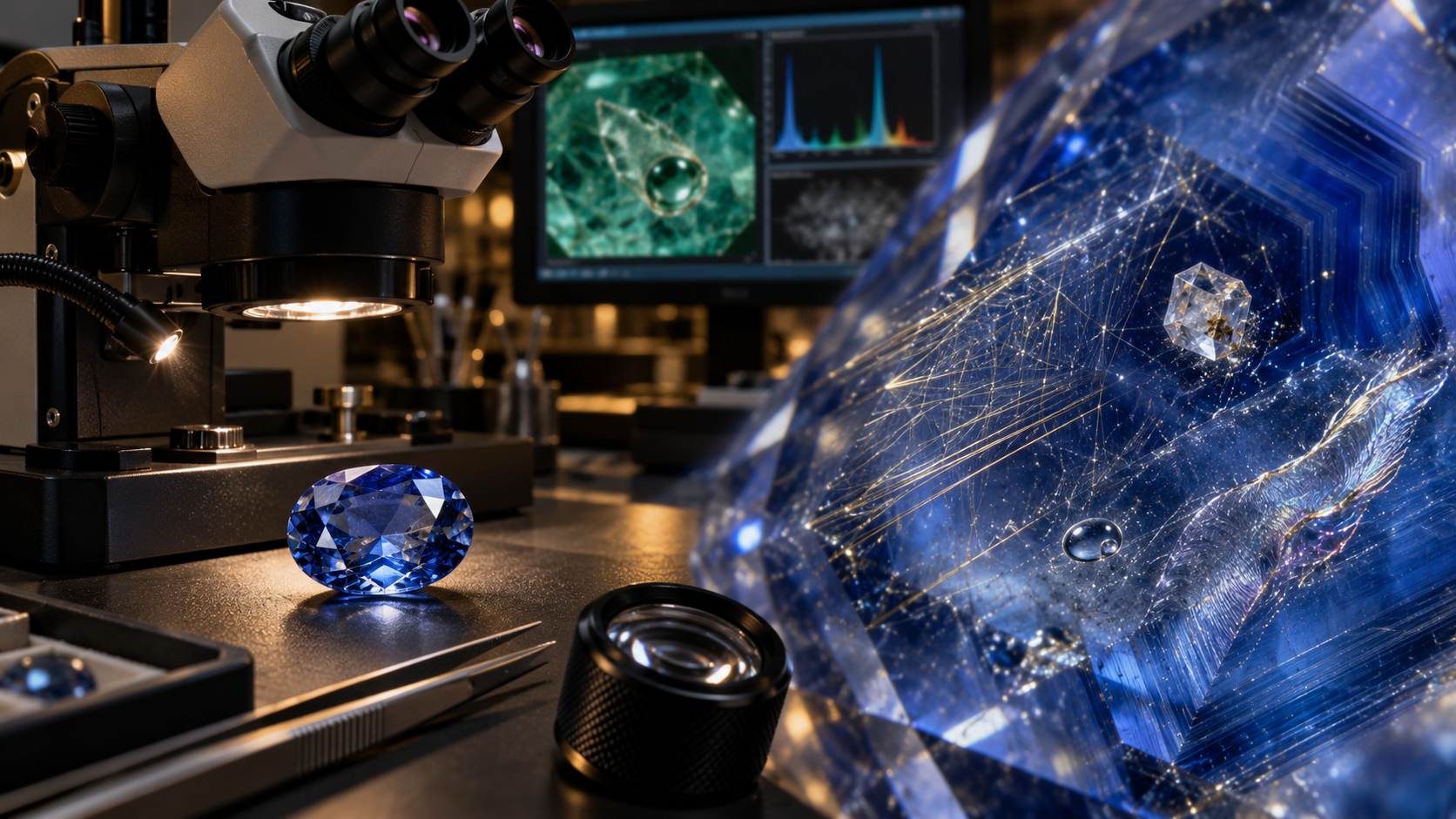
Look into a natural gemstone under a microscope and an entirely different world appears.
Tiny crystals may be suspended within the host. Fine needles can intersect according to crystallographic directions. Microscopic cavities may contain liquid, gas and solid material. Networks of minute channels can mark where an ancient fracture healed while the crystal was still interacting with geological fluids.
To an inexperienced observer, these may simply look like imperfections.
To a gemmologist, they can be evidence.
Inclusions can preserve information about crystal growth, geological environment, natural versus synthetic formation, treatment history and, in some cases, geographic origin.
But their interpretation requires considerable caution.
A single inclusion rarely tells the complete story.
Watch Episode 3 — Gemstone Inclusions: Nature’s Fingerprints
In Episode 3 of the Natural Gems Belgium Gemmology Series, Marnick Elskens, Founder of Natural Gems Belgium, explores the microscopic world inside gemstones and explains how professional gemmologists interpret inclusions.
The episode introduces the major concepts. Below we examine the science in greater depth.
Table of Contents
What Is a Gemstone Inclusion?
In gemmology, an inclusion is broadly an internal feature enclosed within or developed inside a gemstone.
The term covers a remarkably diverse range of phenomena.
An inclusion may consist of another mineral crystal, a fluid, a gas, a combination of several phases, exsolved material or structures associated with crystal growth, deformation, fracturing and healing.
Consequently, inclusions should not be regarded as one homogeneous category.
Their composition, morphology, orientation and relationship with the host crystal can all contain useful information.
Inclusions as Geological Evidence
A gemstone is a geological material.
Before it became a polished object, it existed within a geological environment governed by temperature, pressure, chemistry, fluids, deformation and time.
Crystal growth is not necessarily a perfectly continuous process.
Conditions can change.
Other minerals may already be present.
Fluids can become trapped.
Growth can stop and restart.
Fractures can form and partially heal.
Some minerals can separate from solid solution as conditions change.
The internal world of a gemstone can therefore preserve a partial record of these events.
This is one reason microscopy occupies such an important place in gemmology.
Protogenetic, Syngenetic and Epigenetic Relationships
One scientific approach to inclusions considers their temporal relationship with the host gemstone.
Protogenetic inclusions
A protogenetic inclusion existed before the host crystal enclosed it.
Imagine a small mineral crystal already present within a rock when another mineral begins to crystallise around it.
The older crystal becomes trapped inside the younger host.
Its shape may be modified by reactions or partial dissolution during this process.
Syngenetic inclusions
Syngenetic inclusions form during growth of the host crystal.
A growing crystal can trap other crystals, fluids or material present in its growth environment.
These inclusions can therefore provide information associated with the conditions under which the host itself developed.
Epigenetic inclusions
Epigenetic features form after the host crystal has already developed.
Later geological processes may cause fractures, introduce fluids or produce new minerals along fractures and cleavage-related structures.
This distinction is valuable, but it is not always possible to determine the exact temporal relationship simply by looking at an inclusion.
Interpretation must follow the evidence.
Solid Mineral Inclusions
One gemstone can contain crystals of another mineral.
These solid inclusions may be extremely small or readily visible under magnification.
Depending on the host and geological environment, gemmologists encounter inclusions such as rutile, zircon, apatite, mica, feldspar, spinel and numerous other minerals.
Their diagnostic value depends on context.
Important observations include:
- crystal morphology;
- colour;
- transparency;
- relief against the host;
- crystallographic orientation;
- association with other inclusions;
- surrounding stress features;
- and their relationship with growth zones or fractures.
Experienced gemmologists can sometimes recognise characteristic minerals microscopically.
However, visual resemblance alone is not always sufficient for positive mineral identification.
Where the precise identity of an inclusion is important, analytical methods such as Raman spectroscopy can be used to determine its composition more reliably.
Rutile Needles and Silk
Fine needle-like inclusions in corundum are among the best-known microscopic features in gemmology.
Rutile is an important inclusion mineral associated with natural ruby and sapphire.
Fine oriented particles or needles can produce what gemmologists and the gem trade commonly call silk.
Their orientation is not random. It can reflect crystallographic relationships within the corundum host.
The density and state of these inclusions can affect transparency and optical appearance.
Under suitable conditions, oriented inclusions can interact with light strongly enough to create asterism.
This is the phenomenon responsible for the star seen in star ruby and star sapphire when the material is cut into an appropriately oriented cabochon.
Inclusions can therefore sometimes create beauty rather than merely reduce clarity.
Inclusions and Heat Treatment
Internal features can also provide evidence relevant to treatment.
Heating can modify the microscopic landscape of a gemstone.
Depending on the mineral, temperature, atmosphere and original inclusion assemblage, heating may alter or dissolve certain inclusions, change surrounding stress features or modify fractures and other internal structures.
In corundum, microscopic evidence can therefore form part of an investigation into whether heat treatment has occurred.
However, treatment determination is a specialised discipline.
The absence of one expected feature does not automatically establish that a gemstone is unheated.
Likewise, one unusual inclusion should not be used as the sole basis for a treatment conclusion.
Advanced laboratory analysis may be required.
Fluid Inclusions: Geological Time Capsules
Fluid inclusions are among the most scientifically informative features found within minerals.
A growing or subsequently fractured crystal can trap extremely small quantities of geological fluid.
Once enclosed, these microscopic cavities can preserve material associated with the crystal’s geological environment.
Depending on the system, an inclusion may contain liquid, gas, dissolved components and solid phases.
Geologists study fluid inclusions because they can provide information about the fluids and physical conditions involved in mineral formation and later geological events.
For gemmologists, their morphology, distribution and phase relationships can also contribute to gemstone identification and origin interpretation.
Two-Phase and Multiphase Inclusions
An inclusion containing two observable phases may, for example, contain liquid and a gas bubble.
More complex inclusions can contain several components.
When solid, liquid and gas phases can clearly be observed together, the term three-phase inclusion is commonly used.
Emerald provides one of gemmology’s most famous examples.
Some emeralds contain cavities in which a liquid, a gas bubble and one or more solid crystals can be observed microscopically.
Historically, certain jagged three-phase inclusions became strongly associated with Colombian emerald.
That association eventually produced an important lesson about the limitations of inclusion-based identification.
The Colombian Emerald Problem
For many years, observation of characteristic three-phase inclusions was regarded as strong evidence pointing toward Colombian emerald.
Subsequent research demonstrated that comparable multiphase inclusions can occur in emeralds from other geographic sources.
They have been documented in material from Afghanistan, China and Zambia, among others.
Some of these inclusion scenes can resemble those found in Colombian material closely enough that simplistic visual identification becomes unreliable.
This does not make three-phase inclusions useless.
Quite the opposite.
Their morphology, composition and association with other features can provide valuable evidence.
But they must be interpreted within a larger analytical framework.
A three-phase inclusion is therefore not a Colombian passport.
Fingerprint Inclusions and Healed Fractures
Another familiar internal feature is the so-called fingerprint inclusion.
These structures often consist of networks of tiny cavities associated with a fracture that has partially healed.
The resulting pattern can resemble the ridges of a human fingerprint.
During healing, mineral material can reconnect parts of the fracture while microscopic cavities containing fluid or other phases remain trapped along the former fracture plane.
The visual result can be remarkably beautiful.
The terminology, however, can be misleading.
A fingerprint inclusion is not a unique biometric identifier for an individual gemstone.
It describes a type of microscopic pattern.
Its scientific significance depends on its morphology, composition, relationship with the host and the broader inclusion scene.
Inclusions and Natural Versus Synthetic Gemstones
One of the most important applications of microscopy is separating natural gemstones from synthetic counterparts.
Natural gemstones crystallise in geological environments.
Synthetic gemstones crystallise under controlled manufacturing conditions.
Those different growth environments can produce different internal evidence.
Natural gemstones may contain mineral inclusions, geological fluids, irregular growth structures and other features associated with their natural environment.
Synthetic gemstones can preserve evidence related to their production process.
Flame-fusion material may show curved growth structures.
Flux-grown synthetic gemstones can contain flux-related residues.
Hydrothermal synthetics can show growth features associated with seed crystals and controlled solution growth.
These clues can be extremely powerful.
But modern synthetic materials can be sophisticated.
A gemstone should therefore not be declared natural or synthetic merely because one expected feature appears to be present or absent.
Microscopy is part of an evidence chain.
Inclusions and Clarity
In commercial discussions, inclusions are often considered primarily in terms of clarity.
That is understandable because inclusions can affect transparency and visual appearance.
But scientifically, clarity is only one dimension of the inclusion story.
A large dark crystal positioned directly beneath the table of a transparent faceted gemstone may have a significant visual impact.
A small transparent crystal close to the girdle may have very little.
A fracture extending to the surface may raise durability concerns.
Fine silk may soften transparency but contribute to a desirable optical phenomenon.
Consequently, the mere presence of inclusions says little about the overall quality of a gemstone.
Their type, size, number, position, visibility and effect on structural integrity all matter.
When Inclusions Become Optical Phenomena
Some inclusions interact with light in ways that produce recognised gemstone phenomena.
Asterism is an important example.
When numerous fine inclusions are aligned along appropriate crystallographic directions, reflected light can become concentrated into intersecting bands.
In a correctly oriented cabochon, these bands form a star.
Chatoyancy—the cat’s-eye effect—can similarly arise when aligned internal structures create a concentrated band of reflected light.
These gemstones demonstrate an important principle:
An inclusion is not inherently undesirable.
Sometimes the inclusion is precisely what creates the phenomenon for which the gemstone is valued.
Inclusions and Geographic Origin
Determining geographic origin is among the most demanding applications of gemstone analysis.
Certain gemstone deposits can produce characteristic inclusion assemblages.
For this reason, microscopy plays an important role in origin determination for gemstones such as ruby, sapphire and emerald.
But geology rarely provides perfectly isolated signatures.
Deposits in different countries can form under comparable geological conditions.
Their gemstones may therefore exhibit overlapping microscopic characteristics.
Modern laboratory origin determination consequently uses multiple independent sources of evidence.
Depending on the material, these may include:
- microscopic inclusion analysis;
- growth structures;
- UV-Vis-NIR spectroscopy;
- FTIR spectroscopy;
- Raman spectroscopy;
- trace-element chemistry;
- fluorescence behaviour;
- and comparison with extensive reference collections of known provenance.
Origin determination is therefore not simply pattern recognition.
It is comparative analytical gemmology.
Trace-Element Chemistry
Modern analytical laboratories can measure extremely small concentrations of chemical elements within gemstones.
Techniques such as laser ablation–inductively coupled plasma–mass spectrometry, commonly abbreviated LA-ICP-MS, can generate detailed trace-element profiles.
These chemical fingerprints can be compared with reference populations from documented deposits.
This is particularly valuable where inclusion scenes overlap between geographic sources.
Even then, conclusions depend heavily on the quality of the reference database.
A measurement has meaning only when it can be interpreted against reliable comparative material.
Raman Spectroscopy and Inclusion Identification
Raman spectroscopy is another powerful analytical technique.
Every mineral structure produces characteristic vibrational responses when interacting with monochromatic light.
The resulting Raman spectrum can be compared with reference spectra.
This allows laboratories to identify microscopic mineral inclusions much more confidently than by morphology alone.
An inclusion that merely looks like zircon, for example, can potentially be tested rather than simply assumed to be zircon.
This distinction illustrates the progression from observational gemmology toward analytical gemmology.
The microscope finds the evidence.
Instrumentation can help determine what that evidence actually is.
The Importance of Reference Collections
One of the less visible foundations of professional gemmology is the reference collection.
Major laboratories acquire gemstones from known mines and geological deposits.
Whenever possible, specimens are collected as close to the source as possible and their provenance documented.
Researchers then characterise their inclusions, spectroscopy and chemistry.
Over time, these datasets create comparative populations.
When an unknown gemstone is submitted for origin determination, its characteristics can be compared with those reference populations.
This also explains why origin conclusions can evolve as science advances.
New deposits are discovered.
New material reaches the market.
Previously diagnostic features may be found elsewhere.
Analytical databases grow.
Science must adapt to new evidence.
What Inclusions Cannot Tell Us Alone
The scientific value of inclusions is enormous.
Their limitations are equally important.
One inclusion should not automatically be used to establish:
- geographic origin;
- natural versus synthetic origin;
- treatment history;
- overall quality;
- or commercial value.
Instead, the inclusion must be interpreted together with the complete gemstone.
Good gemmology asks whether independent observations support one another.
If microscopy suggests one conclusion while spectroscopy or chemistry contradicts it, the discrepancy must be investigated rather than ignored.
Are Inclusions Good or Bad?
There is no universal answer.
From a clarity perspective, certain inclusions can reduce transparency or visual appeal.
From a durability perspective, significant fractures may increase structural risk.
From a scientific perspective, however, inclusions can be extraordinarily valuable.
They may preserve evidence of crystal growth.
They can help distinguish natural from synthetic material.
They can contribute to treatment detection.
They may help establish geographic origin.
And occasionally they produce desirable optical phenomena.
Calling every inclusion a defect therefore oversimplifies what is happening inside a gemstone.
Reading the Internal History of a Gemstone
The polished surface of a gemstone shows us the result of cutting and polishing.
Its interior can reveal something much older.
A trapped mineral crystal may predate the host.
A fluid inclusion may preserve evidence of the environment in which crystallisation occurred.
A healed fracture may record a later geological event.
Altered inclusions may provide clues to treatment after mining.
Together, these features create an internal landscape that can sometimes preserve hundreds of millions—or even billions—of years of geological history.
That is why inclusions deserve to be studied rather than merely graded away.
They are not simply imperfections.
They are evidence.
And professional gemmology begins by learning how to read that evidence without asking it to prove more than it scientifically can.
References & Further Reading
Gemological Institute of America — Inclusions in Gemstones
Detailed GIA discussion of solid inclusions and their protogenetic, syngenetic and epigenetic relationships with host gemstones.
https://www.gia.edu/gems-gemology/summer-2022-colored-stones-unearthed
GIA Gems & Gemology — Three-Phase Inclusions in Emerald and Their Impact on Origin Determination
Sudarat Saeseaw, Vincent Pardieu and Supharat Sangsawong. Important study demonstrating why three-phase inclusions cannot by themselves establish Colombian emerald origin.
https://www.gia.edu/gems-gemology/summer-2014-saeseaw-three-phase-inclusions-emerald
GIA Gems & Gemology — Geographic Origin Determination of Emerald
Detailed scientific examination of microscopy, spectroscopy, trace-element chemistry and reference samples in modern emerald origin determination.
https://www.gia.edu/gems-gemology/winter-2019-emerald-geographic-origin-determination
GIA Gems & Gemology — A Review of Analytical Methods Used in Geographic Origin Determination of Gemstones
Technical review of microscopy, Raman spectroscopy, UV-Vis-NIR, FTIR, trace-element analysis and other methods used in modern origin research.
https://www.gia.edu/gems-gemology/winter-2019-analytical-methods-geographic-origin-determination-gemstones
GIA Gems & Gemology — Inclusions in Natural, Synthetic and Treated Emerald
Reference material illustrating internal characteristics encountered in natural, synthetic and clarity-enhanced emeralds.
https://www.gia.edu/gems-gemology/winter-2016-inclusions-natural-synthetic-treated-emerald
Gemological Institute of America — Gems & Gemology
GIA’s peer-reviewed scientific journal covering gemstone identification, treatments, synthesis, inclusions, geology and geographic origin research.
https://www.gia.edu/gems-gemology