

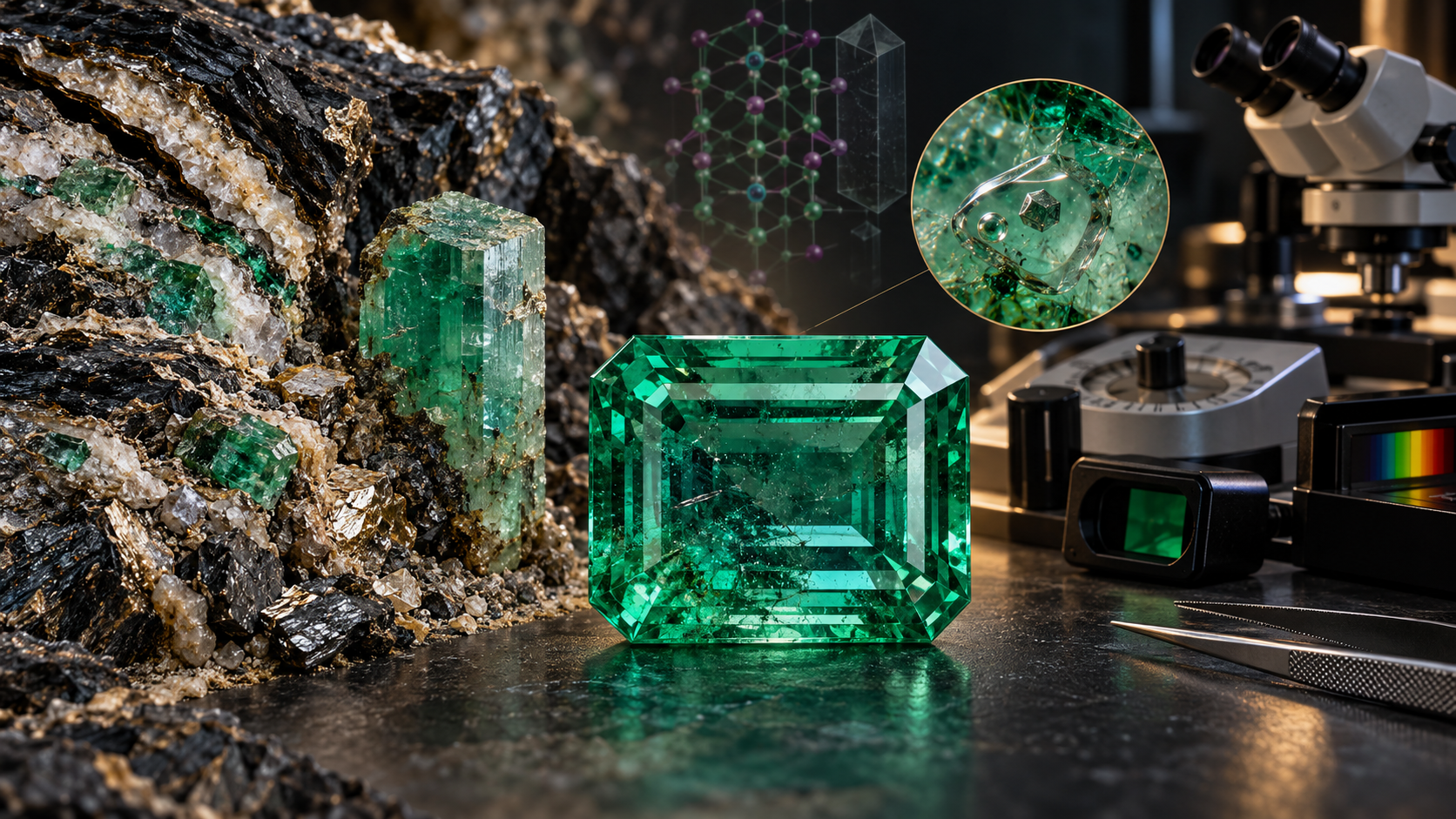
Emerald is the green gem variety of beryl, Be₃Al₂Si₆O₁₈, and one of the most scientifically revealing gemstones encountered in gemmology. Its formation presents a remarkable geochemical problem: beryllium is normally concentrated in geological environments very different from those enriched in chromium and vanadium, the trace elements principally responsible for emerald gemstone’s green colour. Creating emerald therefore requires unusual geological processes capable of bringing these components together.
That unusual origin leaves evidence inside the gemstone. Refractive index, birefringence, specific gravity, pleochroism and absorption spectroscopy establish its gemmological framework, while fluid inclusions, mineral crystals and growth structures can preserve information about the environment in which the emerald crystallised. Modern laboratories can take the investigation further through UV-Vis-NIR and FTIR spectroscopy, Raman analysis and trace-element chemistry.
Emerald is also an excellent demonstration of why professional gemstone identification extends beyond determining a mineral species. A gemmologist may need to distinguish emerald from green beryl and imitations, determine natural versus synthetic origin, assess fissure filling or clarity enhancement, and—where sufficient evidence exists—investigate geographic origin.
In this Nadia Gemstone Academy guide, we examine emerald from crystal lattice to geological deposit: its formation, colour chemistry, optical and physical properties, microscopic inclusions, treatments, synthetic counterparts and the analytical methods used to understand one of gemmology’s most important green gemstones.
In this guide, we discuss the significance of the emerald gemstone in various cultures and its symbolism over the centuries.
Table of Contents
EMERALD — TECHNICAL GEMMOLOGICAL DATA
CLASSIFICATION
Mineral Species: Beryl
Gem Variety: Emerald
Mineral Class: Cyclosilicate
Chemical Formula: Be₃Al₂Si₆O₁₈
Principal Colour Causes: Cr³⁺ and/or V³⁺; Fe can modify colour and spectroscopic behaviour
Important Nomenclature Note:
Emerald is the green to bluish-green gem variety of beryl.
The boundary between pale green beryl and emerald is partly a colour/nomenclature judgement; not every green beryl is universally classified as emerald.
CRYSTALLOGRAPHY
Crystal System: Hexagonal
Crystal Structure: Ring silicate / cyclosilicate
Optical Character: Uniaxial negative
Typical Crystal Habit: Hexagonal prismatic crystals, often flat terminated
Structural Feature: Channels run parallel to the crystallographic c-axis and can host water and alkali ions
PHYSICAL PROPERTIES
Mohs Hardness: 7.5–8
Specific Gravity:
Typical reference value approximately 2.72.
Natural emerald can show a broader range, approximately 2.6–2.9, depending on composition and locality.
Cleavage:
Poor / indistinct basal cleavage
Fracture:
Conchoidal to uneven
Tenacity:
Brittle
Lustre:
Vitreous
Transparency:
Transparent to translucent; strongly included material may approach opacity
Durability Note:
Hardness is relatively high, but emerald commonly contains fissures that can reduce practical toughness.
OPTICAL PROPERTIES
General Refractive Index:
approximately 1.577–1.583
Broader Natural Range:
Natural emerald from different deposits can extend roughly from the low 1.57s to around 1.60.
Birefringence:
General reference approximately 0.005–0.009.
Some locality-specific natural material may reach approximately 0.010–0.011.
Optic Character:
Uniaxial negative
Pleochroism:
Dichroic
Typical components:
yellowish green / green
bluish green
Dispersion:
Low, approximately 0.014
COLOUR CHEMISTRY
Pure Beryl:
Colourless
Principal Emerald Chromophores:
Cr³⁺
V³⁺
Iron:
Can modify hue, absorption and fluorescence and may suppress chromium-related red fluorescence.
Important:
Chromium is NOT the only possible cause of emerald colour.
Vanadium can be a major or dominant chromophore in some natural emerald populations.
ABSORPTION / SPECTROSCOPY
Chromium-bearing emerald commonly shows broad Cr³⁺ absorptions in the blue-violet and orange-red regions.
Characteristic chromium-related red lines can occur around the ~680 nm region.
Vanadium-rich emerald shows related but distinguishable absorption behaviour.
Iron may produce additional UV-Vis-NIR absorption features.
Exact spectra vary with Cr/V/Fe concentrations and crystallographic orientation.
FLUORESCENCE
Highly variable.
Possible response:
inert to red/pink fluorescence
Low-iron, chromium-bearing emerald may show stronger red fluorescence.
Higher Fe concentration can suppress chromium fluorescence.
UV response alone is NOT a reliable identification or geographic-origin criterion.
CHELSEA FILTER
Some chromium-bearing emeralds show pink to red.
Others may show weak or no reaction.
Vanadium-rich and/or iron-rich emeralds can react differently.
Chelsea-filter response is supportive observation only and must never be used as a stand-alone emerald identification test.
COMMON NATURAL INTERNAL FEATURES
Multiphase fluid inclusions
Two-phase inclusions
Three-phase inclusions
Growth tubes
Healed fissures
Partially healed fissures
Angular or irregular fluid inclusions
Mineral crystals
Growth zoning
Colour zoning
Possible mineral inclusions vary strongly by locality and may include:
pyrite
calcite
dolomite/carbonates
quartz
albite/feldspar
mica
phlogopite
actinolite
apatite
magnetite
hematite
fluorite
and other locality-specific minerals
COLOMBIAN THREE-PHASE INCLUSIONS
Classic jagged three-phase inclusions can contain:
liquid
gas bubble
solid crystal, commonly halite and/or sylvite
CRITICAL ORIGIN WARNING:
Three-phase inclusions are NOT exclusive to Colombia.
Similar multiphase inclusions are documented in emeralds from:
Afghanistan
China
Zambia
and other localities.
Origin determination must use the complete evidence set.
GEOLOGICAL FORMATION — PRINCIPAL TYPES
Hydrothermal / sedimentary-related systems
Metamorphic-hydrothermal systems
Schist-hosted deposits
Pegmatite / mafic-ultramafic interaction
Metasomatic reaction zones
Classic Geochemical Problem:
Be and Cr/V are normally concentrated in different geological reservoirs.
Emerald formation requires unusual geological processes that bring them together.
CLARITY ENHANCEMENT / TREATMENT
Most important treatment:
Fissure filling / clarity enhancement
Possible filling materials:
natural oils
resins
polymers
other organic filling substances
Purpose:
Reduce visibility of surface-reaching fissures.
Possible Microscopic Indicators:
flash effects
flattened gas bubbles
filler flow structures
differences in lustre within fissures
Advanced Detection:
FTIR spectroscopy can assist in characterising organic fillers.
SYNTHETIC EMERALD
Major growth methods:
Flux growth
Hydrothermal growth
Possible Flux-Grown Indicators:
flux residues
wispy veil-like inclusions
two-phase flux inclusions
metallic/platinum inclusions in some products
characteristic growth features
Possible Hydrothermal Indicators:
seed plates
nail-head spicules
chevron-like growth
undulating growth structures
phenakite
growth zoning
Important:
RI and SG alone cannot reliably establish natural origin because synthetic emerald is chemically and structurally beryl.
IMPORTANT LOOK-ALIKES / IMITATIONS
Green beryl
Green tourmaline
Tsavorite garnet
Chrome diopside
Dioptase
Peridot
Green fluorite
Green glass
Synthetic simulants
Coated colourless or pale beryl
Some deposits overlap significantly, so origin determination is an expert opinion based on the weight of evidence rather than a single diagnostic feature.
DURABILITY AND CARE
Mohs Hardness:
7.5–8
Practical Toughness:
Often reduced by natural fissures.
Fissure-filled emerald requires additional caution.
Preferred Cleaning:
lukewarm water
mild soap
soft brush
Avoid aggressive ultrasonic and steam cleaning where fissures or clarity enhancement may be present.
Avoid excessive heat and harsh chemicals.
Jewellery repair should take treatment status into account.
Emerald: A Gemmological Reference Guide
Definition and Classification
Emerald is the green to bluish-green gem variety of the mineral species beryl.
Beryl is a cyclosilicate with the ideal chemical formula:
Be₃Al₂Si₆O₁₈
Other familiar gem varieties of the same mineral species include aquamarine, morganite, heliodor and colourless goshenite.
This taxonomy is important. Beryl is the mineral species; emerald is a gem variety. Emerald is therefore not a separate mineral species.
The distinction between emerald and green beryl is not governed by a universally agreed numerical colour boundary. Gemmologists and laboratories may differ over whether very pale green material possesses sufficient saturation to warrant the variety name emerald.
Crystal Structure
Beryl belongs to the hexagonal crystal system.
Its structure is based on six-membered rings of SiO₄ tetrahedra stacked parallel to the crystallographic c-axis.
This arrangement creates channels running through the crystal structure.
Those channels are gemmologically important because they can accommodate water molecules and alkali ions such as sodium, lithium and cesium. Variations in these constituents contribute to measurable differences between emerald populations from different geological environments.
Beryl is optically uniaxial negative.
Natural crystals commonly form hexagonal prisms, sometimes with remarkably flat basal terminations.
The Geochemical Paradox of Emerald
Emerald formation poses an unusual geological problem.
Beryllium is scarce in the Earth’s upper continental crust and tends to become concentrated in evolved continental rocks such as granite and pegmatite.
Chromium and vanadium, by contrast, are commonly associated with very different geological reservoirs, including mafic and ultramafic rocks.
Yet emerald requires beryllium to construct the beryl crystal and chromium and/or vanadium to generate its characteristic green colour.
Nature must therefore create unusual geological circumstances capable of bringing these normally separated chemical components together.
This is one reason emerald deposits are comparatively rare.
There is, however, no single emerald-forming process.
Different geological environments solve this geochemical problem in different ways.
Pegmatite–Mafic/Ultramafic Interaction
One classic model involves Be-rich fluids or pegmatitic material interacting with chromium- and vanadium-bearing mafic or ultramafic rocks.
This interaction can produce metasomatic reaction zones in which the chemical ingredients necessary for emerald crystallisation are brought together.
The Kafubu district of Zambia is an important example.
There, Be-bearing quartz-tourmaline veins and related pegmatitic processes interacted with Cr-bearing metabasite host rocks.
Phlogopite-rich reaction zones developed along these contacts, and economically important emerald mineralisation occurs within them.
This is fundamentally different from the geological model responsible for Colombian emerald.
The Colombian Exception
Colombian emerald deposits are extraordinary because they do not require the classic interaction between granitic pegmatites and chromium-bearing mafic rocks.
The major deposits occur within sedimentary rocks of the Eastern Cordillera.
Hydrothermal brines circulated through organic-rich black shales and associated carbonate-bearing rocks.
Complex fluid-rock reactions mobilised the elements required for emerald formation.
Pressurised fluids moved through fractures and fault systems, where emerald crystallised within hydrothermal veins together with minerals such as calcite, dolomite, albite and pyrite.
One particularly important process involved thermochemical sulfate reduction.
Reactions with organic matter helped mobilise beryllium, chromium and vanadium. Iron was incorporated into pyrite, leaving relatively iron-poor fluids from which emerald could crystallise.
This low iron content has optical consequences: chromium-related red fluorescence can remain relatively strong because it is not quenched as effectively by iron.
The Colombian geological model demonstrates why a gemstone cannot be understood fully from its ideal chemical formula alone.
Emerald Colour
Ideally pure beryl is colourless.
Emerald’s green colour results primarily from trace amounts of:
Cr³⁺ — chromium
and/or
V³⁺ — vanadium
substituting principally for aluminium within the beryl structure.
These ions absorb particular regions of visible light.
Chromium-bearing emerald typically absorbs strongly in portions of the blue-violet and orange-red regions, leaving green wavelengths to dominate the transmitted and reflected light.
Vanadium can create a comparable green colour through related electronic transitions.
Iron can modify the spectrum and visible appearance.
Consequently, emerald colour is not produced by one universal chemical recipe.
Some deposits are strongly chromium dominated.
Others contain important vanadium.
Still others contain significant concentrations of both.
Recent analytical research continues to demonstrate this diversity; for example, some Chinese emerald populations are strongly vanadium-dominant rather than chromium-dominant.
Chromium, Vanadium and Nomenclature
Historically, chromium was sometimes treated as essential to the definition of emerald.
Modern gemmology recognises that natural emerald colour can be produced by chromium and/or vanadium.
Therefore, the absence of dominant chromium does not automatically make a richly coloured natural green beryl something other than emerald.
Colour appearance, chemical composition and accepted laboratory nomenclature must be considered together.
Physical Properties
Emerald has a Mohs hardness of approximately:
7.5–8
This provides reasonably strong resistance to scratching.
However, hardness should never be confused with toughness.
Natural emerald commonly contains fissures and fractures. These can substantially reduce resistance to impact.
Consequently, emerald generally requires more careful handling than ruby or sapphire despite its respectable hardness.
Its lustre is vitreous.
Fracture is typically uneven to conchoidal.
Cleavage is poor or indistinct.
Refractive Index
GIA’s general reference range for emerald is approximately:
1.577–1.583
However, natural emerald is chemically variable.
Studies of different deposits have recorded values extending from the low 1.57s to around 1.60.
This variation is not an inconvenience to be ignored—it is itself scientifically informative.
Alkali contents and other chemical substitutions can alter the optical constants of beryl.
Zambian emeralds, for example, often show higher RI and SG than classic Colombian material.
Refractive index can therefore contribute not only to mineral identification but, when combined with other evidence, to broader geological characterisation.
Birefringence and Optical Character
Emerald is doubly refractive and optically:
uniaxial negative
Typical birefringence is approximately:
0.005–0.009
Some natural populations can extend slightly beyond this general range.
The polariscope and refractometer can therefore provide useful classical evidence distinguishing emerald from many green look-alikes.
Specific Gravity
A commonly quoted specific gravity for emerald is approximately:
2.72
Natural emerald can vary more broadly, approximately within the 2.6–2.9 region, depending on composition.
Again, geographic populations can differ systematically.
SG should therefore be treated as a measured physical property rather than an immutable single number.
Pleochroism
Emerald is dichroic.
When examined with a dichroscope, different crystallographic directions may display differing green components.
Common observations include:
yellowish green or green
and
bluish green
The intensity depends upon colour saturation, trace-element chemistry and orientation.
Pleochroism is useful both for identification and for understanding how a crystal should be oriented during cutting.
Absorption Spectrum
Chromium-bearing emerald produces one of coloured-stone gemmology’s characteristic spectra.
Broad chromium absorptions occur in the blue-violet and orange-red portions of the visible spectrum.
Chromium-related lines can also occur in the red region around approximately 680 nm.
Vanadium-dominant emerald produces related but distinguishable absorption behaviour.
Iron introduces additional absorption features.
Professional UV-Vis-NIR spectroscopy therefore provides substantially more information than simply observing whether a stone appears green.
Fluorescence
Emerald fluorescence varies considerably.
Chromium can produce red luminescence.
Iron tends to quench this effect.
Relatively low-iron chromium-rich emerald may therefore show stronger red fluorescence than iron-rich emerald.
Colombian material is particularly known for potentially strong chromium-related luminescence because many stones contain comparatively little iron.
However, fluorescence alone cannot establish emerald identity or geographic origin.
The Internal World of Emerald
Emerald is famous for inclusions.
The traditional trade expression jardin, French for garden, refers to the complex internal landscapes commonly visible within natural stones.
From a scientific perspective, these features are much more than imperfections.
They may preserve information about:
crystal growth
fluid chemistry
temperature and pressure conditions
host rocks
geological environment
treatment
and sometimes geographic origin.
Natural emerald may contain mineral crystals, fluid inclusions, growth structures, healed fissures and partially healed fractures.
The precise assemblage varies substantially between deposits.
Three-Phase Inclusions
Colombian emeralds are famous for three-phase inclusions.
A classic example consists of:
a liquid phase
a gas bubble
and a solid crystal, commonly a cubic halide such as halite or sylvite.
These may occur within jagged, elongated cavities.
For many years, such inclusions were commonly treated as proof of Colombian origin.
That interpretation is no longer scientifically defensible.
Research has documented similar three-phase or multiphase inclusions in emeralds from Afghanistan, China and Zambia.
This is an excellent example of how gemmology evolves as reference collections improve.
A three-phase inclusion remains valuable evidence—but it must be interpreted in context.
Geographic Origin Determination
Geographic-origin determination is one of the most sophisticated aspects of modern emerald gemmology.
Professional laboratories first examine microscopic evidence.
The morphology of fluid inclusions, mineral inclusions and growth structures can indicate broad geological families.
Analysts then combine these observations with methods such as:
UV-Vis-NIR spectroscopy
FTIR spectroscopy
Raman spectroscopy
EDXRF
LA-ICP-MS trace-element analysis
and comparison with reference samples collected from known deposits.
Trace elements such as chromium, vanadium, iron, gallium, scandium, cesium, lithium, sodium and magnesium can be especially informative.
Colombian emeralds often contain relatively little iron, whereas many Zambian emeralds contain substantially more.
Yet overlap exists.
Consequently, geographic origin is not normally determined from one inclusion, one chemical element or one colour characteristic.
It is an expert conclusion based on the combined weight of evidence.
Colombia
Colombia contains several of the world’s historically most important emerald districts.
Important mining areas include Muzo, Coscuez, Chivor and others within the Eastern Cordillera.
Colombian emeralds are associated with hydrothermal vein systems hosted by sedimentary black shales.
Characteristic internal features can include jagged multiphase inclusions, carbonates, pyrite, quartz, feldspar and particles associated with the host shale.
A growth phenomenon called gota de aceite, Spanish for “drop of oil,” can produce a roiled visual texture in some Colombian emeralds and is regarded as strongly suggestive of this origin when appropriately developed.
Again, no visual feature should be interpreted without context.
Zambia
The Kafubu region is one of the world’s major emerald-producing districts.
Its geology differs strongly from Colombia.
Emerald mineralisation occurs largely in phlogopite reaction zones where Be-bearing veins interacted metasomatically with Cr-bearing metabasite.
Zambian emeralds commonly contain more iron and can show higher refractive indices and specific gravity than Colombian material.
Possible inclusions include:
actinolite
phlogopite
apatite
magnetite
hematite
and partially healed fissures.
These characteristics provide useful laboratory evidence when combined with spectroscopy and chemistry.
Brazil
Brazil hosts several important emerald deposits, many associated with schist, pegmatite and metasomatic geological systems.
Brazilian emerald can show significant chemical and microscopic diversity because multiple deposits occur in different geological contexts.
Origin assessment therefore requires deposit-specific comparison rather than treating “Brazil” as one homogeneous gemmological population.
Afghanistan and Pakistan
The Panjshir Valley of Afghanistan and Swat Valley of Pakistan have produced emeralds of major gemmological interest.
Some Afghan emeralds can contain jagged multiphase inclusions resembling Colombian examples.
Swat emeralds are particularly interesting because some specimens show relatively high RI and SG values, while trace-element and inclusion studies help separate them from other sources.
These deposits are another reason why simplistic “inclusion equals origin” rules should be avoided.
Ethiopia
Ethiopia has emerged as another important modern source.
Analytical studies of Ethiopian emerald have identified inclusions including quartz, calcite, talc, bertrandite, magnetite spinel and chlorite.
Spectroscopic work has documented chromium-related absorptions together with iron-related features.
The chemistry again illustrates how individual emerald populations can have distinctive combinations of Cr, V, Fe and alkali elements.
Russia, Zimbabwe, Madagascar and China
Russia’s Ural Mountains are historically significant for emerald.
Zimbabwe’s Sandawana deposits became famous for relatively small but often strongly coloured stones.
Madagascar contains multiple emerald occurrences within its complex metamorphic geology.
China contains several deposits of growing scientific interest, including emerald populations whose colour may be strongly vanadium-dominated.
Together these localities demonstrate the global geological diversity of emerald.
Ancient Emerald History
Emerald has been valued for thousands of years.
The ancient Egyptian deposits in the Eastern Desert became one of the earliest historically important sources.
The Sikait region and related workings supplied emerald during Greco-Roman and later periods.
Archaeological evidence shows emerald used in beads and jewellery, and the ancient mines became part of a long trade network connecting Egypt, the Mediterranean and Red Sea regions.
The history of emerald therefore predates modern gemmology by many centuries.
Clarity Enhancement
Emerald’s natural tendency to contain surface-reaching fissures led to one of the coloured-stone trade’s most established treatments:
fissure filling or clarity enhancement.
A substance with a refractive index reasonably close to emerald can be introduced into open fissures.
This reduces the optical contrast between the fracture and surrounding beryl, making the fissure less visible.
Traditional fillers include oils.
Modern treatments may also employ resins, polymers and other substances.
The process does not fundamentally transform beryl into another material, but the presence and extent of filling are important gemmological information.
Detecting Fissure Filling
Microscopic evidence can include:
flattened gas bubbles
flow structures
colour flashes
differences in lustre
concentrations of filler within fissures
Some organic fillers produce characteristic FTIR absorption features.
Professional laboratories may therefore combine microscopy with infrared spectroscopy when characterising treatment.
Treatment can also change with time.
Some fillers may dry, leak, discolour or otherwise alter, which is one reason appropriate care is important.
Synthetic Emerald
Synthetic emerald is laboratory-grown beryl with emerald-producing chromophores.
Because synthetic emerald has essentially the same fundamental crystal structure and composition as natural emerald, basic RI and SG measurements can overlap.
Determining natural versus synthetic origin therefore requires examination of growth features and inclusions, sometimes supported by advanced analysis.
Two major synthetic-growth families are particularly important:
flux-grown emerald
and
hydrothermal synthetic emerald.
Flux-Grown Synthetic Emerald
Flux growth dissolves the chemical components needed for emerald within a high-temperature molten flux.
As conditions change, synthetic emerald crystals grow from this solution.
Possible internal evidence includes:
flux residues
wispy veil-like features
two-phase flux inclusions
metallic particles in some products
characteristic growth structures
Some flux inclusions can superficially resemble natural healed fissures, so experience is essential.
Hydrothermal Synthetic Emerald
Hydrothermal growth attempts to reproduce aspects of natural crystal growth using hot aqueous solutions under elevated pressure.
Possible identifying features can include:
seed plates
nail-head spicules
chevron-like growth
undulating growth structures
phenakite crystals
distinctive growth zoning
Again, no single feature should automatically be assumed to occur in every synthetic emerald.
Imitations and Look-Alikes
Emerald can be imitated by both natural and manufactured materials.
Important green gemstones that can resemble emerald include:
green tourmaline
tsavorite garnet
chrome diopside
dioptase
peridot
green fluorite
and green beryl.
Glass is also a common manufactured imitation.
Classical gemmological testing usually separates these materials efficiently.
For example, tsavorite garnet is singly refractive, whereas emerald is doubly refractive and uniaxial.
Dioptase has significantly higher refractive indices and much greater birefringence than emerald.
Some sophisticated imitations can involve colour coatings applied to beryl, making microscopic examination and spectroscopy important.
Durability and Care
Emerald’s hardness of 7.5–8 gives it good scratch resistance.
Its practical durability, however, is strongly influenced by inclusions and fractures.
A heavily fissured emerald can be considerably more vulnerable to impact than its Mohs hardness might suggest.
Fissure-filled material requires additional caution.
A conservative cleaning method is:
lukewarm water
mild soap
a soft brush
Ultrasonic and steam cleaning should generally be avoided when fissures or clarity enhancement are present or suspected.
Strong heat can also affect fillers.
Jewellers should therefore understand an emerald’s treatment status before repair, resetting or other procedures involving heat or aggressive cleaning.
Why Emerald Matters to Gemmology
Emerald is one of the clearest demonstrations that gemmology is an interdisciplinary science.
Mineralogy identifies the stone as beryl.
Crystallography explains its hexagonal structure and channels.
Solid-state chemistry explains how chromium and vanadium create green colour.
Geology explains the extraordinary processes required to bring beryllium and chromophores together.
Microscopy reveals fluids, minerals and growth structures trapped during crystallisation.
Spectroscopy probes colour-causing ions and lattice constituents.
Analytical chemistry helps investigate geographic origin.
Treatment analysis reveals what happened to the gemstone after mining.
The visible green stone is therefore only the final expression of a much longer history.
Within an emerald is a record of chemistry, fluids, rocks, pressure, temperature, crystal growth and human intervention.
For a gemmologist, learning to read that record is what transforms emerald from a beautiful object into a geological document.
References & Further Reading
Gemological Institute of America — Emerald Gem Encyclopedia
https://www.gia.edu/emerald
Gemological Institute of America — Geographic Origin Determination of Emerald
https://www.gia.edu/gems-gemology/winter-2019-emerald-geographic-origin-determination
Giuliani, G. & Groat, L.A. — Geology of Corundum and Emerald Gem Deposits, Gems & Gemology
https://www.gia.edu/gems-gemology/winter-2019-geology-of-corundum-and-emerald-gem-deposits
Saeseaw, S., Pardieu, V. & Sangsawong, S. — Three-Phase Inclusions in Emerald and Their Impact on Origin Determination, Gems & Gemology
https://www.gia.edu/gems-gemology/summer-2014-saeseaw-three-phase-inclusions-emerald
Gemological Institute of America — Inclusions in Natural, Synthetic, and Treated Emerald
https://www.gia.edu/gems-gemology/winter-2016-inclusions-natural-synthetic-treated-emerald
Zwaan, J.C. et al. — Emeralds from the Kafubu Area, Zambia, Gems & Gemology
https://www.gia.edu/gems-gemology/summer-2005-emeralds-kafubu-zambia-zwaan
Gemological Institute of America — A Visit to the Kagem Open-pit Emerald Mine in Zambia
https://www.gia.edu/gia-news-research-kagem-emerald-mine-zambia
Gem-A — Synthetic Emeralds: Growth Technology and Properties
https://gem-a.com/gem-hub/synthetic-emeralds-grown-by-w-zerfass-historical-account-growth-technology-and-properties/


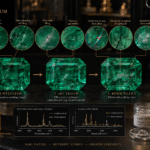
[…] Natural emeralds commonly contain visible internal characteristics and fissures. Many are clarity enhanced. The amount of enhancement can differ considerably between stones. Geographic origin may influence the market, but a famous origin does not automatically guarantee an exceptional individual gemstone. […]