Table of Contents
Three Emeralds. One Natural. Two Synthetic.
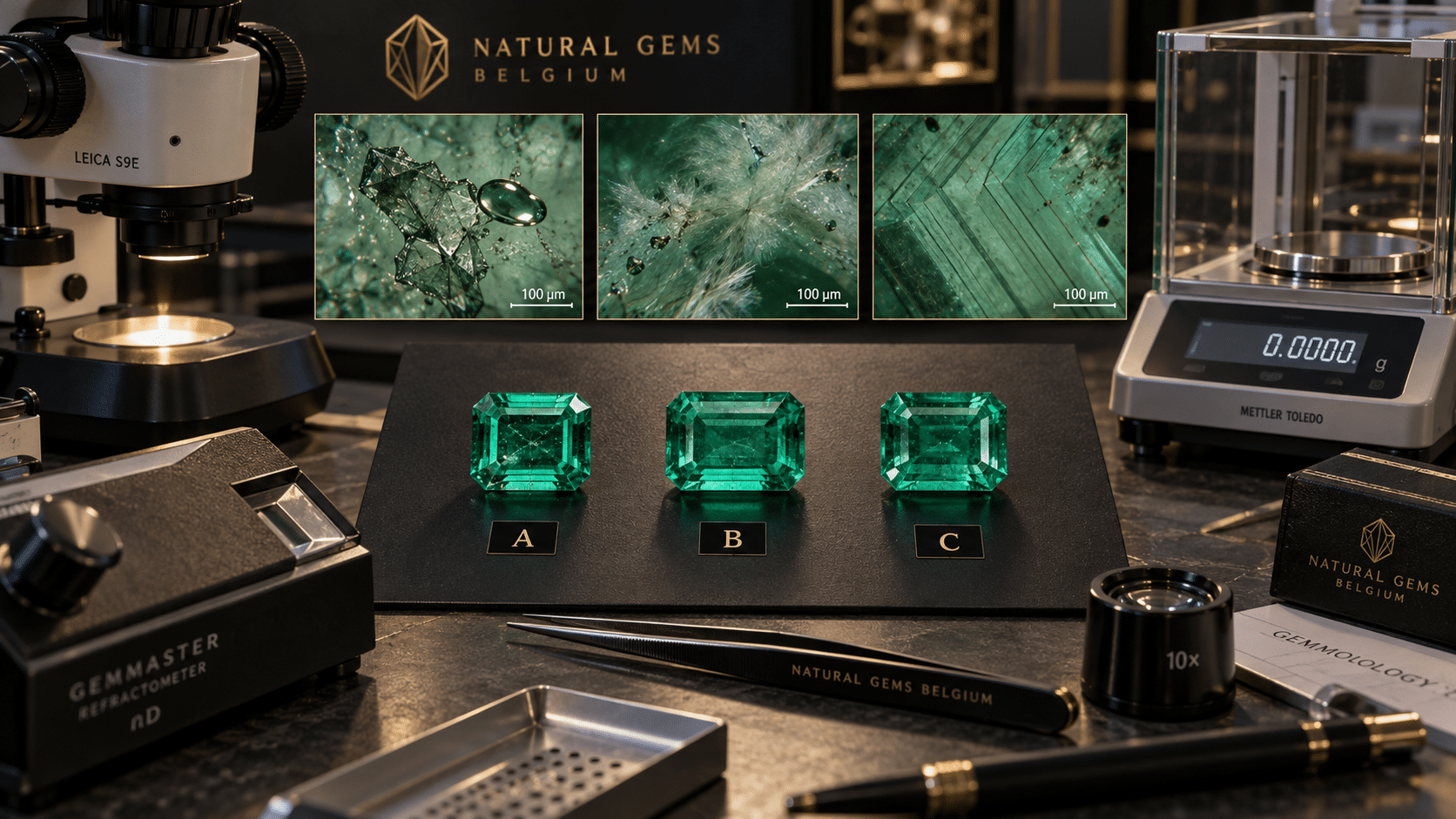
Three transparent green gemstones arrive at the laboratory.
All three are attractive.
All three have the colour we associate with emerald.
All three show properties compatible with beryl.
And all three are, chemically and crystallographically:
emerald.
But they did not form in the same environment.
One crystallised naturally within the Earth.
One was grown artificially from a:
flux.
The third was grown artificially by the:
hydrothermal method.
Your task is not simply to answer:
“Is this emerald?”
That part may be comparatively easy.
The real question is:
HOW DID THIS EMERALD GROW?
Welcome to:
UNKNOWN STONE WORKSHOP 3
Natural Emerald vs Flux-Grown vs Hydrothermal Synthetic Emerald
THE THREE UNKNOWN STONES
We will call them:
SAMPLE A
SAMPLE B
and:
SAMPLE C
The workshop will delve into natural vs synthetic emerald identification to help determine the origins of these gemstones.
For the purpose of this workshop, all three are faceted green emeralds of broadly comparable colour and size.
No laboratory report accompanies them.
No supplier information will be considered.
No conclusion will be based on price.
We begin with the stones themselves.
PART I — DEFINE THE QUESTION CORRECTLY
This workshop introduces one of the most important distinctions in modern gemmology.
There are actually two separate questions:
QUESTION 1
What material is this?
and:
QUESTION 2
Did that material grow naturally or synthetically?
These are not the same investigation.
A synthetic emerald is not green glass pretending to be emerald.
It is not necessarily a simulant.
A correctly manufactured synthetic emerald has essentially the same fundamental crystal structure and chemical framework as natural emerald.
Both belong to:
beryl.
The essential beryl formula is:
Be₃Al₂Si₆O₁₈
Emerald is the green to bluish-green variety of beryl.
So our challenge is more sophisticated than separating emerald from glass.
PART II — SYNTHETIC DOES NOT MEAN IMITATION
Before touching an instrument, establish the terminology.
Natural Emerald
Emerald that crystallised through natural geological processes.
Synthetic Emerald
Emerald crystallised through a human-controlled manufacturing process.
Emerald Imitation or Simulant
A different material that resembles emerald visually.
Examples could include:
- green glass;
- another natural green gemstone;
- another manufactured green material.
This distinction matters enormously.
A piece of green glass may be relatively easy to eliminate because its physical properties differ fundamentally from beryl.
A high-quality synthetic emerald is a much more difficult problem because:
it actually is synthetic beryl.
PART III — WHY SYNTHETIC EMERALD EXISTS
Emerald is difficult to reproduce artificially.
Beryl cannot simply be melted and recrystallised conveniently in the way some other materials can be manufactured.
Successful synthetic emerald production therefore developed around methods that create conditions in which emerald can crystallise without simply melting beryl in an ordinary furnace.
Two historically important approaches are:
flux growth
and:
hydrothermal growth.
Each leaves evidence of its growth environment inside the crystal.
That evidence is where our investigation becomes interesting.
PART IV — A SHORT HISTORY OF SYNTHETIC EMERALD
Attempts to synthesise emerald extend back well over a century.
Research by Karl Schmetzer and co-authors documented important experiments by Richard Nacken in Germany during the 1920s.
Nacken succeeded in producing facetable synthetic emerald crystals in the mid-1920s using flux-growth techniques.
Commercially significant flux-grown emeralds became increasingly important later in the twentieth century.
Hydrothermal synthetic emerald appeared later as another technically sophisticated route to emerald growth.
The important lesson is that synthetic emerald is not a recent invention.
Gemologists have been confronting the natural-versus-synthetic emerald problem for generations.
PART V — FIRST OBSERVATION: COLOUR
Place Samples A, B and C on a neutral background.
Observe them under controlled white light.
All three are:
green.
One may appear slightly more bluish.
Another slightly more yellowish.
One may display stronger colour zoning.
Can we identify the natural emerald from colour alone?
NO.
Natural and synthetic emerald can occupy overlapping colour ranges.
A beautifully saturated green colour is not evidence of natural origin.
Neither is unusually high transparency proof of synthetic origin.
Colour can guide observation.
It cannot settle the question.
PART VI — MAGNIFICATION BEFORE ASSUMPTION
Before advanced testing, inspect the stones with:
Look for:
- surface-reaching fractures;
- obvious inclusions;
- growth zoning;
- cavities;
- polishing features;
- possible assembly;
- coating;
- filling substances.
Already, the three stones may begin to look different.
But do not identify them yet.
Record:
observations first.
Interpretation comes later.
PART VII — ESTABLISHING BERYL
Now begin conventional gemmological testing.
For natural emerald, GIA gives representative properties of approximately:
RI: 1.577–1.583
Birefringence: 0.005–0.009
SG: 2.72
Mohs hardness: 7.5–8
But these are reference values—not immutable boundaries for every emerald from every deposit.
Published natural emerald populations demonstrate compositional variation.
For example, GIA research on Swat Valley emeralds reported RI values extending approximately:
1.580–1.600
and SG values:
2.70–2.82.
Natural emeralds from Fazenda Bonfim, Brazil, showed approximately:
RI 1.578–1.591
and:
SG 2.72–2.74.
The lesson is important:
NEVER TURN A TEXTBOOK RANGE INTO AN ABSOLUTE LAW.
PART VIII — REFRACTIVE INDEX
Measure Sample A carefully.
Then B.
Then C.
Suppose all three produce refractive indices compatible with:
beryl.
Has the problem been solved?
No.
We have obtained strong evidence about:
material identity.
But natural and synthetic emerald are both beryl.
Their refractive-index ranges can overlap.
RI may sometimes contribute useful supporting evidence because chemistry can influence the value, but it is not generally sufficient by itself to establish natural versus synthetic origin.
PART IX — BIREFRINGENCE
Beryl is:
uniaxial.
Emerald is doubly refractive.
Measure both principal refractive indices where possible and calculate:
birefringence.
Again, natural and synthetic emerald can overlap.
Gem-A reports approximate synthetic ranges that vary with growth type and manufacturer.
Therefore a result compatible with emerald confirms another piece of the material-identification puzzle.
It does not automatically reveal the growth environment.
PART X — SPECIFIC GRAVITY
Now perform hydrostatic SG measurement if the stones are loose and appropriate for immersion.
Natural emerald commonly lies around the upper 2.6 to 2.8 region, depending on composition and inclusions.
Gem-A reports typical approximate synthetic emerald densities of:
Flux-grown: 2.65–2.67
Hydrothermal: 2.67–2.71
This can be useful.
But notice the problem.
Those values can overlap natural beryl.
So if Sample B gives:
SG 2.68
we should not write:
“Synthetic emerald proven.”
Instead:
“SG compatible with emerald/beryl; value may be consistent with some synthetic emeralds but is not diagnostic alone.”
That is professional evidence language.
PART XI — WHY NATURAL EMERALD PROPERTIES VARY
Natural emerald is not chemically identical from every deposit.
Beryl’s crystal structure can accommodate various substituting elements.
Emerald colour is associated particularly with chromium and/or vanadium, while iron and other trace elements can influence both colour and measurable properties.
Geological environments differ.
Consequently, emeralds from:
- Colombia;
- Brazil;
- Zambia;
- Pakistan;
- Afghanistan;
- Ethiopia;
- Russia;
- China
do not necessarily possess identical RI, SG, spectra or inclusion populations.
This variation is scientifically valuable.
But it also warns us against oversimplified identification charts.
PART XII — DICHROISM
Examine the samples with a dichroscope.
Emerald commonly displays:
dichroism.
Natural examples may show combinations such as:
yellowish green
and:
bluish green.
GIA’s study of Brazilian Fazenda Bonfim emeralds reported distinct to strong dichroism from light yellowish green to bluish green or greenish blue.
Swat Valley material similarly displayed yellowish-green/green and bluish-green directions.
But synthetic emerald can also be pleochroic.
Therefore:
dichroism supports emerald identification.
It does not automatically establish natural origin.
PART XIII — UV FLUORESCENCE
Now expose the stones appropriately to long-wave and short-wave UV.
Could fluorescence solve the puzzle?
Sometimes it contributes evidence.
But fluorescence in emerald is strongly influenced by chemistry.
Iron, chromium and other compositional factors can alter response.
Gem-A notes that natural emerald may range from red fluorescence to inert behaviour and that synthetic emerald responses also vary.
Hydrothermal synthetics can even be deliberately produced with chemistry that results in weak or inert fluorescence.
Therefore:
“IT FLUORESCES RED, SO IT IS SYNTHETIC”
is not a safe identification rule.
And neither is:
“IT IS INERT, SO IT IS NATURAL.”
Use fluorescence as supporting evidence.
PART XIV — THE CHELSEA FILTER
Historically, the Chelsea Colour Filter became associated strongly with emerald testing.
Chromium-bearing emerald may appear reddish through the filter.
But many other materials can produce responses that reduce its diagnostic value.
Some natural emeralds do not react strongly.
Synthetic emeralds can react.
Other chromium-bearing green stones can also appear red.
Therefore the Chelsea filter can be interesting.
It is not:
a natural-emerald detector.
Modern gemmology requires more.
PART XV — NOW THE MICROSCOPE BECOMES CENTRAL
We have established something important.
Samples A, B and C all show properties compatible with emerald.
RI did not settle natural versus synthetic.
SG did not settle it.
Dichroism did not settle it.
UV did not settle it.
This is not failure.
We have simply reached the next level of the evidence chain.
Place:
Sample A
under the gemmological microscope.
PART XVI — SAMPLE A: A COMPLEX INTERNAL WORLD
Under darkfield illumination, Sample A reveals:
- irregular healed fissures;
- small mineral inclusions;
- fluid inclusions;
- locally complex multiphase inclusions;
- naturally irregular growth-related features.
Some inclusions appear to contain:
liquid + gas bubble
and others may contain:
liquid + gas + a solid crystal.
Three-phase inclusions are famously associated with some Colombian emeralds.
But an important warning is required.
THREE-PHASE INCLUSION DOES NOT AUTOMATICALLY MEAN COLOMBIA.
Natural emeralds from multiple deposits can contain complex fluid inclusions.
Inclusion interpretation must consider:
- morphology;
- orientation;
- associated minerals;
- geological context;
- chemistry.
Nevertheless, a convincing suite of natural geological inclusions can provide strong evidence for:
natural growth.
Sample A is becoming interesting.
PART XVII — THE “JARDIN”
Emerald often contains numerous inclusions and fractures.
The resulting internal appearance is traditionally called:
jardin
—the French word for “garden.”
But “jardin” is a descriptive trade term.
It is not a diagnostic inclusion type.
A stone is not natural merely because it looks included.
Synthetic emerald can contain abundant internal features too.
The question is:
what are those inclusions?
Not:
how many are there?
PART XVIII — NATURAL MINERAL INCLUSIONS
Natural emerald can contain minerals related to its geological growth environment.
Depending on locality, reported inclusions can include various:
- mica-group minerals;
- amphiboles;
- carbonates;
- quartz;
- feldspars;
- sulfides;
- oxides;
- other minerals.
A properly identified natural mineral inclusion can be extremely valuable evidence.
But microscopic appearance alone may not always identify the inclusion mineral reliably.
Advanced laboratories may use:
Raman spectroscopy
to identify inclusions non-destructively.
PART XIX — SAMPLE B UNDER THE MICROSCOPE
Now inspect Sample B.
Its internal world is different.
You observe:
- wispy translucent veils;
- fingerprint-like structures;
- irregular flux-like residues;
- two-phase inclusions;
- occasional reflective metallic-looking particles.
The overall pattern does not resemble a normal geological fracture-and-mineral assemblage.
This is our first major clue.
Sample B may have crystallised from:
A FLUX.
PART XX — WHAT IS FLUX GROWTH?
A flux is a material capable of dissolving the chemical ingredients needed for crystal growth at temperatures below the direct melting point of the target crystal.
In synthetic emerald production, the ingredients required to form beryl dissolve in a high-temperature flux.
As conditions change, emerald crystallises from that solution.
The process can be slow.
High-quality crystals may require extended growth periods.
The result is genuine crystalline synthetic emerald.
But the artificial growth environment can leave:
flux-related inclusions.
PART XXI — FLUX RESIDUES
Residual flux trapped during crystal growth can create characteristic internal features.
These may appear:
- wispy;
- veil-like;
- fingerprint-like;
- irregular;
- translucent.
They can sometimes resemble healed fissures.
This is precisely why inclusion identification requires training.
A beginner may see:
“fingerprint inclusion = natural.”
An experienced gemologist asks:
“What produced this fingerprint-like structure?”
Morphology and context matter.
PART XXII — METALLIC INCLUSIONS
Some flux-grown synthetic emerald processes use equipment or crucible materials capable of contributing metallic inclusions.
Platinum particles are particularly well known in some flux-grown synthetics.
A reflective platinum inclusion inside an emerald can therefore be a powerful clue.
But again:
one bright reflective particle should not be identified casually as platinum from appearance alone.
Laboratory confirmation may be necessary.
The scientific approach remains:
observe → hypothesise → verify.
PART XXIII — SAMPLE C UNDER THE MICROSCOPE
Now examine Sample C.
The internal pattern changes again.
You may observe:
- angular growth structures;
- chevron or zigzag growth zoning;
- seed-related structures;
- nail-head spicule-like inclusions;
- unusual tubes or channels;
- growth boundaries inconsistent with typical natural emerald.
This suite points toward another artificial growth environment:
HYDROTHERMAL GROWTH.
PART XXIV — WHAT IS HYDROTHERMAL GROWTH?
Hydrothermal synthesis attempts to reproduce, in controlled form, an important natural crystal-growth principle:
crystallisation from hot aqueous fluid under elevated pressure.
Modern hydrothermal synthesis takes place inside:
high-pressure autoclaves.
GIA explains that water under the high-temperature, high-pressure conditions used in these systems becomes a highly effective transport medium.
Mineralizers can increase solubility.
A temperature gradient allows material to dissolve in one region and crystallise in another.
Synthetic crystal growth occurs on:
seed material.
This method can produce synthetic:
- quartz;
- emerald;
- ruby;
- sapphire;
- spinel
and other materials.
PART XXV — THE SEED PLATE
A hydrothermal crystal commonly grows from a:
seed.
The seed establishes crystallographic orientation and provides a surface upon which new material can grow.
In rough synthetic material, the seed may sometimes be visible directly.
In a faceted stone, cutting may remove most obvious evidence.
But remnants of:
- seed boundaries;
- growth zoning;
- orientation-related structures
can survive.
These can become highly informative under magnification.
PART XXVI — CHEVRON GROWTH
Hydrothermal synthetics are particularly associated with artificial growth structures that can appear:
- angular;
- zigzag;
- chevron-like.
GIA has noted that hydrothermal synthetics can often show characteristic chevron-patterned graining and colour zoning.
Why is this important?
Because growth structures record:
how the crystal advanced through space during formation.
They are effectively a history of crystal growth frozen inside the gemstone.
PART XXVII — NAIL-HEAD SPICULES
One famous inclusion associated with some synthetic emeralds is the:
NAIL-HEAD SPICULE.
It typically consists of a narrow tube or spicule terminating in a broader feature, producing a shape reminiscent of a nail.
Such inclusions have historically been associated especially with some hydrothermal synthetic emeralds.
But this is where gemmology becomes more nuanced.
Nail-head-like structures have also been documented in certain flux-grown synthetic emeralds.
GIA’s historical research on Richard Nacken’s 1920s flux-grown synthetic emeralds documented oriented inclusions including nail-head spicules.
Therefore:
NAIL-HEAD SPICULE ≠ AUTOMATICALLY HYDROTHERMAL.
The entire inclusion assemblage and growth structure must be considered.
This is exactly why simplistic one-feature identification rules are dangerous.
PART XXVIII — THE IMPORTANCE OF AN INCLUSION SUITE
Professional microscopy rarely asks:
“Did I see one diagnostic-looking object?”
Instead ask:
“What population of internal features does this gemstone contain?”
For Sample A:
natural fluid/mineral assemblages and geological growth features converge.
For Sample B:
flux residues, artificial-looking healed structures and possibly metallic inclusions converge.
For Sample C:
seed-related structures, angular growth zoning and hydrothermal-style features converge.
The conclusion becomes stronger because:
multiple observations agree.
PART XXIX — GROWTH FEATURES ARE A HISTORY BOOK
Every crystal grew.
Therefore every crystal has:
growth history.
Natural emerald growth reflects geological environments operating over geological timescales.
Flux-grown synthetic emerald records crystallisation from an artificial molten solution.
Hydrothermal synthetic emerald records crystallisation from an artificial high-temperature aqueous environment.
Under the microscope, the gemologist is not merely searching for “defects.”
The gemologist is reading:
THE PHYSICAL RECORD OF CRYSTAL GROWTH.
PART XXX — CAN A SYNTHETIC EMERALD BE VERY INCLUDED?
Absolutely.
The common assumption:
“Synthetic gemstones are always flawless.”
is wrong.
Synthetic emeralds may contain:
- flux residues;
- growth structures;
- seed-related features;
- bubbles;
- tubes;
- spicules;
- colour zoning;
- other inclusions.
Some manufacturers have deliberately sought more natural-looking products.
Therefore clarity alone cannot determine growth origin.
PART XXXI — CAN A NATURAL EMERALD BE VERY CLEAN?
Yes.
Although emerald commonly contains visible inclusions, exceptionally clean natural emerald exists.
Therefore:
clean = synthetic
is also wrong.
A high-quality natural stone should never be condemned merely because it lacks an obvious jardin.
The absence of evidence is not automatically evidence of synthetic origin.
PART XXXII — SPECTROSCOPY
Now examine absorption behaviour.
Emerald colour is commonly associated with:
chromium and/or vanadium.
Iron can also influence colour and optical behaviour.
Visible spectroscopy may reveal absorption associated with these chromophores.
Can spectroscopy alone always distinguish natural from synthetic?
No.
Synthetic emerald manufacturers can use the same chromophore elements responsible for natural emerald colour.
However, spectra can contribute to a broader evidence set and can reveal compositional differences worthy of further investigation.
PART XXXIII — TRACE-ELEMENT CHEMISTRY
This is where advanced laboratories gain enormous power.
Natural emerald chemistry reflects:
- host geology;
- fluid composition;
- geological environment;
- available trace elements.
Synthetic emerald chemistry reflects:
- starting materials;
- flux;
- mineralizers;
- crucible environment;
- intentional dopants;
- manufacturing process.
Techniques such as:
LA-ICP-MS
can measure trace-element compositions at extremely low concentrations.
Gem-A specifically notes that trace-element analysis can distinguish natural from synthetic emerald when routine properties or inclusions are insufficient.
PART XXXIV — RAMAN SPECTROSCOPY
Raman spectroscopy can help identify:
- host mineral;
- mineral inclusions;
- some filling materials;
- other microscopic phases.
This is particularly useful when an inclusion could provide evidence of natural geological origin but cannot be identified confidently by appearance.
The microscope tells us:
where to look.
Raman can help tell us:
what we are looking at.
PART XXXV — FTIR AND OTHER ADVANCED METHODS
Modern gem laboratories can also employ:
- FTIR spectroscopy;
- UV-Vis-NIR spectroscopy;
- Raman spectroscopy;
- photoluminescence;
- X-ray methods;
- chemical analysis
depending on the question.
Not every emerald requires every instrument.
The principle is:
USE THE LEAST COMPLEX RELIABLE EVIDENCE CHAIN NECESSARY.
If diagnostic microscopy establishes synthetic growth convincingly, further testing may be unnecessary for a routine educational identification.
If the stone is unusually valuable, atypical or ambiguous, advanced testing becomes appropriate.
PART XXXVI — THE PROBLEM WITH “DIAGNOSTIC” FEATURES
The word:
diagnostic
should be used carefully.
Gemological literature evolves.
New deposits are discovered.
New synthetic processes appear.
Manufacturers change growth chemistry.
Features once thought unique may later be documented elsewhere.
The nail-head spicule example demonstrates this perfectly.
A strong gemologist does not memorise:
feature → gemstone name.
A strong gemologist understands:
feature + context + population + physical properties + analytical confirmation.
PART XXXVII — SAMPLE A: WORKING CONCLUSION
Let us now assemble Sample A’s evidence.
Colour
Compatible with emerald.
RI
Compatible with beryl/emerald.
SG
Compatible with beryl/emerald.
Optical character
Compatible with beryl.
Dichroism
Compatible with emerald.
Microscopy
Natural-looking fluid and mineral inclusion assemblage, healed fissures and geological growth features.
Advanced confirmation
Where necessary, spectroscopy and chemistry support natural emerald.
Working conclusion:
NATURAL EMERALD
But one question remains:
Has it been clarity enhanced?
Natural origin and treatment are separate determinations.
PART XXXVIII — SAMPLE B: WORKING CONCLUSION
Colour
Compatible with emerald.
RI
Compatible with emerald.
SG
Compatible with emerald and potentially some synthetic material.
Optical character
Compatible with beryl.
Microscopy
Flux-like wispy residues, artificial growth-related features and potentially characteristic metallic inclusions.
Working conclusion:
FLUX-GROWN SYNTHETIC EMERALD
The word:
synthetic
does not mean the stone failed the emerald tests.
It passed them because it is synthetic emerald.
Microscopy revealed the growth environment.
PART XXXIX — SAMPLE C: WORKING CONCLUSION
Colour
Compatible with emerald.
RI
Compatible with emerald.
SG
Compatible with emerald.
Optical character
Compatible with beryl.
Microscopy
Artificial angular/chevron growth structures, seed-related features and a hydrothermal-style inclusion suite.
Working conclusion:
HYDROTHERMAL SYNTHETIC EMERALD
Again, the distinction comes primarily from:
growth evidence
rather than simply:
material identity.
PART XL — NOW ADD TREATMENT TO THE NATURAL EMERALD
Sample A has been established as natural.
Are we finished?
No.
Emerald commonly contains surface-reaching fractures.
These may be filled with substances such as:
- oils;
- resins;
- polymers.
The purpose is generally to reduce the visibility of fractures and improve apparent clarity.
Therefore an emerald report may need to address two separate questions:
Origin of growth: natural or synthetic?
and:
Clarity enhancement: present or absent, and to what extent?
Never merge these questions.
PART XLI — SYNTHETIC EMERALD IS NOT “FAKE EMERALD”
Scientifically, the phrase:
fake emerald
is too imprecise.
If the material is synthetic beryl with emerald colour, the correct description is:
synthetic emerald.
If the material is glass:
emerald imitation / green glass.
If another natural stone is being represented as emerald:
an emerald simulant or misrepresented gemstone.
Precise terminology protects both science and consumer understanding.
PART XLII — THE BLIND TEST
Imagine the stones are presented without labels.
Sample A
RI: compatible with emerald
SG: compatible with emerald
Dichroism: emerald-like
Microscopy: complex natural fluid/mineral assemblage
Sample B
RI: compatible with emerald
SG: slightly low but compatible with some synthetic emerald
Microscopy: wispy flux residues and artificial growth features
Sample C
RI: compatible with emerald
SG: compatible with emerald
Microscopy: chevron growth and seed-related features
If you relied only on RI:
all three might remain emerald.
If you relied only on colour:
all three might remain emerald.
If you relied only on SG:
the result could remain ambiguous.
Microscopy transforms the investigation.
PART XLIII — WHAT IF MICROSCOPY IS INCONCLUSIVE?
This is a crucial professional question.
Suppose the stone is:
- exceptionally clean;
- very small;
- poorly oriented for inclusion observation;
- unusually grown;
- lacking familiar diagnostic features.
Do not invent certainty.
The correct conclusion may be:
“Conventional gemmological testing establishes emerald/beryl, but natural versus synthetic origin requires advanced laboratory analysis.”
That is not failure.
That is scientifically responsible gemmology.
PART XLIV — WHAT NOT TO DO
Do not conclude:
Natural because it has inclusions.
Do not conclude:
Synthetic because it is clean.
Do not conclude:
Natural because it is inert to UV.
Do not conclude:
Synthetic because it fluoresces red.
Do not conclude:
Natural because the RI is high.
Do not conclude:
Hydrothermal because one nail-head-like inclusion was observed.
Do not conclude:
Colombian because a three-phase inclusion is present.
Each shortcut converts useful evidence into an unreliable rule.
PART XLV — A PROFESSIONAL DECISION TREE
Begin:
GREEN TRANSPARENT STONE
↓
Measure RI
Compatible with beryl?
NO
Investigate another material or imitation.
YES
↓
Determine optical character
Compatible with uniaxial beryl?
NO
Reconsider identity.
YES
↓
SG / spectroscopy / dichroism
Do properties converge on emerald?
NO
Investigate discrepancy.
YES
↓
MATERIAL IDENTITY: EMERALD / BERYL SUPPORTED
Now begin a different question.
↓
Microscopy
Natural geological inclusion suite?
↓
Potential natural emerald
or:
Flux residues / metallic inclusions / artificial growth structures?
↓
Potential flux-grown synthetic
or:
Seed-related structures / chevron zoning / hydrothermal growth features?
↓
Potential hydrothermal synthetic
↓
Are observations sufficiently diagnostic?
YES
Form evidence-based conclusion.
NO
↓
Advanced laboratory analysis
Raman
FTIR
UV-Vis-NIR
Trace-element chemistry
Other appropriate techniques
↓
FINAL GROWTH-ORIGIN DETERMINATION
Then, separately:
↓
TREATMENT / CLARITY-ENHANCEMENT INVESTIGATION
PART XLVI — WHY THIS WORKSHOP IS MORE DIFFICULT THAN DIAMOND VS CZ
In the previous workshop, diamond and cubic zirconia are fundamentally different materials.
Their physical properties differ dramatically.
Here, all three stones are:
beryl.
All three may show:
- emerald colour;
- beryl RI;
- beryl SG;
- beryl optical character;
- emerald-like dichroism.
The problem has moved from:
WHAT IS IT?
to:
HOW DID IT FORM?
That is a major step upward in gemmological reasoning.
PART XLVII — GROWTH ORIGIN VERSUS GEOGRAPHIC ORIGIN
Do not confuse:
natural/synthetic origin
with:
geographic origin.
First:
Did the emerald grow naturally?
If yes, a much more advanced question may follow:
Did it originate from:
- Colombia?
- Zambia?
- Brazil?
- Afghanistan?
- Pakistan?
- Ethiopia?
- another deposit?
Geographic origin determination may require detailed comparison of:
- inclusions;
- spectroscopy;
- trace-element chemistry;
- geological reference databases.
A natural emerald cannot be assigned confidently to a country merely because one familiar-looking inclusion is present.
PART XLVIII — WHY REFERENCE COLLECTIONS MATTER
Advanced gemstone laboratories maintain:
reference collections.
Known-origin natural emeralds and known-process synthetic emeralds can be characterised and compared with unknown stones.
This allows laboratory scientists to ask:
Does this unknown specimen match established natural populations?
or:
Does its chemistry and growth structure correspond to a known synthetic process?
Gemological expertise therefore depends not only on instruments but on:
reference data.
PART XLIX — HISTORICAL SYNTHETICS MATTER TOO
The study of Richard Nacken’s emeralds demonstrates another important point.
Synthetic materials change through time.
Historical experimental synthetics may contain features different from modern commercial products.
Manufacturers alter:
- flux compositions;
- dopants;
- seed materials;
- growth conditions;
- equipment.
A gemologist therefore studies both:
natural geological diversity
and:
synthetic manufacturing diversity.
PART L — THE MOST IMPORTANT LESSON FROM SAMPLE B
Flux-grown synthetic emerald may look remarkably natural.
Its crystal habit can resemble natural beryl more closely than some hydrothermal rough.
Its inclusions can be complex.
Its growth can be slow.
Its chemistry is genuinely beryl.
Therefore:
visual beauty does not establish geological origin.
A magnificent emerald can still be synthetic.
PART LI — THE MOST IMPORTANT LESSON FROM SAMPLE C
Hydrothermal synthesis is scientifically sophisticated.
It uses:
- high pressure;
- high temperature;
- aqueous transport;
- mineralizers;
- temperature gradients;
- seed crystals.
These concepts resemble processes that can occur in geological environments.
But controlled manufacturing leaves its own structural evidence.
The challenge is not to decide whether the crystal looks “artificial.”
The challenge is to recognise:
how it grew.
PART LII — THE MOST IMPORTANT LESSON FROM SAMPLE A
Natural emerald does not need to look imperfect.
Nor does every natural emerald need to contain textbook Colombian three-phase inclusions.
Nature produces enormous diversity.
The correct approach is not:
“I cannot find the inclusion from my chart.”
It is:
“What does the complete evidence set tell me?”
PART LIII — EVIDENCE HIERARCHY
For this workshop, think in layers.
LAYER 1 — VISUAL OBSERVATION
Colour
Transparency
Cut
Obvious zoning
LAYER 2 — CLASSICAL GEMMOLOGY
RI
Birefringence
SG
Optical character
Dichroism
UV
Spectrum
LAYER 3 — MICROSCOPY
Fluid inclusions
Mineral inclusions
Flux residues
Metallic inclusions
Growth structures
Seed-related features
Spicules
Fractures and fillers
LAYER 4 — ADVANCED ANALYSIS
Raman
FTIR
UV-Vis-NIR
Trace-element chemistry
Other specialised methods
Each layer narrows the interpretation.
PART LIV — THE REPORT LANGUAGE
A professional report should avoid statements exceeding the evidence.
Instead of:
“Looks natural.”
use:
“Microscopic features are consistent with natural emerald.”
Instead of:
“Probably hydrothermal because of lines.”
use:
“Observed chevron-like growth structures and seed-related features are consistent with hydrothermal synthetic growth.”
Instead of:
“Definitely Colombian because of three-phase inclusions.”
use:
“Observed multiphase inclusions support natural origin; geographic-origin determination requires evaluation of the complete inclusion, spectroscopic and chemical dataset.”
Language should mirror evidential strength.
PART LV — THE NGB UNKNOWN EMERALD WORKFLOW
STEP 1 — VISUAL INSPECTION
↓
Do not infer natural origin from colour or clarity.
↓
STEP 2 — REFRACTIVE INDEX
↓
Is the stone compatible with beryl?
↓
STEP 3 — OPTICAL CHARACTER + BIREFRINGENCE
↓
Does the evidence continue to support beryl?
↓
STEP 4 — SPECIFIC GRAVITY
↓
Compatible with emerald?
↓
STEP 5 — DICHROISM + SPECTROSCOPY + UV
↓
Build compositional evidence.
↓
EMERALD IDENTITY SUPPORTED
Now change the question.
↓
NATURAL OR SYNTHETIC?
↓
STEP 6 — MICROSCOPY
↓
Natural geological inclusion suite?
or:
Flux-growth evidence?
or:
Hydrothermal-growth evidence?
↓
STEP 7 — CHECK THE ENTIRE INCLUSION POPULATION
↓
Never identify from one oversimplified feature.
↓
STEP 8 — ADVANCED LAB TESTING IF REQUIRED
↓
Trace-element chemistry
Raman
FTIR
UV-Vis-NIR
Other appropriate techniques
↓
GROWTH ORIGIN CONCLUSION
↓
STEP 9 — TREATMENT INVESTIGATION
↓
Natural does not automatically mean untreated.
↓
FINAL REPORTABLE CONCLUSION
Conclusion
This workshop began with three green gemstones.
At first glance they appeared to pose a simple question:
Which one is the real emerald?
But that question was scientifically wrong.
All three are emerald.
Sample A is:
natural emerald.
Sample B is:
flux-grown synthetic emerald.
Sample C is:
hydrothermal synthetic emerald.
Their shared identity explains why conventional measurements can overlap.
Refractive index may establish:
beryl.
Specific gravity may support:
beryl.
Dichroism may support:
emerald.
Spectroscopy may reveal the chromophores responsible for green colour.
Yet none of those observations necessarily answers:
where and how did the crystal grow?
For that question, microscopy becomes extraordinarily important.
Natural emerald can preserve evidence of geological formation:
- fluid inclusions;
- mineral inclusions;
- healed fissures;
- natural growth structures.
Flux-grown synthetic emerald can preserve evidence of artificial solution growth:
- residual flux;
- wispy veils;
- artificial healed structures;
- metallic inclusions.
Hydrothermal synthetic emerald can preserve evidence of autoclave growth:
- seed-related structures;
- angular or chevron growth;
- characteristic zoning;
- hydrothermal-style inclusion populations.
But even these features require disciplined interpretation.
A three-phase inclusion does not automatically prove Colombian origin.
A nail-head spicule does not automatically prove hydrothermal growth.
Red fluorescence does not automatically prove synthetic origin.
High clarity does not automatically mean synthetic.
Heavy inclusion does not automatically mean natural.
The professional method remains:
EVIDENCE CONVERGENCE.
And when classical gemmology and microscopy cannot provide a sufficiently secure answer, modern laboratory methods can extend the investigation through:
- Raman spectroscopy;
- FTIR;
- UV-Vis-NIR spectroscopy;
- trace-element chemistry;
- specialised analytical techniques.
This workshop therefore introduces a more advanced form of gemstone identification.
The question is no longer simply:
“WHAT MINERAL IS THIS?”
It becomes:
“WHAT GROWTH HISTORY IS RECORDED INSIDE THIS CRYSTAL?”
That distinction lies at the heart of modern gemmology.
A synthetic emerald can possess the chemistry, crystal structure and optical properties of emerald because:
it is emerald.
What separates it from a natural emerald is not whether the crystal is “real.”
It is:
the environment in which that crystal formed.
And that environment leaves evidence.
The gemologist’s task is to find it, interpret it correctly, and never claim more than the evidence can support.
References & Further Reading
Gemological Institute of America (GIA) — “Emerald.” Gem Encyclopedia.
Authoritative overview of emerald as the green to bluish-green variety of beryl, including representative chemical and physical properties: Be₃Al₂Si₆O₁₈ composition, RI 1.577–1.583, birefringence 0.005–0.009, SG 2.72 and Mohs hardness 7.5–8. The page also distinguishes natural emerald from synthetic counterparts and imitations.
https://www.gia.edu/emerald
Gem-A — Schmetzer, K. et al., “Synthetic Emeralds Grown by W. Zerfass: Historical Account, Growth Technology and Properties.”
Detailed study of flux-grown synthetic emerald and the historical development of synthetic emerald production in Germany. Particularly useful for comparing flux and hydrothermal synthetic emerald properties and inclusions. Gem-A reports flux residues, wispy veil-like structures, two-phase inclusions and platinum in flux synthetics, while hydrothermal material can display nail-head spicules, chevron growth, undulating structures, seed plates and phenakite.
https://gem-a.com/gem-hub/synthetic-emeralds-grown-by-w-zerfass-historical-account-growth-technology-and-properties/
Gemological Institute of America (GIA) — Schmetzer, K. et al., “Synthetic Emeralds Grown by Richard Nacken in the Mid-1920s.” Gems & Gemology, Winter 2016.
Important historical and technical research documenting Richard Nacken’s successful production of facetable flux-grown synthetic emerald during the mid-1920s. The study is particularly valuable because it documents colour zoning, seed-related features and oriented inclusions including nail-head spicules, demonstrating why no single inclusion should automatically be assigned to one synthetic-growth method.
https://www.gia.edu/gems-gemology/winter-2016-synthetic-emeralds-richard-nacken-1920s
Gemological Institute of America (GIA) — “Laboratory Growth of Gem Materials and the Attempt to Replicate Nature.” Gems & Gemology, Summer 2024.
A modern scientific overview of synthetic gem growth. Particularly relevant to the hydrothermal section of this workshop: GIA explains high-pressure autoclave growth, supercritical aqueous transport, mineralizers, temperature gradients and seed-controlled crystal growth and discusses synthetic emerald among the materials produced hydrothermally.
https://www.gia.edu/gems-gemology/summer-2024-colored-stones-unearthed
Guo, H. et al. — “Inclusion and Trace Element Characteristics of Emeralds from Swat Valley, Pakistan.” Gems & Gemology, Fall 2020.
Detailed GIA study demonstrating the natural variation possible in emerald physical properties and inclusion populations. Reported Swat material included RI values extending to approximately 1.600 and SG values up to approximately 2.82, illustrating why simplified textbook ranges should not be treated as absolute natural-versus-synthetic boundaries.
https://my.gia.edu/gems-gemology/fall-2020-trace-element-characteristics-emeralds
Zwaan, J. C. et al. — “Emeralds from the Fazenda Bonfim Region, Rio Grande do Norte, Brazil.” Gems & Gemology, Spring 2012.
Comprehensive characterisation of Brazilian emeralds. The samples showed RI values around 1.578–1.591, SG 2.72–2.74, distinct-to-strong dichroism and characteristic fluid inclusions. An excellent reference for understanding natural emerald variability and the value of combining physical properties with microscopy and chemistry.
https://www.gia.edu/gems-gemology/spring-2012-emeralds-brazil-zwaan
Hu, Y. et al. — “Unique Vanadium-Rich Emerald from Malipo, China.” Gems & Gemology, Fall 2019.
A useful study of vanadium-rich natural emerald demonstrating colour zoning, natural growth features and compositional effects on gemmological properties. The studied material showed RI values extending approximately 1.576–1.589 and SG 2.66–2.71.
https://origin.prod.gia.edu/gems-gemology/fall-2019-emerald-from-malipo-china
Gem-A — “Focus on Gemstone Fluorescence: Looking for the Light.”
Useful supporting reference on the limitations of fluorescence testing. The article compares natural, flux-grown and hydrothermal emerald responses and explains why fluorescence should be treated as supporting evidence rather than a stand-alone natural-versus-synthetic test. It also discusses fluorescence associated with some emerald fillers.
https://gem-a.com/gem-hub/focus-on-fluorescence/
Gemological Institute of America (GIA) — “A Gemological and Spectroscopic Study with Mobile Instruments of ‘Emeralds’ from the Coronation Crown of Napoleon III.” Gems & Gemology, Summer 2022.
An instructive historical-object investigation showing how RI, SG, fluorescence and spectroscopy can distinguish genuine emerald/beryl from visually convincing lead-glass substitutes. The study reinforces the distinction between establishing material identity and determining natural versus synthetic growth origin.
https://origin.prod.author.gia.edu/gems-gemology/summer-2022-gems-from-crown-napoleon
Gem-A — “Synthetic Emeralds: Student Project.” The Journal of Gemmology / Gem-A educational material.
A useful educational comparison of natural, flux-grown and hydrothermal emerald, including crystal habit, RI, birefringence, SG and characteristic internal features. It emphasises that natural and synthetic emerald share the same essential chemical composition and crystal structure while their growth features and inclusion populations can reveal different formation environments.
https://gem-a.com/wp-content/uploads/2023/08/GJ-Autumn-2020.pdf