

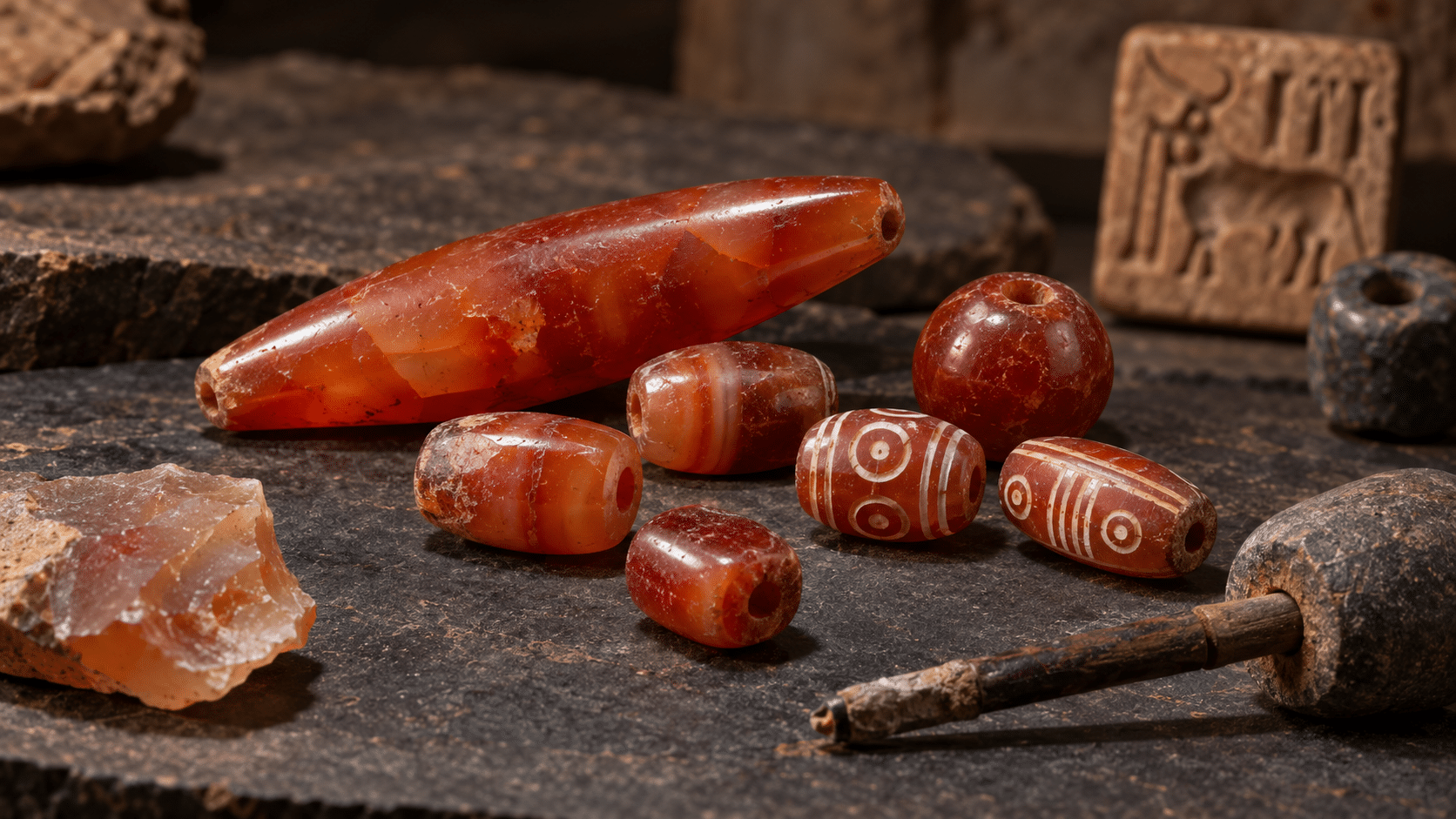
More than four thousand years ago, craftspeople in the cities and settlements of the Indus Civilization were transforming an apparently simple reddish stone into objects of extraordinary refinement.
The material was carnelian.
Some beads were small and understated.
Others were astonishingly long, intensely coloured and polished to a high lustre.
Still others carried carefully produced white patterns—circles, lines and geometric motifs deliberately created against their orange-red surfaces.
These objects travelled.
Indus-style carnelian beads have been found far beyond the Indus region, including archaeological contexts in Mesopotamia. Their distribution provides evidence for one of the great long-distance exchange systems of the Bronze Age.
Today, however, carnelian is usually encountered through an entirely different cultural vocabulary.
Modern crystal traditions associate it with:
- vitality
- courage
- creativity
- motivation
- sexuality
- confidence
- protection
- the Sacral Chakra
It is tempting to project these ideas backwards and claim that the people of the Indus Civilization regarded carnelian as a “stone of vitality” or used it to activate an energy centre.
The archaeological evidence does not justify that conclusion.
What it reveals is arguably more interesting.
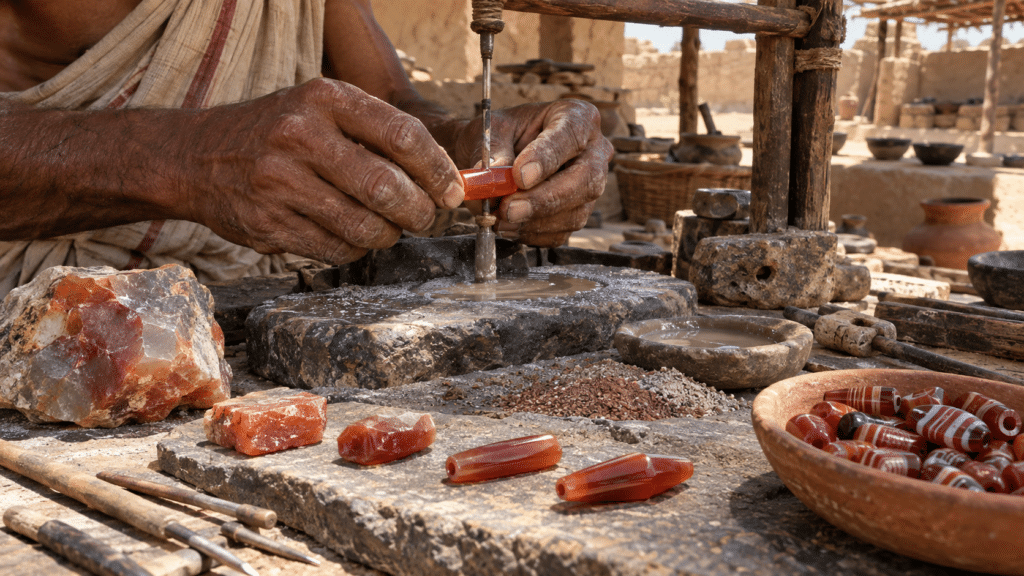
Carnelian was deliberately sourced, transported, heated, shaped, drilled, polished and sometimes decorated by highly specialised craftspeople. Certain forms required extraordinary technical investment. They circulated across enormous distances and appear in contexts suggesting social value and prestige.
The stone clearly mattered.
Exactly what it meant spiritually, however, remains one of the fascinating unanswered questions of South Asian archaeology.
Table of Contents
What Is Carnelian?
Carnelian is a translucent to semi-translucent orange, reddish-orange or brownish-red variety of chalcedony.
Chalcedony itself is a microcrystalline form of silica, principally:
SiO₂ — silicon dioxide.
Unlike transparent macrocrystalline quartz such as rock crystal or amethyst, chalcedony consists of extremely fine intergrowths of silica.
Carnelian’s colour is principally associated with iron compounds.
One fascinating aspect of this ancient civilization is the role of carnelian in the Indus Civilization, reflecting their advanced craftsmanship and cultural significance.
The stone may range from pale orange through intense reddish orange to deeper brownish red.
This variation mattered to ancient craftspeople because colour could be deliberately modified.
Heating certain chalcedony materials can strengthen their orange or reddish appearance by altering iron-bearing compounds.
The Indus bead industry developed sophisticated procedures for producing highly attractive carnelian.
The finished objects therefore represent an interaction between geology and technology.
Nature supplied the stone.
Human expertise transformed its appearance.
The Indus Civilization
The Indus Civilization—also frequently called the Harappan Civilization—developed across a vast region encompassing parts of present-day Pakistan and northwestern India.
Its major urban phase flourished approximately between 2600 and 1900 BCE, although the cultural developments from which it emerged began considerably earlier.
Major sites included:
Harappa
Mohenjo-daro
Dholavira
Ganweriwala
Rakhigarhi
and many smaller settlements.
The civilisation developed sophisticated urban planning, drainage systems, craft industries, systems of weights and measures and extensive regional and international exchange networks.
It also used a writing system.
That last fact creates one of the greatest difficulties in reconstructing Indus spirituality.
The Script We Still Cannot Read
Thousands of short inscriptions survive on Indus seals, tablets, pottery and other objects.
But the Indus script remains undeciphered.
This fundamentally limits what historians can say about Indus religion and symbolism.
Ancient Egypt provides hieroglyphic religious texts.
Mesopotamia provides extensive cuneiform archives.
Later South Asia provides enormous bodies of Sanskrit, Prakrit, Pali and other literature.
The Indus Civilization gives us remarkable material culture—but no securely deciphered written explanation of its beliefs.
Consequently, claims such as:
“Carnelian represented life to the Harappans”
or
“Indus priests used carnelian for spiritual energy”
cannot currently be demonstrated from contemporary texts.
Archaeology allows us to reconstruct behaviour much more confidently than invisible belief.
We can study where carnelian came from.
We can reconstruct how beads were manufactured.
We can examine where they were found.
We can trace their movement.
We can identify differences in labour and value.
But assigning a precise spiritual meaning requires much greater caution.
Carnelian Before the Great Indus Cities
Carnelian was valued in the Indus region even before the Mature Harappan urban period.
Excavations at Harappa have produced carnelian beads from the Ravi Phase, approximately 3300–2800 BCE.
The Harappa Archaeological Research Project records Ravi Phase beads made from materials including carnelian and amazonite.
Significantly, the raw material appears to have travelled considerable distances.
The project notes that material used for these beads probably came from source regions in Gujarat, more than 900 kilometres southeast of Harappa.
This demonstrates that stone ornaments were already embedded in long-distance networks before the great urban expansion of the Indus Civilization.
Carnelian was therefore not an accidental material.
People actively obtained it.
Gujarat and the Carnelian Industry
The region of Gujarat was particularly important for agate and carnelian raw materials.
Its geological resources provided chalcedony suitable for bead manufacture, and Indus communities developed highly specialised lapidary traditions around those materials.
Sites such as Dholavira provide particularly important evidence.
Archaeologists have recovered both ordinary and elaborately decorated carnelian beads there.
Research published on the Dholavira material emphasises that long carnelian beads and decorated or “etched” carnelian beads are important indicators of:
specialised technology,
social hierarchy,
and long-distance trade.
That combination deserves attention.
The value of carnelian was not simply inherent in the raw stone.
Much of its value was created through human labour.
Making Carnelian Redder
One of the most sophisticated aspects of ancient carnelian technology involved heat.
Certain chalcedony can be heated to intensify orange-red coloration.
Indus craftspeople understood this process thousands of years before modern mineralogical chemistry could explain why it worked.
The result could be a rich, visually consistent reddish-orange material.
This raises an important point about ancient gemstone appreciation.
When we see a beautiful archaeological carnelian bead, we are not necessarily looking at a colour exactly as it emerged from the ground.
We may be looking at a deliberately engineered colour.
Ancient lapidaries were manipulating the material properties of gemstones long before modern gem treatment laboratories existed.
The Extraordinary Long Carnelian Beads
Among the most impressive products of Indus lapidary technology are long biconical carnelian beads.
Some examples reach extraordinary lengths.
A necklace or belt from Mohenjo-daro documented by the Harappa Archaeological Research Project contains 42 long bicone carnelian beads together with numerous bronze components.
Some of the carnelian beads measure more than ten centimetres long.
Producing such a bead is much more difficult than simply polishing a pebble.
The stone must first be selected.
Then shaped.
Then drilled through its length.
A mistake during drilling could fracture the object and destroy the accumulated labour.
The existence of these objects demonstrates exceptional technical control.
Drilling Stone with Extraordinary Precision
Drilling long hard-stone beads presented one of the greatest technical challenges of ancient lapidary work.
Harappan craftspeople developed specialised drills capable of producing narrow, elongated perforations.
Archaeological research into Indus bead technology has identified different drilling methods and characteristic perforation forms.
The Harappa Archaeological Research Project documents stone beads with tapering holes as well as beads produced using tubular drilling techniques.
This specialised technology matters socially.
Advanced craft knowledge is rarely distributed randomly.
It requires training, experimentation, tools, access to raw materials and communities capable of supporting specialist labour.
Carnelian beads therefore preserve evidence not only of ornament but of an organised technological system.
The Mystery of “Etched” Carnelian
Even more visually distinctive are the famous etched carnelian beads.
The term etched is traditional but potentially misleading.
These objects were not necessarily engraved mechanically into the stone in the way an intaglio gem is carved.
Instead, pale designs were created chemically on the carnelian surface.
Patterns could include:
circles,
lines,
crossed bands,
zigzags,
eye-like motifs,
and complex geometric arrangements.
The resulting contrast between brilliant white decoration and reddish-orange stone is striking.
Research on material from Dholavira has suggested that terms such as decorated or bleached carnelian may sometimes describe the process more accurately than “etched.”
Whatever terminology is used, the technique demonstrates exceptional material knowledge.
A Technological Signature
Decorated carnelian beads became one of the recognisable products of Indus craft traditions.
Excavations at Chanhu-daro were particularly important for understanding their production.
The Harappa Archaeological Research Project notes that when Ernest Mackay excavated Chanhu-daro in 1935–36, he discovered more etched carnelian beads at the site than were then known elsewhere.
The evidence helped overturn earlier assumptions that these objects had been produced in Mesopotamia.
Today they are strongly associated with Indus manufacturing traditions.
This is important because examples have also been found far to the west.
A small bead can therefore function almost like an archaeological fingerprint.
Carnelian Travels to Mesopotamia
One of the most extraordinary dimensions of Indus carnelian is its geographic reach.
Decorated carnelian beads have been recovered in Mesopotamia.
The British Museum preserves examples from archaeological contexts at Ur, one of the great cities of ancient Mesopotamia.
A necklace from the Royal Cemetery at Ur contains lapis lazuli, gold, agate and carnelian beads, including carnelian examples decorated with white patterns.
Another group dated approximately 2600–2400 BCE combines gold and decorated carnelian.
The British Museum’s catalogue explicitly connects such material with scholarship on etched carnelian beads and Indus–Mesopotamian trade.
These objects are remarkable evidence.
A tiny red stone links two of the world’s earliest urban civilisations.
Meluhha and the Indus World
Mesopotamian texts refer to a distant region called Meluhha.
Many scholars identify Meluhha substantially with the Indus Civilization or regions connected with it.
Mesopotamian records describe imported materials and people associated with these eastern exchange networks.
Archaeological evidence complements the textual picture.
Indus-related seals, beads and other materials have been found west of the Indus region, while materials from distant regions entered Indus settlements.
Carnelian therefore belonged to an interconnected Bronze Age world.
Its value cannot be understood solely within one city.
It moved through networks linking craftspeople, merchants, elites and communities separated by thousands of kilometres.
When a Gemstone Becomes Evidence of Human Connection
Modern gemstone discussions often concentrate on supposed energetic properties.
Archaeological carnelian reveals a different kind of power:
connectivity.
A piece of chalcedony could be extracted in one region.
Transported elsewhere.
Heat-treated.
Shaped by a specialist.
Drilled.
Decorated.
Traded again.
Eventually worn hundreds or thousands of kilometres from its geological source.
The finished bead embodied an entire network of human relationships.
Its significance lay not only in the mineral.
It lay in everything required to transform and move it.
Did Carnelian Have Spiritual Meaning in the Indus Civilization?
Probably—but archaeology does not currently allow us to define that meaning precisely.
This distinction is important.
Humans rarely invest extraordinary labour in ornament purely for functional reasons.
Adornment communicates.
It can express:
identity,
wealth,
status,
gender,
age,
group membership,
religious affiliation,
protection,
beauty,
or combinations of these.
But the presence of carnelian jewellery does not tell us automatically which meanings applied.
Without deciphered Indus texts explaining the stone, we should resist statements such as:
“Carnelian represented the life force.”
“Carnelian protected Harappan warriors.”
“Carnelian was sacred to an Indus sun god.”
“Carnelian activated the Sacral Chakra.”
None of these claims is established by current archaeological evidence.
Status Is Better Supported Than Chakra Symbolism
One interpretation has stronger archaeological support:
social value and status.
Research on decorated carnelian beads from Dholavira specifically identifies long carnelian beads and decorated examples as relevant to understanding social hierarchy.
That makes sense materially.
An object requiring rare raw material, specialised treatment, difficult drilling and extensive labour would not necessarily have been available equally to everyone.
Carnelian could therefore communicate status precisely because its production was costly.
This is a historically grounded interpretation.
It does not require us to invent an invisible energy system.
Were the White “Eye” Patterns Protective?
Some decorated carnelian beads contain circular or eye-like motifs.
Modern observers may immediately connect these with the widespread history of apotropaic eye symbolism—images intended to avert harmful forces or the evil eye.
That interpretation is tempting.
Similar eye motifs certainly became protective symbols in many later cultures.
But resemblance alone does not establish meaning.
An eye-like design on an Indus bead may have carried protective significance.
It may have expressed identity.
It may have been decorative.
It may have communicated something entirely different.
Because the Indus script remains undeciphered, we cannot securely ask its maker.
The responsible wording is therefore:
the motif may invite comparison with later protective eye symbolism, but its original Indus meaning remains uncertain.
Uncertainty is not a weakness.
It is part of the evidence.
Carnelian in Later South Asian Traditions
Carnelian continued to be valued in South Asia long after the Indus cities declined.
The subcontinent maintained major traditions of agate and carnelian cutting, particularly in Gujarat.
Over subsequent millennia, gemstones became incorporated into changing Hindu, Buddhist, Jain, Islamic and regional traditions.
But these later beliefs should not automatically be projected backwards onto the Indus Civilization.
This is particularly important when discussing concepts such as chakras.
The sophisticated chakra systems known from later South Asian religious texts developed in historical contexts far removed from the third millennium BCE Indus cities.
There is no archaeological basis for saying that Harappan carnelian beads were used to balance the Sacral Chakra.
That is a modern synthesis, not an established Indus practice.
Modern Carnelian Spirituality
Contemporary crystal traditions commonly associate carnelian with:
vitality
motivation
creativity
confidence
sexuality
courage
grounding
and the Sacral Chakra.
Its orange-red colour undoubtedly contributes to these modern associations.
Red and orange can readily evoke:
blood,
fire,
warmth,
sunlight,
movement,
and physical vitality.
But colour symbolism is culturally constructed.
We should not assume that people living at Harappa or Dholavira interpreted reddish-orange carnelian in precisely the same way.
Modern spiritual meanings can be meaningful today without being ancient.
Ancient Belief Is Not Scientific Proof
Even where historical cultures explicitly attributed protective or medicinal properties to gemstones, those traditions should not be confused with scientific evidence.
There is no established scientific evidence that wearing carnelian:
increases physical energy,
treats disease,
improves fertility,
balances hormones,
activates a chakra,
or alters human physiology through a gemstone-specific energy field.
Carnelian’s scientifically established properties belong to mineralogy and materials science.
Its spiritual properties belong to traditions of belief and symbolism.
Both can be studied.
They simply answer different questions.
The Spiritual Value of Craftsmanship
There is another way to approach carnelian spiritually that requires no unsupported claims.
Consider the labour embodied in a Harappan bead.
A craftsperson had to understand stone.
They had to recognise suitable raw material.
They had to know how heat would affect colour.
They had to grind the stone into shape.
They had to drill it without breaking it.
They might then decorate the surface through a specialised chemical process.
Finally, someone wore, exchanged or transported the finished object.
A small bead could represent an extraordinary accumulation of:
knowledge,
patience,
precision,
and human cooperation.
For a modern contemplative practice, those qualities may provide richer symbolism than the claim that the mineral automatically transmits energy.
A Historically Inspired Carnelian Reflection
Place a piece of natural carnelian in front of you.
Observe its colour.
Look for translucency.
Notice whether the colour is uniform or variable.
Examine inclusions, banding or surface features rather than searching immediately for metaphysical meaning.
Then imagine the technological journey of an Indus bead.
Stone from Gujarat might travel hundreds of kilometres.
A specialist might heat it.
Another stage might involve shaping.
Drilling a long bead could demand extraordinary patience.
The finished object might then travel still farther—perhaps eventually reaching Mesopotamia.
Consider the question:
What in my own life is worth developing slowly rather than obtaining immediately?
Then:
Which skill deserves patient repetition?
And finally:
What relationships make my own achievements possible?
The carnelian does not supply the answers.
Its archaeological history provides the metaphor.
From “Stone Power” to Human Knowledge
The Harappan carnelian industry encourages us to reconsider what we mean by the “power” of a gemstone.
Was the power located only in the stone?
Or did it also exist in human knowledge?
A rough piece of chalcedony is geological material.
Through knowledge, it becomes intensely coloured carnelian.
Through skill, it becomes a symmetrical bead.
Through drilling, it becomes wearable.
Through decoration, it acquires visual complexity.
Through trade, it becomes evidence of relationships between distant societies.
Through burial and archaeology, it becomes historical evidence.
Perhaps the most demonstrable transformative force in this story is not an invisible energy within the crystal.
It is human intelligence applied to natural material.
The Problem with Inventing Harappan Spirituality
The Indus Civilization is particularly vulnerable to speculative spiritual interpretation because so much remains unknown.
Its script is undeciphered.
Its religious institutions are incompletely understood.
Certain archaeological images have been connected with later South Asian religious traditions, sometimes convincingly and sometimes controversially.
This uncertainty creates an empty space that modern writers can easily fill with attractive stories.
But doing so risks replacing the Indus people with ourselves.
If we claim that Harappans practised chakra healing with carnelian simply because modern practitioners associate orange stones with the Sacral Chakra, we learn nothing about the Harappans.
We merely project a modern system backwards.
Respecting an ancient culture sometimes means refusing to pretend that we know more than we do.
What Can We Say with Confidence?
Several conclusions are well supported.
Carnelian was used in the Indus region from periods predating the Mature Harappan cities.
Raw materials circulated over considerable distances.
Indus craftspeople developed highly specialised techniques for shaping, drilling, heating and decorating carnelian.
Long biconical beads required substantial technological skill.
Decorated carnelian beads became distinctive products associated with Harappan craftsmanship.
Examples travelled beyond the Indus world and reached regions including Mesopotamia.
Some carnelian forms are archaeologically useful for studying long-distance trade and social hierarchy.
Those conclusions already tell an extraordinary story.
The unanswered question is what carnelian meant inside the minds of the people who made and wore it.
Until stronger evidence appears, that question should remain open.
A Stone Between Civilisations
Perhaps the most powerful image is not a crystal resting on a meditation altar.
It is a bead travelling.
Imagine a reddish-orange carnelian object produced within the Indus world around 2500 BCE.
Its stone originates in western South Asia.
Its colour has been deliberately enhanced.
Its shape reflects specialised craft traditions.
Its perforation records sophisticated drilling technology.
Its white decoration identifies another layer of technical knowledge.
Then it moves.
Across settlements.
Across merchants.
Across languages.
Across political territories.
Eventually an object related to this tradition appears in Mesopotamia, perhaps alongside gold and lapis lazuli.
The bead has become evidence of contact between civilisations.
That is a genuine form of connection preserved in stone.
Conclusion
The history of carnelian in the Indus Civilization demonstrates why gemstone spirituality deserves both imagination and discipline.
Scientifically, carnelian is an orange-to-red variety of chalcedony whose colour is related to iron compounds and can be deliberately enhanced through heating.
Archaeologically, it was one of the most remarkable materials of Harappan craft production.
Indus artisans transformed carnelian into exquisitely polished beads, extremely long drilled ornaments and distinctive objects decorated with pale geometric patterns.
The raw material moved across large regions.
Finished beads travelled even farther.
Examples associated with Indus traditions have been recovered in Mesopotamia, revealing exchange networks linking some of the earliest urban societies on Earth.
What we cannot yet reconstruct confidently is the stone’s exact spiritual meaning.
The undeciphered Indus script prevents us from reading a Harappan explanation of carnelian symbolism.
Modern associations with courage, vitality and the Sacral Chakra should therefore remain clearly identified as modern metaphysical beliefs, not ancient Indus facts.
At Natural Gems Belgium, we believe this uncertainty makes the material more—not less—interesting.
The evidence allows us to witness ancient knowledge directly:
geology selected the material; craftspeople transformed it; society gave it value; trade carried it across continents; archaeology allows us to reconstruct the journey.
Carnelian’s ancient spiritual meaning may remain partly silent.
But the stones themselves still tell an extraordinary human story.
References & Further Reading
Indus Archaeology & Early Carnelian
Harappa Archaeological Research Project — Ravi Phase Beads
Archaeological documentation of carnelian and amazonite beads from the Ravi Phase at Harappa, approximately 3300–2800 BCE. The project notes that raw materials probably came from source areas in Gujarat more than 900 kilometres southeast of Harappa.
https://www.harappa.com/indus2/119.html
Harappa Archaeological Research Project — Ravi Phase Jewelry
Early jewellery from Harappa incorporating terracotta, carnelian, amazonite and lapis lazuli, demonstrating the diversity of ornamental materials already circulating before the Mature Harappan urban period.
https://www.harappa.com/blog/ravi-phase-jewelry
Carnelian Bead Technology
Harappa Archaeological Research Project — Stone Beads
Archaeological examples illustrating different Harappan stone-bead drilling technologies, including tapered and tubular perforations. Particularly useful for understanding the specialised technical knowledge required to manufacture hard-stone ornaments.
https://www.harappa.com/slide/stone-beads
Harappa Archaeological Research Project — Necklace or Belt, Mohenjo-daro
Documentation of an extraordinary assemblage containing 42 long biconical carnelian beads together with bronze beads, spacers and terminals. Individual carnelian beads reach more than ten centimetres in length.
https://www.harappa.com/indus/80.html
Decorated or “Etched” Carnelian
Harappa / V. N. Prabhakar — Decorated Carnelian Beads from the Indus Civilization Site of Dholavira
Detailed archaeological study of decorated carnelian from Dholavira. The research discusses long carnelian beads and decorated examples as important evidence for specialised technology, social hierarchy and long-distance exchange.
Harappa Archaeological Research Project — Etched Carnelian Beads from Chanhu-daro
Discussion of the famous decorated carnelian bead industry at Chanhu-daro and the archaeological evidence that helped identify these distinctive objects as products of Indus craftsmanship rather than Mesopotamian manufacture.
https://www.harappa.com/blog/etched-carnelian-beads-chanhu-daro
Carnelian, Production & Regional Exchange
Harappa / Akinori Uesugi, Manmohan Kumar & Vivek Dangi — Indus Stone Beads in the Ghaggar Plain
Research examining stone beads from Farmana and Mitathal. The study discusses carnelian alongside other bead materials and emphasises the importance of manufacturing expertise, production debris and long-distance raw-material movement for reconstructing Indus economic networks.
https://www.harappa.com/content/indus-stone-beads-ghaggar-plain-focus-evidence-farmana-and-mitathal
Harappa Archaeological Research Project — Pot with Beads
A Late Harappan vessel containing 133 beads and decorative objects, including numerous carnelian and faience examples. The assemblage illustrates the diversity and long continuity of bead collecting and ornament traditions at Harappa.
https://www.harappa.com/slide/pot-beads
Indus Carnelian Beyond the Indus Region
The Metropolitan Museum of Art — Indus Carnelian Bead from Nippur
Carnelian bead identified with the Indus cultural tradition but recovered at Nippur in Mesopotamia and dated approximately 2900–2350 BCE. It provides direct archaeological evidence for the movement of carnelian objects or traditions between South Asia and Western Asia.
https://www.metmuseum.org/art/collection/search/324872
British Museum — Decorated Carnelian Bead, Iraq
An Early Dynastic III or Akkadian-period carnelian bead excavated in Iraq and decorated with a pale circular design using a soda-etching technique. The British Museum catalogue specifically references scholarship on early etched beads and Indus–Mesopotamian trade.
https://www.britishmuseum.org/collection/object/W_1977-1212-1
British Museum — Carnelian, Lapis Lazuli and Gold Beads from the Royal Cemetery at Ur
A bead assemblage excavated by Leonard Woolley containing lapis lazuli, gold, agate and carnelian. Several carnelian beads carry white decorated patterns. The catalogue connects them directly with research into early etched beads and Indus–Mesopotamian exchange.
https://www.britishmuseum.org/collection/object/W_1929-1017-302
British Museum — Gold and Decorated Carnelian Beads from Ur
Early Dynastic III assemblage dated approximately 2600–2400 BCE containing gold and carnelian beads, including examples decorated with white circles, lines and semicircular motifs.
https://www.britishmuseum.org/collection/object/W_1928-1009-81
British Museum — Akkadian Bead Assemblage from Ur
A group dated approximately 2300–2100 BCE containing lapis lazuli, gold and an etched carnelian bead. Another important archaeological witness to the circulation of decorated carnelian within Mesopotamia.
https://www.britishmuseum.org/collection/object/W_1930-1213-515
A Note on Spiritual Interpretation
The archaeological sources above provide strong evidence for the technological sophistication, social value and long-distance movement of Indus carnelian.
They do not establish that Harappan people attributed the same metaphysical properties to carnelian that appear in contemporary crystal traditions.
In particular, there is currently no secure evidence that Indus communities associated carnelian with the modern concepts of the Sacral Chakra, energetic activation, manifestation, creativity enhancement or crystal healing.
Because the Indus script remains undeciphered, the original symbolic or religious meanings of many Harappan objects remain uncertain.
For this reason, the most responsible interpretation distinguishes three categories:
Archaeologically demonstrated: carnelian was deliberately sourced, intensively worked, drilled, polished, decorated, worn, exchanged and transported over very long distances.
Historically plausible but incompletely understood: particular carnelian forms or decorative motifs may have communicated status, identity, symbolic meaning or protective significance.
Modern metaphysical tradition: associations with vitality, creativity, motivation, sexuality and the Sacral Chakra belong to later and contemporary crystal spirituality and should not be presented as documented Indus beliefs.
That distinction preserves both the archaeological integrity of the Indus Civilization and the right of modern practitioners to develop their own symbolic relationship with the stone.
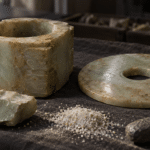
[…] Carnelian has a long history as a material used for engraved gemstones and personal seals. […]