A blank page lies on a desk.
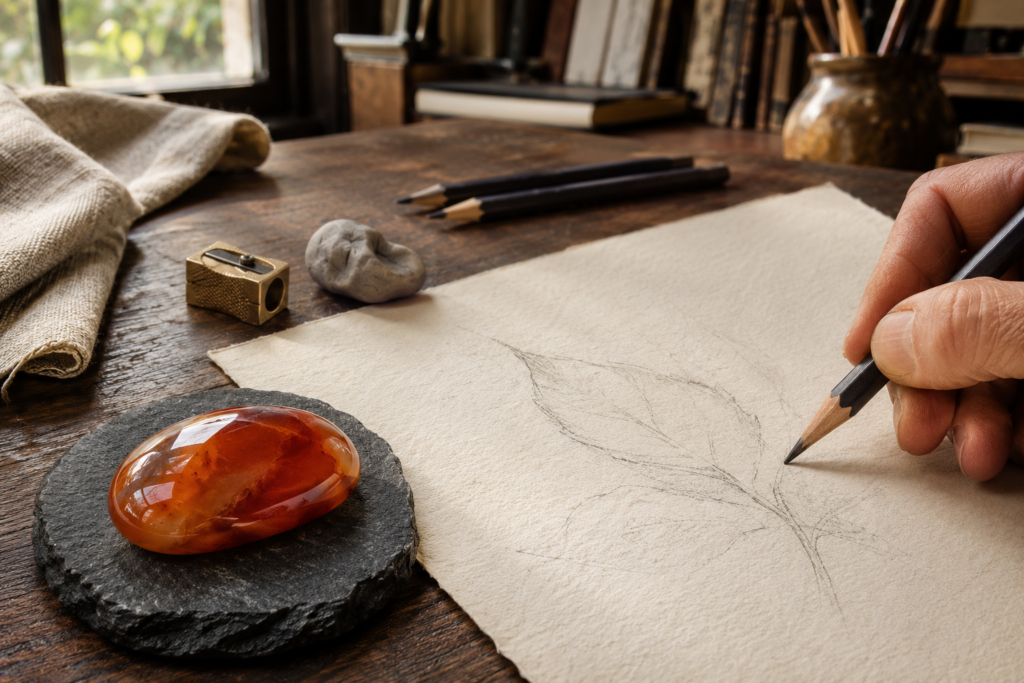
Beside it rests a pencil, a small notebook and a warm orange-red Carnelian stone.
The person sitting at the desk has an idea.
Perhaps they want to write a short story, begin a drawing, learn a musical instrument or create something with their hands.
The idea is appealing.
Yet beginning feels unexpectedly difficult.
There may be uncertainty about the result.
A concern that the work will not be good enough.
Or simply the familiar tendency to postpone an activity until the circumstances feel perfect.
Within contemporary crystal spirituality, Carnelian is frequently associated with creativity, courage, motivation and personal expression.
Some practitioners believe that it stimulates creative energy, strengthens confidence or supports the energetic centre associated with pleasure and creativity.
Others carry it as a pocket stone, hold it during intention-setting practices or place it near creative materials as a symbolic reminder of enthusiasm and action.
These are spiritual interpretations, not scientifically established effects.
There is no reliable evidence that Carnelian increases creativity through supernatural energy, improves motivation through gemstone vibrations or balances anatomical chakra centres.
Nevertheless, a gemstone can serve as a meaningful personal symbol.
And a simple symbolic action can mark the beginning of an ordinary practical activity.
This article introduces an original contemporary exercise:
This article introduces an original contemporary exercise called the Carnelian Creativity Ritual:
The Carnelian Creativity Ritual.
It combines one Carnelian stone with a brief period of preparation and a small, achievable creative action.
The ritual does not promise artistic talent.
It does not reproduce an ancient gemstone ceremony.
And it does not suggest that creativity depends on possessing a particular crystal.
Instead, it explores one important distinction:
Having an idea and beginning to act on it are two different experiences.
Table of Contents
Carnelian in Contemporary Crystal Spirituality
Carnelian is widely associated in modern crystal traditions with vitality, creative expression, enthusiasm and confidence.
Some practitioners describe it as a stone of courage.
Others believe it encourages artistic inspiration, helps overcome hesitation or supports the energetic qualities associated with the sacral chakra.
It may be carried during creative projects or placed near a workspace as a symbolic reminder to begin.
These interpretations vary between practitioners and spiritual communities.
They should not automatically be presented as universal ancient teachings.
The historical appreciation of Carnelian is well documented.
However, historical use does not establish the antiquity or scientific validity of every modern metaphysical interpretation.
For the Creative Threshold Ritual, Carnelian represents a deliberate decision:
I am willing to begin before knowing exactly how the result will turn out.
The stone does not create talent or motivation through supernatural energy.
Its role is symbolic.
Carnelian and the History of Personal Seals
Carnelian has a long history as a material used for engraved gemstones and personal seals.
Ancient artisans carved images, symbols and inscriptions into small stones.
These objects could be worn as jewellery or used to impress a design into a soft material.
The Metropolitan Museum of Art preserves examples of engraved Carnelian gemstones from the ancient Mediterranean world.
Such objects reveal the importance of skilled craftsmanship, personal identity and the practical use of small decorative stones.
An engraved gemstone could communicate ownership, authority or personal affiliation within a particular historical context.
This is different from contemporary crystal-healing beliefs.
An ancient Carnelian seal was not necessarily understood as a device for stimulating creativity through invisible energy.
Its significance depended on the society, the owner and the purpose for which it was made.
The Creative Threshold Ritual does not reproduce ancient seal-making ceremonies.
Instead, it draws a modern symbolic parallel.
A seal could mark an intentional act.
In this ritual, a Carnelian stone marks the decision to begin.
Why Beginning Can Feel Difficult
Creative activities often involve uncertainty.
A person may have a clear idea of what they want to produce but little certainty about the final result.
The first attempt may be imperfect.
The process may require learning unfamiliar skills.
Or the finished work may differ from the original intention.
These possibilities can create hesitation.
However, hesitation does not necessarily indicate a lack of ability.
It may simply reflect the uncertainty inherent in beginning something new.
The Creative Threshold Ritual does not attempt to eliminate uncertainty.
Instead, it reduces the immediate task.
Rather than asking someone to complete an entire project, it invites them to begin with one manageable action.
A single sentence.
A preliminary sketch.
A few notes.
Or a short experiment with materials.
The purpose is to cross the threshold between intention and activity.
Creativity Is Not Limited to Professional Artists
Creativity is often associated with painting, sculpture, literature or music.
Yet creative activity can take many forms.
Designing a garden.
Preparing a new recipe.
Arranging flowers.
Developing an educational presentation.
Solving a practical problem.
Or experimenting with photography.
These activities differ in complexity and purpose.
Some are primarily artistic.
Others are practical.
But they may all involve producing or exploring something new.
The Creative Threshold Ritual does not require artistic training.
It is suitable for anyone who wishes to begin a modest creative activity.
The gemstone is optional.
The important element is the chosen action.
What Research Says About Creative Activities and Wellbeing
Scientific research has examined associations between participation in arts and crafts and subjective wellbeing.
A 2024 study published in Frontiers in Public Health analysed survey data from 7,182 adults in England.
The researchers reported that arts-and-crafts participation was associated with higher life satisfaction, happiness and a stronger sense that life was worthwhile after adjustment for several measured factors.
However, the study was observational.
It cannot establish that creative participation caused those outcomes.
Nor does it mean that every creative activity will improve wellbeing.
Some projects may be frustrating.
Others may involve demanding work or financial expense.
The study did not investigate Carnelian.
It does not establish that gemstones enhance creativity or psychological wellbeing.
Its relevance lies in the broader scientific interest in creative participation as part of everyday life.
The Difference Between Inspiration and Action
Inspiration can be exciting.
A person imagines a finished painting.
A completed manuscript.
A beautiful garden.
Or a new object they would like to create.
Yet imagining the result is not the same as carrying out the work.
The transition requires an action.
It may be small.
But it must be concrete.
The Creative Threshold Ritual focuses on this transition.
The participant does not need to feel completely confident.
They do not need to know every step.
And they do not need to produce something impressive.
They simply choose one action that begins the process.
The Psychology of Implementation Intentions
Psychological research has investigated how people translate goals into action.
One important approach involves implementation intentions.
These are plans that connect a particular situation with a specific behaviour.
For example:
When I finish my morning coffee, I will spend five minutes sketching.
Or:
When I sit at my desk this evening, I will write the first paragraph.
A 2006 meta-analysis by Peter Gollwitzer and Paschal Sheeran examined implementation intentions and goal achievement.
Across 94 independent tests, the researchers reported a positive effect of implementation intentions on goal attainment.
The findings suggest that specifying when, where and how an action will occur can help bridge the gap between intention and behaviour.
However, effects vary across circumstances and tasks.
Implementation intentions do not guarantee success.
And the research does not investigate Carnelian or gemstone rituals.
The Creative Threshold Ritual incorporates a simple planning principle inspired by this broader psychological literature.
Introducing the Carnelian Creative Threshold Ritual
The following practice is an original contemporary symbolic exercise.
It is not an ancient Carnelian ceremony.
It is not a clinically validated psychological intervention.
And it does not require belief in supernatural gemstone energy.
The exercise takes approximately ten to twenty minutes.
Choose a comfortable place where you can work safely.
You will need one Carnelian pocket stone, palm stone or cabochon.
You will also need materials appropriate to your chosen activity.
These might include paper, pencils, a notebook, fabric, clay or other simple creative tools.
No additional gemstones are required.
The practice has three central stages:
Prepare. Begin. Continue if you wish.
Stage One – Choosing One Creative Activity
Begin by selecting a modest creative task.
Avoid choosing an entire large project.
Instead of deciding to write a complete book, choose to write one paragraph.
Instead of planning a finished painting, choose to make a preliminary sketch.
Instead of redesigning a whole garden, choose to draw one planting idea.
The task should be small enough to begin immediately.
It does not need to be important.
It does not need to produce something useful.
And it does not need to be shared with anyone.
The purpose is to make the beginning manageable.
Stage Two – Preparing the Workspace
Place the Carnelian on a stable surface beside your materials.
Choose a location where the stone will not interfere with the activity.
If you are working with sharp tools, heat or equipment, keep the gemstone safely away from the working area.
Arrange only the materials needed for the first action.
A notebook and pencil may be sufficient.
There is no requirement to create an elaborate altar.
The stone does not need to face a particular direction.
It does not require sunlight, moonlight or energetic activation.
Its role is symbolic.
Stage Three – Naming the First Action
Before beginning, identify the smallest useful action.
For example:
I will draw three lines.
I will write one sentence.
I will choose three colours.
I will make one preliminary shape.
The action should be specific.
Avoid vague intentions such as “be more creative” or “make something beautiful.”
These describe aspirations rather than immediate behaviours.
The Creative Threshold Ritual focuses on an action that can actually be performed.
Stage Four – The Threshold Moment
Place the Carnelian near the edge of the workspace.
Consider the following statement:
I do not need to know the final result before beginning.
This is not a magical affirmation.
It does not activate the gemstone.
It simply acknowledges that creative work often develops through experimentation.
Then move the Carnelian a short distance to one side.
This small movement symbolises crossing the threshold between preparation and action.
The stone does not create motivation.
The participant chooses to begin.
Stage Five – Taking the First Step
Perform the action you identified.
Write the sentence.
Draw the lines.
Arrange the materials.
Or make the first simple shape.
Do not immediately evaluate the result.
The purpose of this stage is not quality assessment.
It is participation.
If the first attempt is unsatisfactory, that does not mean the ritual has failed.
Creative work often involves revision.
The first action simply creates something that can be developed, changed or discarded.
Stage Six – Allowing Imperfection
Look at what you have produced.
Perhaps it is promising.
Perhaps it is ordinary.
Or perhaps it differs completely from what you imagined.
All of these outcomes are possible.
The ritual does not require positive thinking about every result.
If something needs improvement, it may be improved.
If the approach does not work, it may be changed.
And if the activity is no longer interesting, it may be stopped.
The purpose is not to celebrate every attempt as successful.
It is to recognise that an imperfect beginning can still provide information.
Stage Seven – Choosing Whether to Continue
After completing the first action, consider whether you want to continue.
You may work for another five minutes.
You may schedule a future session.
Or you may stop.
There is no requirement to finish the project immediately.
If you wish to continue later, write a simple plan.
For example:
Tomorrow after breakfast, I will spend ten minutes developing this sketch.
This connects the next action with a specific situation.
The plan does not guarantee that the work will be completed.
It simply makes the intention more concrete.
Stage Eight – Closing the Ritual
Return the Carnelian to its usual place.
Look at the work you have begun.
Consider one final question:
What did I learn by starting?
Perhaps you discovered that the task was easier than expected.
Perhaps you identified a skill you need to develop.
Or perhaps you realised that the idea requires a different approach.
No particular answer is required.
The ritual is complete.
The gemstone remains a symbol.
The creative action belongs to you.
Carnelian as a Pocket Stone for Creative Confidence
Some contemporary practitioners carry Carnelian as a symbolic stone of courage and motivation.
They may believe it strengthens confidence or encourages personal expression.
These are spiritual interpretations rather than scientifically established effects.
A Carnelian pocket stone can nevertheless serve as a personal reminder.
Before beginning a creative activity, the owner might notice the stone and ask:
What is one small action I can take now?
The question does not require a dramatic response.
It may lead to opening a notebook.
Preparing a workspace.
Or making a short list of ideas.
The stone does not provide creative ability.
Its meaning is chosen by the person carrying it.
Carnelian and the Sacral Chakra
Within contemporary seven-chakra spirituality, Carnelian is frequently associated with the sacral chakra.
Modern practitioners often connect this chakra with creativity, pleasure, emotional expression and personal vitality.
Some believe Carnelian stimulates or balances the energetic qualities of this centre.
These correspondences vary between spiritual systems.
Historical South Asian chakra traditions developed within diverse religious and philosophical contexts.
Modern gemstone-to-chakra charts should not automatically be presented as universal ancient teachings.
There is no reliable biomedical evidence that Carnelian balances an anatomical sacral-chakra energy centre.
For the Creative Threshold Ritual, chakra symbolism is optional.
The gemstone may simply represent the willingness to begin a creative activity.
A Carnelian Centre Stone for a Creative Workspace
Contemporary crystal-grid practices sometimes place Carnelian at the centre of arrangements intended to represent creativity or motivation.
Practitioners may believe that surrounding stones amplify its energetic influence.
These claims have not been scientifically demonstrated.
A simpler symbolic arrangement can be created with one Carnelian stone and three small paper cards.
Write one word on each card:
Imagine
Begin
Explore
Place the Carnelian in the centre.
Arrange the cards around it.
The arrangement represents three aspects of creative activity.
It does not generate a measurable energetic field.
No additional gemstones are necessary.
The cards can be removed when the reflection is complete.
Why Creativity Does Not Require a Perfect Environment
Creative work is sometimes postponed until conditions feel ideal.
A person may wait for a better desk.
More expensive materials.
A longer period of uninterrupted time.
Or greater confidence.
Sometimes better resources genuinely are necessary.
But many modest creative activities can begin with ordinary materials.
A pencil and paper.
A simple notebook.
Or a small collection of objects already available.
The Creative Threshold Ritual deliberately uses a minimal setup.
It does not encourage purchasing additional gemstones or elaborate equipment.
The purpose is to reduce unnecessary barriers to beginning.
A Carnelian Palm Stone for a Short Creative Pause
A larger Carnelian palm stone may be used during a brief seated reflection before creative work.
Place it in your hand or on a nearby table.
Consider one idea you have been postponing.
Then identify a practical first step.
There is no requirement to visualise supernatural energy.
Nor must the stone touch the body.
The exercise can be completed in a few minutes.
Its purpose is to clarify an intention.
The action itself remains the participant’s responsibility.
When Creative Work Feels Frustrating
Creative activities are not always relaxing.
A drawing may fail to match the intended image.
A piece of writing may require substantial revision.
A craft project may prove more difficult than expected.
These experiences are ordinary.
The ritual does not promise to remove frustration.
Nor does it require participants to interpret every difficulty as a spiritual lesson.
If a task becomes overwhelming, it may be reduced.
If equipment is unsafe or unfamiliar, appropriate instruction may be necessary.
And if the activity is no longer enjoyable or useful, stopping is a legitimate choice.
The purpose is exploration, not compulsory achievement.
The Difference Between Creativity and Productivity
Creativity and productivity are related in some circumstances, but they are not identical.
A creative activity may produce something useful.
It may also be exploratory.
Playful.
Unfinished.
Or entirely private.
Not every drawing needs to become a finished artwork.
Not every idea needs to become a business.
And not every hobby needs to generate income.
The Creative Threshold Ritual does not treat creative activity as an obligation to produce more.
Its central focus is the experience of beginning.
A small experiment can be meaningful even when it produces no marketable result.
A Five-Minute Creative Threshold Practice
For a shorter variation, place the Carnelian beside a notebook.
Choose one small creative action.
Move the stone slightly to one side.
Complete the action.
Then stop or continue as you wish.
The exercise can take less than five minutes.
No additional preparation is necessary.
There is no requirement to repeat it daily.
And repetition does not increase the gemstone’s supernatural power.
The symbolic value lies in the chosen transition from intention to activity.
An Alternative Without a Gemstone
The same exercise can be completed without Carnelian.
A small wooden token.
A familiar pen.
A plain ceramic object.
Or a simple mark on paper may serve as the symbolic threshold.
The practical process remains unchanged.
Choose an action.
Begin.
Observe the result.
This matters because the exercise does not depend on a scientifically established gemstone effect.
Carnelian is included because of its contemporary spiritual association with creativity and motivation.
It is not a necessary therapeutic instrument.
Responsible Use of Carnelian in Creative Practices
A symbolic ritual does not require a large gemstone collection.
One stone is sufficient.
A specimen already owned is entirely appropriate.
There is no need to acquire additional crystals to strengthen the intention.
Gemstones are physical materials obtained through extraction, processing and transport.
Their sourcing may involve environmental and social considerations.
The Creative Threshold Ritual therefore avoids unnecessary acquisition.
Its emphasis remains on the creative activity rather than the accumulation of spiritual objects.
What Scientific Research Does Not Establish
Research into creative participation provides evidence of associations between arts-and-crafts activities and subjective wellbeing.
Research into implementation intentions provides evidence that specific action plans can support goal attainment under certain conditions.
Historical museum collections document the use of Carnelian in engraved gemstones and personal seals.
However, these sources address different questions.
They do not establish that Carnelian enhances creativity.
They do not demonstrate that gemstone energy improves motivation.
They do not prove that Carnelian balances chakra centres.
And they do not validate the Creative Threshold Ritual as a clinical intervention.
The exercise is an original contemporary symbolic practice.
Its meaning depends on the participant’s interpretation.
Final Reflection: The Courage to Begin
Carnelian cannot guarantee creative inspiration through scientifically demonstrated crystal energy.
It cannot provide artistic talent.
It cannot eliminate uncertainty.
And it cannot ensure that every project will succeed.
Yet within contemporary crystal spirituality, its association with creativity and courage offers an interesting symbolic starting point.
Creative work often begins before the final result is clear.
A sentence is written.
A line is drawn.
A shape is formed.
And an idea becomes something that can be examined, changed or developed.
The Creative Threshold Ritual does not require perfection.
It does not demand constant productivity.
And it does not turn every creative activity into a spiritual obligation.
It simply marks a moment of choice.
The Carnelian represents the threshold.
The first action crosses it.
And the work that follows belongs to the person who begins.
Creativity does not always begin with confidence.
Sometimes, confidence develops only after we allow ourselves to make the first imperfect mark.
References & Further Reading
The following sources provide historical, psychological and educational context for Carnelian, engraved gemstones, creative participation and the translation of intentions into action.
All references lead to informative, non-commercial resources from museums, academic publications or educational institutions.
None establishes supernatural creativity-enhancing or chakra-balancing properties of Carnelian.
1. The Metropolitan Museum of Art – Ancient Gems and Finger Rings
Institution: The Metropolitan Museum of Art, New York
Type: Museum art-historical education
This educational resource explores engraved gemstones and finger rings in the ancient Mediterranean world.
It provides historical context for the use of small carved stones as personal ornaments, seals and objects of cultural significance.
The source does not document modern Carnelian creativity rituals.
Direct source:
https://www.metmuseum.org/toah/hd/gems/hd_gems.htm
2. The Metropolitan Museum of Art – Greek and Roman Art
Institution: The Metropolitan Museum of Art
Type: Museum collection and historical education
The museum’s Greek and Roman collections provide broader context for ancient personal ornaments, engraved gemstones and material culture.
These collections help distinguish historical gemstone use from contemporary metaphysical interpretations.
Direct source:
https://www.metmuseum.org/about-the-met/collection-areas/greek-and-roman-art
3. Keyes et al. – Creating Arts and Crafting Positively Predicts Subjective Wellbeing
Authors: Helen Keyes and colleagues
Publication: Frontiers in Public Health
Published: 2024
DOI: 10.3389/fpubh.2024.1417997
Type: Peer-reviewed observational research
This study analysed survey data from 7,182 adults in England.
Participation in arts and crafts was associated with higher reported life satisfaction, happiness and a stronger sense that life was worthwhile after adjustment for several measured factors.
Because the study was observational, it cannot establish causation.
It did not investigate gemstones.
Full open-access article:
https://www.frontiersin.org/journals/public-health/articles/10.3389/fpubh.2024.1417997/full
4. Gollwitzer & Sheeran – Implementation Intentions and Goal Achievement: A Meta-Analysis of Effects and Processes
Authors: Peter M. Gollwitzer and Paschal Sheeran
Publication: Advances in Experimental Social Psychology
Volume: 38
Pages: 69–119
Published: 2006
DOI: 10.1016/S0065-2601(06)38002-1
Type: Peer-reviewed meta-analysis
This research reviewed 94 independent tests examining implementation intentions and goal attainment.
The findings provide context for the use of specific action plans that connect a situation with a chosen behaviour.
The research does not investigate Carnelian or crystal rituals.
DOI:
https://doi.org/10.1016/S0065-2601(06)38002-1
5. American Psychological Association – Creativity
Institution: American Psychological Association
Type: Professional psychological education
The APA’s educational resources discuss creativity as a psychological topic involving original thinking, problem-solving and the development of ideas.
These resources provide context for understanding creativity without relying on supernatural explanations.
Direct source:
https://www.apa.org/topics/creativity
6. National Center for Complementary and Integrative Health – Meditation and Mindfulness: Effectiveness and Safety
Institution: US National Institutes of Health
Type: Government evidence-based health education
This resource reviews research into meditation and mindfulness, including possible benefits, limitations and adverse experiences.
It provides context for distinguishing optional reflective practices from established clinical interventions.
Direct source:
https://www.nccih.nih.gov/health/meditation-and-mindfulness-effectiveness-and-safety
Educational and Scientific Clarification
Carnelian’s associations with creativity, courage, motivation, vitality, personal expression and the sacral chakra belong to contemporary crystal spirituality.
These interpretations are not scientifically established therapeutic or supernatural properties.
There is no reliable evidence that Carnelian increases creativity, provides artistic talent, improves motivation through gemstone energy or balances anatomical chakra centres.
The Creative Threshold Ritual described in this article is an original contemporary symbolic exercise.
It is not a historically documented ancient ceremony.
It is not a clinically validated psychological intervention.
And it is not a substitute for professional healthcare, counselling or evidence-based treatment.
Research into creative activities and implementation intentions does not establish additional benefits from Carnelian.
Participation should remain voluntary, flexible and appropriate to individual circumstances.
Gemstones and symbolic rituals should never replace appropriate medical treatment, psychological support or professional assistance.