

Few minerals appear more visually simple than rock crystal.
Colourless, transparent and seemingly composed of solidified light, fine rock crystal can look almost immaterial.
Scientifically, however, there is nothing supernatural about it.
Rock crystal is simply the colourless, transparent variety of quartz: crystalline silicon dioxide, SiO₂.
Yet across history, human beings repeatedly interpreted that transparency as something more than an optical property.
Rock crystal became a material through which cultures could think about purity, preciousness, visibility, protection, divine presence and light.
One of the most remarkable chapters in that history unfolded during the Middle Ages.
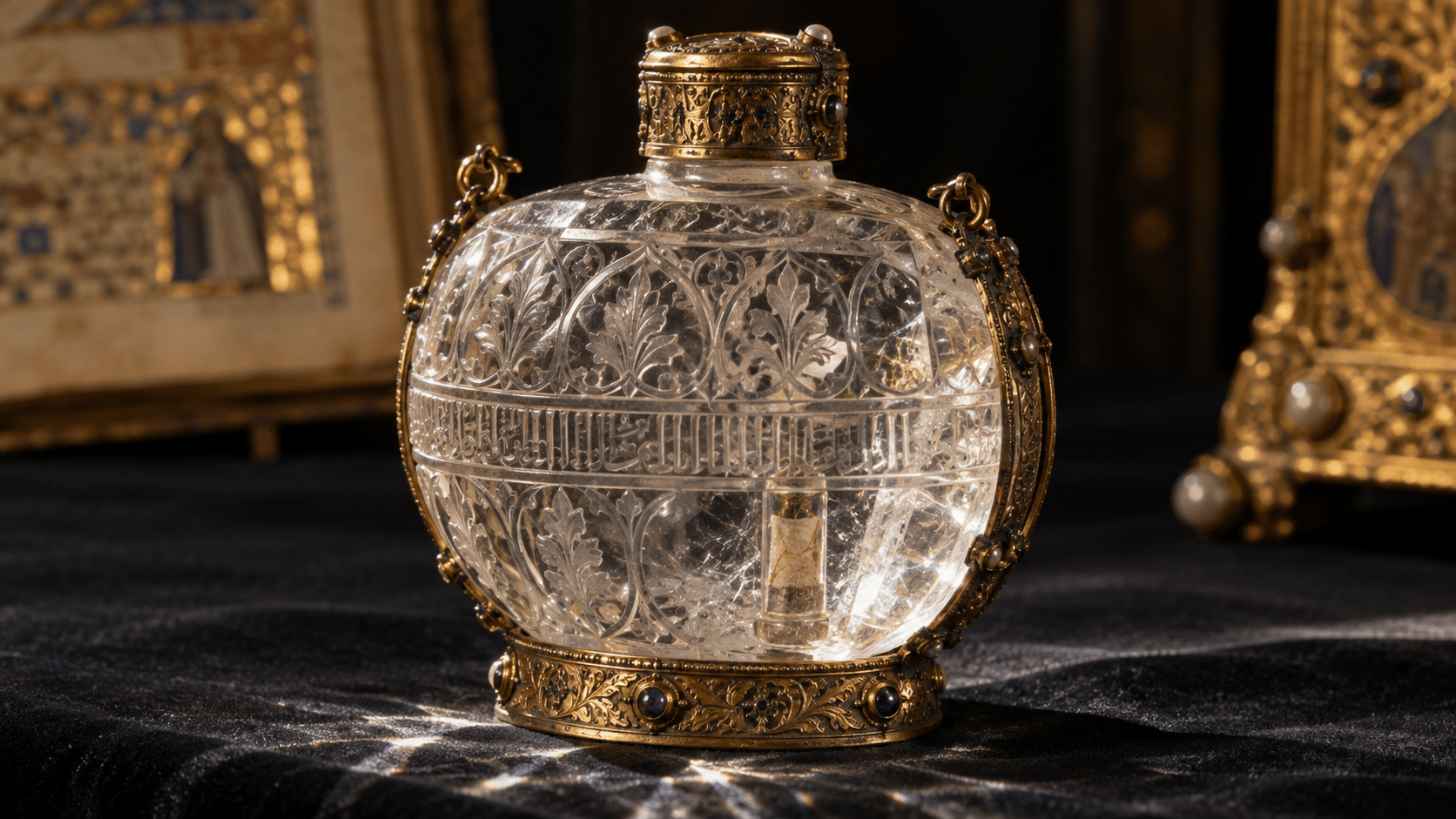
Between roughly the tenth and twelfth centuries, highly skilled craftspeople working under Islamic dynasties—particularly the Fatimids in Egypt—produced extraordinary vessels from large pieces of rock crystal.
Some later travelled into Christian Europe.
There, objects originally created within an Islamic courtly environment could acquire an entirely new identity.
They became Christian reliquaries.
A perfume vessel might eventually hold a saint’s relic.
Arabic inscriptions could coexist with medieval Christian mounts.
A luxury object made in Islamic Egypt could become part of a European church treasury.
This extraordinary movement makes rock crystal an ideal material through which to explore an important principle of gemstone spirituality:
stones do not possess one permanent cultural meaning.
Their meanings travel with people.
And sometimes they change completely.
Table of Contents
What Is Rock Crystal?
The rock crystal spiritual meaning has been interpreted in various ways throughout history, reflecting cultural beliefs and practices.
Rock crystal is transparent, colourless quartz.
Quartz has the chemical formula:
SiO₂ — silicon dioxide.
It crystallises in the trigonal crystal system and has a hardness of 7 on the Mohs scale.
Quartz is abundant in Earth’s crust, but large pieces of exceptionally clear material suitable for sophisticated carving are much less ordinary.
This distinction mattered historically.
A small quartz crystal might be relatively accessible.
A large, transparent piece free from disruptive fractures or inclusions was valuable raw material.
And transforming such material into a thin-walled vessel required exceptional skill.
Unlike glass, which can be formed while molten, rock crystal must be shaped by removing material from a naturally grown crystal.
Every hollow vessel therefore represents an enormous investment of labour.
Why Did Ancient and Medieval People Call It Crystal?
The English word crystal ultimately derives from the Greek krystallos, associated with ice.
Classical writers inherited traditions in which transparent quartz was connected conceptually with intensely frozen water.
This idea was scientifically incorrect.
Rock crystal does not form from permanently frozen ice.
It forms through geological processes involving silica-bearing fluids and appropriate conditions of temperature and pressure.
But the ancient association is understandable.
Hold a fine colourless quartz crystal in sunlight and its resemblance to ice is striking.
It is hard, cold to the touch, transparent and apparently filled with frozen light.
That visual quality became culturally powerful.
Transparency as a Cultural Property
Modern gemmology treats transparency as an observable physical characteristic.
Historical societies could interpret it symbolically.
A transparent material allows something to be simultaneously:
enclosed and visible.
That combination would become particularly important in Christian reliquaries.
But centuries earlier, Islamic craftspeople had already transformed transparent quartz into some of the most technically sophisticated luxury objects of the medieval world.
To understand the later Christian story, we first need to travel to Fatimid Egypt.
Rock Crystal at the Fatimid Court
The Fatimid dynasty ruled large territories of North Africa and the Middle East between 909 and 1171 CE.
Cairo became the dynasty’s capital in 969.
Fatimid court culture produced extraordinary works in ceramics, textiles, metalwork, ivory and carved stone.
Among its most technically demanding luxury arts was rock crystal carving.
The Metropolitan Museum of Art describes rock crystal as one of the most treasured materials at the Fatimid court.
Large quantities of raw material were imported into Cairo, including crystal associated with trade routes reaching the East African coast.
From these pieces, artisans produced:
flasks,
ewers,
small bottles,
cups,
animal-shaped vessels,
and other luxury objects.
Their surfaces could be decorated with vegetal scrolls, animals and inscriptions.
Carving the Almost Impossible
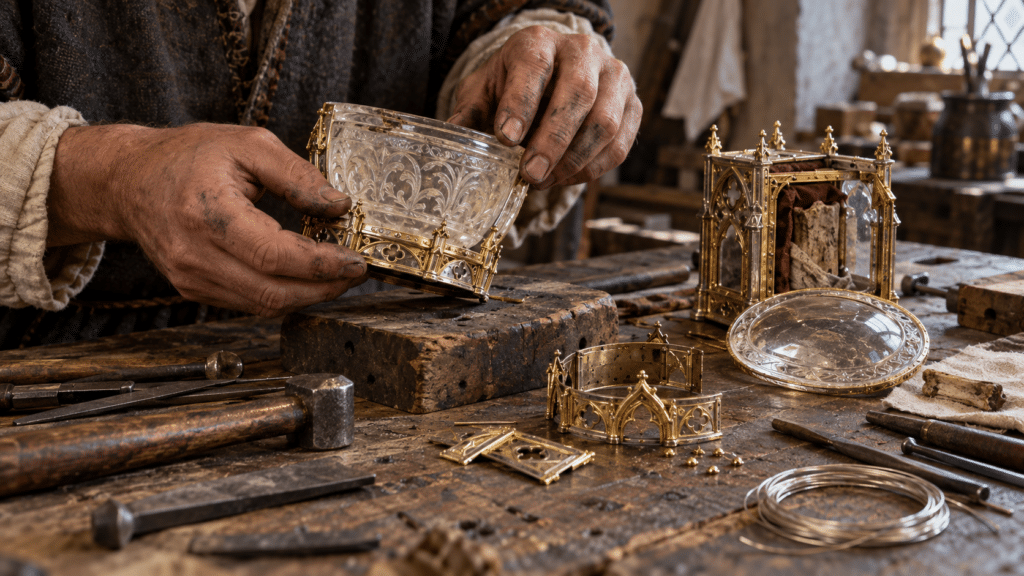
Rock crystal is hard.
That sounds obvious, but it becomes remarkable when we examine a Fatimid vessel.
A craftsman began with a solid piece of quartz.
The exterior had to be shaped.
The interior then had to be hollowed.
Walls could be made remarkably thin.
Decoration was carved into the surface.
The entire object was polished.
A mistake could destroy weeks or months of labour.
The Metropolitan Museum emphasises the exceptional skill and patience required to create the smoothly carved designs found on Fatimid rock crystal.
These objects were therefore valuable not simply because quartz itself was beautiful.
They represented a concentration of:
rare raw material,
specialist knowledge,
time,
technical risk,
and elite patronage.
Material and craftsmanship created preciousness together.
Did Muslims Believe Rock Crystal Was Magical?
Here we must distinguish carefully between documented medieval beliefs and modern crystal terminology.
The Metropolitan Museum notes that rock crystal was historically regarded as possessing magical properties.
Medieval Islamic intellectual culture included extensive traditions concerning minerals, medicine, astrology, talismans and the perceived occult qualities of natural substances.
But it would be misleading to translate this automatically into the modern statement:
“Muslims believed clear quartz had healing energy.”
Islamic societies were enormously diverse across geography and time.
Courtly luxury objects, medical lapidaries, philosophical texts, religious doctrine and popular magical practices did not necessarily express identical ideas.
A Fatimid perfume flask therefore should not automatically be interpreted as a healing crystal.
What archaeology demonstrates securely is that rock crystal was an exceptionally valued material and that extraordinary technical resources were devoted to working it.
Crystal, Light and Courtly Luxury
Why was transparent quartz so desirable?
Part of the answer lies in light.
A carved rock crystal vessel interacts continuously with its surroundings.
Edges refract illumination.
Engraved surfaces interrupt transparency.
Liquids inside can alter its appearance.
The object can seem simultaneously substantial and almost immaterial.
For elite court culture, this visual quality could communicate refinement and rarity.
Fine rock crystal also invited comparison with other prestigious transparent materials.
But unlike glass, quartz was a natural substance extracted from the Earth.
Its transparency was geological rather than manufactured.
That distinction may have contributed to its fascination.
From Cairo to Christian Europe
Some Islamic rock crystal objects eventually travelled into Europe.
Exactly how each individual object moved is not always known.
Trade, diplomatic exchange, gifts, war, pilgrimage and later collecting all moved luxury goods across cultural boundaries.
Once in Christian Europe, some Islamic rock crystals underwent a remarkable transformation.
European goldsmiths added:
gold or silver mounts,
enamel,
pearls,
gemstones,
suspension fittings,
crosses,
and inscriptions.
Objects originally made as luxury vessels could become Christian sacred containers.
This process is one of the most fascinating examples of cross-cultural reuse in medieval art.
When a Bottle Becomes a Reliquary
The British Museum preserves an extraordinary example.
A small Fatimid rock crystal bottle was produced in Egypt during the tenth or eleventh century.
Around its body runs an Arabic Kufic inscription offering:
a blessing to its owner.
Centuries later, European metalworkers added silver-gilt mounts.
The object was repurposed as a Christian reliquary.
The later Latin inscription identifies its sacred contents as:
hair of the Blessed Mary.
One object therefore contains multiple religious and cultural histories.
Islamic Egypt produced the crystal vessel.
Its Arabic inscription blessed its original owner.
Medieval Christians subsequently transformed it into a container for a relic attributed to the Virgin Mary.
The quartz itself did not change.
Its meaning did.
Sacred Transparency
Why was rock crystal so appropriate for Christian reliquaries?
A reliquary is a container for a relic—material believed to be physically connected with Christ, the Virgin Mary, a saint or another sacred person.
Relics could include:
bone,
teeth,
hair,
textiles,
or fragments associated with holy events.
Christian devotion often depended upon physical proximity to such remains.
Yet relics also needed protection.
Rock crystal provided an elegant solution.
It could enclose the relic while allowing the faithful to see it.
Transparency therefore had a practical function.
But practical function and symbolism could reinforce one another.
The material’s clarity made the precious sacred contents visually accessible.
Seeing the Sacred
A Hungarian reliquary dating to around 1500, now at The Metropolitan Museum of Art, illustrates this principle beautifully.
The museum explains that its small scale suggests private devotional use.
The owner could view the relic through the crystal.
This is a very different spiritual relationship with quartz from modern crystal meditation.
The crystal was not necessarily the primary sacred object.
It functioned as a transparent threshold between viewer and relic.
The sacred power was associated principally with the holy remains.
Rock crystal allowed those remains to be protected, framed and seen.
This distinction is crucial.
Rock Crystal and the True Cross
The same principle appears dramatically in reliquaries associated with the True Cross.
Medieval Christians believed that fragments of the wooden cross on which Jesus was crucified survived and were distributed among churches and rulers.
The Metropolitan Museum preserves an Italian reliquary cross dating to approximately 1366–1400.
At its centre is convex rock crystal.
According to the museum, the crystal once sheltered and magnified a fragment believed to come from the True Cross.
Here rock crystal performs three roles simultaneously:
it protects,
it reveals,
and it magnifies.
The physical optical properties of quartz become integrated into devotional experience.
That is a historically documented form of crystal spirituality—but it is very different from the modern idea of quartz amplifying “energy.”
The medieval crystal literally magnified the visual appearance of the relic.
We should not confuse optical magnification with metaphysical amplification.
A Crystal Crucifixion Seal
Rock crystal could also function as a devotional object in the Byzantine world.
The Metropolitan Museum preserves a ninth- to eleventh-century Byzantine rock crystal seal engraved with the Crucifixion.
The museum explains that pyramid-shaped seals of semiprecious stone were sometimes believed to possess protective properties.
Suspended from a chain, such an object could serve both as:
a seal,
and an amulet.
This gives us unusually direct evidence for a protective dimension of rock crystal use.
But again, context matters.
The protective meaning involved not only the mineral.
The engraved image of the Crucifixion, the object’s form and its religious identity all contributed.
Calling it simply a “protective clear quartz crystal” would erase most of what made the object meaningful.
Rock Crystal in Christian Reliquaries
Rock crystal appears repeatedly in medieval European reliquaries.
A thirteenth-century French arm reliquary at The Met combines silver, gilded silver, glass and rock crystal.
It contained relics attributed to Saint Fiacre.
Arm-shaped reliquaries could be displayed at altars and carried in processions.
Another French reliquary contains a large twelfth-century rock crystal engraved with vine scrolls.
It was reportedly associated with relics of several saints.
A fourteenth- and fifteenth-century Italian reliquary attributed to Mary Magdalene incorporates a rock crystal vessel together with precious metals and an actual human tooth.
These objects demonstrate that rock crystal became deeply embedded in Christian material religion.
But the crystal did not replace the relic.
It helped construct the sacred setting around it.
Purity: Historical Meaning or Modern Projection?
Modern crystal books frequently describe clear quartz as a stone of purity.
This association seems intuitively ancient because transparent quartz looks visually pure.
But we should be careful.
Historical symbolism cannot be reconstructed solely from modern visual intuition.
Rock crystal certainly acquired associations with clarity and preciousness, and its transparency made it exceptionally appropriate for sacred containers.
Christian theology also made extensive use of metaphors involving light, purity and transparency.
But not every medieval rock crystal object can therefore be labelled a universal “purity stone.”
The evidence is stronger when we discuss what the material actually did:
it enclosed,
revealed,
magnified,
adorned,
and distinguished sacred contents.
Symbolic interpretations should remain anchored to those functions.
When Islamic Art Became Christian Sacred Art
Perhaps the most fascinating aspect of medieval rock crystal is that objects could cross religious boundaries without losing their value.
Islamic inscriptions did not necessarily prevent an object from entering a Christian treasury.
Indeed, European patrons often valued Islamic craftsmanship enormously.
Rock crystal vessels, textiles, metalwork and other imported luxury goods could be incorporated into Christian sacred contexts.
Sometimes the original meaning of inscriptions was probably not understood.
In other cases, the foreign appearance itself may have contributed to an object’s exotic prestige.
This complicates any attempt to classify an object as simply “Islamic” or “Christian.”
An artefact can possess several biographies.
One Crystal, Multiple Sacred Worlds
Consider again the Fatimid bottle later used as a Christian reliquary.
At the moment of its manufacture, it belonged to an Islamic artistic and courtly environment.
Its Arabic inscription expressed blessing.
Later, European Christians used it to preserve what they believed to be a relic of the Virgin Mary.
Today, it resides in a museum.
The same quartz has therefore occupied at least three distinct conceptual worlds:
luxury object
Christian sacred container
museum artefact
None invalidates the others.
Each is part of the object’s biography.
This is a powerful reminder that spiritual meaning does not exist outside history.
Rock Crystal and Modern Crystal Spirituality
Today clear quartz is frequently called the:
“Master Healer.”
Modern metaphysical traditions associate it with:
clarity,
energy amplification,
intention,
chakra balancing,
spiritual awareness,
manifestation,
and healing.
These ideas should not automatically be attributed to medieval Christianity, Byzantium or Islamic societies.
There is no scientific evidence demonstrating that clear quartz heals disease by transmitting metaphysical energy.
Likewise, the medieval use of convex rock crystal to magnify a relic does not demonstrate that quartz metaphysically “amplifies energy.”
The similarity of vocabulary is tempting.
But one is an optical phenomenon.
The other is a modern metaphysical claim.
Historical responsibility requires us to keep them separate.
Quartz Really Does Have Remarkable Physical Properties
Rejecting unsupported healing claims does not make quartz ordinary.
Quartz has genuinely remarkable scientifically established properties.
It is piezoelectric.
Mechanical stress applied to quartz can generate electrical charge, while an applied electric field can produce mechanical deformation.
This property has made quartz extraordinarily important in modern technology.
Quartz oscillators help regulate timing in:
watches,
electronics,
communications equipment,
and countless other devices.
But piezoelectricity should not be used as scientific proof of crystal healing.
The fact that quartz behaves predictably in an engineered electrical circuit does not demonstrate that holding a quartz crystal balances chakras or cures illness.
Scientific wonder does not require pseudoscience.
A Different Kind of “Amplification”
There is, however, a historically meaningful sense in which rock crystal truly did amplify something.
It amplified visibility.
A convex piece of crystal could magnify a relic.
A polished transparent surface could direct attention toward what lay behind it.
A luxurious crystal mount could increase the visual importance of a tiny fragment.
The crystal amplified not an invisible energy field, but the human experience of looking.
That distinction offers a fascinating alternative way to think about clear quartz.
A Historically Inspired Rock Crystal Reflection
A modern reflective practice can draw inspiration from this history without pretending to recreate a medieval ritual.
Place a transparent quartz crystal in natural light.
Do not begin by assigning it a metaphysical property.
Simply observe.
Look through it.
Notice distortions.
Turn it slowly.
Watch inclusions appear and disappear.
Observe reflections moving across its surfaces.
Then consider the historical role of rock crystal as a material that allowed precious things to remain protected while still being visible.
Ask yourself:
What in my life deserves to be seen more clearly?
Then:
What am I protecting so carefully that I can no longer see it properly?
Finally:
Where am I confusing appearance with substance?
The crystal does not answer these questions.
Its physical transparency provides a metaphor through which to examine them.
That distinction allows historical symbolism and contemporary reflection to coexist responsibly.
Why Rock Crystal Challenges the Idea of a Universal Crystal Meaning
Modern crystal culture often assigns each mineral a stable list of properties.
Clear quartz equals amplification.
Amethyst equals calm.
Rose quartz equals love.
Turquoise equals communication.
History rarely behaves so neatly.
Rock crystal could be:
a Fatimid perfume flask,
a courtly luxury,
an object associated with magical properties,
a Byzantine protective seal,
a container for a saint’s bone,
a window onto a relic,
a magnifier for a fragment of the True Cross,
or a symbolically resonant transparent material.
These meanings overlap in places.
But they are not identical.
The stone remained chemically quartz while cultures continually reinvented what it meant.
Sacredness Was Often Relational
This history also suggests an important principle.
A gemstone did not always need to be sacred in itself.
Its meaning could arise from relationships.
Rock crystal surrounding a relic gained significance partly because of what it contained.
A Byzantine crystal seal derived meaning partly from the sacred image carved into it.
A Fatimid vessel gained prestige through craftsmanship, patronage and courtly use.
Material meaning therefore emerged from combinations of:
stone,
image,
contents,
craftsmanship,
owner,
ritual,
and cultural context.
This relational model is far more historically useful than assuming that every crystal carried one universal invisible vibration.
Conclusion
The spiritual meaning of rock crystal is not one story.
It is many.
Scientifically, rock crystal is colourless transparent quartz—silicon dioxide crystallised through geological processes.
Its transparency is physical.
Its hardness is measurable.
Its optical behaviour is natural.
Its piezoelectric properties are real.
But human cultures transformed those physical characteristics into meaning.
In Fatimid Egypt, master craftspeople turned large quartz crystals into some of the most technically sophisticated luxury vessels of the medieval world. Such objects could carry Arabic blessings and participate in elite court culture.
Some travelled into Christian Europe.
There, their histories changed.
Islamic vessels became reliquaries.
Rock crystal protected sacred remains while allowing worshippers to see them.
Convex crystal could literally magnify fragments believed to come from the True Cross.
Byzantine rock crystal seals combined material, sacred imagery and amuletic protection.
Modern crystal spirituality has transformed quartz once again, giving it associations with energetic amplification, healing and chakra work.
Those modern practices can be studied as contemporary spiritual traditions, but they should not be projected backwards onto medieval Islam or Christianity.
At Natural Gems Belgium, we believe rock crystal demonstrates one of the most important principles in the responsible study of crystal beliefs:
the mineral may remain the same, while its spiritual meaning changes with every culture that encounters it.
Perhaps no object illustrates that better than a Fatimid crystal bottle inscribed with an Arabic blessing that centuries later became a Christian reliquary for a hair attributed to the Virgin Mary.
The quartz did not change.
Everything around it did.
And that journey—from geology to craftsmanship, from one religious world into another—is far more remarkable than any universal list of crystal properties.
References & Further Reading
Fatimid Rock Crystal & Islamic Art
The Metropolitan Museum of Art — Flask, 10th–11th Century, Egypt
A carved Fatimid-period rock crystal flask. The Met describes rock crystal as one of the most treasured materials at the Fatimid court and notes both the exceptional skill required to carve it and historical beliefs in magical properties associated with the material.
https://www.metmuseum.org/art/collection/search/448656
The Metropolitan Museum of Art — Decorative Element, 9th–10th Century, Egypt
Carved rock crystal associated with Fatimid-period production. The museum discusses the importation of raw crystal into Cairo and notes that many fine Islamic rock crystal objects later entered European courts and church treasuries.
https://www.metmuseum.org/art/collection/search/454900
British Museum — Fatimid Rock Crystal Molar Flask
A carved and polished rock crystal flask produced in Egypt during the Fatimid period, approximately 969–999 CE. It provides direct material evidence for highly specialised rock crystal working in the medieval Islamic world.
https://islamicworld.britishmuseum.org/collection/RRM13351
British Museum — Fatimid Rock Crystal Lion Bottle
A small Egyptian rock crystal vessel carved as a recumbent lion, dating to approximately the tenth century. The object demonstrates the technical and sculptural sophistication of Islamic rock crystal carving.
https://www.britishmuseum.org/collection/object/W_FBIs-12
British Museum — Fatimid Rock Crystal Bottle, 969–1099
An Egyptian rock crystal bottle later provided with European metal mounts. Its recorded history illustrates the movement of Islamic luxury objects into Christian European contexts.
https://www.britishmuseum.org/collection/object/W_1894-0517-1
From Islamic Vessel to Christian Reliquary
British Museum — Fatimid Bottle Later Used as a Christian Reliquary
One of the most important objects for understanding the cross-cultural history discussed in this article. The tenth- or eleventh-century Egyptian rock crystal vessel bears a Kufic Arabic inscription translated as “blessing to its owner.” Later European silver-gilt mounts identify the object as containing a hair attributed to the Virgin Mary.
https://islamicworld.britishmuseum.org/collection/MCM3403
The object demonstrates particularly clearly why gemstone symbolism should not be treated as fixed: the same rock crystal vessel participated first in an Islamic cultural context and later in Christian relic devotion.
Medieval Christian Reliquaries
The Metropolitan Museum of Art — Reliquary, ca. 1175–1200
A large engraved rock crystal incorporated into a reliquary associated with relics attributed to Saints Margaret, Philip the Apostle, Catherine and Bishop Valerius.
https://www.metmuseum.org/art/collection/search/464678
The Metropolitan Museum of Art — Arm Reliquary, 13th Century
French reliquary combining silver, gilded silver, glass and rock crystal. Documentary elements identify the contained relics with Saint Fiacre. The Met notes that arm reliquaries could be placed at altars and carried among the faithful in procession.
https://www.metmuseum.org/art/collection/search/464334
The Metropolitan Museum of Art — Hungarian Reliquary, ca. 1500
A small gilded-silver, rock-crystal and pearl reliquary probably intended for private devotion. The museum specifically notes that its owner could view the saint’s relic through the crystal.
https://www.metmuseum.org/art/collection/search/471837
The Metropolitan Museum of Art — Reliquary of Mary Magdalene
Fourteenth- and fifteenth-century Italian reliquary incorporating gilded metal, rock crystal and a human tooth. It demonstrates the use of transparent crystal vessels within elaborate medieval relic displays.
https://www.metmuseum.org/art/collection/search/464469
Rock Crystal & the True Cross
The Metropolitan Museum of Art — Reliquary Cross, ca. 1366–1400
Italian reliquary cross whose convex central rock crystal once protected and magnified a piece of wood believed to be from the cross on which Jesus was crucified.
https://www.metmuseum.org/art/collection/search/464463
This object provides an important historical distinction from modern metaphysical language: rock crystal genuinely functioned as an optical magnifier in medieval devotion, but this should not be confused with the contemporary claim that quartz metaphysically “amplifies energy.”
Byzantine Rock Crystal, Protection & Devotion
The Metropolitan Museum of Art — Intaglio Seal with the Crucifixion, 9th–11th Century
Byzantine rock crystal seal engraved with the Crucifixion. The Met notes that pyramid-shaped semiprecious-stone seals could be believed to possess protective properties and could function simultaneously as seals and amulets.
https://www.metmuseum.org/art/collection/search/468784
The Metropolitan Museum of Art — Rock Crystal Flask with Cross, 10th–12th Century
Byzantine rock crystal flask decorated with a cross, providing another example of transparent quartz within medieval Christian material culture.
https://www.metmuseum.org/art/collection/search/679276
Christian Relics & Material Devotion
The Metropolitan Museum of Art — Reliquary Cross, Southern German, 1586
Later Christian example demonstrating the continued integration of rock crystal into precious reliquary objects.
https://www.metmuseum.org/art/collection/search/193683
The Met’s discussion places these objects within the wider Christian cult of relics, in which physical remains and objects associated with Christ, saints and martyrs could become focal points for devotion.
Research Note: Historical Belief Versus Modern Crystal Healing
Historical evidence demonstrates that rock crystal could be valued for luxury, transparency, religious imagery, relic display, amuletic protection and historically perceived magical properties.
These findings do not demonstrate that quartz medically heals the human body, balances chakras or emits a scientifically established spiritual energy.
Likewise, quartz’s real piezoelectric behaviour should not be used as proof of metaphysical healing claims.
The historically responsible distinction is therefore:
documented religious use is evidence of belief and practice—not scientific verification of supernatural mechanism.
[…] Islamic theology, worship belongs to God […]