Few surviving objects from ancient Mesoamerica are as visually arresting as the turquoise mosaics associated with the Mexica, the Nahuatl-speaking people whose imperial capital, Tenochtitlan, stood where Mexico City stands today.
Thousands of tiny blue-green pieces cover wooden masks, shields, serpents and ceremonial ornaments. Against dark wood, shell, gold and resin, turquoise becomes almost luminous.
These objects are frequently described today using a familiar vocabulary:
protection, healing, spiritual energy, communication and good fortune.
Some of those concepts belong primarily to modern crystal spirituality.
The historical Mexica story is considerably more specific.
Turquoise in Mexica culture and other precious blue-green materials participated in a complex symbolic world involving water, fire, preciousness, rulership, divine beings, warfare, agricultural fertility and ritual power.
To understand that world responsibly, however, we need to resist two temptations.
The first is treating all Indigenous peoples of the Americas as though they shared one universal “turquoise belief.”
The second is translating Mexica religion directly into modern crystal-healing language.
The archaeological evidence gives us something much richer.
Table of Contents
Mexica, Aztec or Both?
The civilisation commonly called Aztec in English is more precisely described in many contexts as Mexica.
The Mexica founded Tenochtitlan in the Basin of Mexico and became the dominant force within the political alliance that modern historians call the Aztec Empire.
The distinction matters because “Aztec” can encompass a broader political and cultural world than the inhabitants of Tenochtitlan alone.
In this article, Mexica is used when discussing the people and religious culture centred on Tenochtitlan, while “Aztec” is retained where it remains useful as a familiar historical term or appears in museum terminology.
This is not merely a question of vocabulary.
It helps prevent the flattening of many different Mesoamerican peoples into a single culture.
What Is Turquoise?
Scientifically, turquoise is a hydrated copper aluminium phosphate.
Its idealised chemical composition is commonly written:
CuAl₆(PO₄)₄(OH)₈·4H₂O
Its colour ranges from greenish blue through sky blue to stronger blue-green tones.
Copper is principally responsible for its characteristic blue colour, while variations in composition can shift the appearance toward green.
Unlike transparent gems such as sapphire, turquoise is normally opaque.
It commonly forms as veins, nodules or crusts in arid environments where copper-bearing groundwater interacts with aluminium- and phosphorus-bearing rocks.
Humans have valued turquoise for thousands of years.
But the meanings attached to it have never been universal.
Ancient Egyptians, Persians, Tibetans, peoples of the North American Southwest and Mesoamerican societies all developed their own relationships with blue-green materials.
The Mexica tradition must therefore be understood on its own terms.
Turquoise Was More Than a Colour
To modern eyes, turquoise is both a gemstone and a colour.
Understanding the significance of turquoise in Mexica culture offers insight into their beliefs and values.
In the Mexica world, blue-green precious materials could participate in much broader systems of meaning.
The Metropolitan Museum of Art notes that a Mexica symbol representing jade and other precious green stones could function metaphorically as a sign of preciousness and also as a symbol of water.
This immediately warns us against imposing rigid modern mineral categories onto ancient Mesoamerican visual culture.
Turquoise, jadeite, other greenstones, blue-green mosaics and their colours could participate in overlapping symbolic systems even though they are geologically different materials.
For the Mexica, the important question was not always simply:
Which mineral species is this?
Material, colour, rarity, origin, imagery and ritual context could all contribute to meaning.
The Language of Xihuitl
One of the most fascinating linguistic dimensions of Mexica turquoise symbolism lies in the Nahuatl term xihuitl.
Depending on context, the word could participate in meanings associated with turquoise, blue-green colour, vegetation, the year and related concepts.
This semantic richness is significant because it demonstrates that the colour-material category existed within a much larger conceptual landscape.
A related term appears in the name Xiuhcoatl—the powerful “Turquoise Serpent” or “Fire Serpent” associated with solar and martial imagery.
Here we encounter one of the most important lessons in interpreting ancient gemstone spirituality:
turquoise symbolism was not restricted to calmness or serenity simply because modern observers perceive blue as peaceful.
Within Mexica thought, turquoise imagery could participate in concepts of fire and weaponry as well as water and fertility.
Turquoise and Water
Water was existentially important in Central Mexico.
Agriculture depended upon rainfall.
Rain could determine whether maize prospered or failed.
Water therefore belonged simultaneously to ecology, subsistence, political life and religion.
The rain deity Tlaloc occupied an immensely important place in Mexica religion.
At the Templo Mayor of Tenochtitlan, one of the two principal shrines crowning the great pyramid was dedicated to Tlaloc.
Blue-green materials naturally participated in this religious world.
The Metropolitan Museum describes Mesoamerican double-headed serpents and turquoise pectorals as being associated with concepts of water, fertility and an aquatic afterlife.
This does not mean turquoise was simply “the stone of Tlaloc.”
Mesoamerican symbolism was far too complex for such a formula.
But archaeological and iconographic evidence demonstrates that turquoise imagery could operate within religious systems concerned with rain, water and agricultural fertility.
The Serpent Mask
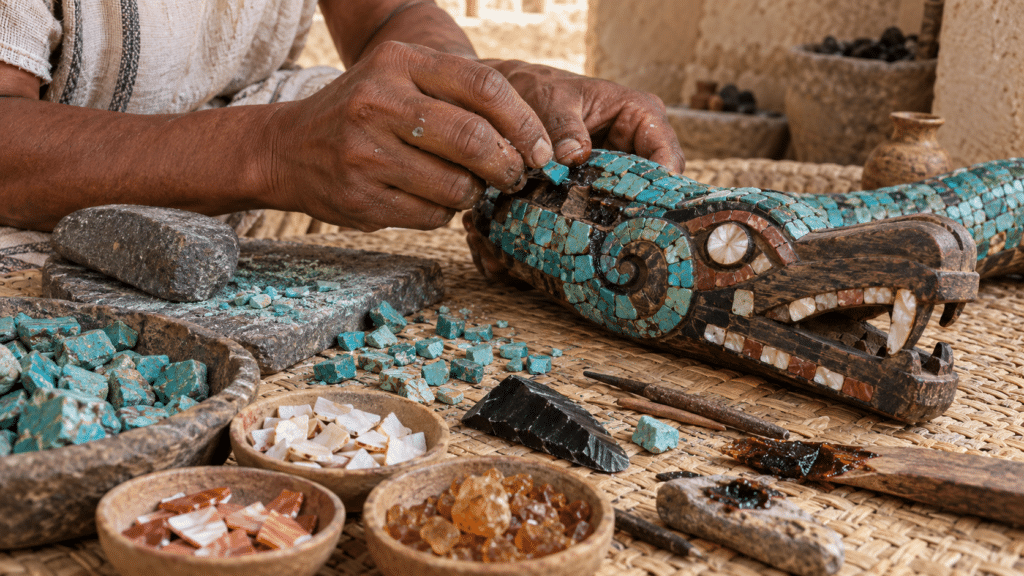
One remarkable surviving turquoise mosaic object is a mask constructed from wood and covered with turquoise mosaic.
Its face is formed from two intertwined serpents.
The British Museum has interpreted the imagery as potentially relating to Quetzalcoatl or Tlaloc, both deities with strong serpent associations.
The two serpents are distinguished through different shades of blue and green turquoise mosaic.
Their bodies twist around the eyes and cross the face.
The object is not merely decorated with turquoise.
The turquoise participates in creating the divine or supernatural image itself.
That distinction is important.
Modern crystal spirituality often imagines a gemstone as an independent source of invisible energy.
In Mexica art, the material could instead work together with image, colour, deity, craftsmanship and ritual context.
Its spiritual significance existed within a cultural system.
The Double-Headed Turquoise Serpent
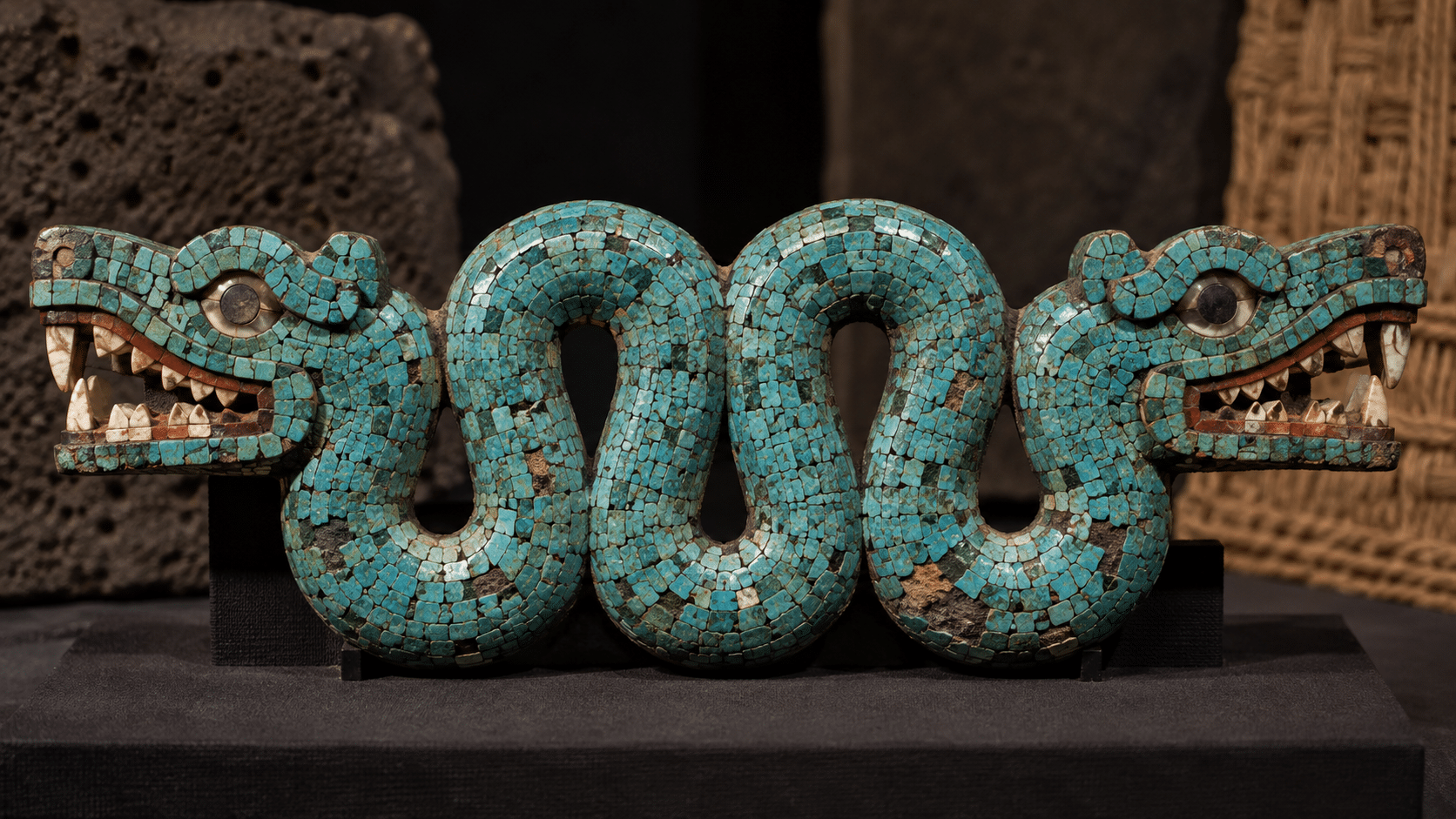
Perhaps the most famous surviving Mexica turquoise object is the spectacular double-headed serpent mosaic now in the British Museum.
Its undulating wooden body is covered with tiny pieces of turquoise.
Two serpent heads face outward at opposite ends.
Shell and other materials create contrasting details.
The object has holes suggesting that it may have been worn, perhaps as a ceremonial chest ornament.
Its precise identity and ritual function remain subjects of interpretation.
What is certain is its extraordinary craftsmanship and the immense investment required to cover a complex wooden form with carefully fitted turquoise tesserae.
The serpent was one of the most powerful symbolic creatures in Mesoamerican art.
It could connect realms, embody forces of nature and appear in the imagery of several major deities.
Turquoise transformed such an object into something even more materially exceptional.
Xiuhcoatl: The Turquoise or Fire Serpent
Another major supernatural serpent in Mexica thought was Xiuhcoatl.
The name is often translated as “Turquoise Serpent,” although the semantic range of xihuitl makes the concept richer than a straightforward gemstone label.
Xiuhcoatl functioned as a powerful supernatural weapon associated with Huitzilopochtli, the Mexica patron deity closely connected with the sun and warfare.
The Metropolitan Museum notes that serpent imagery bearing characteristic features may represent Xiuhcoatl as the animate weapon of Huitzilopochtli.
This presents an important corrective to modern assumptions.
Turquoise symbolism was not exclusively gentle.
It could participate in ideas of solar force, fire, warfare and divine power.
A stone’s cultural meaning cannot be predicted simply from its colour.
Turquoise, Fire and the Paradox of Blue
To a modern Western observer, linking a blue-green stone with fire can initially seem contradictory.
But cultural symbolism does not have to obey modern colour psychology.
The linguistic and religious world surrounding xihuitl connected concepts that modern English tends to separate.
Turquoise could evoke precious blue-green material.
Xiuhcoatl could simultaneously be a fiery supernatural serpent.
Rather than forcing these ideas into a modern framework, we should allow the apparent contradiction to remain.
It demonstrates that gemstone symbolism is culturally constructed.
There is no universal law stating that blue must mean calmness, red must mean passion or green must mean healing.
Cultures create meaning through their own languages, environments, religions and histories.
Turquoise and Preciousness
One theme that repeatedly emerges in Mesoamerican art is preciousness.
Blue-green materials were not ordinary.
They could signal extraordinary value.
The Metropolitan Museum’s discussion of Mexica imagery explains that the conventional motif for jade and other valued green stones could itself become a metaphor for preciousness.
The deity Xochipilli, associated with flowers, music, feasting, games and elite luxury, could be adorned with turquoise and other precious materials.
In such contexts, turquoise participated in visual statements about abundance, elite identity and divine magnificence.
Spiritual and economic value were not necessarily separate categories.
Rarity could contribute to sacredness.
Beauty could communicate authority.
Difficult-to-obtain materials could make divine imagery materially exceptional.
Where Did Mexica Turquoise Come From?
This question has generated considerable archaeological interest.
Turquoise does not occur everywhere, and tracing its source can reveal ancient exchange networks.
For many years, scholars considered long-distance connections with turquoise-producing regions farther north, including areas of what is now the southwestern United States.
Modern scientific provenance studies have complicated this picture.
Isotopic and mineralogical research suggests that at least some Mesoamerican turquoise may have originated from sources within Mesoamerica rather than necessarily arriving from the American Southwest.
The broader question remains an active field of research.
This is precisely why responsible archaeological writing should avoid simple statements such as:
“Aztec turquoise came from New Mexico.”
Different objects may have had different geological histories.
Science continues to refine our understanding of ancient exchange.
Turquoise Mosaic Was a Technology
The visual impact of Mexica turquoise mosaics can make us overlook their technical complexity.
Creating one required much more than possessing turquoise.
Small fragments had to be selected and shaped.
A support—often wood—had to be prepared.
Individual tesserae were attached using adhesive substances such as resins.
Shell, gold and other materials could be incorporated to produce eyes, teeth or contrasting features.
The result was essentially a three-dimensional mosaic.
The British Museum’s technical research into Mexican turquoise mosaics demonstrates the sophistication of these composite objects.
Their spiritual significance therefore cannot be separated from craftsmanship.
The sacred object was made through labour.
Tezcatlipoca and the Turquoise Mosaic Skull
Among the most unsettling surviving objects associated with Mexica turquoise mosaic is the famous skull mask traditionally connected with Tezcatlipoca.
A human skull forms the structural core.
Turquoise and lignite mosaic cover the surface.
Shell creates the eyes.
The interior preserves deer-skin straps that may have allowed the object to be worn.
Tezcatlipoca was one of the most complex deities of Central Mexican religion, associated with rulership, conflict, divination, night and many other domains.
Yet the British Museum’s own research has emphasised that the exact identity of the skull mosaic is not completely secure.
This uncertainty matters.
Museum labels evolve because scholarship evolves.
Responsible interpretation distinguishes between:
what an object physically is,
what scholars currently think it represents,
and
what remains uncertain.
That approach is especially important when dealing with sacred objects from cultures disrupted by colonial conquest.
Turquoise and Divine Identity
Why use precious mosaic at all?
Part of the answer may lie in transformation.
A wooden support is ordinary.
Cover it with hundreds or thousands of carefully shaped turquoise pieces, shell, resin and precious materials, and it becomes something visually extraordinary.
The underlying substance almost disappears.
Surface transforms identity.
This process may have been particularly appropriate for objects representing gods or supernatural beings.
Material splendour could help distinguish sacred imagery from ordinary life.
Turquoise therefore did not necessarily function as an isolated “crystal.”
It was part of a visual technology of sacred transformation.
Turquoise and Rulership
Precious materials also intersected with political authority.
Mexica rulers existed within a ceremonial world in which costume, feathers, gemstones, gold and other rare materials communicated status.
Turquoise could participate in insignia associated with elite or divine power.
This is another reason to be cautious with the modern phrase “turquoise was a healing stone.”
That description captures very little of its historical role.
Turquoise could belong to systems of rulership, tribute, ceremonial display and divine imagery.
Its meaning was simultaneously material, religious and political.
The Problem with “Native American Turquoise Beliefs”
Modern articles often make statements such as:
“Native Americans believed turquoise was sacred.”
The statement sounds respectful.
It is also far too broad.
There are hundreds of distinct Indigenous nations across North America, each with its own languages, histories and religious traditions.
Mexica civilisation in Central Mexico cannot simply be combined with Diné, Pueblo, Apache or other Southwestern traditions under a generic spiritual category.
GIA documents, for example, historical traditions concerning turquoise among peoples of the American Southwest, including particular Apache beliefs.
Those traditions are worthy of study.
But they are not Mexica beliefs.
Likewise, Mexica turquoise mosaics should not be used to explain Navajo jewellery traditions.
Geography does not erase cultural difference.
Future articles can explore individual Indigenous turquoise traditions separately and with the specificity they deserve.
Colonial Encounter and Survival
The Spanish conquest of Tenochtitlan in 1521 profoundly disrupted Mexica political and religious institutions.
Sacred objects were destroyed, dispersed, collected or transported to Europe.
Some of the turquoise mosaics now held in European museums may have reached Europe very early during the colonial encounter.
Their survival is therefore complicated.
They are simultaneously:
masterpieces of Indigenous craftsmanship,
evidence of Mexica religious and political life,
survivors of colonial disruption,
and objects whose modern museum histories raise important questions about provenance and interpretation.
A responsible discussion of their spiritual significance should acknowledge that context.
These were not created as decorative curiosities for European collectors.
They emerged from a living religious world.
Ancient Turquoise Belief Versus Modern Crystal Spirituality
Modern crystal traditions commonly associate turquoise with:
- communication
- protection
- emotional balance
- calmness
- friendship
- good fortune
- spiritual purification
- the Throat Chakra
Some historical cultures genuinely did attribute protective or fortunate properties to turquoise.
GIA documents the stone’s long history of protective and auspicious symbolism in several regions.
But those traditions should not be blended into one supposedly universal ancient belief.
The modern Throat Chakra association is especially important to distinguish.
The chakra traditions developed in South Asian religious contexts.
The now-familiar system assigning blue gemstones to the throat energy centre is a much later modern synthesis.
There is no historical basis for saying that the Mexica used turquoise to “activate the Throat Chakra.”
Doing so would combine unrelated religious systems and erase the specific meaning of Mexica material culture.
Can Turquoise Still Have Personal Spiritual Meaning?
Certainly.
Historical accuracy does not require abandoning contemporary spiritual practice.
A modern person may choose turquoise as a symbol of:
water,
preciousness,
clarity,
protection,
communication,
continuity,
or connection with the natural world.
But personal symbolism becomes more meaningful when we recognise where it comes from.
Someone inspired by Mexica turquoise might contemplate the relationship between precious materials and responsibility, or the way one substance can carry seemingly contradictory associations with both water and fire.
The goal should not be to imitate a sacred Mexica ritual we do not fully understand.
It can instead be to allow historical knowledge to deepen personal reflection.
A Historically Inspired Turquoise Reflection
Place a natural turquoise specimen in front of you.
Before assigning spiritual meaning to it, observe the material itself.
Notice whether the colour leans toward blue or green.
Look for matrix.
Observe the surface texture.
Consider the copper, aluminium, phosphorus and water incorporated into its mineral structure.
Then think about a Mexica mosaic.
A single piece of turquoise may be small.
Hundreds of pieces, deliberately shaped and assembled, become something entirely different.
Use that idea as a reflection:
What becomes possible when small actions are repeated with intention?
Then consider another question:
What do I treat as precious—and does the way I live reflect that value?
The turquoise does not provide an answer.
It provides a material focus for asking the question.
Why Historical Specificity Makes Crystal Spirituality Better
The history of turquoise demonstrates why vague claims such as “ancient people believed…” are rarely adequate.
Which ancient people?
Where?
When?
What evidence survives?
Was the stone worn, traded, buried, carved or incorporated into a divine image?
Did contemporary texts explain its meaning?
Or are modern scholars reconstructing that meaning from archaeology?
These questions do not weaken spiritual history.
They make it richer.
Mexica turquoise does not need to be described as a generic healing crystal.
Its documented world already includes:
rain,
fertility,
fire,
serpents,
gods,
warfare,
rulership,
preciousness,
ritual craftsmanship,
and monumental religious life.
That is far more compelling than reducing it to a list of supposed energetic properties.
Conclusion
Turquoise in Mexica culture occupied a remarkable position at the intersection of material value, craftsmanship, religion and political authority.
Scientifically, turquoise is a hydrated copper aluminium phosphate whose blue-green colour primarily reflects its chemistry.
Historically, however, its significance cannot be explained through mineralogy alone.
Mexica and related Mesoamerican craftspeople transformed tiny pieces of turquoise into extraordinary mosaic objects: masks, serpents, shields and ceremonial ornaments.
These objects participated in religious worlds involving water and agricultural fertility, fire and solar force, divine beings, rulership and preciousness.
The turquoise serpent could belong to fire.
Blue-green material could evoke water.
Precious stones could communicate both supernatural and political authority.
Such combinations remind us that gemstone symbolism is not universal.
It is cultural.
Modern crystal spirituality has given turquoise additional associations with communication, emotional balance and the Throat Chakra. Those practices can be meaningful today, but they should not be retroactively presented as Mexica beliefs.
At Natural Gems Belgium, we believe the most respectful approach is also the most fascinating:
identify the mineral accurately, study the archaeological object carefully, understand the culture specifically, acknowledge uncertainty, and only then explore what the stone might mean to us today.
The surviving turquoise mosaics of ancient Mexico do not need modern mystical language to make them extraordinary.
Thousands of tiny fragments, shaped by human hands and assembled into images of serpents and gods, already preserve one of the most remarkable encounters between gemstones and spiritual imagination in human history.
References & Further Reading
Gemmology & Turquoise
Gemological Institute of America (GIA) — Turquoise
Authoritative gemmological introduction to turquoise, including composition, colour, properties, treatments and historical context.
Gemological Institute of America (GIA) — Turquoise History and Lore
Overview of turquoise’s long cultural history across several regions. Particularly useful for comparing traditions without assuming that they represent one universal turquoise belief.
https://www.gia.edu/turquoise-history-lore
GIA, Gems & Gemology — Persian Turquoise: The Ancient Treasure of Neyshabur
Detailed study of one of the world’s most historically important turquoise-producing regions, illustrating how strongly the spiritual and cultural meaning of turquoise can vary between societies.
https://www.gia.edu/gems-gemology/fall-2021-persian-turquoise-ancient-treasure-neyshabur
Mexica Religion, Precious Stones & Symbolism
The Metropolitan Museum of Art — Tlaltecuhtli (Earth Deity)
Important museum discussion of Mexica symbolism. The sculpture bears the conventional motif for jade and other precious green stones, which the Met explains could signify preciousness and metaphorically represent water.
https://www.metmuseum.org/art/collection/search/307636
The Metropolitan Museum of Art — Rain God Pendant
Discussion of a Mesoamerican water deity and the relationship of double-headed serpents and turquoise pectorals to concepts including water, fertility and an aquatic afterlife.
https://www.metmuseum.org/art/collection/search/313228
The Metropolitan Museum of Art — Head from a Figure, Xochipilli-Macuilxochitl
Museum discussion of Xochipilli and the use of turquoise and other precious materials in representations of a deity associated with flowers, music, feasting, games and elite luxury.
https://www.metmuseum.org/art/collection/search/321292
The Metropolitan Museum of Art — Serpent Labret with Articulated Tongue
Detailed discussion of Mexica serpent imagery, including the possible identification of Xiuhcoatl as the animate fire-serpent weapon associated with Huitzilopochtli. The entry also references the British Museum’s famous turquoise double-headed serpent.
https://www.metmuseum.org/art/collection/search/321343
Turquoise Mosaic Objects
Smarthistory / British Museum — Mosaic Mask of Tezcatlipoca
Detailed educational discussion of the famous turquoise mosaic skull mask, its construction from a human skull, turquoise, shell and other materials, and the scholarly questions surrounding its identification with Tezcatlipoca.
https://smarthistory.org/mosaic-mask-of-tezcatlipoca
Smarthistory / British Museum — Serpent Mask of Quetzalcoatl or Tlaloc
Detailed discussion of a fifteenth–sixteenth-century turquoise mosaic mask constructed as two intertwined serpents and potentially associated with Quetzalcoatl or the rain deity Tlaloc.
https://smarthistory.org/serpent-mask-of-quetzalcoatl-or-tlaloc
These objects demonstrate why Mexica turquoise should not be interpreted as an isolated “healing crystal.” The turquoise participates in composite sacred imagery alongside wood, shell, resin, gold and other materials.
Technical Study of Mexican Turquoise Mosaics
British Museum — Turquoise Mosaics from Mexico / Technical Research
The British Museum has conducted extensive material and technical research into Mexican turquoise mosaic objects, including their wooden supports, shell elements, adhesives and mosaic construction. The research is fundamental for understanding these works as sophisticated composite technologies rather than simply gemstone carvings.
British Museum Research Publications — Technical Research Bulletin
Research portal for scientific and conservation studies of British Museum objects, including work on Mesoamerican mosaic and shell-working technologies.
https://www.britishmuseum.org/research/publications/technical-research-bulletin
Additional Historical Context
Smarthistory — Mexica (Aztec) Introduction
Accessible scholarly material placing Mexica art, religion and political culture within the broader history of Mesoamerica. Useful for avoiding the common mistake of treating all Indigenous American cultures as interchangeable.
https://smarthistory.org/aztec-mexica-an-introduction
The Metropolitan Museum of Art — Arts of the Ancient Americas
The Met’s collection and scholarly resources provide broader archaeological context for Mexica and other Mesoamerican artistic traditions.
https://www.metmuseum.org/art/collection
Modern Crystal Beliefs: A Note on Interpretation
Modern crystal traditions frequently associate turquoise with protection, communication, emotional balance, good fortune and the Throat Chakra.
These beliefs should be distinguished from documented Mexica religious traditions.
In particular, the modern association between blue gemstones and the Throat Chakra belongs to a later synthesis of Western crystal spirituality and South Asian chakra concepts. It should not be presented as an Aztec or Mexica belief.
For historical gemstone lore across different cultures, see:
Gemological Institute of America — Turquoise History and Lore