
A Practical Guide to Refractive Index, Birefringence and Reliable Gem Testing
A blue gemstone lies on the table.
Through a loupe, it appears transparent and well polished.
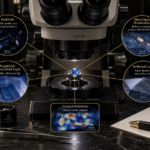
Under a microscope, you discover several natural-looking inclusions.
But what is it?
Sapphire?
Blue spinel?
Iolite?
Topaz?
Glass?
Visual appearance can narrow possibilities.
It rarely settles the question.
The refractometer changes the investigation because it provides something fundamentally different:
a numerical measurement.
Place a suitably polished gemstone on the instrument correctly and its interaction with light produces a boundary on a calibrated scale.
That boundary allows you to measure its:
refractive index — RI.
Rotate an anisotropic gemstone through several orientations and additional readings can reveal:
birefringence.
Those measurements can rapidly eliminate entire families of possible gemstones.
Quartz typically occupies one RI range.
Beryl occupies another.
Corundum another.
Spinel another.
Garnets cover several higher ranges.
Yet the gemstone refractometer is not a machine that simply displays a gemstone’s name.
Different minerals can have overlapping refractive indices.
Some gemstones lie beyond the instrument’s measurable range.
Synthetic gemstones can have essentially the same RI as their natural counterparts.
Treatment can remain completely invisible to refractometry.
And careless technique can produce inaccurate readings.
The refractometer is therefore best understood as one of the core instruments in a larger gemmological process:
observe → measure → compare → confirm.
This guide explains how to use it systematically.
Table of Contents
1. What Is Refractive Index?
Light travels at different speeds through different materials.
In a vacuum, light travels at its maximum speed.
When it enters matter, electromagnetic interaction with that material reduces its effective propagation speed.
The ratio between the speed of light in vacuum and its speed in a material is called the:
refractive index
or:
RI
Symbolically:
n = c / v
where:
- n = refractive index;
- c = speed of light in vacuum;
- v = speed of light in the material.
A higher RI therefore corresponds to light propagating more slowly within that optical medium.
2. Refraction
When light passes obliquely from one transparent material into another with a different refractive index, its direction usually changes.
This bending is called:
refraction.
The amount of bending depends on:
- the angle at which light reaches the boundary;
- the refractive indices of the two materials.
This behaviour is described mathematically by Snell’s law.
Gem refractometers exploit the same underlying physics.
3. Why Gemstones Have Characteristic RI Values
Refractive index depends on a material’s:
- chemical composition;
- atomic structure;
- crystal structure;
- wavelength of light.
Consequently, different gem species commonly occupy characteristic RI ranges.
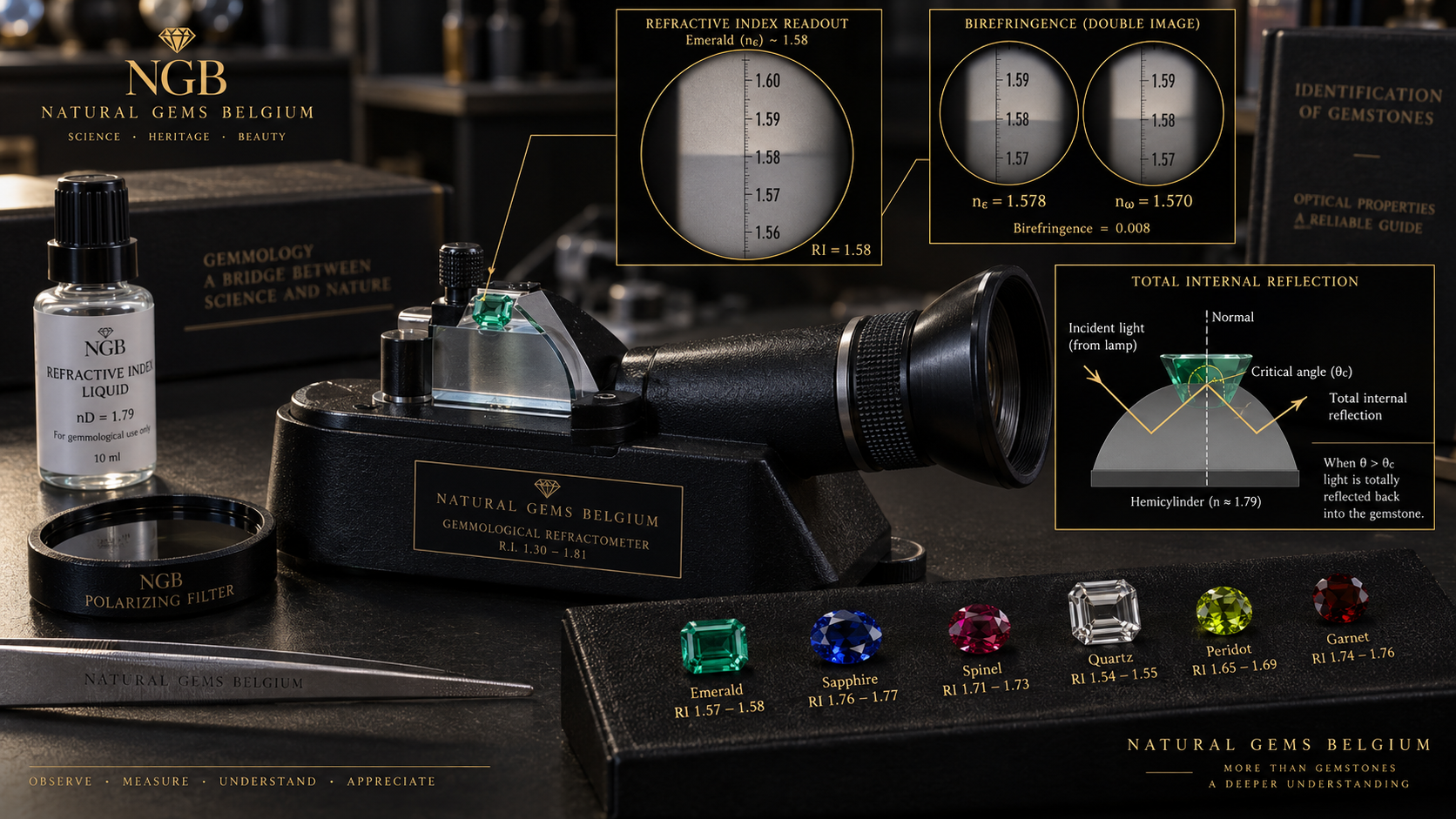
For example, typical values include approximately:
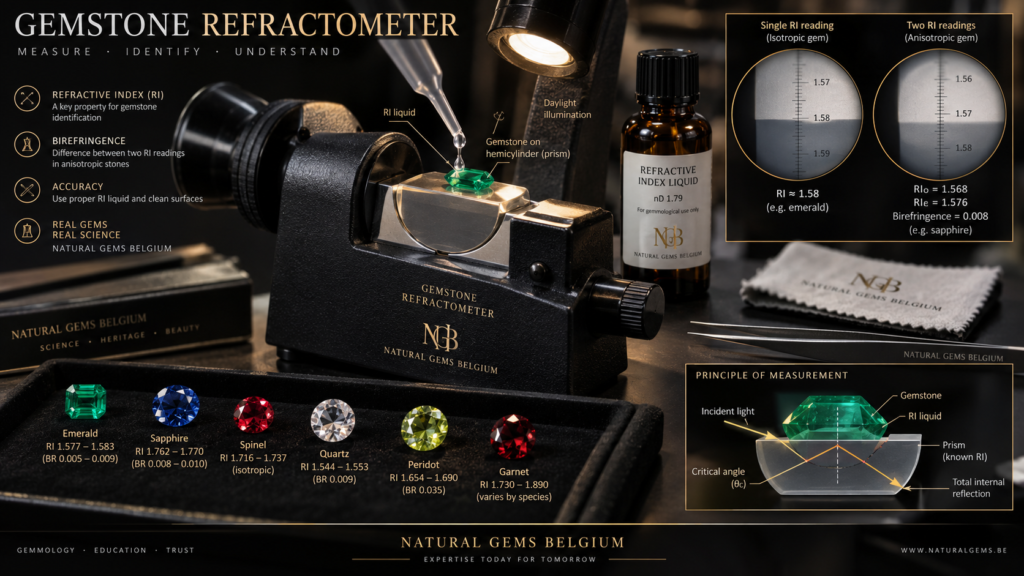
Quartz: 1.544–1.553
Beryl / emerald: around 1.57–1.59
Peridot: around 1.65–1.69
Spinel: around 1.718
Corundum / ruby / sapphire: around 1.76–1.77
These ranges immediately demonstrate why RI is so useful for gem identification.
4. RI Is a Property, Not a Name
Suppose an unknown stone gives an RI around:
1.718
That strongly supports some possibilities and excludes many others.
But the refractometer has not literally identified the gemstone.
Another material could potentially overlap that value.
The correct conclusion is:
“The measured RI is consistent with…”
Then combine it with other evidence.
This distinction between:
measurement
and
identification
is fundamental to practical gemmology.
5. How a Gemstone Refractometer Works
A conventional gem refractometer contains a high-refractive-index optical prism or hemicylinder.
The gemstone is brought into optical contact with this surface.
Light travels through the refractometer and reaches the interface between:
- refractometer prism;
- contact liquid;
- gemstone.
Depending on the angle and relative refractive indices, light is either transmitted into the sample or totally internally reflected.
A boundary forms between these two regions.
This appears on the calibrated scale as a:
shadow edge.
Its position corresponds to the gemstone’s refractive index.
6. The Critical Angle
When light travels from a material with higher refractive index toward one with lower refractive index, there is a particular incidence angle at which the refracted ray travels along the interface.
This is the:
critical angle.
Beyond this angle, the light is no longer transmitted into the lower-index material.
Instead, it undergoes:
total internal reflection.
The refractometer converts the critical-angle relationship into an RI reading.
That is why the shadow boundary represents a physical optical property rather than an arbitrary visual mark.
7. Why Contact Liquid Is Necessary
A polished gemstone simply placed dry on the refractometer rarely makes perfect optical contact.
Microscopic gaps remain between:
- gemstone;
- prism.
Those gaps contain air.
Air creates a severe refractive-index discontinuity and disrupts the measurement.
A tiny amount of:
refractive-index contact liquid
bridges the optical gap.
This allows the instrument to interact properly with the gemstone facet.
8. The Contact Liquid Is Not Gemstone Oil
RI liquid is an instrument reagent.
It is not:
- gemstone cleaning oil;
- emerald treatment oil;
- jewellery lubricant.
It is used only to create optical contact during measurement.
After testing, the liquid should be removed appropriately from both:
- gemstone;
- refractometer surface
according to instrument and chemical instructions.
9. Only a Tiny Amount Is Needed
One of the most common beginner errors is using too much contact liquid.
You need only enough to create optical contact.
Excess liquid can:
- spread across the refractometer;
- obscure the reading;
- contaminate the instrument;
- increase unnecessary chemical exposure.
Gem-A specifically teaches that only a tiny drop of RI liquid is used during practical testing.
Less is usually better than more.
10. RI Liquid Requires Proper Handling
Refractive-index liquids are laboratory chemicals.
Depending on formulation, they may contain substances requiring:
- careful handling;
- ventilation;
- avoidance of unnecessary skin exposure;
- appropriate storage.
Gem-A specifically notes that RI liquid used in practical gemmology can contain diiodomethane and provides students with handling guidance.
GIA likewise provides a safety data sheet for its RI liquid.
Always follow the current safety information supplied with the specific product you are using.
11. Store RI Liquid Correctly
GIA recommends storing its 1.81 RI liquid in a:
cool, dark place.
This is important because high-index liquids can change with:
- light;
- heat;
- evaporation;
- crystallisation;
- ageing.
A degraded contact liquid can compromise practical use.
Keep the bottle securely closed when not in use.
12. The Typical Refractometer Range
A conventional gemmological refractometer does not measure every possible RI.
Gem-A describes practical refractometer testing approximately within RI limits around:
1.43–1.80
while commonly used high-RI liquids extend practical readings to approximately:
1.81.
The precise upper limit depends on:
- instrument;
- refractometer prism;
- contact liquid.
Never assume that every refractometer has exactly the same range.
13. Why the Upper Limit Matters
Some important gemstones have refractive indices beyond the normal refractometer scale.
Diamond is a famous example.
Its RI is approximately:
2.42
— far above a conventional gem refractometer’s range.
Many zircons also exceed the standard measurement limit.
GIA lists zircon populations reaching RI values around:
1.81 to nearly 1.98
depending on structural state.
A normal refractometer cannot provide a conventional direct RI value for the highest-RI material.
14. “Over the Limit” Is Still Information
If a stone’s shadow boundary lies beyond the instrument’s measurable range, the test has not necessarily failed.
You have learned:
RI is higher than the instrument can measure.
That can eliminate many candidate species.
But do not invent a numerical RI.
Record something such as:
OTL — over the limit
according to your laboratory notation.
15. Prepare the Stone
Before taking a reading, clean the gemstone appropriately.
The test facet should be free from:
- fingerprints;
- dust;
- grease;
- polishing residue.
Contamination can interfere with optical contact.
Use a suitable gem cloth and avoid cleaning procedures unsafe for the material.
16. Prepare the Refractometer
The refractometer surface must also be clean.
Dust, dried RI liquid or debris on the optical surface can:
- blur the shadow edge;
- damage contact;
- create misleading readings.
Treat the refractometer prism or hemicylinder as precision optical equipment.
Do not scrape it.
Do not polish it aggressively.
Follow manufacturer cleaning instructions.
17. Choose a Good Facet
For a faceted gemstone, use a reasonably:
- large;
- flat;
- well-polished
facet.
The table is often convenient.
However, other sufficiently large facets can also be used.
The facet needs enough optical contact to create a readable shadow boundary.
Poor polish can produce a fuzzy result.
18. Place the Liquid on the Refractometer, Not Everywhere
Apply a very small droplet to the appropriate contact area of the instrument.
Do not coat the gemstone.
Do not flood the prism.
The objective is to produce a narrow optical bridge between the gemstone facet and refractometer.
19. Lower the Gemstone Carefully
Bring the selected polished facet into contact with the liquid.
Do not:
- drop the stone;
- grind it against the prism;
- slide sharp facet edges forcefully across the optical surface.
A refractometer is both delicate and expensive.
Good gemmological technique protects:
the gemstone and the instrument.
20. Look Through the Scale
With appropriate illumination, look into the refractometer.
You should see a calibrated scale.
A correctly positioned gemstone produces a boundary between light and dark.
This is the:
shadow edge.
Read the value at the boundary.
That is your initial refractive-index measurement.
21. Use the Correct Light
Traditional refractometry is commonly performed using near-monochromatic light in the sodium-yellow region.
Gem-A’s current professional refractometer includes a built-in monochromatic filter for clear readings.
Using a controlled wavelength helps because refractive index changes slightly with wavelength.
White light can otherwise produce a more coloured or less sharply defined boundary.
22. Dispersion Explains Why Wavelength Matters
A material does not generally have exactly the same RI for every wavelength.
Blue light and red light can refract by slightly different amounts.
This variation is called:
dispersion.
By using a standardised narrow wavelength region, gemmologists can compare readings consistently.
That is why published gemmological RI data are not arbitrary.
Measurement conditions matter.
23. The First Reading Is Only the Beginning
A single refractometer reading is often insufficient.
For some materials it may work.
But anisotropic crystals can produce different RI values according to:
- crystallographic direction;
- vibration direction;
- stone orientation.
Therefore the stone should normally be measured through several rotational positions.
24. Isotropic Materials
Some gemstone materials are optically:
isotropic.
Light behaves the same optically in all directions through an ideal isotropic crystal.
Examples include gemstones in the cubic crystal system, such as:
- spinel;
- many garnets.
An ideal isotropic stone normally gives:
one RI value
that remains essentially constant as the stone is rotated.
25. Anisotropic Materials
Most non-cubic crystalline gemstones are optically:
anisotropic.
Their optical properties depend on direction.
Light entering them can split into two polarized rays travelling with different effective velocities.
This is:
double refraction
or:
birefringence.
The refractometer can measure the resulting different refractive indices.
26. Birefringence
Birefringence is the numerical difference between the highest and lowest principal refractive indices measured for an anisotropic gemstone.
Conceptually:
Birefringence = RImax − RImin
For example, GIA gives amethyst approximately:
RI 1.544–1.553
with birefringence around:
0.009.
That RI interval itself contains significant identification information.
27. Peridot Shows Stronger Birefringence
GIA gives peridot approximately:
RI 1.65–1.69
and birefringence around:
0.035–0.038.
That is much greater than quartz.
The double refraction can be strong enough that pavilion facet edges may visibly appear doubled under magnification.
A refractometer turns this visual phenomenon into a measurement.
28. Why a Polarizing Filter Is Used
Modern gem refractometers commonly include a:
polarizing filter.
In a doubly refractive gemstone, the two rays are polarized in different vibration directions.
Rotating the polarizer can selectively emphasise one shadow boundary and then the other.
This helps distinguish and record the gemstone’s RI values.
GIA and Gem-A both provide refractometers with polarizing filters for this reason.
29. The Basic Rotation Method
For an unknown faceted gemstone:
- Position the stone correctly.
- Take an initial reading.
- Rotate the polarizer where appropriate.
- Record visible shadow edges.
- Rotate the gemstone slightly.
- Repeat.
- Continue through several orientations.
- Identify the lowest and highest reliable readings.
These values can then be compared with reference data.
30. Do Not Rotate the Stone by Grinding It Across the Prism
When changing orientation:
lift the stone first.
Rotate it safely.
Then replace it onto the contact point.
Sliding gemstones repeatedly over a precision refractometer surface can damage the instrument.
The correct technique should become habitual.
31. Fixed and Moving Shadow Edges
In some anisotropic gemstones, repeated readings reveal characteristic behaviour.
One shadow edge may remain relatively fixed while another changes as the stone is rotated.
This behaviour can provide information about the optical nature of the crystal.
Interpreting these patterns correctly requires training.
For a beginner, the most important first goal is to obtain reliable:
minimum and maximum RI values.
32. Uniaxial Gemstones
Gemstones in the:
- tetragonal;
- trigonal;
- hexagonal
crystal systems are optically:
uniaxial.
They have two principal refractive indices:
- ordinary ray;
- extraordinary ray.
Examples include:
- quartz;
- corundum;
- beryl.
Their refractometer readings reflect this optical structure.
33. Biaxial Gemstones
Gemstones in the:
- orthorhombic;
- monoclinic;
- triclinic
systems are optically:
biaxial.
They possess three principal refractive indices.
Examples include:
- peridot;
- topaz;
- chrysoberyl;
- iolite.
The complete optical behaviour is consequently more complex.
The refractometer can still provide highly useful minimum and maximum RI information.
34. A Refractometer Is Not the Best Instrument for Every Optical Question
The refractometer provides powerful RI evidence.
But if the objective is to determine more completely whether a stone is:
- singly refractive;
- doubly refractive;
- aggregate;
- uniaxial;
- biaxial;
the:
polariscope
and other optical techniques can provide complementary information.
GIA specifically uses a polariscope to investigate these optical properties.
Good identification combines instruments rather than demanding every answer from one tool.
35. Quartz Example
Suppose an unknown purple gemstone produces readings near:
1.544 and 1.553
with birefringence around:
0.009.
Those measurements are consistent with:
quartz.
Combined with purple colour, the likely gem variety becomes:
amethyst.
But you should still consider:
- natural versus synthetic quartz;
- treatment;
- imitations.
RI identifies the optical material much more readily than its entire history.
36. Spinel Example
Suppose a transparent red gemstone produces a stable RI near:
1.718
and no measurable birefringence.
That is consistent with:
spinel.
A ruby would be expected to show substantially higher RI values around the corundum range and measurable birefringence.
This is an example of the refractometer quickly separating two visually similar gemstones.
37. Peridot Example
A green gemstone gives readings around:
1.65–1.69
with pronounced birefringence.
That strongly supports:
peridot / olivine
over many similarly coloured alternatives.
Its high double refraction can also be observed visually in suitably faceted stones.
Again, several independent observations reinforce one another.
38. Emerald Example
A green gemstone with readings near:
1.57–1.59
may be consistent with:
beryl.
If the colour is sufficiently saturated green to bluish green, emerald becomes a possibility.
But RI cannot establish:
- natural versus synthetic emerald;
- Colombia versus Zambia;
- oil versus resin filling.
Those require additional evidence.
This is exactly why a refractometer should be considered one stage in the identification process.
39. Sapphire Example
A blue gemstone giving RI values around:
1.76–1.77
with corundum-like birefringence is strongly consistent with:
corundum.
If the colour is blue, it can be classified as sapphire after appropriate identification.
But RI alone cannot determine:
- natural versus synthetic sapphire;
- heated versus unheated;
- geographic origin.
Microscopy and laboratory analysis remain necessary for those questions.
40. Alexandrite Example
GIA gives alexandrite/chrysoberyl approximately:
RI 1.746–1.755
and birefringence:
0.008–0.010.
Chrysoberyl is orthorhombic and biaxial.
Its optical properties therefore differ from cubic spinel despite potentially overlapping visual colours.
The refractometer helps reveal those differences numerically.
41. Overlap Exists
RI ranges are extremely useful.
But they are not always unique.
Two different gem species may:
- overlap partially;
- overlap at a boundary;
- vary because of chemistry.
Gem identification tables therefore compare more than one property.
Gem-A’s published work on refractometer interpretation specifically discusses overlapping RI ranges and the use of additional constants such as birefringence.
42. Chemistry Can Shift RI
A gemstone species may not have one perfectly fixed refractive index.
Its composition can vary through:
solid solution.
As one element substitutes for another, RI can shift.
GIA has documented this clearly in the spinel–gahnite series, where increasing zinc content drives RI upward from typical spinel values toward much higher gahnite values.
This is why reference books often give:
RI ranges
rather than one exact number.
43. Temperature and Wavelength Also Matter
Refractive index is influenced by:
- wavelength;
- temperature.
Routine gemmological conditions standardise these variables sufficiently for identification.
But they explain why scientific RI measurements should always be understood within controlled measurement conditions.
Tiny differences should not automatically be treated as dramatic gemmological discoveries.
44. Cabochons Are More Difficult
The traditional refractometer works most easily with:
flat polished facets.
A cabochon has a curved surface.
It cannot create the same broad optical contact.
Nevertheless, certain refractometers can take an approximate:
spot reading
from a small contact area.
GIA’s current Duplex II is specifically designed to allow spot readings on cabochons and facets smaller than 1 mm.
45. What Is a Spot Reading?
A spot reading is an approximate refractive-index reading obtained from a very small polished contact area.
Instead of observing a broad, sharp conventional shadow edge, the gemmologist interprets a smaller optical boundary.
Spot readings are useful for:
- cabochons;
- small polished surfaces;
- carvings;
- tiny facets.
Gem-A likewise notes that refractometers can be useful on cabochons, carvings and crystal faces.
46. Spot Readings Are Less Precise
A spot reading normally does not provide the same precision as an excellent broad facet reading.
Use it to:
- narrow possibilities;
- establish an approximate RI range.
Do not pretend an approximate spot reading is accurate to a degree the instrument does not support.
Scientific reporting should reflect measurement quality.
47. Rough Gemstones
Some rough gemstones have sufficiently flat, polished or naturally smooth crystal faces for refractometer testing.
Many do not.
A rough irregular surface cannot produce good optical contact.
In such cases other methods may be more appropriate:
- microscopy;
- specific gravity;
- spectroscopy;
- Raman analysis;
- crystal morphology.
Do not force a refractometer reading from an unsuitable surface.
48. Mounted Gemstones
Jewellery settings can make refractometer testing difficult.
The table may remain accessible, but:
- metal can interfere with positioning;
- the setting may prevent proper contact;
- the stone may sit at an unsafe angle.
Never damage jewellery merely to obtain a reading.
If reliable contact cannot be made, choose another test.
49. Porous or Delicate Materials Need Caution
Before placing any gemstone into contact with RI liquid, consider the material.
Some gems may be:
- porous;
- fracture filled;
- surface treated;
- chemically sensitive.
Do not automatically expose every unknown gem to contact liquid.
Identification procedures should always consider material safety.
50. Filled Emerald Requires Particular Thought
An emerald may contain surface-reaching fissures filled with:
- oil;
- resin;
- other substances.
The refractometer requires contact liquid on the surface.
Although only a tiny amount is used, treatment condition should be considered before testing.
For valuable treated gemstones, use established professional laboratory procedures rather than improvisation.
51. The Refractometer Cannot Identify Treatment Reliably
Suppose a heated natural sapphire and an unheated natural sapphire share the same fundamental corundum structure.
Their RI ranges can be essentially the same.
Therefore the refractometer generally cannot tell you:
heated versus unheated.
Likewise, an oil-filled emerald remains beryl.
Its fundamental RI still reflects emerald/beryl.
Treatment detection usually requires other evidence.
52. Natural Versus Synthetic Is Another Limit
A synthetic ruby is also corundum.
A hydrothermal synthetic emerald is also beryl.
Their optical properties can overlap their natural counterparts.
Therefore:
A correct RI does not prove natural origin.
RI can establish consistency with a mineral species.
Microscopy, spectroscopy and other methods may be required to establish geological versus laboratory growth.
53. Glass Can Be More Complicated Than Expected
Many glasses are singly refractive and have RI values useful for identification.
But glass compositions vary enormously.
Different glasses can occupy different RI ranges.
A refractometer can provide important evidence that a material is not consistent with the expected natural gem species.
Microscopy can then look for:
- bubbles;
- flow structures;
- moulding evidence.
Use several tests together.
54. Aggregates May Not Behave Like Single Crystals
Materials composed of many microscopic grains may produce:
- indistinct readings;
- spot-like readings;
- unusual optical responses.
Examples can include some:
- jade;
- chalcedony;
- ornamental rocks.
These should not automatically be interpreted using the same assumptions applied to a transparent faceted single crystal.
The material’s structure matters.
55. A Sharp Edge Is Better Than a Fuzzy Edge
A good reading should be:
- clearly defined;
- repeatable.
If the shadow boundary is very fuzzy, check:
- facet polish;
- quantity of liquid;
- cleanliness;
- lighting;
- contact.
Do not immediately record the centre of an uncertain blur as though it were a high-confidence measurement.
Repeat the test.
56. Repeatability Is a Quality Check
Take the stone off.
Clean or reposition where appropriate.
Measure again.
If repeated observations produce the same values, confidence increases.
If readings shift dramatically, investigate technique before concluding the gemstone itself is unusual.
Repeatability is one of the foundations of scientific measurement.
57. Record the Full Range
For an anisotropic gemstone, do not record only one appealing number.
Record:
RI minimum
and
RI maximum.
Then calculate:
birefringence.
This provides far more identification information than one isolated reading.
Gem-A specifically notes that a refractometer can provide minimum and maximum RI values and allow birefringence to be calculated.
58. Do Not Round Too Aggressively
If the instrument allows reliable readings to three decimal places, preserve meaningful precision.
Turning:
1.577–1.583
into:
“about 1.6”
throws away much of the identification value.
Conversely, do not report more decimal places than the instrument can reliably support.
Precision should match measurement capability.
59. Compare with Reliable Reference Data
After recording the readings, compare them with authoritative gemological references.
Do not begin with:
“This looks like emerald, so I expect 1.58.”
That can bias interpretation.
Better:
- measure;
- record;
- compare.
The evidence should guide the identification.
60. Build a Practical RI Reference Set
One of the best training exercises is to measure known examples repeatedly.
Useful study stones include:
- quartz;
- beryl;
- peridot;
- spinel;
- garnet;
- corundum;
- topaz.
Record:
- minimum RI;
- maximum RI;
- birefringence;
- shadow-edge behaviour.
Over time, the numbers become connected to physical gemstones rather than memorised tables.
61. RI and the Loupe Work Together
The loupe may show:
- doubling;
- inclusions;
- surface features.
The refractometer adds numerical optical evidence.
For peridot, for example:
- high birefringence can create visible facet doubling;
- refractometry quantifies that birefringence.
The two instruments reinforce each other.
62. RI and the Microscope Work Together
Suppose RI establishes:
corundum.
The microscope can then ask:
- natural or synthetic?
- heated?
- what inclusions are present?
Suppose RI establishes:
beryl.
Microscopy can investigate:
- natural versus hydrothermal synthetic;
- emerald fissure filling;
- multiphase inclusions.
The refractometer identifies the optical neighbourhood.
The microscope investigates the internal history.
63. RI and the Polariscope Work Together
Refractometry can reveal one or more RI values.
The polariscope can examine whether the material behaves as:
- singly refractive;
- doubly refractive;
- aggregate.
For doubly refractive material it can contribute further optic-character information.
Combining the two instruments produces stronger optical evidence than either alone.
64. RI and the Spectroscope Work Together
Two gemstones can have overlapping RI.
But their absorption spectra may differ.
For example, colour-producing elements create characteristic absorption features.
A spectroscope can therefore resolve ambiguities remaining after refractometry.
This is why traditional gem laboratories use a suite of relatively simple instruments.
65. RI and Specific Gravity
Refractive index and specific gravity describe completely different physical properties.
RI concerns:
interaction with light.
Specific gravity concerns:
relative density.
If two possible gem species overlap in RI but differ substantially in SG, hydrostatic weighing can help separate them.
Again, identification works through converging evidence.
66. RI and Advanced Laboratory Analysis
Professional gem laboratories extend far beyond the traditional refractometer.
GIA uses techniques including:
- FTIR;
- Raman spectroscopy;
- UV-Vis-NIR;
- photoluminescence;
- trace-element analysis.
These can answer questions that RI cannot, including:
- treatment;
- synthetic origin;
- defect structure;
- chemical composition.
GIA nevertheless continues to emphasise basic properties such as refractive index because they reflect the gemstone’s atomic structure and remain fundamental to identification.
67. A Practical Unknown-Stone Workflow
For a transparent faceted unknown, a sensible sequence can be:
Step 1 — Visual Observation
Record:
- colour;
- transparency;
- cut;
- lustre.
Step 2 — Loupe / Microscope
Observe:
- inclusions;
- doubling;
- damage;
- treatment clues.
Step 3 — Refractometer
Measure:
- RI minimum;
- RI maximum;
- shadow-edge behaviour.
Step 4 — Calculate Birefringence
Where applicable.
Step 5 — Polariscope
Investigate optical character.
Step 6 — Spectroscope / Dichroscope
Gather colour and pleochroic evidence.
Step 7 — Specific Gravity
Use when helpful and safe.
Step 8 — Compare All Results
Find the species consistent with the complete dataset.
Step 9 — Escalate
If natural/synthetic, treatment or origin remains commercially important, use an appropriate laboratory.
68. Common Beginner Mistakes
Too Much RI Liquid
Use only the amount necessary for optical contact.
Dirty Stone
Fingerprints can prevent clean contact.
Dirty Prism
Old liquid and dust blur readings.
Sliding the Stone
Lift before rotating to protect the refractometer.
Reading Once
Anisotropic gemstones require multiple orientations.
Ignoring the Polarizer
It can help separate double-refractive shadow edges.
Assuming One RI Equals One Gem
Overlap exists.
Forcing an Over-Limit Reading
Record OTL rather than inventing a number.
Measuring Unsuitable Surfaces
Poor contact produces poor evidence.
Treating RI as Proof of Natural Origin
Synthetic gemstones can share natural RI values.
69. Common Interpretation Errors
“One stable line means it must be spinel.”
Too absolute.
Other isotropic materials exist.
“Two readings prove natural.”
Incorrect.
Synthetic anisotropic crystals can also show birefringence.
“RI matches emerald, therefore Colombian emerald.”
Incorrect.
RI cannot establish geographic origin.
“RI matches ruby, therefore unheated.”
Incorrect.
Heat treatment normally does not transform corundum into another RI family.
“The stone has no readable RI, therefore the refractometer is broken.”
Not necessarily.
The stone may be:
- over limit;
- poorly polished;
- poorly positioned;
- unsuitable for conventional contact.
Technique and material both require consideration.
70. Evidence Classification
| Statement | Classification |
|---|---|
| Refractive index describes the ratio between light speed in vacuum and in a material | Established optical principle |
| Gem species commonly occupy characteristic RI ranges | Established gemmological fact |
| A gem refractometer uses critical-angle/total-internal-reflection principles | Established optical instrument principle |
| RI contact liquid is required for conventional optical contact | Established practical methodology |
| Conventional gem refractometers typically operate up to about RI 1.80–1.81 | Established instrument limitation; exact limit depends on instrument/liquid |
| Minimum and maximum RI values can be used to calculate birefringence | Established gemmological practice |
| Isotropic and anisotropic materials can display different refractometer behaviour | Established optical principle |
| Spot readings can help test cabochons and very small polished surfaces | Established refractometer technique |
| One RI reading always uniquely identifies a gemstone | Incorrect |
| Matching natural ruby RI proves natural origin | Incorrect |
| Refractometry alone determines heat treatment | Incorrect |
| Geographic origin can normally be determined from RI | Incorrect |
| A gemstone above the refractometer range should be assigned the scale’s highest number | Incorrect |
| Repeated measurements improve confidence | Established measurement principle |
71. A Repeatable Refractometer Routine
Use the same workflow each time.
1. Check Safety
Read the manufacturer’s current instructions for the instrument and contact liquid.
2. Clean
Clean both the gemstone facet and refractometer contact surface appropriately.
3. Choose the Facet
Select a flat, polished surface.
4. Apply Contact Liquid
Use only a tiny amount.
5. Position the Stone
Lower it carefully into optical contact.
6. Read the Shadow Edge
Record the value without assuming identity.
7. Use the Polarizer
Check for additional shadow-edge behaviour.
8. Lift and Rotate
Change gemstone orientation safely.
9. Repeat
Find the reliable minimum and maximum values.
10. Calculate Birefringence
Where applicable:
RImax − RImin
11. Compare
Use authoritative reference data.
12. Confirm
Combine the result with other gemmological evidence.
72. The Most Important Habit: Measure Before Naming
A beginner can easily approach the refractometer with a conclusion already formed.
“This looks like sapphire.”
Then every shadow edge is unconsciously interpreted as:
“probably around 1.76.”
Reverse the process.
Write down:
Observed RI: 1.762–1.770
Then ask:
Which gem species are consistent with this?
This simple change makes the procedure scientific rather than confirmatory.
73. What the Refractometer Is Exceptional At
The refractometer is particularly strong at:
- separating visually similar species;
- measuring an optical constant;
- detecting birefringence;
- narrowing unknown-gem possibilities;
- confirming whether observations agree with a suspected identity.
It performs this work:
- rapidly;
- non-destructively in appropriate circumstances;
- with relatively simple equipment.
That is why it remains a core instrument even in the era of Raman and FTIR spectroscopy.
74. What the Refractometer Cannot Do
A refractometer generally cannot by itself determine:
Natural or synthetic?
Heated or unheated?
Oil-filled or untreated?
Colombia or Zambia?
Myanmar or Mozambique?
Exact trace-element chemistry?
Those are different scientific questions.
Recognising these limits does not weaken the refractometer.
It makes you use it correctly.
Conclusion
The refractometer marks an important transition in practical gemmology.
A loupe teaches you to observe.
A microscope teaches you to manipulate light.
A refractometer teaches you to:
measure.
A gemstone’s refractive index arises from its interaction with light at the atomic and structural level.
That property can be translated into a shadow edge on a calibrated scale.
Measure that edge carefully and a visually ambiguous gemstone begins to reveal its identity.
Quartz occupies one optical range.
Beryl another.
Peridot another.
Spinel another.
Corundum another.
An anisotropic gemstone may reveal minimum and maximum refractive indices.
Their difference gives:
birefringence.
The polarizing filter helps separate optical responses.
Rotating the gemstone reveals whether those readings remain fixed or change.
Spot readings extend the technique to some curved or very small polished surfaces.
Yet the instrument also teaches restraint.
Diamond lies above the normal refractometer range.
Many zircons do too.
Different gemstones can overlap in RI.
Synthetic ruby can match natural ruby.
Synthetic emerald can match natural emerald.
A heated sapphire remains corundum.
A Colombian emerald does not acquire a special country-specific refractive index.
So the correct gemmological question is not:
“What gemstone did the refractometer say this is?”
It is:
“What optical evidence did I measure, and which identification is consistent with all the evidence?”
That difference defines professional testing.
Clean the stone.
Protect the instrument.
Use minimal contact liquid.
Read carefully.
Rotate.
Repeat.
Record minimum and maximum values.
Calculate birefringence where appropriate.
Then combine the result with:
microscopy + polarization + spectroscopy + specific gravity + laboratory analysis where necessary.
A refractometer does not replace gemmological reasoning.
It gives that reasoning one of its most useful numerical foundations.
References & Further Reading
Gemological Institute of America — Gem Identification Course.
GIA’s current professional gem-identification curriculum lists the refractometer, polarizing filter and 1.81 RI liquid among the required tools for systematic gemstone identification, alongside microscopy, spectroscope, polariscope and other instruments.
GIA Gem Identification course
Gemological Institute of America — Duplex II Refractometer.
Current technical reference for GIA’s professional refractometer, including its polarizing filter and ability to obtain spot readings on cabochons and very small polished facets.
GIA Duplex II Refractometer
Gemological Institute of America — Refractive Index Liquid.
Technical reference for the 1.81 RI contact liquid used with professional gemstone refractometers, including GIA’s recommendation to store the material in a cool, dark location and consult the manufacturer’s safety data.
GIA Refractive Index Liquid
The Gemmological Association of Great Britain — Gem-A Refractometer.
Current professional instrument description explaining the use of the refractometer for faceted gemstones, cabochons, carvings and crystal faces and its role in distinguishing optically isotropic and anisotropic materials.
Gem-A Refractometer
Gem-A Instruments — Refractometers and Accessories.
Useful professional overview describing the refractometer as an instrument for measuring minimum and maximum refractive indices, observing optical behaviour and calculating birefringence, with RI fluids extending readings to approximately 1.81.
Gem-A Refractometers and Accessories
The Gemmological Association of Great Britain — Gemmology Laboratory Classes.
Current Gem-A practical-training reference confirming that students receive supervised instruction in correct refractometer use and interpretation as part of professional gemstone testing.
Gem-A Laboratory Classes
The Gemmological Association of Great Britain — Gemmology Study Resources and RI-Liquid Safety Guidance.
Current guidance explaining the practical use of RI liquid, the small quantity required during testing and the need to follow chemical-handling instructions.
Gem-A gemmology study information
Hurlbut, C. S. Jr. — “A New Approach to the Teaching and Use of the Refractometer.” The Journal of Gemmology, Vol. 32.
Professional discussion of refractometer interpretation, including the practical RI range, RI overlap between gemstone species and the value of combining maximum RI with birefringence in identification.
Journal of Gemmology refractometer article
Gemological Institute of America — Amethyst.
Reference values for quartz illustrating typical RI 1.544–1.553 and birefringence around 0.009, useful as a practical refractometer comparison specimen.
GIA Amethyst reference
Gemological Institute of America — Peridot.
Reference values for olivine/peridot illustrating RI approximately 1.65–1.69 and unusually strong birefringence around 0.035–0.038.
GIA Peridot reference
Gemological Institute of America — Iolite.
Reference for the refractive-index range and strong directional optical properties of biaxial cordierite/iolite.
GIA Iolite reference
Gemological Institute of America — Alexandrite.
Reference values for biaxial chrysoberyl, including RI approximately 1.746–1.755 and birefringence approximately 0.008–0.010.
GIA Alexandrite reference
Gemological Institute of America — Zircon.
Important reference demonstrating a key refractometer limitation: zircon can display RI values from approximately 1.81 to well above 1.90 depending on structural state, exceeding the range of conventional gem refractometers in many specimens.
GIA Zircon reference
Gemological Institute of America — Infrared Spectroscopy and Its Use in Gemology. Gems & Gemology, Winter 2024.
Modern laboratory overview placing basic gemmological properties such as refractive index within the larger analytical framework and explaining why advanced spectroscopy is required for questions involving many treatments and natural-versus-laboratory-grown determinations.
GIA infrared spectroscopy review