
Introduction
Ruby is one of the world’s most familiar gemstones.
Its name immediately suggests red.
But scientifically, ruby is not an independent mineral species.
It is corundum.
The same mineral species that produces blue, yellow, pink, green, purple and colourless sapphire can become ruby when its colour enters the red range.
That apparently simple definition opens a surprisingly complex branch of gemmology.
Why is ruby red?
Why does one ruby glow intensely under ultraviolet-rich light while another appears comparatively subdued?
Why are some rubies associated with white marble while others occur in completely different geological environments?
What can rutile silk, crystals, twinning and healed fractures tell us?
How can heat improve ruby colour?
Why can a heavily fractured ruby suddenly become transparent after glass filling?
And how can a laboratory distinguish a natural ruby from synthetic corundum whose chemical and optical properties may be extremely similar?
Modern ruby identification combines:
- mineralogy;
- optics;
- microscopy;
- spectroscopy;
- trace-element chemistry;
- treatment analysis;
- geological reference data.
This guide develops that framework step by step.
Table of Contents
1. Ruby Is Corundum
Ruby belongs to the mineral species:
corundum
with ideal chemical composition:
Al₂O₃
— aluminium oxide.
Corundum produces two major gem categories:
Ruby: red gem-quality corundum.
Sapphire: gem-quality corundum of colours other than red.
This means ruby and sapphire share essentially the same fundamental crystal structure.
The dramatic difference between a colourless corundum crystal and an intense red ruby can be produced by very small concentrations of trace elements.
2. Basic Gemmological Properties
Natural ruby has the characteristic physical and optical properties of corundum.
Typical reference values include:
Chemical composition: Al₂O₃
Crystal system: Trigonal
Mohs hardness: 9
Specific gravity: approximately 4.00
Refractive index: approximately 1.762–1.770
Birefringence: approximately 0.008–0.010
Optical character: Uniaxial negative
These properties make ruby both durable and gemmologically distinctive.
Only diamond is substantially harder among common natural gemstones.
3. Hardness Does Not Mean Indestructibility
Mohs hardness measures resistance to scratching.
It does not measure:
- toughness;
- fracture resistance;
- resistance to impact.
Ruby’s hardness makes it highly suitable for jewellery.
But a ruby with a major surface-reaching fracture can still be damaged by impact.
A strongly glass-filled ruby introduces additional durability considerations because the filler does not behave exactly like natural corundum.
Therefore:
hardness and durability are not identical concepts.
4. Why Ruby Is Red
Chemically pure corundum is colourless.
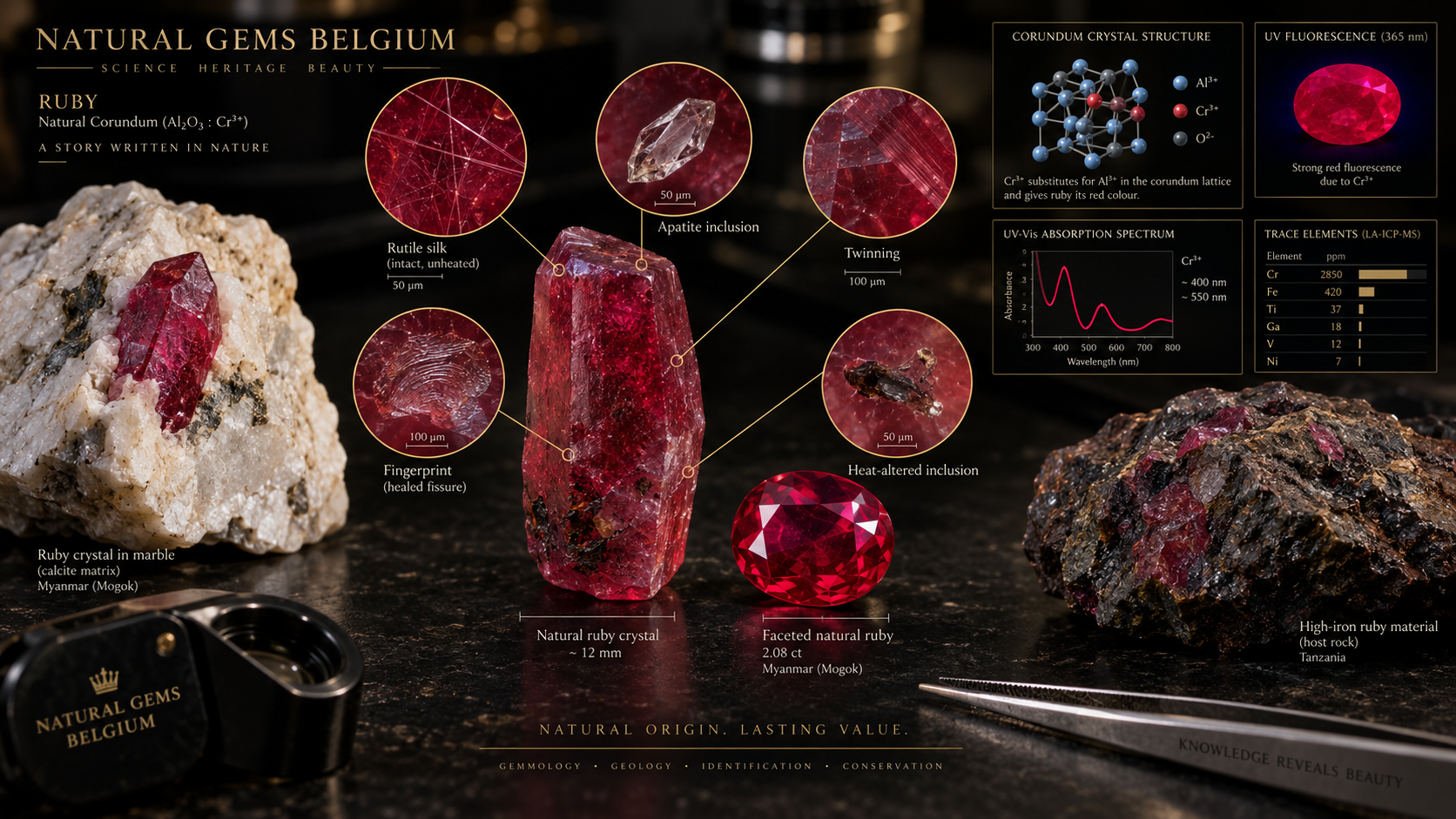
Ruby becomes red primarily because chromium enters the crystal structure.
The key ion is:
Cr³⁺
Chromium substitutes for a small proportion of aluminium ions.
That substitution changes how the crystal absorbs visible light.
Certain wavelengths are absorbed strongly while red wavelengths remain dominant in transmitted light.
The result is ruby’s characteristic red colour.
5. Chromium Is a Trace Element
Ruby does not need to contain large quantities of chromium.
Trace amounts can produce intense colour.
This demonstrates one of the central principles of gemstone science:
A very small chemical change can create a very large visual change.
Chromium concentration influences:
- saturation;
- tone;
- fluorescence;
- overall appearance.
But chromium is not the only trace element that matters.
Iron can significantly alter ruby’s optical behaviour.
6. Why Ruby and Emerald React Differently to Chromium
Chromium also contributes green colour to emerald.
That may seem contradictory.
In ruby:
Cr³⁺ → red
In emerald:
Cr³⁺ → green
The reason is the host crystal.
Chromium occupies different structural environments in:
- corundum;
- beryl.
Those different crystal fields alter the energy levels available to chromium’s electrons.
Different wavelengths are therefore absorbed.
Colour belongs to the interaction between:
chromophore + crystal structure
—not simply to one element.
7. Fluorescence Gives Ruby Its Famous Glow
Chromium does more than create body colour.
It can also produce intense red luminescence.
Many rubies fluoresce strongly under ultraviolet radiation.
Sunlight contains ultraviolet wavelengths, so fluorescence can sometimes reinforce ruby’s red appearance in daylight.
This contributes to the famous glowing visual character of some fine rubies.
8. Iron Can Suppress the Glow
Not every ruby fluoresces with the same intensity.
Iron can suppress chromium-related luminescence.
Rubies with low iron concentrations may therefore show particularly strong red fluorescence.
Higher-iron rubies can display:
- weaker fluorescence;
- darker tone;
- somewhat different optical character.
This relationship becomes important when comparing rubies from different geological environments.
9. Marble-Hosted Ruby
Some of the world’s historically famous rubies formed in metamorphosed carbonate rocks:
marble.
Important marble-hosted ruby regions include areas of:
- Myanmar;
- Vietnam;
- Afghanistan;
- Tajikistan.
Marble is generally low in iron.
Rubies from these environments can consequently have:
- relatively low iron;
- strong chromium fluorescence;
- vivid red appearance.
This geological relationship partly explains the visual reputation of certain traditional ruby sources.
10. Ruby Forms During Metamorphism
Ruby formation requires unusual geological conditions.
Corundum needs an environment rich enough in aluminium but relatively poor in silica.
If abundant silica is available, aluminium tends to enter other silicate minerals instead.
In major metamorphic ruby deposits, geological processes involving:
- heat;
- pressure;
- fluid interaction;
- chemical exchange
create conditions in which corundum can crystallise.
Chromium must also be available to produce ruby rather than colourless corundum or other sapphire colours.
11. Marble-Hosted Ruby Formation
Research on major Asian ruby deposits indicates formation within metamorphosed carbonate rocks.
In such environments, original limestone is transformed into marble during mountain-building processes.
Fluid-assisted chemical interaction can introduce or redistribute the components necessary for ruby formation.
Important ruby-bearing marble belts are linked to major tectonic events associated with the Himalayan region.
The gemstone is therefore a product of large-scale geological processes.
12. High-Iron Ruby
Not all ruby is marble-hosted.
GIA origin research broadly separates many rubies into:
low-iron marble-hosted rubies
and
high-iron rubies.
Important high-iron ruby sources include:
- Mozambique;
- Madagascar;
- Thailand;
- Cambodia;
- other localities.
Their geological environments can differ significantly from marble-hosted deposits.
13. Mozambique Changed the Modern Ruby Market
Mozambique has become one of the major modern sources of ruby.
Its rubies are generally classified among high-iron ruby populations.
They occur in geological environments associated with metamorphosed mafic or ultramafic precursor rocks rather than classic marble-hosted systems.
Mozambican rubies can reach exceptional colour and quality.
This is an important reminder that prestigious ruby quality is not restricted to historically famous localities.
14. Thailand and Cambodia
Ruby deposits near the Thailand-Cambodia border represent another important geological population.
These stones commonly contain more iron than classic marble-hosted rubies.
Their inclusion scenes can also be distinctive.
GIA documents features such as:
- negative crystals;
- melt inclusions;
- iridescent decrepitation haloes;
- strong twinning;
- intersection tubules.
Rutile silk is generally absent from this population.
Such inclusion patterns can become important in professional geographic-origin analysis.
15. Ruby or Pink Sapphire?
The border between ruby and pink sapphire is not defined by a universal chromium concentration.
It is fundamentally a:
colour classification.
Different historical markets have sometimes drawn the boundary differently.
GIA uses controlled comparison stones and requires red to be the dominant hue for corundum to receive a ruby identification.
This demonstrates an unusual fact:
the mineralogical species is objective, while the commercial variety boundary contains an element of controlled visual judgement.
16. Chromium Concentration Does Not Define Ruby
It may seem logical to say:
“If chromium exceeds a certain concentration, the stone becomes ruby.”
That is not how laboratory classification works.
Two corundum stones can contain chromium yet be classified differently because of their visible colour.
A sufficiently pink corundum can be:
pink sapphire
even though chromium contributes to its colour.
Ruby is defined by the resulting red appearance, not a simple chemical threshold.
17. What Is “Pigeon’s Blood”?
Few ruby terms are more famous—or more frequently misused—than:
pigeon’s blood.
Historically, it referred to exceptionally fine red ruby, particularly material associated with Myanmar.
Modern laboratory and trade definitions can vary.
GIA describes the historical concept as a vivid red to slightly purplish or pinkish red appearance accompanied by a soft glowing fluorescence.
The term should therefore not be treated as a universally standardised scientific colour grade.
18. “Pigeon’s Blood” Does Not Mean Burmese Origin
This distinction is critical.
A ruby may possess a colour appearance described by a laboratory or trader as pigeon’s blood without necessarily coming from Myanmar.
Likewise, not every Myanmar ruby displays that colour.
Origin and colour are separate questions.
A responsible description should distinguish:
colour designation
from
geographic-origin determination.
19. Colour Is the Dominant Quality Factor
For fine ruby, colour is usually the most important value factor.
Highly valued appearances generally fall within:
- vivid red;
- slightly purplish red
with strong saturation and an attractive tone.
If tone becomes too dark, the stone can lose brightness.
If saturation is weak, it may appear:
- pinkish;
- brownish;
- greyish.
The ideal balance cannot be reduced to a single wavelength or chemical measurement.
It is ultimately a visual quality judgement.
20. Cut Changes Colour
Ruby colour does not depend only on chemistry.
Cut affects optical path length.
A deep gemstone may make light travel through more material, producing a darker appearance.
A shallow gemstone may appear lighter.
Orientation also matters because ruby is:
pleochroic.
Different crystallographic directions can display slightly different colours or colour strengths.
A cutter can therefore influence the finished appearance substantially.
21. Pleochroism in Ruby
Because corundum is anisotropic, ruby interacts differently with polarized light travelling along different crystallographic directions.
Typical directional colours can differ between:
- red;
- purplish red;
- orangy red.
The exact appearance varies with composition.
Faceting orientation can be selected to maximise desirable red while minimising less attractive directional components.
22. Ruby Inclusions Are Evidence
Natural ruby commonly contains internal characteristics.
These can include:
- rutile silk;
- mineral crystals;
- partially healed fissures;
- fluid-related cavities;
- twinning;
- growth structures;
- particle clouds;
- hollow channels.
To the gemmologist, inclusions are not merely clarity defects.
They can provide evidence about:
- natural growth;
- geological environment;
- treatment;
- possible origin.
23. Rutile Silk
Rutile is titanium dioxide:
TiO₂
and can occur within ruby as fine oriented needles.
When numerous, these needles are called:
silk.
Silk can occur as:
- fine individual needles;
- intersecting systems;
- clouds;
- nested patterns.
Its crystallographic orientation can make the inclusion scene highly organised.
24. Silk and Appearance
Fine rutile silk can scatter light.
In some ruby, this contributes a soft glowing appearance.
Dense silk can reduce transparency.
The effect therefore depends on:
- density;
- distribution;
- orientation.
As with sapphire, an inclusion is not automatically aesthetically negative.
25. Ruby Stars
When oriented rutile or other reflective inclusions are sufficiently abundant, ruby can show:
asterism.
Correctly oriented cabochon cutting can produce a star.
A six-rayed star is particularly associated with corundum’s crystallographic symmetry.
In such stones, the inclusions create the optical phenomenon that defines the gemstone’s appeal.
26. Mineral Crystal Inclusions
Natural ruby can contain numerous mineral species.
Depending on geological environment, these may include:
- calcite;
- apatite;
- spinel;
- mica;
- zircon;
- feldspar;
- diopside;
- garnet;
- other minerals.
A mineral inclusion can provide valuable geological information.
But one inclusion should rarely be converted directly into a geographic-origin claim.
27. Raman Spectroscopy Can Identify Inclusions
Microscopic appearance alone may not establish the identity of a tiny internal crystal.
Modern laboratories can use:
Raman spectroscopy
to analyse inclusions within transparent gemstones.
This can transform an observation such as:
“colourless crystal”
into a scientifically supported identification such as:
“apatite.”
The ability to identify internal minerals strengthens geological and origin interpretation.
28. Twinning
Twinning is common in many natural rubies.
Twin planes can appear as:
- straight lamellae;
- intersecting structures;
- repeated planar patterns.
They may interact with:
- inclusions;
- fractures;
- growth structures.
Twinning itself is not unique to natural ruby, but its morphology and associations contribute to the overall identification picture.
29. Rose Channels
Some natural corundum contains linear hollow structures called:
Rose channels.
These were once commonly misidentified as boehmite needles.
Modern work has demonstrated that they are hollow channels rather than solid boehmite crystals.
Their high optical relief can make them conspicuous under magnification.
This is a useful example of gemmology changing as analytical methods improve.
30. Fingerprint-Like Healed Fractures
Ruby can contain partially healed fractures.
Small cavities remaining along the healed plane create patterns resembling:
- fingerprints;
- feathers;
- networks.
These can provide evidence of natural geological history.
But similar-looking features can occur in other gemstones and can even be imitated or induced in some synthetic materials.
A fingerprint is therefore evidence—not an automatic verdict.
31. Heat Treatment Is Common
Heating ruby is a long-established treatment.
Its purposes can include:
- improving colour;
- reducing unwanted blue or purple components;
- changing inclusion appearance;
- improving apparent clarity.
GIA advises consumers to assume that ruby may have been heated unless reliable laboratory evidence indicates no evidence of heat.
Fine unheated ruby can command a premium because such material is comparatively rare.
32. What Heat Can Do to Colour
Some natural ruby contains colour components involving iron and titanium in addition to chromium.
Heating in appropriate conditions can change oxidation states and Fe-Ti interactions.
For example, unwanted bluish components in some ruby can be reduced through heating.
The resulting stone may show a purer:
red to pinkish-red
appearance.
Heat therefore modifies existing atomic and microscopic systems rather than simply “painting” the gemstone red.
33. What Heat Does to Inclusions
At sufficiently high temperatures, inclusions can change.
Possible evidence includes:
- altered rutile;
- recrystallised minerals;
- damaged crystal surfaces;
- expanded fractures;
- reaction products.
These microscopic changes are important treatment clues.
But their interpretation depends strongly on:
- temperature;
- duration;
- atmosphere;
- inclusion type.
34. Low-Temperature Heat Is More Difficult
One of modern gemmology’s important challenges is detecting relatively low-temperature heating.
GIA experiments on Burmese ruby between approximately 600°C and 1500°C showed that some solid inclusions can respond to relatively low temperatures.
Yet changes may be subtle.
Modern treatment investigation can therefore combine:
- microscopy;
- Raman analysis;
- ultraviolet fluorescence imaging;
- FTIR spectroscopy;
- other methods.
A natural-looking inclusion scene alone is no longer sufficient to prove an unheated history.
35. FTIR and Heat Detection
Fourier-transform infrared spectroscopy:
FTIR
is an important analytical tool in corundum treatment investigation.
Certain absorption features can provide evidence related to:
- heating;
- hydroxyl-bearing phases;
- inclusion stability.
Recent GIA analytical reviews show how FTIR complements microscopy in determining heat-treatment history.
Treatment determination is strongest when several independent observations agree.
36. Lead-Glass-Filled Ruby
One of the most significant ruby clarity treatments is:
lead-glass filling.
Highly fractured ruby can be heated with a lead-rich glass.
The glass enters surface-reaching fractures.
Because the filler can reduce the optical visibility of fractures, an initially very fractured stone may appear dramatically more transparent.
This is not equivalent to ordinary heat treatment.
37. How Glass Filling Can Be Recognised
Under a gemmological microscope, lead-glass-filled ruby may show features such as:
- flash effects;
- gas bubbles;
- filled cavities;
- flow-like structures;
- differences associated with the filler.
GIA research found this treatment generally recognisable with standard gemological microscopy.
Its disclosure is essential because the material’s treatment history and durability differ substantially from untreated or conventionally heated ruby.
38. Glass Filling Changes Practical Care
Corundum itself is highly durable.
The glass filling may be much less resistant to certain:
- chemicals;
- heat;
- jewellery repair procedures.
Therefore jewellery care must consider the treated composite system rather than only the hardness of ruby.
A customer hearing:
“Ruby has Mohs hardness 9”
could otherwise receive incomplete care information for a heavily filled stone.
39. Other Ruby Treatments
Other ruby enhancement methods have included:
- heating with flux-related fracture healing;
- diffusion-related processes;
- dyeing of lower-grade materials.
Treatments differ greatly in:
- mechanism;
- stability;
- disclosure significance;
- commercial value.
A generic statement such as:
“treated ruby”
is therefore less informative than identifying the actual treatment where known.
40. Natural Ruby Versus Synthetic Ruby
Synthetic ruby is genuine corundum grown artificially.
It is not simply red glass.
A synthetic ruby can possess essentially the same:
- Al₂O₃ composition;
- hardness;
- refractive index;
- chromium-related red colour
as natural ruby.
The fundamental distinction is:
growth environment.
Natural ruby formed through geological processes.
Synthetic ruby formed under controlled human-created conditions.
41. Flame-Fusion Synthetic Ruby
The Verneuil or flame-fusion method became historically important for producing synthetic ruby.
Typical microscopic features may include:
- curved growth lines;
- gas bubbles.
These can make many examples relatively straightforward to recognise.
However, relying only on a textbook feature is dangerous.
Not every synthetic stone displays a perfect diagnostic inclusion scene.
42. Flux-Grown Synthetic Ruby
Flux-grown synthetic ruby forms through a very different laboratory process.
It can contain:
- flux residues;
- characteristic growth features;
- metallic or other growth-related inclusions.
Some flux-grown synthetics can be much more challenging than classic flame-fusion material.
They may contain internal scenes that superficially resemble natural gemstones.
43. Synthetic “Fingerprints” Demonstrate the Danger
Researchers have documented synthetic rubies treated in flux melts to create fracture patterns resembling natural fingerprint inclusions.
This is a powerful caution.
A feature that appears “natural” at first glance may not prove geological origin.
Good identification depends on the entire growth environment rather than one inclusion.
44. Trace-Element Chemistry Helps
When microscopic evidence is ambiguous, laboratories can analyse trace-element chemistry.
Natural and synthetic ruby may show different trace-element signatures.
Elements such as:
- titanium;
- vanadium;
- iron;
- gallium
can be considered together.
Some synthetic processes may also introduce elements unusual for natural ruby.
Modern identification therefore combines classic microscopy with instrumental chemistry when required.
45. Ruby Geographic Origin
Geographic origin can significantly affect the commercial perception and value of fine ruby.
Common origin requests include:
- Myanmar;
- Mozambique;
- Vietnam;
- Afghanistan;
- Tajikistan;
- Madagascar;
- Thailand;
- Cambodia.
But geographic origin is not determined by colour alone.
A laboratory must compare the gemstone with documented reference populations.
46. Modern Origin Determination
GIA’s ruby-origin methodology integrates evidence from:
Microscopy
Including:
- silk;
- crystals;
- twinning;
- healed fractures;
- negative crystals.
Trace-element chemistry
Often using:
LA-ICP-MS
Spectroscopy
Including:
- UV-Vis-NIR;
- FTIR where appropriate.
Reference collections
Samples collected from known geological sources provide comparison data.
The final origin determination comes from convergence.
47. Low-Iron and High-Iron Populations
Trace-element chemistry often allows laboratories to first place ruby into a broad population.
Low-iron material may direct attention toward classic marble-hosted sources such as:
- Myanmar;
- Vietnam;
- Afghanistan;
- Tajikistan.
High-iron ruby may direct investigation toward:
- Mozambique;
- Madagascar;
- Thailand/Cambodia;
- other populations.
This is only the beginning.
Further evidence is needed for a country-level conclusion.
48. Burmese Ruby
Ruby from Myanmar—particularly the Mogok region—has a legendary historical reputation.
Possible supporting features can include:
- characteristic silk;
- crystalline inclusions;
- low iron;
- strong fluorescence.
GIA case studies demonstrate how nested straw-like silk and minerals such as apatite can support a Burmese interpretation.
Yet none of those observations alone proves Myanmar.
Trace-element comparison remains important.
49. Mozambican Ruby
Mozambique has become one of the most commercially important modern ruby sources.
These rubies generally belong to high-iron geological populations.
Inclusion scenes and trace-element chemistry can often help distinguish them from:
- marble-hosted ruby;
- Thai/Cambodian material;
- Madagascar material.
Fine Mozambique ruby can rival classic sources visually.
Source prestige and gemstone quality should therefore not be confused.
50. Geographic Origin Can Be Inconclusive
Not every ruby can be assigned confidently to one country.
Different deposits can overlap in:
- chemistry;
- inclusions;
- spectroscopy.
Heat treatment can also destroy or alter valuable inclusion evidence.
When independent evidence does not converge, a responsible laboratory may issue:
inconclusive
origin.
That is scientifically stronger than forcing a geographical answer.
51. Origin Is Not Quality
A crucial commercial distinction is:
origin ≠ quality.
Myanmar can produce:
- exceptional ruby;
- ordinary ruby.
Mozambique can produce:
- exceptional ruby;
- ordinary ruby.
Madagascar can produce:
- exceptional ruby;
- ordinary ruby.
Country names describe provenance.
They do not automatically describe:
- colour quality;
- clarity;
- cut;
- treatment;
- beauty.
Each gemstone must be evaluated individually.
52. Microscopy Comes Before Origin Labels
When examining an unknown ruby under magnification, a professional approach is:
Observation:
Fine intersecting needles, transparent crystal, healed fracture.
Not:
Conclusion:
Burmese ruby.
The first description remains objectively useful.
The second requires multiple supporting datasets.
This distinction prevents origin mythology from replacing science.
53. Ruby and Fluorescence
Long-wave ultraviolet illumination can reveal ruby’s chromium-related red luminescence.
Intensity varies.
Low-iron ruby can fluoresce especially strongly.
High iron may suppress fluorescence.
Fluorescence can therefore provide useful supporting information about:
- chemistry;
- geological population.
But it cannot determine geographic origin alone.
54. The Ruby Laser
Ruby also occupies an important place in modern technological history.
The first successful laser, demonstrated in 1960, used synthetic ruby as its active medium.
Chromium ions responsible for ruby’s red optical behaviour can emit intense red radiation at characteristic wavelengths.
This connects gemstone science directly with:
- spectroscopy;
- solid-state physics;
- laser technology.
Ruby is therefore both a gemstone and an historically important optical material.
55. Ruby Clarity
Natural ruby commonly contains inclusions.
Completely inclusion-free natural ruby is uncommon.
Clarity evaluation therefore differs fundamentally from the expectation applied to many diamonds.
Important questions include:
- Are inclusions eye-visible?
- Do they reduce transparency?
- Do they reduce brilliance?
- Are they structurally dangerous?
- Are they attractive or characteristic?
An inclusion’s effect matters more than simply its existence.
56. Surface-Reaching Fractures
A fracture becomes especially important when it reaches the surface.
It can affect:
- durability;
- treatment possibilities;
- cleaning recommendations.
Surface-reaching fissures are also pathways through which:
- glass;
- oil-like substances;
- dyes
can enter a gemstone.
Microscopy should therefore always include careful examination of the surface.
57. Cut Quality
Ruby rough is valuable.
Cutters often face a compromise between:
- preserving weight;
- improving colour;
- maximising brilliance.
Ruby can therefore be cut in:
- oval mixed cuts;
- cushion shapes;
- traditional mixed cuts;
- other forms.
A perfectly symmetrical cut is not automatically commercially superior if achieving it would require sacrificing large amounts of rare high-quality ruby rough.
58. Extinction
Poor orientation or unsuitable proportions can cause areas of a faceted ruby to appear:
dark or black.
This is called extinction.
Some extinction is expected in many coloured stones.
Excessive extinction can reduce:
- brightness;
- apparent colour quality;
- overall appeal.
Therefore colour evaluation should consider the finished optical performance, not just the material’s chemistry.
59. Windowing
A ruby cut too shallowly can allow the observer to see through part of the pavilion instead of receiving strong internal light return.
This creates:
windowing.
A prominent window can reduce:
- saturation;
- brilliance;
- visual balance.
Again, excellent ruby colour depends on an interaction between:
material + orientation + proportions.
60. Carat Weight and Rarity
Fine ruby becomes dramatically rarer as size increases.
High-quality transparent ruby above one carat can already be significantly less common than smaller material.
Large stones combining:
- vivid colour;
- good transparency;
- attractive cut;
- minimal treatment
are exceptionally rare.
Size therefore interacts strongly with quality in ruby valuation.
61. Why Laboratory Reports Matter
A laboratory report can address questions that visual examination alone may not answer confidently.
Depending on report type and laboratory capability, it may determine:
- natural versus synthetic origin;
- ruby identity;
- evidence of heating;
- fracture filling;
- other treatments;
- geographic origin.
Reports are particularly important when treatment or provenance substantially affects commercial value.
62. A Laboratory Report Does Not Grade Beauty
A report may identify a natural ruby and document treatment or origin.
That does not necessarily mean it assigns an overall quality grade.
Beauty still depends on factors such as:
- colour;
- transparency;
- cut;
- inclusions;
- optical performance.
Laboratory identity and commercial quality evaluation are related but distinct tasks.
63. Common Misconceptions About Ruby
Myth 1 — “Ruby is a separate mineral from sapphire.”
Incorrect.
Both are corundum.
Myth 2 — “Chromium concentration alone determines whether corundum is ruby.”
Incorrect.
The ruby/pink-sapphire boundary is based primarily on colour.
Myth 3 — “Pigeon’s blood means Burmese.”
Incorrect.
Colour terminology and geographic origin are separate.
Myth 4 — “All Burmese ruby is top quality.”
Incorrect.
Every source produces multiple qualities.
Myth 5 — “Every ruby with silk is unheated.”
Incorrect.
Low-temperature treatment can leave inclusions relatively intact.
Myth 6 — “Heated ruby is synthetic.”
Incorrect.
A heated natural ruby remains natural corundum.
Myth 7 — “Glass-filled ruby is simply ordinary heated ruby.”
Incorrect.
Glass filling is a substantially different clarity-enhancement process.
Myth 8 — “A fingerprint proves natural ruby.”
Incorrect.
Synthetic materials can contain or be modified to create deceptively natural-looking features.
Myth 9 — “Origin can be determined by colour.”
Incorrect.
Professional origin determination requires multiple lines of evidence.
Myth 10 — “Mohs hardness 9 means ruby cannot break.”
Incorrect.
Hardness measures scratch resistance, not complete resistance to fracture.
64. Evidence Classification
| Statement | Classification |
|---|---|
| Ruby is red corundum | Established mineralogical fact |
| Corundum has ideal composition Al₂O₃ | Established mineralogical fact |
| Chromium is the principal cause of ruby’s red colour | Established spectroscopic fact |
| Chromium can produce strong red fluorescence in ruby | Established optical fact |
| Iron can suppress ruby fluorescence | Established gemmological observation |
| Marble-hosted rubies are commonly relatively low in iron | Established geological/gemmological pattern |
| Ruby can contain rutile silk, crystals and twinning | Established inclusion evidence |
| Heat treatment is common in ruby | Established trade and gemmological fact |
| Low-temperature heating can be difficult to detect | Established experimental finding |
| Lead glass can fill fractures and greatly improve apparent clarity | Established treatment fact |
| Synthetic ruby can have essentially the same major chemical and optical properties as natural ruby | Established gemmological fact |
| Inclusion scenes can help separate natural and synthetic ruby | Established laboratory practice |
| Ruby origin determination combines microscopy, chemistry and spectroscopy | Established laboratory methodology |
| One inclusion proves geographic origin | Incorrect |
| Pigeon’s blood automatically proves Myanmar origin | Incorrect |
| All vivid ruby is treated | Incorrect |
| All natural ruby is untreated | Incorrect |
| All high-quality ruby comes from Myanmar | Incorrect |
65. A Practical Ruby Examination Framework
When examining a ruby, proceed systematically.
Identity
Ask first:
Is the material actually corundum?
Use appropriate gemmological testing.
Colour
Describe:
- hue;
- tone;
- saturation.
Determine whether red is dominant.
Fluorescence
Observe reaction under appropriate UV illumination.
Record intensity rather than jumping immediately to origin conclusions.
Surface
Inspect:
- scratches;
- fractures;
- cavities;
- filler;
- coating.
Internal Features
Look for:
- silk;
- crystals;
- twinning;
- healed fissures;
- growth structures.
Treatment Evidence
Ask whether inclusions show:
- alteration;
- melting;
- recrystallisation;
- fracture filling.
Natural or Synthetic
Evaluate the complete growth environment rather than one inclusion.
Origin
Only proceed to geographic interpretation when sufficient:
- microscopy;
- chemistry;
- spectroscopy;
- reference data
are available.
This order keeps observation ahead of assumption.
Conclusion
Ruby appears simple because its identity is familiar.
Red corundum.
Yet the science contained within those two words is remarkably rich.
Pure corundum is colourless.
Introduce small amounts of chromium and the crystal begins selectively absorbing visible light.
Red becomes dominant.
The same chromium can produce intense red luminescence, giving some rubies an extraordinary glow.
Introduce more iron and fluorescence can weaken.
Place the growing crystal within marble and one geological style emerges.
Form it in mafic or ultramafic environments and another ruby population appears.
Inside the gemstone, rutile, apatite, calcite, spinel, zircon, twinning and healed fractures preserve parts of that geological history.
Then humans can change the record.
Heat can alter:
- colour;
- rutile;
- crystals;
- fractures.
Lead-rich glass can make heavily fractured material appear dramatically clearer.
Synthetic growth can reproduce ruby’s fundamental chemistry and colour while leaving a different microscopic and trace-element history.
The role of the gemmologist is therefore not simply to decide:
“Is it red?”
The real investigation asks:
Is it corundum?
Is the red sufficient for ruby classification?
Is it natural or laboratory-grown?
Has it been heated?
Has it been fracture-filled or otherwise treated?
What do its inclusions reveal?
Can its geological origin be determined confidently?
No single observation answers all of these questions.
Colour does not prove origin.
Silk does not prove unheated status.
A fingerprint does not automatically prove natural growth.
A famous country name does not prove quality.
Modern ruby gemmology works through convergence:
optical properties + microscopy + spectroscopy + chemistry + geological comparison.
When those independent lines of evidence agree, the internal story of a ruby becomes increasingly clear.
And that is what makes ruby scientifically as fascinating as it is visually compelling.
Its red colour is only the beginning.
References & Further Reading
Gemological Institute of America — “Ruby.”
Authoritative introductory reference for ruby as the red variety of corundum, its chromium colour mechanism, physical and optical properties, fluorescence and major quality factors.
https://www.gia.edu/ruby
Gemological Institute of America — “Ruby Description.”
Useful introduction to ruby geology, including the relationship between marble-hosted ruby, low iron concentration, chromium fluorescence and basalt-associated higher-iron material.
https://www.gia.edu/gia-website/ruby-description
Gemological Institute of America — “Ruby Quality Factors.”
Authoritative discussion of ruby colour, clarity, cut and carat weight, including the ruby-versus-pink-sapphire boundary and the limitations of traditional terms such as “pigeon’s blood.”
https://www.gia.edu/ruby-quality-factor
Palke, A. C., Saeseaw, S., Renfro, N. D., Sun, Z. & McClure, S. F. — “Geographic Origin Determination of Ruby.” Gems & Gemology, Winter 2019, Gemological Institute of America.
Major modern reference explaining professional ruby-origin methodology through inclusion scenes, trace-element chemistry, spectroscopy and documented reference collections. Includes detailed comparisons between marble-hosted and high-iron ruby populations.
https://www.gia.edu/gems-gemology/winter-2019-ruby-geographic-origin-determination
Giuliani, G. & Groat, L. A., reviewed in “Colored Stones Unearthed: Gems Formed in Metamorphic Rocks.” Gems & Gemology, Summer 2023, Gemological Institute of America.
Detailed geological overview of metamorphic ruby and sapphire formation, including Pan-African and Himalayan geological events and the formation of ruby in marble, mafic and ultramafic metamorphic environments.
https://www.gia.edu/gems-gemology/summer-2023-colored-stones-unearthed0
Renfro, N. D., Koivula, J. I., Muyal, J., McClure, S. F., Schumacher, K. & Shigley, J. E. — “Chart: Inclusions in Natural, Synthetic, and Treated Ruby.” Gems & Gemology, Winter 2017, Gemological Institute of America.
Comprehensive visual reference for microscopic features in natural ruby, synthetic ruby and treated material, useful for understanding why inclusion interpretation requires comparison rather than simplistic rules.
https://www.gia.edu/gems-gemology/winter-2017-inclusions-natural-synthetic-ruby
McClure, S. F., Smith, C. P., Wang, W. & Hall, M. — “Identification and Durability of Lead Glass–Filled Rubies.” Gems & Gemology, Spring 2006, Gemological Institute of America.
Foundational treatment study describing the identification of lead-glass-filled ruby, including flash effects, gas bubbles, fracture filling and important durability implications.
https://www.gia.edu/gems-gemology/spring-2006-identification-lead-glass-filled-rubies-mcclure
Sutherlin, K. et al. — “A Canary in the Ruby Mine: Low-Temperature Heat Treatment Experiments on Burmese Ruby.” Gems & Gemology, Winter 2022, Gemological Institute of America.
Controlled heating study of Mogok ruby at temperatures from approximately 600°C to 1500°C, documenting subtle inclusion, fluorescence and spectroscopic changes relevant to modern heat-treatment detection.
https://origin.prod.gia.edu/gems-gemology/winter-2022-burmese-ruby
McClure, S. F. et al. — “Analysis of Gemstones at GIA Laboratories.” Gems & Gemology, Winter 2024, Gemological Institute of America.
Modern overview of laboratory gemstone analysis, including microscopy, spectroscopy, trace-element chemistry and FTIR methods applied to ruby, sapphire and other gemstones.
https://www.gia.edu/gems-gemology/winter-2024-gemstone-analysis
Breeding, C. M. et al. — “Infrared Spectroscopy and Its Use in Gemology.” Gems & Gemology, Winter 2024, Gemological Institute of America.
Current technical overview of FTIR spectroscopy, including corundum examples showing how infrared absorptions can contribute evidence for both heated and unheated ruby.
https://www.gia.edu/gems-gemology/winter-2024-infrared-spectroscopy
Muhlmeister, S., Fritsch, E., Shigley, J. E., Devouard, B. & Laurs, B. M. — “Separating Natural and Synthetic Rubies on the Basis of Trace-Element Chemistry.” Gems & Gemology, Summer 1998, Gemological Institute of America.
Important study demonstrating how combinations of trace-element concentrations can supplement conventional microscopy when distinguishing natural from synthetic ruby.
https://www.gia.edu/gems-gemology/summer-1998-separating-natural-synthetic-rubies-mulhmeister
Schmetzer, K. & Schupp, F.-J. — “Flux-Induced Fingerprint Patterns in Synthetic Ruby: An Update.” Gems & Gemology, Spring 1994, Gemological Institute of America.
Valuable cautionary reference documenting synthetic ruby in which flux treatment produces fingerprint-like structures that can imitate natural inclusion scenes.
https://www.gia.edu/gems-gemology/spring-1994-inclusions-synthetic-ruby-schmetzer
Sayed, A. — “Rose Channels in Ruby.” Gems & Gemology, Spring 2024, Gemological Institute of America.
Recent photomicrographic reference explaining hollow Rose channels in natural corundum and the historical correction of their former identification as boehmite needles.
https://www.gia.edu/gems-gemology/spring-2024-microworld-rose-channels-in-ruby
Nasdala, L. & Fritsch, E. et al. — “Glowing Gems: Fluorescence and Phosphorescence of Diamonds, Colored Stones, and Pearls.” Gems & Gemology, Winter 2024, Gemological Institute of America.
Modern scientific review of gemstone luminescence, including Cr³⁺-related red luminescence in ruby and its relationship to the optical physics underlying the ruby laser.
https://www.gia.edu/gems-gemology/winter-2024-fluorescence-phosphorescence