
Introduction
What causes gemstone color?
Why is ruby red?
Why can the same mineral species produce a blue sapphire, yellow sapphire, pink sapphire and colourless sapphire?
Why is emerald green while aquamarine—another variety of the same mineral—is blue?
Why can irradiation create or modify colour in some gemstones?
And how can opal display flashes of red, green and blue even though those colours are not produced by ordinary gemstone pigments at all?
The answer is that gemstone color does not have one universal cause.
Colour can originate from several very different physical mechanisms.
These include:
- transition-metal ions;
- trace-element impurities;
- interactions between neighbouring atoms;
- charge-transfer processes;
- atomic defects;
- colour centres;
- electronic band structures;
- microscopic inclusions;
- scattering;
- diffraction;
- interference.
Sometimes only a tiny quantity of an impurity is needed to transform a colourless crystal into an intensely coloured gemstone.
In other cases the chemistry remains essentially the same, but an atomic defect changes how the crystal absorbs visible light.
And in phenomenal gems such as precious opal or moonstone, the spectacular colours and optical effects arise largely because microscopic structures interact physically with light.
Understanding gemstone colour therefore requires us to move from what we see with our eyes to what happens inside matter at atomic and microscopic scales.
That journey is one of the most fascinating parts of modern gemmology.
Table of Contents
1. Gemstone Color Begins with Light
Visible light is only a small portion of the electromagnetic spectrum.
Human eyes detect wavelengths approximately within the range we perceive as:
- violet;
- blue;
- green;
- yellow;
- orange;
- red.
White light contains many visible wavelengths together.
When white light enters or reflects from a gemstone, several things can happen.
Some wavelengths may be:
- absorbed;
- transmitted;
- reflected;
- scattered;
- diffracted.
The wavelengths that eventually reach our eyes determine the colour we perceive.
A gemstone therefore does not simply “contain blue” or “contain red.”
Its structure interacts selectively with light.
2. Absorption Creates Many Gemstone Colours
Suppose white light enters a gemstone.
If the gemstone absorbs much of the red, orange and yellow portion while transmitting more blue light, the stone can appear blue.
If it absorbs portions of the green and blue region while allowing red wavelengths to dominate, it can appear red.
This selective removal of wavelengths is called:
selective absorption.
Most familiar body colours in transparent gemstones involve selective absorption somewhere within the visible spectrum.
The exact absorption pattern depends on the gemstone’s chemistry and structure.
3. The Colour We See Is the Light That Survives
This point is easy to misunderstand.
If a sapphire appears blue, it is not generally because it emits blue light.
Instead, its atomic structure preferentially absorbs other parts of the visible spectrum.
The remaining transmitted or reflected light appears blue.
Likewise, ruby’s red colour results because its absorption pattern leaves strong red transmission.
Gemstone colour is therefore an interaction between:
light source + gemstone + observer.
4. Lighting Matters
A gemstone does not have an appearance entirely independent of its environment.
The spectrum of the illumination influences which wavelengths are available for the gemstone to transmit or reflect.
This is why the same gemstone can appear somewhat different under:
- daylight;
- incandescent lighting;
- LED lighting;
- fluorescent lighting.
The effect becomes particularly dramatic in colour-change gemstones.
A gemstone may selectively transmit different parts of two different illumination spectra, producing an obvious colour shift.
5. Color Is Also Perception
The physical spectrum reaching the eye is only part of the story.
The human visual system interprets that spectrum.
Perception can be influenced by:
- surrounding colours;
- brightness;
- adaptation;
- viewing conditions.
Professional gemstone colour evaluation therefore attempts to control lighting and viewing environment.
Scientific colour measurement requires even more precise instrumentation.
6. Idiochromatic and Allochromatic Gemstones
One traditional gemmological distinction separates gemstones into:
idiochromatic
and
allochromatic
materials.
Idiochromatic
The colouring element is an essential part of the mineral’s normal chemical composition.
Colour is therefore intrinsic to the material.
Examples include several strongly coloured minerals containing transition metals as major constituents.
Allochromatic
The mineral would ideally be colourless if chemically pure.
Its colour results from trace impurities, defects or other mechanisms.
Many major gemstones belong to this group.
Corundum is one of the clearest examples.
Pure Al₂O₃ is colourless.
Trace elements and lattice defects create the extraordinary colour range of ruby and sapphire.
7. A Tiny Chemical Difference Can Transform a Gemstone
This is one of gemmology’s most extraordinary facts.
A crystal can contain more than 99 percent of the same major chemical constituents as a colourless specimen, yet tiny amounts of additional elements can change its appearance dramatically.
These elements are called:
trace elements.
They may occur at concentrations measured in:
- parts per million;
- fractions of a percent.
Yet their interaction with visible light can be strong enough to dominate the gemstone’s colour.
8. Transition Metals Are Especially Important
Many important gemstone chromophores are transition-metal elements.
Examples include:
- chromium;
- iron;
- titanium;
- vanadium;
- manganese;
- copper.
Their electrons can occupy energy levels that interact with visible wavelengths.
When particular wavelengths are absorbed during electronic transitions, complementary portions of the spectrum remain visible.
The resulting colour depends not only on which element is present.
It also depends on:
- oxidation state;
- surrounding atoms;
- crystallographic site;
- geometry;
- concentration.
The same chemical element can therefore contribute to different colours in different minerals.
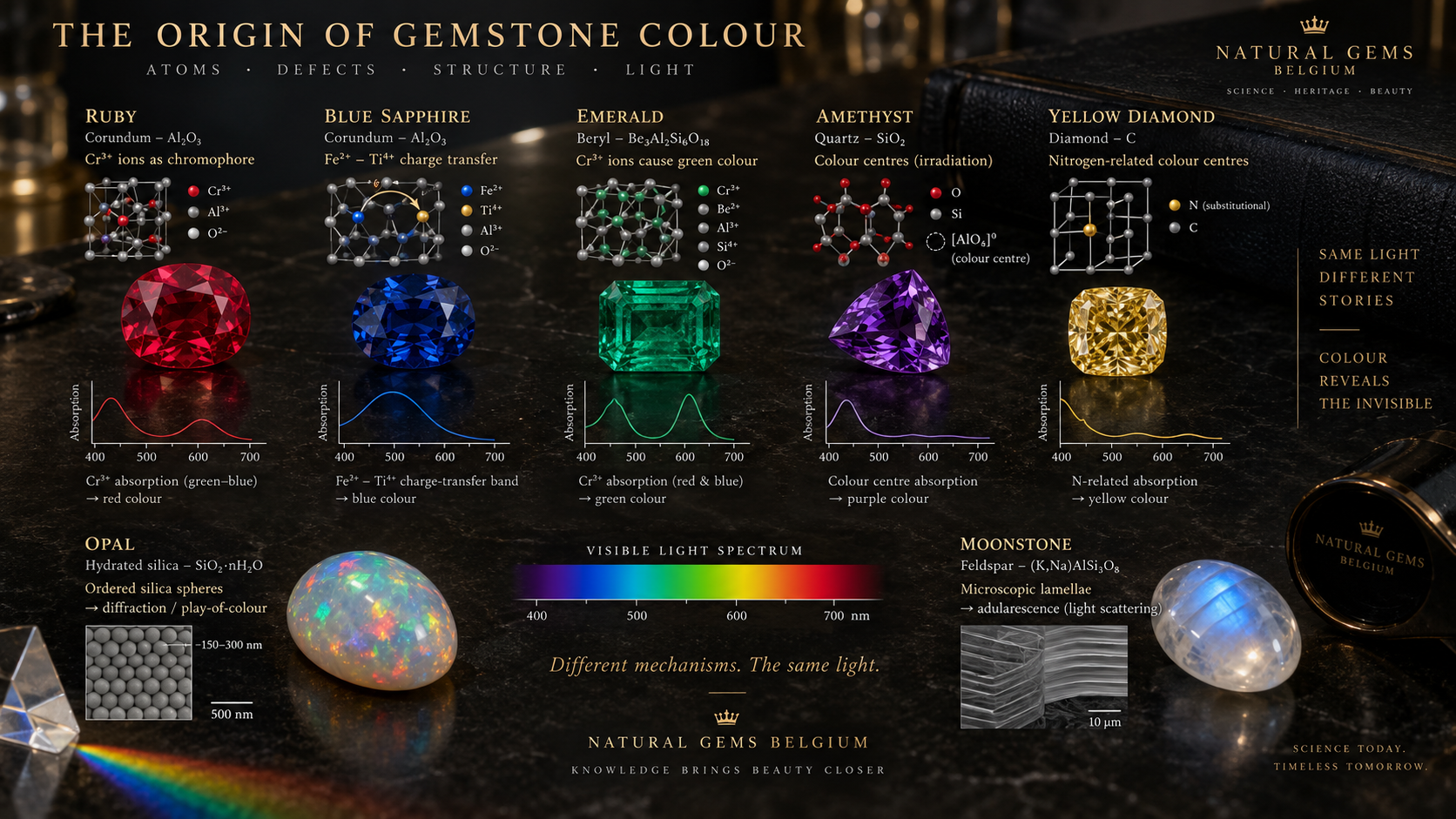
9. Chromium: Ruby’s Famous Chromophore
Ruby is the red variety of corundum.
Pure corundum is:
Al₂O₃
and is colourless.
In ruby, some aluminium positions are occupied by chromium, particularly:
Cr³⁺
Chromium interacting with the corundum crystal field produces strong absorption in portions of the visible spectrum.
Red wavelengths remain strongly transmitted.
The result is ruby’s characteristic:
- red;
- purplish red;
- pinkish red
colour range.
The concentration of chromium and the presence of other trace elements influence the final appearance.
10. Why Chromium Does Not Always Produce Red
Chromium provides a beautiful demonstration that a trace element does not carry one universal colour.
In ruby:
Cr³⁺ → red
But chromium can contribute to green colour in other mineral structures.
The reason is that the energy levels of the chromium ion are modified by its surrounding crystal environment.
Different host structures create different:
crystal fields.
Those differences change which wavelengths chromium absorbs.
Therefore:
The identity of a colouring element alone does not determine gemstone colour.
The host crystal matters.
11. Chromium and Emerald
Emerald is the green to bluish-green variety of beryl.
Beryl has a completely different crystal structure and chemistry from corundum.
Chromium can occupy appropriate sites within that structure.
The interaction between Cr³⁺ and the beryl crystal field produces strong green colour.
Vanadium can also contribute significantly to green in many emeralds.
Thus:
chromium + corundum → ruby red
while
chromium + beryl → emerald green
This is one of the clearest examples of why gemstone colour must be understood through both chemistry and crystal structure.
12. One Mineral Species Can Produce Many Colours
Beryl provides another useful example.
The beryl family includes varieties such as:
- emerald;
- aquamarine;
- morganite;
- heliodor;
- colourless goshenite.
They share the same basic mineral structure.
Their different colours arise primarily from trace chemistry and related electronic mechanisms.
This is why mineral species and gemstone colour should never be treated as equivalent concepts.
A mineral species can contain several gemstone varieties.
13. Corundum Is an Extraordinary Colour Laboratory
Corundum produces an even wider colour palette.
Depending on its trace elements and defects, natural corundum can appear:
- red;
- pink;
- orange;
- yellow;
- blue;
- green;
- purple;
- colourless.
Modern research has identified several major chromophores contributing to natural corundum colour.
These include combinations involving:
- Cr³⁺;
- Fe³⁺;
- V³⁺;
- Fe²⁺–Ti⁴⁺;
- hole-related chromium centres;
- hole-related iron centres.
Natural gemstones frequently contain more than one colour-producing mechanism simultaneously.
14. Blue Sapphire Requires More Than “Iron”
A common simplified statement says:
“Iron makes sapphire blue.”
That explanation is incomplete.
One of the principal mechanisms responsible for classic blue sapphire involves an interaction between:
Fe²⁺ and Ti⁴⁺
— iron and titanium ions in neighbouring positions within the corundum structure.
The mechanism is known as:
intervalence charge transfer.
This interaction produces intense absorption in parts of the visible spectrum, leaving blue as the dominant transmitted colour.
15. Charge Transfer
Charge-transfer colour is different from ordinary absorption centred primarily on one isolated ion.
An electron can transfer, or partially transfer, between neighbouring atoms.
In blue sapphire, the important interaction can be represented conceptually as:
Fe²⁺ ↔ Ti⁴⁺
The optical transition associated with this pair absorbs strongly.
Because charge-transfer transitions can be very intense, relatively small concentrations of appropriate ion pairs may create substantial colour.
This is one reason trace chemistry can have such dramatic visual consequences.
16. Sapphire Colour Is Usually More Complicated Than One Chromophore
Real natural sapphire is rarely a chemically perfect demonstration sample.
A single gemstone can contain measurable amounts of:
- iron;
- titanium;
- chromium;
- vanadium;
- magnesium;
- silicon;
- gallium;
- other trace elements.
Several chromophores can therefore contribute simultaneously.
The final colour is the cumulative result of their absorption.
Modern quantitative research on corundum emphasises exactly this point.
Natural colour is often a mixture of mechanisms, not a single element acting alone.
17. Concentration Matters
More chromophore does not always mean simply “more beautiful colour.”
Increasing concentration may increase absorption until a gemstone becomes:
- darker;
- more saturated;
- less transparent;
- visually over-dark.
Gemstone colour quality therefore depends on the balance between:
- hue;
- tone;
- saturation;
- transparency;
- cut.
Chemical concentration creates optical consequences, but market beauty is a visual judgement.
18. Optical Path Length Matters Too
Imagine two pieces of the same coloured material.
One is 2 mm thick.
The other is 20 mm thick.
Light travelling through the thicker sample interacts with much more material.
Consequently, it has more opportunity to be absorbed.
The thicker specimen may therefore appear much darker.
This concept is called:
optical path length.
It helps explain why gemstone cutting and orientation can dramatically affect apparent colour even when chemistry remains unchanged.
19. Cut Influences Colour
Faceting is not just about brilliance.
It changes the path light travels through a gemstone.
A deeper stone may produce:
- stronger colour;
- darker tone.
A shallower stone may appear:
- lighter;
- less saturated.
The pavilion design can also concentrate or distribute colour visually.
Cutters therefore sometimes orient and proportion coloured stones specifically to manage colour.
Gemstone colour is partly chemistry and partly optical engineering.
20. Pleochroism
Some anisotropic gemstones absorb light differently along different crystallographic directions.
This produces:
pleochroism.
The stone may show two or more different colours or colour intensities depending on viewing direction.
Examples occur in numerous gem minerals.
Pleochroism is another reason cutting orientation matters.
A faceter may orient rough to display the most desirable directional colour through the face of the finished gemstone.
21. Colour Centres
Not all gemstone colour depends directly on a conventional trace-metal chromophore.
Another major mechanism is the:
colour centre.
A colour centre is an atomic-scale defect or defect-related electronic configuration capable of absorbing visible light.
These centres can involve:
- missing atoms;
- displaced atoms;
- trapped electrons;
- trapped electron deficiencies known as holes;
- impurities associated with lattice defects.
They can form naturally or be created or modified by treatment.
22. Radiation Can Create Colour Centres
Natural rocks contain radioactive elements.
Over geological timescales, radiation from surrounding minerals can interact with gemstones.
High-energy radiation can displace electrons or alter defect structures.
In suitable materials, this creates colour centres.
Human treatment can sometimes reproduce similar processes using controlled irradiation.
The resulting gemstone may remain chemically almost unchanged at the major-element level while displaying a dramatically different colour.
23. Smoky Quartz
Smoky quartz provides a classic example.
Quartz can contain aluminium substituting for silicon in its structure.
Natural irradiation can interact with these defect systems and create colour centres responsible for smoky coloration.
The resulting colour can range from:
- pale brown;
- smoky grey;
- deep brown;
- nearly black.
The colour therefore depends on both:
impurity + irradiation-related defect chemistry.
Neither component alone tells the whole story.
24. Amethyst
Amethyst is another iron-related quartz variety whose purple colour involves more complex defect chemistry than the simple statement:
“iron makes amethyst purple.”
Iron is incorporated into the quartz structure during crystal growth.
Natural irradiation subsequently modifies appropriate iron-related centres.
The resulting electronic defects produce the characteristic purple absorption.
Heating can change these centres.
That is why some amethyst can be converted through heating to:
- yellow;
- orange;
- brownish;
- sometimes greenish
quartz colours depending on the material and conditions.
25. Natural and Artificial Processes Can Overlap
This creates an important gemmological challenge.
Radiation exists in nature.
Heat exists in nature.
Humans can also apply:
- irradiation;
- heating.
The resulting atomic mechanisms can sometimes resemble natural processes.
Treatment identification therefore does not always reduce to asking:
“Can this colour occur naturally?”
Instead laboratories may need to determine whether the available evidence supports:
- natural colour;
- treated colour;
- an inconclusive history.
26. Green Diamond and Radiation Damage
Natural green diamond demonstrates the power of radiation-related lattice defects.
Radiation can displace carbon atoms from their normal lattice positions.
This leaves vacancies.
One important vacancy-related defect is known as:
GR1 — General Radiation 1.
GR1 absorbs strongly in the red portion of the spectrum.
The remaining light can produce green or blue-green appearance.
Some natural green diamonds acquire only shallow surface-related radiation stains.
Others develop deeper body colour.
27. Treatment Can Mimic Geological Radiation
Diamonds can also be irradiated artificially.
Therefore the fact that radiation can produce a green diamond does not automatically establish whether the radiation occurred:
- naturally underground;
- artificially after mining.
Distinguishing natural and treated colour can require advanced spectroscopic investigation.
This is one reason fancy-colour diamond testing belongs in specialised laboratories.
Appearance alone may not reveal colour history.
28. Nitrogen and Yellow Diamond
Diamond demonstrates another extraordinary principle:
atomic arrangement matters as much as elemental identity.
Nitrogen is the most common impurity in many natural diamonds.
Certain nitrogen-related configurations absorb blue light strongly enough to produce:
- yellow;
- orange-yellow
colour.
But nitrogen atoms arranged differently can produce little visible colour.
Therefore simply detecting nitrogen is not enough.
Its atomic configuration matters.
29. Boron and Blue Diamond
Some natural blue diamonds contain trace quantities of:
boron.
These are commonly classified as type IIb diamonds.
Boron modifies diamond’s electronic properties and can produce:
- blue;
- grey-blue
colour.
Remarkably, boron-bearing diamonds can also behave as electrical semiconductors.
A trace impurity therefore influences both:
- optical behaviour;
- electrical behaviour.
30. One Colour Can Have Several Causes
A particularly important gemmological lesson is:
The same visible colour can arise from completely different mechanisms.
Green diamond, for example, can involve different defect systems.
Blue gems may derive colour from:
- charge transfer;
- isolated ions;
- defects;
- structural effects.
Therefore colour itself is rarely sufficient for gemstone identification.
A blue stone is not automatically sapphire.
A green stone is not automatically emerald.
A purple stone is not automatically amethyst.
Colour is evidence.
It is not identity.
31. Colour From Inclusions
Some gems owe colour partly or predominantly to microscopic particles included within another material.
Very fine mineral inclusions can selectively absorb or scatter light.
Examples across mineralogy include materials coloured by:
- hematite;
- chlorite;
- copper minerals;
- other microscopic phases.
In these cases, the host crystal itself may not be the primary colour source.
The colour comes from material physically dispersed inside it.
32. Structural Colour
We now move into a completely different category.
Some gemstone colours do not arise primarily because atoms absorb particular visible wavelengths.
Instead, microscopic physical structures manipulate light.
This is often called:
structural colour.
Important mechanisms include:
- diffraction;
- interference;
- scattering.
Precious opal is one of the finest examples.
33. Precious Opal
Precious opal can display:
play-of-colour.
As the stone or observer moves, flashes can appear in:
- red;
- orange;
- yellow;
- green;
- blue;
- violet.
This phenomenon is fundamentally different from the ordinary body colour of ruby or sapphire.
The spectral flashes arise because light interacts with highly ordered microscopic silica spheres.
34. Silica Spheres and Diffraction
In precious opal, submicroscopic silica spheres can be arranged in sufficiently regular arrays.
Light interacting with these structures undergoes:
diffraction.
The spacing and size of the spheres influence which wavelengths are reinforced and seen.
GIA notes that approximately:
0.1 micrometre spheres can produce violet
while approximately:
0.2 micrometre spheres can produce red.
Intermediate dimensions contribute other spectral colours.
This is structural colour generated by microscopic architecture.
35. Why Common Opal Lacks Play-of-Colour
Not every opal displays spectral flashes.
The silica particles must possess sufficiently ordered structure for strong diffraction.
If the particles are:
- irregularly arranged;
- too disordered;
- distributed without suitable periodicity,
the stone may show body colour but no play-of-colour.
Thus two chemically similar opals can behave very differently optically because of their microscopic structure.
36. Colour Can Move
One clue that you are dealing with an optical phenomenon rather than ordinary body colour is movement.
Rotate precious opal.
The colours:
- appear;
- disappear;
- change position;
- change hue.
The physical relationship between:
light source + microscopic structure + viewing angle
changes continuously.
The gemstone therefore creates a dynamic colour display.
37. Moonstone Uses Another Physical Mechanism
Moonstone’s famous glow is called:
adularescence.
Classic moonstone belongs to the feldspar group.
During geological cooling and structural development, feldspar compositions can separate into very fine alternating layers.
Light interacting with these microscopic layers is scattered and interferes.
The result is the characteristic floating:
- white;
- blue
sheen.
38. Microscopic Layers Create the Moonlight Effect
GIA describes the blue adularescence of moonstone as arising from light interacting with alternating microscopic feldspar layers.
These structures can be comparable in scale to visible-light wavelengths.
The effect therefore depends on physical structure.
The material does not simply contain a blue pigment.
That is why the blue sheen appears to float and move as the gemstone is rotated.
39. Body Colour and Optical Phenomenon Can Coexist
A gemstone can possess:
body colour
and
an optical phenomenon
simultaneously.
Black opal, for example, may have a dark body colour while displaying vivid play-of-colour.
Moonstone may have:
- colourless;
- cream;
- grey;
- peach
body colour while simultaneously showing blue or white adularescence.
These should be described separately.
The physical mechanisms creating them may also be different.
40. Colour Change
Colour-change gemstones provide another demonstration of selective absorption.
A famous example is alexandrite.
Its absorption spectrum sits in such a way that the dominant perceived colour can change according to the spectral composition of illumination.
Under daylight-like illumination, one colour component may dominate.
Under incandescent-style illumination, another can dominate.
This does not mean the stone’s chemistry changes when you enter another room.
The light source changes.
41. Fluorescence Is Different from Ordinary Colour
Some gemstones can also emit visible light after absorbing higher-energy radiation.
This phenomenon is:
fluorescence.
Ruby provides a famous example.
Chromium can contribute both:
- red body colour;
- red fluorescence.
But these are different optical processes.
Body colour mainly concerns selective absorption and transmission.
Fluorescence involves absorption followed by emission of light at a different energy.
A gemstone can therefore exhibit both simultaneously.
42. Why Ruby Can Look Exceptionally Vivid
Strong chromium-bearing ruby may fluoresce red under appropriate illumination.
This additional emitted red light can contribute to an exceptionally vivid visual impression.
However, iron can suppress chromium fluorescence.
Therefore two rubies with similar chromium-related red colour may show different fluorescence depending on their broader trace-element chemistry.
Again:
one element alone rarely tells the whole story.
43. Treatment Works Because Colour Has a Physical Mechanism
Gemstone treatments are not magic transformations.
They exploit known or empirically discovered physical and chemical mechanisms.
Heat can alter:
- oxidation states;
- defect configurations;
- trace-element interactions;
- microscopic mineral phases.
Irradiation can create:
- vacancies;
- trapped-electron centres;
- other defects.
Diffusion can introduce elements from outside the gemstone.
Understanding natural colour mechanisms therefore helps explain why treatments work.
44. Heating Sapphire
Heat treatment of sapphire demonstrates this connection clearly.
Heating can alter:
- Fe-Ti interactions;
- oxidation states;
- rutile dissolution;
- defect chemistry.
The result may:
- deepen blue;
- lighten blue;
- remove unwanted colour components;
- improve colour uniformity.
The exact outcome depends on the starting material and treatment environment.
A furnace does not simply “add colour.”
It changes the physical and chemical conditions responsible for colour.
45. Heating Amethyst
Heating can also transform certain amethyst.
The process changes iron-related colour centres.
Depending on the material and conditions, purple can become:
- yellow;
- orange;
- brownish;
- greenish;
- colourless.
The quartz remains quartz.
Its crystal structure is still principally SiO₂.
What changed is the electronic state of colour-producing defects.
46. Irradiating Gemstones
Controlled irradiation can modify colour in several gemstones.
Depending on the material, radiation may create or alter:
- vacancies;
- electron traps;
- hole centres.
Sometimes subsequent heating stabilises or transforms these defects.
Examples exist in:
- diamond;
- quartz;
- topaz;
- other gem materials.
Treatment disclosure remains essential because naturally and artificially produced colour can have different commercial significance.
47. Why Chemical Analysis Alone Cannot Always Explain Colour
Suppose two gemstones contain similar concentrations of the same trace element.
They may nevertheless show different colours.
Why?
Because colour also depends on:
- oxidation state;
- site occupancy;
- neighbouring ions;
- defect structure;
- crystallographic orientation;
- optical path length.
Chemical concentration is therefore only one part of the problem.
Modern colour research often combines:
chemistry + spectroscopy + crystallography.
48. Spectroscopy Reveals What the Eye Cannot
A spectrometer measures how a gemstone interacts with light across wavelength ranges.
In visible-light spectroscopy, researchers can examine absorption responsible for colour.
A spectrum may reveal:
- broad absorption bands;
- narrow lines;
- colour-centre features;
- transition-metal absorptions.
These patterns can help investigate:
- colour mechanism;
- treatment;
- gemstone identity;
- sometimes geological history.
The beautiful colour seen by eye is therefore also measurable scientific data.
49. Why Gemmologists Study Absorption Spectra
Two gemstones may appear almost identical to the eye but have very different absorption spectra.
Conversely, different mechanisms can combine to produce similar visual colours.
Spectroscopy provides another layer of evidence.
In modern laboratories, techniques may include:
- UV-Vis;
- UV-Vis-NIR;
- FTIR;
- Raman spectroscopy;
- photoluminescence.
Different instruments answer different questions.
50. Colour Zoning Records Growth
A gemstone does not always contain identical trace-element concentrations throughout its crystal.
During growth, conditions may change.
The crystal can therefore preserve:
colour zoning.
Examples include:
- blue and colourless sapphire zones;
- purple and colourless amethyst zones;
- green variations in tourmaline.
These bands are chemical and structural records of changing crystal-growth conditions.
Colour can therefore reveal geological history as well as beauty.
51. Parti-Coloured Gemstones
When zoning is sufficiently strong and visually attractive, cutters may deliberately preserve several colours.
Examples include:
- parti sapphires;
- multicoloured tourmalines;
- ametrine.
The faceter may orient the stone to:
- separate colours;
- blend colours;
- create deliberate contrast.
The rough crystal’s growth history becomes part of the finished design.
52. Why Orientation Matters
Many crystals are optically anisotropic.
Their interaction with light varies according to crystallographic direction.
Therefore the same stone can appear different when viewed along different axes.
This affects:
- pleochroism;
- tone;
- saturation;
- optical phenomena.
A skilled faceter considers crystallographic orientation before cutting.
Colour is therefore one of the central decisions in rough evaluation.
53. Colour and Origin
Gemstone colour can sometimes provide clues about geological environment.
Certain deposits become famous for typical colour ranges.
But colour alone rarely proves geographic origin.
Different deposits can produce visually similar stones.
Treatment can also modify colour.
Professional origin determination may require:
- inclusions;
- trace-element chemistry;
- spectroscopy;
- reference comparison.
A beautiful blue sapphire does not carry a readable country name in its colour.
54. Colour and Value
Colour is often one of the most important value factors in coloured gemstones.
Professional evaluation commonly considers:
Hue
The basic colour family.
Tone
How light or dark the colour appears.
Saturation
The strength or intensity of the colour.
However, there is no universal ideal valid for every gemstone.
The preferred colour range for:
- ruby;
- sapphire;
- emerald;
- aquamarine;
- tourmaline
is different.
Market preference also changes over time.
55. Bigger Is Not Always Better for Colour
Increasing gemstone size increases optical path length.
This can deepen colour.
But the effect can become excessive.
Very dark rough may require:
- shallower cutting;
- strategic orientation;
- open designs.
Very pale rough may benefit from:
- greater depth;
- colour concentration.
The relationship between carat retention and colour is therefore one of the fundamental compromises of coloured-stone faceting.
56. Why Photographs Can Misrepresent Colour
Digital gemstone colour is influenced by:
- camera sensor;
- white balance;
- exposure;
- lighting spectrum;
- background;
- screen calibration;
- image processing.
A photograph therefore cannot reproduce gemstone colour perfectly for every viewer.
This is particularly important in online gemstone commerce.
Responsible photography should attempt to represent the stone faithfully rather than maximise saturation artificially.
57. Why Two Screens Show Different Gemstones
Even a perfectly prepared image can look different on different devices.
Displays vary in:
- brightness;
- colour gamut;
- calibration;
- contrast;
- viewing mode.
A phone using vivid display settings may exaggerate gemstone colour compared with a calibrated monitor.
Digital presentation therefore introduces another layer between the physical gemstone and human perception.
58. Natural Colour Does Not Mean Untreated
The term:
natural gemstone
refers to geological rather than synthetic origin.
A natural gemstone can still have undergone treatment.
For example:
natural heated sapphire
is still natural sapphire.
Its colour history has simply been modified after mining.
Likewise, naturally formed gemstones may be:
- irradiated;
- heated;
- dyed;
- coated;
- fracture-filled;
- diffusion treated
depending on material and treatment practice.
Natural origin and treatment status are different questions.
59. Synthetic Gemstones Can Have the Same Colour Mechanism
A laboratory-grown ruby can contain chromium.
It can therefore produce red colour through essentially the same Cr³⁺ mechanism as natural ruby.
A laboratory-grown sapphire can reproduce relevant chromophores.
Therefore:
A scientifically correct colour mechanism does not establish natural origin.
Natural-versus-synthetic determination depends on growth evidence and analytical testing, not merely colour chemistry.
60. Colour Is Not Proof of Treatment
The reverse is also true.
A vivid colour does not automatically mean a gemstone has been treated.
Nature can produce extraordinarily saturated gems.
Treatment determination requires evidence.
That evidence may involve:
- microscopy;
- spectroscopy;
- fluorescence;
- chemical analysis.
Appearance can suggest questions.
It should not manufacture conclusions.
61. Common Misconceptions
Myth 1 — “One element always produces one colour.”
Incorrect.
The same ion can produce different colours in different host crystal structures.
Myth 2 — “Iron makes sapphire blue.”
Incomplete.
Classic blue sapphire commonly involves Fe²⁺–Ti⁴⁺ intervalence charge transfer, among other possible chromophores.
Myth 3 — “Chromium is always red.”
Incorrect.
Chromium produces red in ruby but contributes green in emerald.
Myth 4 — “All gemstone colour comes from trace elements.”
Incorrect.
Colour centres, defects, inclusions, band structures and physical-optical phenomena can also produce colour.
Myth 5 — “Opal contains all the rainbow pigments.”
Incorrect.
Precious opal’s play-of-colour results from diffraction associated with ordered microscopic silica spheres.
Myth 6 — “Moonstone contains a blue pigment.”
Incorrect.
Its blue adularescence arises from interaction of light with microscopic feldspar structures.
Myth 7 — “Natural colour means untreated.”
Incorrect.
Natural origin and treatment history are separate classifications.
Myth 8 — “Colour proves gemstone identity.”
Incorrect.
Many different gem materials can share similar colours.
62. Evidence Classification
| Statement | Classification |
|---|---|
| Pure corundum is colourless | Established mineralogical fact |
| Cr³⁺ produces red/pink colour in corundum | Established spectroscopic fact |
| Chromium can contribute green colour in emerald | Established gemmological fact |
| Fe²⁺–Ti⁴⁺ charge transfer is a major cause of blue sapphire colour | Established spectroscopic mechanism |
| Natural corundum commonly contains multiple chromophores | Established modern research finding |
| Trace-element concentration affects colour intensity | Established optical/chemical principle |
| Colour centres can be produced by natural or artificial irradiation | Established solid-state physics and gemmological fact |
| Smoky quartz colour involves radiation-related defects associated with impurities | Established gemmological mechanism |
| Green diamond can arise from radiation-related lattice vacancies | Established diamond science |
| Boron can produce blue colour in type IIb diamond | Established diamond science |
| Precious opal play-of-colour involves diffraction from ordered silica spheres | Established physical-optical mechanism |
| Moonstone adularescence involves microscopic feldspar structures and light interference/scattering | Established physical-optical mechanism |
| One colour automatically identifies one gemstone | Incorrect |
| Detecting one trace element alone always explains a gemstone’s colour completely | Incorrect |
| Intense colour proves treatment | Incorrect |
| Natural origin automatically means untreated colour | Incorrect |
63. A Practical Framework for Understanding Gemstone Colour
When studying a coloured gemstone, ask these questions.
What Is the Mineral?
First establish the host material.
The same colouring ion behaves differently in different minerals.
What Is the Body Colour?
Describe:
- hue;
- tone;
- saturation.
Is the Colour Uniform?
Look for:
- zoning;
- sectors;
- concentrations;
- surface-related colour.
Is an Optical Phenomenon Present?
Examples include:
- play-of-colour;
- adularescence;
- colour change;
- asterism.
What Mechanism Is Plausible?
Possible categories include:
- isolated transition-metal ions;
- charge transfer;
- colour centre;
- band structure;
- inclusion-related colour;
- diffraction;
- interference;
- scattering.
Could Treatment Modify This Mechanism?
Heat, irradiation, diffusion or other treatments may influence colour.
What Can Actually Be Demonstrated?
Do not confuse a plausible colour mechanism with proof of:
- origin;
- treatment status;
- natural versus synthetic growth.
That requires appropriate evidence.
Conclusion
Gemstone colour begins with light.
But the reason one gemstone appears red while another appears blue can exist deep inside the material at scales far too small for the human eye to see.
In ruby, chromium ions interact with the corundum crystal field and create red.
In emerald, chromium and vanadium interact with a different host structure and create green.
In blue sapphire, interactions involving iron and titanium can produce intense intervalence charge-transfer absorption.
In smoky quartz and amethyst, impurities and atomic defects interact with natural radiation.
In diamond, minute quantities of nitrogen or boron—or vacancies created by radiation—can transform an otherwise colourless crystal.
And then gemstone science moves beyond chemistry entirely.
Precious opal produces spectral flashes because ordered microscopic silica spheres diffract light.
Moonstone’s floating glow comes from microscopic feldspar structures interacting with light.
These mechanisms are profoundly different.
Yet they all create what we perceive simply as:
colour.
Understanding this science teaches several important lessons.
One element does not always equal one colour.
One colour does not equal one gemstone.
A beautiful colour does not prove natural origin.
A vivid colour does not prove treatment.
And the colour visible to our eyes represents only the final result of a much more complex interaction between:
chemistry + crystal structure + microscopic structure + light + observation.
That is why gemstone colour is much more than decoration.
It is physical evidence.
A ruby’s red can reveal trace chromium.
A sapphire’s blue can reveal atomic interactions between iron and titanium.
A smoky quartz can preserve the effects of geological radiation.
An opal’s shifting rainbow can reveal an ordered structure measured in fractions of a micrometre.
Every colour therefore carries a scientific story.
And learning to read that story is one of the foundations of modern gemmology.
References & Further Reading
Fritsch, E. & Rossman, G. R. — “An Update on Color in Gems. Part 1: Introduction and Colors Caused by Dispersed Metal Ions.” Gems & Gemology, Fall 1987, Gemological Institute of America.
Foundational review of gemstone colour perception and colour produced by transition-metal ions, including the important role of chromium in ruby and emerald.
https://www.gia.edu/gems-gemology/fall-1987-color-gems-fritsch0
Fritsch, E. & Rossman, G. R. — “An Update on Color in Gems. Part 2: Colors Involving Multiple Atoms and Color Centers.” Gems & Gemology, Spring 1988, Gemological Institute of America.
Fundamental reference for charge-transfer processes and colour centres, including blue sapphire and irradiation-related gemstone coloration.
https://www.gia.edu/gems-gemology/spring-1988-gem-color-fritsch
Fritsch, E. & Rossman, G. R. — “An Update on Color in Gems. Part 3: Colors Caused by Band Gaps and Physical Phenomena.” Gems & Gemology, Summer 1988, Gemological Institute of America.
Completes the classic three-part framework by addressing band theory and physical-optical mechanisms including diffraction, interference, scattering and the play-of-colour of opal.
https://www.gia.edu/gems-gemology/summer-1988-color-gems-fritsch
Dubinsky, E. V., Stone-Sundberg, J. & Emmett, J. L. — “A Quantitative Description of the Causes of Color in Corundum.” Gems & Gemology, Spring 2020, Gemological Institute of America.
Major modern study identifying and quantitatively examining the principal chromophores responsible for the wide range of colours found in natural ruby and sapphire. Particularly important for understanding Cr³⁺, Fe³⁺, V³⁺ and Fe²⁺–Ti⁴⁺ interactions.
https://www.gia.edu/gems-gemology/spring-2020-corundum-chromophores
Breeding, C. M., Eaton-Magaña, S. & Shigley, J. E. — “Natural-Color Green Diamonds: A Beautiful Conundrum.” Gems & Gemology, Spring 2018, Gemological Institute of America.
Detailed examination of the atomic defects responsible for natural green diamond colour, including the GR1 vacancy created by radiation damage.
https://www.gia.edu/gems-gemology/spring-2018-natural-color-green-diamonds-beautiful-conundrum
Eaton-Magaña, S. et al. — “Natural-Color Blue, Gray, and Violet Diamonds: Allure of the Deep.” Gems & Gemology, Summer 2018, Gemological Institute of America.
Scientific examination of several mechanisms producing blue, grey and violet diamond, including boron, hydrogen-related defects and microscopic inclusions.
https://www.gia.edu/gems-gemology/summer-2018-natural-color-blue-gray-violet-diamonds
Eaton-Magaña, S. et al. — “Naturally Colored Yellow and Orange Gem Diamonds: The Nitrogen Factor.” Gems & Gemology, Summer 2020, Gemological Institute of America.
Detailed research into nitrogen-related defects responsible for important yellow and orange diamond colour mechanisms.
https://www.gia.edu/gems-gemology/summer-2020-naturally-colored-yellow-orange-diamonds
Gemological Institute of America — “Opal Description.”
Accessible authoritative explanation of precious opal’s play-of-colour, including diffraction by ordered silica spheres and the relationship between sphere size and spectral colour.
https://www.gia.edu/opal-description
Gemological Institute of America — “Moonstone.”
Overview of feldspar moonstone and the microscopic structural origin of adularescence produced by interaction of light with alternating feldspar layers.
https://www.gia.edu/moonstone
Gemological Institute of America — “Emerald Description.”
Authoritative introductory reference to emerald as the green to bluish-green variety of beryl and the gemmological distinctions used in describing emerald and green beryl.
https://www.gia.edu/emerald-description
Nassau, K. — “Artificially Induced Color in Amethyst-Citrine Quartz.” Gems & Gemology, Spring 1981, Gemological Institute of America.
Experimental discussion of iron-related quartz colours and the effects of heating and irradiation on amethyst and citrine material.
https://www.gia.edu/gems-gemology/spring-1981-artificial-color-nassau
Ashbaugh, C. E. III — “Gemstone Irradiation and Radioactivity.” Gems & Gemology, Winter 1988, Gemological Institute of America.
Detailed background on natural and artificial radiation, gemstone irradiation, treatment and the scientific basis of radiation-related colour modification.
https://www.gia.edu/gems-gemology/winter-1988-irradiation-radioactivity-ashbaugh