Table of Contents
When a Small Shell Became a Sacred Treasure
A cowrie shell is a modest natural object.
Its surface is smooth and often glossy. Its underside features a narrow opening bordered by tooth-like ridges. Many examples display delicate cream, ivory or yellowish colours.
To a marine biologist, the shell is part of the protective structure produced by a sea snail.
To a gemmologist, it is an organic ornamental material rather than a mineral crystal.
But in parts of West Africa, cowrie shells acquired meanings extending far beyond their biological origins.
They circulated as currency, appeared in elaborate personal ornaments and became important components of religious and ceremonial objects.
Among Yoruba communities, particularly in what is now southwestern Nigeria, cowries could communicate prosperity, prestige and relationships with the spiritual world.
Some were attached to objects associated with Orí, the concept of the inner head and personal destiny.
Others appeared in devotional contexts connected with particular òrìṣà, or divine beings.
Their significance was not determined simply by their physical composition.
It developed through history, social relationships, religious knowledge and artistic practice.
The story of cowrie shells in Yoruba spirituality demonstrates how a natural marine object can become a powerful cultural symbol without requiring scientifically demonstrable supernatural properties.
It also provides an opportunity to examine a living religious tradition on its own terms, rather than reducing it to modern Western interpretations of crystal energy.
What Exactly Is a Cowrie Shell?
Cowries are marine gastropod mollusks belonging to the family Cypraeidae.
Their shells are generally rounded or oval, with a smooth external surface and a narrow opening along the underside.
Many species possess attractive natural patterns.
The shell forms through biological processes involving the mollusk’s mantle and the deposition of calcium carbonate.
Cowrie shells are therefore organic products of living organisms.
They are not mineral species.
Their chemical composition commonly includes calcium carbonate in biologically organised structures.
Their glossy appearance is produced by natural shell formation rather than by gemstone faceting.
The small shells historically used as currency included species traditionally identified as Cypraea moneta, now generally classified as Monetaria moneta.
The Smithsonian National Museum of African Art identifies this shell in its discussion of Yoruba ceremonial imagery.
However, not every cowrie-shaped ornament is necessarily an authentic shell of that species.
Modern jewellery may incorporate other cowrie species, manufactured imitations or cast-metal representations.
Accurate material identification remains important.
Cowrie Shells as Wealth in West African History
Cowries were widely used as money in parts of Africa.
Their usefulness as a medium of exchange depended upon social acceptance, availability and established systems of valuation.
Their small size made them portable.
Their recognisable shape helped people identify them.
Their durability allowed repeated handling.
The Smithsonian National Museum of African Art documents their use as common currency among Yoruba communities.
The same institution also records their importance as ritual offerings.
These two functions were closely related but should not be treated as identical.
A shell used in a market transaction had an economic function.
A shell attached to a sacred object could carry additional cultural significance.
The material was the same.
Its meaning depended upon the context.
A Shell That Travelled Across Oceans
Cowrie shells used in West Africa did not necessarily originate from nearby coastal waters.
The Smithsonian identifies shells imported from the Maldive Islands in the Indian Ocean as part of historical Yoruba material culture.
This is a remarkable example of long-distance exchange.
A marine shell could begin its existence in a tropical ocean environment.
It might then enter commercial networks spanning several regions.
Eventually, it could become currency or a ceremonial ornament in a community far from its biological origin.
The shell’s economic and cultural value was therefore created through human exchange and use.
Its geographical journey also demonstrates that valuable ornamental materials were not limited to gemstones extracted from mines.
Marine materials could participate in extensive trade systems.
Why Were Cowries Associated with Prosperity?
The connection between cowrie shells and wealth was not merely symbolic.
Cowries had an established economic history.
Their use as currency provided a practical foundation for associations with prosperity.
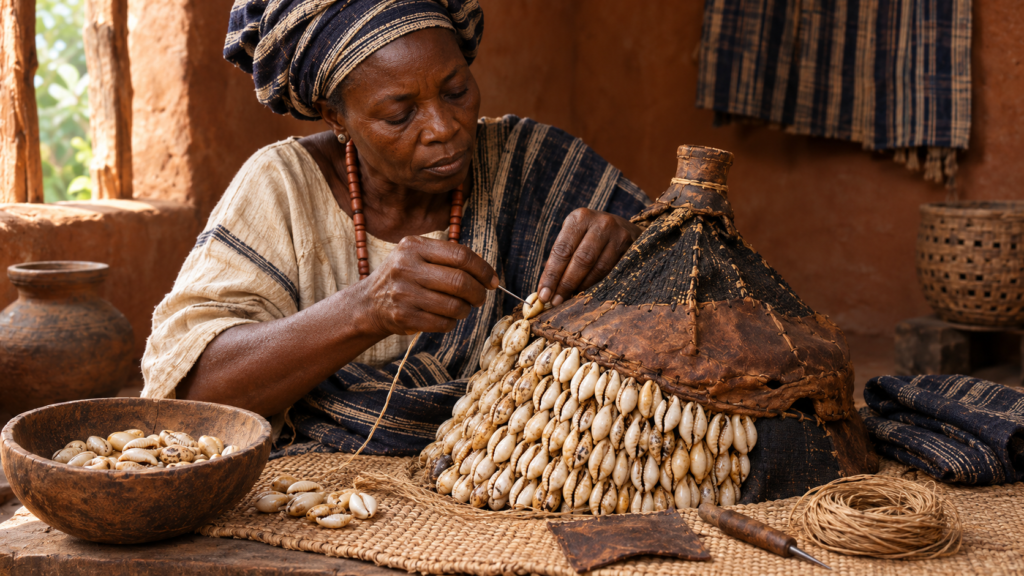
When numerous shells were attached to a ceremonial object, they could visually communicate abundance.
Their repeated arrangement also demonstrated the investment of labour and material resources.
The Metropolitan Museum of Art documents this relationship in its collection of Yoruba shrines.
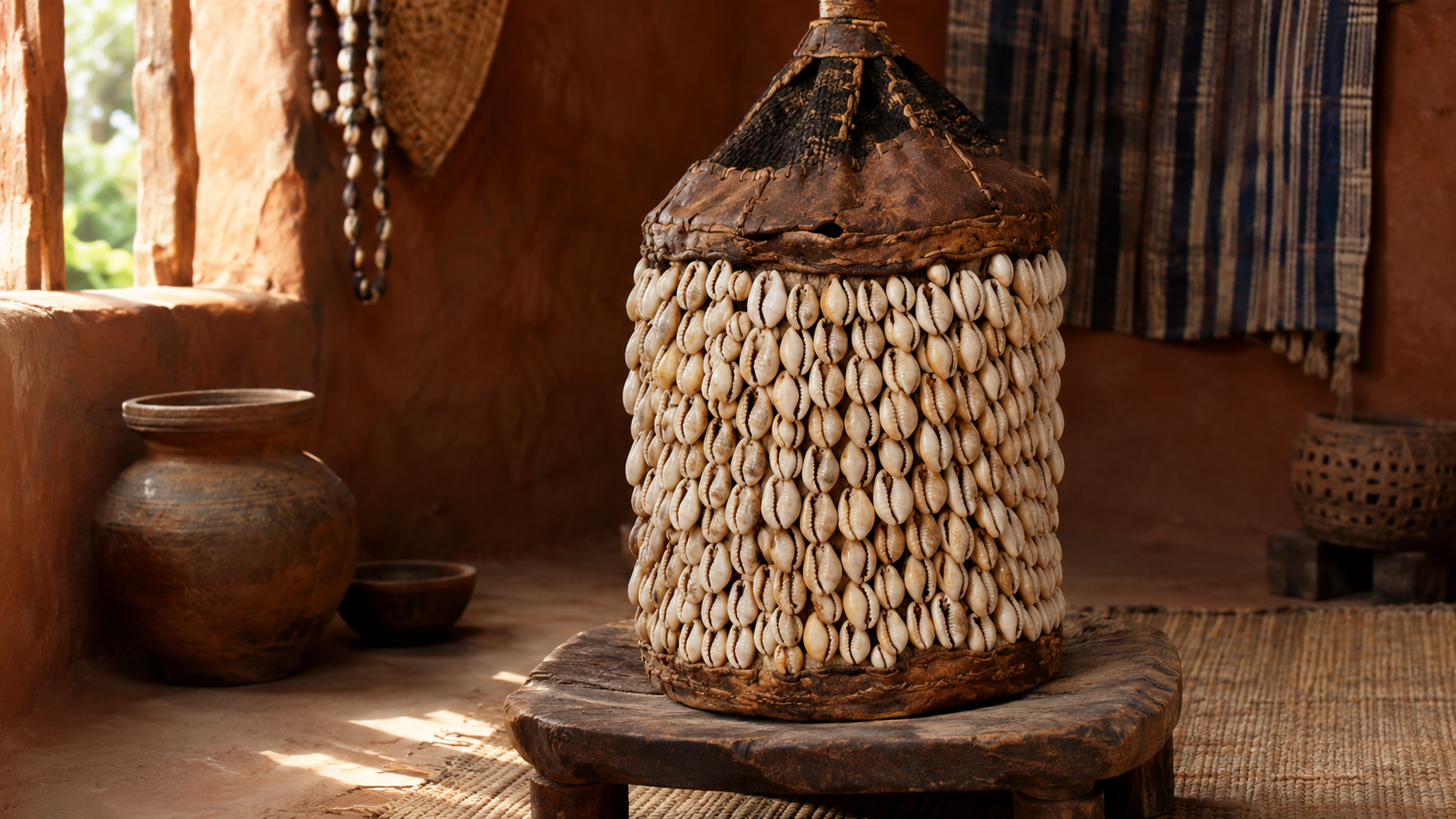
One particularly important example is an ilé-orí, or house for the head, decorated with dense rows of cowries.
The museum interprets the shells as an expression of material wealth and spiritual significance.
This demonstrates how economic value could become part of religious visual language.
The shells did not need to possess an invisible physical energy to communicate prosperity.
Their historical value and cultural associations already made them meaningful.
Understanding Orí in Yoruba Religious Thought
To understand the sacred role of cowrie shells, it is necessary to examine the Yoruba concept of Orí.
The word can refer to the head.
In Yoruba philosophical and religious traditions, it also carries meanings connected with personal identity, destiny and the inner self.
The Metropolitan Museum describes orí inú as the inner head.
This concept concerns the deepest aspects of an individual’s identity and destiny.
The Smithsonian National Museum of African Art similarly explains the importance of the head as the focus of spiritual significance.
However, Yoruba religious thought is not a single, unchanging system.
Interpretations may differ among communities, religious specialists and historical periods.
The concept of Orí should therefore be understood through specific cultural sources rather than reduced to a universal formula.
The Ilé-Orí: A House for the Inner Head
One of the most remarkable objects associated with Orí is the ilé-orí.
The term means house for the head.
Such objects were created to contain an ìbọrí, a representation associated with the owner’s inner head.
The Metropolitan Museum preserves a nineteenth- to twentieth-century example from southwestern Nigeria.
The object is constructed from cowrie shells, cotton, leather and other materials.
It measures approximately 35 centimetres in height.
Its surface is densely covered with carefully arranged cowries.
The museum explains that the shrine supported the owner’s relationship with the inner self.
The shells honoured the head through a lavish display of material wealth.
The resulting object united craftsmanship, personal identity and religious practice.
Twelve Thousand Cowries: Abundance and Sacred Display
The Metropolitan Museum describes the cowries covering one ilé-orí as symbolically numbering twelve thousand.
This should not be interpreted as a verified physical count of every shell on the object.
The number belongs to the museum’s explanation of the shrine’s symbolic abundance.
The dense decoration communicates extraordinary investment.
Each shell contributes to a larger visual structure.
The overall effect transforms a relatively simple natural material into an elaborate ceremonial object.
The significance arises from accumulation, arrangement and cultural meaning.
A single shell might have been economically modest.
Thousands of shells assembled together could express exceptional value.
The shrine therefore demonstrates how quantity and craftsmanship can transform the social meaning of natural materials.
The Ìbọrí and Personal Destiny
The ìbọrí is a representation associated with the inner head.
In documented Yoruba religious practice, it may be placed within an ilé-orí.
The Metropolitan Museum explains that the owner could cultivate a relationship with the inner self through the shrine.
Offerings might be made under the guidance of a babaláwo, an Ifá religious specialist.
The museum documents offerings such as kola nuts and gin in connection with one example.
These practices belong to a specific religious tradition.
They should not be confused with modern crystal-charging rituals.
The shrine’s meaning derives from Yoruba concepts of personhood, destiny and religious obligation.
Its cowrie decoration participates in that larger system.
The shells are not interchangeable with generic decorative crystals.
What Happens to a Shrine After Its Owner Dies?
One particularly revealing detail concerns the treatment of certain Orí shrines after the owner’s death.
The Metropolitan Museum documents a practice in which the ìbọrí could be turned onto its side.
The orderly arrangement of cowries on the ilé-orí could also be dismantled.
This action marked a transition associated with death and the spiritual world.
The significance lies in the deliberate transformation of the object.
During the owner’s life, the shrine expressed an ongoing relationship with the inner head.
Following death, its arrangement could be altered.
The object was therefore not merely a permanent decorative possession.
Its form and treatment could change according to the owner’s circumstances.
However, this documented practice should not be assumed to apply identically to every Yoruba community or historical period.
Cowries, Whiteness and Spiritual Meaning
The Smithsonian National Museum of African Art identifies cowrie shells with both wealth and the whiteness of spiritual power in certain Yoruba shrine contexts.
This is a culturally specific interpretation.
The shells’ pale surfaces contribute to the visual language of the object.
Their colour can participate in religious symbolism.
However, the meaning should not be reduced to a universal statement that all white stones or shells possess the same energy.
Colour symbolism varies across societies.
Even within a particular tradition, meanings may depend upon the object, ritual and religious association.
In the documented Yoruba shrine context, cowries communicate more than decoration.
Their whiteness and economic value contribute to the religious significance of the assembled object.
The Relationship Between Cowries and Ọ̀ṣun
Cowrie shells also appear in devotional contexts associated with Ọ̀ṣun, an important òrìṣà connected with rivers and other aspects of Yoruba religious life.
The Smithsonian National Museum of African Art preserves a carved mask attributed to Bamgboshe of Osi-Ilorin.
The work dates to the early twentieth century.
Its sculptural composition includes a kneeling female figure interpreted as a priestess of Ọ̀ṣun.
She holds strings of cowrie shells.
The museum explains that devotees of Ọ̀ṣun used cowries in divination.
This provides specific historical and artistic evidence for their religious use.
However, it does not establish that every cowrie shell belongs exclusively to Ọ̀ṣun.
The material appears in multiple Yoruba contexts.
Its meaning depends upon the religious practice and object involved.
Cowrie Shells and Divination
Divination is a practice through which people seek guidance or insight using culturally established procedures.
Cowrie shells have been used in several African and African-diasporic divinatory traditions.
Within Yoruba religious contexts, shell divination can involve interpreting the positions of cast shells according to learned systems.
However, different divination traditions should not be treated as interchangeable.
A shell-divination practice associated with a particular òrìṣà may differ from another system in its procedures and religious interpretation.
The Smithsonian’s documentation of Ọ̀ṣun devotees using cowries provides evidence of one such association.
The important point is that the shells function within an established interpretive tradition.
Their meaning is not determined simply by a supposed universal energy emitted by calcium carbonate.
Cowrie Divination Is Not the Same as Ifá Divination
This distinction is particularly important.
Ifá is a complex Yoruba divinatory and literary tradition.
UNESCO recognises the Ifá divination system as intangible cultural heritage.
Its documented procedures involve sacred palm nuts or a divination chain.
The resulting configurations correspond to an extensive corpus of interpretive literature.
The Smithsonian also documents Ifá diviners manipulating palm nuts and recording patterns on a divination tray.
Cowrie shells may appear on the decorations of diviners’ objects.
However, their decorative presence does not mean that they replace the palm nuts or divination chain in the specific Ifá procedures described by UNESCO.
Cowrie-shell divination and Ifá divination are related to broader Yoruba religious worlds, but they must not be casually described as the same technique.
The Babaláwo and the Search for Knowledge
A babaláwo is a specialist in the Ifá divination tradition.
The Metropolitan Museum preserves an elaborate diviner’s bag known as an apo Ifá.
The museum describes it as a portable accessory used by a religious specialist who travels to provide advice and develop knowledge.
The bag could contain divination implements.
Its exterior might incorporate cowrie shells or imported beads.
Such decoration was not necessarily ornamental in a purely secular sense.
The museum interprets the colour and material arrangements as expressions of the diviner’s vocation.
The bag demonstrates how objects used in religious practice could communicate knowledge, identity and authority.
Cowries formed one possible component of this visual language.
Cowrie Shells and Yoruba Ancestral Remembrance
Cowries also appear on objects associated with remembrance.
The Smithsonian preserves a Yoruba twin figure, or èrè ìbejì, decorated with cowrie shells.
The figure dates to the twentieth century.
In the documented tradition, such figures could commemorate a twin who had died.
They might be cared for through washing, oiling and adornment.
The museum explains that cowries could function as offerings and also refer to Ṣàngó, an òrìṣà associated with thunder and linked with twins in certain Yoruba traditions.
This example is significant because it demonstrates a different ceremonial context.
The shells are not simply money.
They are incorporated into an object associated with memory, care and religious relationships.
Their meaning arises from the practice surrounding the figure.
Sacred Objects Are Not Merely Decorations
When a cowrie shell is attached to a ritual object, its significance cannot be understood solely through its appearance.
The object may have a name.
It may belong to a particular person.
It may require specific forms of handling.
It may be associated with offerings or religious obligations.
Its materials may communicate wealth, identity or sacred relationships.
A museum photograph can document the physical object.
But it cannot fully reproduce the cultural relationships through which that object becomes meaningful.
This is why responsible interpretation should include the knowledge of the communities whose traditions produced and continue to engage with such objects.
The history of sacred materials is not simply a history of attractive ornaments.
It is also a history of relationships.
Cowrie Shells and the Material Expression of Mana or Spiritual Authority
Different cultures have different concepts of spiritual power.
It is therefore inappropriate to use terms from one tradition as universal labels for another.
In Yoruba contexts, discussions of sacred authority and spiritual significance should use the relevant Yoruba concepts.
The Metropolitan Museum and Smithsonian explain the importance of Orí and the sacred role of the head.
These concepts should not be automatically translated into the terminology of chakras, auras or universal crystal frequencies.
Such comparisons may be tempting for modern readers.
However, they risk obscuring the specificity of Yoruba religious thought.
The cowrie’s cultural meaning is best understood through the documented objects and practices in which it appears.
The Artistic Power of Repetition
Cowrie-decorated objects often use repeated rows or clusters of shells.
This creates a distinctive visual rhythm.
The shells may follow the contours of a shrine.
They may frame a figure.
They may cover a surface almost completely.
Their natural similarity makes repetition possible.
Yet each shell retains slight variations in shape and colour.
The result combines order with natural irregularity.
In an ilé-orí, this arrangement can communicate abundance and value.
The artistic structure contributes to the object’s significance.
The meaning is not located exclusively in an individual shell.
It emerges through the relationship between material, craftsmanship and cultural interpretation.
The Natural Science of Cowrie Shells
Cowrie shells are products of biological mineralisation.
Their structures form as mollusks deposit mineral and organic components.
Calcium carbonate is a major constituent.
This material is chemically different from silicate gemstones such as quartz or garnet.
The shell’s appearance depends upon its biological formation and surface structure.
Its smoothness, pattern and colour are natural properties.
These characteristics can be investigated scientifically.
However, the chemical composition of calcium carbonate does not establish that a shell influences personal destiny or produces supernatural protection.
Such claims belong to belief systems rather than demonstrated material science.
Why Cowries Are Not Crystals in the Conventional Gemmological Sense
Modern spiritual marketing sometimes groups shells, fossils, minerals and gemstones under the general term crystals.
From a scientific perspective, these categories should be distinguished.
A cowrie shell is a biological structure produced by a mollusk.
It contains mineral constituents, but it is not itself a single mineral crystal.
A quartz crystal develops through geological crystallisation.
A cowrie shell develops through biological processes.
Both may be used as ornaments.
Both may acquire cultural significance.
But their origins and structures differ.
Accurate terminology helps preserve the distinction between natural science and cultural interpretation.
Do Cowrie Shells Possess Protective Energy?
Some modern spiritual practitioners associate cowries with protection, prosperity, fertility or intuitive guidance.
These associations may be meaningful within particular contemporary practices.
However, they should not be presented as scientifically established properties.
There is no reliable scientific evidence that a cowrie shell emits a supernatural protective field.
Nor is there evidence that its calcium carbonate structure can alter destiny, cure illness or prevent misfortune through invisible energy.
Historical Yoruba religious interpretations should also not be reduced to such claims.
The significance of cowries in an Orí shrine arises from a documented cultural and religious framework.
It is not equivalent to a laboratory finding about the shell’s physical properties.
The Difference Between Prosperity Symbolism and Financial Claims
Cowries have a genuine historical connection with wealth because they were used as currency.
Their presence on ceremonial objects could communicate prosperity.
However, this does not mean that carrying a cowrie shell causes financial success.
The historical relationship is symbolic and economic.
It does not establish a supernatural mechanism.
A modern person may choose to wear a cowrie as a reminder of abundance or cultural heritage.
That is a personal interpretation.
It should not be advertised as a guaranteed means of attracting money.
The historical evidence is more interesting than a simplified promise of prosperity.
It reveals how a once-circulating form of currency could become a powerful visual element in religious art.
Cultural Respect and Modern Cowrie Jewellery
Cowrie shells are widely used in contemporary jewellery.
They appear in necklaces, bracelets, earrings and decorative accessories.
However, their historical significance differs across cultures.
A shell necklace worn as fashion is not automatically a Yoruba religious object.
Likewise, a ceremonial Yoruba shrine should not be treated as merely an elaborate piece of decorative shellwork.
Responsible appreciation requires attention to context.
Modern jewellery descriptions should avoid claiming sacred authority or ritual authenticity without evidence.
Historical forms should not be copied and marketed as ancient ceremonial objects when they are modern designs.
Where particular designs or objects carry community-specific significance, cultural knowledge and appropriate consultation matter.
The goal is not to prevent appreciation of cowries.
It is to distinguish general ornamental use from specific living religious traditions.
What the Museum Evidence Establishes
The surviving museum collections support several important conclusions.
Cowrie shells were used as currency in Yoruba communities.
They were also used as ritual offerings.
Some were imported through long-distance trade networks.
Cowries decorated Orí shrines and objects associated with personal destiny.
Their accumulation could communicate wealth and abundance.
Their pale surfaces contributed to religious symbolism in certain contexts.
They appeared in artistic representations of Ọ̀ṣun devotees.
They were attached to some commemorative twin figures.
They could decorate objects used by religious specialists.
However, these examples belong to different periods and practices.
They should not be combined into a single universal rule governing all Yoruba cowrie use.
The historical evidence demonstrates diversity, not uniformity.
The Importance of Living Traditions
Yoruba religious traditions are not simply relics of the past.
They continue to be practised and interpreted by communities in West Africa and the wider diaspora.
Their meanings are shaped by inherited knowledge, religious specialists, family traditions and changing historical circumstances.
Museum collections provide valuable evidence.
But they do not contain the entirety of living cultural knowledge.
An object collected in the nineteenth century may reflect one local practice.
A contemporary religious community may preserve related traditions while interpreting particular details differently.
Respectful research therefore distinguishes historical documentation from present-day religious practice.
It also avoids presenting a single museum object as representative of every Yoruba community.
Conclusion: A Shell Between the Ocean and the Spiritual World
The history of cowrie shells in Yoruba spirituality connects several remarkable worlds.
It begins with marine biology.
It continues through long-distance trade.
It enters markets as currency.
It appears in artistic objects as a symbol of prosperity.
It becomes part of shrines associated with personal destiny.
It participates in devotional and commemorative practices.
And it remains meaningful within living cultural traditions.
The shell itself is a natural biological structure.
Its religious significance develops through human relationships, inherited knowledge and ceremonial use.
Cowrie shells demonstrate that a natural material can become spiritually important because of its place within a cultural tradition, without requiring scientifically proven supernatural properties.
For Natural Gems Belgium, this history offers a valuable perspective on the relationship between natural materials and human belief.
Biology explains how cowrie shells form.
History explains their role in trade.
Art history reveals their use in ceremonial objects.
Religious studies investigates their connection with Orí, òrìṣà traditions and personal destiny.
Scientific inquiry establishes the limits of claims about their physical powers.
Together, these perspectives reveal a material whose significance extends far beyond its modest size.
A small shell once used as money could also become part of a carefully constructed expression of wealth, memory, identity and sacred relationship.
That cultural history deserves to be understood in its own terms.
References & Further Reading
1. Metropolitan Museum of Art – Ilé-Orí (House for the Head) Shrine with Ìbọrí
https://www.metmuseum.org/art/collection/search/310459
Source description: Official museum catalogue for a nineteenth- to twentieth-century Yoruba shrine decorated with cowrie shells. Explains the relationship between Orí, personal identity, offerings, symbolic abundance and the treatment of the shrine following its owner’s death.
2. Smithsonian National Museum of African Art – House of the Head
https://africa.si.edu/collection/object/nmafa_2014-32-16
Source description: Official Smithsonian collection record explaining the importance of the head in Yoruba religious thought and the use of cowrie-decorated shrine structures.
3. Smithsonian National Museum of African Art – Shrine Figure
https://africa.si.edu/collection/object/nmafa_2013-14-1
Source description: Museum record for a cowrie-covered Yoruba shrine figure. Discusses the association between cowrie shells, wealth, spiritual whiteness and the concept of the inner head.
4. Metropolitan Museum of Art – Ilé-Orí Shrine, Ekiti-Yoruba Peoples
https://www.metmuseum.org/art/collection/search/314971
Source description: Official collection record for a shrine created by an Adéṣínà compound artist. Explains how cowries, beads and other materials expressed leadership, prosperity and Yoruba concepts of personal identity.
5. Smithsonian National Museum of African Art – Face Mask by Bamgboshe of Osi-Ilorin
https://africa.si.edu/collection/object/nmafa_94-12-1
Source description: Authoritative museum record documenting a Yoruba ceremonial mask incorporating a representation of an Ọ̀ṣun priestess holding cowrie shells. Discusses historical cowrie trade, wealth symbolism and their use in divination.
6. Smithsonian National Museum of African Art – Female Twin Figure
https://africa.si.edu/collection/object/nmafa_73-7-253
Source description: Official collection record for a Yoruba commemorative twin figure decorated with cowries. Explains their role as currency, ritual offerings and symbols connected with Ṣàngó and twin remembrance.
7. Metropolitan Museum of Art – Diviner’s Bag (Apo Ifá)
https://www.metmuseum.org/art/collection/search/318332
Source description: Scholarly museum documentation of an Ifá diviner’s bag, its religious function, portable divination implements and the possible use of cowrie shells and beads in its decoration.
8. Smithsonian National Museum of African Art – Divination Board
https://africa.si.edu/collection/object/nmafa_84-15-1
Source description: Official museum record explaining the use of palm nuts and divination trays in Yoruba Ifá practice. Important for distinguishing Ifá divination from other forms of shell divination.
9. UNESCO – Ifá Divination System
https://ich.unesco.org/en/RL/ifa-divination-system-00146
Source description: UNESCO’s authoritative documentation of the Ifá divination tradition, including its oral literary corpus, religious specialists, palm nuts, divination chains and transmission of cultural knowledge.
10. Metropolitan Museum of Art – Òdìgbà Ifá or Idè Ifá, Diviner’s Ceremonial Necklace
https://www.metmuseum.org/art/collection/search/844647
Source description: Official collection record discussing Yoruba beadwork as a devotional medium, the importance of colour and light, and the incorporation of shells and other precious materials into religious regalia.
Historical, Cultural and Scientific Distinctions
Scientifically established: Cowrie shells are biological structures produced by marine gastropod mollusks and consist largely of calcium carbonate.
Historically documented: Cowries circulated as currency and were used in ritual offerings among Yoruba communities.
Historically documented: Cowrie shells were incorporated into Yoruba shrines, ornaments and commemorative objects.
Religious tradition: Orí is associated with the inner head, personal identity and destiny in Yoruba religious thought.
Museum-documented interpretation: Cowries on certain ilé-orí shrines expressed wealth, abundance and spiritual significance.
Historically documented: Cowrie shells appeared in devotional contexts associated with Ọ̀ṣun and in certain divination practices.
Important distinction: Ifá divination, as documented by UNESCO, uses sacred palm nuts or a divination chain; it should not be confused with all forms of cowrie-shell divination.
Cultural interpretation: Cowries may communicate prosperity, sacred relationships, remembrance or personal identity depending on their specific context.
Modern metaphysical belief: Some contemporary spiritual traditions associate cowrie shells with protection, abundance, intuition or personal harmony.
Scientific limitation: There is no reliable scientific evidence that cowrie shells generate supernatural protective energy, alter destiny, attract money or cure medical conditions.
Cowrie shells demonstrate how a natural material can move between economic, artistic and religious worlds.
Their formation belongs to marine biology.
Their historical circulation belongs to economic history.
Their ceremonial use belongs to Yoruba art and religious traditions.
Their supposed supernatural physical effects remain matters of belief rather than scientifically established facts.