Table of Contents
Introduction: The Difference Between Hard and Unbreakable
Diamond is the hardest natural mineral on the Mohs scale.
Yet a diamond can chip.
Topaz has a Mohs hardness of 8, making it considerably more scratch-resistant than quartz.
Yet a sharp blow can split a topaz crystal.
Kunzite may display beautiful transparency and an impressive polished surface, but it requires special care during cutting and jewellery setting.
Fluorite can form remarkable cubic crystals, yet it is vulnerable to breakage along specific crystallographic directions.
These examples demonstrate an important principle in gemmology.
Hardness does not mean that a gemstone is unbreakable.
The resistance of a gemstone to scratching is different from its resistance to chipping, cracking or splitting.
To understand why some stones break more easily than others, we must examine their internal crystal structures.
Two concepts are particularly important: cleavage and fracture.
Both describe ways in which minerals break, but they involve different structural mechanisms.
Understanding these properties helps gemstone cutters, jewellers, collectors and buyers make better decisions about handling, setting and preserving natural gemstones.
1. Three Different Properties of Gemstone Durability
The Gemological Institute of America identifies three principal aspects of gemstone durability: hardness, toughness and stability.
These properties describe different responses to external conditions.
Hardness
Hardness measures resistance to scratching and abrasion.
The Mohs scale ranks minerals according to their relative scratch resistance.
Diamond has a hardness of 10.
Corundum, including ruby and sapphire, has a hardness of 9.
Topaz has a hardness of 8.
Quartz has a hardness of 7.
Fluorite has a hardness of 4.
However, the Mohs scale is ordinal rather than linear.
The difference between 9 and 10 does not represent the same increase in hardness as the difference between 4 and 5.
Toughness
Toughness concerns resistance to breaking, chipping and fracture.
A gemstone can be highly resistant to scratches while remaining vulnerable to a sharp impact.
Toughness is influenced by atomic bonding, crystal structure, defects and existing fractures.
Stability
Stability describes resistance to environmental influences such as heat, light, chemicals and humidity.
A gemstone may be hard and reasonably tough but sensitive to heat or chemical exposure.
These three properties must be considered separately.
2. What Is Gemstone Cleavage?
Cleavage is the tendency of a crystalline mineral to break along particular crystallographic planes.
These planes are related to the arrangement and bonding of atoms within the crystal.
In some directions, the crystal structure offers relatively favourable paths for separation.
When sufficient stress is applied, the mineral may split along these planes.
The resulting surfaces can be relatively flat and smooth.
Cleavage is not a random imperfection.
It is an intrinsic property of the mineral’s crystal structure.
However, the presence of a cleavage direction does not mean that every crystal will split easily during normal handling.
The likelihood of damage depends on the mineral, the direction and magnitude of applied force, existing defects and the shape of the specimen.
Cleavage is particularly important during cutting, polishing and jewellery setting.
A cutter may need to orient a crystal to reduce the risk of splitting.
A jeweller may need to avoid concentrating pressure along a vulnerable direction.
Collectors should also recognise that a mineral specimen can possess excellent crystal form while remaining mechanically fragile.
3. Why Do Crystals Have Cleavage Planes?
Crystals consist of atoms arranged in repeating structures.
The bonding arrangement is not always mechanically equivalent in every direction.
Some crystallographic planes provide more favourable paths for crack propagation than others.
When stress concentrates along such a direction, a crack may extend through the crystal.
This can produce a relatively flat cleavage surface.
The process is governed by crystal structure and fracture mechanics.
It is not simply a matter of the mineral being soft.
Diamond provides a particularly important example.
Its carbon atoms are strongly bonded in a three-dimensional network.
This structure gives diamond exceptional hardness.
Nevertheless, diamond possesses perfect octahedral cleavage.
A sufficiently strong impact under favourable conditions can cause it to split.
The coexistence of exceptional hardness and distinct cleavage is not contradictory.
The two properties describe different mechanical behaviours.
4. Cleavage Quality and Cleavage Directions
Mineralogists describe cleavage using terms such as perfect, good, distinct, poor or indistinct.
These terms describe how readily and cleanly a mineral tends to separate along particular planes.
Perfect cleavage can produce smooth, well-defined surfaces.
Poor or indistinct cleavage is more difficult to recognise.
Minerals can also possess cleavage in different numbers of crystallographic directions.
For example, topaz has one principal direction of perfect basal cleavage.
Kunzite, a variety of spodumene, has two directions of perfect cleavage.
Diamond has four equivalent octahedral cleavage directions.
Fluorite also has four octahedral cleavage directions.
These directions are related to the symmetry and atomic arrangement of each mineral.
However, cleavage direction should not be confused with the external shape of a crystal.
A mineral may form one characteristic crystal habit while breaking along planes that intersect that habit at particular angles.
5. What Is Gemstone Fracture?
Fracture describes breakage that does not follow the mineral’s characteristic cleavage planes.
Unlike cleavage, fracture does not necessarily produce flat crystallographic surfaces.
Fracture surfaces can be curved, irregular, splintery or uneven.
One important type is conchoidal fracture.
Conchoidal fracture produces curved, shell-like surfaces.
Quartz commonly exhibits this type of breakage.
Obsidian, a natural volcanic glass, is another familiar example.
A gemstone does not need to possess cleavage in order to break.
Minerals without significant cleavage can still fracture when sufficient stress is applied.
Fracture can also occur in minerals that possess cleavage, depending on the direction and conditions of the applied force.
Therefore, cleavage and fracture are not mutually exclusive descriptions of a mineral’s possible breakage behaviour.
6. Cleavage, Fracture and Parting: Three Different Concepts
A third term is important in mineralogy: parting.
Parting can resemble cleavage because it may produce relatively flat surfaces.
However, it differs in origin.
Cleavage is an intrinsic crystallographic property.
Parting occurs along planes of weakness associated with particular structural features, such as twinning or other defects.
These planes may not be present in every specimen of the mineral.
Corundum provides an instructive example.
Ruby and sapphire generally lack true cleavage.
However, some corundum crystals can exhibit parting associated with twinning or other structural features.
Consequently, a flat break in a gemstone should not automatically be identified as cleavage.
Correct interpretation requires knowledge of the mineral and its structure.
This distinction is especially important in gemmological education and mineral identification.
7. Diamond: The Hardest Mineral Can Still Chip
Diamond has a Mohs hardness of 10.
Its exceptional scratch resistance makes it highly suitable for many jewellery applications.
However, diamond is not immune to mechanical damage.
GIA documents diamond chipping and breakage associated with cleavage planes.
Diamond has perfect octahedral cleavage.
A sharp impact may initiate or extend a crack along a favourable direction.
Certain gemstone shapes are particularly vulnerable.
Pear-shaped and marquise-cut diamonds have pointed ends.
Princess-cut diamonds possess exposed corners.
Very thin girdles can also increase the risk of chipping.
The vulnerability is influenced by the stone’s shape, setting and existing internal characteristics.
A protective jewellery setting can reduce the likelihood of impact damage.
For example, appropriately designed V-shaped prongs can help protect pointed corners.
A bezel setting may protect portions of the girdle.
Nevertheless, no setting makes a gemstone completely immune to damage.
The lesson is straightforward.
Diamond’s exceptional hardness does not eliminate the possibility of cleavage-related breakage.
8. Topaz: Hardness 8, but Perfect Cleavage
Topaz provides one of the clearest examples of the difference between hardness and toughness.
It has a Mohs hardness of 8.
This makes it relatively resistant to scratching.
However, topaz possesses perfect basal cleavage.
A sufficiently strong blow can cause it to split along that direction.
GIA specifically identifies topaz as requiring special care during cutting, polishing and mounting.
Professional cutters consider the cleavage orientation when planning a faceted stone.
GIA describes an approach in which the cleavage direction is oriented at approximately 15 degrees to the table to reduce cutting-related risks.
This is a specialist cutting consideration rather than a universal instruction for every specimen.
For jewellery owners, the practical implication is to avoid sharp impacts.
Topaz rings should be protected from activities that may subject the stone to knocks.
GIA also recommends avoiding ultrasonic and steam cleaning for topaz.
Warm, soapy water is generally the preferred cleaning method.
9. Kunzite: Two Directions of Perfect Cleavage
Kunzite is the pink-to-violet variety of spodumene.
It has a Mohs hardness of approximately 6.5 to 7.
Its attractive transparency and colour make it suitable for faceted gemstones.
However, kunzite has two directions of perfect cleavage.
GIA describes its toughness as poor because of this cleavage.
A sharp blow, excessive pressure or sudden temperature change can cause damage.
This creates challenges during cutting and setting.
A cutter must consider the orientation of the rough crystal.
A jeweller must avoid excessive pressure during mounting.
Protective settings are often preferable.
Pendants, earrings and pins may be more suitable for some kunzite gemstones than rings exposed to frequent impacts.
Kunzite also has documented sensitivity to prolonged intense light and heat.
Its mechanical fragility and colour stability are separate considerations, but both influence appropriate care.
10. Fluorite: Beautiful Crystals with Four Cleavage Directions
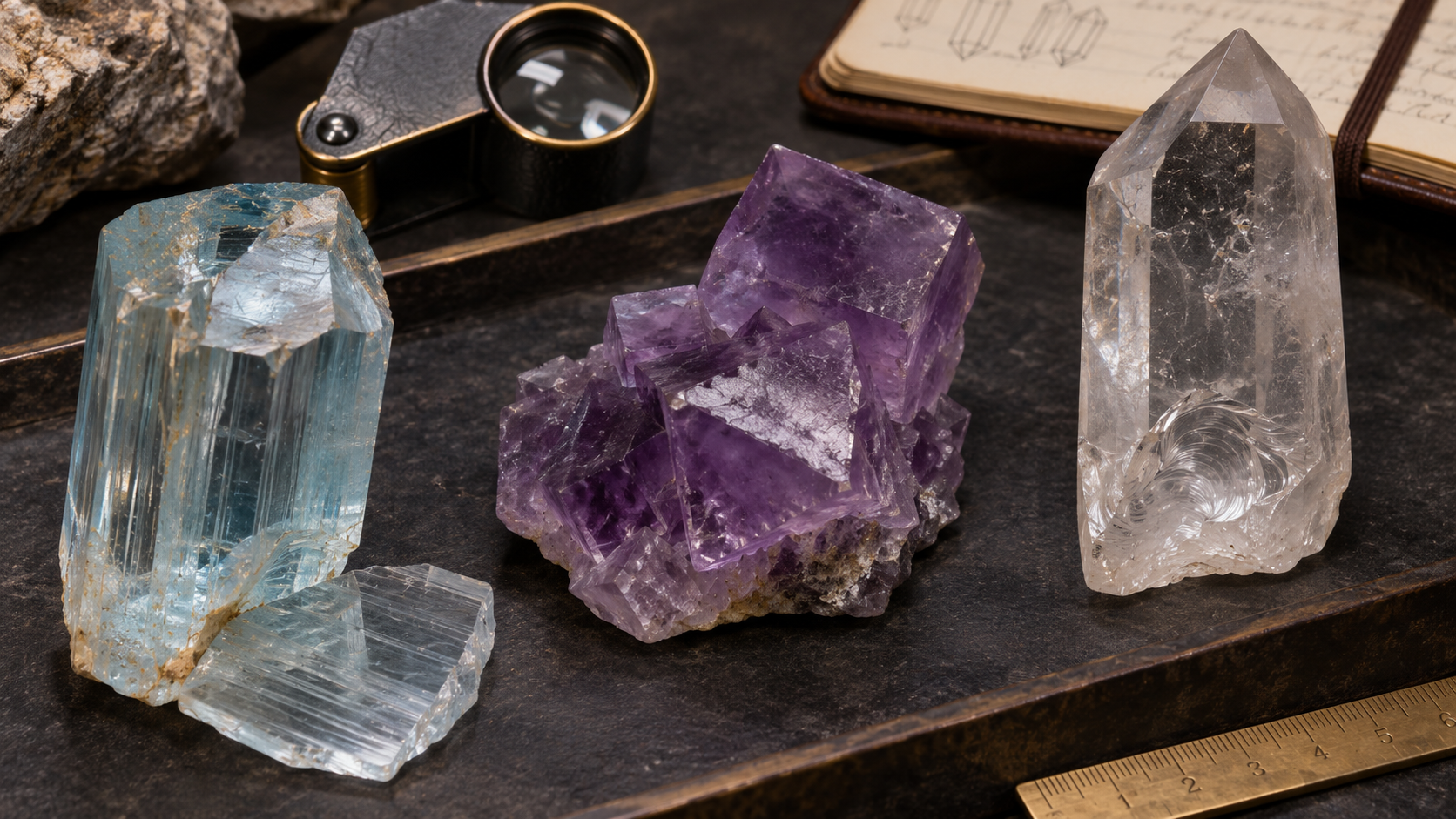
Fluorite is calcium fluoride, CaF₂.
It commonly forms cubic crystals and can occur in attractive purple, green, blue, yellow and colourless varieties.
Fluorite has a Mohs hardness of 4.
It also possesses perfect octahedral cleavage in four directions.
This combination makes fluorite relatively vulnerable to scratching and breakage.
The cleavage geometry is particularly interesting.
Although fluorite frequently forms cubic crystals, it can break along octahedral planes.
These planes do not simply correspond to the external faces of the cube.
Collectors should avoid assuming that a cubic fluorite crystal is mechanically strongest or weakest only in directions parallel to its visible faces.
For mineral specimens, careful support and handling are important.
A large fluorite cluster may contain multiple crystals with exposed edges and naturally fractured areas.
Such specimens should be lifted by stable supporting matrix where appropriate, rather than by individual crystal points.
Fluorite is often better suited to protected display or decorative use than to jewellery exposed to frequent abrasion and impact.
11. Quartz: No Prominent Cleavage, but Still Breakable
Quartz has a Mohs hardness of 7.
It is relatively resistant to everyday scratching compared with softer minerals.
Quartz does not possess prominent cleavage.
Instead, it commonly exhibits conchoidal fracture.
This means that quartz can break along curved or irregular surfaces rather than predictable cleavage planes.
Amethyst, citrine, smoky quartz and rock crystal share the basic quartz structure.
They therefore share important mechanical characteristics.
However, the absence of cleavage does not make quartz unbreakable.
A pointed amethyst crystal can chip.
A quartz sphere can crack if dropped.
A thin quartz carving may break under impact.
Existing fractures, inclusions and geometric weaknesses can increase vulnerability.
The absence of perfect cleavage is an advantage in some applications, but it is not a guarantee of exceptional toughness.
12. Ruby and Sapphire: Hardness Without Prominent Cleavage
Ruby and sapphire are varieties of corundum.
They have a Mohs hardness of 9.
Corundum generally lacks true cleavage, although parting may occur in some specimens.
This combination contributes to the suitability of many rubies and sapphires for jewellery.
However, corundum can still fracture or chip.
A sharp impact may damage a vulnerable corner or thin girdle.
Existing fractures may influence the behaviour of an individual gemstone.
Some heavily included or fracture-filled materials require additional precautions.
Treatment can also influence appropriate cleaning methods.
Consequently, the high hardness of corundum should not be interpreted as complete resistance to mechanical damage.
Its practical durability depends on the individual specimen, cut and setting.
13. Emerald: When Existing Fractures Matter
Emerald is the green variety of beryl.
Its Mohs hardness is approximately 7.5 to 8.
However, many natural emeralds contain visible inclusions and fractures.
These internal features can influence toughness.
An existing fracture may provide a pathway for crack propagation when the stone experiences stress.
This is different from the predictable crystallographic cleavage found in topaz or diamond.
Emeralds may also be treated with oils or resins to reduce the visibility of surface-reaching fractures.
Such treatments can introduce additional cleaning and stability considerations.
GIA recommends caution with ultrasonic and steam cleaning for emeralds, particularly when fracture filling is present.
The practical lesson is that gemstone durability depends not only on mineral identity but also on the condition of the individual stone.
Two emeralds of similar hardness may behave differently because of their internal characteristics.
14. Why Existing Fractures Increase Breakage Risk
A pre-existing crack can concentrate stress at its tip.
When force is applied, the crack may extend.
This is a fundamental concept in fracture mechanics.
A gemstone with a significant internal fracture may therefore be more vulnerable than a similar stone without that feature.
However, not every visible inclusion is a fracture.
An enclosed mineral crystal, a growth feature and a surface-reaching crack are different characteristics.
Their effects on durability can differ.
A gemmological examination can help distinguish them.
For rough faceting material, the position and orientation of fractures are particularly important.
A large rough crystal may contain only a limited volume of usable material.
The cutter must consider whether the intended shape can be produced without intersecting critical fractures.
15. Why Gemstone Shape Influences Damage Risk
A gemstone’s shape affects how external forces are distributed.
Pointed corners can concentrate stress.
Thin girdles may be more vulnerable to chipping.
Exposed edges can suffer direct impacts.
This is why gemstone design and jewellery setting are closely related.
A rounded cabochon generally lacks the sharp facet junctions of a faceted stone.
However, a cabochon can still crack or break.
A pear-shaped faceted gemstone may require protection at its pointed end.
A princess-cut stone may benefit from carefully designed corner protection.
Large mineral crystals with delicate terminations require similar consideration.
The most vulnerable part of a specimen is not necessarily the largest or most visually prominent area.
Small exposed points can be particularly susceptible to damage.
16. The Role of Jewellery Settings
Jewellery settings do more than hold gemstones in place.
They can also provide mechanical protection.
A bezel setting surrounds part or all of the gemstone’s perimeter.
This can reduce exposure to certain impacts.
V-shaped prongs can help protect pointed gemstone corners.
Other settings may leave more of the gemstone exposed.
However, the suitability of a setting depends on the mineral, cut, size and intended use.
A setting that protects a diamond may not be ideal for a fragile kunzite or heavily fractured emerald.
Setting pressure is another concern.
Excessive force during mounting can damage gemstones with pronounced cleavage or existing fractures.
Professional jewellers must consider these risks when selecting tools and applying pressure.
A protective setting reduces risk but cannot eliminate it completely.
17. Cutting Rough Gemstones: Why Orientation Matters
Gemstone cutters evaluate rough material before deciding how to shape it.
The crystal’s external form is only one consideration.
Internal fractures, colour zoning, inclusions and cleavage directions may influence the cutting plan.
For topaz and kunzite, cleavage is particularly important.
A cutter may choose an orientation that reduces the likelihood of splitting during sawing, grinding or polishing.
However, avoiding cleavage-related problems may require sacrificing weight.
The best cutting orientation for colour may not be the best orientation for mechanical safety.
A large rough crystal can therefore present several competing objectives.
The cutter may need to balance finished weight, colour, optical performance and structural integrity.
This is one reason why the commercial value of rough gemstones cannot be determined from weight alone.
18. Rough Crystals and Mineral Specimens
Natural mineral specimens are often valued for their original crystal form.
Preserving that form requires careful handling.
Crystal clusters can contain delicate terminations.
Some crystals are attached to matrix through relatively small contact areas.
Others contain natural fractures that are not immediately visible.
A specimen may also include several minerals with different mechanical properties.
For example, a pegmatite specimen can contain quartz, feldspar, mica and tourmaline.
Each component has different structural characteristics.
A handling method suitable for one mineral may not be appropriate for another.
Collectors should therefore support specimens from their most stable areas.
Avoid lifting large clusters by isolated crystal points.
Use padded surfaces when examining fragile material.
For valuable specimens, a fitted support or display stand may reduce the risk of accidental movement.
19. Cleaning Risks: Ultrasound, Steam and Temperature Changes
Cleaning can introduce mechanical and thermal stress.
Ultrasonic cleaners use high-frequency vibrations in a liquid medium.
These systems are useful for some jewellery materials, but they are not universally safe.
Gemstones with significant fractures, cleavage-related vulnerability or certain treatments may be unsuitable.
Steam cleaning can introduce heat and rapid temperature changes.
GIA specifically advises against steam and ultrasonic cleaning for topaz and kunzite.
For many fragile gemstones, mild soap and lukewarm water are safer options.
However, even water-based cleaning is not suitable for every mineral or treated specimen.
Some porous, soluble or environmentally sensitive materials require different procedures.
Collectors should identify the material and consider known treatments before cleaning.
Never assume that a gemstone is safe for ultrasonic cleaning simply because its Mohs hardness is high.
20. A Practical Comparison of Gemstone Breakage Risks
| Gemstone | Mohs hardness | Important mechanical characteristic |
|---|---|---|
| Diamond | 10 | Perfect octahedral cleavage; vulnerable to sharp impacts at certain orientations |
| Ruby and sapphire | 9 | No true cleavage; can fracture or exhibit parting |
| Topaz | 8 | Perfect basal cleavage |
| Emerald | 7.5–8 | Fractures and inclusions may reduce toughness |
| Quartz / amethyst | 7 | No prominent cleavage; commonly conchoidal fracture |
| Kunzite | 6.5–7 | Two directions of perfect cleavage |
| Fluorite | 4 | Perfect octahedral cleavage in four directions |
These values and descriptions provide general mineralogical guidance.
They do not establish the durability of every individual specimen.
Existing fractures, treatments, cutting geometry and mounting conditions can significantly influence practical behaviour.
21. Common Misconceptions About Cleavage and Fracture
Diamond cannot break because it is the hardest gemstone.
Incorrect. Diamond has perfect cleavage and can chip or fracture.
Topaz is safe from breakage because its hardness is 8.
Incorrect. Its perfect basal cleavage creates a significant vulnerability.
Quartz has no cleavage, so it cannot crack.
Incorrect. Quartz can fracture and chip.
All flat breaks are cleavage surfaces.
Incorrect. Parting and other fracture processes can also produce relatively flat surfaces.
Every inclusion makes a gemstone fragile.
Incorrect. The effect depends on the nature, position and extent of the inclusion.
A protective setting makes a gemstone unbreakable.
Incorrect. Settings reduce certain risks but cannot eliminate all mechanical damage.
A gemstone with high hardness is automatically suitable for ultrasonic cleaning.
Incorrect. Cleaning suitability depends on several properties and treatments.
A mineral specimen should always be lifted by its largest crystal.
Incorrect. The crystal may be poorly supported or attached through a fragile contact.
22. Practical Workshop: How to Assess a Gemstone Before Handling
This workshop is designed for collectors and gemstone owners.
It does not involve scratch testing, impact testing or deliberate breakage.
Step 1 – Identify the gemstone
Determine the mineral species or variety as reliably as possible.
If identification is uncertain, avoid assumptions about durability.
Step 2 – Review its known mechanical properties
Check whether the mineral has prominent cleavage.
Consider its general toughness and fracture behaviour.
Step 3 – Inspect the visible condition
Under suitable lighting, look for existing chips, cracks, exposed corners and fragile crystal terminations.
Do not assume that every internal line is a fracture.
Step 4 – Identify vulnerable areas
Consider thin edges, pointed corners, delicate attachments and unsupported projections.
Step 5 – Select a safe handling method
Support the specimen from a stable area.
Avoid concentrated pressure on individual crystals or vulnerable gemstone edges.
Step 6 – Choose appropriate storage
Use separate compartments, padded supports or fitted display stands where necessary.
Avoid allowing harder gemstones to rub against softer materials.
Step 7 – Avoid unsuitable cleaning
Do not use ultrasonic or steam cleaning unless the material and its treatment status are known to be compatible.
Step 8 – Document existing damage
Photographs can help record chips, fractures and condition changes over time.
Use consistent lighting and viewing angles.
Step 9 – Seek professional advice
For valuable gemstones, significant fractures or damaged jewellery settings, consult a qualified gemmologist or experienced jeweller.
Do not attempt to test cleavage by striking or bending the specimen.
23. What Cleavage and Fracture Mean for Gemstone Grading
Mechanical characteristics can influence gemstone quality evaluation.
However, they should not be reduced to a universal penalty.
For faceted gemstones, fractures and chips may affect clarity, appearance and durability.
For rough faceting material, cleavage and fracture orientation can influence cutting potential.
For decorative rough, natural fractures may form part of the specimen’s character.
For mineral collectors, a natural cleavage surface may be scientifically interesting.
The significance depends on the intended use.
A naturally cleaved fluorite specimen is not necessarily defective.
A faceted topaz with a major surface-reaching fracture may require greater caution.
A quartz crystal with a small natural contact mark may remain an excellent collector’s specimen.
The correct evaluation considers the individual material and its purpose.
24. Why Scientific Transparency Matters
Gemstone durability is frequently oversimplified in commercial descriptions.
Statements such as “extremely hard” or “scratch-resistant” can be accurate but incomplete.
They do not necessarily describe toughness.
A more informative description distinguishes between hardness, cleavage and existing fractures.
For example, topaz can be accurately described as a relatively hard gemstone with perfect cleavage.
Kunzite can be described as a transparent gem material that requires protection from sharp impacts.
Fluorite can be presented as an attractive collector mineral requiring careful handling.
Diamond can be described as exceptionally scratch-resistant while still susceptible to chipping.
These distinctions help buyers understand the actual properties of the material.
They also support realistic expectations about jewellery wear and specimen preservation.
Conclusion: Hardness Is Only One Part of Durability
Gemstone cleavage and fracture reveal how internal crystal structure influences mechanical behaviour.
Cleavage occurs along particular crystallographic planes.
Fracture describes breakage that does not follow those characteristic planes.
Parting can produce cleavage-like surfaces through structural weaknesses that are not inherent to every crystal of the mineral.
Diamond demonstrates that exceptional hardness does not prevent chipping.
Topaz and kunzite show why perfect cleavage requires careful cutting and handling.
Fluorite illustrates the importance of cleavage in mineral specimens.
Quartz demonstrates that a mineral without prominent cleavage can still break.
Ruby, sapphire and emerald show how different structural characteristics and existing fractures influence practical durability.
The most important principle is simple.
A gemstone’s resistance to scratching does not determine its resistance to breaking.
For jewellery buyers, this means considering gemstone type, cut, setting and intended use.
For collectors, it means supporting delicate specimens and avoiding unnecessary pressure.
For gemstone cutters, it means understanding crystal orientation and internal characteristics before shaping the rough.
And for responsible gemstone descriptions, it means communicating durability accurately rather than relying on the Mohs hardness number alone.
Understanding cleavage and fracture helps preserve the beauty and scientific integrity of natural gemstones for years to come.
References & Further Reading
The following references are authoritative educational and gemmological sources. They explain gemstone durability, cleavage, fracture, toughness, cutting considerations and practical care. The links lead to informational resources rather than gemstone product listings.
1. Gemological Institute of America – More Than the Mohs Scale: Understanding Gem Durability
An authoritative introduction to the differences between hardness, toughness and stability, including cleavage-related damage and appropriate jewellery care.
https://4cs.gia.edu/en-us/blog/more-than-mohs-scale-gem-durability
2. Gemological Institute of America – How to Protect Your Diamond from Chipping
Explains diamond cleavage, fracture toughness, vulnerable cutting shapes and the importance of protective jewellery settings.
https://www.gia.edu/gia-news-research/how-protect-diamond-chipping
3. Gemological Institute of America – Topaz Care and Cleaning Guide
Documents topaz hardness, perfect basal cleavage, cutting orientation, impact vulnerability and recommended cleaning precautions.
https://www.gia.edu/topaz-care-cleaning
4. Gemological Institute of America – Kunzite Care and Cleaning
Explains kunzite’s two directions of perfect cleavage, poor toughness, sensitivity to mechanical stress and recommended handling practices.
https://www.gia.edu/kunzite-care-cleaning
5. International Gem Society – What Is Gemstone Cleavage?
Author: Joel E. Arem, Ph.D., FGA
Updated: 6 January 2025
An educational explanation of cleavage, fracture and parting, including the crystallographic origins of cleavage planes.
https://www.gemsociety.org/article/cleavage-gemology
6. International Gem Society – The Mohs Hardness Scale and Chart for Select Gems
Explains the relative nature of Mohs hardness and why scratch resistance should not be confused with toughness or resistance to impact.
https://www.gemsociety.org/article/select-gems-ordered-mohs-hardness
7. International Gem Society – Topaz Facet / Faceting Information
Author: Jeff R. Graham
Updated: 20 July 2021
Provides practical information on topaz cleavage, crystal orientation and cutting considerations.
https://www.gemsociety.org/article/topaz-facet-faceting-information
8. Gemological Institute of America – Gem Encyclopedia
An institutional reference for gemstone properties, including mineral identity, hardness, care requirements and durability considerations.
https://www.gia.edu/gem-encyclopedia
Scientific Interpretation and Limitations
Cleavage is an intrinsic crystallographic property, but the likelihood of actual breakage depends on stress orientation, magnitude, existing defects and specimen geometry.
Mohs hardness measures relative scratch resistance and should not be used as a direct measure of fracture toughness.
General mineralogical properties do not establish the mechanical condition of an individual gemstone.
Parting and cleavage are distinct phenomena, even when their visible surfaces appear similar.
Cleaning and handling recommendations must consider gemstone identity, treatments, inclusions, fractures and mounting conditions.
The practical workshop in this article is non-destructive and intended for educational observation.
Do not attempt to identify cleavage by deliberately striking, bending or breaking valuable gemstones.
For significant damage or valuable jewellery, seek qualified professional assessment.