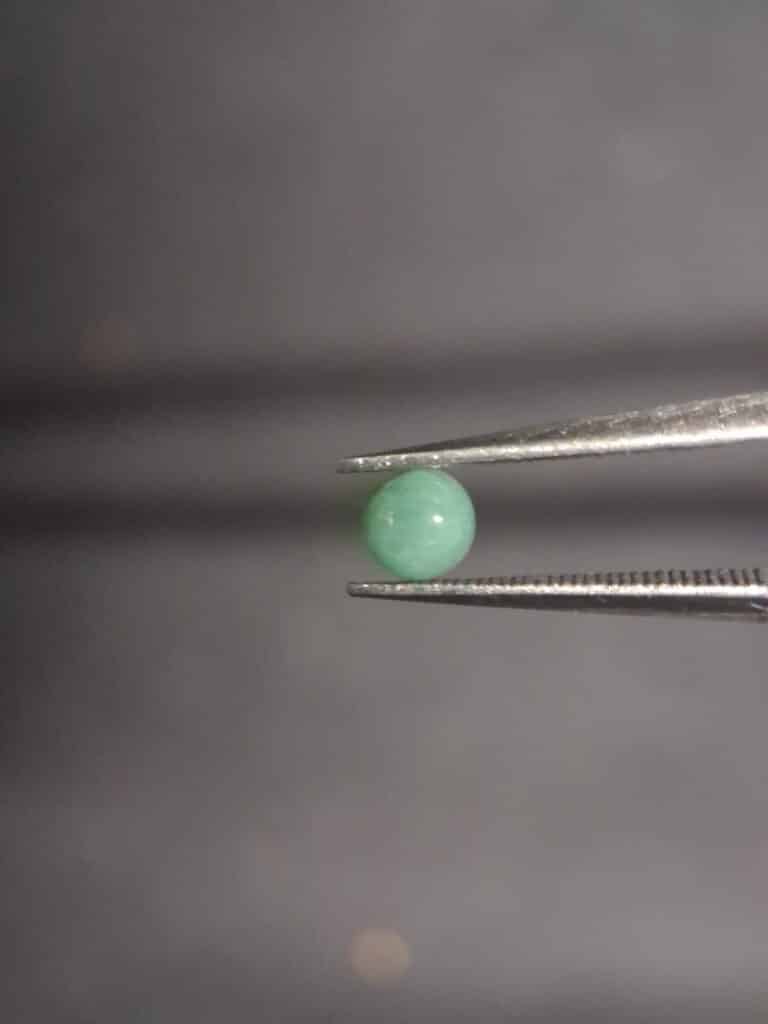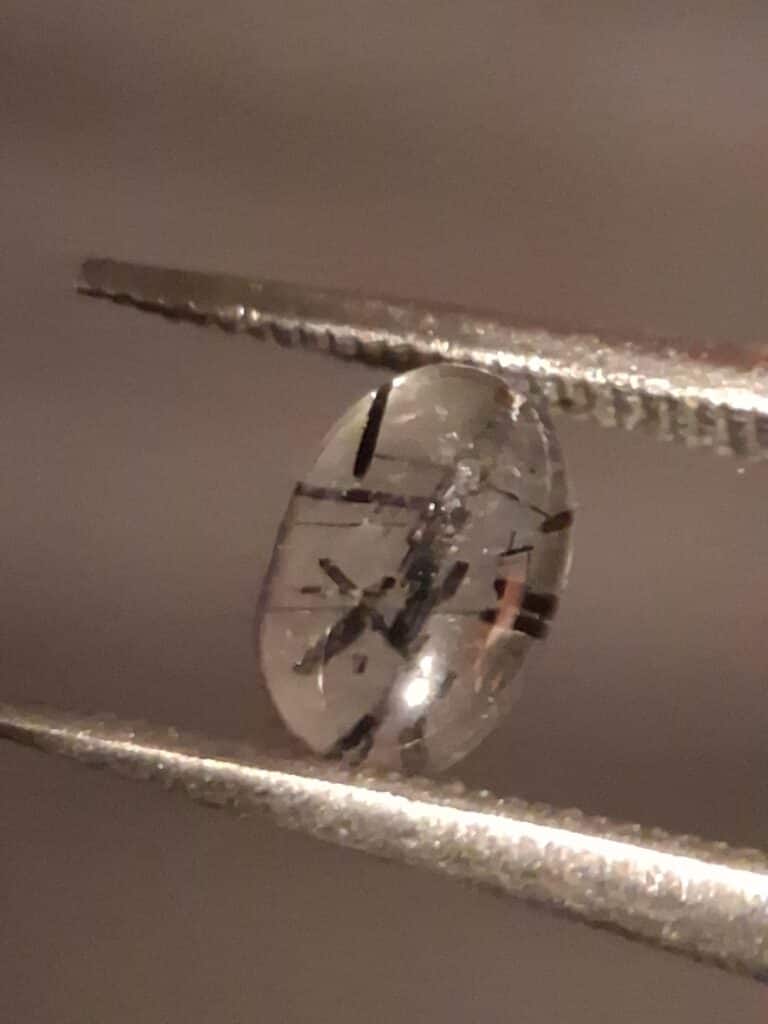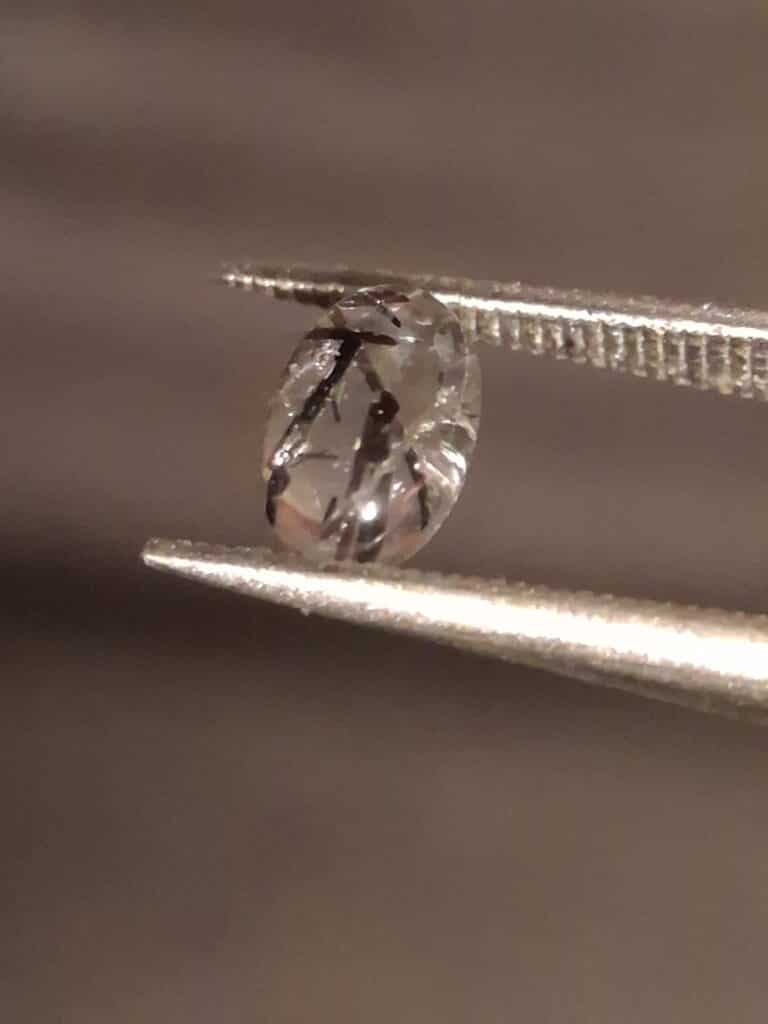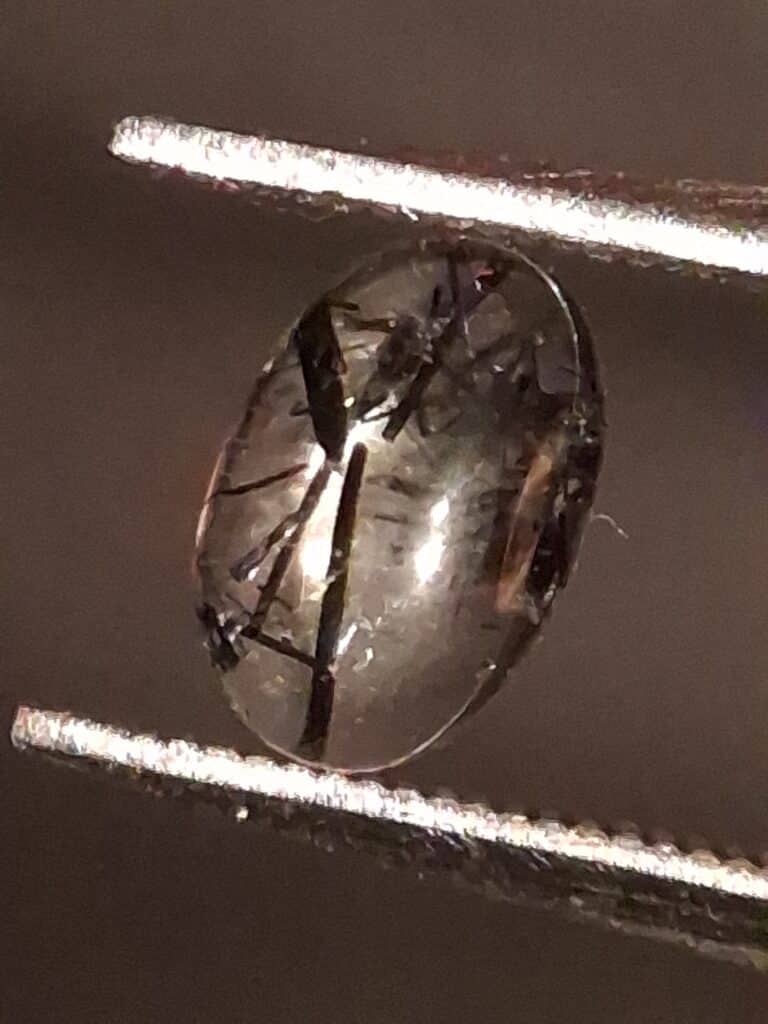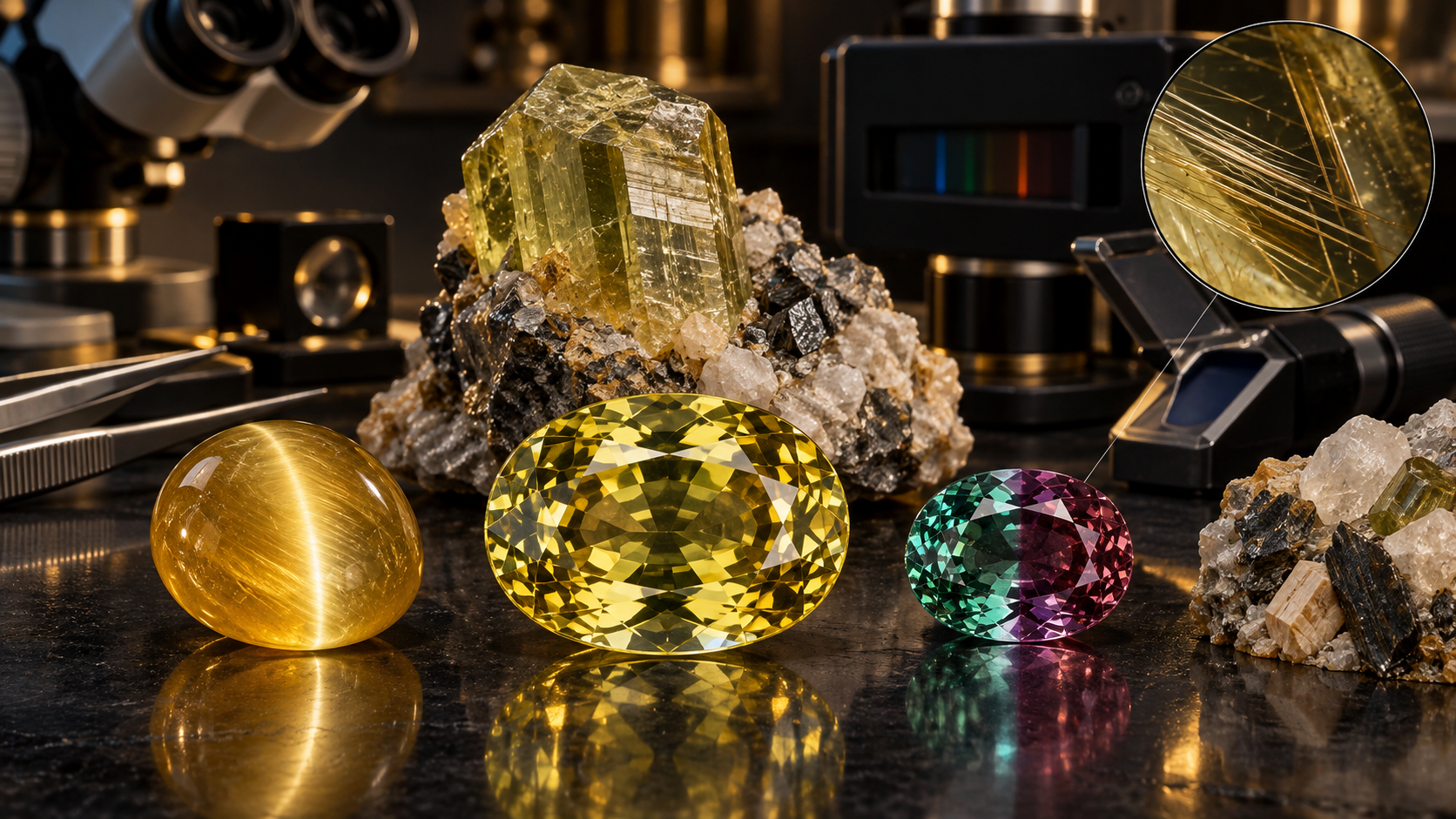
Chrysoberyl is a naturally occurring beryllium aluminium oxide mineral with the chemical formula BeAl₂O₄. Its exceptional hardness, distinctive orthorhombic crystal structure and diverse optical characteristics make it one of the most important mineral species in professional gemmology.
Although ordinary chrysoberyl is most frequently encountered in yellow, golden-yellow, yellowish-green and brownish-green colours, the species also includes two particularly remarkable gemstone types: alexandrite, famous for its colour change under different illumination, and cat’s-eye chrysoberyl, renowned for its sharply defined moving band of reflected light.
These appearances originate from fundamentally different physical mechanisms.
Iron is an important contributor to the yellow and yellow-green colours of ordinary chrysoberyl. Chromium, sometimes accompanied by vanadium and iron, influences the absorption characteristics responsible for the alexandrite effect. In cat’s-eye chrysoberyl, numerous oriented microscopic inclusions, commonly rutile needles, reflect and scatter light to produce chatoyancy.
The geological formation of chrysoberyl is equally significant. The mineral occurs in certain evolved granitic and pegmatitic environments, in reaction zones involving beryllium-bearing fluids and aluminium-rich rocks, and in high-grade metamorphic settings. Its hardness and chemical resistance also allow crystals to survive weathering and accumulate in secondary alluvial deposits.
From a gemmological perspective, chrysoberyl combines a refractive index commonly around 1.746–1.755, birefringence near 0.008–0.010, a specific gravity of approximately 3.73 and a Mohs hardness of 8.5. These properties provide valuable diagnostic evidence, although natural compositional variation must always be considered.
Advanced identification extends beyond these constants. Microscopic growth structures, inclusion mineralogy, UV-Vis-NIR absorption, infrared spectroscopy and trace-element analysis can help investigate natural versus synthetic origin, colour mechanisms and, in selected cases, geographic provenance.
In this episode of the Nadia Gemstone Academy, we examine chrysoberyl as a complete mineral species, exploring its formation, chemistry, crystallography, optical properties, internal features, treatments and laboratory identification.
The objective is to understand how one mineral structure can produce several exceptionally different gemstone appearances—and how professional gemmology distinguishes those appearances through measurable scientific evidence.
Table of Contents
Chrysoberyl: A Complete Gemmological Reference Guide
Introduction
Chrysoberyl gemstone is a naturally occurring beryllium aluminium oxide mineral with the chemical formula BeAl₂O₄. It crystallises in the orthorhombic crystal system and possesses a combination of physical and optical properties that make it an important gemstone species.
With a Mohs hardness of 8.5, chrysoberyl ranks among the harder gemstones commonly encountered in jewellery. Its relatively high refractive index, vitreous lustre and generally excellent durability contribute to its suitability for faceted gemstones and cabochons.
However, the scientific significance of chrysoberyl extends beyond its mechanical properties.
The mineral encompasses ordinary yellow-green and golden-yellow gemstones, the colour-change variety alexandrite, and chatoyant chrysoberyl traditionally known as cat’s-eye or cymophane.
This includes the popular varieties of chrysoberyl gemstone, such as ordinary yellow-green and golden-yellow gemstones, the colour-change variety alexandrite, and chatoyant chrysoberyl traditionally known as cat’s-eye or cymophane.
These materials share the same fundamental mineral structure but exhibit different appearances because of trace-element chemistry, crystal orientation and microscopic internal features.
Understanding the chrysoberyl gemstone therefore provides a particularly useful introduction to the relationship between mineralogy, crystal chemistry, spectroscopy and optical phenomena.
1. Mineralogical Classification
Chrysoberyl belongs to the oxide mineral class.
Its ideal chemical formula is:
BeAl₂O₄
The principal chemical elements are beryllium, aluminium and oxygen.
Despite its name, chrysoberyl is not a member of the beryl mineral species.
Beryl has the chemical formula Be₃Al₂Si₆O₁₈ and belongs to the silicate class.
Chrysoberyl is an oxide with a fundamentally different crystal structure.
This distinction is important because the names are superficially similar but refer to mineralogically different materials.
Chrysoberyl is the mineral species. Alexandrite is a recognised colour-change variety within that species, while cat’s-eye chrysoberyl describes material exhibiting chatoyancy.
The term cymophane is traditionally applied to chatoyant chrysoberyl.
2. Crystal Structure
Chrysoberyl crystallises in the orthorhombic crystal system.
Its structure contains beryllium and aluminium cations occupying different coordination environments within an oxygen framework.
The arrangement produces an optically anisotropic mineral.
Chrysoberyl is biaxial positive.
Consequently, light travelling through the crystal may experience different refractive indices depending on its direction and polarisation.
This optical anisotropy also permits pleochroism in coloured specimens.
The strength and appearance of pleochroism depend on the distribution of colour-producing elements and the orientation of the crystal.
3. Crystal Morphology and Twinning
Chrysoberyl commonly forms tabular or short prismatic crystals.
A particularly distinctive characteristic is cyclic twinning.
Several orthorhombic crystal individuals can join in a repeated arrangement to produce a crystal that appears approximately hexagonal.
These aggregates are often described as pseudohexagonal trillings.
Their external appearance may suggest hexagonal symmetry, but each component remains orthorhombic.
This is a useful example of why external crystal shape does not always reveal the true crystallographic symmetry of a mineral.
Twinning can also influence internal growth structures and the distribution of inclusions.
4. Chemical Composition and Trace Elements
Ideally pure chrysoberyl would be colourless.
Most natural gem-quality material contains small quantities of additional elements.
Iron, chromium and vanadium are particularly important.
These elements can substitute for aluminium within the crystal structure.
Their electronic properties influence which wavelengths of visible light are absorbed.
Iron contributes significantly to many yellow and yellow-green colours.
Vanadium is important in certain attractive green specimens.
Chromium is the principal chromophore associated with the colour-change variety alexandrite.
The effects of these elements may overlap.
Therefore, the colour of an individual chrysoberyl should not automatically be attributed to a single trace element without supporting evidence.
5. Geological Formation
Chrysoberyl forms in several geological environments.
Two broad categories are particularly important: pegmatite-related mineralisation and high-grade metamorphism.
In pegmatitic environments, beryllium becomes concentrated during the evolution of certain granitic magmas.
Under suitable chemical conditions, chrysoberyl may crystallise directly from a melt or form in reaction zones where beryllium-bearing material interacts with aluminium-rich host rocks.
High-grade metamorphic environments provide another important setting.
Chrysoberyl may form during mineral reactions under elevated temperature and pressure.
The geological environment controls not only the mineral’s formation but also the availability of colour-producing trace elements.
6. Pegmatite-Related Chrysoberyl
Granitic pegmatites are commonly associated with the late stages of magmatic differentiation.
As a magma evolves, certain elements may become concentrated within the remaining melt.
Beryllium is one such element.
However, the presence of beryllium alone does not guarantee chrysoberyl formation.
The stability of chrysoberyl depends on the surrounding chemical environment, including aluminium availability, silica activity and the presence of competing beryllium-bearing minerals.
In some systems, beryl or phenakite may form instead.
Chrysoberyl can therefore provide information about the chemical conditions of mineralisation.
7. Metamorphic Formation
Chrysoberyl also occurs in metamorphic rocks.
High-grade metamorphic conditions can promote reactions between beryllium-bearing fluids or minerals and aluminium-rich host material.
Such environments include certain amphibolite- and granulite-facies rocks.
The geological history may involve multiple stages of deformation, recrystallisation and fluid movement.
Consequently, a chrysoberyl crystal can preserve evidence of complex mineral-forming processes.
The exact origin of an individual specimen cannot be determined merely from its colour or external shape.
8. Formation of Alexandrite
Alexandrite requires an appropriate chrysoberyl-forming environment together with sufficient chromium to produce a distinct colour-change effect.
This combination is relatively uncommon.
Beryllium-rich geological systems and chromium-bearing rocks are not always associated.
However, where pegmatitic or metamorphic processes bring these chemical environments into contact, chromium-bearing chrysoberyl may form.
The resulting gemstone may display a pronounced difference between its colour under daylight-equivalent illumination and warm incandescent light.
Not all chromium-bearing chrysoberyl displays an equally strong colour change.
The observed effect depends on chromium concentration, other trace elements, absorption characteristics, optical orientation and illumination.
9. Secondary Deposits
Chrysoberyl is relatively resistant to weathering.
Its hardness and chemical stability allow crystals to survive the breakdown of their original host rocks.
Weathering releases the crystals into sediments.
Water transport can subsequently concentrate them in alluvial or eluvial deposits.
Because chrysoberyl has a specific gravity considerably higher than that of common quartz-rich sediment, it may accumulate with other heavy minerals.
Many gem-quality chrysoberyls are recovered from such secondary deposits.
This creates an important distinction between the location where a gemstone is mined and the geological environment in which it originally crystallised.
10. Brazil
Brazil is one of the historically important sources of chrysoberyl.
The states of Minas Gerais, Espírito Santo and Bahia contain significant occurrences.
Brazilian deposits have produced ordinary chrysoberyl, cat’s-eye chrysoberyl and alexandrite.
The pegmatite districts of Minas Gerais are particularly important.
Research published in Gems & Gemology in 1988 documented several important deposits, including the Barro Preto occurrence and alexandrite-producing localities near Malacacheta and Hematita.
Brazilian alexandrite has also played an important role in modern geographic-origin research.
Laboratory investigations have documented trace-element chemistry, mineral inclusions and growth structures useful for comparison with material from other regions.
11. Sri Lanka
Sri Lanka has a long history of gemstone production.
Chrysoberyl occurs in the country’s gem-bearing gravels, commonly alongside other resistant minerals.
Sri Lankan material includes yellow-green chrysoberyl, cat’s-eye chrysoberyl and alexandrite.
Some of the world’s most recognisable cat’s-eye gemstones have been associated with Sri Lankan deposits.
The stones may exhibit a sharp luminous eye and the characteristic milk-and-honey appearance.
Sri Lanka is also important in scientific studies of chrysoberyl inclusions and trace-element chemistry.
12. Russia – The Ural Mountains
The Ural Mountains are historically associated with the discovery of alexandrite during the early nineteenth century.
The gemstone became known for its remarkable change in appearance under different lighting conditions.
Its name honours the future Russian Emperor Alexander II.
Historical accounts differ in some details concerning the precise discovery circumstances, but the Ural deposits remain central to alexandrite’s scientific and cultural history.
Russian alexandrite helped establish the colour-change phenomenon as a major subject of gemmological interest.
13. Tanzania
Tanzania is an important source of chrysoberyl.
The Tunduru region became particularly significant for attractive green material containing vanadium.
Some specimens display bright mint-green colours without the characteristic green-to-red colour change of alexandrite.
Scientific comparisons between natural Tanzanian chrysoberyl and laboratory-grown vanadium-bearing material have demonstrated the importance of trace-element chemistry and growth structures in establishing natural or synthetic origin.
Tanzania also produces alexandrite from selected geological environments.
14. Madagascar
Madagascar produces several types of chrysoberyl.
The Ilakaka region is particularly important in studies of natural green material.
Some Malagasy specimens contain vanadium and iron in proportions that influence their colour and absorption spectra.
The country’s complex geological history includes high-grade metamorphic rocks and numerous gemstone-bearing secondary deposits.
Chrysoberyl recovered from these environments may preserve different inclusion assemblages and trace-element signatures.
15. India, Myanmar and Zimbabwe
India has produced alexandrite and other chrysoberyl types.
Myanmar, particularly the Mogok region, is another important source.
Some Mogok chrysoberyls display strong green or bluish-green colours associated with chromium and vanadium.
Zimbabwe has also produced alexandrite in geological environments associated with chromium-bearing rocks.
These localities demonstrate that the distribution of chrysoberyl is not restricted to one geological province or formation mechanism.
16. Australia – New England Gem Fields
An important scientific investigation published in 2016 examined chrysoberyl recovered from the New England gem fields of New South Wales.
The material occurred in placer deposits associated with volcanic geological settings.
The studied crystals displayed yellow, yellowish-brown and brown colours.
Some specimens exhibited sectorial colour zoning.
Chemical analysis revealed variations in titanium, niobium and tantalum between different growth sectors.
The study demonstrated that internal growth structures and trace-element distributions can preserve information about mineral formation.
It also showed that some cabochons developed chatoyancy associated with particular internal zones.
17. Physical Properties
Chrysoberyl has a Mohs hardness of 8.5.
Its specific gravity is commonly approximately 3.73.
The mineral has a vitreous lustre and is generally brittle, although sound gemstone material possesses excellent practical toughness.
Fracture is typically uneven to conchoidal.
Cleavage is not a prominent practical weakness in most faceted chrysoberyl.
Some mineralogical references describe crystallographically controlled cleavage on selected planes, but chrysoberyl does not possess the pronounced perfect basal cleavage characteristic of topaz.
These properties make chrysoberyl suitable for many jewellery applications.
However, existing fractures, inclusions and treatments can influence individual durability.
18. Refractive Index
Chrysoberyl has relatively high refractive indices.
A commonly accepted gemmological range is approximately:
1.746–1.755
Individual specimens may fall slightly outside this interval.
Because chrysoberyl is biaxial, it possesses three principal refractive indices.
Their measured values depend on crystal orientation and chemical composition.
The refractive index is a valuable diagnostic property.
It helps distinguish chrysoberyl from gemstones such as topaz, peridot and beryl.
However, the same optical properties are also found in true laboratory-grown chrysoberyl.
Refractive index alone therefore cannot establish natural origin.
19. Birefringence
Chrysoberyl commonly has birefringence of approximately:
0.008–0.010
Birefringence is the difference between the maximum and minimum principal refractive indices.
The relatively modest value means that chrysoberyl does not normally display the conspicuous facet doubling associated with highly birefringent minerals such as high-type zircon.
Nevertheless, double refraction can be confirmed with appropriate gemmological instruments.
20. Optical Character and Pleochroism
Chrysoberyl is optically biaxial positive.
Its orthorhombic structure permits three principal optical vibration directions.
In coloured specimens, selective absorption may produce different colours along these directions.
This phenomenon is called pleochroism.
Ordinary yellow-green chrysoberyl may display weak or moderate pleochroism.
Alexandrite can exhibit strong trichroism.
The colours observed through a dichroscope depend on crystal orientation and trace-element chemistry.
In a faceted gemstone, multiple internal reflections mix light travelling along different directions.
Consequently, the face-up colour may differ from the appearance predicted by simple examination along one crystallographic axis.
21. Colour Chemistry of Ordinary Chrysoberyl
Iron is an important chromophore in many yellow and yellow-green chrysoberyls.
Ferric iron, Fe³⁺, can substitute for aluminium within the crystal structure.
This influences absorption in the blue-violet region.
A characteristic absorption feature near 444 nm is observed in many yellow-green specimens.
Vanadium can contribute to green colour.
Chromium may also be present in some green chrysoberyl without producing a strong alexandrite effect.
The colour mechanisms can therefore involve several overlapping absorption processes.
22. The Alexandrite Effect
Alexandrite is the colour-change variety of chrysoberyl.
Its most familiar appearance is green or bluish green under daylight-equivalent illumination and red or reddish purple under incandescent illumination.
The phenomenon is associated principally with chromium-related absorption.
Alexandrite transmits light relatively effectively in portions of the green and red regions while absorbing strongly in parts of the yellow-orange region.
The relative proportions of wavelengths in the illumination source influence which transmitted colour dominates.
Daylight contains a broad distribution of visible wavelengths.
Traditional incandescent illumination contains proportionally more long-wavelength light.
The interaction between the source spectrum and the gemstone’s selective absorption produces the apparent colour change.
The stone is not physically transforming its chemical composition when the light changes.
Rather, the observed colour depends on the illumination and the optical characteristics of the gemstone.
23. Spectroscopy of Alexandrite
UV-Vis-NIR spectroscopy provides important information about alexandrite colour.
Chromium-related absorption features occur in the visible spectrum.
A broad absorption region near 580–590 nm has been documented in studied material.
Additional chromium-related features may occur in the red region, including near 680 nm.
The exact position, shape and intensity of these features depend on composition, orientation and measurement conditions.
Vanadium and iron may also influence the spectrum.
Therefore, a single absorption wavelength should not be treated as an absolute diagnostic constant for every alexandrite.
Professional interpretation requires examination of the overall spectral pattern.
24. Colour Change Versus Pleochroism
Colour change and pleochroism are different optical phenomena.
Pleochroism results from directional differences in absorption within an anisotropic crystal.
Colour change results from the interaction between selective absorption and different illumination spectra.
Alexandrite can display both phenomena.
This distinction is particularly important when evaluating faceted stones.
A gemstone may show different directional colours without exhibiting a strong change between daylight and incandescent illumination.
Conversely, the visible strength of colour change depends partly on the illumination used during observation.
For consistent assessment, lighting conditions should be controlled and documented.
25. Cat’s-Eye Chrysoberyl
Cat’s-eye chrysoberyl displays chatoyancy.
The phenomenon appears as a narrow luminous band that moves across the surface of a polished cabochon when the illumination or viewing direction changes.
The effect is caused by numerous oriented microscopic inclusions.
In chrysoberyl, these are commonly rutile needles.
The inclusions reflect and scatter light in a directional manner.
When the stone is correctly oriented and polished with a curved dome, the reflections combine to produce a concentrated band.
The sharpness of the eye depends on inclusion orientation, density, cabochon geometry and illumination.
Not all chrysoberyl contains the necessary inclusions.
Therefore, chatoyancy is not a universal property of the species.
26. Rutile Inclusions
Rutile is titanium dioxide, TiO₂.
Microscopic rutile needles are an important cause of chatoyancy and asterism in several gemstone species.
A detailed scientific review published in Gems & Gemology in 2025 discussed the crystallographic orientations and microscopic structures of rutile inclusions in chrysoberyl.
Research has shown that natural chrysoberyl can contain needles in several crystallographic orientations.
The arrangement of these needles determines the resulting optical phenomenon.
Some rare material displays asterism rather than a single cat’s-eye band.
The review also documented unusual ilmenite needles in certain star chrysoberyl specimens.
This demonstrates why microscopic inclusion identification should be based on analysis rather than visual assumption.
27. The Milk-and-Honey Effect
Some cat’s-eye chrysoberyl displays a particularly attractive phenomenon known as the milk-and-honey effect.
Under directional illumination, one side of the luminous eye appears relatively pale or milky, while the other appears darker or more translucent.
As the stone moves, the contrasting regions appear to exchange positions.
The effect is related to the interaction of light with the oriented internal structures.
It is most apparent under appropriate directional illumination.
The strength of the effect varies between specimens.
28. Rare Star Chrysoberyl
Although cat’s-eye chrysoberyl is much better known, chrysoberyl can also display asterism.
GIA has documented four-rayed star chrysoberyl.
More recent research has discussed additional unusual star-producing inclusion arrangements.
Asterism requires suitable internal structures and cutting orientation.
It should not be assumed to occur in ordinary faceted chrysoberyl.
The presence of a star also does not independently establish natural origin.
Laboratory-grown phenomenal chrysoberyl has been produced.
29. Microscopic Examination
Microscopic examination is central to professional chrysoberyl identification.
Possible internal features include mineral inclusions, fluid inclusions, growth tubes, fingerprint-like structures, colour zoning and twinning-related growth patterns.
Some specimens are exceptionally clean.
Others contain dense microscopic inclusions responsible for optical phenomena.
The significance of an inclusion depends on its identity, morphology, geological context and association with other internal features.
No single inclusion type should automatically be considered proof of a particular geographic origin.
30. Natural Growth Structures
Natural chrysoberyl may exhibit growth zoning and crystallographically controlled internal patterns.
Some growth structures are visible under ordinary transmitted illumination.
Others require immersion or specialised microscopy.
Research on green chrysoberyl has demonstrated that natural and laboratory-grown material may differ in growth patterns and trace-element distributions.
However, the interpretation must consider the particular synthetic growth method.
The absence of visible inclusions is not proof of synthetic origin.
Likewise, the presence of an inclusion does not automatically establish natural origin.
31. Synthetic Chrysoberyl
True synthetic chrysoberyl has essentially the same chemical composition and crystal structure as natural chrysoberyl.
Laboratory-grown alexandrite is commercially documented.
Synthetic material has been produced through crystal-pulling and flux-growth techniques.
The Czochralski method involves growing a crystal from a molten material using a seed crystal.
Flux growth involves crystallisation from a suitable high-temperature solvent.
Different growth methods can produce different internal structures and trace-element patterns.
Because synthetic chrysoberyl shares the fundamental properties of the natural mineral, routine refractive-index and specific-gravity measurements cannot reliably distinguish the two.
32. Synthetic Alexandrite
Synthetic alexandrite is an important commercial gemstone material.
Flux-grown synthetic alexandrite has been studied in detail.
Research published in Gems & Gemology in 1996 documented growth patterns, residual flux inclusions, trace-element chemistry, colour zoning and spectroscopic features in Russian synthetic alexandrite.
These characteristics can assist in distinguishing laboratory-grown material from natural gemstones.
However, diagnostic evidence must be evaluated in relation to the particular production method.
Not all synthetic alexandrite displays the same internal features.
33. Synthetic Cat’s-Eye Chrysoberyl
Laboratory-grown chrysoberyl can also exhibit chatoyancy.
Synthetic cat’s-eye alexandrite has been commercially documented.
In some production methods, titanium is incorporated during crystal growth and subsequently precipitated as microscopic inclusions.
These inclusions can create optical phenomena resembling those of natural cat’s-eye material.
Consequently, the presence of a sharp cat’s-eye does not establish natural origin.
Professional identification requires examination of growth structures, inclusion chemistry and other relevant laboratory evidence.
34. Vanadium-Bearing Synthetic Chrysoberyl
Green vanadium-bearing chrysoberyl is another important subject in synthetic gemstone identification.
Research has compared natural material from Tanzania, Madagascar, Sri Lanka and Myanmar with laboratory-grown material.
The investigated natural and synthetic populations displayed differences in trace-element distributions and growth structures.
However, individual properties overlapped.
This demonstrates the limitations of identification based solely on colour or a small number of measurements.
The strongest conclusions generally result from combining microscopy, spectroscopy and chemical analysis.
35. Imitations
Chrysoberyl can be imitated by several other gemstones and manufactured materials.
Yellow or yellow-green chrysoberyl may resemble yellow sapphire, peridot, topaz or tourmaline.
Alexandrite can be imitated by colour-change synthetic corundum and other colour-changing materials.
Cat’s-eye chrysoberyl may be imitated by fibre-optic glass.
The latter is particularly important because manufactured glass can produce a convincing luminous band.
In 2023, GIA documented a fibre-optic glass imitation submitted as cat’s-eye chrysoberyl.
The imitation displayed a spot refractive index near 1.57, substantially below the chrysoberyl range.
Microscopy revealed a honeycomb-like fibre structure characteristic of the manufactured material.
This case demonstrates the importance of combining classical gemmological measurements with microscopic examination.
36. Chrysoberyl Versus Topaz
Topaz and chrysoberyl can resemble one another in certain colours.
However, their chemical compositions and optical properties differ.
Topaz is an aluminium fluorosilicate with a typical refractive index around 1.619–1.627.
Chrysoberyl is a beryllium aluminium oxide with a typical refractive index around 1.746–1.755.
Topaz also possesses perfect basal cleavage.
Chrysoberyl does not exhibit a comparable practical cleavage weakness.
These differences provide strong diagnostic evidence.
37. Chrysoberyl Versus Sapphire
Yellow sapphire can resemble golden chrysoberyl.
Sapphire is corundum, Al₂O₃, and crystallises in the trigonal system.
Chrysoberyl is orthorhombic.
Sapphire is optically uniaxial negative, whereas chrysoberyl is biaxial positive.
Sapphire also has a higher typical specific gravity.
A combination of refractive index, optical character and density generally separates the two.
38. Chrysoberyl Versus Peridot
Peridot is the gem variety of magnesium-rich olivine, commonly forsterite-dominant.
Its refractive index and birefringence differ from those of chrysoberyl.
Peridot generally has stronger birefringence and a lower specific gravity.
The two minerals also differ chemically and crystallographically.
Their overlapping yellow-green appearances should not be used as the basis for identification.
39. Geographic-Origin Determination
Geographic-origin determination is an advanced analytical problem.
A mineral species may form in similar geological environments across several countries.
Consequently, specimens from different regions can exhibit overlapping physical properties and trace-element compositions.
GIA’s 2019 investigation of alexandrite combined trace-element chemistry, inclusion analysis and controlled colour observations.
The study demonstrated that reliable origin interpretation depends on comparison with known-source reference material.
No single inclusion or absorption feature can universally establish geographic origin.
Origin conclusions should therefore be accompanied by appropriate scientific confidence and acknowledgement of uncertainty.
40. Treatment Assessment
Natural chrysoberyl is generally encountered without routine colour enhancement.
Alexandrite is also commonly untreated.
However, unusual treatments and clarity modifications may occur.
Fracture filling is possible in transparent gemstones and should be investigated when suspicious surface-reaching fractures or filling-related features are present.
Treatment status is separate from mineral identification.
A gemstone may be correctly identified as natural chrysoberyl while still requiring additional investigation to determine whether it has been modified.
Professional disclosure should reflect the evidence available.
41. Durability
Chrysoberyl has a Mohs hardness of 8.5.
This provides excellent resistance to ordinary scratching.
Sound chrysoberyl also possesses good practical toughness.
However, hardness is not equivalent to indestructibility.
Existing fractures, surface-reaching inclusions and inappropriate setting techniques can increase the risk of damage.
Cat’s-eye cabochons should be protected against abrasion that could alter their polished dome.
The shape and surface quality of the cabochon are essential to the appearance of the optical phenomenon.
42. Cleaning and Care
Warm water, mild soap and a soft brush are generally suitable for chrysoberyl.
GIA indicates that ultrasonic and steam cleaning are usually acceptable for sound, untreated alexandrite.
However, these methods should be avoided when fractures, fillers or uncertain treatments are present.
Sudden mechanical impact and unnecessary extreme heat should also be avoided.
Gemstones should be stored separately to prevent abrasion from harder materials.
43. Why Chrysoberyl Matters to Gemmology
Chrysoberyl provides an unusually comprehensive illustration of the principles of gemstone science.
Its chemical formula establishes its mineral identity.
Its orthorhombic structure determines its biaxial optical behaviour.
Its trace elements influence colour and absorption spectra.
Its geological formation reflects the interaction of beryllium-bearing systems with particular host-rock environments.
Its cyclic twins demonstrate how crystal morphology can conceal underlying symmetry.
Its alexandrite variety illustrates the interaction between selective absorption and illumination.
Its cat’s-eye material demonstrates the role of microscopic oriented inclusions in producing optical phenomena.
Its synthetic counterparts reveal why mineral identification and natural-origin determination must be treated as separate questions.
Finally, its inclusion chemistry and trace-element patterns provide valuable evidence for geological research and geographic-origin investigations.
Chrysoberyl is therefore not merely a durable and attractive gemstone.
It is a mineral species that connects crystallography, spectroscopy, geology, optical physics and modern laboratory gemmology.
References & Further Reading
The following sources are educational, scientific or professional research publications. All links lead to informational material rather than gemstone product listings.
1. Gemological Institute of America – Alexandrite Gem Encyclopedia
Authoritative reference for the chrysoberyl species, alexandrite classification, standard gemmological constants, colour change and related properties.
https://www.gia.edu/alexandrite
2. Schmetzer, K., Caucia, F., Gilg, H. A. & Coldham, T. S. – Chrysoberyl from the New England Placer Deposits, New South Wales, Australia
Gems & Gemology, Spring 2016.
Detailed scientific investigation of geological formation, crystal morphology, trace-element chemistry, growth zoning and optical characteristics.
3. Sun, Z., Palke, A. C., Muyal, J., DeGhionno, D. & McClure, S. F. – Geographic Origin Determination of Alexandrite
Gems & Gemology, Winter 2019.
Professional investigation of alexandrite from important geographic sources using inclusion analysis, trace-element chemistry and controlled colour observations.
https://www.gia.edu/gems-gemology/winter-2019-alexandrite-geographic-origin-determination
4. Jin, S., Renfro, N. D., Palke, A. C. & Shigley, J. E. – Structures Behind the Spectacle: A Review of Optical Effects in Phenomenal Gemstones and Their Underlying Nanotextures
Gems & Gemology, Summer 2025.
Advanced scientific review of chatoyancy, asterism, oriented rutile inclusions and the physical mechanisms responsible for phenomenal gemstone appearances.
https://www.gia.edu/gems-gemology/summer-2025-phenomenal-gemstones
5. Gem-A – Understanding the Cat’s Eye Effect in Gemstones
Gem-A, 28 November 2019.
Educational reference explaining chatoyancy, cabochon orientation, chrysoberyl cat’s-eye and the milk-and-honey effect.
https://gem-a.com/gem-hub/understanding-the-cats-eye-effect-in-gemstones
6. Schmetzer, K. – Pleochroism and Color Change in Faceted Alexandrite: Influence of Cut and Sample Orientation
Gems & Gemology, Spring 2019.
Research investigating the relationship between pleochroism, crystallographic orientation, internal reflections and apparent colour change.
7. Gübelin, E. & Schmetzer, K. – Gemstones with Alexandrite Effect
Gems & Gemology, Winter 1982.
Foundational scientific discussion of selective absorption, light-source dependence and colour-change mechanisms in gemstones.
https://www.gia.edu/gems-gemology/winter-1982-alexandrite-effect-gubelin
8. Proctor, K. – Chrysoberyl and Alexandrite from the Pegmatite Districts of Minas Gerais, Brazil
Gems & Gemology, Spring 1988.
Geological and gemmological investigation of important Brazilian chrysoberyl, cat’s-eye and alexandrite deposits.
https://www.gia.edu/gems-gemology/spring-1988-pegmatites-brazil-proctor
9. Stone-Sundberg, J. – Distinguishing Between Natural and Synthetic Green Chrysoberyl
Gems & Gemology, Spring 2014.
Scientific summary of research on vanadium-bearing natural and synthetic chrysoberyl, trace-element chemistry and growth characteristics.
https://www.gia.edu/gems-gemology/spring-2014-v-chrysoberyl-stone-sundberg
10. Schmetzer, K. et al. – Russian Flux-Grown Synthetic Alexandrite
Gems & Gemology, Fall 1996.
Detailed examination of synthetic alexandrite growth methods, inclusions, trace elements and diagnostic laboratory features.
https://www.gia.edu/gems-gemology/fall-1996-flux-grown-alexandrite-schmetzer
11. Gemological Institute of America – Glass Imitation of Cat’s-Eye Chrysoberyl
Gems & Gemology, Summer 2023.
Laboratory case study demonstrating the identification of fibre-optic glass imitating natural cat’s-eye chrysoberyl.
https://www.gia.edu/gems-gemology/summer-2023-lab-notes-glass-imitation-cats-eye-chrysoberyl
12. Gemological Institute of America – Alexandrite Care and Cleaning Guide
Professional guidance on chrysoberyl hardness, toughness, stability, cleaning methods and treatment-related precautions.
https://www.gia.edu/alexandrite-care-cleaning
13. Gemological Institute of America – Four-Rayed Star Chrysoberyl
Gems & Gemology, Winter 2022.
Laboratory documentation of rare four-rayed asterism in chrysoberyl and its diagnostic gemmological properties.
https://www.gia.edu/gems-gemology/winter-2022-lab-notes-four-rayed-star-chrysoberyl
14. Gemological Institute of America – Cat’s-Eye Alexandrite with Unique Inclusion Pattern
Gems & Gemology, Winter 2017.
Microscopic and Raman investigation of a natural cat’s-eye alexandrite containing oriented rutile inclusions.
https://www.gia.edu/gems-gemology/winter-2017-labnotes-cats-eye-alexandrite-unique-inclusion-pattern