

Table of Contents
Introduction: A Crystal That Records Its Own Formation
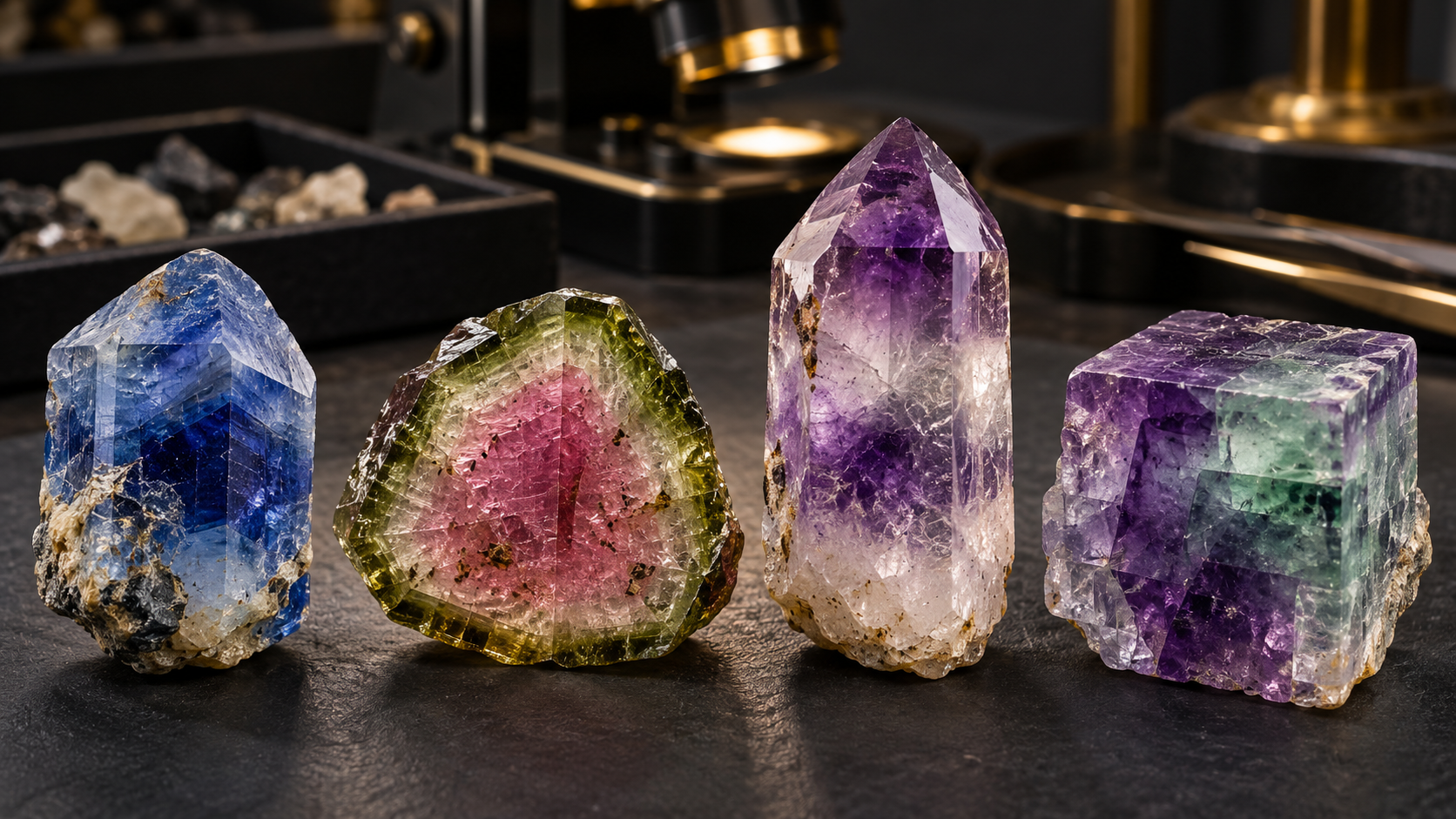
Imagine holding a natural sapphire crystal against a source of soft, transmitted light.
At first glance, the crystal appears blue.
But when examined more carefully, its colour is not distributed evenly.
Some regions are intensely blue. Others are pale, almost colourless. Between them, sharply defined boundaries follow geometric patterns within the crystal.
Now consider a tourmaline crystal.
One end may be green, while the opposite end is pink. Another specimen may possess a pink centre surrounded by a green outer layer.
An amethyst crystal may display alternating purple and nearly colourless bands. Some specimens reveal striking hourglass-shaped colour patterns.
These features are examples of gemstone colour zoning.
Colour zoning is the uneven distribution of colour within a gemstone. It may appear as bands, layers, patches, sectors or transitions between different hues.
In many natural gemstones, these patterns are connected with changes in chemical composition or crystal-growth conditions.
However, not every uneven colour distribution develops through the same process.
Some zoning records variations during crystal growth.
Other patterns arise from differences in how particular crystal faces incorporate trace elements.
Certain gemstones develop colour changes after crystallisation through radiation, diffusion or the formation of microscopic particles.
Treatments can also create or modify colour distributions.
Understanding these distinctions is essential to modern gemmology.
Colour zoning can provide information about a gemstone’s formation history. It can influence cutting decisions, affect commercial value and sometimes contribute to laboratory identification.
Yet it can also be deliberately preserved as an attractive natural feature.
A gemstone with uneven colour is not necessarily a defective gemstone. In many cases, its colour patterns reveal something remarkable about the conditions under which the crystal developed.
1. What Is Gemstone Colour Zoning?
Colour zoning describes spatial differences in colour within a single gemstone.
These differences may involve variations in intensity, hue or both.
For example, a sapphire may contain alternating dark-blue and pale-blue bands.
A tourmaline may transition from green to pink along its length.
An amethyst may display purple sectors separated by nearly colourless quartz.
The appearance depends on the mineral species and the processes responsible for its colour.
Some zones have sharply defined boundaries.
Others display gradual transitions.
Certain patterns follow the external crystal shape.
Others are associated with particular crystallographic directions.
Colour zoning can be visible to the unaided eye, but some patterns require magnification or specialised lighting.
The important distinction is that colour zoning concerns the distribution of colour within the material.
It should not automatically be confused with surface reflections, inclusions, pleochroism or optical extinction.
These phenomena can also produce differences in apparent colour or brightness, but they are not necessarily examples of true colour zoning.
2. Why Natural Crystals Do Not Always Grow Uniformly
A natural crystal develops when atoms or ions become incorporated into an ordered crystalline structure.
The process requires suitable physical and chemical conditions.
These may include appropriate temperature, pressure, chemical composition and availability of the components needed for mineral growth.
However, geological environments are not perfectly constant.
The composition of a mineralising fluid can change.
The availability of particular trace elements may increase or decrease.
Temperature and pressure may evolve.
The rate of crystal growth can vary.
New fluid pulses may enter the formation environment.
These changes can influence which elements become incorporated into successive portions of a crystal.
A crystal may therefore develop in stages.
During one growth period, it may incorporate a relatively high concentration of a colour-producing element.
During another, the concentration may be lower.
The resulting zones can display different colours even though they belong to the same continuous crystal.
This process is known as growth zoning.
The colour pattern can preserve a record of changing conditions during crystallisation.
However, the pattern is not always a simple chronological sequence.
Different crystal faces may incorporate impurities differently even while growing simultaneously.
This introduces another important mechanism: sector zoning.
3. Growth Zoning: Changes Through Time
Growth zoning develops when the characteristics of material added to a crystal change during successive growth stages.
Imagine a crystal forming from a mineral-rich fluid.
Initially, the fluid contains relatively little of a particular colouring element.
The first portion of the crystal may therefore appear pale.
Later, the chemical environment changes.
More of the colouring element becomes available.
New crystal growth incorporates a higher concentration of that element, producing a more intensely coloured region.
If the original conditions return, another pale layer may form.
The result can be a sequence of alternating colour bands.
These bands may follow the crystal’s growth surfaces.
In some minerals, they produce repeated geometric outlines.
In others, they appear as relatively broad transitions.
The exact appearance depends on crystal symmetry, growth conditions and the colour-producing mechanism.
Growth zoning can therefore provide information about the changing environment in which the crystal formed.
Nevertheless, colour bands alone do not reveal exact formation temperatures, ages or chemical concentrations.
Such interpretations require additional geological and analytical evidence.
4. Sector Zoning: Different Crystal Faces, Different Colours
Sector zoning differs from ordinary successive growth zoning.
A crystal contains faces with different crystallographic orientations.
These faces do not always incorporate impurities at identical rates.
Under the same general growth conditions, one face may preferentially incorporate a particular trace element or defect-producing component.
Another face may incorporate less.
As the crystal grows, these differences can produce distinct internal sectors.
The boundaries may reflect the geometry of the crystal.
In cross-section, the pattern can resemble triangular wedges, an hourglass or other angular arrangements.
Sector zoning is particularly interesting because different coloured regions can develop during the same overall period of crystal growth.
The colour differences do not necessarily mean that one sector is substantially older than another.
Instead, they may reflect the different chemical behaviour of crystallographically distinct growth surfaces.
Amethyst provides an excellent example.
Research on amethyst from Boudi, Morocco, documents striking hourglass-shaped colour zoning associated with preferential incorporation of iron during growth.
This demonstrates how crystal symmetry and impurity incorporation can combine to produce a distinctive natural pattern.
5. Trace Elements and the Chemistry of Colour
Many gemstones owe their colours to elements present in relatively small concentrations.
These are commonly described as trace elements.
The relevant elements depend on the mineral species.
Chromium is important in ruby.
Iron and titanium interactions contribute to the blue colour of many sapphires.
Iron-related mechanisms influence amethyst colour.
Manganese and iron contribute to various tourmaline colours, although tourmaline colour chemistry is more complex than a single-element explanation.
A change in the concentration or electronic state of a colouring component may alter the wavelengths of light absorbed by the crystal.
The observer then perceives a different colour.
However, trace-element concentration is not always the only factor.
The electronic state of an element can matter.
The local arrangement of neighbouring atoms can matter.
Structural defects may influence optical absorption.
Radiation can create or modify colour-producing defects.
Microscopic particles may also contribute through absorption and scattering.
Consequently, two zones with similar concentrations of a particular element may not necessarily display identical colours.
The relationship between chemistry and appearance must be established for the specific mineral.
This is particularly important when interpreting unusual colour-zoned gemstones.
6. Sapphire: Angular Colour Zoning in Corundum
Sapphire is a variety of the mineral corundum, with the chemical composition Al₂O₃.
Many natural sapphires display colour zoning.
In blue sapphire, the pattern often consists of angular bands or sectors containing different intensities of blue.
Some regions may be strongly coloured.
Others may appear pale or nearly colourless.
The patterns can follow crystallographic growth structures.
GIA’s research on sapphires from the Sutara region of the Russian Far East documents pronounced growth zoning, including angular and irregular colour distributions.
Such patterns can provide useful information about crystal growth.
However, the visibility of zoning depends on the orientation of the crystal and the direction of observation.
A sapphire may display obvious bands when viewed through one direction but appear relatively uniform from another.
This creates an important challenge for gemstone cutters.
The original crystal may contain enough attractive blue material to produce a visually appealing finished gemstone, but the colour may not be evenly distributed.
The cutter must determine how to orient the stone to achieve the best face-up appearance.
GIA notes that some Sri Lankan sapphires contain concentrated colour close to particular regions of the crystal.
By carefully positioning this colour within the finished gemstone, a cutter may produce a face-up appearance that seems more uniformly blue.
The result is an example of optical and cutting optimisation rather than a change in the mineral’s original chemistry.
7. Why Sapphire Colour Zoning Matters to Gemmologists
Colour zoning can be useful during the examination of natural corundum.
Angular growth-related colour bands are frequently encountered in natural sapphire.
However, the presence of angular zoning is not an absolute guarantee of natural origin.
Likewise, the absence of visible zoning does not establish that a gemstone is synthetic.
Some natural sapphires are remarkably uniform in colour.
GIA research on Yogo sapphires from Montana documents the relative absence of strong colour zoning in many blue specimens.
This demonstrates that natural sapphire appearance varies between geological environments.
A gemmologist must therefore evaluate colour zoning alongside other evidence.
Relevant observations may include inclusions, growth structures, fluorescence, spectroscopic characteristics and trace-element composition.
The interpretation becomes especially important when distinguishing natural corundum from laboratory-grown material.
Certain synthetic growth processes produce characteristic patterns.
For example, flame-fusion synthetic sapphire may display curved growth bands.
These differ from the angular zoning commonly observed in natural corundum.
However, this distinction applies to particular growth methods and must not be treated as a universal rule for every synthetic gemstone.
Professional identification relies on a combination of diagnostic evidence.
8. Tourmaline: One Crystal, Several Colours
Tourmaline is one of the most visually impressive examples of gemstone colour zoning.
The tourmaline supergroup contains several closely related mineral species with complex chemical compositions.
Many gem-quality tourmalines form in granitic pegmatites.
These environments can undergo changes in fluid composition during crystallisation.
As the crystal grows, the availability of colouring elements may vary.
The resulting colour distribution can be dramatic.
Some tourmaline crystals display different colours along their length.
Others contain concentric zones around the crystal’s long axis.
A crystal may begin growing with one colour and subsequently develop a contrasting outer layer.
GIA’s 2024 research on tourmaline micro-features identifies changing nutrient-solution chemistry as an important cause of colour zoning.
The result is not merely a decorative effect.
It can preserve evidence of changes in the chemical environment during crystal formation.
Tourmaline is especially suitable for illustrating this process because its crystal chemistry allows substantial compositional variation.
However, a multicoloured appearance alone does not establish the precise chemical cause of the zoning.
Individual specimens may require analytical investigation.
9. Watermelon Tourmaline: Colour Zoning as the Main Attraction
Watermelon tourmaline is a familiar trade description for tourmaline displaying a pink or reddish centre surrounded by a green outer zone.
The colour arrangement resembles the flesh and rind of a watermelon.
This pattern is an example of concentric colour zoning.
It is commonly revealed by cutting the crystal across its length.
A transverse slice may display a pink centre enclosed by a green border.
In some specimens, the boundary is sharp.
In others, intermediate or pale zones are present.
The appearance depends on the individual crystal’s growth history.
Watermelon tourmaline illustrates an important exception to the preference for uniform gemstone colour.
In many conventional faceted gemstones, obvious uneven colour distribution is considered less desirable.
For watermelon tourmaline, the contrasting zones are the defining visual feature.
Cutters may deliberately preserve the colour arrangement.
Thin slices, cabochons and carefully designed faceted stones can emphasise the contrast.
The commercial appeal therefore depends partly on how effectively the natural pattern is presented.
A clearly defined and attractive colour arrangement may be more desirable than a poorly balanced or indistinct pattern.
10. Bicolour Tourmaline and Longitudinal Growth Changes
Not every colour-zoned tourmaline has a pink centre and green exterior.
Some crystals change colour along their length.
One end may be pink.
The middle may be nearly colourless.
The opposite end may be green or blue-green.
Such patterns can reflect changes in the chemical composition of the growth environment over time.
These transitions can be abrupt or gradual.
The cutter must decide whether to preserve both colours or concentrate on one portion.
A long rectangular cut may emphasise the transition.
A smaller gemstone cut from one end may display only a single colour.
Alternatively, an artistic cutting design may create an attractive mixture of colours.
This means that two finished gemstones cut from the same rough crystal can look very different.
The relationship between natural zoning and cutting decisions is therefore central to the appearance of many multicoloured tourmalines.
11. Amethyst: Purple Zones Within Quartz
Amethyst is the purple variety of quartz.
Its chemical composition is SiO₂.
The purple colour is associated with iron-related defects and natural irradiation.
Many amethyst crystals display uneven colour distribution.
Some contain alternating light and dark purple bands.
Others show strongly coloured sectors surrounded by nearly colourless quartz.
The patterns can follow crystallographic growth structures.
A particularly instructive example comes from Boudi, Morocco.
Research published in Gems & Gemology in 2015 documented amethyst crystals with distinctive hourglass-shaped colour zoning.
The study associated these patterns with preferential iron incorporation along particular crystallographic growth faces.
The crystals also contained mineral inclusions, including hematite.
This example demonstrates how colour zoning and inclusions can provide complementary information about the geological formation environment.
Another study, published in 2024, examined amethyst from Newfoundland, Canada.
Researchers documented variations in colour, crystal size and mineral inclusions across different growth stages and neighbouring pockets.
The findings showed how changes in hydrothermal fluid conditions could influence the development of amethyst.
These studies demonstrate that amethyst colour zoning is not simply a decorative irregularity.
It can reflect the mineral’s growth history and the availability of iron during crystallisation.
12. Ametrine: Purple and Yellow Within One Crystal
Ametrine is a bicoloured quartz material containing amethyst and citrine regions within the same crystal.
Its most recognisable appearance combines purple and yellow-to-orange colour zones.
The colour differences are associated with iron-related mechanisms.
However, the relevant electronic and structural conditions differ between the amethyst and citrine regions.
The formation of natural ametrine requires a particular combination of geological and chemical conditions.
GIA’s educational research on natural and synthetic ametrine describes the importance of quartz growth conditions, iron incorporation and irradiation-related processes.
The best-known commercial source of natural ametrine is the Anahí mine in Bolivia.
Ametrine is particularly interesting because its colour zoning is usually not considered an undesirable feature.
Instead, the contrasting purple and yellow regions are central to its identity and appeal.
A cutter may orient the gemstone to display two clearly separated colours.
Alternatively, facet placement may produce a blended appearance.
The choice depends on the original colour distribution and the intended design.
However, natural ametrine is not the only material that can display purple-and-yellow quartz coloration.
Synthetic ametrine also exists.
Therefore, the presence of two colours is not sufficient to establish natural origin.
Professional identification may require examination of crystallographic relationships and other diagnostic characteristics.
13. Fluorite: Colour Bands in a Cubic Mineral
Fluorite is calcium fluoride, with the chemical composition CaF₂.
It belongs to the cubic crystal system.
Natural fluorite occurs in a wide range of colours, including purple, green, blue, yellow and colourless varieties.
Some specimens display pronounced colour zoning.
The colour distribution may appear as bands, layers or geometric patterns.
Fluorite colour mechanisms are complex.
Depending on the specimen, colour can involve structural defects, impurity-related centres and radiation-associated processes.
It would therefore be inaccurate to attribute every fluorite colour band to one particular trace element.
GIA’s published research includes examples of fluorite containing prominent colour zoning and mineral inclusions.
Such specimens demonstrate that colour patterns can occur alongside other geological features within the same crystal.
Fluorite is especially popular among mineral collectors because its colour zoning can be visually striking.
However, its relatively low hardness of 4 on the Mohs scale and its perfect octahedral cleavage require careful handling.
These properties make fluorite more suitable for protected collections and decorative objects than for jewellery exposed to frequent impacts.
For collectors, the value of a zoned fluorite specimen may lie in the relationship between crystal shape, transparency, colour contrast and mineralogical interest.
14. Oregon Sunstone: A More Complex Colour Mechanism
Not all gemstone colour zoning results directly from changes in trace-element concentration during growth.
Oregon sunstone provides an important exception.
This gemstone is a variety of feldspar.
Some specimens display red, green and colourless zones.
The colours are associated with microscopic metallic copper particles.
These particles interact with light through absorption and scattering.
Their size, shape, concentration and orientation influence the resulting appearance.
In 2023, GIA researchers published a detailed study of Oregon sunstone’s optical effects.
The research demonstrated that colour zoning in this material can involve processes more complex than ordinary growth zoning.
Copper diffusion and the formation of microscopic particles during cooling can influence the distribution of colour.
The researchers also examined how the orientation of these particles affects pleochroism and optical appearance.
This is scientifically important.
It demonstrates that the presence of colour zoning does not necessarily mean that the observed pattern formed entirely during the original growth of the crystal.
Some colour patterns can develop or evolve after crystallisation.
Understanding the mechanism requires examination of the particular mineral and its physical history.
15. Colour Zoning Versus Pleochroism
Colour zoning and pleochroism are frequently confused.
They are different phenomena.
Colour zoning describes the spatial distribution of colour within a gemstone.
Pleochroism describes changes in observed colour when an optically anisotropic crystal is viewed along different directions.
A pleochroic gemstone may appear blue from one direction and greenish blue from another.
This does not necessarily mean that the crystal contains separate blue and green growth zones.
Instead, the optical absorption of the crystal depends on the direction and polarisation of light.
Tourmaline, sapphire and tanzanite can display significant pleochroism.
A single gemstone can also possess both colour zoning and pleochroism.
This makes visual interpretation more complicated.
A cutter must consider the spatial distribution of colour and the directional optical properties of the material.
In some cases, orienting the gemstone to display a desirable pleochroic colour can conflict with the best orientation for its colour zoning.
The final cutting decision may therefore involve a compromise.
Understanding this distinction is essential when examining coloured gemstones.
16. Colour Zoning Versus Inclusions
Inclusions are materials or features enclosed within a gemstone.
They may include mineral crystals, fluids, gases or structural features.
Some inclusions affect transparency.
Others influence colour or produce optical phenomena.
However, an inclusion is not automatically a colour zone.
A region containing numerous microscopic particles may appear darker or cloudier than the surrounding material.
This visual difference may resemble colour zoning.
Yet the underlying mechanism may be scattering rather than a difference in colour-producing ions within the crystal lattice.
Likewise, a coloured mineral inclusion can create a local patch of colour.
The host gemstone itself may remain chemically uniform.
Professional examination must distinguish between intrinsic colour distribution and effects produced by included material.
The distinction can be important when interpreting geological formation and evaluating gemstone quality.
17. Can Colour Zoning Help Identify Natural Gemstones?
Certain growth patterns can provide useful evidence during gemmological identification.
Angular growth zoning is commonly associated with natural corundum.
Curved growth bands can be characteristic of flame-fusion synthetic ruby and sapphire.
However, these observations must be interpreted in context.
Not all natural gemstones display angular zoning.
Not all synthetic gemstones are produced through flame fusion.
Different laboratory growth methods can produce different internal structures.
Some natural materials may also possess irregular or curved-looking features unrelated to flame-fusion growth.
Consequently, colour zoning should never be used as the sole basis for declaring a gemstone natural or synthetic.
Professional identification may require microscopic examination, spectroscopy, trace-element analysis and other appropriate methods.
Colour zoning is one source of evidence within a broader diagnostic process.
18. Can Treatments Change Colour Zoning?
Yes.
Certain gemstone treatments can modify the visibility or distribution of colour.
Heat treatment may alter colour-producing defects or trace-element interactions.
In some sapphires, heating can reduce the contrast between existing colour zones.
Other treatments involve the introduction of foreign elements.
Diffusion treatments can create or modify colour distributions.
These processes are not equivalent to ordinary natural growth zoning.
A gemstone may display colour concentrated near its surface because of treatment rather than its original geological formation.
However, treatment-related colour patterns are not always easily recognised.
Some processes can penetrate deeply into the crystal.
Others produce subtle changes.
A simple visual inspection cannot reliably distinguish every natural colour zone from every treatment-related pattern.
This is particularly important for corundum.
Professional laboratories may use advanced analytical techniques to investigate treatment history.
The presence of colour zoning therefore does not establish that a gemstone is untreated.
Likewise, the absence of visible zoning does not prove that a gemstone has undergone treatment.
19. How Gemstone Cutters Work With Colour Zoning
A cutter must examine the distribution of colour before selecting the final cutting orientation.
The objective depends on the gemstone.
For a conventional blue sapphire, the cutter may attempt to produce an even face-up colour.
For a bicoloured tourmaline, the goal may be to preserve the contrast between two zones.
For ametrine, the design may emphasise the separation between purple and yellow.
For a strongly zoned amethyst, the cutter may position the richest purple region to improve the finished appearance.
These decisions can affect usable yield.
Removing pale regions may reduce the finished gemstone’s weight.
Preserving more material may result in a larger stone with less uniform colour.
The cutter must also consider inclusions, fractures, crystal orientation and optical performance.
The final design is therefore a compromise between several competing objectives.
A technically successful cut is not always the one that retains the greatest weight.
It is the one that makes the most effective use of the available material.
20. Does Colour Zoning Reduce Gemstone Value?
The commercial effect of colour zoning depends on the gemstone species, variety and intended appearance.
In many conventional faceted gemstones, evenly distributed colour is preferred.
Visible patches of weak or uneven colour may reduce visual appeal.
GIA’s coloured gemstone value research identifies face-up colour uniformity as an important quality factor.
However, there are significant exceptions.
Watermelon tourmaline is valued for its contrasting colour arrangement.
Ametrine is recognised for its purple and yellow zones.
Certain artistic gemstone cuts deliberately emphasise unusual natural patterns.
Some mineral collectors also value strongly zoned crystals because their patterns reveal growth characteristics.
Therefore, colour zoning is not inherently positive or negative.
Its significance depends on how the pattern contributes to the finished specimen.
For a traditional faceted blue sapphire, obvious patchiness may be undesirable.
For a carefully fashioned multicoloured tourmaline, the same general concept of contrasting zones may be the principal attraction.
The correct evaluation must consider the material and the intended presentation.
21. How to Examine Colour Zoning in a Finished Gemstone
Colour zoning can sometimes be observed without specialised laboratory equipment.
A practical examination begins with clean, controlled lighting.
The gemstone should be viewed against a neutral background.
Diffused transmitted light can reveal internal differences in colour intensity.
For loose faceted gemstones, placing the stone table-down on a white background can make some zones easier to observe.
The gemstone should then be examined face-up.
This is important because the colour distribution visible through the pavilion may not be equally apparent in the normal viewing position.
A loupe or gemmological microscope may reveal finer patterns.
However, reflections and facet junctions can complicate the appearance.
The observer should rotate the gemstone carefully and distinguish persistent internal colour boundaries from changing reflections.
For valuable specimens, immersion examination may be appropriate in a professional setting.
However, immersion liquids should only be used when compatible with the material and its treatment or assembly characteristics.
Not every gemstone is suitable for immersion.
The objective is to understand the actual colour distribution without damaging the specimen.
22. A Practical Comparison: Three Different Colour Patterns
Consider three hypothetical natural gemstones.
Sapphire A
A blue sapphire contains sharply defined darker and lighter blue growth bands.
The bands are obvious when the stone is viewed through the pavilion.
However, the cutter has positioned the concentrated colour so that the finished gemstone appears relatively uniform face-up.
The zoning may have limited influence on visual quality.
Tourmaline B
A natural tourmaline contains a pink region and a green region separated by a distinct boundary.
The cutter deliberately chooses an elongated shape to display both colours.
In this case, the zoning is an intentional design feature.
Amethyst C
A faceted amethyst contains broad pale zones that interrupt the otherwise rich purple appearance.
The uneven distribution remains clearly visible face-up.
For a conventional amethyst intended to display uniform purple colour, this may reduce commercial desirability.
These examples demonstrate why colour zoning cannot be evaluated using one universal rule.
The relationship between the natural pattern, cutting orientation and finished appearance is essential.
23. Colour Zoning in Rough Gemstone Evaluation
Colour zoning can have significant consequences for rough gemstones intended for faceting.
A rough crystal may appear strongly coloured from one direction but relatively pale from another.
The distribution of colour may restrict cutting options.
A concentrated colour zone near one end of the crystal may offer an opportunity to produce a smaller, more saturated gemstone.
Alternatively, a broad transition between two attractive colours may support a bicoloured design.
The cutter must consider the three-dimensional arrangement of the zones.
A surface photograph alone may not reveal the full distribution.
Transmitted-light examination from several directions can be useful.
However, strongly included or opaque material may prevent reliable internal observation.
The evaluation should distinguish between observed colour distribution and assumptions about what lies inside the rough.
This is particularly important when estimating faceting potential and usable yield.
A rough gemstone’s total weight does not establish how much material can be fashioned into an attractive finished stone.
24. Colour Zoning and Gemstone Documentation
Accurate gemstone descriptions should distinguish the primary colour from additional colour characteristics.
For example, a sapphire may be described as blue while its colour distribution is noted separately as uneven or angularly zoned.
A bicoloured tourmaline may require a more detailed colour description.
The general colour category and the specimen’s specific colour pattern are not necessarily the same information.
A multicoloured gemstone may contain several component colours.
These should be documented without creating contradictory classifications.
Photographs can help communicate the pattern.
However, lighting, camera exposure and viewing orientation can affect how colour zoning appears.
For particularly distinctive specimens, several photographs may be appropriate.
One image can show the normal face-up appearance.
Another may illustrate the colour distribution under transmitted light.
The aim is to present the specimen accurately rather than exaggerating or concealing its natural characteristics.
25. Common Misconceptions About Colour Zoning
Colour zoning means a gemstone is defective.
Incorrect. Many natural gemstones display colour zoning, and some varieties are valued specifically for their contrasting patterns.
Colour zoning proves natural origin.
Incorrect. Laboratory-grown and treated gemstones can also display colour zoning.
Every colour band formed during crystal growth.
Incorrect. Some colour patterns can develop or change after crystallisation.
Different colours always mean different minerals.
Incorrect. A single continuous crystal can contain several colour zones.
Pleochroism and colour zoning are the same.
Incorrect. Pleochroism is direction-dependent optical behaviour, while colour zoning describes spatial colour distribution.
A strongly zoned gemstone must be worth less.
Incorrect. The effect on value depends on the gemstone variety and intended appearance.
Heating always removes colour zoning.
Incorrect. The response depends on the mineral and treatment conditions.
A gemstone without visible zoning must have formed under perfectly constant conditions.
Incorrect. Growth conditions can change without producing visible colour differences.
Colour zoning reveals the exact geographical origin of a gemstone.
Incorrect. Similar patterns can occur in gemstones from different deposits.
A cutter should always remove every colour zone.
Incorrect. Some zones can be incorporated into attractive designs or positioned to improve the finished appearance.
26. What Colour Zoning Reveals About the Earth
Colour zoning illustrates the dynamic nature of mineral formation.
A natural crystal is not always the product of one perfectly stable event.
Its growth may respond to changing fluids, temperature, chemistry and other geological conditions.
Different crystal faces may incorporate impurities differently.
Radiation can influence the development of colour centres.
Later geological processes may modify the original distribution of colour-producing components.
In some minerals, microscopic particles can create optical effects that depend on their size, shape and orientation.
These mechanisms demonstrate that gemstone colour is not simply a property of the mineral’s chemical formula.
It is the result of interactions between composition, structure, defects and light.
Colour zoning can preserve evidence of these interactions.
For mineral collectors, such patterns provide an opportunity to observe aspects of crystal growth directly.
For gemmologists, they offer useful evidence that must be interpreted alongside other characteristics.
For gemstone cutters, they create both challenges and creative possibilities.
For buyers, they reinforce the importance of evaluating individual specimens rather than relying on general assumptions.
Conclusion: When Natural Colour Tells a Geological Story
Gemstone colour zoning is one of the clearest visual demonstrations of the complexity of natural crystal formation.
A sapphire may contain angular bands reflecting variations in growth conditions.
A tourmaline may record changes in the chemical composition of its mineralising environment.
An amethyst may preserve distinct crystallographic colour sectors.
An ametrine crystal may display contrasting purple and yellow regions associated with different iron-related colour mechanisms.
Fluorite may exhibit striking bands and colour contrasts.
Oregon sunstone demonstrates that colour zoning can also involve processes occurring after the initial growth of the crystal.
These examples reveal an important principle.
Not every colour pattern has the same cause.
Not every pattern has the same gemmological significance.
And not every unevenly coloured gemstone should be evaluated in the same way.
For some gemstones, uniform colour is a major quality consideration.
For others, natural colour contrast is the very characteristic that makes the specimen desirable.
Understanding the difference requires knowledge of mineral chemistry, crystal growth, optical behaviour and cutting principles.
A natural gemstone’s colour is more than an attractive visual characteristic. In many specimens, the distribution of that colour preserves evidence of the geological processes that shaped the crystal.
Recognising these patterns allows collectors, gemmologists and buyers to appreciate not only the beauty of natural gemstones, but also the scientific history contained within them.
References & Further Reading
The following references are authoritative educational and gemmological research publications. They support the scientific explanations of colour zoning, crystal growth, trace-element behaviour, optical effects, cutting decisions and gemstone identification.
All 12 links lead directly to informational or scientific resources, not gemstone product listings.
1. Gemological Institute of America – Micro-Features of Tourmaline
Authors: Nathan Renfro, Tyler Smith, John I. Koivula, Shane F. McClure and James E. Shigley
Publication: Gems & Gemology, Summer 2024
A comprehensive scientific overview of tourmaline’s internal features. The publication explains the relationship between colour zoning, changing nutrient-solution chemistry and crystal growth.
https://www.gia.edu/gems-gemology/summer-2024-micro-features-tourmaline
2. Gemological Institute of America – Sapphire Quality Factors
Institution: Gemological Institute of America
Resource: Gem Encyclopedia, educational quality reference
Explains sapphire colour distribution, angular colour zoning, pleochroism and the influence of cutting orientation on finished gemstone appearance.
https://www.gia.edu/sapphire-quality-factor
3. Gemological Institute of America – Sapphires from the Sutara Placer in the Russian Far East
Publication: Gems & Gemology, Fall 2016
A detailed investigation of natural sapphire specimens displaying prominent growth zoning, crystallographic features and distinctive internal characteristics.
https://www.gia.edu/gems-gemology/fall-2016-sapphires-sutara-placer-russian-far-east
4. Troilo, Fabrizio, et al. – Amethyst from Boudi, Morocco
Publication: Gems & Gemology, Spring 2015
A scientific study of Moroccan amethyst displaying characteristic hourglass-shaped colour zoning. The research examines the relationship between crystal growth, iron incorporation and mineral inclusions.
https://www.gia.edu/gems-gemology/spring-2015-amethyst-from-boudi-morocco
5. Maloney, Joshua William Lloyd, et al. – Amethyst from Newfoundland, Canada: Geology, Internal Features, and Fluid Inclusion Microthermometry
Publication: Gems & Gemology, Fall 2024
A geological and gemmological investigation of Canadian amethyst. The research documents variations in colour zoning, mineral inclusions and hydrothermal formation conditions.
https://www.gia.edu/gems-gemology/fall-2024-canadian-amethyst
6. Gemological Institute of America – Tourmaline Quality Factors
Institution: Gemological Institute of America
Resource: Gem Encyclopedia, educational quality reference
Explains tourmaline colour, pleochroism, multicoloured crystals, watermelon tourmaline and the influence of colour distribution on cutting and value.
https://www.gia.edu/tourmaline-quality-factor
7. Gemological Institute of America – Using Conventional Equipment to Separate Natural from Synthetic Ametrine
Author: Guy Lalous
Publication: Gems & Gemology, Summer 2014
An educational discussion of natural and synthetic ametrine, including colour-zone orientation, quartz crystallography and methods used to investigate origin.
https://www.gia.edu/gems-gemology/summer-2014-abstracts-separate-natural-from-synthetic-ametrine
8. Jin, Shiyun, et al. – Special Colors and Optical Effects of Oregon Sunstone: Absorption, Scattering, Pleochroism, and Color Zoning
Publication: Gems & Gemology, Fall 2023
A detailed scientific investigation of Oregon sunstone. The research examines metallic copper particles, colour zoning, diffusion, pleochroism and the optical mechanisms responsible for red and green coloration.
https://www.gia.edu/gems-gemology/fall-2023-oregon-sunstone-effects
9. Gilbertson, Al – Colored Gemstone Value Factors
Institution: Gemological Institute of America
Published: 9 August 2018
A comprehensive educational examination of coloured gemstone value factors, including colour uniformity, cutting quality and the commercial significance of visible zoning.
10. Gilbertson, Al – Factors in Colored Stones that Interact to Affect Value
Institution: Gemological Institute of America
Published: 9 August 2018
Explains how gemstone cutters manage colour zoning, pleochroism and other characteristics. Includes examples of sapphires, tourmalines and ametrine.
https://www.gia.edu/gia-news-research-some-factors-that-interact-to-affect-value
11. Hughes, E. Billie – Curved Banding in Flame-Fusion Synthetic Sapphires
Publication: Gems & Gemology, Summer 2019
Documents characteristic curved growth bands in flame-fusion synthetic sapphire and explains their significance in gemmological identification.
https://www.gia.edu/gems-gemology/summer-2019-microworld-curved-banding-flame-fusion-sapphires
12. Nicastro, Ian, and Renfro, Nathan – Beryl Crystal in Fluorite
Publication: Gems & Gemology, Spring 2018
A documented microscopic investigation of a natural fluorite specimen displaying prominent colour zoning, fluid inclusions and an enclosed beryl crystal.
https://www.gia.edu/gems-gemology/spring-2018-microworld-beryl-crystal-fluorite
Scientific Interpretation and Limitations
Colour zoning can arise through different geological and physical mechanisms.
Growth zoning, sector zoning, diffusion-related colour changes and treatment-induced colour distributions must not be treated as interchangeable processes.
The presence of colour zoning does not independently establish natural origin, geographical origin or untreated status.
Likewise, the absence of visible zoning does not establish that a gemstone is synthetic or treated.
Colour zoning can influence commercial value, but its effect depends on the mineral species, variety, cutting style and intended appearance.
The observations and examples in this article are based on published gemmological research and should be interpreted within the limitations of the available evidence.
Professional identification of valuable or uncertain gemstones may require laboratory examination and advanced analytical techniques.
[…] Colour zoning describes an uneven distribution of colour within a gemstone. […]