

Introduction: Is a Larger Gemstone Always More Valuable?
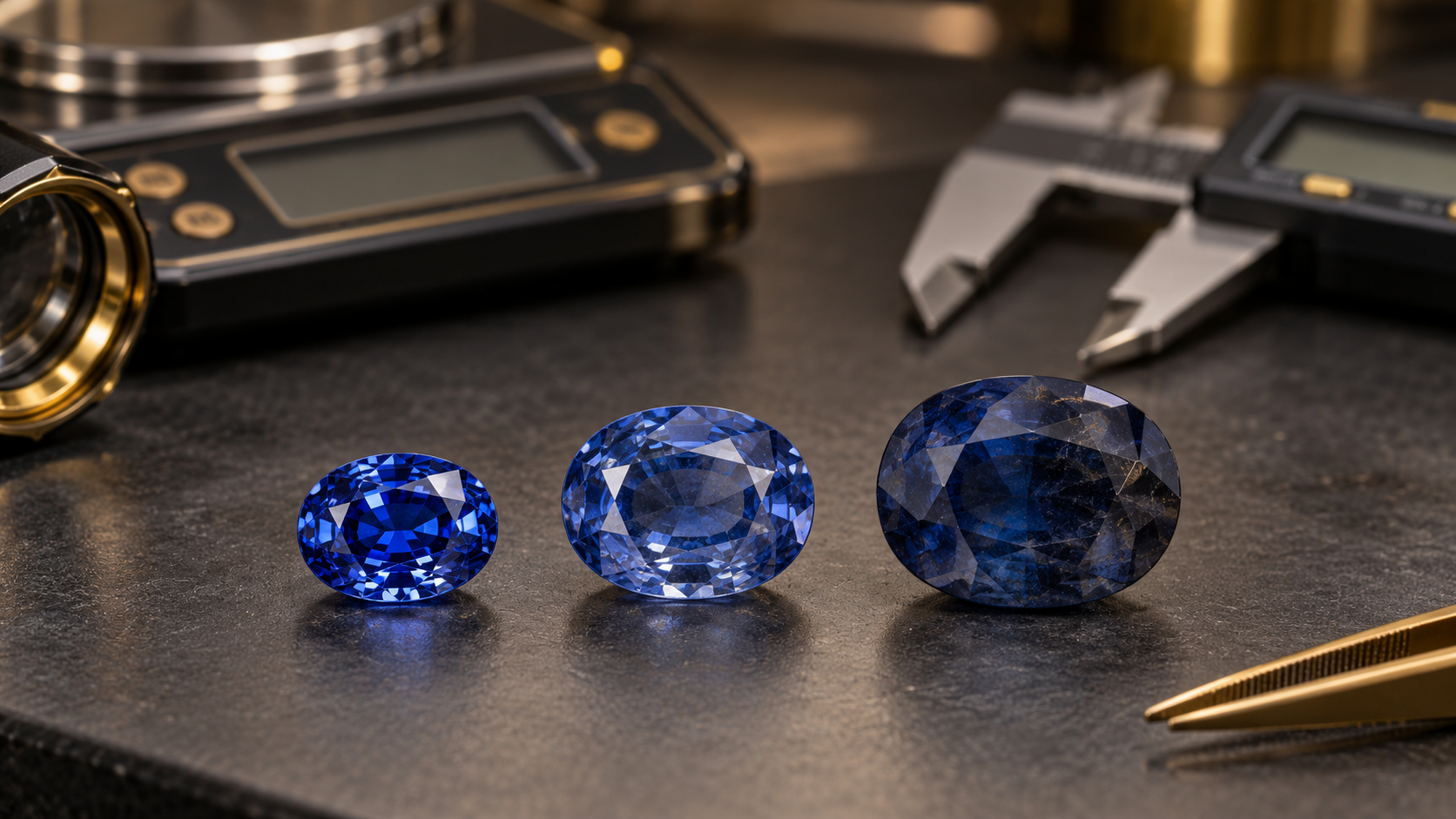
Imagine two natural sapphires displayed beside one another.
The first weighs 1.20 carats and possesses vivid, evenly distributed blue colour, excellent transparency and attractive brilliance.
The second weighs 2.50 carats but displays uneven colour, noticeable inclusions and a poorly proportioned cut.
Which gemstone is more valuable?
Many buyers instinctively select the larger stone.
However, gemstone valuation is considerably more complex than comparing weight.
A larger gemstone may command a higher price because large, high-quality crystals can be rare. Yet additional weight does not automatically produce better colour, clarity, brilliance or commercial desirability.
In some gemstone species, size strongly influences price. In others, large crystals are comparatively common, and additional weight contributes relatively little to value.
Even two gemstones with identical carat weights may look surprisingly different when viewed from above.
These differences arise from mineral density, cutting proportions, optical behaviour and the quality of the original rough material.
Understanding gemstone size therefore requires examining three separate concepts:
- Carat weight: the mass of the gemstone.
- Physical dimensions: its measurable length, width and depth.
- Commercial value: the price a particular gemstone may command under specific market conditions.
These concepts are connected, but they are not interchangeable.
For gemstone collectors and informed buyers, understanding the distinction is essential.
1. What Exactly Is a Carat?
The carat is the internationally recognised unit of mass used for gemstones.
One metric carat equals exactly 200 milligrams, or 0.20 grams.
A gemstone weighing five carats therefore has a mass of one gram.
The abbreviation is ct.
A carat is divided into 100 points, allowing smaller gemstones to be described precisely.
For example:
| Carat weight | Weight in grams |
|---|---|
| 0.25 ct | 0.05 g |
| 0.50 ct | 0.10 g |
| 1.00 ct | 0.20 g |
| 2.00 ct | 0.40 g |
| 5.00 ct | 1.00 g |
| 10.00 ct | 2.00 g |
The metric carat is a measurement of mass, not physical dimensions.
It should also not be confused with karat, which describes gold purity in expressions such as 18K gold.
The carat system has historical connections with carob seeds, which were used as counterweights in early trading.
However, individual seeds were not perfectly identical in mass.
The modern metric standard eliminated that uncertainty by establishing a fixed relationship between carats and grams.
GIA records that the United States adopted the metric carat in 1913, followed by other countries.
Today, a one-carat gemstone has the same mass regardless of where it is weighed.
2. Why Carat Weight Does Not Equal Visible Size
A gemstone’s weight does not tell us exactly how large it will appear.
Two factors are particularly important: density and cutting proportions.
Density describes the mass contained within a given volume.
Different minerals possess different densities because their chemical compositions and crystal structures differ.
For example, diamond has a specific gravity of approximately 3.52.
Corundum, the mineral species containing ruby and sapphire, has a specific gravity of approximately 4.00.
Emerald, a variety of beryl, has a specific gravity of approximately 2.72.
Consequently, equal masses of these minerals occupy different volumes.
A one-carat ruby generally occupies less physical volume than a one-carat diamond.
A one-carat emerald generally occupies more volume than a one-carat diamond.
However, the visible face-up dimensions also depend on how each stone is cut.
A deep emerald can look smaller from above than a shallower emerald of identical weight.
The same principle applies to sapphires, rubies, tourmalines and other faceted gemstones.
Therefore, a buyer should never rely on carat weight alone when comparing visible gemstone size.
3. The Hidden Weight Problem
A gemstone’s weight is distributed throughout its three-dimensional structure.
When a gemstone is viewed face-up, much of that structure is hidden beneath the visible surface.
The pavilion is the lower portion of a faceted gemstone.
If the pavilion is excessively deep, a substantial proportion of the gemstone’s weight may be concentrated below the girdle.
This additional weight does not necessarily contribute to visible size.
A shallower gemstone of lower weight may therefore appear larger when viewed from above.
However, cutting a gemstone too shallowly can create optical problems.
Light may escape through the pavilion rather than returning toward the observer.
This can produce a transparent-looking area known as a window.
Excessively deep proportions can also produce undesirable optical effects, depending on the mineral and cutting design.
The ideal objective is not simply to maximise diameter.
It is to achieve an attractive balance between face-up dimensions, colour, light return, symmetry and usable weight.
GIA’s research on coloured gemstone cut quality explains how cutting decisions influence both visual appearance and commercial value.
A gemstone should therefore be evaluated as a three-dimensional optical object, not merely as a number on a scale.
4. Why Doubling the Weight Does Not Double the Diameter
Consider two gemstones of the same mineral species, shape and proportions.
If the second gemstone has twice the mass, it also has twice the volume.
However, its linear dimensions do not double.
For geometrically similar objects, volume increases with the cube of their linear dimensions.
Consequently, doubling the volume increases each linear dimension by approximately 26%.
A hypothetical round gemstone measuring 6.0 mm across would therefore measure approximately 7.6 mm across if its mass doubled while its proportions and density remained unchanged.
This is a mathematical illustration, not a universal gemstone size chart.
Actual dimensions vary with cut design, pavilion depth, girdle thickness and mineral density.
The practical lesson is important.
A two-carat gemstone is not necessarily twice as wide as a one-carat gemstone.
It is twice as heavy.
Buyers should examine millimetre measurements alongside carat weight when judging physical size.
5. Why Larger High-Quality Gemstones Can Be Rare
The relationship between gemstone size and value begins with geological rarity.
Natural crystals develop under particular physical and chemical conditions.
Some minerals readily form large crystals.
Others rarely produce large specimens suitable for faceting.
However, crystal size alone is not sufficient.
A large crystal may contain extensive fractures.
Its colour may be uneven.
It may include opaque zones or mineral inclusions.
Some portions may be unsuitable for cutting.
The probability of obtaining a large, transparent, attractively coloured finished gemstone may therefore be considerably lower than the probability of finding a large crystal.
This distinction is particularly important for ruby.
GIA explains that fine-quality rubies weighing more than one carat are rare, although commercial-quality rubies occur across a wider range of sizes.
For exceptional ruby material, price per carat can increase significantly with weight.
A similar relationship can occur with fine emerald and certain tourmaline varieties.
However, these patterns are species-specific.
They should not be treated as universal gemstone pricing rules.
6. Understanding Price per Carat
Price per carat is a commercial comparison measure.
It is calculated by dividing the total gemstone price by its carat weight.
Price per carat = Total price ÷ Carat weight
For example, a hypothetical natural gemstone weighing 1.50 carats and priced at €600 has a price per carat of €400.
If another gemstone weighs 2.00 carats and costs €1,200, its price per carat is €600.
The second gemstone is more expensive both in total and per unit of weight.
However, this does not automatically mean that the second gemstone is overpriced.
It may possess better colour, greater transparency, superior cutting or a more desirable treatment history.
The price per carat becomes meaningful only when the compared gemstones are sufficiently similar.
Comparing a pale sapphire with a vivid sapphire using weight alone is not a valid quality comparison.
Nor is comparing a heavily included ruby with a transparent ruby without accounting for their different characteristics.
Price per carat is a useful analytical tool, but it is not an independent measure of gemstone quality.
7. Why Gemstone Value Often Increases Nonlinearly
A common assumption is that doubling gemstone weight should double gemstone value.
In practice, this is frequently incorrect.
For certain gemstone varieties, larger high-quality specimens are disproportionately rare.
Market demand may also favour particular sizes.
Consequently, the price per carat can rise as gemstone weight increases.
Consider the following entirely hypothetical comparison.
| Gemstone | Weight | Price per carat | Total price |
|---|---|---|---|
| Stone A | 1.00 ct | €500 | €500 |
| Stone B | 2.00 ct | €850 | €1,700 |
| Stone C | 3.00 ct | €1,100 | €3,300 |
These figures are illustrative calculations, not actual market quotations or recommended selling prices.
They demonstrate how an increase in price per carat can produce a total value that rises faster than weight.
The reverse can also occur.
If a larger gemstone has poorer colour or clarity, its price per carat may be lower than that of a smaller, superior specimen.
Market value is therefore not a simple linear function of weight.
8. Why Size Premiums Differ Between Gemstone Species
Not every gemstone responds to increasing size in the same commercial way.
Ruby
Fine-quality ruby becomes increasingly rare in larger sizes.
The combination of attractive red colour, good transparency and significant weight can command a substantial premium.
However, large commercial-quality rubies with less desirable characteristics are not necessarily exceptionally valuable.
Sapphire
Fine sapphires may also command size premiums.
Colour, transparency, treatment history and cutting quality remain essential considerations.
A large sapphire with weak colour or significant extinction may be less desirable than a smaller, better-balanced stone.
Emerald
High-quality emeralds with attractive colour and transparency can become disproportionately valuable as size increases.
However, inclusions are common in emerald.
The nature, visibility and effects of these inclusions must be considered.
Treatment information can also influence commercial value.
Tourmaline
Tourmaline illustrates the importance of variety and colour.
GIA notes that for certain tourmalines of comparable quality, price per carat can increase significantly beyond particular size ranges.
However, the commercial behaviour of common green tourmaline is not necessarily the same as that of rare copper-bearing blue-green tourmaline.
Aquamarine
Aquamarine provides an interesting contrast.
Large crystals and sizeable finished gemstones are relatively available compared with some other fine coloured stones.
GIA notes that aquamarines often need to be fairly large to display stronger blue colour, although exceptional smaller specimens also occur.
A smaller aquamarine with outstanding colour may therefore command a higher price per carat than a larger specimen of less desirable appearance.
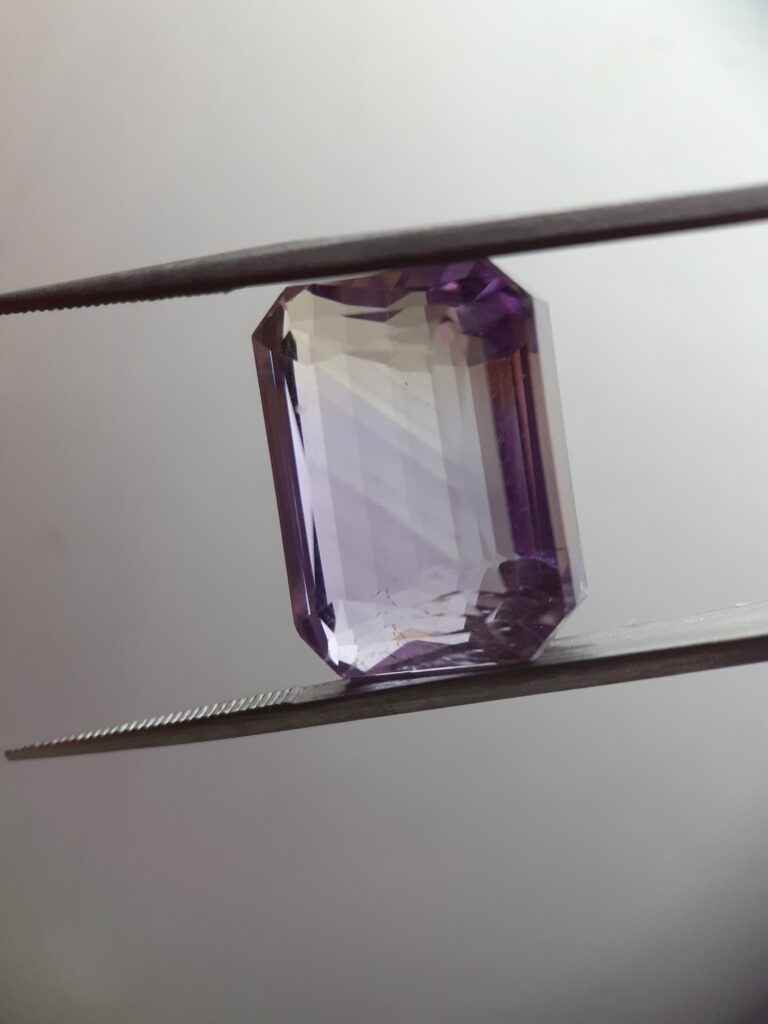
Quartz
Quartz can form very large crystals.
Amethyst, citrine and other quartz varieties are therefore not automatically rare simply because they possess substantial weight.
Colour, transparency, cutting quality and the particular material type can be more important than size alone.
These examples demonstrate that rarity must be evaluated within the context of the individual gemstone species and variety.
9. Why Extremely Large Gemstones Are Not Always More Valuable per Carat
An especially interesting exception occurs when gemstones become unusually large.
A gemstone may be rare in geological terms but less practical for conventional jewellery.
Very large specimens can be difficult to incorporate into everyday rings or pendants.
The number of potential buyers may be smaller.
GIA’s research on coloured gemstone value factors explains that price per carat can decrease when gemstones exceed the sizes commonly demanded for jewellery.
This does not mean that all exceptionally large gemstones lose value.
Extraordinary specimens with exceptional colour, transparency, rarity or historical significance may command substantial premiums.
However, increasing size does not guarantee an unlimited increase in price per carat.
Commercial demand matters alongside geological rarity.
A large gemstone can be unusual without necessarily being the most desirable purchase for every buyer.
10. Colour Can Matter More Than Carat Weight
For many coloured gemstones, colour is among the most important value factors.
A larger gemstone may possess greater mass but weaker colour.
A smaller specimen may display a more desirable hue, tone and saturation.
Hue describes the basic colour impression.
Tone describes relative lightness or darkness.
Saturation describes colour intensity or purity.
These characteristics influence visual appeal.
A gemstone that is too dark may appear almost black in certain lighting conditions.
A gemstone that is too pale may lack the intensity preferred in its market.
Uneven colour distribution can also affect appearance.
Cutting orientation and proportions may further influence the observed colour.
For example, a cutter may choose a deeper design to increase the apparent colour intensity of pale material.
However, excessive depth can reduce face-up size and may affect light performance.
The relationship between colour, cut and weight therefore involves practical trade-offs.
A buyer should evaluate colour before assuming that additional carat weight represents better quality.
11. Clarity and Transparency Become Increasingly Important
A large gemstone can make internal features more noticeable.
However, inclusion visibility does not increase according to one universal mathematical rule.
The effect depends on inclusion size, position, contrast, lighting and the gemstone’s optical characteristics.
Some inclusions have little effect on appearance.
Others interrupt transparency or produce visible fractures.
A large transparent gemstone may be exceptionally desirable when its species rarely produces clean material.
Conversely, a large gemstone containing prominent fractures may be less attractive or present durability concerns.
Clarity expectations also differ between gemstone species.
Eye-visible inclusions are relatively common in emerald.
Faceted aquamarine is generally expected to display high transparency.
Ruby and sapphire have their own characteristic inclusion patterns.
Therefore, a clarity assessment must be appropriate to the mineral species.
A single universal clarity expectation cannot be applied fairly to every coloured gemstone.
12. Cutting Quality Can Outweigh Additional Weight
Cutting transforms natural rough material into a finished gemstone.
The cutter must balance several competing objectives.
These include preserving weight, maintaining desirable colour, avoiding inclusions and producing attractive optical performance.
A larger finished gemstone may result from a decision to retain more of the original rough.
However, this does not necessarily produce the most attractive cut.
An excessively deep pavilion can conceal weight below the visible surface.
A shallow pavilion may produce windowing.
Poor symmetry may affect the overall appearance.
Uneven proportions can reduce visual balance.
A smaller gemstone with a well-planned cut may therefore provide greater brilliance, more attractive proportions and better face-up presentation.
The most desirable choice depends on the characteristics of the original material.
There is no single ideal cutting geometry suitable for every coloured gemstone.
The relationship between cutting and value must be considered alongside colour, transparency and the mineral’s optical properties.
13. Treatment History and Size Premiums
Treatment history introduces another important variable.
Two natural sapphires of similar size and visual quality may have different commercial values if their documented treatment histories differ.
In some fine ruby and sapphire markets, unheated material may command a premium.
However, unheated status does not automatically establish superior quality.
A poorly coloured unheated gemstone may be less desirable than an attractive heated specimen.
Likewise, treatments involving diffusion or fracture filling may have different commercial implications from conventional heating.
The correct evaluation requires considering both appearance and treatment information.
Gemstone weight should not obscure these distinctions.
A larger treated gemstone is not automatically more valuable than a smaller untreated gemstone.
Nor is the reverse universally true.
Treatment history is one part of a broader assessment.
14. The Importance of Carat Weight in Rough Gemstones
The weight of a rough gemstone is not the same as the weight of the finished gemstone that may be cut from it.
During cutting, material is removed.
The amount lost depends on crystal shape, inclusions, fractures, colour distribution and the chosen cutting design.
A ten-carat rough crystal does not necessarily produce a ten-carat finished gemstone.
It may yield a substantially smaller stone.
In some cases, several smaller gemstones may be more desirable than one larger finished specimen.
The cutter must also consider whether removing a particular inclusion will improve the final result.
Preserving maximum weight can conflict with achieving attractive proportions.
Consequently, rough gemstone value cannot be calculated reliably by simply multiplying rough weight by the price per carat of finished gemstones.
Rough material requires its own evaluation.
Natural characteristics, inclusion distribution, cutting potential and expected usable yield all influence commercial assessment.
15. How to Compare Two Gemstones Properly
A practical gemstone comparison should proceed beyond carat weight.
First, establish the correct mineral species and variety.
Comparing gemstones of different species using weight alone provides little meaningful information.
Next, examine colour under appropriate lighting.
Consider hue, tone, saturation and distribution.
Then evaluate transparency and visible inclusions.
Assess the quality of the cut, including proportions, symmetry, polish and optical performance.
Compare the face-up dimensions in millimetres.
Review treatment information and any available laboratory documentation.
Finally, compare the total price and price per carat.
The most meaningful comparison involves gemstones that are similar in species, variety, colour quality, clarity, cut and treatment status.
Even then, market conditions and individual preferences can influence the final decision.
16. A Practical Buying Example
Imagine three hypothetical natural blue sapphires offered for sale.
| Characteristic | Sapphire A | Sapphire B | Sapphire C |
|---|---|---|---|
| Weight | 0.95 ct | 1.50 ct | 2.20 ct |
| Colour | Vivid blue | Medium blue | Dark, uneven blue |
| Transparency | High | High | Moderate |
| Cut | Well proportioned | Slightly deep | Noticeably deep |
| Treatment | Heated | Heated | Heated |
| Visual impression | Bright and balanced | Attractive | Darker with reduced brilliance |
Which sapphire should the buyer choose?
There is no automatic answer.
Sapphire A may offer the strongest colour and optical performance.
Sapphire B may provide an attractive compromise between size and appearance.
Sapphire C offers the greatest weight but may have less desirable visual characteristics.
Without actual prices, it is impossible to determine which represents the best financial value.
Even with prices, the buyer must consider individual preferences.
A collector prioritising colour and optical performance may favour Sapphire A.
A buyer seeking a larger centre stone may prefer Sapphire B.
The example demonstrates why carat weight should be treated as one evaluation factor rather than the final purchasing decision.
17. Carat Weight and Gemstone Grading Are Different Concepts
Gemstone grading and gemstone valuation are related but distinct.
Grading evaluates the characteristics of an individual specimen.
Valuation considers how those characteristics interact with rarity, demand and market conditions.
A gemstone may receive a strong quality evaluation while remaining relatively affordable because its mineral variety is abundant.
Another gemstone may possess more modest optical characteristics but command a substantial price because of rarity or exceptional size.
Therefore, a quality score should not be interpreted as a direct monetary valuation.
A 95/100 gemstone is not automatically worth 95% of a hypothetical maximum price.
Similarly, a gemstone weighing five carats is not necessarily five times as valuable as a one-carat gemstone of the same species.
A transparent grading system should help buyers understand observable quality.
Treatment history, rarity, market price and physical dimensions should remain identifiable as separate information.
18. Common Misconceptions About Gemstone Size and Value
A two-carat gemstone is twice as large as a one-carat gemstone.
It has twice the mass, but not necessarily twice the visible dimensions.
A larger gemstone always costs more per carat.
Not necessarily. Species, quality and market demand influence the relationship.
A large gemstone must be rare.
Some minerals commonly form large crystals. Size alone does not establish rarity.
Carat weight determines gemstone quality.
Incorrect. Weight is a measurement of mass, not a quality grade.
Two gemstones of identical weight must look equally large.
Incorrect. Density and cutting proportions influence visible size.
A deep-cut gemstone is always better because it weighs more.
Incorrect. Excessive depth can conceal weight and affect appearance.
A gemstone with a higher price per carat must be better.
Not necessarily. Pricing may reflect rarity, market conditions, treatment history or other factors.
Unheated gemstones are always more valuable.
Incorrect. Treatment status must be considered alongside quality and rarity.
Rough gemstone weight predicts finished gemstone weight precisely.
Incorrect. Cutting yield depends on the individual rough specimen.
The largest available gemstone is always the best purchase.
Incorrect. The best choice depends on appearance, quality, purpose, documentation and price.
19. A Practical Checklist Before Buying
Before purchasing a faceted gemstone, consider the following questions.
Is the mineral species correctly identified?
Does the gemstone display attractive colour under suitable lighting?
Are its transparency and inclusions acceptable for the species?
Does the cut provide pleasing proportions and optical performance?
How large does the gemstone appear when viewed face-up?
Are its millimetre dimensions provided?
Is the carat weight measured accurately?
Has treatment information been disclosed appropriately?
Does any available laboratory report support the relevant claims?
Is the price reasonable when compared with gemstones of genuinely similar characteristics?
These questions provide a more reliable basis for purchasing than selecting the largest gemstone within a budget.
20. What Gemstone Size Really Tells Us
Carat weight provides one precise piece of information.
It tells us how much a gemstone weighs.
It does not independently establish colour quality, transparency, cutting performance, treatment history, geological rarity or commercial value.
Nevertheless, size remains important.
For certain gemstone species, large high-quality specimens are exceptionally uncommon.
Their rarity can contribute to substantial market premiums.
For other species, larger sizes are more readily available.
The commercial relationship between weight and value may therefore be much weaker.
Cutting proportions introduce another dimension.
A well-cut gemstone can provide an attractive face-up appearance without maximising weight.
A heavier stone may conceal much of its mass below the visible surface.
The informed buyer must therefore look beyond carat weight and evaluate the complete gemstone.
Conclusion: The Best Gemstone Is Not Necessarily the Largest
Gemstone size is one of the most visible and easily measured characteristics in the gemstone trade.
Yet it is also one of the most frequently misunderstood.
A carat is a measurement of mass.
It is not a measurement of beauty, quality or rarity.
The commercial significance of weight depends on the gemstone species, variety, colour, clarity, cut, treatment history and market demand.
Large, high-quality gemstones can be disproportionately rare.
However, additional weight does not automatically create additional beauty.
A smaller gemstone with exceptional colour and attractive optical performance may be more desirable than a larger specimen with weaker characteristics.
Likewise, a carefully cut gemstone may appear larger and more brilliant than a heavier stone with less effective proportions.
For collectors and buyers, the most reliable approach is to evaluate each gemstone as an individual natural specimen.
Understand its mineral identity.
Examine its colour and transparency.
Assess its cut and optical performance.
Review its treatment information.
Compare its physical dimensions and weight.
Then consider its price within the appropriate market context.
Carat weight tells us how much of a gemstone we have. Quality, rarity and market conditions help determine what that gemstone is worth.
References & Further Reading
The following references provide authoritative educational and gemmological information supporting the scientific and commercial principles discussed in this article. All links lead to informational resources, not gemstone product listings.
1. Gemological Institute of America – GIA 4Cs Carat Weight
An authoritative explanation of the metric carat, its historical origins, the relationship between carats and points, and the importance of accurate gemstone weighing.
https://www.gia.edu/gia-about/4Cs-carat
2. Gilbertson, Al – Colored Gemstone Value Factors
Gemological Institute of America, 9 August 2018.
A substantial educational research article examining coloured gemstone value factors, including colour, clarity, cut, size, market demand and the relationship between cutting quality and value.
3. Gemological Institute of America – Ruby Buyer’s Guide
An educational reference covering ruby colour, clarity, cutting quality, carat weight, treatment disclosure and the rarity of larger fine-quality specimens.
https://www.gia.edu/ruby/buyers-guide
4. Gemological Institute of America – Emerald Quality Factors
A detailed discussion of emerald colour, clarity, cutting considerations and the relationship between carat weight and commercial value.
https://www.gia.edu/emerald-quality-factor
5. Gemological Institute of America – Aquamarine Quality Factors
An explanation of aquamarine colour, transparency, cutting practices and the distinctive relationship between size and colour intensity.
https://www.gia.edu/aquamarine-quality-factor
6. Gemological Institute of America – Tourmaline Quality Factors
A professional reference examining tourmaline colour varieties, pleochroism, clarity, cutting decisions and size-related pricing differences.
https://www.gia.edu/tourmaline-quality-factor
7. Gemological Institute of America – Nine Things About Diamond Carat Weight You Need to Know
An educational article explaining the differences between carat weight, physical dimensions, density, cutting proportions, price-per-carat comparisons and popular weight thresholds.
Although focused on diamonds, the physical principles of mass, volume and density are relevant to other gemstones.
https://4cs.gia.edu/en-us/blog/nine-things-about-diamond-carat-weight-you-need-to-know
8. Gemological Institute of America – Understanding Carat Weight: GIA Diamond Grading Reports
Published 9 May 2017.
A reference discussing carat measurement, gemstone density, visible dimensions and the effects of cutting proportions on apparent size.
https://4cs.gia.edu/en-us/blog/gia-diamond-grading-reports-understanding-carat-weight
9. Gemological Institute of America – Diamond Quality Factors
An authoritative educational explanation of how colour, clarity, cut and carat weight interact in diamond quality and value.
The discussion provides a useful comparative framework while recognising that coloured gemstones have different quality priorities.
https://www.gia.edu/diamond-quality-factor
Scientific and Commercial Interpretation
The numerical price examples in this article are hypothetical and are intended exclusively to demonstrate mathematical relationships.
They are not market quotations, gemstone appraisals or recommended retail prices.
Gemstone prices vary according to species, variety, quality, size, treatment history, supply, demand and commercial circumstances.
The size-related patterns documented for one gemstone species should not automatically be applied to another.
Carat weight is an exact measurement of mass when established using appropriate equipment, but visible dimensions depend on density and cutting proportions.
Gemstone quality grading and monetary valuation are separate processes.
A professional valuation should consider the characteristics of the individual specimen and relevant market evidence.
[…] Gemstone rarity therefore involves several different forms of scarcity. […]