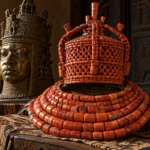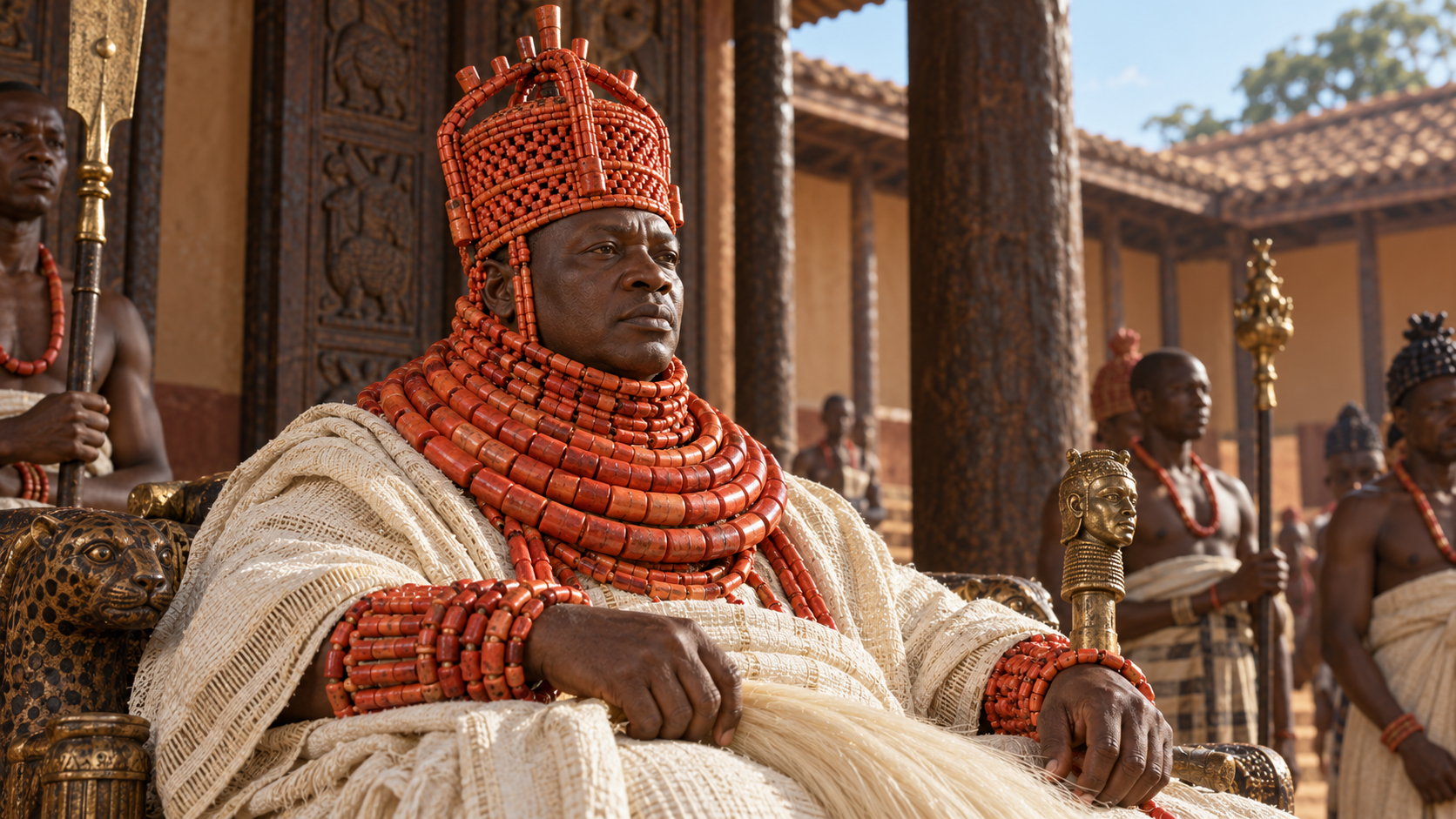
Imagine a royal figure dressed in white, almost entirely covered in deep red beads.
A carefully constructed coral crown surrounds the head.
Layer upon layer of polished beads forms a substantial collar around the neck.
Additional strands cover the wrists, ankles and portions of the ceremonial garments.
The overall effect is extraordinary.
Yet this elaborate appearance was not simply intended to communicate wealth.
In the historic Kingdom of Benin, situated in present-day southern Nigeria, coral became one of the most recognisable materials associated with royal authority.
Its significance extended beyond decoration.
Coral participated in a complex cultural world involving kingship, ancestry, maritime exchange, religious traditions and the relationship between political power and the spiritual realm.
For the Edo people of Benin, particular coral objects could represent authority and sacred legitimacy.
The material was associated with Olokun, a deity connected with the waters, prosperity and wealth.
Royal coral regalia also formed part of ceremonial practices intended to maintain and renew the significance of the king’s position.
This history provides an important example of how natural gem materials can acquire profound cultural meanings.
But it also requires careful interpretation.
The historical significance of coral in Benin does not demonstrate that coral possesses scientifically measurable supernatural powers. It demonstrates that natural materials can become integral to religious institutions, political identity and cultural memory.
To understand this relationship, we must examine both the material itself and the society that transformed it into a powerful symbol.
Table of Contents
The Kingdom of Benin: A Major Centre of West African Art and Culture
The Kingdom of Benin developed in the region surrounding present-day Benin City in southern Nigeria.
It should not be confused with the modern Republic of Benin, a separate country to the west.
The kingdom became one of the most influential political and artistic centres in West Africa.
Its rulers, known as Obas, governed through an elaborate court system supported by titled officials, specialist guilds and ceremonial institutions.
The royal court commissioned exceptional works of art.
These included cast-brass commemorative heads, plaques, carved ivory objects, ceremonial implements and sophisticated beadwork.
Many of these objects communicated political authority and religious significance simultaneously.
The palace was not merely a residence.
It was also an important centre of ceremonial life, dynastic remembrance and the representation of royal power.
Within this environment, coral acquired an especially prominent position.
What Is Red Coral?
Before exploring its cultural significance, it is important to understand the material scientifically.
Coral is an organic gem material derived from marine organisms.
Unlike ruby, sapphire or garnet, coral is not a mineral species formed through ordinary geological crystallisation.
It originates from colonial marine animals known as coral polyps.
These animals produce supporting skeletal structures.
In precious red corals used historically for jewellery, the hard skeletal material is composed predominantly of calcium carbonate.
The Mediterranean red coral species Corallium rubrum is particularly important in the history of ornamental coral.
Its branching skeleton can be cut and polished into beads, cabochons and carvings.
Natural precious coral may display colours ranging from pale pink and salmon to saturated red.
Its surface can acquire a smooth, attractive polish.
These qualities made coral desirable in many historical jewellery traditions.
However, coral is relatively soft compared with most crystalline gemstones.
GIA describes its hardness as approximately 3–4 on the Mohs scale.
It is also sensitive to heat, chemicals and certain cleaning methods.
Coral is therefore best understood as a natural organic gem material rather than a crystal in the strict mineralogical sense.
How Did Mediterranean Coral Reach Benin?
The arrival of red Mediterranean coral in the Kingdom of Benin is closely connected with the development of maritime trade.
Portuguese merchants established contact with Benin during the late fifteenth century.
Among the materials entering the kingdom through European trade networks was red coral.
The Metropolitan Museum of Art identifies Mediterranean coral as an important commodity in the commercial relationship between European merchants and the Kingdom of Benin.
However, the appreciation of red ornamental materials did not begin with the Portuguese.
Before the introduction of Mediterranean coral, reddish stone beads were already valued in the region.
These included materials identified in museum scholarship as agate, jasper and related varieties of chalcedony.
Some had entered West African trade networks from northern regions.
The imported coral therefore entered an existing cultural environment in which red beads already possessed prestige.
This is an important distinction.
The Portuguese did not simply introduce the idea that red ornamental materials were valuable.
They introduced a new material that could be incorporated into established systems of status and symbolism.
The Importance of Red in Edo Symbolism
Colour played an important role in the visual culture of Benin.
Red was associated with concepts including power, blood and danger.
These associations help explain why coral could become particularly appropriate for royal display.
Its saturated colour made it visually striking.
Its rarity increased its prestige.
Its imported origin connected it with distant commercial networks.
And its use within ceremonial regalia gave it a meaning extending beyond its physical appearance.
However, it would be inaccurate to claim that red possessed one identical meaning throughout Africa.
Colour symbolism differs between communities, historical periods and ceremonial contexts.
The associations discussed here concern documented Edo traditions connected with the Kingdom of Benin.
They should not be generalised to all African cultures.
Coral as a Material of Royal Authority
The Oba occupied a central position in the political and ceremonial life of Benin.
Coral became one of the most recognisable materials associated with that position.
The Metropolitan Museum of Art explains that coral and red stone beads entering the kingdom were historically regarded as belonging to the Oba.
The ruler controlled their distribution.
This gave coral an important political function.
Possessing certain beads or wearing particular forms of beadwork could communicate a person’s relationship with royal authority.
The right to wear elaborate coral regalia was therefore not simply a matter of personal wealth.
It could also reflect rank, office and permission.
The Oba alone possessed the privilege of wearing a complete costume of coral beadwork.
Other important individuals could receive particular coral ornaments according to their position.
The material became part of a visible system of hierarchy.
A Crown Made from Coral
Among the most remarkable surviving examples of Benin beadwork are coral crowns.
The British Museum preserves an Edo royal crown dated approximately to the eighteenth or nineteenth century.
Its construction combines coral, agate and glass beads arranged in an openwork mesh.
The object demonstrates the extraordinary skill involved in creating royal regalia.
The beads are not merely arranged into a simple necklace.
They are assembled into a complex textile-like structure.
Their placement produces a flexible yet visually substantial object.
The crown is therefore both jewellery and specialised craftsmanship.
Its form communicates royal identity.
Its materials communicate prestige.
And its ceremonial use connects it with the institution of kingship.
The Royal Body as a Symbol of Authority
The significance of coral becomes especially apparent when considering the complete royal costume.
Benin rulers could wear coral crowns, collars, bracelets, anklets and elaborate beaded garments.
The cumulative visual effect was deliberate.
The body of the ruler became surrounded by materials associated with royal authority.
The Metropolitan Museum of Art notes that the degree of beadwork worn by court officials could also indicate their proximity to the Oba.
This created a visible political language.
A richly ornamented individual could be recognised as occupying an important position.
The materials communicated information about social relationships.
Coral was therefore not simply a decorative addition to clothing.
It helped transform the appearance of the wearer into an expression of institutional authority.
Olokun: The Spiritual Connection with the Waters
One of the most fascinating aspects of Benin coral symbolism concerns Olokun.
Within Edo religious traditions, Olokun is associated with the waters and with wealth or prosperity.
The exact interpretation of Olokun varies across communities and religious contexts.
It is important not to assume that every tradition involving a deity called Olokun is identical.
In the historical Kingdom of Benin, Olokun occupied an important place within the religious understanding of kingship and prosperity.
The British Museum documents a tradition connecting the acquisition of coral with Oba Ewuare.
According to this account, Ewuare obtained coral beads and riches from the watery kingdom of Olokun.
The story establishes a symbolic connection between royal wealth and the spiritual realm associated with water.
The Legend of Oba Ewuare
Oba Ewuare is remembered as one of the important rulers in Benin’s historical traditions.
He is generally associated with the fifteenth century.
According to a tradition recorded in museum scholarship, Ewuare travelled to the waters and obtained coral and other riches from Olokun.
This account helps explain why coral became associated with the royal institution.
The material was not understood merely as a foreign commodity.
Within the tradition, it could be interpreted as wealth originating from the spiritual domain of the waters.
The historical development of maritime trade provides another dimension.
Portuguese merchants brought Mediterranean coral into Benin during the late fifteenth century.
Some scholars have suggested that the Olokun narrative may preserve or reinterpret memories of wealth arriving from overseas.
This is a historical interpretation rather than a demonstrated explanation of the legend’s origin.
The tradition itself remains culturally significant regardless of whether every element can be connected with a specific historical event.
Coral and the Boundary Between Worlds
The association between coral and Olokun becomes particularly meaningful when considered within broader Edo ideas concerning the relationship between the living and the dead.
The Metropolitan Museum of Art describes traditions in which a vast body of water separates these realms.
The movement of people and goods across the sea could therefore acquire symbolic significance.
European maritime traders were sometimes represented in Benin art because their arrival was associated with overseas wealth.
The sea connected distant regions through commerce.
Within the religious imagination, it could also represent a boundary between different domains of existence.
Coral participated in this complex relationship.
Its origin in the sea made it particularly appropriate for associations with Olokun.
Its arrival through maritime trade connected it with economic prosperity.
And its incorporation into royal regalia connected it with the Oba.
The Oba and Olokun
The relationship between the Oba and Olokun was not simply decorative.
Museum interpretations describe the Oba as the ruler of the land and Olokun as a ruler associated with the waters.
This relationship helped connect royal authority with the spiritual sources of prosperity.
The Oba’s possession of coral could therefore communicate more than ownership of valuable material.
It could evoke a relationship between earthly kingship and the spiritual realm.
However, the symbolic connection should not be interpreted as proof that coral itself possesses supernatural energy.
The historical evidence establishes that coral was culturally and religiously meaningful.
The supernatural explanations belong to the religious tradition.
Coral Beads and Sacred Power
The British Museum records beliefs that coral beads could possess protective and spiritually significant qualities.
In particular, museum scholarship discusses the concept of ase in connection with royal coral regalia.
The term is associated in this context with the capacity to bring about or accomplish what is spoken or intended.
Such interpretations belong to the historical and religious framework in which the objects were used.
They are not scientific descriptions of a measurable physical force.
This distinction is essential.
A coral bead can be examined scientifically for its material composition, structure and authenticity.
Its sacred significance must be studied through historical evidence, religious traditions and cultural interpretation.
These are different forms of knowledge.
The Ugie Ivie Ceremony
One of the clearest examples of coral’s ceremonial significance is the Ugie Ivie tradition.
The British Museum documents this ceremony in connection with royal coral regalia.
Museum accounts describe the ritual renewal or reactivation of the spiritual significance attributed to the beads.
Historical descriptions include ceremonial actions involving the regalia and sacrificial materials.
Such practices belong to a specific religious and royal context.
They should not be reduced to a generic idea of “charging crystals.”
Modern crystal spirituality sometimes describes placing stones in moonlight or using meditation to restore their energy.
The documented Benin ceremony belongs to a very different cultural institution.
Its meaning is connected with kingship, ritual authority and established Edo traditions.
It cannot responsibly be presented as an early version of a modern crystal-cleansing practice.
Why Ritual Context Matters
A material does not acquire the same meaning in every society.
Consider two objects made from natural red coral.
One is a simple polished bead worn as jewellery.
The other forms part of royal regalia maintained by specialist palace attendants and used during ceremonial occasions.
The material may be similar.
The cultural significance is not.
The royal bead participates in a system of inherited authority, ritual practice and social recognition.
Its meaning depends upon the institution surrounding it.
This is an important principle in the historical study of gemstone symbolism.
A sacred object cannot be understood fully by examining its material alone.
Its history, ownership, use and cultural context are equally important.
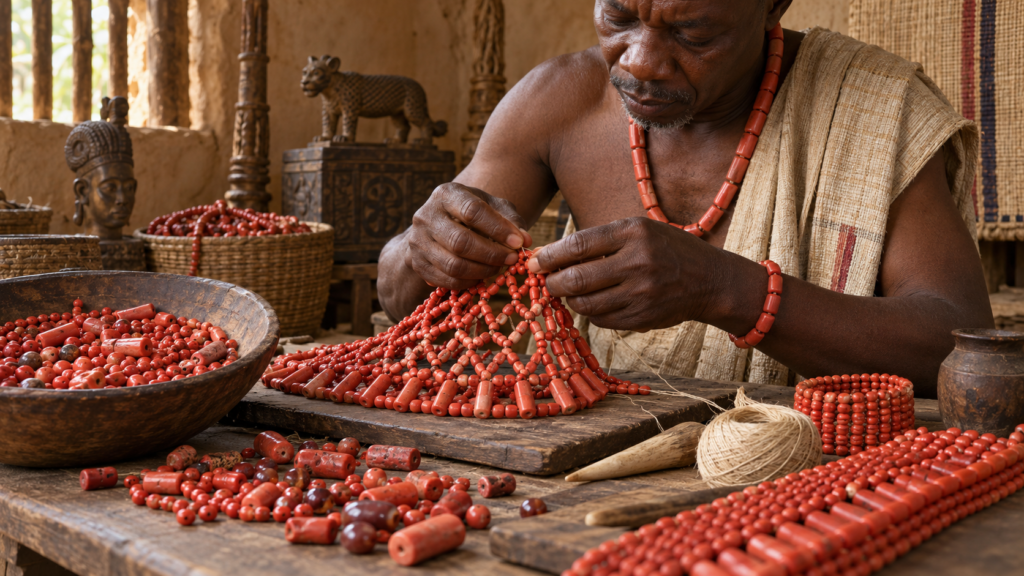
The Craftspeople Behind the Royal Regalia
The elaborate coral ornaments of Benin required considerable technical skill.
The beads had to be selected, arranged and assembled into wearable structures.
Some royal garments contained large quantities of beads.
Their weight and complexity required careful construction.
The British Museum identifies specialist palace attendants associated with the preparation and maintenance of beaded regalia.
These included members of the Iwebo palace organisation, with specialist dressers known as Enisen.
Their work demonstrates that royal beadwork was supported by established court institutions.
The objects were not simply purchased and worn.
They required specialist knowledge, maintenance and ceremonial management.
Coral, Agate and Glass: Different Materials, Shared Prestige
Not every bead described historically as coral was necessarily made from biological coral.
Museum scholarship distinguishes between Mediterranean red coral and older red stone beads.
Agate and jasper are varieties of chalcedony, a microcrystalline form of silica.
They differ fundamentally from coral.
Coral is an organic gem material.
Agate and jasper are mineral aggregates belonging to the quartz family.
Glass beads represent another category.
They are manufactured materials rather than naturally occurring gemstones.
Yet all three could participate in Benin beadwork traditions.
This is particularly important for gemmological interpretation.
A historical reference to “coral beads” may sometimes involve a broader local category of prestigious red beads.
The exact material of an individual object should therefore be established through examination rather than assumed from its cultural description.
How Can Natural Coral Be Identified?
Modern gemmology provides several methods for investigating coral.
The first step is careful visual examination.
Natural precious coral may display characteristic growth structures and subtle variations in colour.
Magnification can reveal details that help distinguish natural coral from certain imitations.
However, visual appearance alone is not always sufficient.
Coral can be imitated using materials such as glass, plastic, dyed stone or reconstructed composites.
GIA also documents treatments including dyeing, bleaching, waxing and impregnation.
For valuable or historically important objects, laboratory analysis may be necessary.
Scientific techniques can investigate composition, structure and possible treatments.
Research published in X-Ray Spectrometry has demonstrated the usefulness of Raman spectroscopy and X-ray fluorescence in the non-destructive examination of precious coral.
Such methods are particularly valuable when an object cannot safely be sampled.
Coral Is Not a Crystalline Gemstone
The distinction between coral and crystalline gemstones deserves emphasis.
Natural red coral originates from biological processes.
Its hard supporting structure is produced by marine organisms.
Although calcium carbonate within the skeleton possesses crystalline structure, the coral object itself is an organic skeletal material rather than a single mineral crystal.
This is why coral is generally classified among organic gem materials.
Other familiar organic gem materials include pearl and amber.
Their origins differ.
Pearl forms through biological processes involving molluscs.
Amber originates from fossilised tree resin.
Coral develops from marine animal colonies.
These distinctions are important for accurate gemmological education.
Coral in Benin Commemorative Sculpture
One of the strongest sources of visual evidence for royal coral regalia comes from Benin’s commemorative brass heads.
These sculptures often depict Obas wearing elaborate beaded crowns and collars.
The Metropolitan Museum of Art preserves an early example dating approximately from the fifteenth to sixteenth century.
The sculpture represents an idealised royal figure wearing coral bead ornaments.
Such heads were associated with royal ancestral altars.
They were not necessarily intended as realistic portraits of individual rulers.
Instead, they communicated the enduring identity and authority of kingship.
The presence of coral regalia in these sculptures demonstrates how closely the material was associated with the royal institution.
Coral and Ancestral Remembrance
Royal ancestral altars played an important role in the ceremonial life of Benin.
Commemorative heads could be placed on these altars in honour of deceased rulers.
The Metropolitan Museum of Art explains that a new Oba had responsibilities connected with establishing a shrine for his predecessor.
Such practices helped express dynastic continuity.
The living ruler was connected with those who had ruled before him.
Coral regalia formed part of the visual language through which royal authority was represented.
When sculptors depicted an Oba wearing coral, they were not merely recording a fashionable accessory.
They were representing the recognised appearance of kingship.
The material helped communicate continuity between successive rulers.
The Symbolism of Coral in Royal Portraiture
The importance of coral becomes especially clear when comparing commemorative heads from different centuries.
Earlier examples often depict relatively restrained beadwork.
Later sculptures may show increasingly elaborate collars and crowns.
The Metropolitan Museum of Art notes this development in its study of Benin beadwork.
The changing visual emphasis reflects developments in courtly display and access to prestigious materials.
Yet the basic relationship remains recognisable.
Coral identifies royal status.
The material becomes part of the visual definition of the Oba.
This is a powerful example of gemstone symbolism functioning through artistic convention and social recognition.
Coral and the Spiritual Importance of the Sea
The sea occupies a central position in this history.
Biologically, coral originates from marine organisms.
Economically, Mediterranean coral reached Benin through long-distance maritime trade.
Religiously, coral became associated with Olokun and the spiritual significance of the waters.
Politically, control over coral helped communicate royal authority.
These connections reinforce one another.
The material’s physical origin contributed to its cultural associations.
Its commercial value contributed to its prestige.
Its use in royal ceremonies contributed to its religious significance.
Coral therefore provides an unusually clear example of how natural history, commerce and spirituality can become intertwined.
Coral and the Problem of Universal Crystal Meanings
Modern gemstone literature often assigns coral a standard collection of spiritual properties.
These may include vitality, protection, courage, emotional balance or prosperity.
Such descriptions are usually presented without specifying a particular historical tradition.
This creates a problem.
The documented Edo significance of coral is not simply equivalent to a universal statement that “coral attracts prosperity.”
Within the Kingdom of Benin, coral was associated with a specific religious and political system.
Its relationship with prosperity was connected with Olokun, royal wealth and ceremonial authority.
Removing those details changes the meaning.
It turns a historically situated tradition into a generic metaphysical claim.
Responsible cultural interpretation requires preserving the original context.
Did Coral Have Protective Significance?
Some museum sources document protective beliefs associated with coral regalia.
The British Museum discusses these traditions in connection with royal ceremonies.
However, there is an additional historical complication.
Coral was also associated with protective beliefs in parts of Europe.
In Renaissance European traditions, coral could be used as an amulet against the evil eye.
Museum scholars have suggested that some protective associations may have circulated through contact between European traders and Benin.
This possibility is historically interesting.
But it should not be treated as proof that all Edo beliefs about coral originated in Europe.
Benin already possessed its own systems of colour symbolism, sacred kingship and prestige beadwork.
Cultural exchange could introduce new materials or ideas while existing traditions shaped their interpretation.
The Living Tradition of Olokun
The religious significance of Olokun did not disappear with the historical period represented by early royal sculptures.
The Smithsonian National Museum of African Art preserves a necklace associated with an Edo priest or priestess of Olokun.
The object dates to the late twentieth century.
It incorporates cowrie shells, a coral bead and a brass bell.
The museum identifies the coral bead and cowrie shells as emblems of wealth.
This object is especially important because it demonstrates that Olokun-related religious material culture cannot be treated only as a distant archaeological subject.
It also belongs to more recent and living cultural traditions.
The precise meanings of individual objects should be understood through their documented contexts and, wherever possible, the knowledge of the communities concerned.
Coral, Cowrie Shells and Religious Identity
The Smithsonian necklace illustrates another important principle.
A spiritual object may combine several different natural materials.
Coral.
Cowrie shells.
Metal.
Textile or cord.
Each material contributes to the complete object.
The religious significance does not necessarily belong to one component in isolation.
The necklace is identified through its association with Olokun religious practice.
Its meaning is therefore connected with the role of the wearer and the tradition in which it was used.
This differs substantially from treating an isolated coral bead as a universal spiritual instrument.
The British Invasion of 1897
Any serious discussion of historic Benin royal regalia must also address the colonial history of museum collections.
In 1897, British forces invaded Benin City.
The invasion resulted in extensive destruction and the removal of large numbers of objects from the royal palace and surrounding institutions.
Many objects were subsequently sold, exchanged or transferred into European collections.
These included works made from brass, ivory, wood and coral.
The British Museum’s catalogue for a surviving coral crown explicitly records its acquisition history in relation to this period.
This context matters.
The presence of Benin royal objects in European museums cannot automatically be interpreted as evidence of voluntary cultural exchange.
Some objects entered collections through violence and dispossession.
Why Provenance Matters
Provenance concerns the documented history of an object’s ownership and movement.
For historic coral regalia, provenance can be especially important.
A crown may have been created for royal ceremonial use.
It may later have been removed during conflict.
It may have passed through private collections.
Eventually, it may have entered a museum.
Each stage forms part of the object’s history.
The original cultural significance should not be separated from the circumstances through which the object left its community.
Museums increasingly recognise the importance of researching these histories.
The Smithsonian has documented the return of Benin artworks to Nigeria as part of wider restitution efforts.
Such developments form an important part of contemporary discussions about cultural heritage.
Cultural Heritage Is More Than Material Value
A historic coral crown can be examined in several ways.
A gemmologist may investigate the beads.
An art historian may study the craftsmanship.
A historian may investigate trade networks.
A scholar of religion may examine its ceremonial significance.
A provenance researcher may reconstruct its ownership history.
For the communities connected with the object, additional meanings may involve identity, inheritance and cultural continuity.
No single perspective is sufficient.
This is particularly important when objects belong to living traditions rather than vanished civilisations.
Their significance cannot be reduced to their commercial value or physical composition.
The Environmental Cost of Precious Coral
The historical prestige of coral raises an important contemporary question.
Should natural coral continue to be harvested for jewellery?
Precious corals are living marine resources.
Many species grow slowly.
Some require long periods to reach reproductive maturity.
NOAA warns that commercial harvesting for jewellery and decorative objects has contributed to declines in certain precious coral populations.
Harvesting can reduce colony size, density and reproductive capacity.
This creates a tension between historical appreciation and modern environmental responsibility.
A material can possess extraordinary cultural significance while also requiring conservation.
Understanding its history does not require encouraging the extraction of additional coral.
Responsible Appreciation of Historic Coral
Historic coral objects can be appreciated through museum collections, photographs, academic publications and cultural heritage programmes.
These approaches allow people to study the material without creating additional demand for newly harvested coral.
Where coral jewellery is considered, provenance, species identification and applicable trade restrictions matter.
Not every coral species is subject to identical regulations.
Nor should all coral materials be treated as environmentally equivalent.
Responsible decisions require species-specific information and reliable documentation.
The historical importance of coral in Benin should encourage respect for both cultural heritage and marine ecosystems.
Does Coral Possess Scientifically Proven Spiritual Energy?
No established scientific evidence demonstrates that coral emits supernatural protective energy or produces spiritual healing through an intrinsic metaphysical force.
Its physical properties can be investigated.
Its chemical composition can be analysed.
Its biological origin can be established.
Its colour and structure can be examined.
But these scientific characteristics do not demonstrate the existence of spiritual powers.
The religious beliefs associated with coral in Benin belong to the cultural and spiritual traditions in which the material was used.
They should be described accurately as beliefs and traditions.
Their importance does not depend upon laboratory confirmation of supernatural effects.
The Difference Between Sacred Meaning and Physical Properties
Consider a royal coral crown.
Scientifically, it consists of identifiable materials.
Historically, it belongs to a particular courtly tradition.
Politically, it communicates authority.
Religiously, it may participate in ceremonies involving sacred kingship.
These statements describe different aspects of the same object.
There is no contradiction in recognising all of them.
The problem arises only when one category is presented as proof of another.
A documented religious belief is not automatically a scientific fact.
A scientific explanation of coral’s composition does not invalidate its cultural importance.
Both forms of knowledge can be discussed responsibly.
What Makes Benin Coral Symbolism Distinctive?
Several characteristics distinguish this tradition from generic gemstone spirituality.
First, coral was connected with a specific political institution: the monarchy of Benin.
Second, its distribution and use were historically regulated through systems of royal authority.
Third, the material was associated with Olokun and the religious significance of the waters.
Fourth, elaborate beadwork transformed coral into complex ceremonial garments.
Fifth, coral appeared in commemorative sculptures associated with royal ancestors.
Sixth, particular ceremonial practices maintained the significance attributed to royal regalia.
Finally, coral belonged to a living cultural tradition whose history was profoundly affected by colonial intervention.
These characteristics cannot be reduced to a simple statement that red coral symbolises protection or prosperity.
The historical reality is considerably richer.
A Modern Reflection on Coral and Cultural Meaning
The story of coral in Benin offers an opportunity for reflection without attempting to reproduce sacred ceremonies.
A person examining a photograph of a historic coral crown might consider several questions.
How does a natural material become a symbol of authority?
Why do societies reserve particular forms of jewellery for specific roles?
How can the origin of a material influence its spiritual interpretation?
What responsibilities accompany the preservation of cultural objects?
And how should contemporary collectors respond when a historically prestigious material comes from vulnerable ecosystems?
These questions connect natural history with cultural understanding.
They also encourage a more thoughtful approach to gemstone collecting.
The objective is not to appropriate Edo religious practices.
It is to appreciate the relationship between material, history and meaning.
Conclusion: When a Material Becomes a Symbol of Kingship
Red coral occupies an extraordinary position in the history of the Kingdom of Benin.
Originating from marine organisms, it entered West African trade networks and became incorporated into a sophisticated tradition of royal beadwork.
Its colour suited established preferences for prestigious red materials.
Its imported origin connected it with maritime commerce.
Its association with Olokun linked it to religious ideas concerning the waters and prosperity.
Its controlled distribution helped communicate political authority.
And its appearance in commemorative sculpture connected it with dynastic memory.
The resulting symbolism was neither simple nor universal.
It belonged to a specific cultural world.
One in which natural materials could communicate authority, identity, religious relationships and historical continuity.
For the modern reader, the most important lesson is not that coral possesses an invisible power.
It is that a material formed by marine life could become one of the most powerful visible expressions of a human institution.
The sacred coral of Benin demonstrates that the meaning of a gemstone is not determined solely by its chemistry, colour or rarity. Meaning also emerges from the histories, relationships, ceremonies and cultural knowledge surrounding it.
That is what makes the study of gemstone symbolism so compelling.
It allows us to understand natural materials not only as beautiful objects, but also as participants in the cultural history of humanity.
References & Further Reading
The following references are drawn from museum collections, academic art-historical research, gemmological institutions and government scientific resources.
They provide evidence for the history of coral in Benin, its cultural and religious significance, its material properties and the ethical questions surrounding its collection and conservation.
1. The Metropolitan Museum of Art – Beadwork in the Arts of Africa and Beyond
https://www.metmuseum.org/perspectives/beadwork-in-arts-of-africa-and-beyond
Source description: Art-historical study by James Green, published in 2018.
Examines the role of beads in global exchange and cultural expression.
The discussion of Benin explains the introduction of Mediterranean coral, royal control over red beads and the use of elaborate beadwork to communicate political authority.
A principal reference for the historical relationship between coral, trade and kingship.
2. The Metropolitan Museum of Art – Head of an Oba
https://www.metmuseum.org/art/collection/search/312290
Source description: Museum record for an early commemorative brass head produced by Edo artists between the fifteenth and sixteenth centuries.
The sculpture depicts an Oba wearing coral bead regalia.
The accompanying interpretation discusses royal ancestral altars, dynastic continuity, sacred authority and coral’s association with the ancestral realm of the sea.
3. British Museum – Benin Coral Crown
https://www.britishmuseum.org/collection/object/E_Af1898-0630-5
Source description: Detailed museum catalogue for an eighteenth- or nineteenth-century Edo royal crown made from coral, agate and glass beads.
Includes substantial historical interpretation of coral symbolism, royal regalia, Portuguese trade, the Ugie Ivie ceremony and the significance of red materials.
The catalogue also documents the object’s acquisition history in connection with the British invasion of Benin.
4. British Museum – Commemorative Head of an Oba
https://www.britishmuseum.org/collection/object/E_Af1944-04-1
Source description: Museum documentation of a nineteenth-century commemorative brass head depicting an Oba wearing elaborate coral bead ornaments.
The curatorial interpretation discusses the relationship between the Oba and Olokun, traditions concerning Oba Ewuare and the sacred significance attributed to royal coral regalia.
5. British Museum – Benin Coral Apron
https://www.britishmuseum.org/collection/object/E_Af1898-0630-4
Source description: Catalogue record for an Edo ceremonial apron made from coral beads arranged in an openwork structure.
Provides information about courtly beadwork, specialist palace attendants, historical coral symbolism and ceremonial practices.
The record also documents the object’s colonial acquisition context.
6. Smithsonian National Museum of African Art – Necklace Associated with Olokun
https://africa.si.edu/collection/object/nmafa_2008-9-9
Source description: Museum record for a late twentieth-century Edo necklace incorporating cowrie shells, a coral bead and a brass bell.
The museum identifies the object as part of the regalia of a priest or priestess of Olokun.
An important reference demonstrating the continuing religious significance of coral and related materials within Edo traditions.
7. The Metropolitan Museum of Art – Altar Bell with Portuguese Heads
https://www.metmuseum.org/art/collection/search/316555
Source description: Museum documentation of a sixteenth- or seventeenth-century Benin altar bell.
Explains the symbolic relationship between Portuguese maritime traders, Olokun, prosperity and the distinction between the realms of the living and the dead.
Provides valuable historical context for the association between overseas wealth and spiritual significance.
8. Gemological Institute of America – Captivated by Coral
https://4cs.gia.edu/en-us/blog/captivated-coral
Source description: GIA educational article examining coral as an organic gem material.
Explains its biological origin, ornamental qualities, hardness, treatments, imitations and appropriate care.
Supports the article’s scientific distinction between natural coral and crystalline gemstones.
9. Macchia et al. – Precious Coral Non-Destructive Characterization by Raman and XRF Spectroscopy
https://doi.org/10.1002/xrs.2703
Source description: Peer-reviewed scientific research published in X-Ray Spectrometry in 2016.
Investigates the use of Raman spectroscopy and X-ray fluorescence for characterising precious coral.
Provides scientific context for the identification, authentication and non-destructive examination of coral materials.
10. National Oceanic and Atmospheric Administration – Does Coral Jewelry Make a Good Gift?
https://oceanservice.noaa.gov/facts/coral-jewelry.html
Source description: United States government educational resource examining the environmental consequences of harvesting coral for jewellery and decorative objects.
Discusses the vulnerability of precious coral populations, slow growth and the effects of commercial extraction.
Provides an authoritative conservation perspective.
11. Smithsonian Institution – The Smithsonian Returns a Trove of Benin Bronzes to Nigeria
https://www.smithsonianmag.com/smithsonian-institution/benin-bronzes-going-back-to-nigeria-180980917
Source description: Smithsonian publication from October 2022 documenting the return of artworks removed from the Kingdom of Benin during the British invasion of 1897.
Provides context for the restitution of cultural heritage and the importance of provenance research.
12. The Metropolitan Museum of Art – The Art of Africa: A Resource for Educators
Source description: Museum educational publication examining African artistic traditions, materials and cultural contexts.
Includes discussion of Benin royal imagery, coral regalia, the relationship with Olokun and the symbolism of royal authority.
A useful supplementary reference for understanding the relationship between materials, religious beliefs and artistic representation.
Historical Evidence, Religious Tradition and Scientific Interpretation
The spiritual significance of coral in the Kingdom of Benin must be understood through several distinct categories of evidence.
Scientifically established: Precious red coral is an organic gem material originating from marine organisms.
Scientifically established: The hard skeletal material of precious coral consists predominantly of calcium carbonate.
Scientifically established: Natural coral can be identified and investigated using appropriate gemmological and analytical techniques.
Historically documented: Mediterranean coral entered the Kingdom of Benin through maritime trade involving Portuguese merchants from the late fifteenth century.
Historically documented: Red ornamental stone beads were already valued in the region before the widespread introduction of Mediterranean coral.
Historically documented: Coral became an important component of royal regalia associated with the Oba of Benin.
Historically documented: Royal control over coral and red stone beads contributed to systems of political authority and social distinction.
Religious and cultural tradition: Coral was associated with Olokun, a deity connected with the waters, wealth and prosperity.
Religious and cultural tradition: Accounts involving Oba Ewuare connect the acquisition of coral with the spiritual domain of Olokun.
Historically documented religious practice: Ceremonial traditions, including Ugie Ivie, involved the maintenance and ritual treatment of royal coral regalia.
Historically documented: Coral beadwork appears in commemorative sculptures associated with royal ancestral altars.
Historically documented: Edo religious objects incorporating coral continued to be produced and used in the twentieth century.
Historically documented: Numerous Benin cultural objects were removed during the British invasion of 1897 and subsequently entered foreign collections.
Modern conservation concern: Commercial harvesting has negatively affected certain precious coral populations.
Modern metaphysical interpretation: Contemporary spiritual literature sometimes attributes protection, vitality, prosperity or energetic properties to red coral.
Scientific limitation: There is no established scientific evidence that coral emits supernatural energy or independently produces spiritual or medical healing.
The historical significance of coral in Benin does not depend upon proving supernatural effects.
Its importance lies in the documented relationship between natural materials, maritime trade, religious traditions, political authority, ancestral remembrance and cultural identity.
These connections make the coral traditions of Benin an exceptional subject for understanding how gem materials acquire meaning within human societies.