

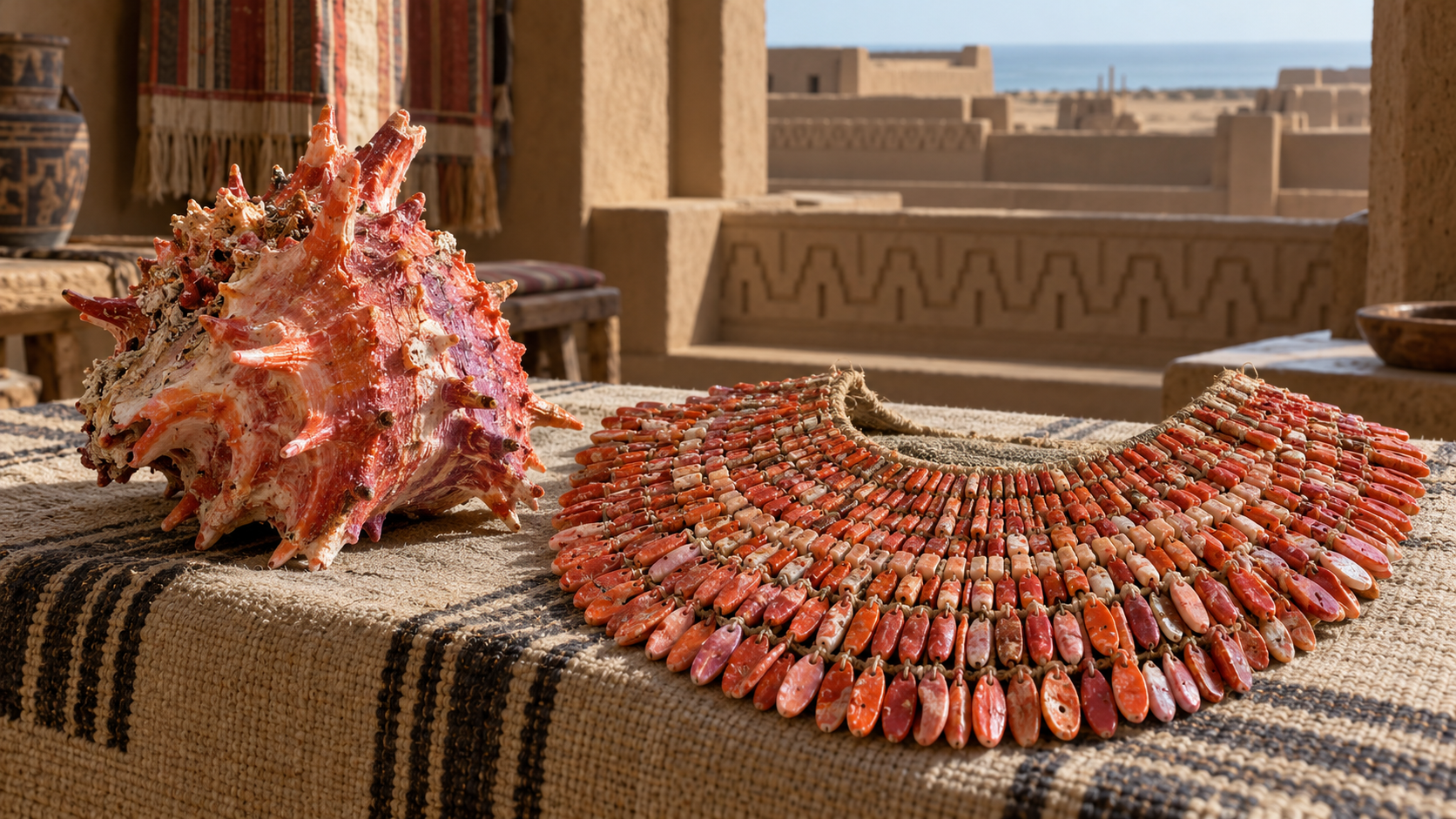
Imagine a precious object travelling hundreds of kilometres across ancient South America.
It begins its journey beneath the warm waters of the Pacific Ocean.
Divers retrieve it from the seabed.
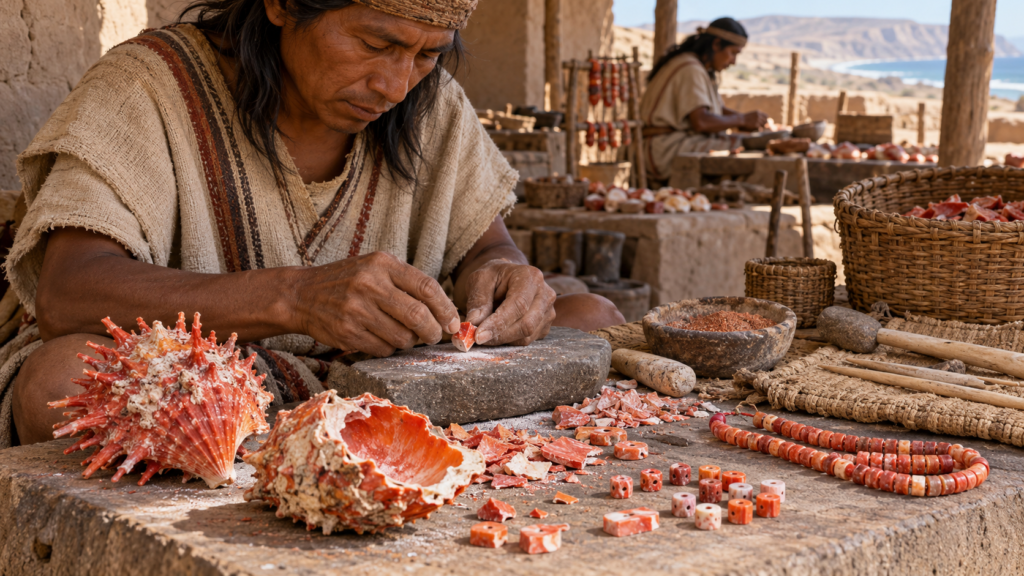
Skilled craftspeople carefully cut, shape and polish its brilliantly coloured surface.
Traders transport it through coastal settlements and into the mountains.
Eventually, it reaches a ceremonial centre, a powerful ruler or a sacred landscape.
The object is not a ruby.
It is not an emerald.
It is not gold.
It is a marine shell.
Known as Spondylus, or mullu in Quechua, this extraordinary natural material became one of the most culturally significant substances in the ancient Andes.
Its red, orange and purple colours made it visually remarkable.
Its distant marine origin contributed to its value.
Its use in ornaments demonstrated wealth and status.
But its importance extended far beyond decoration.
For certain ancient Andean societies, Spondylus was intimately associated with water, agricultural abundance and relationships with sacred powers.
Archaeological discoveries demonstrate that these shells were deposited as offerings, incorporated into elaborate jewellery and transformed into miniature ceremonial figures.
Some were carried into the highest mountains of the Andes.
Others were placed near springs or agricultural landscapes.
The story of Spondylus reveals a fascinating aspect of gemstone history: a natural material does not need to be a rare mineral to become culturally precious.
In the ancient Andes, a shell from the sea could possess a significance that gold alone could not express.
Table of Contents
What Exactly Is Spondylus?
Spondylus is a genus of marine bivalve molluscs commonly called thorny oysters.
Despite their common name, they are not true oysters in the narrow taxonomic sense.
Their shells are composed primarily of biogenic calcium carbonate.
Unlike crystalline gemstones such as quartz, garnet or corundum, Spondylus is an organic-origin gem material.
The animal produces the shell through biological processes.
The resulting structure combines mineral material with an organic matrix.
Spondylus shells are particularly recognisable because of their distinctive external appearance.
Many possess prominent spines.
Their surfaces may display intense shades of red, orange, pink, purple and white.
Some specimens show several colours within the same shell.
The dramatic appearance made them desirable materials for ornamentation.
However, their historical significance cannot be explained through colour alone.
Their geographical origin, rarity in particular regions and cultural associations were equally important.
The Thorny Oyster and Its Natural Environment
Several Spondylus species occur in the eastern Pacific.
Species historically identified in archaeological literature include Spondylus princeps and Spondylus calcifer, although zoological names and classifications have undergone revisions.
The shells particularly valued in the ancient Central Andes were often obtained from warmer waters near present-day Ecuador and the far northern Peruvian coast.
These environments differ considerably from the cooler marine conditions found farther south along Peru’s Pacific coastline.
The Humboldt Current carries relatively cold water northward along much of the western South American coast.
Consequently, the tropical Spondylus species sought by ancient Andean communities were not equally available along every section of the coastline.
This geographical distribution contributed to their importance.
Communities living far from the principal harvesting areas often depended upon exchange networks to obtain them.
A Spondylus shell discovered deep within the Andes could therefore represent a connection with a distant marine environment.
Why Would a Seashell Be More Valuable Than Gold?
To modern observers, gold may appear inherently more valuable than shell.
But value is not determined exclusively by the physical rarity or market price of a material.
Different societies establish different systems of value.
An object may be important because it is difficult to obtain.
Because it requires exceptional craftsmanship.
Because it communicates political authority.
Or because it participates in religious and ceremonial traditions.
The Metropolitan Museum of Art discusses a remarkable observation recorded by the Spanish chronicler Pedro Sarmiento de Gamboa in 1572.
He described the extraordinary esteem in which a red marine shell was held in the Andean world.
The shell was almost certainly Spondylus.
The historical account indicates that it could be valued more highly than silver or gold.
This should not be interpreted as a universal economic rule applying to every Andean community.
Rather, it illustrates the exceptional importance that Spondylus could possess within particular cultural and ceremonial contexts.
Its value was not simply material. It was also symbolic.
The Sea as a Source of Sacred Materials
Water occupied an essential position in the lives of ancient Andean communities.
Agriculture depended upon seasonal rainfall, rivers, irrigation systems and carefully managed water resources.
In many regions, water availability could determine the success or failure of crops.
Drought could threaten entire communities.
Excessive rainfall and flooding could also cause destruction.
Within this environmental setting, it is understandable that water became associated with powerful religious and symbolic ideas.
Spondylus came from the sea.
Yet its importance extended into inland valleys and mountain landscapes.
Its movement connected different ecological environments.
The ocean.
The coastal desert.
The agricultural valleys.
And the high Andes.
For some ancient Andean communities, the shell became associated with the relationships between these environments and the forces that sustained life.
The Daughters of the Sea
One of the most evocative descriptions of Spondylus comes from historical accounts of Andean religious traditions.
The shells were associated with the idea of the daughters of the sea, the mother of all waters.
The Metropolitan Museum of Art discusses this expression in its research on ancient Andean shell symbolism.
The association is particularly significant because it connects the marine origin of Spondylus with the wider importance of water.
Within documented Andean ceremonial practices, shells were deposited in springs, wells and other places associated with water.
They were also used as offerings in agricultural fields.
Such actions expressed hopes for continued water availability and successful harvests.
The shells were not necessarily regarded as possessing an independently measurable physical ability to produce rainfall.
Their significance belonged to religious and ceremonial relationships between people, landscapes and sacred powers.
Rain, Fertility and Agricultural Abundance
The association between Spondylus and agricultural fertility is one of the best-documented aspects of its ancient symbolism.
In many Andean environments, agricultural success depended upon access to water.
A shell originating in the ocean could therefore acquire special meaning when placed in an inland agricultural setting.
The act of offering Spondylus may have expressed a request for favourable environmental conditions.
Rainfall.
Water availability.
Fertile land.
And successful crops.
However, the archaeological record does not establish that every Spondylus offering possessed precisely the same purpose.
Different communities and historical periods developed their own ceremonial traditions.
The association with fertility is important, but it should not be treated as a universal explanation for every archaeological object made from Spondylus.
Before the Incas: A Much Older Tradition
Spondylus was already culturally important in South America long before the expansion of the Inca Empire.
The Metropolitan Museum of Art documents its use from at least the first millennium BCE.
Over subsequent centuries, several societies along the northern Peruvian coast incorporated the shell into ornaments, ceremonial objects and artistic representations.
These included communities associated with the Moche, Lambayeque and Chimú cultural traditions.
Each developed its own artistic and political institutions.
It would therefore be inaccurate to describe all ancient Andean Spondylus traditions as exclusively Inca.
The Incas inherited and transformed a much older history of shell exchange and symbolic use.
The Lambayeque: A Shell Held by a Powerful Figure
An extraordinary object preserved in the Metropolitan Museum of Art illustrates the importance of Spondylus before the Inca period.
The object is a gold beaker created by artists of the Lambayeque, or Sicán, culture.
It dates approximately to 900–1100 CE.
The vessel represents a human figure wearing an elaborate cap.
The figure holds a shell.
Museum research identifies the represented shell as most likely Spondylus.
This detail is particularly significant.
The vessel is made of gold, yet the figure prominently displays a marine shell.
The precious metal communicates wealth and technical sophistication.
The shell introduces another dimension of meaning.
The Metropolitan Museum suggests that the image may refer to the ability of a powerful individual to secure agricultural prosperity for a wider community.
This remains an interpretation rather than a direct statement from the object’s original maker.
Nevertheless, it demonstrates the importance of considering Spondylus within the political and ceremonial imagery of the northern Peruvian coast.
The Chimú and the Extraordinary Spondylus Collar
One of the most impressive surviving Spondylus ornaments was created by artists of the Chimú culture.
The Metropolitan Museum of Art preserves a remarkable collar dated broadly between 1000 and 1470 CE.
The object consists of thousands of small reddish-orange Spondylus beads.
These beads were arranged in vertical rows and attached to a cotton backing.
The collar was designed to rest across the shoulders and chest.
Its broad form would have created an extraordinary visual effect.
The intense colour of the shell contrasted with darker and lighter decorative elements.
The object demonstrates remarkable craftsmanship.
Each bead required preparation.
The shell had to be cut.
The pieces needed to be shaped and perforated.
The finished components were assembled into a complex textile-supported ornament.
The result was far more than a simple necklace.
It was an elaborate expression of artistic skill and social significance.
Jewellery as an Expression of Authority
The Chimú collar illustrates how natural materials could communicate political and social identity.
A large ornament containing thousands of carefully prepared shell beads required considerable labour.
Its production depended upon access to raw materials and skilled craftspeople.
Its appearance would have been immediately recognisable.
Such an object could distinguish its wearer from other members of society.
But the symbolism of Spondylus added another dimension.
The shell’s associations with water, fertility and sacred power meant that its display could communicate more than wealth.
It could suggest a relationship between political authority and the forces believed to sustain agricultural prosperity.
This does not mean that every Spondylus necklace was sacred.
The interpretation depends upon the object’s archaeological and historical context.
Chan Chan: A Centre of Craftsmanship and Power
The Chimú capital of Chan Chan was located near the northern Peruvian coast.
It became one of the most important urban centres in pre-Columbian South America.
The city was renowned for its architecture and specialised craft production.
Its monumental compounds contained extensive decorative programmes.
Archaeological and art-historical research has identified representations of marine activities, including figures associated with shell gathering.
These images are important because they connect the acquisition of marine resources with elite artistic and architectural expression.
Spondylus was not simply an exotic material arriving anonymously from distant waters.
Its collection and movement could become subjects of artistic representation.
The control of valuable exchange networks may also have contributed to political power.
The Dangerous Work of Collecting Spondylus
Obtaining Spondylus was not necessarily easy.
The shells could be attached to rocky surfaces beneath the sea.
The Metropolitan Museum notes that desirable specimens were collected from depths of approximately five to twenty metres.
Retrieving them required considerable skill.
Divers worked without modern compressed-air equipment.
They needed knowledge of local marine conditions.
They also needed to locate suitable shell beds.
The physical effort involved in harvesting Spondylus contributed to the complex chain of activities required to transform a living marine organism into a prestigious ceremonial material.
From the seabed to the mountains, many people could participate in the shell’s journey.
A Remarkable Encounter in 1525
One of the earliest European descriptions of the region provides evidence of sophisticated Indigenous maritime exchange.
In 1525, members of Francisco Pizarro’s expedition encountered a trading vessel off the coast near Tumbes.
The vessel carried valuable goods.
Gold.
Silver.
Textiles.
Ornaments.
And other luxury materials.
The Metropolitan Museum explains that the exchange described in this account involved highly valued coral-coloured marine shells, identified as Spondylus.
The episode is important because it demonstrates that the shell circulated within established commercial networks before the Spanish conquest.
However, European accounts must be read critically.
The observers did not necessarily understand the cultural systems that determined the value of the materials they encountered.
Their surprise reveals as much about European expectations as it does about Andean economic practices.
The Incas and the Expansion of Sacred Exchange
During the fifteenth century, the Inca Empire expanded across a vast area of western South America.
Its territories eventually included parts of present-day Peru, Ecuador, Bolivia, Chile, Argentina and Colombia.
The empire incorporated numerous peoples with distinct cultural traditions.
The Incas developed extensive administrative systems and road networks.
They also maintained elaborate ceremonial relationships with sacred places and beings.
Within this imperial context, Spondylus became an important material for offerings and prestigious objects.
Its significance was not invented by the Incas.
Rather, the empire incorporated existing Andean traditions into wider systems of political authority and ceremonial practice.
Mullu: The Shell of Sacred Offerings
In Quechua, Spondylus is commonly known as mullu.
Historical accounts describe its importance in offerings.
Shells could be used whole.
They could be broken into smaller pieces.
They could be transformed into beads.
Or carved into miniature figures.
The material appeared in different ceremonial contexts.
Some offerings were associated with agricultural landscapes.
Others were deposited at sacred places.
Certain examples formed part of elaborate imperial ceremonies.
The diversity of these uses is important.
Spondylus was not restricted to one religious function.
Its meaning depended upon the circumstances in which it was used.
The Workshop of Cabeza de Vaca
Archaeological discoveries at Cabeza de Vaca, near Tumbes in northwestern Peru, provide particularly valuable evidence concerning the production of Spondylus objects.
In 2011, excavations investigated a shell-working area associated with this important Inca-period administrative and ceremonial centre.
Archaeologist Carolina Vílchez Carrasco published the results in Cuadernos del Qhapaq Ñan, a publication associated with Peru’s Ministry of Culture.
The research confirmed substantial shell-working activity during the Inca period, with continuity into the early colonial era.
Spondylus was the principal material being worked.
Other marine shells were also present in smaller quantities.
The discoveries demonstrate that the production of ceremonial and ornamental shell objects could occur within organised workshop environments.
This was not necessarily a small-scale activity performed by isolated individuals.
It could form part of a larger economic and administrative system.
From Raw Shell to Finished Ornament
The transformation of Spondylus required several stages of craftsmanship.
First, the raw material had to be obtained.
The shell then needed to be cleaned and prepared.
Suitable sections were selected.
Pieces could be cut into smaller forms.
Beads required shaping and perforation.
Finished surfaces were refined through abrasion and polishing.
The precise methods varied according to the intended object and available tools.
Archaeological evidence from workshop contexts allows researchers to investigate different stages of manufacture.
Discarded fragments are particularly informative.
They can reveal how raw material was divided and which parts of a shell were selected for particular purposes.
A finished necklace may demonstrate artistic achievement.
A workshop can reveal the labour behind it.
Spondylus and the Inca Road Network
The Inca road system, commonly known as the Qhapaq Ñan, connected extensive territories.
These routes facilitated communication, administration and the movement of people and goods.
The strategic location of Tumbes helped connect northern coastal resources with the wider imperial world.
Spondylus could move from coastal production centres toward inland settlements and ceremonial destinations.
The archaeological evidence demonstrates the importance of such connections.
However, the precise route travelled by every surviving Spondylus object cannot be reconstructed.
A shell found in a distant mountain offering does not automatically reveal every stage of its journey.
The wider distribution nevertheless demonstrates the remarkable geographical reach of ancient Andean exchange.
Sacred Mountains and Miniature Offerings
Some of the most extraordinary Inca ceremonial deposits have been discovered in high-altitude mountain environments.
These locations could possess profound religious significance.
The Inca ceremonial practice known as capac hucha, also written capacocha, involved elaborate offerings associated with imperial authority, major events and sacred places.
Certain ceremonies included human sacrifice, including children.
Archaeological investigations have recovered miniature figures, textiles, ceramics and other objects from these contexts.
Spondylus was among the materials used to manufacture some of the miniature figures.
The Metropolitan Museum of Art documents examples of human and camelid figurines made from metal and Spondylus shell.
These discoveries provide direct evidence that the shell participated in important Inca ceremonial practices.
Llamas Carved from the Sea
One particularly fascinating category of Inca offering consists of miniature camelid figures.
Camelids, including llamas and alpacas, were essential to many Andean communities.
They provided fibre and other resources.
Llamas also served as pack animals.
Their importance extended into religious and ceremonial traditions.
Miniature camelid figures were produced in several materials.
Gold.
Silver.
Metal alloys.
And Spondylus shell.
The use of marine shell to represent an animal associated with highland life creates a remarkable material connection between different environments.
The object brings together the sea and the mountains.
This interpretation is consistent with the wider geographical relationships expressed through Andean ceremonial materials.
However, the exact meaning of an individual figurine must still be investigated through its archaeological context.
The Llullaillaco Discoveries
Mount Llullaillaco, located in the Andes on the border between present-day Argentina and Chile, is associated with extraordinary Inca ceremonial discoveries.
Archaeological investigations recovered human burials and associated offerings.
These included miniature figures made from precious metals and Spondylus shell.
The Metropolitan Museum discusses the presence of camelid figures and other ceremonial materials at Llullaillaco.
Such deposits provide evidence of the importance of carefully selected objects in Inca imperial ritual.
They also raise important ethical questions.
Some of these mountain locations remain sacred to Indigenous communities.
The treatment, excavation and display of human remains and associated objects can therefore involve contemporary cultural concerns.
The archaeological significance of these discoveries should be considered alongside the perspectives of communities connected to these landscapes.
Was Spondylus Considered Food for the Gods?
Historical Andean traditions sometimes describe Spondylus as a substance desired by sacred beings.
An important example appears in the Huarochirí manuscript, a collection of traditions recorded in the early colonial period.
The manuscript preserves accounts relating to religious beliefs in the Huarochirí region of the central Peruvian highlands.
One narrative describes a supernatural being requesting Spondylus rather than more ordinary offerings.
The Metropolitan Museum discusses this passage in its examination of the shell’s symbolic importance.
The story is significant because it provides textual evidence for the special status of Spondylus within a particular religious narrative.
However, the Huarochirí manuscript should not be treated as a complete account of all ancient Andean religious beliefs.
It preserves traditions from a particular region, recorded under colonial circumstances.
Its evidence is valuable but historically situated.
The Relationship Between Water and Divine Power
The association of Spondylus with water becomes particularly meaningful when considered alongside Andean environmental conditions.
Agriculture often required careful management of limited water resources.
Communities developed irrigation systems and other methods of adapting to difficult landscapes.
Rainfall could be irregular.
Some regions experienced prolonged dry conditions.
Others faced destructive flooding.
Within these environments, water could become the focus of powerful religious ideas.
Spondylus, originating from the ocean, provided a material through which relationships with water and sacred powers could be expressed.
This does not mean that the shell possessed a scientifically measurable ability to influence weather.
Its significance was cultural and religious.
Did Spondylus Predict El Niño?
Popular accounts sometimes suggest that ancient Andean communities used Spondylus as a reliable predictor of El Niño events.
The relationship requires caution.
Spondylus species have environmental requirements influenced by marine conditions.
Changes in ocean temperature can affect marine ecosystems and species distributions.
However, establishing that ancient communities possessed a specific and reliable forecasting system based on Spondylus would require independent evidence.
The shell’s association with warm tropical waters does not by itself demonstrate such a system.
It is more defensible to state that Spondylus belonged to marine environments whose ecological conditions differed from those of much of the Peruvian coast.
Its symbolism developed within societies deeply concerned with water and agricultural productivity.
The Difference Between Shell and Gemstone
From a gemmological perspective, Spondylus is not a crystalline gemstone.
It is a shell produced by a marine organism.
Its principal mineral component is calcium carbonate.
Its structure and formation differ from those of minerals such as quartz, beryl or corundum.
Nevertheless, organic-origin materials have long played important roles in jewellery and ornamentation.
Pearl.
Mother-of-pearl.
Coral.
Amber.
And certain decorative shells.
These materials demonstrate that the history of personal adornment extends beyond mineral crystals.
Spondylus belongs to this broader category of natural ornamental materials.
Its cultural importance makes it highly relevant to the historical study of gemstone symbolism.
Why Colour Alone Cannot Explain Its Meaning
The red and orange colours of Spondylus undoubtedly contributed to its visual appeal.
But it would be misleading to assign the shell a universal meaning based solely on its colour.
Modern spiritual systems sometimes associate red materials with vitality, strength or grounding.
Those associations cannot automatically be applied to ancient Andean societies.
The archaeological evidence provides a more specific explanation.
Spondylus was associated with water, fertility, offerings and political authority in particular historical contexts.
Its significance emerged through relationships between natural origin, exchange, craftsmanship and ceremonial use.
The shell’s colour was one element of that larger history.
Modern Spiritual Interpretations of Spondylus
Contemporary metaphysical literature sometimes associates Spondylus with emotional balance, creativity, personal transformation or connections to the ocean.
Such interpretations may be meaningful within modern personal practices.
However, they should not be presented as established beliefs of the Chimú, Lambayeque or Inca.
The surviving archaeological evidence supports specific historical uses.
It does not establish that the shell emitted an invisible energy capable of changing emotional or physical health.
Nor does it demonstrate that ancient Andean communities understood Spondylus through modern chakra systems.
Those systems belong to different historical and cultural traditions.
Can Spondylus Bring Rain or Fertility?
Historical evidence demonstrates that Spondylus was used in ceremonies associated with water and agricultural abundance.
This is an important cultural fact.
It does not establish that the shell could physically produce rainfall or improve crop yields through supernatural means.
Scientific research can investigate the biological characteristics of Spondylus.
Its chemical composition.
Its shell structure.
Its geographical distribution.
And its environmental requirements.
These are measurable properties.
Claims that a shell can influence weather through spiritual energy have not been scientifically established.
Understanding this distinction allows historical religious traditions to be discussed respectfully without presenting their supernatural claims as verified physical effects.
The Importance of Provenance
The history of Spondylus also demonstrates why archaeological provenance matters.
An isolated shell ornament may be visually attractive.
But its original meaning can be difficult to determine without reliable contextual information.
Was it recovered from a burial?
A workshop?
A domestic setting?
A ceremonial deposit?
Or a disturbed archaeological site?
These differences can substantially affect interpretation.
An ornament from a high-status burial may have possessed a different function from a shell fragment deposited near a spring.
Objects without secure archaeological provenance often present significant interpretive limitations.
Their material can still be identified.
Their original cultural significance may remain uncertain.
Natural Materials and Cultural Transformation
Consider the remarkable journey of a Spondylus shell.
It begins as part of a living marine organism.
The animal develops its protective shell through biological processes.
After collection, the shell enters human exchange networks.
A craftsperson transforms it into beads or a miniature figure.
The finished object may become an ornament.
A prestigious possession.
Or part of a ceremonial offering.
Its biological origin remains unchanged.
Its cultural identity has been transformed.
This process reveals a fundamental principle in the history of natural materials.
The physical substance of an object and its cultural meaning are not the same thing.
One can be investigated through natural science.
The other requires archaeology, history and cultural interpretation.
What Makes Spondylus Different from Other Sacred Materials?
The history of Spondylus is particularly remarkable because of its relationship with geography.
The material originated in the sea.
Yet some of its most significant uses occurred far inland.
It connected coastal harvesting communities with highland ceremonial centres.
It required specialised collection and craftsmanship.
It circulated through extensive exchange networks.
It became associated with agricultural abundance.
And it could participate in ceremonies expressing relationships between political authority and sacred landscapes.
Few natural ornamental materials illustrate so clearly how biological origin, geography and cultural belief can become interconnected.
What Can We Establish with Confidence?
The archaeological and historical evidence supports several important conclusions.
Spondylus is a marine bivalve shell rather than a crystalline mineral gemstone.
Its naturally coloured shell was valued by several ancient societies in western South America.
Spondylus circulated through long-distance exchange networks.
It was used in ornaments, including elaborate bead collars.
The Lambayeque and Chimú cultures incorporated the shell into prestigious artistic and ceremonial traditions before the expansion of the Inca Empire.
Historical accounts associate Spondylus with water, agricultural fertility and sacred offerings.
Archaeological discoveries demonstrate its use in Inca ceremonial deposits.
Some miniature figures used in Inca rituals were manufactured from Spondylus shell.
Excavations at Cabeza de Vaca provide evidence of organised shell-working during the Inca period.
However, the exact meaning of every Spondylus object cannot be reconstructed.
Different communities and periods may have assigned different functions and interpretations to the material.
Modern claims concerning spiritual energy, chakra activation or healing properties should not be confused with documented ancient Andean traditions.
Conclusion: A Shell That Connected the Ocean, the Mountains and the Sacred
The history of Spondylus challenges modern assumptions about what makes a natural material precious.
Its importance did not depend upon the hardness of a gemstone.
It did not require exceptional transparency.
It did not need the brilliance of a faceted crystal.
Its value emerged through a remarkable combination of natural appearance, geographical origin, craftsmanship and cultural significance.
For ancient Andean communities, Spondylus could connect the sea with agricultural landscapes.
It could communicate prestige.
It could become part of an offering.
And it could participate in ceremonies through which people expressed relationships with sacred powers.
The Chimú transformed it into extraordinary jewellery.
The Lambayeque incorporated its image into prestigious metalwork.
The Incas used it in elaborate ceremonial contexts.
Across these traditions, the shell became far more than a decorative material.
Yet its meaning was never necessarily identical everywhere.
Different peoples, places and periods shaped its significance.
At Natural Gems Belgium, the history of Spondylus offers an important perspective on gemstone symbolism.
The cultural value of a natural material cannot always be understood through its mineralogical properties alone.
Sometimes its greatest significance lies in the relationships people create around it.
Spondylus reminds us that a precious material does not need to come from deep within the Earth.
It can emerge from the ocean.
Travel across mountains.
Become part of extraordinary works of art.
And acquire a place within the religious history of an entire region.
Its physical structure belongs to marine biology.
Its craftsmanship belongs to human ingenuity.
Its symbolism belongs to the history of ancient Andean societies.
And its surviving objects allow all three dimensions to be investigated together.
References & Further Reading
The following sources have been selected from major museum collections, official archaeological publications and established research institutions. They provide documented evidence for the history of Spondylus in ancient South America, its use in ornaments and offerings, its relationship with water and fertility, and its importance within Chimú and Inca cultural traditions.
1. The Metropolitan Museum of Art — Thorny Oysters: The Daughters of the Sea
https://www.metmuseum.org/perspectives/design-for-eternity-thorny-oysters
Source description: An authoritative museum article by Joanne Pillsbury, published on 22 August 2016. Examines the historical significance of Spondylus in ancient Peru, including its association with water, fertility, sacred offerings, maritime exchange and the Huarochirí religious traditions.
This is a principal reference for the article’s discussion of Spondylus symbolism.
2. The Metropolitan Museum of Art — Chimú Spondylus Collar
https://www.metmuseum.org/art/collection/search/319053
Source description: Detailed museum record for an extraordinary Chimú collar made from thousands of reddish-orange Spondylus beads. Discusses the object’s construction, the history of Chan Chan, shell exchange networks and the relationship between Spondylus, political authority and sacred power.
The accompanying curatorial essay provides substantial historical and archaeological context.
3. The Metropolitan Museum of Art — Beaker with Figure and Spondylus Shell
https://www.metmuseum.org/art/collection/search/309414
Source description: Museum collection record for a Lambayeque gold beaker dated approximately 900–1100 CE. The vessel depicts a figure holding what is interpreted as a Spondylus shell.
The curatorial commentary examines the shell’s association with fertility, agricultural abundance and political authority before the Inca period.
4. Ministerio de Cultura del Perú — El Taller de Spondylus de Cabeza de Vaca, Tumbes
https://revistas.cultura.gob.pe/index.php/cuadernosqn/article/view/459
Source description: Archaeological research by Carolina Vílchez Carrasco, published in Cuadernos del Qhapaq Ñan in 2013.
Documents excavations conducted in 2011 at the Cabeza de Vaca shell-working centre in northwestern Peru.
The study establishes the importance of organised Spondylus production during the Inca period and its continuation into the early colonial era.
This is a particularly valuable primary archaeological reference.
5. The Metropolitan Museum of Art — Inca Miniature Camelid Effigy
https://www.metmuseum.org/art/collection/search/309960
Source description: Extensive curatorial study of an Inca miniature camelid figure.
Although the particular object is metallic, the accompanying research discusses comparable figures manufactured from Spondylus shell and their presence in Inca ceremonial deposits.
Includes detailed information about capac hucha ceremonies, sacred places and archaeological discoveries at Llullaillaco and other sites.
6. The Metropolitan Museum of Art — Inca Female Figurine
https://www.metmuseum.org/art/collection/search/312558
Source description: Museum research concerning Inca female figurines and their use in ceremonial offerings.
The commentary documents an archaeological example of a female figure made from Spondylus princeps, discovered within an Inca offering at Huaca de la Luna.
Provides evidence for the use of shell figurines in formal ritual contexts.
7. The Walters Art Museum — Pacific Thorny Oyster
https://art.thewalters.org/object/2005.69.10
Source description: Official museum collection record for a Pacific Spondylus shell.
Explains the importance of the shell’s natural colour, its collection in warm waters near Ecuador and its use as a valuable material for trade, ornaments and ritual offerings.
Useful for understanding the natural material underlying the archaeological traditions.
8. Musei di Genova — Spondylus Shells
https://www.museidigenova.it/en/spondylus-shells
Source description: Official museum documentation from the Castello D’Albertis Museum of World Cultures in Genoa.
Describes the historical importance of Spondylus, known as mullu, in Andean exchange, prestigious ornamentation and religious offerings.
The collection includes an archaeological shell associated with ancient Peru.
9. The Metropolitan Museum of Art — Inca Miniature Female Effigy
https://www.metmuseum.org/art/collection/search/309944
Source description: Detailed museum study of Inca miniature figurines and their relationship with sacred places, ceremonial deposits and religious practices.
The research discusses comparable Spondylus figurines, miniature textiles and archaeological offerings.
It also addresses ethical considerations concerning sacred Indigenous sites and the treatment of ceremonial objects.
Historical Tradition, Archaeological Evidence and Modern Belief
The history of Spondylus requires several important distinctions.
Scientifically established: Spondylus is a genus of marine bivalves that produce shells composed primarily of calcium carbonate.
Archaeologically documented: Spondylus shells were used in ornaments, workshops and ceremonial deposits across several ancient Andean societies.
Historically documented: Colonial-era accounts and surviving religious narratives associate Spondylus with water, agricultural abundance and offerings to sacred beings.
Culturally specific: The significance of Spondylus varied among different peoples, including the Lambayeque, Chimú and Inca.
Archaeologically demonstrated: Spondylus figurines and ornaments were included in certain Inca ceremonial offerings.
Modern metaphysical interpretation: Contemporary spiritual literature sometimes associates Spondylus with emotional transformation, creativity or ocean-related energy.
Scientific limitation: There is no established evidence that Spondylus shells emit supernatural energy, influence rainfall through spiritual forces, activate chakras or provide medically effective healing.
The cultural significance of Spondylus does not depend upon proving supernatural effects.
Its importance lies in the historical relationships between natural materials, human craftsmanship, environmental conditions and religious traditions.
Studying those relationships provides a richer understanding of ancient gemstone and ornamental-material symbolism than assigning universal metaphysical properties to a shell.
[…] story of cowrie shells in Yoruba spirituality demonstrates how a natural marine object can become a powerful cultural […]