In 1695 or 1696, somewhere within the sophisticated artistic world of Mughal India, an exceptional emerald received an extraordinary transformation.
The gemstone was already remarkable.
It weighed 217.8 carats.
Its rich green colour reflected the geological conditions under which it had formed.
Its considerable size made it a rare and valuable object.
Yet the person commissioning its decoration wanted something more than a beautiful gemstone.
One side was engraved with an elaborate religious invocation.
The other was carved with flowers.
The inscription invoked blessings upon the Prophet Muhammad, Fatima and the Twelve Imams, figures of particular importance within Shi’a Islam.
The result was an object in which natural beauty, exceptional craftsmanship and religious devotion became inseparable.
Today, this extraordinary gemstone is preserved in the Museum of Islamic Art in Doha, Qatar.
It is commonly known as the Mogul Mughal Emerald.
Its history reveals a fascinating chapter in the relationship between gemstones and spiritual belief.
Unlike modern crystal-healing literature, which often assigns emerald a universal meaning associated with love, prosperity or emotional balance, the surviving Mughal emeralds reveal something considerably more specific.
Their significance could depend upon the words engraved into them.
The religious tradition of their owner.
Their association with royal authority.
Their place within international trade.
And the historical circumstances in which they were created.
In Mughal India, the meaning of an emerald could be transformed not only by its colour or rarity, but by the words that human beings chose to inscribe upon it.
Table of Contents
The Mughal Empire: A World of Precious Stones
The Mughal Empire was established in northern India in 1526 by Babur, a ruler of Central Asian Timurid ancestry.
Over the following centuries, the empire developed into one of the most influential political and cultural powers in South Asia.
Its courts became celebrated for architecture, painting, manuscript production, textiles, metalwork and jewellery.
The rulers accumulated extraordinary collections of precious stones.
Diamonds.
Rubies.
Spinels.
Emeralds.
Sapphires.
Pearls.
And numerous ornamental gem materials.
These objects were not valued exclusively for their beauty.
Precious stones could express imperial authority, dynastic continuity, wealth, diplomatic relationships and personal prestige.
Some also acquired explicitly religious or talismanic significance.
The Metropolitan Museum of Art’s exhibition Treasury of the World: Jeweled Arts of India in the Age of the Mughals documented the extraordinary sophistication of this tradition.
The exhibition included personal ornaments, ceremonial weapons, inscribed gemstones and elaborately decorated objects associated with Mughal and Deccan courts.
Yet it would be inaccurate to describe every Mughal gemstone as sacred.
Some were primarily decorative.
Others expressed political authority.
Certain objects incorporated religious texts.
And some combined several functions.
Understanding the differences is essential.
Why Were Emeralds So Desirable?
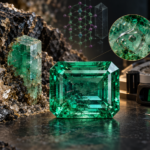
Emerald is the green gem variety of the mineral beryl.
Its chemical composition is:
Be₃Al₂Si₆O₁₈
The green colour results principally from trace amounts of chromium and/or vanadium within the crystal structure.
Emerald possesses a Mohs hardness of approximately 7.5–8.
However, hardness does not mean that every emerald is resistant to breakage.
Natural emeralds frequently contain fractures and inclusions.
Their internal characteristics can influence how they are cut, carved and handled.
Fine emeralds combine attractive colour with desirable transparency and an appealing overall appearance.
Large specimens suitable for elaborate carving are particularly exceptional.
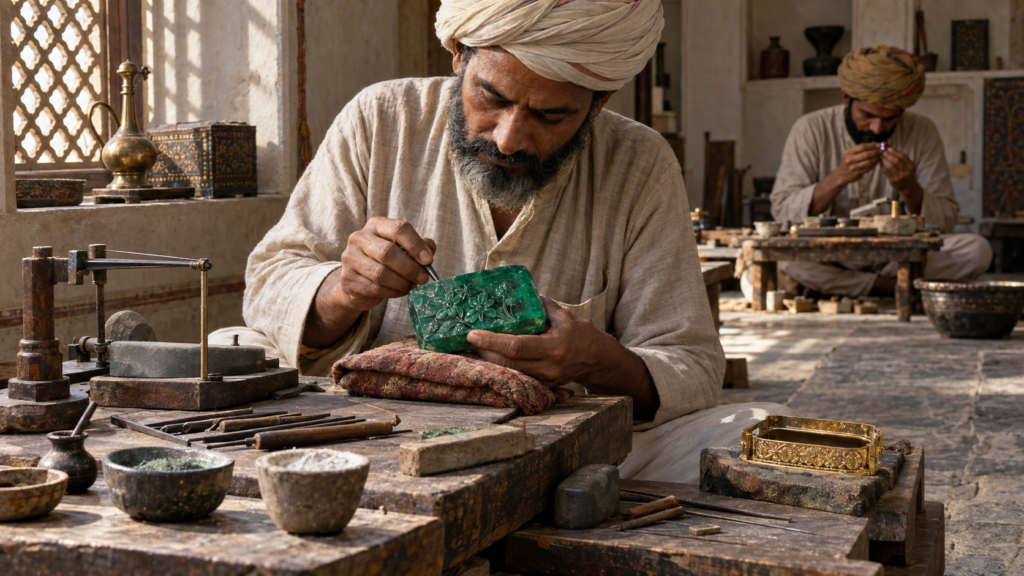
For Mughal lapidaries, a substantial emerald offered an opportunity to create something beyond conventional faceted jewellery.
Its surface could become a place for artistic decoration.
Or for words.
The Journey from Colombia to India
One of the most remarkable aspects of Mughal emerald history is that many important specimens originated far from India.
During the sixteenth century, emeralds from the territories of present-day Colombia entered expanding international commercial networks.
The mines around Muzo and Chivor became particularly important sources.
Spanish colonial exploitation of these deposits introduced substantial quantities of Colombian emeralds into international trade.
From South America, gemstones travelled through European and Asian commercial networks.
Some reached India through Portuguese trading connections, including Goa.
Other routes involved merchants operating across the Atlantic, Mediterranean and Indian Ocean worlds.
The Gemological Institute of America documents these complex trading relationships in its research on gemstones during the Mughal period.
Emeralds moved alongside other valuable commodities.
Precious metals.
Pearls.
Textiles.
Spices.
And luxury goods.
By the time an emerald reached a Mughal workshop, it might already have travelled thousands of kilometres.
A Gemstone That Crossed Cultural Boundaries
Consider the extraordinary journey of a Colombian emerald.
Its crystal structure formed through geological processes long before human civilisation.
It was extracted from a South American deposit.
It entered commercial networks shaped by European colonial expansion.
It travelled through international markets.
Eventually, it reached South Asia.
There, a skilled lapidary might transform it into a courtly ornament.
A religious patron might commission an inscription.
And a jeweller might mount it for personal use.
The gemstone’s geological identity remained unchanged.
Its cultural identity did not.
This transformation is central to the history of precious materials.
A gemstone can retain the same physical properties while acquiring entirely new meanings as it moves between societies.
The Mogul Mughal Emerald: A Remarkable Survivor
The Museum of Islamic Art in Doha preserves one of the most extraordinary examples of Mughal gemstone engraving.
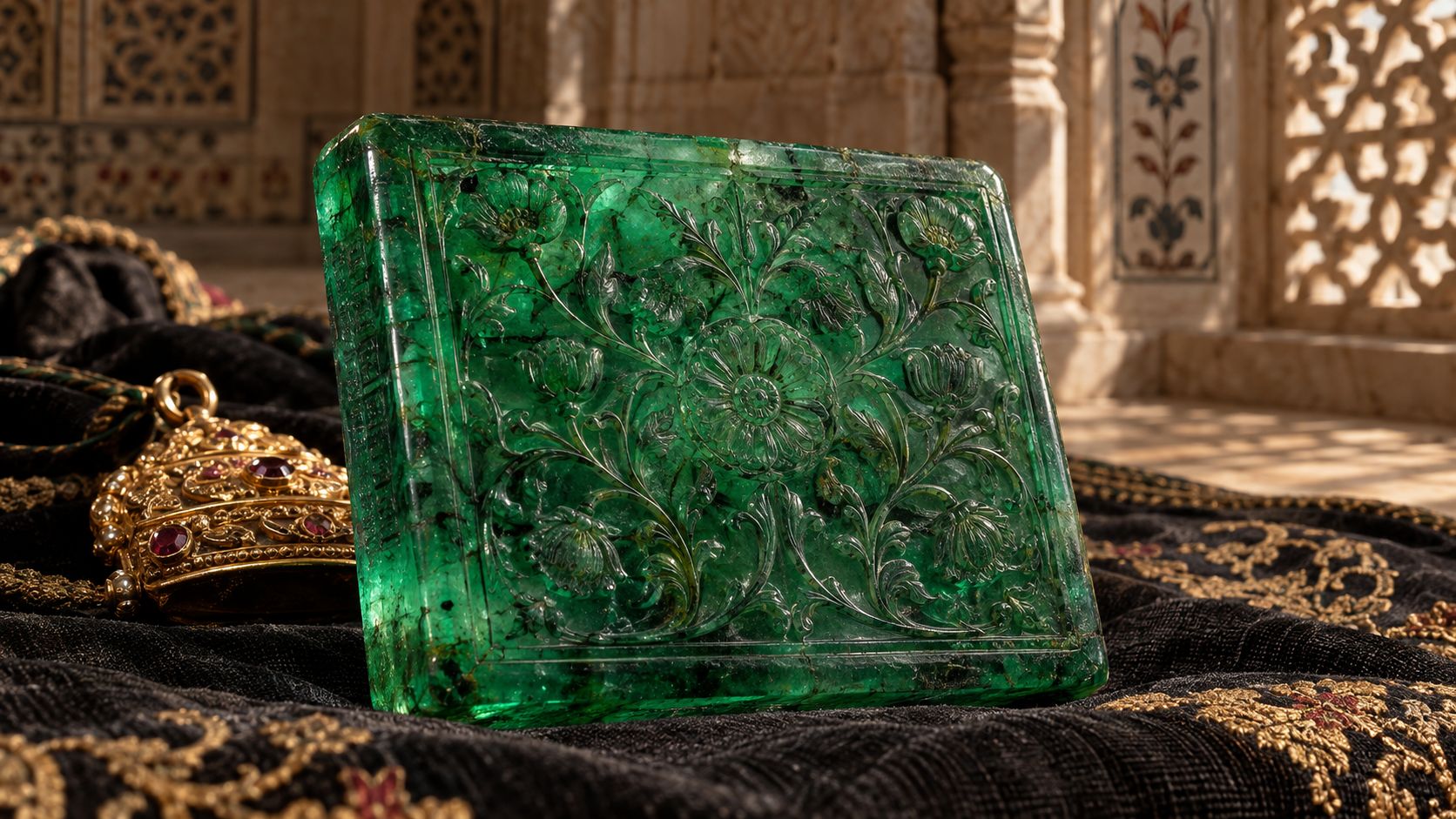
The object is a rectangular emerald plaque measuring approximately:
5.2 centimetres in height.
4 centimetres in width.
And 1 centimetre in thickness.
Its weight is 217.8 carats.
The gemstone is carved on both sides.
One face carries a religious inscription.
The reverse displays floral decoration.
The date engraved into the stone corresponds to 1107 AH, equivalent to 1695–1696 CE.
This places the object within the reign of the Mughal emperor Aurangzeb.
However, its inscription provides important evidence that the gemstone should not automatically be identified as a personal possession of the emperor.
What Does the Inscription Say?
The inscription contains a Shi’a devotional invocation.
It invokes blessings upon the Prophet Muhammad, Fatima and the Twelve Imams.
These religious figures possess particular significance within Twelver Shi’a Islam.
The text is therefore not simply a decorative arrangement of Arabic letters.
It expresses a recognisable devotional tradition.
This distinction is important.
The inscription on the Mogul Mughal Emerald is a religious prayer or invocation, not merely an ornamental pattern.
It should also not be inaccurately described as a direct quotation from the Qur’an.
Other surviving Mughal emeralds contain Qur’anic inscriptions.
The famous 1695–1696 emerald is distinguished by its Shi’a invocation.
The precise identification of the text matters because it helps historians understand the object’s religious context.
Was the Emerald Owned by Aurangzeb?
The emerald was produced during Aurangzeb’s reign, but that does not establish that he owned it.
Aurangzeb ruled from 1658 to 1707.
He was a Sunni Muslim ruler.
The gemstone’s inscription, however, reflects Shi’a devotional traditions.
This has encouraged scholars to consider alternative possibilities concerning its patronage.
It may have belonged to a Shi’a noble, court official or wealthy patron associated with the Deccan.
Persianate and Deccani cultural networks included influential Shi’a communities.
Nevertheless, the original owner’s identity remains uncertain.
The historical evidence supports the gemstone’s date and religious character.
It does not conclusively identify its first owner.
This is an important principle in the study of historical gemstones.
A date engraved into a stone establishes a chronological reference. It does not automatically establish ownership.
The Reverse: A Garden Carved into Emerald
The opposite face of the Mogul Mughal Emerald contains elaborate floral decoration.
A central rosette is surrounded by carved poppy flowers and additional botanical motifs.
The arrangement reflects the importance of floral imagery within Mughal decorative arts.
Flowers appeared in paintings, textiles, architecture, metalwork and gemstone carving.
Mughal artists developed exceptionally sophisticated representations of natural forms.
These could be highly stylised while retaining recognisable botanical characteristics.
The floral carving on the emerald therefore belongs to a wider artistic tradition.
But it should not automatically be assigned one universal spiritual interpretation.
The presence of flowers does not prove that the object was intended to represent a particular chakra, mystical energy or botanical doctrine.
Its meaning must be investigated through the artistic conventions of its period.
A Gemstone with Two Visual Languages
The Mogul Mughal Emerald combines two forms of expression.
One face contains religious writing.
The other contains floral decoration.
These elements create a fascinating relationship between devotion and ornament.
The inscription identifies a religious framework.
The flowers demonstrate artistic refinement.
The natural emerald provides the material foundation.
The finished object therefore combines three distinct forms of value:
Material value: the rarity and quality of the emerald.
Artistic value: the skill required to carve and engrave it.
Religious significance: the devotional meaning of its inscription.
None of these dimensions fully explains the object alone.
Together, they make it extraordinary.
Was the Emerald Intended to Be Worn?
The Museum of Islamic Art describes the emerald as a plaque shaped for wearing on the body or mounting in jewellery.
Its physical construction supports the possibility of personal adornment.
The stone was not necessarily intended to remain permanently in a display case or treasury.
It may have formed part of an elaborate ornament.
Historically, substantial gemstones could be incorporated into necklaces, pendants or arm ornaments.
In South Asia, a jewelled upper-arm ornament is commonly called a bazuband.
Such ornaments could be worn by members of elite society.
However, the original mounting of the Mogul Mughal Emerald has not survived in a form that establishes precisely how it was worn.
Its probable function should therefore be distinguished from documented certainty.
What Is a Talisman?
A talisman is an object believed within a particular cultural or religious system to possess protective, beneficial or otherwise significant properties.
Historically, talismans have taken many forms.
They may contain inscriptions.
Religious texts.
Symbols.
Numbers.
Images.
Or materials considered significant within a particular tradition.
Not every talisman depends upon the belief that its physical material emits an invisible energy.
In some traditions, the inscription itself is central.
A sacred text may be understood as invoking divine protection.
A prayer may express devotion.
A religious formula may connect the object with a particular spiritual practice.
This distinction is essential when examining inscribed gemstones.
Why Engrave a Prayer into Emerald?
An inscription transforms the surface of a gemstone into a medium for written communication.
A precious stone becomes more than an ornament.
It carries words.
Those words may express religious devotion.
They may identify a ruler.
They may commemorate a person.
Or they may communicate a wish for divine protection.
In the case of the Mogul Mughal Emerald, the inscription provides direct evidence of a Shi’a devotional context.
The Museum of Islamic Art notes that several surviving inscribed Indian emeralds contain Qur’anic verses or prayers.
The museum interprets this pattern as suggesting that such gemstones were believed to possess talismanic properties.
This is a historically grounded interpretation.
It does not require assuming that all emeralds were regarded as magical.
Prayer and Protection in Islamic Material Culture
Inscribed amulets occur in several historical Islamic societies.
Some contain Qur’anic verses.
Others carry invocations, divine names or religious formulas.
The Metropolitan Museum of Art preserves an eighteenth-century agate amulet from Iran.
Its surface contains verses from the Qur’an and the names of the Prophet Muhammad and Ali.
The museum explains that the object may originally have been mounted in jewellery and worn as a talisman.
Within its historical religious context, the sacred words were understood as offering protection.
This example is useful because it demonstrates that talismanic meaning was not restricted to emerald.
Agate could also carry religious inscriptions.
The significance therefore cannot be explained solely through emerald’s green colour.
Does Islam Universally Approve of Gemstone Talismans?
No single interpretation should be attributed to all Muslims.
Islam encompasses different theological schools, legal traditions, devotional practices and historical communities.
Attitudes toward amulets and talismans have varied.
Some Muslims have accepted particular forms of protective objects containing religious texts.
Others have criticised such practices, especially when an object is believed to possess independent supernatural power.
The distinction between seeking divine protection and attributing autonomous power to an object can be theologically significant.
Consequently, historical Islamic gemstone talismans should not be presented as evidence of one universal Islamic doctrine.
They document particular practices within particular communities and periods.
The Importance of the Written Word
Calligraphy occupies an exceptionally important position within Islamic artistic traditions.
Religious manuscripts, architecture, metalwork, ceramics and other objects frequently incorporate inscriptions.
The written word can communicate devotion, identity and authority.
When applied to gemstones, calligraphy introduces an additional challenge.
The surface is small.
The material is valuable.
And the engraving must remain legible despite the stone’s physical characteristics.
A skilled artisan must combine technical precision with artistic judgement.
The result can transform a natural gemstone into a remarkably sophisticated work of miniature calligraphy.
Another Extraordinary Emerald: Jahangir’s Inscribed Gemstone
The Museum of Islamic Art in Doha also preserves a different Mughal emerald dated 1609–1610.
This gemstone carries the name of Emperor Jahangir.
Its inscription reads:
“Jahangir Shah-i Akbar Shah”
The wording identifies Jahangir in relation to his father, Akbar.
The gemstone also carries the date 1018 AH.
This is an important contrast with the Mogul Mughal Emerald.
The Jahangir emerald contains a royal inscription.
The 1695–1696 emerald contains a Shi’a devotional invocation.
Both are inscribed emeralds.
Yet their inscriptions communicate different forms of significance.
One expresses imperial identity.
The other expresses religious devotion.
The Difference Between Royal and Religious Inscriptions
Mughal rulers inherited traditions of inscribing precious stones from earlier Central Asian and Persianate courts.
The Timurids had used gemstones to record royal names and titles.
Such inscriptions could express legitimacy, prestige and dynastic continuity.
Religious inscriptions performed different functions.
A Qur’anic verse or devotional invocation could connect an object with religious belief.
The same gemstone material could therefore serve multiple cultural purposes.
It is historically inaccurate to assume that every engraved emerald was intended as a protective amulet.
The actual inscription must be examined.
Why the Green Colour Mattered
Emerald’s vivid green colour contributed to its desirability.
Green also acquired religious and cultural associations in various Islamic contexts.
However, it would be misleading to claim that all Muslims considered every green gemstone sacred.
Colour symbolism changes according to historical period, region and religious interpretation.
The Museum of Islamic Art documents historical beliefs that emeralds could protect against illness or evil spirits.
Such beliefs help explain why emeralds sometimes became talismanic objects.
But they remain historically documented beliefs.
They are not scientifically established properties of emerald.
Emeralds and Historical Healing Beliefs
Historical gemstone literature frequently attributed medicinal or protective qualities to precious stones.
Emerald was sometimes associated with protection from illness.
Other traditions connected gemstones with eyesight, poisoning, emotional states or supernatural dangers.
The Museum of Islamic Art notes that emeralds were historically believed to repel illnesses and evil spirits.
This is evidence that such beliefs existed.
It is not evidence that the claimed effects actually occurred.
Modern scientific understanding does not establish that wearing emerald prevents infection, neutralises harmful supernatural influences or treats medical conditions.
The historical belief and the physical gemstone must be studied separately.
A Gemstone Does Not Become a Medicine Because It Was Historically Prescribed
This distinction is especially important for contemporary readers.
Historical medical systems sometimes incorporated minerals and gemstones.
Those practices belong to the history of medicine and belief.
They do not automatically satisfy modern standards of scientific evidence.
A gemstone can be historically significant without possessing therapeutic efficacy.
Emerald’s chemical composition and crystal structure are measurable.
Its ability to prevent disease through spiritual energy has not been scientifically established.
Respecting historical traditions does not require presenting their medical claims as proven facts.
The Difference Between a Gemstone and Its Inscription
Imagine two natural emeralds with similar physical characteristics.
Both possess attractive green colour.
Both have comparable transparency.
Both were formed through geological processes involving beryl.
One remains undecorated.
The other carries a religious invocation.
From a mineralogical perspective, both are emerald.
From a cultural perspective, their meanings may be very different.
The inscription introduces a layer of human intention.
This distinction reveals something fundamental about sacred objects.
Their significance may arise from the interaction between material, text, belief and use—not from the material alone.
Emeralds, Royal Gifts and Political Relationships
Mughal gemstones were also important diplomatic and political objects.
Precious stones could be presented as gifts.
They could reward service.
They could communicate favour.
And they could reinforce relationships between rulers and elites.
The Gemological Institute of America’s research on Mughal gemstone history documents the elaborate systems of gift exchange associated with imperial courts.
Such gifts were not always religious.
A gemstone might possess political importance because of the identity of the person who presented it.
A jewelled object could therefore communicate authority without functioning as a talisman.
A Royal Emerald Is Not Necessarily a Sacred Emerald
This distinction becomes particularly clear when comparing surviving objects.
The Jahangir emerald records imperial identity.
The Mogul Mughal Emerald carries a religious invocation.
Other emeralds were carved with flowers.
Some were mounted into elaborate jewellery.
A single gemstone species participated in several different traditions.
Royal.
Artistic.
Commercial.
Religious.
And personal.
The material was the same.
The meaning depended upon context.
The Mughal Love of Nature
Floral ornament became a defining feature of Mughal artistic production.
Artists carefully studied plants and flowers.
Botanical forms appeared in miniature paintings, architectural decoration, textiles and hardstone carving.
The carved flowers on the Mogul Mughal Emerald belong to this broader aesthetic.
The Metropolitan Museum preserves a seventeenth-century Mughal emerald later incorporated into a twentieth-century brooch.
Its surface contains a carved lotus-blossom rosette and surrounding foliage.
The gemstone demonstrates the technical sophistication of Mughal lapidary work.
It also reveals how historical gemstones could acquire entirely new identities centuries after their original creation.
When a Mughal Emerald Became European Jewellery
In the early twentieth century, European jewellers developed considerable interest in Indian gemstones.
Historic carved emeralds were sometimes incorporated into new settings.
The Metropolitan Museum documents a seventeenth-century Mughal emerald that was transformed into a brooch around 1920.
Its original setting and function are not definitively known.
The museum suggests that it may once have belonged to an upper-arm ornament.
Its later use was very different.
A gemstone originally created within Mughal artistic traditions became part of modern European luxury jewellery.
This transformation illustrates how the same historical object can move between cultural systems.
Does Reusing a Sacred Gemstone Change Its Meaning?
The answer depends upon the object and its history.
A carved emerald may retain evidence of its original artistic tradition even after being remounted.
An inscription may preserve religious meaning.
A new setting may introduce different aesthetic values.
A later owner may appreciate the stone primarily for its beauty or rarity.
The physical gemstone can survive these changes.
Its cultural interpretation may evolve.
For historians, this makes provenance particularly important.
Without reliable information about an object’s earlier history, its original function may remain uncertain.
The Problem of Lost Provenance
Many historical gemstones have passed through numerous collections.
Some were removed from their original settings.
Others were recut.
Some acquired new inscriptions.
Others were incorporated into modern jewellery.
These changes can complicate identification.
A seventeenth-century emerald mounted in a twentieth-century brooch is not necessarily a twentieth-century gemstone.
Equally, a gemstone associated with a famous ruler may not actually have belonged to that person.
Responsible interpretation requires distinguishing documented evidence from tradition, attribution and speculation.
Can Gemmology Identify a Mughal Emerald?
Gemmological examination can establish important information about a gemstone.
It may identify the material as natural emerald.
It may reveal inclusions characteristic of particular geological environments.
It may detect treatments.
Advanced laboratory methods may provide evidence relevant to geographic origin.
However, identifying an emerald as Colombian does not prove that it belonged to a Mughal emperor.
Likewise, the presence of an old inscription does not automatically establish its authenticity.
Historical attribution requires several kinds of evidence.
Gemmological analysis.
Art-historical comparison.
Epigraphy.
Documentary records.
And provenance research.
The strongest conclusions emerge when these methods support one another.
The Gemmological Importance of Inclusions
Natural emeralds frequently contain internal characteristics.
These may include mineral crystals, fractures and fluid inclusions.
Certain Colombian emeralds are particularly famous for multiphase inclusions.
Such features can provide valuable information about geological formation.
The Gemological Institute of America has extensively documented inclusions in natural, synthetic and treated emeralds.
For historical gemstones, careful examination may help distinguish natural materials from later substitutes.
However, inclusions alone should not be treated as definitive proof of geographic origin.
Reliable origin determination generally requires a combination of observations and analytical evidence.
Why Historical Emeralds Require Careful Handling
Emerald is relatively hard but can be vulnerable to damage because of fractures.
Many modern emeralds have undergone clarity enhancement using oils or resins.
These substances can affect the appearance of surface-reaching fractures.
The Gemological Institute of America advises against ultrasonic and steam cleaning for many emeralds.
Historical engraved gemstones require particular caution.
Their surfaces may preserve important evidence of craftsmanship.
An inscription can be damaged.
A fragile edge can fracture.
An old mounting can become unstable.
For significant historical objects, professional conservation assessment is preferable to ordinary jewellery cleaning.
Emeralds and Modern Crystal Spirituality
Modern crystal-healing literature frequently associates emerald with several qualities.
Love.
Compassion.
Prosperity.
Emotional harmony.
Wisdom.
Renewal.
And the Heart Chakra.
Some practitioners also describe emerald as a stone that encourages spiritual insight.
These interpretations belong to contemporary metaphysical traditions.
They should not automatically be presented as the beliefs of Mughal rulers, lapidaries or religious patrons.
The surviving Mughal emeralds provide more specific evidence.
Their inscriptions, decorative styles and historical contexts reveal particular meanings.
They do not demonstrate that every emerald was believed to activate a universal energy centre.
Emerald and the Heart Chakra
Modern crystal traditions commonly associate green gemstones with the Heart Chakra.
This association is frequently applied to emerald.
However, the relationship between modern Western crystal-healing systems and historical South Asian chakra traditions is complex.
The chakra systems found in Hindu and Buddhist religious literature developed within particular philosophical and ritual contexts.
Modern gemstone-to-chakra correspondences should not be assumed to reproduce those traditions accurately.
The Mogul Mughal Emerald’s Shi’a inscription belongs to a different religious framework.
Its meaning cannot responsibly be explained through modern Heart Chakra terminology.
Did Mughal Emeralds Protect Their Owners?
Some historical owners may indeed have believed that inscribed emeralds offered protection.
The Museum of Islamic Art explicitly interprets surviving religious inscriptions as evidence of talismanic beliefs.
But this does not establish that the gemstones possessed supernatural protective powers.
A religious inscription can be historically meaningful because of the belief attached to it.
Its importance does not depend upon scientific verification of the claimed effect.
The responsible distinction is between:
A documented belief in protection.
And scientifically established protection.
These are not equivalent.
A Sacred Text Is Not the Same as Crystal Energy
This distinction deserves particular attention.
A historical owner might have regarded a Qur’anic inscription as spiritually important because of the sacred text.
The religious meaning would arise from the words and the devotional framework surrounding them.
That is different from claiming that emerald emits a universal vibration that can be measured scientifically.
The first is a matter of documented religious belief.
The second is a contemporary metaphysical claim requiring independent scientific evidence.
Confusing them obscures the actual history of the object.
The Emerald as a Meeting Point of Worlds
The Mogul Mughal Emerald brings together several remarkable histories.
Its mineral structure reflects geological processes.
Its probable South American origin connects it with international gemstone trade.
Its carving reflects Mughal artistic traditions.
Its inscription expresses Shi’a devotion.
Its date places it within the reign of Aurangzeb.
Its survival allows modern historians and gemmologists to examine it.
And its presence in a museum demonstrates how precious objects continue to acquire new cultural significance.
Few gemstones illustrate so clearly how natural materials can participate in multiple histories simultaneously.
What Can We Say with Confidence?
The surviving evidence supports several important conclusions.
Emeralds were highly valued within Mughal court culture.
Large numbers of Colombian emeralds entered international trade networks during the sixteenth and seventeenth centuries.
Some reached India and were incorporated into Mughal jewellery and decorative arts.
Certain emeralds were engraved with royal names.
Others carried Qur’anic verses or devotional invocations.
The Mogul Mughal Emerald dates to 1695–1696.
It weighs 217.8 carats.
Its religious inscription invokes blessings upon Muhammad, Fatima and the Twelve Imams.
Its reverse contains elaborate floral decoration.
The original owner’s identity is not conclusively established.
Museum scholarship suggests that religiously inscribed emeralds could have talismanic significance.
Historical sources also document beliefs concerning emerald’s supposed protective or medicinal properties.
These beliefs are culturally significant.
They do not demonstrate that emerald possesses scientifically measurable supernatural energy or therapeutic powers.
What Makes an Emerald Sacred?
The history of Mughal emeralds suggests that the answer is not always found within the gemstone itself.
An emerald may be valued for its colour.
Its rarity.
Its size.
Its craftsmanship.
Its association with a ruler.
Or the religious words engraved upon it.
A sacred inscription can transform an object into a medium of devotion.
But that transformation occurs within a particular cultural and religious framework.
It is not a universal mineralogical process.
The distinction is essential for understanding gemstone symbolism.
A Contemporary Reflection on Inscribed Gemstones
A modern reader can appreciate the history of Mughal emeralds without adopting historical talismanic beliefs.
Consider the difference between a natural gemstone and a gemstone carrying an inscription.
The mineral remains physically the same.
But the inscription introduces a message.
A name can preserve identity.
A date can preserve memory.
A prayer can express devotion.
A dedication can communicate affection.
The object becomes meaningful because human beings have given it a particular purpose.
This offers a historically grounded way to reflect upon gemstones.
It does not require claims about invisible energy or supernatural healing.
Why This History Matters Today
Modern gemstone culture often reduces precious stones to simplified symbolic categories.
Emerald represents love.
Amethyst represents calm.
Rose quartz represents affection.
Black gemstones represent protection.
Such associations may be meaningful within contemporary personal practices.
But historical gemstone traditions were frequently more complicated.
The meaning of a Mughal emerald could depend upon its inscription.
Its owner.
Its religious context.
Its place within courtly society.
And the circumstances of its creation.
Studying these details reveals a richer and more accurate history.
Conclusion: When a Gemstone Became a Prayer
The Mogul Mughal Emerald is one of the most remarkable surviving examples of the relationship between natural gemstones and religious belief.
Its geological history began long before the Mughal Empire existed.
Its probable journey from South America to India connected distant regions through international trade.
Its extraordinary size and colour made it a precious material.
Its floral carving transformed it into a work of art.
And its devotional inscription gave it a meaning that extended beyond material beauty.
The emerald did not become spiritually significant because modern crystal-healing concepts assigned it a particular vibration.
Its documented religious importance arose from the prayer engraved upon it and the beliefs of the community for which it was created.
This distinction is fundamental.
At Natural Gems Belgium, the history of Mughal emeralds illustrates why gemstone symbolism deserves careful historical and gemmological investigation.
The physical properties of emerald can be measured.
Its chemical composition can be established.
Its inclusions can be examined.
Its treatment status can be investigated.
But the meaning of an inscribed gemstone requires another kind of knowledge.
History.
Religion.
Language.
Art.
And cultural context.
The Mogul Mughal Emerald reminds us that a gemstone can become extraordinary not only because of what nature created, but because of what human beings chose to communicate through it.
Its green colour belongs to geology.
Its carving belongs to craftsmanship.
Its inscription belongs to history and religious devotion.
And its survival allows all three to be studied together.
References & Further Reading
The following sources have been selected from museum collections, academic art-historical resources and established gemmological institutions. They provide evidence for the history of Mughal emeralds, religious inscriptions, gemstone trade, mineralogical characteristics and the distinction between historical beliefs and scientifically established properties.
1. Qatar Museums — Carved Mughal Emerald, 1695–1696
https://collections.qm.org.qa/en/objects/carved-mughal-emerald-je862002
Source description: Official Museum of Islamic Art collection record for the extraordinary 217.8-carat Mogul Mughal Emerald. Documents its dimensions, date, floral carving, Shi’a devotional inscription and probable talismanic significance. This is the principal primary-object reference for the article.
2. Qatar Museums — Emerald Inscribed with the Name of Jahangir, 1609–1610
https://collections.qm.org.qa/en/objects/emerald-je18120041
Source description: Museum record for an exceptional Mughal emerald bearing the name of Emperor Jahangir and the date 1018 AH. Explains the tradition of royal gemstone inscriptions, historical protective beliefs associated with emeralds and the importance of Colombian emeralds in Mughal trade.
3. Gemological Institute of America — Gemstones in the Era of the Taj Mahal and the Mughals
https://www.gia.edu/gems-gemology/fall-2019-era-of-the-taj-mahal-and-mughals
Source description: Substantial research article published in Gems & Gemology in 2019 by Dona Mary Dirlam, Chris L. Rogers and Robert Weldon. Examines Mughal gemstone culture, international trade routes, royal jewellery, engraved emeralds, artistic craftsmanship and the political significance of precious stones.
Particularly valuable for connecting gemmology with documented historical trade and courtly practices.
4. Gemological Institute of America — In Rainier’s Footsteps: Journey to the Chivor Emerald Mine
https://www.gia.edu/gems-gemology/summer-2016-rainier-footsteps-journey-chivor-emerald-mine
Source description: Gemmological research examining Colombia’s Chivor emerald deposits and the historical movement of emeralds through international trade. Includes discussion of Colombian emeralds fashioned during the Mughal period and the commercial networks that connected South America with Europe and Asia.
5. The Metropolitan Museum of Art — Treasury of the World: Jeweled Arts of India in the Age of the Mughals
https://www.metmuseum.org/exhibitions/listings/2001/jeweled-arts-of-mughal-india
Source description: Major museum exhibition examining the extraordinary gemstone traditions of Mughal India and the Deccan. Documents precious stones, inscribed gems, royal ornaments, ceremonial weapons and the artistic sophistication of Mughal jewellery.
6. The Metropolitan Museum of Art — Amulet, Eighteenth-Century Iran
https://www.metmuseum.org/art/collection/search/458263
Source description: Museum record for an agate amulet engraved with Qur’anic verses and the names of Muhammad and Ali. The object provides a valuable comparison for understanding how religious inscriptions could give gemstones talismanic significance within particular historical Islamic traditions.
7. The Metropolitan Museum of Art — Ring with Emerald, Nineteenth-Century Jaipur
https://www.metmuseum.org/art/collection/search/450397
Source description: Museum collection record for a gold ring containing a large emerald. The accompanying commentary discusses Mughal preferences for emeralds and the historical movement of Colombian gemstones into India through Portuguese trading connections.
8. The Metropolitan Museum of Art — Brooch with Carved Emeralds and Sapphires
https://www.metmuseum.org/art/collection/search/458799
Source description: Museum record documenting a seventeenth-century Mughal carved emerald incorporated into a twentieth-century brooch. Explains the gemstone’s floral decoration, possible original use as an upper-arm ornament and later transformation into European luxury jewellery.
Particularly useful for understanding changing cultural meanings and the importance of provenance.
9. Gemological Institute of America — Emerald Gemstone Overview
Source description: Authoritative gemmological reference covering emerald’s mineral classification, chemical composition, optical properties, hardness, colour, inclusions, treatments and general identification characteristics.
10. Gemological Institute of America — Inclusions in Natural, Synthetic and Treated Emerald
https://origin.prod.gia.edu/gems-gemology/winter-2016-inclusions-natural-synthetic-treated-emerald
Source description: Technical gemmological research illustrating inclusions and other identifying characteristics found in natural, synthetic and treated emeralds. Relevant to the scientific examination of historical gemstones and the limitations of determining origin or authenticity from appearance alone.
11. Gemological Institute of America — Emerald Care and Cleaning Guide
https://www.gia.edu/emerald-care-cleaning
Source description: Practical scientific guidance concerning emerald durability, fracture characteristics, clarity enhancement and appropriate cleaning methods. Particularly relevant when discussing the preservation of historically significant carved and inscribed emeralds.
12. Royal Collection Trust — A Jewelled Necklace with a Hidden Treasure
https://www.rct.uk/collection/conservation/a-jewelled-necklace-with-a-hidden-treasure
Source description: Conservation study of a Mughal-associated talismanic necklace containing a miniature Qur’an within a jewelled gold case. The object is traditionally associated with Zinat Mahal Begum, wife of the last Mughal emperor, Bahadur Shah Zafar.
Although considerably later than the seventeenth-century emerald discussed in this article, the object provides valuable comparative evidence for the use of precious jewellery as a container for religious texts.
Historical Belief, Religious Tradition and Scientific Evidence
The historical evidence demonstrates that some emeralds in Mughal India carried explicitly religious inscriptions.
These objects could possess talismanic significance within the traditions of their owners.
However, several distinctions must be maintained.
Documented history: The Mogul Mughal Emerald survives as a dated seventeenth-century gemstone carrying a Shi’a devotional inscription.
Religious tradition: Some historical Islamic communities used inscribed objects as expressions of devotion or as talismans associated with divine protection.
Royal symbolism: Other Mughal gemstones carried names and titles identifying rulers or expressing dynastic authority.
Artistic tradition: Floral carving and decorative gemstone engraving belonged to sophisticated Mughal artistic practices.
Modern metaphysical interpretation: Contemporary crystal-healing systems associate emerald with love, prosperity, emotional harmony and the Heart Chakra.
Scientifically established properties: Emerald is a chromium- and/or vanadium-coloured variety of beryl with measurable physical, chemical and optical characteristics.
There is no established scientific evidence that emerald emits supernatural protective energy, activates chakras or treats medical conditions.
The historical significance of an inscribed gemstone does not depend upon demonstrating such effects.
Its importance lies in the relationship between the natural material, the words engraved upon it and the cultural traditions through which those words acquired meaning.
This is what makes Mughal emeralds such exceptional subjects for the historical study of gemstone symbolism.