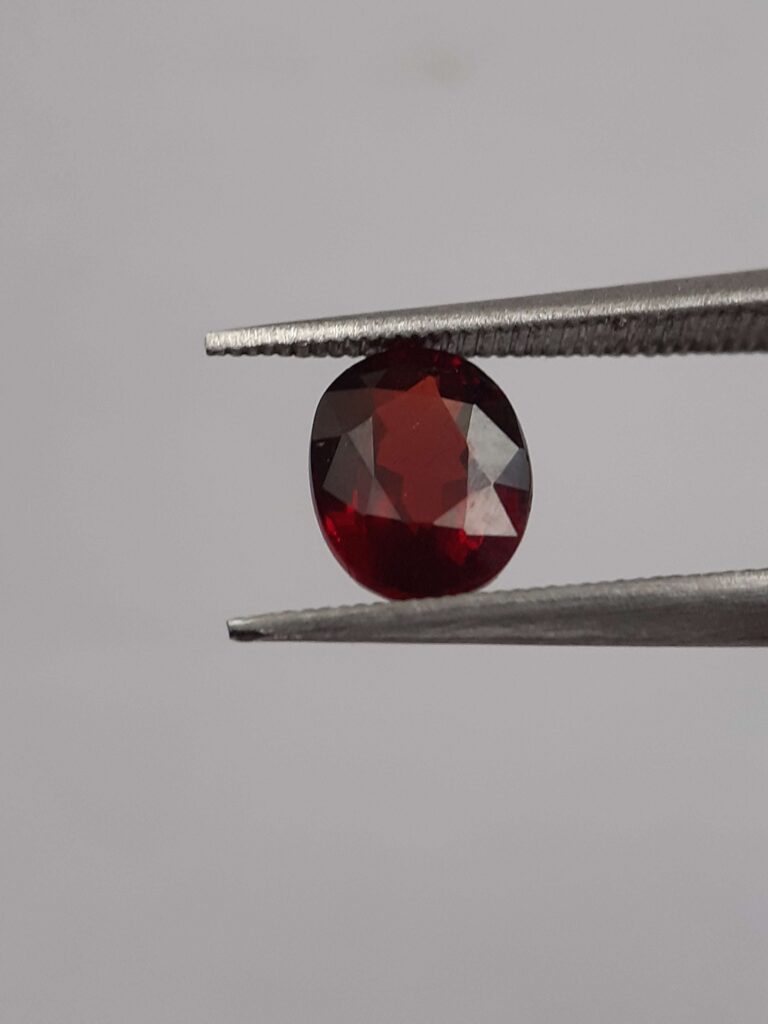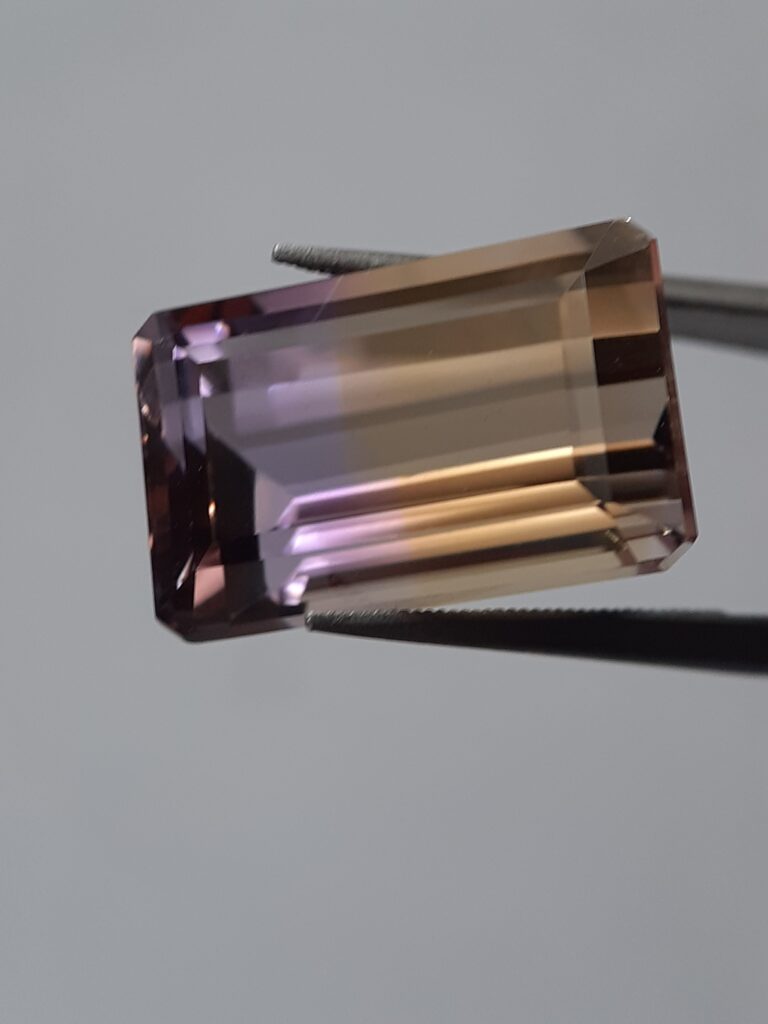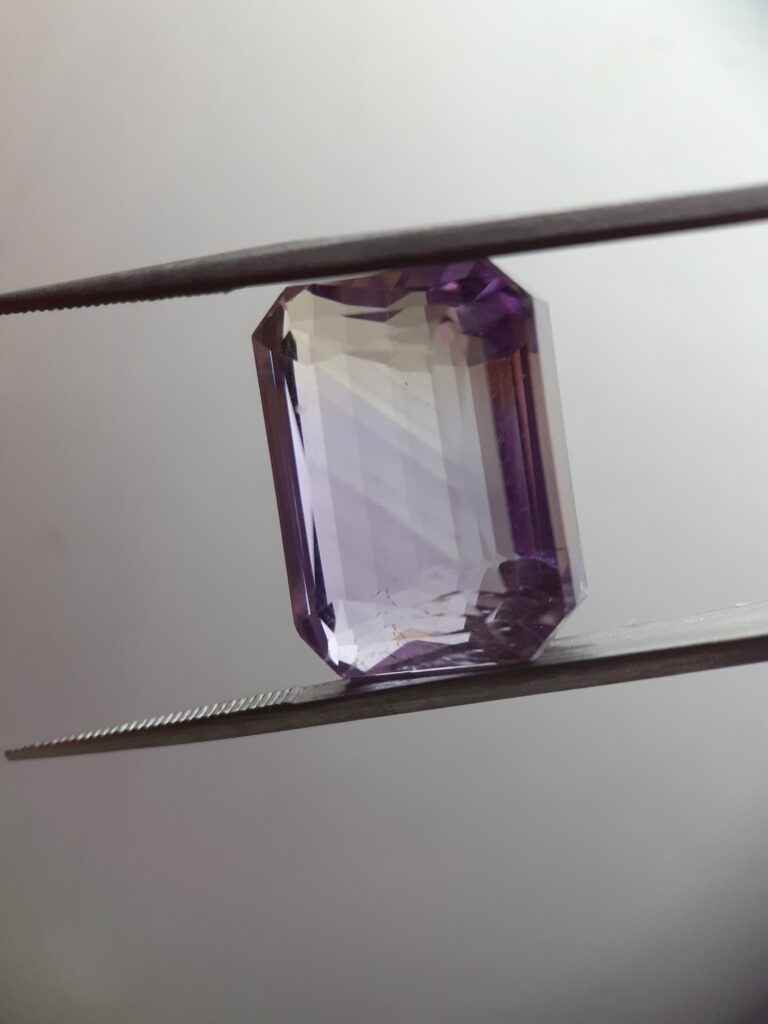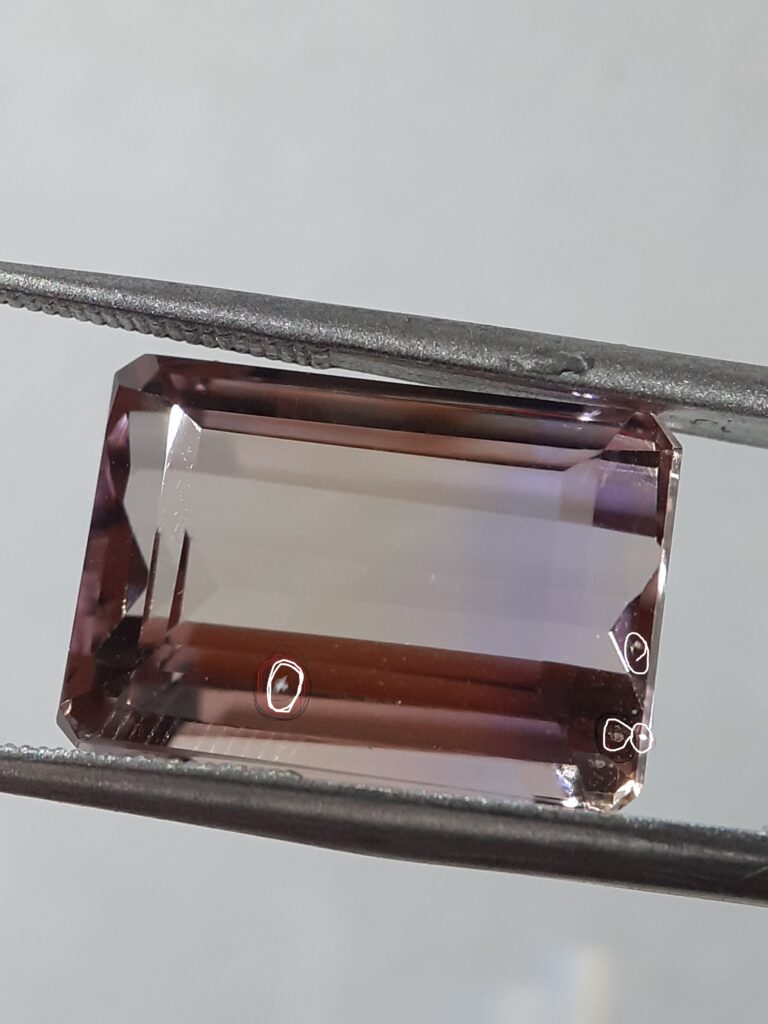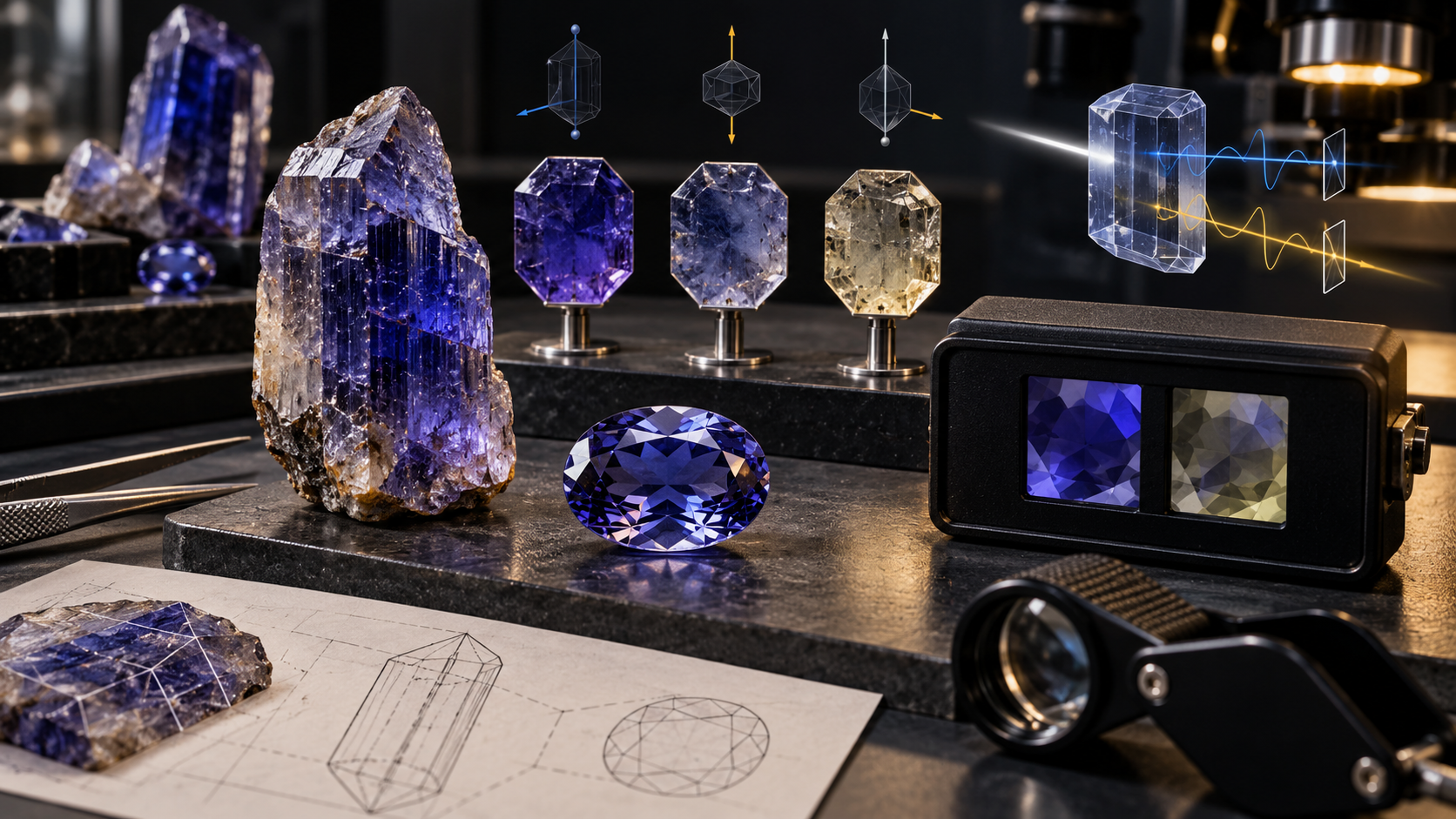
Take a strongly pleochroic gemstone such as iolite and examine it from different directions.
From one direction, it may appear richly violet-blue.
Turn the same crystal and the colour can become considerably paler, yellowish or almost colourless.
Nothing has been added to the gemstone.
Its chemical composition has not suddenly changed.
The light source does not even need to change.
What changed was the direction in which the gemstone was observed.
This remarkable optical property is known as pleochroism.
Far from being merely an attractive visual curiosity, pleochroism connects gemstone colour directly with crystal structure. It can assist identification, reveal optical character and strongly influence how a gemstone should be oriented before cutting.
Watch Episode 5 — Pleochroism: Why One Gemstone Can Show Different Colours
In Episode 5 of the Natural Gems Belgium Gemmology Series, Marnick Elskens, Founder of Natural Gems Belgium, explores why some gemstones display different colours in different crystallographic directions, how dichroism and trichroism differ, how a dichroscope reveals pleochroic colours and why cutters must consider pleochroism before deciding how to orient valuable rough.
The video introduces the phenomenon visually. Below, we examine the underlying crystal optics in greater scientific detail.
Table of Contents
What Is Pleochroism?
Pleochroism is the directional variation in colour displayed by certain coloured anisotropic materials.
The phenomenon arises because light vibrating in different crystallographic directions can experience different degrees of selective absorption.
That definition contains three important concepts:
direction, vibration and absorption.
To understand pleochroism properly, we therefore need to look beyond the visible colour and consider how light interacts with an anisotropic crystal.
Isotropic and Anisotropic Gemstones
Gem materials can be divided optically into broad groups.
In isotropic materials, optical behaviour is equivalent in all directions.
Cubic crystalline materials such as diamond and spinel are isotropic under normal conditions. Glass is also generally isotropic.
Anisotropic crystals behave differently.
Their optical properties vary according to crystallographic direction.
Gemstones belonging to the tetragonal, hexagonal and trigonal crystal systems are optically uniaxial.
Gemstones belonging to the orthorhombic, monoclinic and triclinic systems are optically biaxial.
These anisotropic materials can exhibit double refraction and, when coloured and sufficiently different in directional absorption, pleochroism.
Why Does Pleochroism Occur?
Visible gemstone colour is strongly influenced by selective absorption.
White visible light contains a range of wavelengths.
When light enters a coloured gemstone, certain wavelengths may be absorbed more strongly than others.
The wavelengths that remain and eventually reach the observer contribute to the colour we perceive.
In an anisotropic coloured crystal, absorption can vary with vibration direction.
One polarized component of light may therefore emerge with a different spectral balance from another.
If that difference is large enough for our eyes to distinguish, the gemstone displays visible pleochroism.
This is why pleochroism is fundamentally connected to both crystal structure and selective absorption.
Pleochroism and Double Refraction
Anisotropic gemstones are doubly refractive except when light travels along particular optic directions.
When light passes through such a crystal, it can be resolved into polarized components vibrating in different directions.
These components experience the crystal differently.
In a coloured anisotropic material, the different vibration directions can also experience different absorption.
The result can be different colours or different intensities of colour.
Pleochroism is therefore not simply a gemstone reflecting different colours from different facets.
Its origin lies within the directional optical behaviour of the crystal itself.
Dichroism
Uniaxial gemstones possess two principal vibration directions.
These are conventionally described using the Greek letters omega (ω) and epsilon (ε).
If absorption differs sufficiently between these directions, two distinguishable pleochroic colours can be observed.
This is known as dichroism.
Examples of gem materials that can display dichroism include:
- ruby;
- sapphire;
- tourmaline;
- aquamarine;
- some zircon;
- and other coloured uniaxial gemstones.
But an important qualification is necessary.
A gemstone being uniaxial does not guarantee that two dramatically different colours will be visible.
The difference in absorption may be weak.
The colours may differ mainly in intensity rather than hue.
Pleochroism may therefore be strong, moderate, weak or effectively imperceptible to the unaided eye.
Trichroism
Biaxial gemstones have three principal vibration directions, conventionally designated X, Y and Z, or associated with the principal refractive indices alpha, beta and gamma.
Where directional absorption differs sufficiently, three pleochroic colours can be distinguished.
This is known as trichroism.
Iolite and tanzanite provide famous examples.
Again, the term should not be interpreted too simplistically.
A biaxial gemstone does not necessarily present three dramatically separated colours every time it is viewed.
The strength and visibility of the effect depend on the material, colour saturation, orientation, cutting and observation conditions.
Iolite: One of Gemmology’s Classic Pleochroic Gems
Iolite is the gem variety of cordierite.
It is particularly useful for demonstrating pleochroism because the effect can be strong enough to observe without specialised equipment.
Depending on orientation and the individual material, different directions can show combinations of violet-blue, blue, greyish, yellowish or nearly colourless appearances.
This spectacular directional difference has major consequences for cutting.
A piece of rough iolite cannot simply be oriented to maximise weight.
The cutter must determine which crystallographic direction produces the most desirable face-up colour.
Poor orientation can result in a finished gemstone that appears pale, greyish or weakly coloured even when the original rough was capable of producing a much more attractive stone.
Correct orientation can allow the richer blue-violet component to dominate.
Pleochroism therefore directly affects both beauty and commercial value.
Tanzanite: A Trichroic Gemstone
Tanzanite is the blue-to-violet gem variety of the mineral zoisite.
It is biaxial and can display strong trichroism.
Early descriptions of untreated tanzanite documented combinations of blue, violet and yellow-green or brownish pleochroic components.
This is particularly interesting because most commercial tanzanite is heat treated.
Heating commonly reduces or removes much of the yellow-green to brownish component, producing the blue and violet appearance strongly associated with tanzanite in today’s gemstone market.
But heating does not make the crystal isotropic.
The gemstone remains anisotropic and pleochroic.
Blue and violet components can still be readily apparent in fashioned tanzanite.
The final face-up colour depends partly on the original material and partly on cutting orientation.
A cutter can favour a more blue or more violet appearance depending on how the rough is oriented.
This means that two tanzanites with related starting material can produce noticeably different face-up colours because of cutting decisions.
Tourmaline: Directional Absorption and Cutting
Tourmaline provides another excellent demonstration of why pleochroism matters to gemstone cutters.
Tourmaline is uniaxial and often strongly dichroic.
In many tourmalines, one pleochroic direction is significantly darker than the other.
This becomes particularly important in dark green or strongly saturated material.
If the cutter chooses an orientation that sends too much of the darkest pleochroic component toward the observer, the finished gemstone can appear excessively dark or even nearly black in some areas.
Orientation can therefore be used strategically.
For pale material, the cutter may try to maximise colour saturation.
For dark material, the objective may instead be to minimise the darkest directional component.
The best cutting orientation is consequently not universal.
It depends on the optical character of the individual piece of rough.
Pleochroism in Ruby and Sapphire
Ruby and sapphire both belong to the mineral species corundum.
Corundum is trigonal and optically uniaxial.
Coloured corundum can therefore display dichroism.
In blue sapphire, different crystallographic directions can produce different blue-related colour components.
In ruby, pleochroic colours may involve different red, purplish-red or orangish-red appearances depending on the material.
These directional colours can contribute to the final face-up appearance of a cut gemstone.
However, pleochroic colour descriptions should not be treated as rigid formulas for identification.
Natural gemstones vary.
Chemistry varies.
Colour concentration varies.
Treatment can influence appearance.
Observation conditions vary.
The gemmologist should observe what the specimen actually does rather than force it into a memorised colour description.
What Is a Dichroscope?
The dichroscope is a classic gemmological instrument designed to make pleochroism easier to observe.
One traditional design uses calcite.
Calcite possesses very strong double refraction.
Inside the instrument, it separates the image of a small aperture into two adjacent images representing mutually perpendicular vibration directions.
When light from a pleochroic gemstone enters the instrument, the observer can compare the colours associated with those two directions side by side.
If the gemstone is pleochroic, the two windows may show different colours or different intensities of the same general colour.
The gemstone is then rotated and observed repeatedly.
This allows the gemmologist to search systematically for the strongest pleochroic difference.
Why Rotate the Gemstone?
A dichroscope displays only two perpendicular components at one time.
Orientation therefore matters.
If the gemstone happens to be held in an unfavourable direction, pleochroism may appear weak or may not be obvious.
Rotating the stone allows different crystallographic relationships to be sampled.
This is particularly important when examining biaxial gemstones.
Three principal pleochroic colours may exist, but they are not necessarily presented simultaneously as three separate windows.
Systematic observation is required.
Can You See Pleochroism Without a Dichroscope?
Absolutely.
Strongly pleochroic gemstones can display the effect directly to the unaided eye.
Iolite is an excellent example.
Tanzanite can also reveal blue and violet components as a fashioned gemstone is tilted and examined from different directions.
In a faceted gemstone, however, the situation becomes more complex.
Light travels through multiple facets and directions.
Internal reflection mixes contributions from different optical directions.
The face-up colour is therefore not necessarily one pure pleochroic colour.
Several directional components can contribute simultaneously to the visual appearance.
This is one reason pleochroism can strongly influence the colour of a faceted gemstone even when the observer is not consciously seeing separate colours.
Pleochroism and Cutting Orientation
Before cutting strongly pleochroic rough, the cutter faces a fundamental decision:
Which crystallographic direction should dominate the face-up appearance?
That decision can influence:
- hue;
- tone;
- saturation;
- apparent darkness;
- brilliance;
- finished weight;
- shape;
- and ultimately market desirability.
The orientation that produces maximum carat yield may not produce the best colour.
The orientation that produces the finest colour may require sacrificing more rough.
This creates one of the classic compromises in coloured gemstone cutting:
weight versus optical quality.
An expert cutter must understand both.
Pleochroism Versus Colour Change
Pleochroism and colour change are fundamentally different phenomena.
With pleochroism, the observed colour changes primarily because the gemstone is viewed along different crystallographic directions.
The illumination can remain unchanged.
With colour change, the spectral composition of the light source changes.
A classic colour-change gemstone may therefore look different under daylight-equivalent illumination and incandescent illumination even when viewed from the same direction.
The distinction can be summarised simply:
Pleochroism is direction-dependent.
Colour change is illumination-dependent.
A gemstone can potentially exhibit both properties, which makes careful observation even more important.
Pleochroism Versus Colour Zoning
Colour zoning is another phenomenon that should not be confused with pleochroism.
Colour zoning means that different physical regions of the crystal contain different colour concentrations or hues.
This may result from changes in trace-element concentration or growth conditions while the crystal formed.
Pleochroism does not require different coloured regions.
The same region of crystal can display different colours when viewed in different crystallographic directions.
Therefore:
Colour zoning is spatial.
Pleochroism is directional.
Both can occur in the same gemstone.
Pleochroism Versus Dispersion
Dispersion creates another type of colour effect.
In dispersion, refractive index varies with wavelength, allowing white light to separate into spectral colours.
In a faceted gemstone, this can create coloured flashes known as fire.
Pleochroism operates through a different mechanism.
It arises through directional differences in selective absorption.
A red flash caused by dispersion is therefore not evidence of red pleochroism.
The optical mechanism must always be considered.
Pleochroism Versus Iridescence
Iridescence can arise from interference or diffraction associated with thin layers, fine structures or other optical interfaces.
The resulting colours can change dramatically with viewing geometry.
Again, this is not pleochroism.
Pleochroism originates from anisotropic absorption within the crystalline material.
Several optical phenomena can therefore produce changing colours as a gemstone moves.
Their appearance alone does not establish the mechanism.
Can Pleochroism Identify a Gemstone?
Pleochroism can provide valuable gemmological evidence.
A strongly pleochroic blue gemstone behaves differently from an isotropic blue gemstone.
The presence, absence, strength and character of pleochroism can therefore narrow identification possibilities.
But pleochroism should not normally be treated as a complete identification.
Professional gemmology combines independent observations.
Depending on the gemstone, these may include:
- refractive index;
- birefringence;
- optic character;
- specific gravity;
- absorption spectrum;
- microscopy;
- fluorescence;
- inclusions;
- and advanced laboratory analysis where necessary.
This principle appears repeatedly throughout gemmology:
the strongest identification comes from converging evidence.
Why Pleochroism Matters When Buying a Gemstone
Pleochroism is not merely a laboratory property.
It can directly affect the beauty of the gemstone a buyer sees.
A strongly pleochroic gemstone may show a rich attractive face-up colour when expertly oriented.
The same rough oriented differently might have produced a much less attractive finished stone.
When evaluating gemstones such as iolite, tanzanite and tourmaline, it can therefore be useful to observe the gemstone from several directions.
Tilt it.
Rotate it.
Observe it under consistent lighting.
Look for changes in hue and tone.
Then return to the normal face-up position.
Ultimately, the important question for a finished gemstone is not simply whether pleochroism exists.
It is whether the cutter used it effectively.
Crystal Structure Becomes Visible
Pleochroism is remarkable because it makes something normally invisible—crystal anisotropy—visually perceptible.
The colour we observe is not determined only by chemical composition.
It is also influenced by the direction in which light interacts with the crystal structure.
That connects several branches of gemmology:
crystallography,
optics,
colour science,
gemstone identification,
and cutting.
One gemstone can show several colours without changing its composition, treatment or light source.
Change the direction.
Change the optical interaction.
And the crystal itself reveals another part of its colour.
That is pleochroism.
References & Further Reading
Gemological Institute of America (GIA), Gems & Gemology — Pleochroism in Faceted Gems: An Introduction
Richard W. Hughes. Detailed technical discussion of pleochroism, principal vibration directions, dichroism, trichroism and the complex expression of pleochroic colour in faceted gemstones.
https://www.gia.edu/gems-gemology/fall-2014-introduction-pleochroism-faceted-gems
Gemological Institute of America (GIA) — Iolite Description
Professional overview of iolite, its exceptionally strong eye-visible pleochroism and the challenges pleochroism creates for gemstone cutting and orientation.
https://www.gia.edu/iolite-description
Gemological Institute of America (GIA) — Iolite Buyer’s Guide
Additional reference explaining why iolite must be carefully oriented during cutting to display its most desirable face-up colour.
https://www.gia.edu/iolite/buyers-guide
Gemological Institute of America (GIA) — Tanzanite Description
Detailed discussion of tanzanite’s pleochroism, its blue, violet and historical yellow-green components, the influence of heat treatment and the importance of cutting orientation.
https://www.gia.edu/tanzanite-description
Gemological Institute of America (GIA) — Tanzanite Buyer’s Guide
Explains how strong pleochroism contributes to the face-up colour and quality evaluation of fashioned tanzanite.
https://www.gia.edu/tanzanite/buyers-guide
Gemmological Association of Great Britain (Gem-A) — Foundation in Gemmology Specification
Educational framework covering selective absorption, pleochroism, colour phenomena and the principles and use of the dichroscope in professional gem testing.
https://gem-a.com/wp-content/uploads/2025/05/Gem-A-Foundation-in-Gemmology-Specifications.pdf