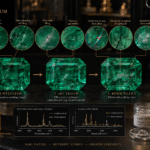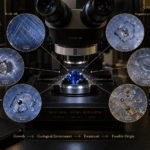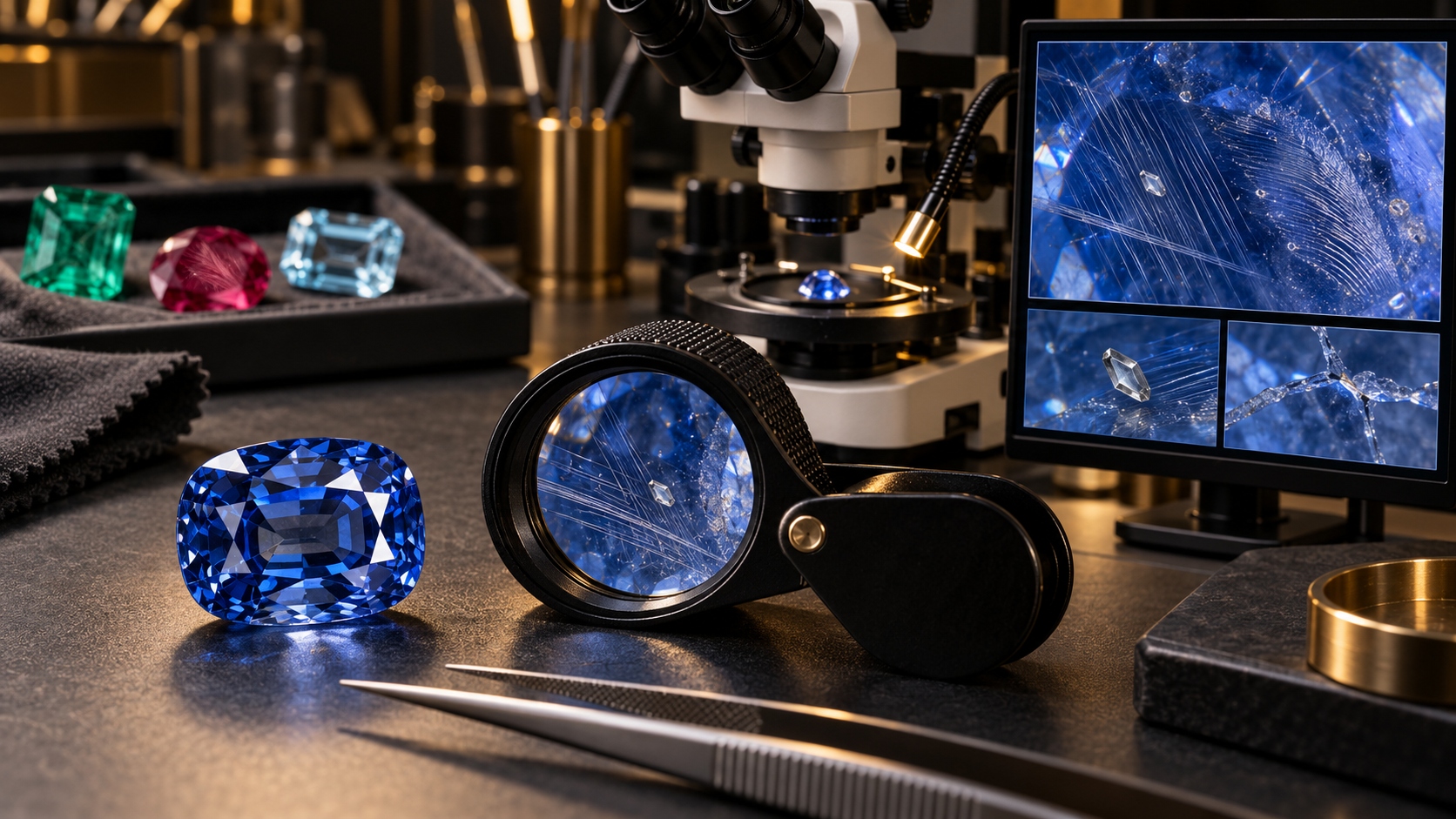
A gemstone can appear perfectly clean when held in the hand and reveal an entire microscopic landscape when placed under a loupe.
Does that mean the gemstone is low clarity?
Not necessarily.
Does eye-clean mean flawless?
Definitely not.
Clarity is one of the most frequently discussed—and frequently oversimplified—quality factors in gemstones.
For diamonds, clarity benefits from a highly standardised international grading framework. Coloured gemstones present a more complex situation.
Different gem materials form in different geological environments. Some characteristically contain numerous inclusions. Others commonly produce transparent faceted material with very few eye-visible internal features.
The meaning and importance of clarity must therefore be interpreted in the context of the gemstone being examined.
Watch Episode 4 — Gemstone Clarity: What Does Eye-Clean Really Mean?
In Episode 4 of the Natural Gems Belgium Gemmology Series, Marnick Elskens, Founder of Natural Gems Belgium, explains how clarity is evaluated, what gem dealers mean by eye-clean, why magnification changes what we see and why the cleanest coloured gemstone is not automatically the best gemstone.
The video provides the practical introduction. Below, we examine gemstone clarity in greater scientific detail.
Table of Contents
What Is Gemstone Clarity?
Clarity broadly concerns internal inclusions and, depending on the grading context, external characteristics that influence the appearance of a gemstone.
But clarity is not simply the number of inclusions present.
Two gemstones containing the same number of inclusions can look completely different.
Important variables include:
- size;
- number;
- position;
- nature;
- colour;
- relief or contrast;
- visibility;
- orientation;
- effect on transparency;
- effect on optical performance;
- and possible effect on durability.
One small dark crystal directly beneath the table facet may be considerably more noticeable than several transparent crystals positioned near the girdle.
A large surface-reaching fracture may raise structural concerns while a completely enclosed microscopic crystal may have virtually no effect on durability.
Clarity therefore requires interpretation rather than simple counting.
What Does Eye-Clean Mean?
Eye-clean is a practical gem-trade expression.
In general terms, it describes a gemstone in which inclusions are not readily visible to the unaided eye under the applicable viewing conditions.
That does not mean the gemstone contains no inclusions.
An eye-clean gemstone may reveal numerous crystals, needles, fluid inclusions, growth structures or healed fissures under magnification.
Eye-clean should therefore never be treated as a synonym for inclusion-free or flawless.
It is primarily a statement about visibility without magnification.
Eye-Clean Is Not an Absolute Measurement
There is another complication.
The human eye is part of the test.
How close is the gemstone being examined?
What lighting is being used?
Is it being viewed face-up?
How large is the gemstone?
How saturated is its colour?
What type of cut does it have?
How good is the observer’s eyesight?
An inclusion that disappears at normal viewing distance may become obvious when the gemstone is brought close to the eye.
An inclusion hidden face-up can become obvious when viewed through the pavilion.
A strongly coloured gemstone can mask an inclusion that would be conspicuous in a pale transparent stone.
Consequently, eye-clean is useful descriptive terminology, but it is not a perfectly reproducible physical measurement unless viewing conditions are carefully defined.
What Happens at 10× Magnification?
Magnification changes the clarity landscape dramatically.
A professional 10× loupe reveals features far too small to be resolved by the unaided eye.
The number ten is particularly familiar because 10× magnification is fundamental to diamond clarity grading.
Under the GIA International Diamond Grading System, diamonds are evaluated for clarity at 10× magnification.
The clarity scale contains eleven grades:
FL — Flawless
IF — Internally Flawless
VVS1 and VVS2 — Very, Very Slightly Included
VS1 and VS2 — Very Slightly Included
SI1 and SI2 — Slightly Included
I1, I2 and I3 — Included
Factors such as the size, nature, position, relief and quantity of clarity characteristics contribute to the diamond clarity grade.
This is a highly developed and internationally recognised system.
But an important distinction follows.
Diamond Clarity Is Not a Universal Coloured Gemstone Scale
The diamond clarity scale was developed for diamonds.
It should not automatically be presented as a universal grading system for ruby, sapphire, emerald, tourmaline, aquamarine, quartz and every other coloured gemstone.
For most coloured gemstones, there is no universally accepted clarity grading system equivalent to the GIA diamond scale.
Commercial organisations may use terms such as VVS, VS, SI, AAA or other internal quality designations for coloured gemstones.
Those systems can be useful when they are clearly defined and consistently applied. Natural Gems Belgium applies consistently the same system of gemstone clarity based on the diamond clarity scale, based on the gemstone’s natural characteristics.
But they should not be mistaken for a single universal international coloured-stone clarity standard. Natural Gems Belgium Being a pioneer in doing so, is providing therefor more information and transparency in the gemstone quality offered.
This distinction becomes particularly important when comparing gemstones from different sellers.
The same terminology may not necessarily represent exactly the same assessment criteria.
Why Clarity Must Be Species-Specific
Gemstones do not all have the same geological history.
Their typical inclusion populations therefore differ.
A level of clarity that would be exceptional for one gemstone may be routine for another.
Emerald
Emerald provides one of the clearest examples.
Natural emerald commonly contains inclusions visible to the unaided eye.
Its internal landscape is sometimes described using the French term jardin, meaning garden.
Eye-clean emeralds exist, but they are comparatively rare.
This means that demanding the same apparent cleanliness from emerald that one might expect from aquamarine would ignore the geological reality of the material.
In emerald, transparency remains extremely important. Inclusions that substantially reduce transparency can strongly affect quality and value.
But the simple presence of visible inclusions is not unusual.
Ruby
Ruby also commonly contains inclusions.
Completely inclusion-free natural ruby is exceptionally unusual.
Fine ruby can contain needles, crystals, colour variations and fingerprint-like features while remaining highly desirable.
Visibility matters.
Large or prominent inclusions beneath the table can reduce transparency and brightness significantly.
Surface-reaching fractures may also affect durability.
At the same time, fine rutile silk can scatter light and contribute positively to the visual appearance of some rubies.
Clarity therefore cannot be reduced to a simple clean-versus-included distinction.
Sapphire
Blue sapphire generally shows better clarity than ruby, although inclusions remain common.
Needles, crystals, partially healed fractures, colour zoning and colour banding may all occur.
Very high clarity in fine blue sapphire can be rare and valuable.
But some microscopic inclusions can contribute positively to appearance.
Fine inclusions associated with the velvety appearance prized in certain exceptional sapphires demonstrate again that maximum microscopic cleanliness is not always equivalent to maximum beauty.
Aquamarine
Aquamarine creates almost the opposite expectation.
Most faceted aquamarines encountered in the market are eye-clean.
Large transparent crystals can occur with relatively few visible clarity characteristics.
Consequently, an obvious inclusion in faceted aquamarine can have greater commercial impact than a comparable inclusion in emerald.
This does not mean included aquamarine lacks beauty.
Included material can be used effectively for cabochons, carvings, beads and unusual designer pieces.
It simply means that the clarity expectation for faceted aquamarine is different.
Amethyst and Citrine
Much faceted amethyst and citrine is also eye-clean.
Because clean transparent material is relatively available, visible inclusions—particularly in lightly coloured stones—can have a stronger negative influence on commercial quality.
Again, context determines significance.
Clarity and Transparency Are Not the Same Thing
The terms clarity and transparency are closely connected, but they describe different concepts.
Transparency concerns the degree to which light passes through a material.
A gemstone can broadly be described as transparent, translucent or opaque depending on its interaction with transmitted light.
Clarity concerns the internal and external characteristics and how they influence visual appearance.
A transparent gemstone can still contain visible inclusions.
An emerald can be transparent while displaying numerous internal features.
A translucent gemstone can transmit light while preventing clear visual transmission through the material.
Dense inclusions can reduce transparency, so the concepts interact strongly.
But they should not be treated as synonyms.
Why Inclusion Position Matters
Imagine two gemstones.
The first contains several tiny transparent crystals near the girdle.
The second contains one dark inclusion directly beneath the centre of the table.
The second gemstone may appear considerably more included even though it contains fewer inclusions.
This demonstrates the importance of position.
Faceted gemstones are optical systems.
An inclusion may be reflected internally by facets, making one physical feature appear multiple times.
A centrally positioned inclusion can dominate the face-up appearance.
A peripheral inclusion may be largely hidden by facet reflections or body colour.
Clarity therefore depends not merely on what exists inside the gemstone, but also on where it exists and how the cut makes it visible.
Relief and Contrast
Gemologists often consider how strongly an inclusion contrasts with its host.
An inclusion with high visual relief can appear sharply defined.
A low-relief inclusion may blend much more subtly into the surrounding gemstone.
Colour also matters.
A dark crystal in a pale gemstone can attract attention immediately.
A transparent inclusion with little contrast may remain difficult to see even when relatively large.
This is why two inclusions of similar physical dimensions can have completely different effects on perceived clarity.
Clarity and Durability
Clarity is not exclusively aesthetic.
Certain internal characteristics can have structural significance.
A small enclosed mineral crystal may present essentially no durability problem.
A large fracture reaching the surface can be very different.
Surface-reaching fractures can create potential weakness, particularly when positioned in vulnerable areas or subjected to impact.
This does not mean every fractured gemstone is unstable.
Fracture orientation, extent, position, host material and intended use all matter.
Nevertheless, responsible clarity evaluation should ask two different questions:
How does this characteristic affect appearance?
and
Could this characteristic affect durability?
These are not always the same question.
When Inclusions Improve Appearance
But inclusions can also influence beauty.
Fine particles can scatter light and create a softer visual appearance.
In some highly regarded sapphires, microscopic inclusions contribute to a desirable velvety appearance without destroying transparency.
Other inclusion arrangements create entire optical phenomena.
Oriented needle-like inclusions can generate asterism, producing the star visible in appropriately cut star sapphire and star ruby.
Aligned inclusions or internal structures can create chatoyancy, the cat’s-eye effect.
In these gemstones, removing the inclusions would effectively remove the phenomenon.
This is perhaps the clearest demonstration that an inclusion is not automatically a defect.
Clarity and Colour Interact
Coloured gemstones are not colourless diamonds.
Colour is often the dominant visual quality factor.
Strong body colour can partially mask inclusions.
Lightly coloured transparent stones reveal internal features much more easily.
This changes the balance between colour and clarity.
Consider two rubies.
One possesses exceptional vivid red colour but contains several minor inclusions.
The other is considerably cleaner but has weak, unattractive colour.
It would be incorrect to assume that the cleaner ruby must automatically be the superior gemstone.
The same principle applies throughout coloured gemstone evaluation.
Clarity must be interpreted together with colour.
Clarity and Cut Interact
Cutting also changes how inclusions appear.
Brilliant-style faceting can create complex reflections that hide some features and multiply others.
Large open step facets can make internal characteristics easier to observe.
Facet orientation may place an inclusion directly beneath the table or move it toward a less conspicuous location.
A skilled cutter therefore considers the internal characteristics of the rough before deciding how to orient and fashion a gemstone.
The final clarity appearance is partly geological and partly the result of cutting decisions.
Does High Clarity Prove a Gemstone Is Synthetic?
No.
This is an important misconception.
Some synthetic gemstones can be exceptionally clean.
But natural gemstones can also possess very high clarity.
A gemstone should never be declared synthetic simply because it appears unusually clean.
Likewise, the presence of inclusions does not automatically prove natural origin.
Synthetic gemstones can contain inclusions and growth-related features of their own.
Natural-versus-synthetic identification requires diagnostic evidence, not assumptions based on cleanliness.
Does High Clarity Prove a Gemstone Is Untreated?
Again, no.
Clarity and treatment status are different questions.
Treatment can sometimes modify apparent clarity.
Emerald fissures may be filled with oils or other substances.
Fracture filling can reduce the visibility of fractures in other gem materials.
Heating can alter certain inclusion scenes.
But an exceptionally clean gemstone is not automatically treated, and an included gemstone is not automatically untreated.
Treatment determination requires appropriate gemmological examination.
Is the Cleanest Gemstone the Best?
Not necessarily.
Extreme clarity can contribute significantly to rarity and value.
But a gemstone is a combination of many properties.
For a faceted coloured gemstone, relevant considerations can include:
- colour;
- clarity;
- transparency;
- cut quality;
- optical performance;
- carat weight;
- durability;
- treatment status;
- rarity;
- and overall visual appeal.
Improving one factor does not automatically compensate for weaknesses in every other factor.
The goal is therefore not always to find the gemstone with the fewest microscopic characteristics.
It is to understand how those characteristics affect the gemstone as a whole.
Five Practical Questions for Evaluating Clarity
When examining a coloured gemstone, five questions provide a useful starting framework.
1. Are the inclusions visible without magnification?
This establishes their immediate effect on face-up appearance.
2. Where are the inclusions located?
A central inclusion can have a very different impact from one near the girdle.
3. Do they reduce transparency, brightness or visual appeal?
Some inclusions are visible without being strongly distracting.
Others substantially alter the optical appearance.
4. Could they affect durability?
Surface-reaching fractures deserve different consideration from harmless enclosed crystals.
5. Is this clarity normal for the gemstone?
An included emerald and an equally included aquamarine should not automatically be judged according to identical expectations.
Material context matters.
Clarity Is About Understanding, Not Perfection
The word clarity can encourage an overly simple idea:
Cleaner is always better.
Gemology reveals a more interesting reality.
An inclusion can reduce transparency.
Another can threaten durability.
Another may be virtually irrelevant to face-up beauty.
Another may provide evidence of geological formation.
And another may create the optical phenomenon that makes the gemstone exceptional.
The correct objective is therefore not microscopic perfection at any cost.
It is informed evaluation.
Look at the gemstone without magnification.
Look at it under magnification.
Understand what the inclusions are doing.
Consider what is normal for that gem material.
Then evaluate clarity together with colour, cut, transparency, durability and overall appeal.
That is a far more meaningful approach to gemstone quality than simply counting inclusions.
References & Further Reading
Gemological Institute of America (GIA) — Colored Gemstone Value Factors: Clarity
Detailed discussion of clarity as a value factor in coloured gemstones and why clarity expectations differ between gem materials.
https://www.gia.edu/gia-news-research/value-factors-design-cut-quality-colored-gemstone-value-factors
Gemological Institute of America (GIA) — GIA 4Cs: Diamond Clarity
Official explanation of the GIA diamond clarity scale, its eleven grades and the role of 10× magnification.
https://www.gia.edu/gia-about/4cs-clarity
Gemological Institute of America (GIA) — Seven Things to Know About Diamond Clarity
Includes GIA’s explanation of the trade term “eye-clean” and explicitly notes that GIA does not use eye-clean as a diamond clarity grade.
https://4cs.gia.edu/en-us/blog/seven-things-to-know-about-diamond-clarity/
Gemological Institute of America (GIA) — Emerald Quality Factors
Professional reference on emerald colour, clarity, inclusions, transparency and clarity enhancement.
https://www.gia.edu/emerald-quality-factor
Gemological Institute of America (GIA) — Ruby Quality Factors
Detailed explanation of ruby clarity, expected inclusions, rutile silk, durability considerations and the relationship between clarity and value.
https://www.gia.edu/ruby-quality-factor
Gemological Institute of America (GIA) — Sapphire Quality Factors
Reference covering sapphire clarity, rutile silk, included crystals, healed fractures, colour zoning and inclusion-related optical phenomena.
https://www.gia.edu/sapphire-quality-factor
Gemological Institute of America (GIA) — Aquamarine Quality Factors
Explains why most faceted aquamarine is expected to be eye-clean and how included material is commonly used for other cutting styles.
https://www.gia.edu/aquamarine-quality-factor
Gemological Institute of America (GIA) — Amethyst Buyer’s Guide
Provides additional comparison with a coloured gemstone for which much faceted market material is eye-clean.
https://www.gia.edu/amethyst/buyers-guide
GIA Gems & Gemology — Inclusions in Gemstones
Scientific discussion of inclusion formation, study, identification significance and inclusion-related optical phenomena.
https://www.gia.edu/gems-gemology/summer-2022-colored-stones-unearthed
GIA Gems & Gemology — Inclusions in Natural, Synthetic and Treated Sapphire
Professional visual and scientific reference for microscopic features in natural, synthetic and treated sapphire.
https://www.gia.edu/gems-gemology/summer-2017-inclusions-sapphire