In the early seventh century, an extraordinarily powerful individual was buried beside the River Deben in eastern England.
His mourners placed him inside a ship.
Around him they assembled weapons, armour, drinking vessels, silver from the Mediterranean world, coins, textiles, feasting equipment and some of the finest jewellery produced anywhere in early medieval Europe.
Among the colours dominating this extraordinary assemblage was red.
Not painted red.
Not enamelled red.
But the deep translucent red of hundreds of carefully cut garnets.
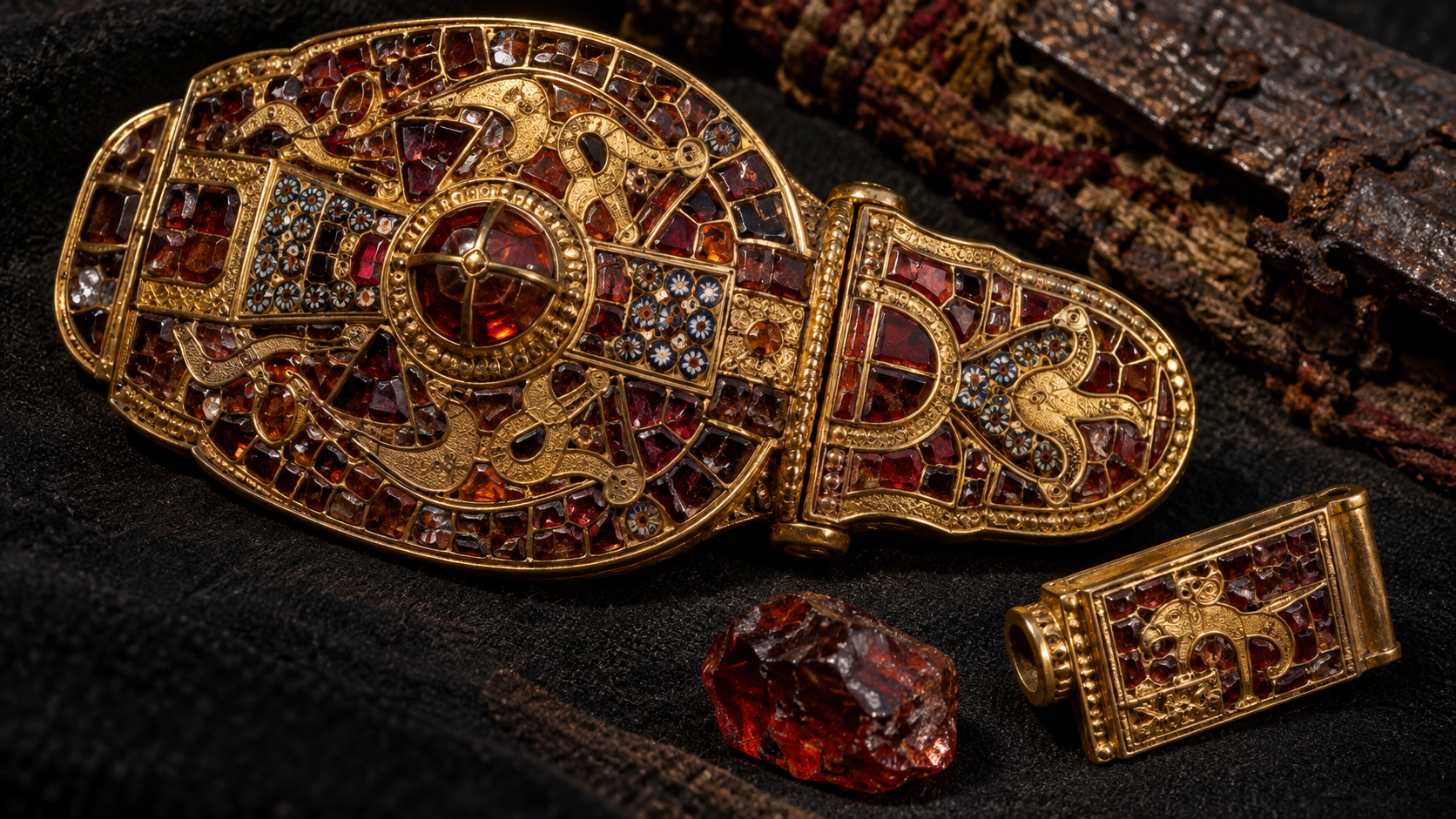
They appeared on shoulder clasps.
On sword fittings.
On a purse lid.
On belt equipment.
Even along the eyebrows of the famous Sutton Hoo helmet.
The effect must once have been extraordinary.
Against gold, the thin red stones would have caught and reflected light from patterned metal foils beneath them, making the surfaces seem more luminous than the raw gemstones alone.
Today, garnet is often described in crystal traditions as a stone of:
- passion
- vitality
- courage
- protection
- grounding
- strength
- sexuality
At first glance, such associations might appear perfectly suited to the weapons and warrior imagery of Sutton Hoo.
But that is precisely where historical caution becomes essential.
We know that garnets were deliberately selected for some of the most prestigious objects in the burial.
We know the grave expressed extraordinary status, wealth and martial authority.
We know some of the images surrounding those garnets involved powerful animals and warriors.
What we do not possess is an early Anglo-Saxon text stating that garnet itself emitted courage, protection or warrior energy.
The historical story is more sophisticated.
At Sutton Hoo, garnet belonged to a complex visual language of power, craftsmanship, identity, long-distance connection, burial and belief.
And modern scientific analysis has made that story even more remarkable.
Some of the garnets decorating an English ruler’s equipment had travelled from India and Sri Lanka.
A tiny red gemstone could therefore connect seventh-century East Anglia with trade networks extending across much of the known world.
In this context, the significance of garnet at Sutton Hoo reflects a blend of artistry and cultural expression.
Table of Contents
First: Garnet Is Not One Mineral
The name garnet does not refer to a single mineral species.
Garnets form a group of closely related silicate minerals sharing essentially the same crystal structure but differing in chemical composition.
Important gem species include:
- almandine
- pyrope
- spessartine
- grossular
- andradite
and less commonly uvarovite.
Red garnets frequently contain mixtures of the chemical components associated with pyrope and almandine.
This matters when discussing archaeological garnets.
A red stone identified simply as “garnet” may preserve chemical information capable of helping researchers investigate where the material originated.
Modern analytical techniques can compare elemental characteristics with known geological sources.
The gemstones themselves can therefore become evidence for ancient trade.
Why Garnet Became So Important in Early Medieval Europe
Red garnets were enormously popular in European elite metalwork during the Migration Period and early Middle Ages.
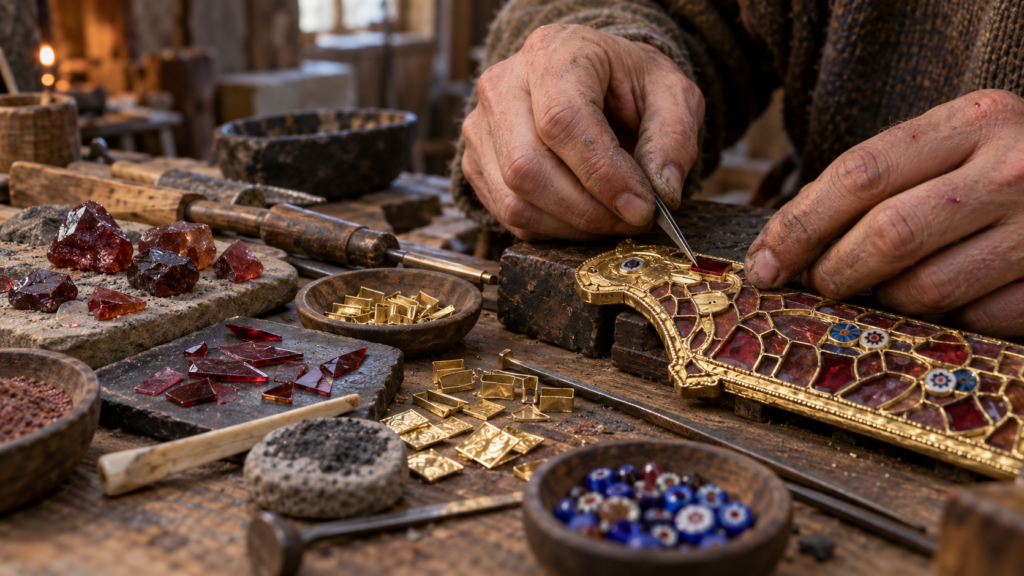
From roughly the fifth through seventh centuries, craftspeople working for powerful patrons transformed thin pieces of garnet into brilliantly coloured surfaces using a technique known as cloisonné.
Small gold partitions—called cloisons—formed cells.
Carefully cut pieces of garnet were fitted into those compartments.
Beneath many stones, patterned gold foil reflected light back through the translucent gem.
The result was not simply red jewellery.
It was an engineered optical effect.
Light entered the garnet.
Reflected from the metallic surface beneath.
And returned toward the viewer.
Early medieval goldsmiths were therefore manipulating both material and light.
Garnet Cloisonné
The Metropolitan Museum of Art describes the technique clearly in its collection of Frankish jewellery.
Goldsmiths created small compartments across the metal surface.
Textured gold foil was placed beneath the gems.
Thin garnet slices were then inserted above it.
Because the stones were translucent, the pattern below remained visible.
This could create extraordinary brilliance.
The technique spread widely through elite European jewellery and became particularly characteristic of high-status objects during the Migration Period.
By the early seventh century, craftspeople in Anglo-Saxon England were producing some of its most technically sophisticated surviving examples.
Sutton Hoo represents a spectacular culmination.
Sutton Hoo
Sutton Hoo lies in Suffolk in eastern England.
Its most famous monument is Mound 1, where archaeologist Basil Brown uncovered the impression of a large buried ship in 1939.
At its centre had been a burial chamber.
The acidic soil destroyed most human remains, but later soil analysis confirmed that a body had once been present.
The identity of the deceased remains uncertain.
King Rædwald of East Anglia, who died in the early seventh century, is frequently proposed as a candidate.
But archaeology cannot identify him with certainty.
That distinction is important.
The burial tells us that the dead man possessed extraordinary status.
It does not give us his name.
A Funeral Designed to Communicate Power
The ship burial required immense organisation.
A large vessel had to be moved from the river.
A trench was excavated.
A burial chamber was built inside the ship.
Exceptional possessions were assembled.
The entire structure was then covered beneath a monumental mound.
The British Museum interprets the grave goods as deliberately arranged to communicate the deceased person’s identity and status: powerful, wealthy, generous, internationally connected and associated with both martial leadership and the prestigious Roman past.
This was not simply disposal of a body.
It was monumental communication.
Death became political theatre.
Religion at a Moment of Change
Sutton Hoo is especially fascinating because it belongs to a period when religious traditions in England were changing dramatically.
Christian missionary activity was expanding among Anglo-Saxon kingdoms.
Older pre-Christian traditions remained powerful.
The National Trust describes the burial as belonging to precisely this period of transition.
Some objects within the chamber appear connected with the Christian Mediterranean world.
Silver spoons bear the names Saulos and Paulos, recalling the biblical Saul and Paul.
Certain silver objects incorporate cross-like imagery.
Yet the monumental ship burial itself belongs to a burial tradition fundamentally different from later Christian practices.
If the deceased was indeed Rædwald, the historical context becomes even more intriguing, because later accounts describe him as maintaining associations with both Christian and traditional religious practice.
We should not simplify this into “pagan versus Christian.”
Sutton Hoo reflects a world in transition.
Did the Garnets Have a Spiritual Meaning?
Almost certainly they possessed meaning beyond simple decoration.
But identifying that meaning precisely is difficult.
There is no surviving Sutton Hoo instruction manual telling us:
“Garnet represents courage.”
Or:
“Garnet protects the warrior.”
Or:
“Red stones contain life force.”
Instead, we must reconstruct meaning from context.
Where are the garnets?
Which objects carry them?
What imagery surrounds them?
Who could possess such objects?
Where were those objects placed?
Those questions produce stronger historical interpretations than projecting modern crystal meanings backwards.
The Shoulder Clasps
Among the most spectacular garnet objects at Sutton Hoo are the famous gold shoulder clasps.
They were designed to fasten a heavy garment.
Each clasp contains extraordinarily intricate garnet cloisonné alongside patterned glass and gold filigree.
At the rounded ends appear pairs of interlocking boars.
The bodies of these animals themselves are created partly through garnet inlay.
Around them are additional intertwined creatures.
The object therefore combines:
gold
garnet
animal imagery
elite costume
and exceptional craftsmanship.
The wearer would not merely have looked wealthy.
He would have carried an entire visual language of authority across his shoulders.
The Boar
The boar appears repeatedly in early Germanic and Anglo-Saxon elite imagery.
It occurs on weapons and helmets as well as jewellery.
At Sutton Hoo, boar heads appear at the ends of the helmet’s eyebrows, while interlocking boars dominate the shoulder clasps.
Within early medieval warrior culture, boar imagery could be associated with martial strength and protection.
Old English literary traditions also preserve references to boar imagery on helmets.
But once again, distinction matters.
The boar image may carry protective or martial associations.
That does not prove that the garnet mineral itself was believed to generate protection.
Material and image operate together.
Red, Gold and the Warrior Body
Imagine the shoulder clasps in use.
They were not static museum objects.
They were worn.
Gold covered the shoulders.
Thin translucent garnets reflected patterned gold beneath them.
Animal bodies appeared to emerge through networks of red and gold.
Movement altered the light.
The wearer himself became part of the visual effect.
These objects transformed clothing into political display.
Their symbolism therefore existed not merely in images but in performance.
Garnet on the Sword
Garnet also appeared on the Sutton Hoo sword.
The sword’s gold pommel contains multiple panels of garnet cloisonné.
Additional garnet fittings decorated the scabbard and harness.
This is significant because the sword was not an ordinary utilitarian tool.
In warrior societies, prestigious weapons could communicate rank, lineage and political identity.
At Sutton Hoo, the sword combined sophisticated iron technology with precious metals and imported gemstones.
It was both weapon and regalia.
A Gemstone on an Instrument of Violence
Modern crystal culture often describes garnet as a stone of courage or strength.
Seeing garnet set into a warrior’s sword may tempt us to declare this an ancient equivalent.
But the archaeological interpretation should remain more disciplined.
The garnet unquestionably enhanced the sword’s visual prestige.
It connected the weapon to elite craftsmanship.
Its rarity contributed to the object’s value.
Its red colour participated in the aesthetic of martial regalia.
Whether the wearer believed the gemstone itself enhanced courage cannot currently be demonstrated.
That boundary between evidence and speculation is essential.
The Helmet’s Garnet Eyebrows
Perhaps the most intriguing garnet placement occurs on the famous Sutton Hoo helmet.
Rows of tiny garnets line the lower edges of its eyebrows.
The eyebrows terminate in boar heads.
The entire face mask also contributes to a larger animal image, often interpreted as forming a dragon or bird-like creature when viewed as a whole.
One detail is especially curious.
The garnets beneath one eyebrow have reflective foil backing.
Those beneath the other do not.
British Museum specialists have suggested that this asymmetry may have had deliberate significance.
One interpretation connects it with the one-eyed god Woden, although this remains interpretive rather than proven.
Here archaeology reaches one of its most fascinating boundaries.
The physical asymmetry is real.
Its intended meaning remains uncertain.
Why Uncertainty Makes Sutton Hoo More Interesting
Historical writing often feels pressure to provide definite answers.
But Sutton Hoo belongs to a world from which relatively little explanatory writing survives.
Objects frequently tell us that symbolism existed without explaining exactly what the symbolism meant.
That is not a failure.
It is part of archaeological reality.
The responsible position is often:
we can identify the pattern, but not securely decode it.
This restraint prevents modern imagination from becoming false history.
The Purse Lid
Another masterpiece is the Sutton Hoo purse lid.
Its surviving gold framework once covered a leather pouch.
The lid contains garnet cloisonné, patterned glass and complex animal ornament.
Several panels depict confronted or intertwined creatures.
Another remarkable panel presents a human figure positioned between animals.
Scholars have compared this motif with wider traditions of heroic or authoritative imagery.
But its exact story remains unknown.
Once again, the object is visually rich but textually silent.
Garnets and Wealth
The purse itself contained gold coins.
The combination is extraordinary.
A purse containing imported gold currency was decorated with gold, glass and garnets whose geological sources extended across distant regions.
The object physically concentrated international exchange.
Its material components had travelled through multiple economic networks before becoming part of one elite possession in East Anglia.
Prestige was literally global.
Where Did the Garnets Come From?
This question has transformed our understanding of early medieval jewellery.
For many years, historians knew that garnets travelled widely.
Modern scientific analysis can now investigate their probable geological origins in far greater detail.
Research undertaken by the British Museum and collaborating laboratories has analysed Sutton Hoo garnets using advanced elemental techniques.
The results are remarkable.
Different stones within the Sutton Hoo assemblage appear to have originated from several widely separated geological regions.
India, Sri Lanka and Bohemia
British Museum research associated with the Silk Roads exhibition found that garnets used on selected Sutton Hoo objects originated in:
India
Sri Lanka
and Bohemia, in the region of modern Czechia.
On one shoulder clasp, purple-red garnets forming the boars were traced to Indian sources.
Tiny orange-red stones were linked with Sri Lankan and Bohemian material.
Other analysed Sutton Hoo objects also contained gems from distant sources.
This immediately transforms how we see the jewellery.
An “Anglo-Saxon” object might be made in England while incorporating gemstones from thousands of kilometres away.
From Rajasthan to Suffolk
Some Sutton Hoo garnets have been linked specifically with sources in Rajasthan, India.
Consider the geographical scale.
A garnet forms naturally in geological conditions in South Asia.
It is extracted.
It enters a network of traders.
It moves toward the Indian Ocean or through overland exchange.
It passes through intermediary markets.
Eventually it reaches Europe.
Another craft network moves it north.
Finally, a goldsmith in early seventh-century England cuts it into an extremely thin piece and sets it into gold.
Then it enters a ship burial in Suffolk.
The entire journey is preserved in a gemstone a few millimetres across.
Sri Lanka to Suffolk
Sri Lankan garnets tell a similar story.
Sri Lanka was deeply integrated into Indian Ocean commerce.
Early medieval exchange connected South Asia with the Red Sea, eastern Mediterranean and wider European networks.
This does not mean that an Anglo-Saxon merchant sailed directly from Suffolk to Sri Lanka.
Trade normally operated through chains of intermediaries.
Objects and materials could travel far farther than the individuals exchanging them.
A gem therefore becomes evidence for interconnected economies rather than simple point-to-point voyages.
Not the “Dark Ages”
This is one reason Sutton Hoo fundamentally changed perceptions of early medieval England.
Older historical narratives sometimes imagined post-Roman Britain as isolated, impoverished and culturally diminished.
The burial demonstrates something very different.
Its objects connect East Anglia with:
Scandinavia,
Frankish Europe,
the Byzantine world,
the eastern Mediterranean,
India,
Sri Lanka,
and other regions.
The British Museum describes Sutton Hoo as evidence of remarkable artistic achievement, complex belief systems and far-reaching international connections.
Garnet is one of the clearest physical witnesses to that world.
Gemstones as Global History
A gemstone can travel more easily than almost any monument.
Buildings remain in place.
Stone sculptures are heavy.
Precious gems are small.
Durable.
Portable.
Valuable.
They can cross borders repeatedly.
As a result, gemstones are uniquely powerful archaeological indicators of connectivity.
A thin Sutton Hoo garnet is simultaneously:
a geological object,
a luxury commodity,
a craft material,
a status symbol,
and evidence of international exchange.
Why Were the Stones Cut So Thin?
Cloisonné craftsmanship made extremely efficient use of precious raw material.
Thin garnet plates required less stone than thick cabochons.
But thinness also improved the optical effect.
When patterned gold foil was placed beneath the transparent or translucent red stone, light could penetrate the garnet and reflect from the metallic backing.
The texture beneath the gemstone became visible.
The stone therefore operated almost like a coloured optical window.
This was sophisticated material engineering.
The Gold Foil Was Not Hidden
To a modern viewer, placing elaborate patterned foil beneath a gemstone might seem strange.
Why decorate something that will be covered?
Because the covering was translucent.
The pattern interacted with the stone.
Fine stamped designs beneath garnets helped scatter and reflect light.
The effect depended upon both materials.
Neither garnet nor gold alone produced the complete visual result.
This is another reminder that historical gemstone meaning often exists within a material system.
Garnet and Blood
The deep red colour naturally invites comparison with blood.
Across many cultures, red materials have acquired associations with life, violence, vitality or sacrifice.
It is therefore tempting to interpret Sutton Hoo garnets as symbolic blood.
But temptation is not evidence.
No surviving early Anglo-Saxon source securely tells us that the garnets on Sutton Hoo weapons represented blood.
We can acknowledge the visual association without converting it into historical fact.
Responsible interpretation sometimes requires leaving an attractive idea unclaimed.
Garnet and Fire
The same caution applies to fire.
Red garnets have frequently been compared with glowing coals.
Ancient and medieval traditions elsewhere sometimes used language connecting red gemstones with fire.
The term carbuncle, for example, ultimately developed associations with glowing red stones.
But broad medieval gemstone lore should not automatically be used to explain the specific intentions of Sutton Hoo’s goldsmiths.
Chronology and cultural context matter.
Garnet in Medieval Tradition More Broadly
Garnet did continue to accumulate symbolic associations throughout the Middle Ages.
GIA notes that red garnets were favoured by medieval clergy and nobility.
Later lapidary and religious traditions attributed various properties to red gemstones.
However, these traditions often used gemstone names inconsistently by modern mineralogical standards.
Terms such as carbuncle could refer to different red stones.
A medieval text discussing a “red gem” therefore cannot always be translated directly into modern gemmological nomenclature.
This is another reason historical gemstone studies require both textual scholarship and mineralogical caution.
The Problem of “Ancient Garnet Meaning”
Search online and one often finds statements such as:
“Garnet has always symbolised protection.”
“Warriors wore garnet into battle.”
“Garnet was believed to protect travellers.”
Some such traditions have historical roots.
But they come from different periods and cultures.
Combining them into one universal “ancient garnet belief” creates a mythology of its own.
Sutton Hoo deserves more precision.
Its garnets belong specifically to early seventh-century elite Anglo-Saxon material culture and to wider early medieval European craftsmanship.
What the Burial Can Tell Us
The burial context itself is spiritually significant.
An enormous ship was deliberately taken out of ordinary use.
A body was placed inside it.
Weapons were included.
Treasures were included.
Food and drinking equipment were included.
Objects connecting the deceased with distant worlds were included.
A mound monumentalised the entire event.
The National Trust notes that such grave provision reflects developing spiritual belief systems that included concepts concerning existence after death.
Exactly what the mourners expected to happen to the deceased cannot be reconstructed with certainty.
But death was clearly treated as more than biological disposal.
Objects Continued a Relationship with the Dead
The extraordinary cost of the burial is revealing.
Valuable gold, silver, weapons and imported gemstones were removed from circulation.
They were placed underground.
From a purely economic perspective, this destroyed usable wealth.
From a ritual perspective, however, the objects continued to perform.
They communicated who the deceased had been.
They may have equipped him symbolically beyond death.
They demonstrated the resources and loyalty of those who buried him.
And the mound transformed memory into landscape.
Garnet as Part of a Funerary Statement
The garnets therefore acquired another layer of meaning when buried.
Before the funeral they had been jewellery and regalia.
During burial they became grave goods.
After burial they became invisible.
For roughly thirteen centuries, their brilliance existed beneath the earth.
Their value did not depend on being continuously seen by living people.
That fact alone distinguishes funerary use from ordinary luxury display.
Christianity and the Old Gods
The early seventh century was not culturally static.
Christianity was expanding in England.
Traditional belief persisted.
Rulers negotiated between political and religious systems.
Sutton Hoo belongs to this liminal moment.
If Rædwald was indeed the deceased—a possibility rather than certainty—the historical accounts concerning his divided religious allegiance become especially relevant.
But even without identifying the dead man, the assemblage shows interaction between northern European burial tradition and objects belonging to Christian Mediterranean culture.
The grave does not fit neatly into one label.
Spiritual Meaning Without “Crystal Energy”
This creates an important lesson for modern gemstone spirituality.
A gemstone can possess profound religious meaning without being conceptualised as an independent energy source.
At Sutton Hoo, garnet participated in:
warrior imagery,
elite costume,
funerary ritual,
international prestige,
animal symbolism,
political authority,
and commemoration.
Those relationships are demonstrable.
We do not need to invent a measurable garnet vibration to make the stone spiritually significant.
Modern Garnet Spirituality
Contemporary crystal traditions commonly associate garnet with:
- courage
- passion
- motivation
- physical vitality
- sexuality
- grounding
- protection
- commitment
- the Root Chakra
These are modern metaphysical associations.
Some appear superficially compatible with the warrior world represented at Sutton Hoo.
That compatibility should not be mistaken for historical continuity.
There is no evidence that the people responsible for Sutton Hoo used the modern chakra system.
The Root Chakra belongs to religious traditions ultimately derived from South Asian concepts and later modern reinterpretations.
Early Anglo-Saxon England had a different spiritual vocabulary.
Did Garnet Protect Anglo-Saxon Warriors?
Possibly in some symbolic sense—but we cannot currently prove it as a specific mineral belief.
Warrior equipment frequently incorporated animal and protective imagery.
The Sutton Hoo shoulder clasps display boars.
The helmet includes boar-headed eyebrows and complex animal forms.
Such imagery may have carried protective significance.
But whether garnet itself was independently believed to protect the warrior remains uncertain.
The distinction should remain visible.
Does Garnet Increase Physical Energy?
Modern crystal healing sometimes claims garnet can stimulate circulation, increase physical energy, support sexual function or improve vitality.
These claims are not scientifically established properties of garnet.
A garnet’s measurable characteristics include:
chemical composition,
crystal structure,
optical behaviour,
hardness,
density,
and spectral features.
Historical associations with courage or vitality do not demonstrate medical effects.
Cultural belief and biomedical evidence are different categories.
A Historically Inspired Garnet Reflection
Sutton Hoo offers a powerful basis for personal reflection without requiring unsupported metaphysical claims.
Take a natural red garnet.
Hold it against light.
Notice how dark the stone may appear until illumination passes through a thinner section.
Then imagine a Sutton Hoo goldsmith deliberately cutting garnet into an extremely thin plate.
Behind it, a patterned sheet of gold is placed.
What initially looked dark becomes luminous.
Consider:
Which parts of my own abilities only become visible under the right conditions?
Then think about the gemstone’s journey.
Perhaps India.
Perhaps Sri Lanka.
Perhaps Central Europe.
Then hundreds or thousands of kilometres of human exchange before reaching England.
Ask:
How many people contribute invisibly to the things I consider mine?
Finally consider the burial.
Something extraordinarily valuable was deliberately surrendered to the earth.
Ask:
What does a culture’s willingness to give something up reveal about what it truly values?
The gemstone does not provide supernatural answers.
Its history provides unusually powerful questions.
The Invisible World Inside an Object
Perhaps this is the deepest spiritual lesson offered by Sutton Hoo’s garnets.
Every gemstone contains relationships we cannot see.
Geology.
Mining.
Trade.
Craftsmanship.
Ownership.
Power.
Belief.
Death.
Memory.
A visitor looking quickly at the shoulder clasps may simply see red and gold.
A gemmologist sees garnet.
An archaeologist sees technology and chronology.
A historian sees political authority.
A trade historian sees India, Sri Lanka and Europe.
A scholar of religion sees a burial created during a profound spiritual transition.
All these readings can exist simultaneously.
A Stone Can Be Local and Global at Once
The Sutton Hoo jewellery is unmistakably part of early Anglo-Saxon culture.
Yet some of its material came from the other side of the world.
This challenges simplistic ideas about cultural identity.
Objects are often culturally specific while materially international.
An English goldsmith could transform an Indian garnet using a technique with roots and parallels extending across continental Europe and western Asia.
The finished object became part of East Anglian royal or princely identity.
Culture was never simply isolated.
What Can We Say with Confidence?
Several conclusions are securely supported.
Garnet was an important luxury material in early medieval European jewellery.
Sutton Hoo contains some of the finest surviving examples of garnet cloisonné.
Garnets occur on the shoulder clasps, purse lid, sword equipment, helmet and other prestigious objects.
Gold foil beneath many stones enhanced their optical appearance.
The objects communicated elite status, wealth and martial authority.
The ship burial belonged to a period of major religious transition in early seventh-century England.
The grave represented an extraordinarily elaborate funerary statement.
Modern scientific analysis has traced garnets used at Sutton Hoo to geological sources including India, Sri Lanka and Bohemia/Czechia.
What remains uncertain is whether garnet itself possessed a specific named supernatural property in early Anglo-Saxon belief.
Modern associations involving the Root Chakra, crystal energy and healing should therefore not be presented as Sutton Hoo beliefs.
Conclusion
The garnets of Sutton Hoo tell a story much larger than gemstone symbolism alone.
They began as minerals formed through geological processes.
Some originated thousands of kilometres from England.
Trade networks moved them across continents.
Specialist craftspeople cut them into exceptionally thin pieces.
Goldsmiths placed patterned foil beneath them and fitted them into microscopic gold compartments.
The gems became boars.
Sword decoration.
Animal ornament.
Purse fittings.
Helmet eyebrows.
Regalia.
Eventually, the objects were carried into a ship burial created for one of the most powerful individuals in early seventh-century East Anglia.
Then they disappeared beneath a mound.
For more than a millennium, no light entered the garnets at all.
Their rediscovery revealed a society very different from the isolated “Dark Age” world once imagined.
Sutton Hoo belonged to international networks stretching across Europe and toward the Indian Ocean.
Its people possessed exceptional craft technology.
Its rulers communicated power through objects.
And its burial traditions reveal a society confronting death through monumental ritual at the same moment that Christianity was transforming England’s religious landscape.
Modern crystal traditions may describe garnet as a stone of strength, protection, passion and grounding.
Those associations can form part of contemporary spiritual practice.
But they should not replace the historically documented story.
At Natural Gems Belgium, that distinction allows the gemstone to become more fascinating rather than less.
A Sutton Hoo garnet does not need an invented ancient “energy” to connect different worlds.
It already does.
India to England.
Geology to jewellery.
Warrior identity to burial ritual.
Material wealth to spiritual memory.
A gemstone only a few millimetres wide can contain a history spanning continents.
That is the real power of garnet at Sutton Hoo.
References & Further Reading
Garnet Gemmology
Gemological Institute of America (GIA) — Garnet Description
Authoritative gemmological introduction explaining that garnet is a group of closely related mineral species rather than one single mineral. Includes the major gem species and discussion of garnet colour and composition.
https://www.gia.edu/garnet-description
Gemological Institute of America (GIA) — Garnet History and Lore
Overview of the long history of garnet use, including Ancient Egyptian, Roman and medieval European traditions and the popularity of red garnets among medieval clergy and nobility.
https://www.gia.edu/garnet-history-lore
Sutton Hoo: Archaeology, Burial and Belief
British Museum — The Anglo-Saxon Ship Burial at Sutton Hoo
Authoritative overview of the Mound 1 ship burial, its discovery, probable royal or princely status, grave goods, international connections and the ways the burial communicated the deceased’s identity and authority.
https://www.britishmuseum.org/collection/death-and-memory/anglo-saxon-ship-burial-sutton-hoo
National Trust — History of Sutton Hoo
Detailed overview of Sutton Hoo’s history, the dating of the Great Ship Burial to around AD 625 and the religious transition occurring in England between older traditions and Christianity.
https://www.nationaltrust.org.uk/visit/suffolk/sutton-hoo/history-of-sutton-hoo
National Trust — The Anglo-Saxons at Sutton Hoo
Interpretation of Anglo-Saxon society, warrior values, feasting, wealth and burial beliefs based on evidence from Sutton Hoo. The National Trust notes that the provision of extensive grave goods contributes to evidence for spiritual concepts concerning existence after death.
https://www.nationaltrust.org.uk/visit/suffolk/sutton-hoo/the-anglo-saxons
National Trust — The Royal Burial Ground at Sutton Hoo
Overview of the seventh-century burial mounds and the probable relationship between the cemetery and the East Anglian ruling dynasty. Also discusses Rædwald as the leading—but unproven—candidate for the individual buried in Mound 1.
https://www.nationaltrust.org.uk/visit/suffolk/sutton-hoo/royal-burial-ground-at-sutton-hoo
Garnet Shoulder Clasps
British Museum — Sutton Hoo Gold and Garnet Shoulder Clasp
Detailed collection record for one of the famous shoulder clasps. The object combines gold, garnet cloisonné, millefiori glass, filigree and complex animal imagery including interlinked boars.
https://www.britishmuseum.org/collection/object/H_1939-1010-5
British Museum — Sutton Hoo Shoulder Clasp, Matching Half
Companion collection record documenting the sophisticated garnet cloisonné construction, stamped gold-foil backing and intertwined animal ornament.
https://www.britishmuseum.org/collection/object/H_1939-1010-4-a
Sutton Hoo Purse Lid
British Museum — Sutton Hoo Purse Lid
Collection record for the celebrated gold purse lid decorated with garnet cloisonné, millefiori glass and complex animal imagery. It demonstrates the extraordinary technical and symbolic richness of elite Anglo-Saxon goldsmithing.
https://www.britishmuseum.org/collection/object/H_1939-1010-2-a-l
Garnet and the Warrior Equipment
British Museum — Sutton Hoo Sword
Collection record for the early seventh-century sword and its gold pommel, which contains multiple panels of garnet cloisonné alongside filigree and beaded wire.
https://www.britishmuseum.org/collection/object/H_1939-1010-19-a-c
British Museum — Sutton Hoo Sword-Scabbard Boss
Gold fitting decorated with an elaborate cruciform arrangement of garnet cloisonné. The stones were placed over stamped gold foil, illustrating the optical sophistication of Sutton Hoo gem setting.
https://www.britishmuseum.org/collection/object/H_1939-1010-27
British Museum — Sutton Hoo Sword-Harness Pyramidal Mount
Gold sword fitting set with garnet cloisonné and blue glass, another example of prestigious gemstones incorporated directly into elite weapon equipment.
https://www.britishmuseum.org/collection/object/H_1939-1010-28
The Sutton Hoo Helmet
British Museum — Sutton Hoo Helmet
Detailed collection record describing the early seventh-century helmet, including the rows of garnet cloisonné beneath the eyebrows, boar-head terminals and complex animal and warrior imagery.
https://www.britishmuseum.org/collection/object/H_1939-1010-93
The unequal reflective backing beneath the two garnet eyebrows is physically documented. Interpretations connecting this asymmetry with Woden remain scholarly hypotheses rather than established facts.
Garnets from India, Sri Lanka and Europe
British Museum — Sri Lanka to Suffolk: Sutton Hoo and the Silk Roads
British Museum account of recent scientific analysis of the Sutton Hoo garnets using advanced analytical equipment. The research identified garnets originating in India, Sri Lanka and Czechia and demonstrates the extraordinary geographic reach of the trade networks supplying early medieval Europe.
https://www.britishmuseum.org/exhibitions/silk-roads/sri-lanka-suffolk-sutton-hoo-and-silk-roads
The research includes analysis indicating that purple-red garnets forming boars on one shoulder clasp originated in India, while additional orange-red stones were associated with Sri Lankan and Bohemian sources.
Comparative Anglo-Saxon Garnet Jewellery
The Metropolitan Museum of Art — Anglo-Saxon Disk Brooch, Early 600s
Gold brooch from Faversham, Kent, decorated with polished garnets and interlace. The Met identifies Kent as an important centre of Anglo-Saxon jewellery production and notes that such high-quality objects were worn in life and subsequently buried with their owners.
https://www.metmuseum.org/art/collection/search/466157
Comparative Frankish Cloisonné
The Metropolitan Museum of Art — Frankish S-Shaped Brooch, Mid-6th Century
Useful comparative example illustrating how garnet cloisonné operated across continental European elite jewellery. The Met explains the construction of gold cells, patterned foil backing and thin translucent garnet plates.
https://www.metmuseum.org/art/collection/search/465246
The Metropolitan Museum of Art — Frankish Rosette Brooch, First Half of the 6th Century
Another well-documented example of the cloisonné technique and the use of patterned foil behind translucent garnet in early medieval European jewellery.
https://www.metmuseum.org/art/collection/search/465340
Historical Interpretation Versus Modern Crystal Belief
The archaeological evidence demonstrates beyond reasonable doubt that garnet occupied an important position within early medieval elite material culture.
At Sutton Hoo we can document:
garnet on prestigious weapons,
garnet on elite costume fittings,
garnet incorporated into animal imagery,
garnet in one of Europe’s most elaborate early medieval burials,
exceptionally sophisticated cloisonné technology,
and gemstones transported from India, Sri Lanka and continental Europe to England.
The burial also provides evidence for a society with complex funerary beliefs during a period of profound religious transformation.
What the evidence does not currently establish is that early Anglo-Saxon people attributed a universal independent metaphysical property such as “courage energy,” “Root Chakra activation” or medically protective power specifically to garnet.
Modern associations involving passion, grounding, courage and protection may be meaningful within contemporary crystal traditions.
They should not be presented as direct translations of Sutton Hoo belief.
The strongest historical interpretation therefore distinguishes:
documented archaeological use
from
plausible symbolic interpretation
from
modern metaphysical belief.
Doing so reveals something more remarkable than a simple list of crystal meanings:
the garnets of Sutton Hoo were part of a material language through which early medieval people expressed power, identity, craftsmanship, international connection and their relationship with death.