Table of Contents
Why Two Gemstones of the Same Size Can Have Completely Different Weights
Place three colourless faceted gemstones beside one another.
Imagine that all three have almost exactly the same external dimensions.
One is quartz.
One is diamond.
One is cubic zirconia.
They may occupy approximately the same volume.
But place them individually on a precision balance and something immediately becomes apparent:
they do not weigh the same.
Quartz has a specific gravity of approximately:
2.65
Diamond:
3.52
Cubic zirconia commonly:
about 5.6–6.0
The cubic zirconia can therefore be dramatically heavier than a similarly sized quartz gemstone.
Why?
The answer lies in one of the fundamental physical properties used in gemmology:
SPECIFIC GRAVITY
The concept of gemstone specific gravity is crucial for identifying gemstones based on their physical properties.
Specific gravity does not depend primarily on colour.
It does not depend on whether a gemstone is beautifully cut.
It does not depend on whether it is transparent or opaque.
It reflects something more fundamental:
how much mass is packed into a given volume of material.
That makes specific gravity an extremely useful piece of identification evidence.
But—as with every instrument and property examined in the NGB Learning Center—it must be understood correctly.
Specific gravity does not identify every gemstone by itself.
Instead, it becomes one component in a larger:
evidence chain.
PART I — MASS, VOLUME AND DENSITY
1. Start with Density and Gemstone Specific Gravity
Density describes the amount of mass contained within a particular volume.
In simplified form:
Density = Mass ÷ Volume
Two objects can therefore have identical dimensions but very different masses.
Imagine two cubes of exactly equal size.
One is made from a relatively low-density material.
The other is made from a high-density material.
The second cube weighs more because more mass is contained within the same volume.
Gemstones behave according to the same physical principle.
2. Why Minerals Have Different Densities
Minerals are constructed from atoms arranged into crystal structures.
Their density depends on factors including:
- which chemical elements are present;
- the masses of those atoms;
- how many atoms occur within the crystal structure;
- how tightly those atoms are packed.
A mineral containing relatively heavy elements can therefore have a higher density than one composed largely of lighter elements.
But crystal structure matters too.
Density is not simply a list of atomic weights.
It is a structural property of the material.
PART II — WHAT IS SPECIFIC GRAVITY?
3. Density and Specific Gravity Are Related but Not Identical
In gemmology we frequently use:
specific gravity
rather than density itself.
Specific gravity compares the density of a substance with the density of a reference substance.
For gemstones, the reference is conventionally:
water.
Therefore:
Specific Gravity = Density of Gemstone ÷ Density of Water
Because it is a ratio of two densities expressed in the same units:
specific gravity has no unit.
4. An SG of 4.00
Suppose a ruby has an SG close to:
4.00.
Conceptually, this means the material has approximately four times the density of water under the relevant reference conditions.
Quartz, with an SG near:
2.65,
has approximately 2.65 times the density of water.
This is why an equally sized ruby feels considerably heavier than quartz.
PART III — A GEMSTONE DENSITY LADDER
Consider some approximate values commonly encountered in gemmology:
Amber: ~1.05–1.10
Opal: commonly ~2.15
Quartz: ~2.65
Beryl: commonly ~2.7
Feldspar: commonly around ~2.55–2.75
Tourmaline: commonly around ~3.0–3.2
Synthetic moissanite: ~3.22
Diamond: ~3.52
Spinel: commonly ~3.58–3.61
Topaz: ~3.5–3.6
Garnets: broadly variable, commonly from the mid-3s to above 4 depending on composition
Corundum: ~4.00
Zircon: commonly around ~3.9–4.7 depending on structural state and composition
Cubic zirconia: commonly ~5.6–6.0
These values immediately demonstrate something important:
there is no single “gemstone density.”
Different gem materials can differ dramatically.
PART IV — WHY SPECIFIC GRAVITY HELPS IDENTIFICATION
5. Imagine an Unknown Red Stone
Suppose a transparent red gemstone is submitted as ruby.
A ruby should possess physical properties compatible with:
corundum.
Corundum has an SG close to:
4.00.
Now imagine the measured SG is:
2.50.
That result is not a small discrepancy.
It is fundamentally inconsistent with corundum.
The stone cannot simply be accepted as ruby because:
“it looks like ruby.”
The density evidence contradicts the proposed identity.
6. A Real Laboratory Principle
This happens in professional gemmology.
GIA reported a purplish-pink chatoyant stone submitted as ruby.
Standard testing produced approximately:
RI 1.63
and:
SG 3.02.
Neither was consistent with corundum.
Further Raman analysis established the material as tremolite—specifically the gem variety known as hexagonite.
The original visual or commercial identification:
ruby
was therefore overturned by physical evidence.
This is exactly how gemmology should work.
PART V — ARCHIMEDES ENTERS THE GEM LABORATORY
7. How Do We Measure the Volume of a Faceted Gemstone?
A gemstone is rarely a convenient geometric cube.
It may be:
- oval;
- cushion;
- pear;
- brilliant cut;
- carved;
- irregular rough.
Calculating its exact volume from a ruler can therefore be difficult.
Fortunately, there is another method.
It relies on:
Archimedes’ principle.
8. Archimedes’ Principle
A body immersed in a fluid experiences an upward buoyant force equal to the weight of the fluid displaced by that body.
In practical terms:
when a gemstone is suspended in water, it appears to weigh less than it does in air.
The difference between:
weight in air
and:
apparent weight in water
is related to the volume of water displaced.
And that displaced-water volume corresponds to the volume of the gemstone.
This allows us to calculate specific gravity without having to geometrically reconstruct every facet.
PART VI — THE HYDROSTATIC FORMULA
For a loose gemstone:
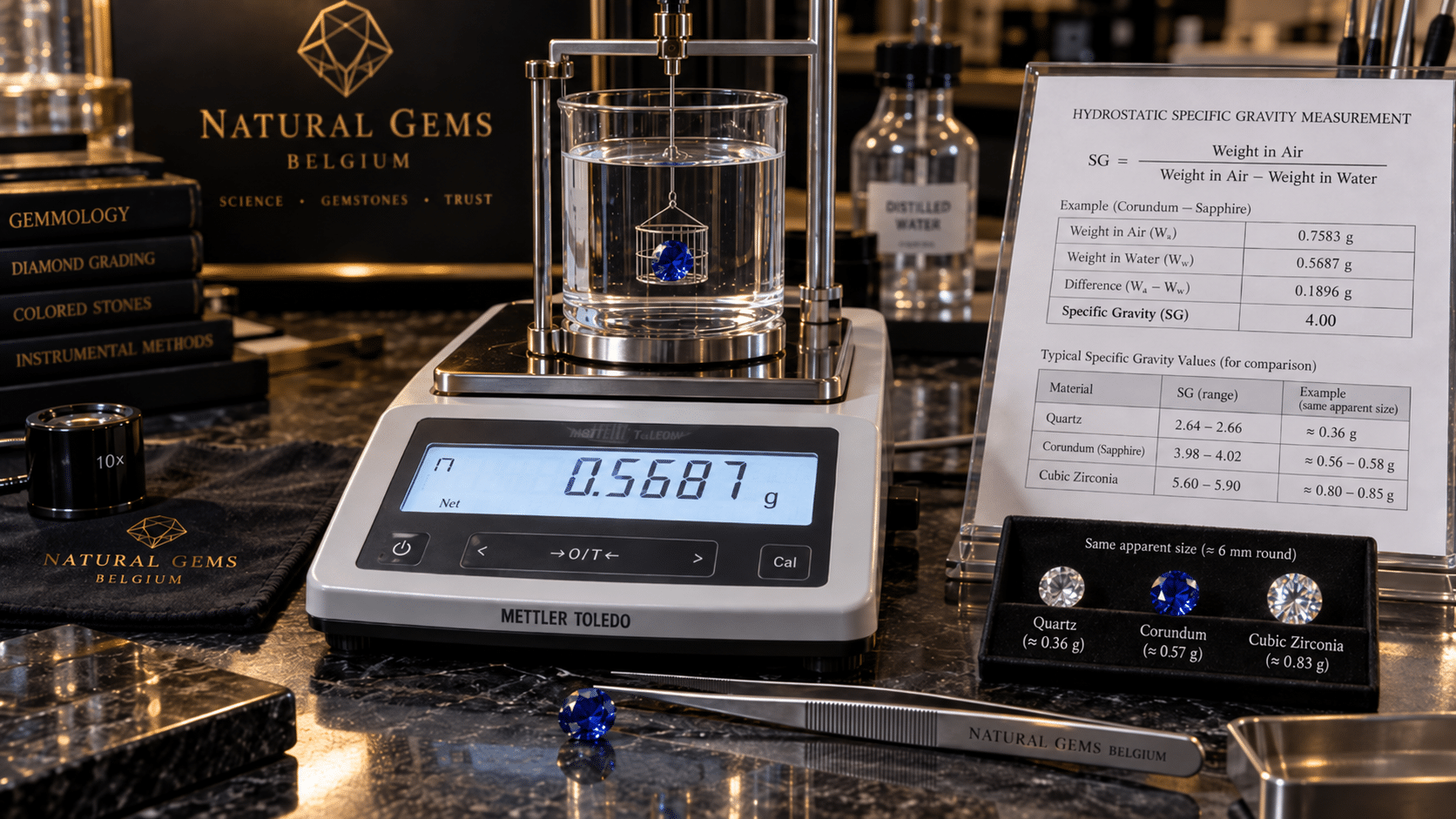
SG = Weight in Air ÷ (Weight in Air − Weight in Water)
where:
Weight in Air = gemstone weight measured normally
and:
Weight in Water = apparent gemstone weight while completely suspended in water.
The denominator:
Weight in Air − Weight in Water
represents the buoyancy-related weight difference.
PART VII — A WORKED EXAMPLE
9. Unknown Gemstone A
Suppose our gemstone weighs:
4.00 ct in air
When suspended completely in water it produces an apparent weight of:
3.00 ct
Then:
SG = 4.00 ÷ (4.00 − 3.00)
Therefore:
SG = 4.00 ÷ 1.00
Result:
SG = 4.00
That result is highly interesting.
If the stone also has:
- RI compatible with corundum;
- appropriate birefringence;
- ruby or sapphire optical characteristics;
then SG provides another independent piece of evidence supporting:
corundum.
PART VIII — ANOTHER EXAMPLE
10. Unknown Gemstone B
Weight in air:
2.65 ct
Weight suspended in water:
1.65 ct
Calculation:
SG = 2.65 ÷ (2.65 − 1.65)
SG = 2.65 ÷ 1.00
Therefore:
SG = 2.65
That value is strongly compatible with:
quartz.
Does this prove quartz?
No.
Other materials can have similar specific gravities.
But if the RI, optical character, spectrum and microscopic evidence also support quartz, the identification becomes increasingly strong.
PART IX — EVIDENCE CONVERGENCE AGAIN
This returns us to the central principle from our Unknown Stone Workshops.
Suppose an unknown gemstone gives:
SG: 2.65
RI: approximately 1.544–1.553
Optical behaviour: doubly refractive, uniaxial
Microscopy: compatible with quartz
Now several independent observations point toward:
quartz.
That is much stronger than saying:
“SG 2.65, therefore quartz.”
PART X — WHY SG ALONE IS NOT AN IDENTITY
11. Overlapping Values
Different gem materials can possess similar specific gravities.
Diamond is approximately:
3.52
Topaz commonly lies around:
3.5–3.6
Some spinels lie around:
3.6
Certain garnets can occupy overlapping regions.
Therefore a specific gravity near 3.5 cannot automatically mean:
diamond.
Other properties must be tested.
PART XI — WHY SG WAS SO USEFUL WITH CZ
In our previous workshop we compared:
diamond
synthetic moissanite
and:
cubic zirconia.
Their approximate specific gravities are:
Synthetic moissanite: 3.22
Diamond: 3.52
Cubic zirconia: ~5.6–6.0
CZ is therefore dramatically denser.
If similarly proportioned stones have approximately the same dimensions, the CZ will generally weigh considerably more.
That difference can be highly informative.
PART XII — SIZE VERSUS CARAT WEIGHT
12. Carat Measures Mass, Not Size
This is a very common misunderstanding.
A carat is a unit of:
mass.
One metric carat equals:
0.200 grams.
It is not a unit of diameter.
Therefore:
1 ct diamond
and:
1 ct cubic zirconia
do not necessarily have the same dimensions.
Because CZ is denser, a 1 ct CZ generally occupies less volume than a 1 ct diamond.
Conversely, a CZ cut to the same dimensions and proportions as a 1 ct diamond will weigh substantially more than 1 ct.
PART XIII — WHY THIS MATTERS FOR GEMSTONE BUYERS
Two gemstones may both be described as:
10 × 8 mm oval
but one may weigh substantially more than the other.
That does not necessarily mean:
- one was weighed incorrectly;
- one is fake;
- one has unusual cutting.
Their materials may simply possess different densities.
Weight must always be interpreted alongside:
dimensions + material + cut proportions.
PART XIV — THE HYDROSTATIC BALANCE
13. Practical Equipment
A hydrostatic specific-gravity setup typically includes:
- a sufficiently precise balance;
- a support structure;
- a fine suspension wire or basket;
- a container of water;
- the loose gemstone.
The balance first measures the stone:
in air.
The stone is then suspended:
completely below the water surface
without resting on the container.
A second reading is taken.
PART XV — THE GEMSTONE MUST BE COMPLETELY SUBMERGED
If part of the stone remains above the water:
the measurement is invalid.
Why?
Because the displaced-water volume no longer represents the entire gemstone volume.
The stone must be:
fully immersed.
PART XVI — BUT IT MUST NOT TOUCH THE CONTAINER
If the gemstone rests against:
- the bottom;
- the side of the vessel;
- another solid support not accounted for by the setup;
the reading can be distorted.
The stone should be:
freely suspended.
PART XVII — AIR BUBBLES: THE SMALL ENEMY
14. A Bubble Can Change the Result
Imagine a tiny air bubble adhering to the gemstone.
The bubble adds apparent displaced volume without corresponding gemstone mass.
The hydrostatic reading changes.
The calculated SG may become artificially low.
For large gemstones the effect may be relatively small.
For very small gemstones it can become significant.
PART XVIII — CHECK FOR BUBBLES
Before recording the immersed weight:
- inspect the stone;
- inspect the basket;
- gently remove trapped bubbles;
- repeat the reading.
If successive measurements disagree noticeably:
investigate why.
Do not simply select the number you prefer.
PART XIX — SURFACE TENSION
15. The Suspension Wire Interacts with Water
Where the suspension system crosses the water surface, surface tension can affect the measurement.
This is one reason a hydrostatic setup should be:
- fine;
- stable;
- properly zeroed;
- consistently positioned.
Precision gemmology depends on controlling seemingly small physical effects.
PART XX — WATER TEMPERATURE
16. Water Is Not Perfectly Constant
The density of water changes slightly with temperature.
For routine gemmological measurements, the resulting correction may be small compared with other practical uncertainties.
For high-precision scientific work, however:
temperature matters.
This reminds us that specific gravity is fundamentally a physical measurement, not merely a gemstone lookup trick.
PART XXI — CLEAN THE GEMSTONE
Oil, grease and contamination can:
- trap air;
- interfere with wetting;
- affect suspension behaviour.
A gemstone intended for hydrostatic measurement should therefore be appropriately:
clean and dry before weighing in air
and clean when immersed.
PART XXII — SMALL STONES ARE HARDER
17. Error Becomes Proportionally Larger
Suppose a balance has a small measurement uncertainty.
For a large gemstone, that uncertainty represents only a small fraction of total weight.
For a tiny gemstone, the same uncertainty can represent a much larger percentage.
Therefore hydrostatic SG becomes increasingly difficult to measure accurately as gemstone size decreases.
PART XXIII — REPEAT THE MEASUREMENT
A good procedure is not:
measure once → accept result.
Instead:
measure
↓
repeat
↓
compare
If repeated values differ substantially, inspect:
- bubbles;
- suspension;
- balance stability;
- water movement;
- contact with vessel;
- weighing precision.
Reproducibility matters.
PART XXIV — POROUS GEM MATERIALS
18. A Major Limitation
Hydrostatic weighing assumes that the measured object behaves appropriately during immersion.
Porous materials complicate this.
Water may enter pores or cavities.
That changes the relationship between:
- apparent displaced volume;
- actual solid volume;
- measured immersed weight.
Materials such as certain:
- opals;
- turquoise;
- porous aggregates;
- organic gem materials
may therefore require particular caution.
PART XXV — WATER-SENSITIVE MATERIALS
Not every gem material should casually be immersed in water.
Some specimens may be:
- porous;
- fracture-filled;
- assembled;
- glued;
- dyed;
- unstable;
- otherwise sensitive.
The gemologist must understand the material before selecting the test.
The principle is:
a test should never create avoidable damage merely to obtain a measurement.
PART XXVI — MOUNTED GEMSTONES
19. Hydrostatic SG Works Best on Loose Stones
Imagine a ruby mounted in a gold ring.
If you hydrostatically weigh the entire ring, you are measuring the combined displacement and mass of:
- ruby;
- gold;
- solder;
- other stones;
- structural components.
That does not give the ruby’s SG.
Therefore conventional hydrostatic SG measurement is primarily appropriate for:
loose gemstones.
PART XXVII — COMPOSITE STONES
A doublet or triplet presents another problem.
Suppose an object contains:
- natural gemstone;
- glass;
- adhesive.
The measured SG represents the:
combined object.
It may not correspond exactly to any one component.
An unusual SG can therefore sometimes become a clue that:
something more complicated is happening.
But microscopy may be needed to reveal the construction.
PART XXVIII — INCLUSIONS CAN SHIFT SG
20. Gemstones Are Not Always Chemically Perfect
Natural gemstones can contain:
- mineral inclusions;
- fluid inclusions;
- cavities;
- fractures.
These may influence bulk density slightly.
Chemical composition itself can also vary within mineral groups and solid solutions.
Therefore gemmological reference values are frequently:
ranges
rather than infinitely precise constants.
PART XXIX — GARNET: A PERFECT EXAMPLE
21. “Garnet SG” Is Not One Number
Garnet is a mineral group containing multiple species and extensive solid solution.
Important gem garnets include:
- pyrope;
- almandine;
- spessartine;
- grossular;
- andradite.
Their chemical compositions differ.
So do their specific gravities.
22. Real GIA Examples
GIA examined a pink pyrope garnet with:
SG 3.77
and RI:
1.741.
Another study of blue-green pyrope-spessartine garnets found hydrostatic SG values around:
3.83–3.88.
A pyrope-spessartine colour-change garnet with significant grossular component produced:
SG 3.93–4.00.
This demonstrates an important principle:
chemical substitution can shift physical properties within a mineral group.
PART XXX — SPINEL AND GAHNOSPINEL
Another excellent example involves the spinel group.
Ordinary magnesium-aluminium spinel has a lower SG than zinc-rich gahnite.
As zinc substitutes into the structure, density can increase substantially.
GIA has documented gahnospinel whose properties fall between the relevant end members.
Therefore:
composition influences SG.
This is not measurement noise.
It can be mineral chemistry expressed as a physical property.
PART XXXI — CORUNDUM
23. Ruby and Sapphire
Ruby and sapphire are varieties of:
corundum.
Corundum has an SG close to:
4.00.
GIA’s examination of a rare Montana ruby, for example, produced a hydrostatic SG of:
4.00
alongside a chromium spectrum and microscopic observations.
A measured SG dramatically outside the expected corundum range would therefore require investigation.
PART XXXII — QUARTZ
Quartz provides another useful benchmark.
Its SG is approximately:
2.65.
GIA’s investigation of unusual trapiche quartz from Inner Mongolia reported:
hydrostatic SG approximately 2.65
together with an RI around:
1.54.
The combination of properties supported quartz identification.
Again:
one measurement supports another.
PART XXXIII — BERYL
The beryl family includes:
- emerald;
- aquamarine;
- morganite;
- heliodor;
- goshenite;
- red beryl.
Beryl commonly has an SG around the upper 2.6s to 2.8 region, depending on composition.
GIA’s classic investigation of red beryl from Utah measured:
SG 2.66–2.70.
This is dramatically lower than corundum.
A transparent red gemstone with SG around 2.68 therefore requires a very different hypothesis from one with SG around 4.00.
PART XXXIV — SG CAN REVEAL THE UNEXPECTED
Imagine a rare-looking gemstone arrives.
Its colour resembles one species.
Its refractive index suggests another.
Its SG suggests something else.
This contradiction is not an inconvenience.
It is:
information.
A contradiction tells the gemologist:
your current hypothesis is incomplete or wrong.
That is when investigation becomes interesting.
PART XXXV — NEVER “CORRECT” THE DATA TO FIT THE STONE
Suppose you expect ruby.
You measure:
SG 3.02.
Do not say:
“The measurement must be wrong because this looks like ruby.”
Instead ask:
Was my measurement technically valid?
If yes:
Why is the stone not behaving like corundum?
That distinction separates testing from confirmation bias.
PART XXXVI — THE THREE-RESULT RULE
When practical, perform the hydrostatic measurement several times.
For example:
Measurement 1: 3.99
Measurement 2: 4.01
Measurement 3: 4.00
These are mutually consistent.
A reasonable working value is:
approximately 4.00.
Now consider:
3.61
3.94
4.18
That spread is unacceptable for a routine identification conclusion.
Something is wrong.
Investigate before proceeding.
PART XXXVII — PRECISION VERSUS ACCURACY
24. They Are Not the Same
Precision describes how closely repeated measurements agree.
Accuracy describes how close the result is to the true value.
A badly calibrated system might repeatedly give:
3.80, 3.80, 3.81
for a specimen whose true SG is 4.00.
That is:
precise but inaccurate.
Professional measurement requires both.
PART XXXVIII — CALIBRATION
A gemmological balance should be:
- appropriately calibrated;
- sufficiently precise;
- placed on a stable surface;
- protected from vibration and drafts where necessary.
A hydrostatic apparatus adds additional variables.
Measurement quality begins before the gemstone enters the water.
PART XXXIX — WHY MODERN LABORATORIES CAN CALCULATE SG DIFFERENTLY
Hydrostatic weighing is not the only possible approach.
Modern gem laboratories can obtain highly accurate dimensional data from optical measurement systems.
If the gemstone’s volume can be calculated accurately from its geometry and its mass is known, density—and therefore SG—can be derived.
GIA describes using non-contact optical measurement for loose faceted gemstones and calculating volume from the measured geometry.
When this approach is unsuitable, gemologists can turn to:
hydrostatic measurement.
This is a useful example of classical gemmological physics remaining relevant inside a modern analytical laboratory.
PART XL — A MODERN GIA WORKFLOW
GIA describes its coloured-stone laboratory process as beginning with accurate:
- weight;
- dimensions;
- optical measurement.
For loose faceted stones, non-contact measurement can provide detailed geometry.
Specific gravity can then be calculated from volume.
When that is not possible, hydrostatic measurement may be used.
The resulting physical data then become part of a larger identification process involving additional analytical methods as necessary.
Specific gravity therefore remains:
one component of professional laboratory evidence.
PART XLI — SG DOES NOT DETERMINE NATURAL VERSUS SYNTHETIC
This is particularly important after our recent Learning Center articles.
Natural ruby is corundum.
Synthetic ruby is also corundum.
Their bulk densities can be essentially similar.
Therefore SG may establish:
corundum
without establishing:
natural corundum.
The same principle applies to diamond.
Natural diamond and laboratory-grown diamond are both diamond.
An SG near 3.52 cannot by itself determine:
natural versus laboratory-grown.
PART XLII — SG DOES NOT DETERMINE TREATMENT
Suppose a sapphire measures approximately:
SG 4.00.
Can we conclude:
unheated?
No.
A heated natural sapphire remains corundum.
Its fundamental density does not suddenly become a unique “heated sapphire SG.”
Treatment investigation requires other evidence.
Again:
identity
≠
growth origin
≠
treatment status.
PART XLIII — SG AND IMITATIONS
Where specific gravity can become particularly powerful is when the imitation is made from:
a different material.
For example:
ruby vs glass
diamond vs cubic zirconia
quartz vs certain imitations
If their density ranges differ sufficiently, SG can rapidly eliminate possibilities.
PART XLIV — A REAL GLASS EXAMPLE
GIA examined bluish-green artificial glass manufactured to resemble valuable copper-bearing tourmaline crystals.
The samples even contained reflective brownish metallic inclusions that contributed to their convincing appearance.
Standard testing produced:
RI 1.50
and:
SG 2.43.
Those physical properties were inconsistent with the identity suggested by appearance.
The stones were:
artificial glass.
Visual sophistication could not override physical measurement.
PART XLV — AN IDENTIFICATION TABLE
Approximate reference values can be useful:
| Material | Approximate SG |
|---|---|
| Amber | ~1.05–1.10 |
| Opal | ~2.15 |
| Quartz | ~2.65 |
| Beryl | ~2.7 |
| Feldspar | ~2.55–2.75 |
| Tourmaline | ~3.0–3.2 |
| Synthetic moissanite | ~3.22 |
| Diamond | ~3.52 |
| Spinel | ~3.58–3.61 |
| Topaz | ~3.5–3.6 |
| Corundum | ~4.00 |
| Cubic zirconia | ~5.6–6.0 |
These are identification guides.
They are not substitutes for:
actual measurement + appropriate reference ranges + other gemmological tests.
PART XLVI — UNKNOWN STONE EXERCISE 1
A colourless faceted stone has:
SG 5.82
The seller claims:
diamond.
What can you conclude?
The SG is dramatically inconsistent with diamond’s approximately:
3.52.
Cubic zirconia becomes a strong possibility.
But continue testing.
Do not identify solely from SG.
PART XLVII — UNKNOWN STONE EXERCISE 2
A transparent red gemstone has:
SG 4.00
Does that prove ruby?
No.
It is compatible with:
corundum.
Now examine:
- RI;
- optical character;
- spectrum;
- pleochroism;
- microscopy.
If these converge on chromium-bearing corundum:
ruby becomes supported.
Then investigate:
natural/synthetic
and:
treatment.
PART XLVIII — UNKNOWN STONE EXERCISE 3
A transparent colourless gemstone has:
SG 3.52.
Is it natural diamond?
Absolutely not from SG alone.
At most, SG is compatible with diamond.
Material identity must be established.
And if it is diamond:
natural versus laboratory-grown remains a separate investigation.
PART XLIX — UNKNOWN STONE EXERCISE 4
A transparent red gemstone submitted as ruby gives:
SG 2.67
What should happen?
Do not force the ruby hypothesis.
A value near 2.67 is fundamentally inconsistent with normal corundum.
Consider other possibilities.
Measure RI.
Determine optical behaviour.
Investigate the material.
The discrepancy is your clue.
PART L — UNKNOWN STONE EXERCISE 5
A green gemstone gives:
SG 3.77
and properties compatible with garnet.
Can SG tell you the exact garnet species?
Not necessarily.
Garnets form compositional series.
Combine SG with:
- RI;
- spectrum;
- colour;
- chemistry where required.
The material may occupy a compositional position rather than behaving like a perfectly pure end member.
PART LI — WHY GEMSTONE REFERENCE TABLES USE RANGES
Natural minerals are not always chemically uniform.
Elements substitute within crystal structures.
Inclusions occur.
Structural state varies.
Different species form solid solutions.
Therefore a reference table might list:
3.58–3.61
rather than:
3.595000 exactly.
Gemology deals with natural materials.
Variation is scientifically meaningful.
PART LII — THE ERROR CHECKLIST
Before trusting a hydrostatic SG measurement, ask:
Is the balance calibrated?
Is the gemstone loose?
Is it completely submerged?
Is it touching the vessel?
Are air bubbles attached?
Is the suspension system stable?
Is the water moving?
Is the stone porous?
Could water enter cavities?
Is the specimen assembled or filled?
Is the stone large enough for the available balance precision?
Can I reproduce the measurement?
If not:
do not overinterpret the number.
PART LIII — WHEN NOT TO USE HYDROSTATIC SG
Avoid or reconsider hydrostatic measurement when:
- the gemstone is mounted;
- immersion could damage it;
- the specimen is highly porous;
- the stone contains unstable assembly adhesives;
- water could penetrate significant cavities;
- the stone is too small for reliable measurement;
- another method provides safer or better information.
The correct test is not always:
the test you happen to own.
PART LIV — SPECIFIC GRAVITY AS A SCREENING TOOL
SG is particularly valuable when it can rapidly answer:
Is the proposed identity physically plausible?
Example:
Claim:
ruby
Measured SG:
~4.00
Plausible.
Claim:
ruby
Measured SG:
~2.43
Not plausible for corundum.
That distinction can save considerable time.
PART LV — SPECIFIC GRAVITY AS CONFIRMATORY EVIDENCE
SG becomes even more powerful when combined with RI.
Suppose:
RI ~1.54–1.55
and:
SG ~2.65
Both support:
quartz.
Or:
RI ~1.76–1.77
and:
SG ~4.00
Both support:
corundum.
The more independent properties converge, the stronger the identification.
PART LVI — SPECIFIC GRAVITY AS CONTRADICTORY EVIDENCE
Contradictory data are equally valuable.
Suppose:
RI suggests one material
but:
SG strongly contradicts it.
Possible explanations include:
- measurement error;
- unusual composition;
- composite construction;
- wrong initial hypothesis;
- unusual or rare material.
The next step is not to ignore one measurement.
It is to:
investigate the contradiction.
PART LVII — THE GEMMOLOGIST’S NOTEBOOK
A professional record might read:
Weight in air: 4.018 ct
Weight in water: 3.014 ct
Calculated SG: 4.00
Repeat measurements: consistent
RI: 1.762–1.770
Optical character: uniaxial negative
Dichroism: observed
Working identity: corundum
Notice the language:
working identity.
Microscopy may still be needed for:
- natural/synthetic determination;
- treatment evidence.
PART LVIII — OBSERVATION VERSUS CONCLUSION
Bad note:
“SG proves ruby.”
Better:
“Hydrostatic SG approximately 4.00, consistent with corundum.”
That difference matters.
The first statement exceeds the evidence.
The second states exactly what the measurement supports.
This is scientific discipline expressed through language.
PART LIX — WHY SG REMAINS BEAUTIFUL GEMMOLOGY
Specific gravity is conceptually elegant because it requires no knowledge of:
- gemstone colour;
- market value;
- country of origin;
- seller’s description.
The stone interacts with:
gravity
and:
water.
From two measurements we obtain information about a fundamental physical property of the material.
The principle is centuries old.
Its application remains relevant in modern gem laboratories.
PART LX — FROM ARCHIMEDES TO MODERN GEM LABS
The physical principle behind hydrostatic weighing reaches back to classical science.
Modern laboratories now add:
- precision electronic balances;
- non-contact optical measurement;
- digital volume calculation;
- Raman spectroscopy;
- FTIR;
- photoluminescence;
- trace-element chemistry.
Yet the underlying question remains beautifully simple:
How much material is contained in this volume?
That question can eliminate an incorrect gemstone identity before the most sophisticated instrument is even switched on.
PART LXI — THE NGB SPECIFIC-GRAVITY WORKFLOW
For a suitable loose gemstone:
INSPECT THE SPECIMEN
↓
Is hydrostatic measurement safe and appropriate?
↓
CLEAN THE GEMSTONE
↓
CALIBRATE / ZERO THE BALANCE
↓
WEIGH IN AIR
↓
Record value
↓
SUSPEND COMPLETELY IN WATER
↓
Check for bubbles and contact
↓
RECORD IMMERSED WEIGHT
↓
CALCULATE
SG = Wair ÷ (Wair − Wwater)
↓
REPEAT
↓
Are results reproducible?
↓
COMPARE WITH REFERENCE DATA
↓
COMBINE WITH RI + OPTICAL TESTS + MICROSCOPY
↓
DRAW ONLY THE CONCLUSION THE EVIDENCE SUPPORTS
PART LXII — THE CENTRAL LESSON
Specific gravity is not a gemstone-name machine.
It is a:
physical constraint.
A gemstone cannot simply choose to possess the density of another mineral because its colour resembles it.
Glass can be coloured like ruby.
CZ can be cut like diamond.
Synthetic material can resemble natural material.
But physical properties place limits on what the object can actually be.
That makes SG powerful.
Conclusion
A gemstone’s beauty is immediately visible.
Its density is not.
Yet density can reveal information that colour cannot.
Two stones may have:
- the same colour;
- the same shape;
- the same diameter;
- similar brilliance;
and still contain dramatically different amounts of mass.
That difference originates in:
chemistry + crystal structure + atomic packing.
Specific gravity translates that invisible structural difference into a measurable gemmological property.
Using hydrostatic weighing, the gemologist records:
weight in air
and:
apparent weight in water.
Archimedes’ principle allows the displaced-water relationship to reveal the gemstone’s specific gravity.
The calculation is straightforward:
SG = Weight in Air ÷ (Weight in Air − Weight in Water)
But obtaining a reliable result requires discipline.
The gemstone must be appropriately suited to immersion.
It must be fully submerged.
It must not touch the vessel.
Air bubbles must be removed.
The balance must be sufficiently precise.
Measurements should be repeated.
Porous, mounted, composite and water-sensitive materials require caution.
And even a technically perfect SG measurement should not normally be interpreted alone.
An SG of approximately:
2.65
supports quartz.
It does not automatically prove quartz.
An SG around:
4.00
supports corundum.
It does not automatically prove ruby.
An SG around:
3.52
is compatible with diamond.
It certainly does not establish:
natural diamond.
This is why professional gemmology works through:
evidence convergence.
Specific gravity may support refractive index.
Refractive index may support optical character.
Spectroscopy may support composition.
Microscopy may reveal growth history.
Advanced laboratory methods may establish origin or treatment.
Each observation contributes something different.
Specific gravity is particularly powerful when the result:
contradicts expectation.
A stone submitted as ruby but measuring SG 3.02 demands investigation.
A supposed diamond with SG near 5.8 demands investigation.
A gemstone whose RI and SG disagree demands investigation.
The contradiction is not a failed test.
It is:
a scientific clue.
And that may be the most important lesson.
Gemologists do not measure gemstones in order to confirm what they hoped the stone would be.
They measure them to discover:
what the stone actually allows the evidence to say.
References & Further Reading
Ahline, N. J. & Rizzo, J. — “Analysis of Gemstones at GIA Laboratories.” Gems & Gemology, Winter 2024.
An important modern overview of the gemstone-analysis workflow at GIA laboratories. It explains how gemstones are weighed and measured and how physical-property measurements are integrated with increasingly advanced analytical methods.
https://www.gia.edu/gems-gemology/winter-2024-gemstone-analysis
Gem-A Instruments — “Specific Gravity Kit.”
Professional hydrostatic specific-gravity equipment designed for use with precision balances and loose gemstones. Useful for visualising the practical arrangement of a contemporary hydrostatic SG setup.
https://shop.gem-a.com/product/specific-gravity-kit/
Malaquias, C. — “A Rare Ruby from Montana.” Gems & Gemology, Winter 2018.
A GIA laboratory example in which a 1.70 ct ruby produced a hydrostatic specific gravity of 4.00. The case demonstrates how SG, spectroscopy and microscopic observations combine in corundum identification.
https://origin.prod.gia.edu/gems-gemology/winter-2018-labnotes-rare-ruby-from-montana
Wang, X. & Song, Y. — “A Special Type of Trapiche Quartz.” Gems & Gemology, Summer 2019.
The investigated quartz produced a spot refractive index of 1.54 and a hydrostatic specific gravity of approximately 2.65, providing a useful real-world example of RI and SG supporting the same identification.
https://www.gia.edu/gems-gemology/summer-2019-gemnews-special-type-of-trapiche-quartz
Ahline, N. — “Pink Pyrope Garnet.” Gems & Gemology, Spring 2023.
GIA examination of a 7.26 ct pink pyrope garnet with RI 1.741 and hydrostatic SG 3.77. Particularly useful for understanding how physical properties contribute to classification within the chemically variable garnet group.
https://archive.gia.edu/gems-gemology/spring-2023-lab-notes-pink-pyrope-garnet
Sun, Z., Muyal, J. & Palke, A. C. — “Pyrope-Spessartine Color-Change Garnet with a High Grossular Component.” Gems & Gemology, Spring 2017.
The investigated garnets showed RI values of 1.76–1.77 and hydrostatic SG values of 3.93–4.00. The study demonstrates how solid-solution chemistry can move garnet properties substantially across conventional reference ranges.
https://www.gia.edu/gems-gemology/spring-2017-gemnews-pyrope-high-grossular-component0
Sun, Z., Renfro, N. D. & Palke, A. C. — “Blue-Green Pyrope-Spessartine Garnet with High Vanadium.” Gems & Gemology, Fall 2017.
A detailed study of unusual blue-green garnet. The material provides another useful example of compositional variation within garnet and illustrates why SG must be interpreted together with RI, spectroscopy and chemical analysis.
https://www.gia.edu/gems-gemology/fall-2017-gemnews-blue-green-pyrope-spessartine
Rizzo, J. — “Large Faceted Gahnospinel.” Gems & Gemology, Spring 2019.
An especially instructive example of how mineral chemistry influences physical properties. Increasing zinc substitution within the spinel–gahnite solid-solution system raises both refractive index and specific gravity, so intermediate gahnospinel can differ significantly from ordinary magnesium-rich spinel.
https://www.gia.edu/gems-gemology/spring-2019-labnotes-large-faceted-gahnospinel
Shigley, J. E. & Foord, E. E. — “Gem-Quality Red Beryl from the Wah Wah Mountains, Utah.” Gems & Gemology, Winter 1984.
Classic mineralogical investigation of Utah red beryl. The study reports RI values of 1.564–1.574 and SG values of approximately 2.66–2.70, providing an excellent physical-property comparison with visually similar red gem materials such as corundum.
https://www.gia.edu/gems-gemology/winter-1984-beryl-utah-shigley
Robb, C. — “Cat’s-Eye Hexagonite.” Gems & Gemology, Summer 2024.
A particularly useful identification case. A purplish-pink chatoyant stone submitted as ruby produced a spot RI of 1.63 and hydrostatic SG of 3.02, both inconsistent with corundum. Raman spectroscopy subsequently confirmed tremolite/hexagonite.
https://www.gia.edu/gems-gemology/summer-2024-lab-notes-cats-eye-hexagonite
Cooper, A., Price, J. & Breitzmann, H. — “Artificial Glass Imitating a Paraíba Tourmaline.” Gems & Gemology, Winter 2020.
GIA examined convincing bluish-green artificial glass imitations containing reflective metallic inclusions. Standard testing produced RI 1.50 and hydrostatic SG 2.43, demonstrating how measured physical properties can contradict a convincing visual imitation.
https://www.gia.edu/gems-gemology/winter-2020-labnotes-glass-imitating-tourmaline
Jaisanit, N. — “A Remarkable 16.71 ct Transparent Orange-Yellow Sodalite.” Gems & Gemology, Winter 2023.
A modern example of systematic gemstone identification. Standard testing produced RI 1.484 and hydrostatic SG 2.28, followed by UV observations, microscopy, Raman spectroscopy and chemical analysis confirming sodalite.
https://www.gia.edu/gems-gemology/winter-2023-lab-notes-remarkable-sodalite
Gem-A Instruments — “Weight Estimation and Measurement.”
Gem-A’s instrument reference emphasises the relationship between gemstone density and identification and provides professional balances, gauges and hydrostatic equipment used in practical gemmology.
https://shop.gem-a.com/product-category/gemmological-instruments/catalogue/