Few gemstones demonstrate the complicated relationship between history, mythology and modern crystal belief as clearly as amethyst.
Today, amethyst is commonly associated with calmness, meditation, spiritual awareness, intuition and protection. In crystal traditions it is frequently connected with the Third Eye and Crown Chakras.
But long before these modern associations developed, purple amethyst already occupied a fascinating place within the Mediterranean world.
For the ancient Greeks and Romans, one association became particularly enduring:
wine and intoxication.
Even the gemstone’s name is connected with this idea.
Yet the history contains an important surprise.
The beautiful story frequently repeated today about the god Dionysus transforming a maiden named Amethyst into crystal is not an ancient Greek myth.
It appeared many centuries later.
The genuine ancient tradition is both more complicated and more interesting.
Understanding it allows us to separate documented history from later folklore while preserving the extraordinary cultural story surrounding one of the world’s most recognisable gemstones.
Table of Contents
What Is Amethyst?
Before exploring belief, it is useful to understand the stone itself.
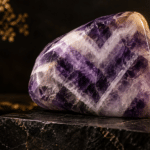
Amethyst is the purple variety of quartz.
Its chemical composition is:
SiO₂ — silicon dioxide
The Gemological Institute of America identifies amethyst as the most valued gem variety of quartz. Its colour can range from delicate lilac through reddish purple to intensely saturated deep purple.
Natural crystals may also display pronounced colour zoning.
Research into amethyst colour shows that iron-related colour centres combined with natural irradiation are responsible for its characteristic purple appearance.
This geological explanation is entirely separate from the meanings humans subsequently attached to the stone.
Nature created the crystal.
People created its symbolism.
And in the ancient Mediterranean world, its purple colour became connected with one of humanity’s oldest intoxicating substances:
wine.
What Does the Word Amethyst Mean?
The name provides our first clue to its ancient reputation.
The English word amethyst ultimately derives from the Greek amethystos.
It is traditionally interpreted through:
a- — “not”
and
methyein / methyo — relating to drunkenness or intoxication.
The resulting sense is approximately:
“not intoxicated” or “not drunken.”
The Gemological Institute of America notes this ancient Greek etymology and the historical belief that amethyst could prevent intoxication.
This does not demonstrate that the gemstone actually prevents drunkenness.
It demonstrates that the association between amethyst and sobriety is genuinely ancient.
That distinction is essential.
Amethyst and Wine in the Ancient Greek World
Wine occupied a complex position in Greek society.
It was not simply an alcoholic beverage.
Wine could be connected with agriculture, hospitality, social identity, religious ritual and communal drinking.
The symposium — a structured drinking gathering among elite men — became an important social institution in many parts of the Greek world.
Wine was normally mixed with water rather than consumed undiluted, and the symposium operated according to conventions concerning drinking, conversation, entertainment and social conduct.
Against this background, a gemstone whose very name evoked freedom from intoxication acquired an obvious cultural resonance.
Ancient literary traditions associated amethyst with the possibility of maintaining sobriety or resisting drunkenness.
Whether individuals genuinely expected the mineral to neutralise alcohol cannot always be established.
What can be established is that the association existed.
Dionysus: God of Wine and Altered States
The Greek god most obviously connected with this world was Dionysus, known to the Romans as Bacchus.
Dionysus was associated with wine and viticulture, but reducing him simply to a “god of drinking” misses much of his religious significance.
His sphere could encompass:
- wine
- vegetation
- fertility
- theatre
- ecstatic religious experience
- altered states
- celebration
- transformation
Dionysian religion explored boundaries between order and ecstasy, restraint and release, ordinary identity and altered experience.
Because amethyst became culturally connected with resisting intoxication, it eventually entered a symbolic world that could easily be placed alongside Dionysus.
But this is where historical caution becomes especially important.
The Famous Dionysus and Amethyst Story
A story repeated across modern gemstone books, crystal websites and jewellery descriptions tells of a beautiful maiden named Amethyst or Amethystos.
There are several versions.
In a familiar retelling, Dionysus becomes angry and vows revenge upon the next mortal he encounters.
A young maiden named Amethyst crosses his path.
When danger approaches, she appeals to the goddess Artemis, who transforms her into colourless quartz.
Dionysus, overcome with remorse, pours wine over the crystal.
The quartz becomes purple.
And thus, according to the story, amethyst is created.
It sounds exactly like a classical Greek myth.
There is one major problem:
the story is not found in surviving ancient Greek mythology.
A Renaissance-Era Myth Mistaken for Antiquity
The familiar transformation story appears to derive from the French Renaissance poet Rémy Belleau (1528–1577).
Belleau included the story in his poetic treatment of gemstones, transforming existing associations between amethyst, wine and Bacchus into a new mythological narrative.
Over time, the distinction between a Renaissance poem inspired by classical mythology and an actual ancient Greek myth became blurred.
The story was repeatedly retold.
Eventually it began appearing as though it were an authentic myth inherited directly from ancient Greece.
This is an excellent example of how gemstone folklore evolves.
A genuine ancient association existed:
amethyst → sobriety → wine
Later literature elaborated that association into a compelling story involving:
Amethyst → Dionysus → transformation → wine → purple quartz
The later story is culturally interesting.
But it should not be presented as archaeological evidence for ancient Greek belief.
The Ancient Tradition Was Real—Just Different
Correcting the later myth does not mean that the relationship between amethyst and wine was invented during the Renaissance.
The underlying association is genuinely old.
GIA records the traditional Greek belief that amethyst protected its wearer against drunkenness.
Ancient and Roman-era authors also preserve traditions concerning supposed protective properties of gemstones.
Pliny the Elder, writing in the first century CE, discussed amethyst in his Natural History.
Significantly, Pliny was capable of considerable scepticism toward magical gemstone claims.
When discussing amethyst, he reports claims that it could prevent intoxication but attributes such ideas to magical belief rather than presenting them uncritically as demonstrated fact.
That makes his account particularly valuable.
It shows not only that the belief existed, but that ancient people themselves could disagree about whether such claims were credible.
Scepticism about crystal powers is therefore not exclusively modern.
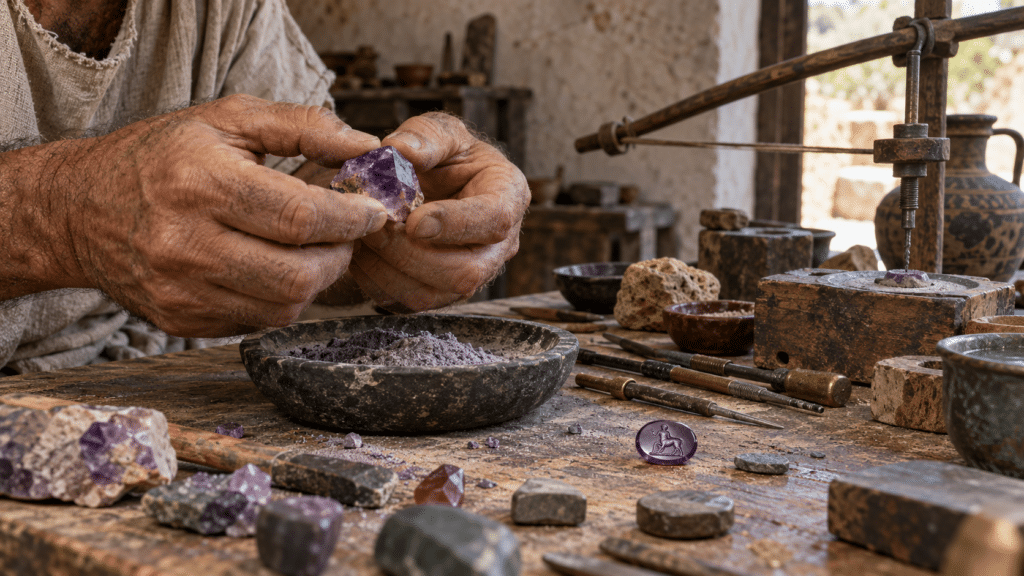
Amethyst as an Engraved Gem
Gemstones in the Greek and Roman worlds were not valued only for colour.
They could also become miniature works of art.
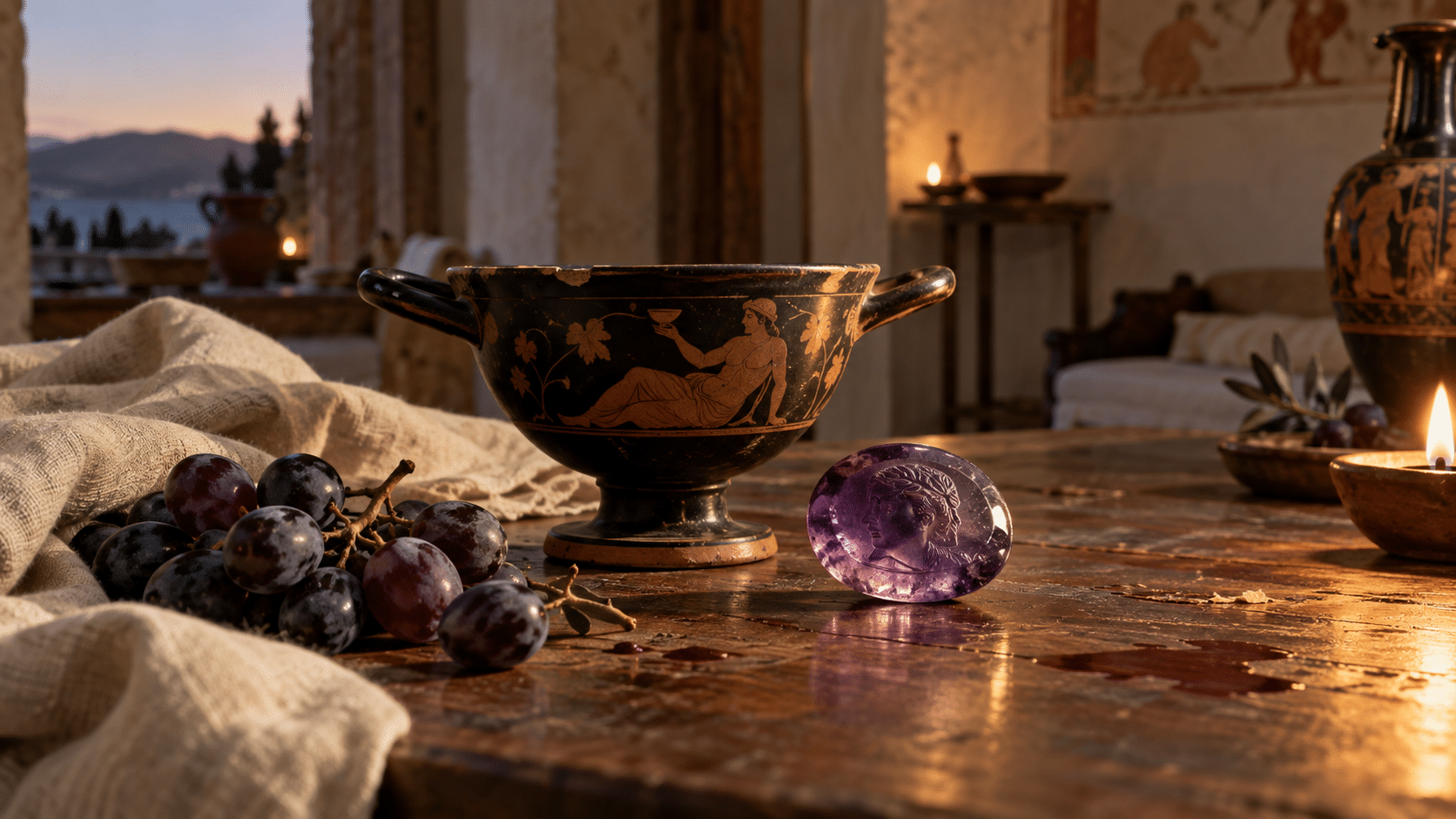
Intaglio engraving involved carving an image into the surface of a gemstone or similar material.
When pressed into wax or clay, the recessed image produced a raised impression.
Engraved gems could therefore function simultaneously as:
- jewellery
- seals
- personal identifiers
- artistic objects
- status objects
- images of gods or mythological figures
The British Museum preserves an extraordinary amethyst seal from Bronze Age Crete, dating to approximately 1700–1450 BCE.
The lentoid-shaped amethyst is engraved with a goat.
This object considerably predates Classical Greece and demonstrates that amethyst was already being worked as an engraved material in the Aegean Bronze Age.
Its existence should not automatically be interpreted as evidence of a specific spiritual property.
It is evidence of something more fundamental:
people in the ancient Aegean valued amethyst enough to shape and engrave it.
When Imitation Reveals Value
An especially fascinating body of evidence comes from ancient glass imitations of amethyst.
The British Museum holds numerous Hellenistic and Roman glass-paste intaglios deliberately produced to resemble amethyst.
Their imagery includes figures such as:
- Eros
- Athena
- Artemis
- Orpheus
- Fortuna
- Victory
- Galene, the personification of calm seas
One Roman Imperial example depicts Eros gathering grapes from a vine.
These objects should not be confused with natural amethyst.
But their existence is revealing.
Ancient craftspeople considered the visual appearance of amethyst sufficiently desirable to reproduce it in glass.
As with ancient imitations of other precious stones, imitation provides indirect evidence of cultural and aesthetic value.
Was Amethyst Actually Used to Prevent Drunkenness?
There is no scientific evidence that wearing, holding or drinking from amethyst can prevent alcohol intoxication.
Alcohol affects the body through biochemical processes.
Quartz does not neutralise ethanol simply through contact or proximity.
The ancient belief should therefore be treated as historical belief, not medical advice.
This distinction allows us to discuss the tradition without ridiculing it or falsely validating it.
Ancient people interpreted natural materials through the intellectual and religious frameworks available to them.
Gemstones could acquire meaning through colour, rarity, language, mythology, astrology and perceived correspondences with human experience.
Amethyst’s name and wine-like colour made it especially suitable for associations with intoxication and restraint.
The Symbolism of Sobriety
The ancient association becomes more interesting when interpreted symbolically rather than medically.
Intoxication represents a loss of ordinary control.
Sobriety represents its preservation.
Amethyst therefore became connected with a boundary between:
indulgence and restraint
ecstasy and control
altered consciousness and clarity
wine and sobriety
These oppositions fit remarkably well into the cultural world surrounding Dionysus.
The stone could symbolically represent not the rejection of wine, but the idea of remaining oneself while encountering something capable of altering consciousness.
That is a far more nuanced interpretation than simply calling amethyst an ancient “hangover cure.”
From Sobriety to Spiritual Clarity
Modern crystal traditions have substantially expanded the symbolism of amethyst.
Today the stone is commonly associated with:
- mental clarity
- calm
- meditation
- intuition
- spiritual awareness
- protection
- the Third Eye Chakra
- the Crown Chakra
These concepts should not all be projected backwards into ancient Greece.
The modern chakra associations in particular belong to a much later synthesis between South Asian concepts and Western crystal spirituality.
Ancient Greeks did not describe amethyst as a Crown Chakra stone.
Nevertheless, there is an interesting conceptual continuity.
The ancient theme of remaining clear-minded despite intoxication and the modern theme of mental or spiritual clarity are not identical beliefs, but they share a recognisable symbolic direction.
This may partly explain why amethyst adapted so easily to later spiritual traditions.
Amethyst in Later Religious Tradition
Amethyst continued to accumulate meanings after antiquity.
It became particularly prominent within Christian ecclesiastical jewellery.
Purple itself acquired strong liturgical associations, while amethyst rings became associated with bishops.
GIA notes the long use of fine amethyst in religious jewellery and records its association with ecclesiastical and royal regalia.
This later Christian history deserves its own detailed study because its symbolism should not simply be merged with Greek belief.
Gemstones rarely possess one fixed meaning across history.
Their symbolism changes as they move between cultures.
Amethyst demonstrates this particularly well.
Ancient Belief and Modern Crystal Healing
Modern descriptions sometimes state that amethyst:
- eliminates anxiety
- cures insomnia
- detoxifies the body
- prevents addiction
- balances hormones
- protects against electromagnetic radiation
- activates chakras
- raises spiritual vibration
These claims require careful separation.
There is currently no established scientific evidence demonstrating that amethyst itself produces these medical or physiological effects.
Its ancient reputation for preventing intoxication likewise does not provide scientific evidence for modern addiction treatment.
Historical belief is evidence that people believed something.
It is not evidence that the belief is biologically correct.
That distinction becomes particularly important when claims concern health.
A gemstone should never replace appropriate medical or psychological care.
Amethyst as a Modern Meditation Object
None of this prevents amethyst from being incorporated meaningfully into meditation or personal spiritual practice.
A physical object can function as:
- a focus for attention
- a reminder of an intention
- a symbol
- a ritual object
- a tactile anchor
- a connection with history
Meditation itself has been studied scientifically, although results vary according to the technique, population and quality of the research.
The potential effects of meditation should not be confused with claims that a gemstone emits a healing force.
An amethyst can therefore be meaningful within a meditation practice without requiring an unproven physical mechanism.
A Historically Inspired Amethyst Meditation
A particularly appropriate modern meditation can be built around amethyst’s oldest documented symbolism:
clarity and restraint.
Place an amethyst in front of you or hold it comfortably.
Observe the colour.
Notice whether the purple is uniform or zoned.
Look at how the colour changes under different angles of light.
Then consider the history of its name.
For more than two thousand years, people have connected this purple stone with the idea of remaining clear-minded in circumstances where clarity might otherwise disappear.
Instead of asking the crystal to change your mind, ask yourself:
Where in my life would greater clarity be useful?
Then:
What tends to cloud my judgement?
And finally:
Which decision would I make differently if I approached it calmly rather than impulsively?
The stone does not supply the answer.
It provides a tangible symbol around which the question can be organised.
That is a responsible way to combine historical symbolism with contemporary reflective practice.
Why the False Myth Still Matters
Discovering that the famous Amethyst maiden story is not ancient may initially seem disappointing.
In reality, it makes the history more interesting.
The story demonstrates how traditions evolve.
Ancient Greeks created an association between amethyst and intoxication.
Greek and Roman culture connected wine with Dionysus or Bacchus.
Centuries later, a Renaissance poet transformed these existing ideas into a compelling origin story.
Later writers repeated it.
Modern gemstone culture inherited it.
Eventually the distinction between ancient tradition and later literary invention disappeared.
This process is not unique to amethyst.
Many supposed “ancient crystal beliefs” found online are combinations of genuine historical material, later folklore and very recent metaphysical ideas.
Separating these layers does not destroy crystal history.
It reveals it.
What Can We Responsibly Say About Ancient Amethyst Beliefs?
The evidence allows several reasonably strong conclusions.
Amethyst was known and worked in the ancient Mediterranean world.
Its Greek name was associated with the concept of not being intoxicated.
Ancient traditions connected the stone with protection from drunkenness.
Greek and Roman societies valued engraved gems, and amethyst could be used for such objects.
Materials imitating amethyst were also used for Hellenistic and Roman engraved gems.
The relationship between amethyst, wine and sobriety is genuinely ancient.
But the popular tale of Dionysus transforming a maiden named Amethyst into quartz is not securely attested in ancient Greek sources and should not be presented as an original Greek myth.
Likewise, modern chakra and crystal-healing systems should not be retrospectively attributed to ancient Greece.
These distinctions give us a historically richer understanding of the stone.
From Ancient Symposium to Modern Meditation
Few gemstones have travelled symbolically as far as amethyst.
In the ancient Mediterranean world, its name evoked sobriety.
Its colour recalled wine.
It could become an engraved seal or personal ornament.
Roman authors recorded claims concerning its supposed ability to resist intoxication.
Later religious traditions gave it new meanings.
Modern crystal spirituality transformed it again, associating purple amethyst with meditation, intuition and spiritual consciousness.
None of these meanings exists entirely outside history.
Each generation encountered the same natural material and interpreted it through its own worldview.
That may be one of the most fascinating aspects of gemstone spirituality.
The mineral remains.
The meanings change.
Conclusion
The story of amethyst in Ancient Greece and Rome is more fascinating than the familiar modern legend suggests.
Amethyst is scientifically a purple variety of quartz whose colour results from iron-related colour centres and natural irradiation.
Culturally, however, its history extends far beyond mineralogy.
Its ancient Greek name became associated with avoiding intoxication, creating a relationship between the purple gemstone, wine and sobriety that survived for centuries.
Archaeological objects demonstrate that amethyst was worked in the Aegean world from at least the Bronze Age, while later Greek and Roman gem engraving incorporated both natural stones and glass imitations resembling amethyst.
The famous story of Dionysus, the maiden Amethyst and wine turning colourless quartz purple belongs to a much later literary tradition rather than securely documented ancient Greek mythology.
That distinction matters.
At Natural Gems Belgium, we believe gemstone history becomes more compelling when its different layers are allowed to remain visible:
geology tells us what the stone is; archaeology tells us how people used it; historical texts tell us what people believed; later folklore shows how those beliefs evolved; and modern spirituality reveals how gemstones continue to acquire new meanings.
Amethyst does not need an invented ancient past to be spiritually fascinating.
For more than two millennia, its purple colour has invited human beings to think about wine, consciousness, restraint and clarity.
That genuine history is already extraordinary.
References & Further Reading
Gemmology & Mineralogy
Gemological Institute of America (GIA) — Amethyst
Authoritative gemmological overview of amethyst, including its identity as the purple variety of quartz, quality factors and the historical meaning of its name.
Gemological Institute of America (GIA) — Amethyst Description
Detailed introduction to the colour range, colour zoning and gemmological characteristics of natural amethyst.
https://www.gia.edu/amethyst-description
Gemological Institute of America (GIA) — Amethyst History and Lore
GIA’s overview of the historical association between amethyst, wine, sobriety, religious jewellery and later gemstone traditions.
https://www.gia.edu/amethyst-history-lore
GIA, Gems & Gemology — Amethyst from Boudi, Morocco
Technical gemmological study discussing natural amethyst formation, colour zoning and the iron-related colour centres combined with natural irradiation that produce its purple colour.
https://www.gia.edu/gems-gemology/spring-2015-amethyst-from-boudi-morocco
Archaeology & Ancient Material Culture
British Museum — Minoan Amethyst Sealstone, Crete
A genuine amethyst lentoid seal dating to approximately 1700–1450 BCE. The object is engraved with a goat and provides direct archaeological evidence for the working of amethyst in the Bronze Age Aegean.
https://www.britishmuseum.org/collection/object/G_1884-0628-5
British Museum — Hellenistic Intaglio Imitating Amethyst: Galene
A third-century BCE glass-paste intaglio deliberately imitating amethyst and engraved with Galene, the personification of calm at sea.
https://www.britishmuseum.org/collection/object/G_1923-0401-142
British Museum — Roman Intaglio Imitating Amethyst: Eros Gathering Grapes
Roman Imperial glass-paste gem imitating amethyst and depicting Eros gathering grapes from a vine. It provides particularly interesting material evidence linking amethyst-like colour, viticulture and classical imagery.
https://www.britishmuseum.org/collection/object/G_1923-0401-488
British Museum — Roman Intaglio Imitating Amethyst: Orpheus
Roman Imperial engraved glass-paste gem imitating amethyst and depicting Orpheus playing the lyre among animals.
https://www.britishmuseum.org/collection/object/G_1923-0401-716
British Museum — Roman Intaglio Imitating Amethyst: Athena
Roman Imperial glass-paste intaglio imitating amethyst, engraved with Athena wearing a helmet and accompanied by her shield.
https://www.britishmuseum.org/collection/object/G_1923-0401-404
Ancient Literature & Historical Gemstone Belief
Pliny the Elder — Natural History, Book XXXVII: Precious Stones
One of the most important surviving Roman literary sources on gemstones. Pliny discusses amethyst, its wine-like colour, its varieties and numerous magical gemstone beliefs while frequently expressing scepticism toward exaggerated claims.
Perseus Digital Library:
https://www.perseus.tufts.edu/hopper/text?doc=Perseus%3Atext%3A1999.02.0137%3Abook%3D37
Alternative Latin text through the University of Chicago’s LacusCurtius project:
https://penelope.uchicago.edu/Thayer/L/Roman/Texts/Pliny_the_Elder/37*.html
The Dionysus and Amethyst Legend: Historical Context
Liz Greene — “The God in the Stone: Gemstone Talismans in Western Magical Traditions” — Culture and Cosmos
Academic discussion of gemstone beliefs in Western magical traditions. Greene specifically addresses the popular story of Dionysus and the maiden Amethyste and traces the familiar narrative to the French Renaissance poet Rémy Belleau in 1576 rather than to surviving Greek, Roman or medieval sources.
https://www.cultureandcosmos.org/pdfs/19/19-1_greene_the_god_in_stone.pdf
The article provides an important caution for modern crystal-history writing: literature can create new gemstone myths that later become incorrectly presented as ancient traditions.
Modern Historical Overview
Gemological Institute of America — Amethyst History and Lore
Useful accessible overview documenting the longstanding relationship between amethyst, wine and the belief that the gemstone could help its wearer remain clear-headed or resist drunkenness.
https://www.gia.edu/amethyst-history-lore
GIA presents these ideas as historical lore rather than scientifically demonstrated effects.
Meditation & Scientific Wellness Context
U.S. National Center for Complementary and Integrative Health — Meditation and Mindfulness: Effectiveness and Safety
Evidence-based overview of meditation and mindfulness research, including potential benefits, limitations of the evidence and safety considerations.
https://www.nccih.nih.gov/health/meditation-and-mindfulness-effectiveness-and-safety
This source is useful for distinguishing scientifically investigated contemplative practices from claims that amethyst itself produces medical or psychological effects.