Table of Contents
Natural Does Not Mean Untreated—and Synthetic Does Not Mean Fake
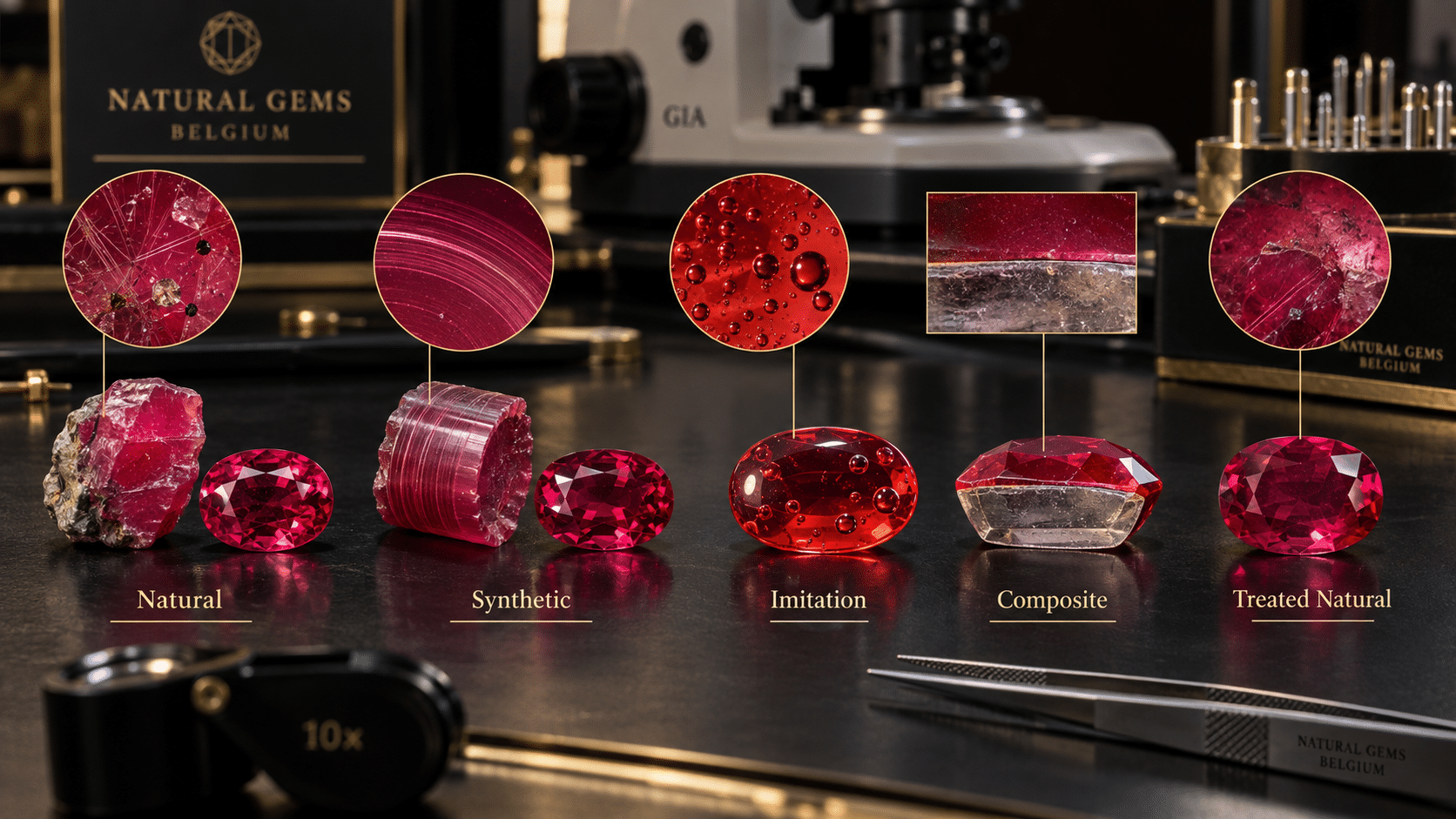
Place five beautiful red stones beside one another.
To the unaided eye, all five might look like ruby.
Yet they could be:
a natural untreated ruby
a natural heated ruby
a laboratory-grown synthetic ruby
a red glass imitation
or:
a composite stone containing ruby and another material.
Visually similar.
Gemmologically very different.
Few areas of gemstone terminology generate more confusion than the words:
- natural;
- synthetic;
- laboratory-grown;
- treated;
- imitation;
- simulated;
- composite.
The problem is not merely academic.
These words describe fundamentally different facts about a gemstone.
Confusing them can misrepresent:
- what the material is;
- how it formed;
- whether humans modified it;
- whether it is one material or several;
- and ultimately what a buyer is purchasing.
The most important principle is:
identity, origin, treatment and construction are separate questions.
Once those questions are separated, the terminology becomes much easier to understand.
PART I — FOUR QUESTIONS
1. What Is the Material?
The first question is:
What substance is this?
For example:
- corundum;
- beryl;
- quartz;
- diamond;
- spinel;
- glass;
- cubic zirconia.
This establishes:
gemological identity.
2. How Did It Form?
The second question is:
Was it created naturally by geological processes or grown artificially?
This establishes:
natural versus synthetic origin.
3. Has It Been Modified?
The third question is:
Has the material been treated after formation or growth?
Examples include:
- heating;
- irradiation;
- diffusion;
- fracture filling;
- dyeing;
- impregnation.
This establishes:
treatment status.
4. Is It One Material or an Assembly?
The fourth question is:
Is the object a single piece of material, or has it been assembled from multiple components?
This establishes whether it is:
a composite stone.
These four questions should never be collapsed into one.
PART II — NATURAL GEMSTONES
5. What Is a Natural Gemstone?
A natural gemstone is a gem material produced by:
natural geological processes.
Its formation was not deliberately caused by humans.
Natural gemstones can form through processes including:
- magmatic crystallisation;
- pegmatitic crystallisation;
- metamorphism;
- metasomatism;
- hydrothermal activity;
- sedimentary or near-surface processes;
- deep-mantle crystallisation.
This connects directly with our previous NGB article:
How Gemstones Form.
6. Natural Does Not Mean Untreated
This is perhaps the most important terminology rule in this entire article.
A gemstone can be:
natural AND treated.
For example:
natural heated sapphire
means:
the sapphire formed naturally within Earth, but humans subsequently subjected it to heat treatment.
The heating does not transform the sapphire into a synthetic sapphire.
Its origin remains:
natural.
Its treatment status becomes:
heated.
7. Natural Untreated
A natural untreated gemstone formed through natural geological processes and has not undergone a recognised artificial treatment intended to alter relevant properties.
Examples could include:
natural unheated sapphire
natural untreated spinel
natural untreated garnet
depending on the evidence available.
Again, two separate facts are being communicated:
Origin: natural
Treatment: untreated / no indications of treatment detected
Professional wording should reflect the level of evidence actually established.
PART III — SYNTHETIC GEMSTONES
8. What Is a Synthetic Gemstone?
A synthetic gemstone is produced artificially but has essentially the same:
- chemical composition;
- crystal structure;
- physical properties;
- optical properties
as the natural gemstone whose name it carries.
A synthetic ruby is therefore not simply:
something red that resembles ruby.
It is artificially grown:
corundum.
Its red colour is generally produced through chromium, just as chromium produces red colour in natural ruby.
9. Synthetic Sapphire Is Sapphire Material
Natural sapphire is:
corundum — Al₂O₃.
Synthetic sapphire is also:
corundum — Al₂O₃.
The fundamental difference is:
formation history.
Natural sapphire crystallised through geological processes.
Synthetic sapphire crystallised through a human-controlled growth process.
10. Synthetic Emerald Is Beryl
Natural emerald belongs to the mineral species:
beryl.
Synthetic emerald is artificially grown beryl with the appropriate green coloration and gemmological characteristics.
It is not merely green glass.
That distinction is fundamental.
11. Synthetic Does Not Mean Imitation
This deserves emphasis:
SYNTHETIC ≠ IMITATION
A synthetic ruby is ruby material produced artificially.
An imitation ruby only needs to resemble ruby.
The imitation might actually be:
- glass;
- synthetic spinel;
- synthetic corundum of another commercial description;
- another red material.
The difference is based on:
identity.
PART IV — WHY “FAKE” IS BAD GEMMOLOGICAL TERMINOLOGY
12. One Word Hides Several Different Categories
People frequently call anything that is not a natural gemstone:
fake.
Gemmologically, that word is almost useless.
A supposed “fake ruby” might actually be:
- synthetic ruby;
- red glass;
- red spinel;
- a composite;
- treated natural corundum;
- another material entirely.
These are not equivalent.
Professional gemmology therefore uses:
precise classification instead of emotional terminology.
PART V — HOW SYNTHETIC GEMSTONES ARE GROWN
13. Humans Learned to Reproduce Crystal Growth
To grow a synthetic gemstone, manufacturers must create an environment in which the appropriate chemical components can organise into the required crystal structure.
Several important techniques have been developed.
Major methods include:
- flame fusion;
- Czochralski pulling;
- flux growth;
- hydrothermal growth.
Diamond requires additional specialised methods, notably:
- HPHT;
- CVD.
Each growth method can leave characteristic evidence.
PART VI — FLAME FUSION
14. The Verneuil Process
One of the most historically important synthetic gemstone techniques is:
flame fusion.
It is closely associated with French chemist:
Auguste Verneuil.
Commercial production of synthetic ruby using the process began around the start of the twentieth century.
It revolutionised the availability of synthetic corundum.
15. How Flame Fusion Works
In simplified form:
1. Powdered chemical material is fed downward.
2. A high-temperature flame melts the powder.
3. Molten droplets fall onto a support.
4. The material crystallises as it cools.
5. A synthetic crystal mass gradually grows.
The resulting elongated crystal is commonly called a:
boule.
16. Materials Grown by Flame Fusion
The method has been used to produce materials including:
- synthetic ruby;
- synthetic sapphire;
- synthetic spinel;
- synthetic rutile.
It is relatively fast and economical.
Consequently, enormous quantities of flame-fusion synthetic corundum have entered the jewellery and industrial markets.
PART VII — CURVED GROWTH: A CLASSIC CLUE
17. Natural Corundum Usually Does Not Grow Like a Verneuil Boule
Flame-fusion corundum develops under growth conditions very different from geological corundum.
One classic microscopic feature is:
curved growth banding or curved striae.
Natural corundum growth zoning is generally:
angular
because it follows crystal morphology.
Curved banding can therefore provide powerful evidence of flame-fusion synthetic origin.
18. Gas Bubbles
Flame-fusion synthetics may also contain:
gas bubbles.
These can be:
- spherical;
- elongated;
- distorted.
Combined with curved growth features, they can strongly support synthetic identification.
But responsible gemmology never relies blindly on one isolated feature.
PART VIII — CZOCHRALSKI GROWTH
19. Pulling a Crystal from Melt
The Czochralski method is another melt-growth technique.
A small seed crystal contacts molten material.
The seed is:
slowly pulled upward while rotating.
Material from the melt crystallises onto the seed.
A large single crystal develops.
20. Materials Produced by Czochralski Growth
The method can produce synthetic:
- ruby;
- sapphire;
- alexandrite;
- spinel;
- garnet materials;
- other crystalline materials.
It is particularly important technologically because high-quality single crystals have uses extending far beyond jewellery.
PART IX — FLUX GROWTH
21. Not Every Gem Material Can Simply Be Melted
Some gem minerals cannot conveniently be grown by simply melting material and allowing it to recrystallise.
Instead, manufacturers may dissolve the necessary chemical ingredients in a:
molten flux.
The flux acts as a solvent.
22. Slow Crystal Growth
As conditions change, the desired gemstone material crystallises from the flux.
Growth can be:
very slow.
That slow growth can produce synthetic crystals whose appearance and inclusions may resemble natural gemstones much more closely than inexpensive flame-fusion material.
23. Flux-Grown Ruby
Synthetic ruby can be grown using flux methods.
Such stones may contain:
- flux residues;
- veils;
- fingerprint-like patterns;
- metallic particles;
- characteristic growth features.
Some can appear surprisingly natural under casual examination.
24. Why the Microscope Requires Experience
A natural ruby can contain:
healed fissures resembling fingerprints.
A flux-grown synthetic ruby can contain:
flux-filled patterns resembling fingerprints.
Therefore:
fingerprint-like feature ≠ automatically natural.
Context matters.
PART X — A SYNTHETIC THAT LOOKS NATURAL
25. Nature Is Not the Only Source of Complicated Inclusions
Modern and historical synthetic growth techniques can produce sophisticated internal scenes.
GIA has documented flux-grown synthetic ruby containing:
- angular milky clouds;
- veil-like features;
- negative crystals;
- flux-like material.
Some features looked sufficiently natural that chemical analysis was needed to strengthen the synthetic identification.
This teaches an important lesson:
natural-looking inclusions do not guarantee natural origin.
PART XI — HYDROTHERMAL GROWTH
26. Natural Hydrothermal Versus Synthetic Hydrothermal
Our gemstone-geology article discussed natural hydrothermal processes.
Hot aqueous fluids move through Earth and can grow minerals.
Humans can reproduce aspects of this process in:
high-pressure autoclaves.
This is called:
hydrothermal synthetic growth.
27. How It Works
In simplified form, an autoclave contains:
- water;
- dissolved chemical components;
- mineralisers;
- nutrient material;
- seed crystals.
High temperature and pressure create conditions under which material dissolves in one part of the vessel and crystallises onto seeds elsewhere.
28. Synthetic Quartz
Hydrothermal growth is enormously important for:
quartz.
Large, controlled synthetic quartz crystals are produced for technological applications.
Quartz has uses in:
- electronics;
- frequency control;
- oscillators;
- communications.
Synthetic quartz therefore exists far beyond the jewellery industry.
29. Synthetic Emerald
Hydrothermal methods can also grow:
synthetic emerald.
Because the growth environment involves fluids, synthetic hydrothermal emerald can contain internal features that resemble aspects of natural hydrothermal growth.
Again:
similar growth physics can create similar-looking evidence.
Identification requires expertise.
PART XII — SEED CRYSTALS
30. Starting Crystal Growth
Many synthetic processes use:
seed crystals.
A seed provides an ordered crystal surface on which additional material can grow.
The final synthetic crystal can therefore contain evidence of:
- seed plates;
- seed boundaries;
- growth interfaces.
These can be diagnostically important.
PART XIII — SYNTHETIC DIAMOND
31. Diamond Requires Different Technology
Diamond is unusual because its natural formation requires extreme conditions.
Two principal modern synthetic diamond technologies are:
HPHT
and:
CVD.
32. HPHT
HPHT means:
High Pressure High Temperature.
The method recreates conditions under which diamond is thermodynamically stable.
Carbon dissolves in a metallic flux or catalyst and crystallises onto a diamond seed.
33. CVD
CVD means:
Chemical Vapour Deposition.
Instead of reproducing mantle pressure, CVD diamond grows from a carbon-containing gas environment at much lower pressure.
Carbon-bearing gases are activated.
Carbon is deposited layer by layer onto diamond seed plates.
34. Same Material, Different Growth History
Natural diamond:
formed naturally.
HPHT synthetic diamond:
grown artificially under high pressure and temperature.
CVD synthetic diamond:
grown artificially from activated carbon-bearing gases.
All are diamond material.
Their growth histories differ.
PART XIV — IMITATIONS AND SIMULANTS
35. What Is an Imitation?
An imitation gemstone is a material used to:
imitate the appearance of another gemstone
without having essentially the same composition and crystal structure as the gemstone being imitated.
Another commonly used term is:
simulant.
36. Glass as an Imitation
Glass can be manufactured in almost any colour.
Red glass can imitate:
ruby.
Green glass can imitate:
emerald.
Blue glass can imitate:
sapphire.
But glass is not:
- ruby;
- emerald;
- sapphire.
Its visual similarity does not change its identity.
37. Cubic Zirconia
Cubic zirconia—CZ—is:
cubic zirconium oxide.
It can be colourless, transparent and highly brilliant.
It is widely used as a:
diamond simulant.
But it is not diamond.
Its:
- chemistry;
- density;
- hardness;
- optical behaviour;
- crystal structure
differ from diamond.
38. Synthetic Moissanite
Moissanite provides an especially useful terminology lesson.
Jewellery-quality moissanite is typically:
synthetic silicon carbide.
It is therefore a synthetic form of the mineral moissanite.
But when used to resemble diamond, it simultaneously functions commercially as a:
diamond simulant.
Thus one material can be:
synthetic relative to its own mineral identity
and:
an imitation relative to another gemstone.
PART XV — SYNTHETIC OF WHAT?
39. The Reference Material Matters
Consider:
synthetic moissanite.
The word synthetic refers to:
moissanite.
It means artificially produced moissanite material.
If that moissanite is sold as an alternative to diamond, it is:
a diamond simulant.
It is not:
synthetic diamond.
This distinction is essential.
PART XVI — TREATED GEMSTONES
40. Treatment Is a Different Axis
Treatment modifies an existing gemstone.
It does not automatically change whether the gemstone is natural or synthetic.
Examples:
natural heated ruby
natural irradiated topaz
natural fracture-filled emerald
synthetic treated material
are conceptually possible because:
origin and treatment are separate properties.
41. Heat Treatment
Heat can modify:
- colour;
- clarity;
- inclusions;
- crystal defects.
Ruby and sapphire are among the most important heat-treated gemstones.
If natural sapphire is heated, the correct conceptual description remains:
natural sapphire — heated.
Not:
synthetic sapphire.
42. Irradiation
Radiation can alter colour centres in certain gem materials.
Irradiation may be combined with heating.
Examples occur in materials including:
- topaz;
- diamond;
- quartz.
Again, treatment does not automatically make the material synthetic.
43. Fracture Filling
Surface-reaching fractures may be filled with materials intended to improve apparent clarity or durability.
Examples include:
- oil or resin in emerald;
- glass filling in ruby;
- fracture filling in diamond.
The underlying gemstone can still be natural.
The filling must be described appropriately.
44. Diffusion
Diffusion treatment introduces chemical elements into a gemstone at high temperature.
In corundum, examples include diffusion involving:
- beryllium;
- titanium;
- chromium.
The material may remain natural corundum while its colour has been artificially modified.
PART XVII — WHEN CATEGORIES BECOME COMPLICATED
45. Synthetic Overgrowth on Natural Material
Gemstone technology can create objects that resist simplistic classification.
GIA has documented natural corundum with:
synthetic ruby overgrowth.
The centre is natural.
The surface-grown ruby layer is synthetic.
What is the whole object?
The answer requires:
precise disclosure of its construction.
46. Why Binary Thinking Fails
Consumers often expect only:
real
or:
fake.
But gemmology may encounter:
natural untreated
natural treated
synthetic untreated
synthetic treated
imitation
composite natural/synthetic
natural core + synthetic overgrowth
and other combinations.
This is why professional nomenclature matters.
PART XVIII — COMPOSITE STONES
47. What Is a Composite?
A composite gemstone is assembled from:
two or more components.
The components may be:
- natural gemstone;
- synthetic gemstone;
- glass;
- plastic;
- other materials.
They are joined to create one gem object.
48. Doublets
A:
doublet
consists of two joined components.
The upper and lower parts may be different materials.
The joining plane can sometimes be visible under magnification.
49. Triplets
A:
triplet
consists of three principal layers.
One of the best-known examples is:
opal triplet.
PART XIX — OPAL DOUBLET
50. Construction
CIBJO defines an opal doublet as a composition in which a slice of natural opal is bonded to:
a base material.
The dark backing can intensify the apparent play-of-colour.
The object contains natural opal.
But it is not equivalent to:
a solid natural opal.
51. Disclosure Matters
A correct description should identify it as:
opal doublet
rather than simply:
opal
if that wording would conceal its composite nature.
The construction is commercially relevant.
PART XX — OPAL TRIPLET
52. Three Layers
An opal triplet generally contains:
top: transparent protective layer
middle: thin natural opal layer
bottom: dark backing
The transparent cap may be:
- quartz;
- glass;
- another transparent material.
53. Why Make a Triplet?
The construction allows a very thin layer of precious opal to produce an attractive face-up appearance.
It can also protect the thin opal layer.
But again:
opal triplet ≠ solid opal.
PART XXI — OTHER COMPOSITES
54. Historical Garnet-and-Glass Doublets
Historically, gemstone doublets were sometimes constructed with:
garnet + coloured glass.
Viewed face-up, such stones could imitate more valuable gemstones.
The joining plane and differences between components can reveal the construction.
55. Assembled Stones Can Be Sophisticated
Modern adhesives and careful cutting can make junctions difficult to detect.
A gemologist may need to examine:
- girdle;
- pavilion;
- reflections;
- bubbles in cement;
- differences in lustre;
- refractive behaviour.
Magnification is particularly important.
PART XXII — NATURAL VERSUS SYNTHETIC: WHY IDENTIFICATION CAN BE HARD
56. They Are Supposed to Be Similar
A successful synthetic gemstone is not chemically random.
Manufacturers deliberately attempt to grow the:
same crystalline material.
Therefore many standard properties can overlap.
Natural ruby and synthetic ruby can share:
- refractive index;
- birefringence;
- hardness;
- spectrum;
- pleochroism.
That is expected.
Both are:
corundum.
57. The Question Becomes Growth History
The gemologist therefore asks:
How did this crystal grow?
Evidence can include:
- inclusions;
- growth zoning;
- trace chemistry;
- fluorescence;
- spectroscopy;
- defect structures.
The task is not merely identifying the mineral.
It is reconstructing:
formation history.
PART XXIII — THE MICROSCOPE
58. Natural Inclusion Evidence
Natural gemstones may contain:
- mineral crystals;
- fluid inclusions;
- healed fractures;
- exsolution features;
- growth zoning.
These can reflect natural geological processes.
59. Synthetic Inclusion Evidence
Synthetic gemstones may contain:
- gas bubbles;
- curved growth lines;
- flux residues;
- metallic particles;
- seed plates;
- growth boundaries.
The exact features depend strongly on:
growth method.
60. No Universal “Synthetic Inclusion”
A flame-fusion ruby and a flux-grown ruby can look very different internally.
A hydrothermal synthetic emerald may look different again.
Therefore a gemologist must ask:
Which growth method could have produced these features?
PART XXIV — CHEMISTRY
61. Trace Elements Can Reveal the Growth Environment
Synthetic crystal growers use:
- crucibles;
- fluxes;
- dopants;
- nutrient chemicals;
- metallic catalysts.
These can introduce chemical signatures.
Natural gemstones obtain trace elements from:
their geological environments.
Advanced chemical analysis can therefore help distinguish:
geological growth
from:
laboratory growth.
62. Ramaura Synthetic Ruby Example
GIA recently documented a Ramaura flux-grown synthetic ruby with unusually natural-looking internal features.
LA-ICP-MS revealed chemical characteristics inconsistent with natural ruby, including unusual concentrations of elements associated with its synthetic growth environment.
The combination of:
microscopy + chemistry
established synthetic origin.
This is a perfect demonstration of evidence convergence.
PART XXV — SPECTROSCOPY
63. Spectra Can Reveal Growth-Related Differences
Techniques including:
- UV-Vis-NIR;
- FTIR;
- photoluminescence;
- Raman spectroscopy
can reveal differences in:
- impurities;
- defects;
- growth environments;
- treatments.
For some modern synthetics, advanced spectroscopy is essential.
PART XXVI — NATURAL VERSUS SYNTHETIC DIAMOND
64. Why Diamond Identification Became More Sophisticated
Early synthetic diamonds were often relatively easy for specialists to recognise.
Modern HPHT and CVD growth can produce extremely high-quality diamonds.
Some are:
- colourless;
- very clean;
- large enough for important jewellery.
Visual examination alone is therefore insufficient in many cases.
65. Growth Structure
Natural diamonds generally grew over immense geological timescales within Earth’s mantle.
HPHT and CVD diamonds grow under very different controlled environments.
These processes create differences in:
- impurity distribution;
- lattice defects;
- fluorescence;
- phosphorescence;
- growth structure.
Advanced instruments exploit these differences.
PART XXVII — WHY A DIAMOND TESTER IS NOT ENOUGH
66. Thermal Conductivity
Traditional diamond testers commonly use:
thermal conductivity.
Diamond conducts heat exceptionally well.
But synthetic diamond is:
diamond.
Therefore it also conducts heat like diamond.
A conventional diamond tester cannot determine:
natural versus synthetic diamond
simply by confirming diamond’s thermal properties.
67. Moissanite Complicated the Picture
Synthetic moissanite also has unusually high thermal conductivity.
Early thermal diamond testers could therefore respond to moissanite as though it were diamond.
Modern screening requires additional methods.
This demonstrates again:
identification technology must evolve with gem technology.
PART XXVIII — NATURAL VERSUS SYNTHETIC EMERALD
68. Similarity Is the Objective
A well-grown synthetic emerald has:
- beryl crystal structure;
- appropriate chemistry;
- emerald colour;
- corresponding optical properties.
Therefore basic refractive-index testing may identify:
emerald/beryl
without necessarily proving:
natural origin.
69. Inclusion Scene
Natural emerald may contain:
- mineral inclusions;
- multiphase fluid inclusions;
- growth structures;
- fissures.
Flux-grown synthetic emerald may contain:
- flux residues;
- veil-like features;
- growth structures.
Hydrothermal synthetic emerald may show:
- seed-related structures;
- characteristic growth zoning;
- fluid-related features.
The distinction can require careful microscopy and spectroscopy.
PART XXIX — NATURAL VERSUS SYNTHETIC RUBY
70. Flame Fusion
Classic evidence can include:
curved growth striae
and:
gas bubbles.
71. Flux Growth
Evidence may include:
- flux residues;
- metallic particles;
- synthetic growth structures.
These may resemble natural healed fissures.
72. Hydrothermal Growth
Hydrothermal synthetic corundum presents a different inclusion and growth environment again.
There is therefore no single appearance for:
synthetic ruby.
PART XXX — IMITATION VERSUS SYNTHETIC: THE FASTEST TEST
Ask one question:
Is the material actually the gemstone it is being represented as?
If yes, but grown artificially:
synthetic.
If no, and it merely resembles the gemstone:
imitation / simulant.
Example:
laboratory-grown Al₂O₃ ruby → synthetic ruby
red glass sold to resemble ruby → ruby imitation
synthetic SiC sold to resemble diamond → diamond simulant
laboratory-grown carbon diamond → synthetic diamond
That distinction solves much of the terminology problem immediately.
PART XXXI — TREATMENT VERSUS SYNTHESIS
Ask another question:
Did humans grow the crystal, or modify a crystal that already existed?
If humans grew the crystal:
synthetic.
If a natural crystal formed first and humans later modified it:
treated natural gemstone.
Example:
Earth grows sapphire → humans heat it
equals:
natural heated sapphire.
Humans did not manufacture the sapphire crystal.
They modified it.
PART XXXII — A CLASSIFICATION MATRIX
| Material | Formed Naturally? | Same Material as Named Gem? | Artificially Modified? | Multiple Components? |
|---|---|---|---|---|
| Natural untreated ruby | Yes | Yes | No recognised treatment | No |
| Natural heated ruby | Yes | Yes | Yes | No |
| Synthetic ruby | No | Yes | May or may not be further treated | No |
| Red glass ruby imitation | No geological ruby | No | Manufactured | No |
| Ruby composite | Partly / depends on components | Depends | Assembled | Yes |
| Natural diamond | Yes | Yes | May be untreated or treated | No |
| CVD synthetic diamond | No | Yes | Laboratory-grown | No |
| Synthetic moissanite used as diamond simulant | No | No — relative to diamond | Laboratory-grown | No |
| Opal doublet | Natural opal component present | Composite | Assembled | Yes |
The table reveals why one simple word such as:
fake
cannot describe the gem trade accurately.
PART XXXIII — WHAT “LAB-GROWN” MEANS
73. Laboratory-Grown and Synthetic
In modern consumer language:
laboratory-grown
and:
laboratory-created
are commonly used for synthetic gem materials.
The essential concept remains:
the material was grown artificially and has essentially the same defining optical, physical and chemical properties as its natural counterpart.
74. Marketing Language Must Not Hide Identity
Terms should clarify rather than obscure.
A buyer should be able to understand whether the product is:
- natural;
- laboratory-grown;
- imitation;
- composite;
- treated.
Creative marketing terminology should never make those distinctions harder to understand.
PART XXXIV — DOES SYNTHETIC MEAN LOW QUALITY?
75. Not Necessarily
Synthetic gemstones can possess exceptional:
- transparency;
- colour;
- clarity;
- crystal perfection.
Indeed, technological applications often require extraordinarily high crystal quality.
The question:
natural or synthetic?
is therefore not the same as:
good or bad?
76. Value Is a Different Question
Natural gemstones derive part of their rarity from:
geological scarcity.
Synthetic gemstones can be manufactured repeatedly.
Their economics are therefore fundamentally different.
A laboratory-grown crystal may be technically superb while lacking the geological rarity of a natural gemstone.
Quality and rarity are separate concepts.
PART XXXV — WHY NATURAL GEMSTONES ARE DIFFERENT
77. Geological Rarity
A natural ruby required nature to create:
- suitable aluminium-rich material;
- sufficiently low silica activity;
- chromium availability;
- appropriate temperature;
- appropriate pressure;
- favourable growth conditions;
- preservation;
- uplift;
- eventual discovery.
That chain cannot simply be repeated on demand.
78. Geological History Is Part of the Object
A natural gemstone can preserve:
- ancient mineral inclusions;
- trapped geological fluids;
- deformation structures;
- trace-element patterns;
- evidence of tectonic events.
Its internal characteristics are not manufacturing defects.
They are:
records of Earth history.
PART XXXVI — BUT NATURAL DOES NOT AUTOMATICALLY MEAN BETTER
79. Avoid the Opposite Error
Scientific terminology should not become marketing prejudice.
A synthetic gemstone is not “bad” because it is synthetic.
A natural gemstone is not automatically beautiful because it is natural.
They are:
different product categories.
The important requirement is:
accurate disclosure.
PART XXXVII — CONSUMER CHECKLIST
80. Ask What the Material Is
Is it:
- ruby?
- sapphire?
- emerald?
- diamond?
- glass?
- cubic zirconia?
- moissanite?
81. Ask Whether It Is Natural or Laboratory-Grown
Do not assume.
If commercial value is substantial, obtain appropriate documentation.
82. Ask About Treatment Separately
A statement that a gemstone is:
natural
does not answer whether it is:
treated.
Ask both questions.
83. Ask Whether It Is Composite
This is especially relevant for materials commonly encountered as:
- doublets;
- triplets;
- assembled stones.
84. Read Laboratory Wording Precisely
A professional report may distinguish:
natural ruby
from:
synthetic ruby
and may separately state evidence of:
heating
or another treatment.
Do not combine separate report conclusions into inaccurate terminology.
PART XXXVIII — THE GEMMOLOGIST’S DECISION TREE
An unknown stone enters the laboratory.
Question 1
What is it?
↓
Mineral / material identification.
Question 2
Natural or synthetic?
↓
Growth-origin investigation.
Question 3
Treated or untreated?
↓
Treatment analysis.
Question 4
Single or composite?
↓
Construction analysis.
Question 5
Where scientifically appropriate:
What is its geographic origin?
↓
Reference comparison.
This sequence shows why:
“Is it real?”
is usually the wrong gemmological question.
PART XXXIX — BETTER QUESTIONS THAN “IS IT REAL?”
Instead ask:
What material is it?
Is it natural or synthetic?
Has it been treated?
Is it composite?
Is the stated geographic origin supported?
These questions produce meaningful answers.
PART XL — FIVE RED STONES REVISITED
Return to our five visually similar red gemstones.
Stone 1
Natural ruby.
Earth grew the corundum crystal.
No recognised treatment detected.
Natural untreated ruby.
Stone 2
Natural ruby.
Earth grew the crystal.
Humans subsequently heated it.
Natural heated ruby.
Stone 3
Laboratory-grown corundum containing chromium.
Humans grew the crystal.
Synthetic ruby.
Stone 4
Red glass cut to resemble ruby.
Different composition.
Different structure.
Ruby imitation.
Stone 5
Multiple materials joined together to imitate or enhance the appearance of a ruby.
Composite stone.
All five can be red.
All five can be faceted.
All five can appear attractive.
But scientifically:
they are not the same thing.
PART XLI — THE CENTRAL TERMINOLOGY
The complete distinction can be reduced to four lines:
NATURAL
Nature formed the gemstone.
SYNTHETIC / LABORATORY-GROWN
Humans grew essentially the same gem material.
IMITATION / SIMULANT
A different material resembles the gemstone.
COMPOSITE
Two or more components have been assembled into one stone.
And separately:
TREATED
Humans modified an existing material.
That final category can overlap with natural or synthetic origin.
PART XLII — WHY THIS MATTERS FOR NATURAL GEMS BELGIUM
At Natural Gems Belgium, terminology should communicate:
what the gemstone actually is.
Not merely:
what it looks like.
For a natural gemstone, relevant disclosure can include:
- mineral species;
- gemstone variety;
- natural origin;
- treatment;
- geographic origin where supported;
- laboratory documentation where present.
These are different layers of information.
Keeping them separate creates transparency.
Conclusion
Natural, synthetic, treated, imitation and composite are not interchangeable gemstone terms.
Each answers a different question.
A:
natural gemstone
was created by geological processes.
A:
synthetic gemstone
was grown artificially but possesses essentially the same defining chemical, physical and optical properties as the corresponding natural gemstone.
An:
imitation or simulant
resembles another gemstone but is actually a different material.
A:
composite
has been assembled from multiple components.
And a:
treated gemstone
has undergone human intervention intended to alter one or more characteristics after the relevant material already existed.
This creates perhaps the most important equation in this article:
NATURAL ≠ UNTREATED
A natural sapphire can be heated.
It remains natural sapphire.
Likewise:
SYNTHETIC ≠ IMITATION
A synthetic ruby is artificially grown ruby material.
Red glass is not.
And:
SYNTHETIC ≠ POOR QUALITY
Laboratory-grown crystals can possess remarkable optical and structural quality.
Their distinction from natural gemstones concerns:
origin and rarity
rather than an automatic judgement of beauty.
Modern gemmology therefore does not ask the vague question:
“Is this gemstone real?”
It asks a sequence of precise questions:
What is the material?
How did it form?
Has it been treated?
Is it assembled?
And, where appropriate:
Where did it originate geographically?
Those questions transform ambiguity into scientific classification.
They also reveal something deeper.
Synthetic gemstone production is possible because humans have learned enough about:
- crystallography;
- chemistry;
- thermodynamics;
- pressure;
- temperature;
- fluid behaviour
to reproduce some of nature’s crystal-growth processes.
Flame fusion grows crystals from molten droplets.
Czochralski growth pulls crystals from a melt.
Flux methods grow crystals from high-temperature solutions.
Hydrothermal systems reproduce aspects of fluid-driven crystal growth.
HPHT creates conditions suitable for diamond growth at extreme pressure.
CVD builds diamond from carbon-bearing gases.
Each technique leaves evidence.
The gemmologist’s task is to find that evidence and reconstruct:
growth history.
That connects directly with the central philosophy running throughout the NGB Learning Center.
A gemstone is not identified simply by colour.
Its internal features matter.
Its chemistry matters.
Its crystal structure matters.
Its geological—or technological—history matters.
The goal is therefore not to divide gemstones emotionally into:
“real” and “fake.”
The goal is to describe them correctly.
Because in professional gemmology:
precision is more valuable than a convenient label.
References & Further Reading
Palke, A. C. et al. — “Laboratory Growth of Gem Materials and the Attempt to Replicate Nature.” Gems & Gemology, Summer 2024.
The principal modern scientific reference for this article. Reviews melt growth, flame fusion, Czochralski growth, flux growth and hydrothermal synthesis, explains why different gem materials require different growth techniques, and compares laboratory crystallisation with natural geological processes.
GIA — Laboratory Growth of Gem Materials and the Attempt to Replicate Nature
Federal Trade Commission — Jewelry Guides and Guidance on Laboratory-Grown and Simulated Gemstones.
Important nomenclature and consumer-disclosure reference. The FTC explains that terms such as laboratory-grown, laboratory-created and synthetic used with the name of a natural stone require the product to have essentially the same optical, physical and chemical properties as the named stone, while imitation or simulated products must be disclosed as such.
FTC — Guidance on Laboratory-Grown and Simulated Gemstones
CIBJO — The Gemstone Book: CIBJO Coloured Stone Commission.
International trade nomenclature reference covering natural gem materials, artificial products and composite stones. Particularly useful for the formal distinction between solid stones and assembled products such as opal doublets and opal triplets.
CIBJO — The Gemstone Book
Hughes, E. B. — “Curved Banding in Flame-Fusion Synthetic Sapphires.” Gems & Gemology, Summer 2019.
Clear microscopic demonstration of curved growth banding in Verneuil flame-fusion synthetic sapphire and its distinction from the angular growth zoning generally encountered in natural corundum.
GIA — Curved Banding in Flame-Fusion Synthetic Sapphires
Kane, R. E. — “The Ramaura Synthetic Ruby.” Gems & Gemology, Fall 1983.
Classic study of flux-grown synthetic ruby. Demonstrates why some synthetic rubies can present sophisticated internal characteristics and why detailed gemmological examination is required to distinguish them from natural material.
GIA — The Ramaura Synthetic Ruby
Sun, Z. & Breitzmann, H. — “Flame-Fusion Synthetic Ruby Boule with Flux Synthetic Ruby Overgrowth.” Gems & Gemology, Fall 2014.
Unusual but educational example combining two synthetic growth methods in a single specimen. Microscopy revealed both curved flame-fusion striae and flux-related fingerprint structures, demonstrating how complex synthetic growth histories can become.
GIA — Flame-Fusion Ruby with Flux Synthetic Overgrowth
Smith, C. P. — “‘Diffusion Ruby’ Proves to Be Synthetic Ruby Overgrowth on Natural Corundum.” Gems & Gemology, Fall 2002.
Important case study showing why the boundary between natural, treated and synthetic material can occasionally become unusually complex. The examined stones contained natural corundum cores with synthetic ruby surface growth.
GIA — Synthetic Ruby Overgrowth on Natural Corundum
Ahline, N. — “Ruby with Interesting Synthetic Overgrowth.” Gems & Gemology, Spring 2023.
Modern laboratory example of a natural heated Burmese ruby containing synthetic corundum overgrowth produced during high-temperature treatment. Particularly useful for understanding why origin, treatment and construction must sometimes be described independently.
GIA — Ruby with Synthetic Overgrowth
GIA — “Natural-Looking Inclusions in a Ramaura Synthetic Ruby.” Gems & Gemology, Summer 2024.
Recent example demonstrating that synthetic gemstones can contain surprisingly natural-looking inclusions. LA-ICP-MS trace-element chemistry, together with microscopy, supported identification of the specimen as flux-grown synthetic ruby.
GIA — Natural-Looking Inclusions in a Synthetic Ruby
Nassau, K., McClure, S. F., Elen, S. & Shigley, J. E. — “Synthetic Moissanite: A New Diamond Substitute.” Gems & Gemology, Winter 1997.
Foundational study of synthetic moissanite as a diamond simulant. Particularly valuable for understanding how a material can simultaneously be synthetic relative to its own mineral identity while functioning as an imitation of a different gemstone.
GIA — Synthetic Moissanite: A New Diamond Substitute
Schmetzer, K. & Henn, U. — “Synthetic or Imitation? An Investigation of Products Showing Play-of-Color.” Gems & Gemology, Fall 1987.
Excellent nomenclature case study demonstrating that an artificial product should not automatically be called synthetic merely because it resembles a natural gem material. Composition and structure must sufficiently correspond to the natural material; otherwise the correct category may be imitation or simulant.
GIA — Synthetic or Imitation?