Table of Contents
Can Science Really Tell Whether a Sapphire Came from Sri Lanka, Myanmar or Madagascar?
A natural blue sapphire arrives at a gemmological laboratory.
The laboratory identifies it as:
natural corundum — sapphire.
Its treatment status is investigated.
Then comes a much more difficult question:
Where did it come from?
Sri Lanka?
Myanmar?
Madagascar?
Kashmir?
Or somewhere else?
There is no microscopic country name hidden inside the stone.
There is no instrument into which a sapphire can be placed that simply displays:
“Origin: Sri Lanka.”
Geographic gemstone origin determination works very differently.
A professional gemmological laboratory builds a conclusion from multiple forms of evidence:
- geological context;
- microscopic inclusions;
- growth structures;
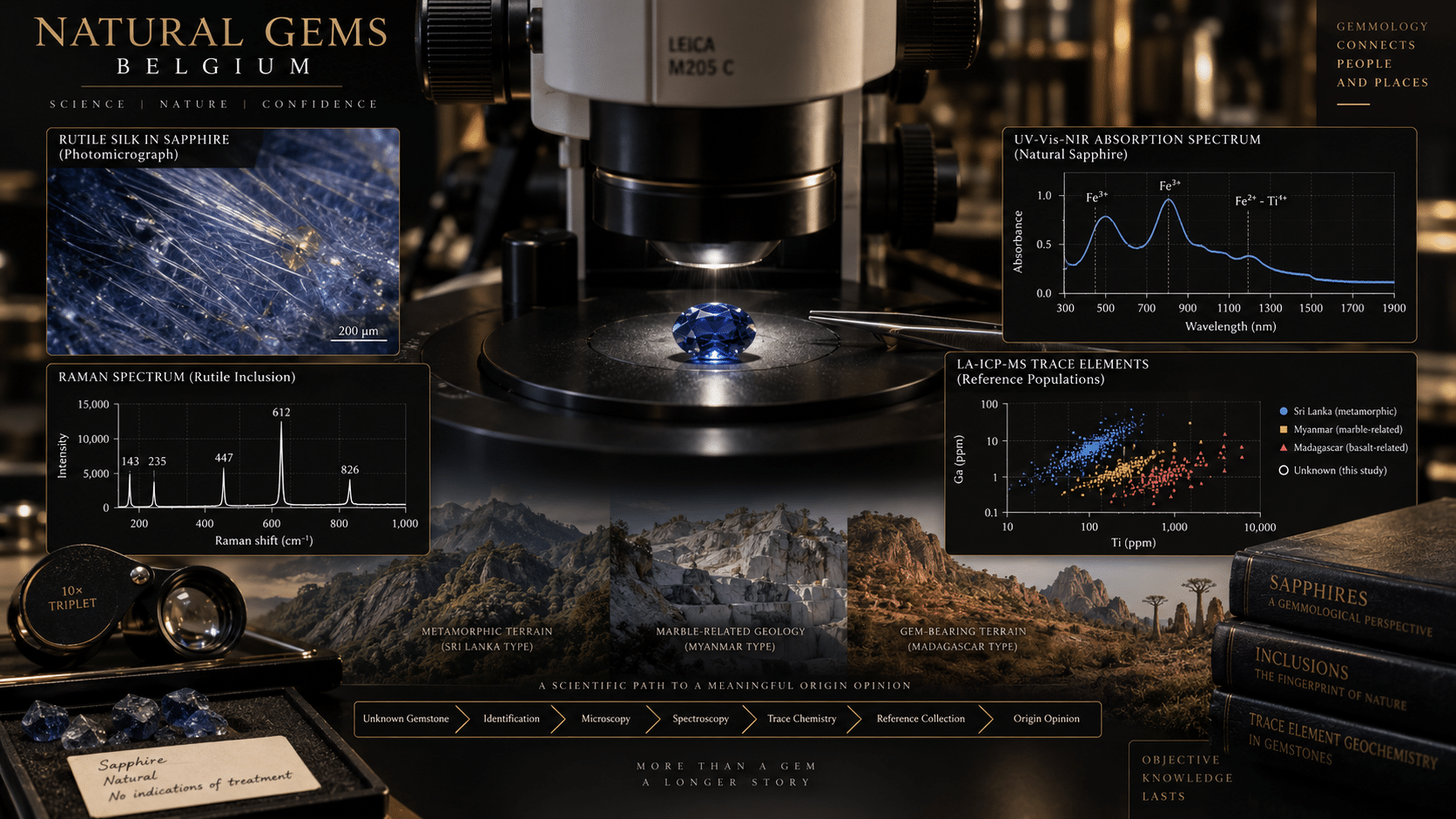
- spectroscopy;
- trace-element chemistry;
- sometimes isotopic information;
- comparison with gemstones of reliably known origin.
The laboratory is therefore performing something closer to:
scientific pattern comparison
than:
country detection.
And sometimes the scientifically correct answer is:
inconclusive.
Understanding why requires us to connect everything discussed in our previous two Learning Center articles:
inclusions
and:
gemstone geology.
PART I — WHAT DOES “ORIGIN” ACTUALLY MEAN?
1. Several Different Meanings Are Often Confused
In the gemstone trade, the word:
origin
can refer to several different things.
These must be separated.
Natural or synthetic origin
Did the gemstone form naturally within Earth, or was it produced artificially?
Geological origin
In what geological environment did the gemstone form?
Examples include:
- metamorphic;
- magmatic-related;
- hydrothermal;
- pegmatitic.
Geographic origin
From which geographical mining region or country did the gemstone originate?
Examples:
- Sri Lanka;
- Myanmar;
- Madagascar;
- Mozambique;
- Colombia;
- Zambia.
Commercial provenance
What documented chain of ownership, mining location, dealer history or custody accompanies the stone?
These questions are related.
They are not identical.
2. Geographic Origin Is Not Provenance
Suppose a laboratory concludes:
Sri Lanka
for a sapphire.
That does not necessarily mean the laboratory knows:
- which miner recovered it;
- which mine produced it;
- who first sold it;
- its complete chain of custody.
The laboratory has interpreted measurable characteristics as being consistent with its reference data for Sri Lankan sapphire.
That is:
geographic origin determination.
A documented chain linking a stone to a particular mining operation is:
provenance or traceability.
The two concepts should never be treated as interchangeable.
PART II — WHY DOES GEOGRAPHIC ORIGIN MATTER?
3. History
Certain gemstone localities have acquired exceptional historical reputations.
Examples include:
- Kashmir for blue sapphire;
- Mogok in Myanmar for ruby;
- Colombia for emerald.
These names can carry:
- historical importance;
- collector interest;
- market prestige.
Consequently, geographic origin can influence commercial value.
4. But Country Is Not Quality
This requires immediate qualification.
A gemstone does not become fine simply because it came from a famous locality.
Likewise, an exceptional gemstone can come from a newer or less famous source.
Quality depends on the stone itself:
- colour;
- transparency;
- clarity;
- cut;
- optical performance;
- size;
- treatment status;
- overall appearance.
Origin is:
additional information.
It is not a substitute for evaluating the gemstone.
5. Famous Origin Should Never Rescue a Poor Stone
A mediocre ruby from a famous locality remains a mediocre ruby.
An exceptional ruby from another locality can be extraordinarily valuable.
Responsible gemstone evaluation therefore separates:
quality
from:
origin prestige.
PART III — WHY ORIGIN DETERMINATION IS POSSIBLE AT ALL
6. Geology Leaves Evidence
In the previous NGB Learning Center article we established:
different geological environments create different gemstone characteristics.
During crystal growth, a gemstone interacts with its surroundings.
Its environment can influence:
- trace elements;
- inclusions;
- growth structures;
- spectroscopy;
- isotope composition.
These features can remain preserved after the gemstone leaves its host rock.
The gemstone therefore carries:
geological memory.
7. From Geology to Geography
If two mining regions have sufficiently different geological histories, gemstones from those regions may show statistically different characteristics.
For example:
Deposit A
may typically produce gemstones with one inclusion assemblage and trace-element range.
Deposit B
may produce another.
If an unknown gemstone closely matches Deposit A and conflicts with Deposit B, an origin conclusion may become possible.
But there is a problem.
8. Nature Repeats Itself
Different regions can contain:
- similar host rocks;
- similar geological processes;
- similar temperatures;
- similar fluids;
- similar chemical environments.
Consequently, gemstones from geographically distant deposits can overlap.
This is the fundamental limitation of origin determination.
The laboratory is trying to distinguish:
geography
using evidence produced by:
geology.
If the geology overlaps, the evidence can overlap.
PART IV — THE FOUNDATION: KNOWN-ORIGIN REFERENCE STONES
9. You Cannot Compare an Unknown Without a Known
Imagine receiving an unknown sapphire.
You measure:
- iron;
- titanium;
- magnesium;
- gallium.
The numbers alone do not tell you:
Sri Lanka.
They become meaningful only when compared with measurements from sapphires whose origins are reliably known.
This makes the:
reference collection
one of the most important assets in origin determination.
10. Field Gemmology
GIA established a dedicated field gemmology programme in 2008 to support geographic-origin research.
Gemologists travel to gemstone-producing regions to:
- visit deposits;
- study geology;
- document mining;
- collect samples;
- record locality information;
- build known-origin reference populations.
The closer the collection process is to the actual source, the stronger the provenance of the reference material.
11. Why Buying Stones in a Market Is Not Enough
Suppose a researcher buys a sapphire from a dealer in Sri Lanka.
Does that prove the sapphire formed in Sri Lanka?
No.
Gemstones move internationally.
A stone purchased in:
Country A
could have been mined in:
Country B.
Reliable reference collections therefore require careful documentation.
12. Reference Collection Confidence
Field gemologists can classify samples according to the strength of their provenance.
The strongest examples are stones collected:
directly at or extremely close to the producing deposit.
Samples obtained farther along the supply chain require greater caution.
The quality of the origin conclusion ultimately depends partly on:
the quality of the reference data.
PART V — THE LABORATORY WORKFLOW
13. Step 1 — Identify the Gemstone
Before determining geographic origin, the laboratory must establish:
what the material actually is.
A blue gemstone might be:
- sapphire;
- spinel;
- tourmaline;
- zircon;
- glass;
- synthetic material;
- something else.
Origin analysis begins only after identity is established.
14. Step 2 — Establish Natural Versus Synthetic
A geographic origin report for a natural gemstone is meaningless if the material is actually laboratory-grown.
The laboratory therefore examines:
- inclusions;
- growth structures;
- spectroscopy;
- chemistry
to establish whether the gemstone is:
natural
or:
synthetic.
15. Step 3 — Investigate Treatment
Treatment can alter or obscure origin evidence.
Examples include:
- heating;
- diffusion;
- fracture filling;
- irradiation;
- other modifications.
Treatment determination is therefore closely connected with origin analysis.
Some extreme treatments can prevent a meaningful geographic-origin conclusion.
16. Step 4 — Microscopy
The microscope is often one of the first major origin tools.
Gemologists examine:
- solid mineral inclusions;
- fluid inclusions;
- negative crystals;
- growth zoning;
- healed fractures;
- exsolution features;
- internal structures.
The question becomes:
Does this inclusion population resemble gemstones from particular geological environments or known deposits?
PART VI — MICROSCOPIC ORIGIN CLUES
17. One Inclusion Is Rarely Enough
This principle cannot be repeated too often.
A mineral inclusion may occur in gemstones from several localities.
A fluid inclusion may resemble examples from several countries.
The laboratory therefore evaluates:
inclusion populations
rather than chasing a single visual “country marker.”
18. Emerald Example
Emerald provides an excellent case study.
Different emerald deposits can contain characteristic:
- mineral inclusions;
- fluid inclusions;
- growth features.
Colombian emeralds are associated with hydrothermal systems in sedimentary rocks.
Many Zambian, Russian and Ethiopian emeralds occur in different geological environments, commonly involving schist-related systems.
These contrasting geological settings can create different inclusion populations.
19. The Three-Phase Inclusion Warning
Historically, spectacular three-phase inclusions containing:
- liquid;
- gas;
- a solid crystal
became strongly associated with Colombian emerald.
But similar multiphase inclusions have been documented in emerald from:
- Afghanistan;
- China;
- Zambia.
Therefore:
three-phase inclusion ≠ automatic Colombia.
This is exactly why modern origin determination requires converging evidence.
PART VII — RAMAN SPECTROSCOPY
20. What Is That Tiny Crystal?
Suppose microscopy reveals a colourless crystal inside a sapphire.
It resembles:
zircon.
Visual appearance creates a hypothesis.
But if identifying that mineral matters to the origin conclusion, the laboratory may use:
Raman spectroscopy.
21. Molecular Fingerprints
When laser light interacts with a material, a tiny fraction is scattered with changed energy.
The resulting Raman spectrum reflects vibrational behaviour characteristic of the material.
By comparing the measured spectrum with reference databases, the laboratory can identify microscopic inclusions.
Thus:
“looks like zircon”
can become:
“Raman-confirmed zircon.”
That is a major increase in evidential strength.
PART VIII — UV-VIS-NIR SPECTROSCOPY
22. Colour Leaves a Spectrum
Gemstone colour results from interaction between light and the gemstone’s electronic structure.
UV-Vis-NIR spectroscopy measures absorption across:
- ultraviolet;
- visible;
- near-infrared
wavelengths.
The resulting spectrum can reveal information associated with:
- transition-metal ions;
- charge-transfer processes;
- colour mechanisms;
- sometimes geological environment.
23. Spectroscopy Is Comparative
A spectrum does not normally contain a line labelled:
“Madagascar.”
Instead, the laboratory asks whether spectral characteristics correspond with patterns observed in known-origin stones.
Again:
measurement → comparison → interpretation.
PART IX — INFRARED SPECTROSCOPY
24. FTIR
Fourier-transform infrared spectroscopy—FTIR—is another major laboratory technique.
It can reveal absorption associated with:
- hydroxyl;
- water-related species;
- structural defects;
- treatment-related features.
In some gemstones it contributes both to:
treatment detection
and:
origin interpretation.
25. Why Several Spectra May Be Needed
No single spectroscopic technique answers every question.
UV-Vis-NIR examines one range of interactions.
FTIR examines another.
Raman spectroscopy is particularly powerful for mineral identification.
Their strengths are complementary.
A modern gem laboratory therefore builds:
multiple independent datasets.
PART X — TRACE-ELEMENT CHEMISTRY
26. The Chemistry Beyond the Formula
Corundum has the ideal chemical formula:
Al₂O₃.
But natural corundum contains small concentrations of other elements.
These may include:
- Fe;
- Ti;
- Cr;
- V;
- Mg;
- Ga.
Their concentrations can reflect the environment in which the crystal grew.
27. Parts per Million Can Matter
Trace elements may occur at extremely low concentrations.
Yet differences of only parts per million can contain useful geological information.
This is why sophisticated origin analysis often requires techniques capable of measuring very small elemental concentrations accurately.
28. LA-ICP-MS
One of the most powerful methods is:
Laser Ablation–Inductively Coupled Plasma–Mass Spectrometry
or:
LA-ICP-MS.
The name sounds intimidating.
The basic concept is manageable.
29. Step 1 — Laser Ablation
A highly focused laser removes a microscopic amount of material from the gemstone.
This creates a tiny ablation spot.
The amount removed is extremely small, but the method is technically:
micro-destructive.
That distinction should be stated honestly.
30. Step 2 — Plasma
The ablated material is carried into an extremely hot:
inductively coupled plasma.
There it is ionised.
31. Step 3 — Mass Spectrometry
The ions enter a mass spectrometer.
They are separated according to their mass-to-charge relationships.
The instrument can then quantify extremely small concentrations of multiple elements.
The laboratory obtains a:
trace-element profile.
32. Step 4 — Comparison
That profile is compared with:
known-origin reference populations.
Now the laboratory may see that the unknown stone:
- matches one locality strongly;
- conflicts with another;
- overlaps several;
- matches none sufficiently.
The final conclusion depends on the total evidence.
PART XI — RUBY ORIGIN DETERMINATION
33. First Geological Separation
GIA’s published ruby methodology begins by considering broad geological groups.
One particularly important distinction is between:
marble-hosted rubies
and:
higher-iron rubies from other geological environments.
Iron concentration can help separate these populations.
34. Marble-Hosted Ruby
Important marble-related ruby deposits occur in regions including:
- Myanmar;
- Vietnam;
- Afghanistan;
- Tajikistan.
Their geological similarities can produce overlapping characteristics.
This makes distinguishing between them challenging.
35. High-Iron Ruby
Important higher-iron ruby deposits include material from:
- Mozambique;
- Madagascar;
- Thailand;
- Cambodia.
Again, chemistry, inclusions and spectroscopy must be evaluated together.
36. Mozambique Changed the Market
The development of major ruby production in Mozambique transformed the modern ruby market.
It also increased the importance of laboratory origin determination because high-quality Mozambique ruby can overlap visually with ruby from historically prestigious sources.
Appearance alone cannot reliably establish country.
PART XII — BLUE SAPPHIRE ORIGIN DETERMINATION
37. A Particularly Difficult Problem
Blue sapphire provides one of the best demonstrations of origin complexity.
Important sources include:
- Sri Lanka;
- Myanmar;
- Madagascar;
- Kashmir;
- Thailand;
- Cambodia;
- Australia;
- Ethiopia;
- Nigeria.
Several deposits produce stones with overlapping characteristics.
38. Geological Group First
Laboratories can often first ask whether a sapphire belongs broadly to a:
metamorphic
or:
basalt-related
population.
This significantly narrows the possibilities.
39. Metamorphic Sapphire
Important metamorphic-type sources include:
- Sri Lanka;
- Myanmar;
- Madagascar;
- Kashmir.
These are among the commercially most important—and sometimes most difficult—to distinguish.
40. Basalt-Related Sapphire
Basalt-related sapphires occur in locations including:
- Australia;
- Thailand;
- Cambodia;
- Nigeria;
- Ethiopia.
Their trace-element chemistry can differ significantly from metamorphic sapphire.
Yet overlap can still occur between individual basalt-related localities.
41. Why Clean Sapphires Can Be Harder
Ironically, a very fine sapphire may be more difficult to origin.
Why?
Because exceptionally clean stones may contain:
few useful inclusions.
The microscope then provides less geological evidence.
The laboratory must rely more heavily on:
- spectroscopy;
- chemistry;
- remaining growth structures.
Beauty can therefore remove some of the clues that gemmologists would like to see.
PART XIII — KASHMIR SAPPHIRE
42. A Famous Origin
Kashmir sapphire occupies an exceptional place in gemstone history.
Fine examples are celebrated for:
- saturated blue colour;
- characteristic visual appearance;
- rarity;
- historical significance.
But a sapphire does not become Kashmir merely because it looks:
“velvety.”
43. Appearance Is Not Origin Proof
Similar visual characteristics can occur in sapphire from other deposits.
Laboratories therefore investigate:
- inclusions;
- growth structures;
- spectroscopy;
- chemistry;
- comparison with historical stones of verifiable provenance.
Origin must be supported scientifically.
44. The Reference Problem
Historic deposits create another challenge.
Modern field gemologists cannot necessarily collect large fresh samples from every famous historical mine.
For Kashmir sapphire, laboratories may depend substantially on:
- historic collections;
- stones with reliable documented provenance;
- independently corroborated reference specimens.
This makes high-quality reference material exceptionally valuable.
PART XIV — EMERALD ORIGIN DETERMINATION
45. Emerald Chemistry Is Rich in Information
Emerald has a more chemically complex crystal structure than corundum.
Various elements can enter different structural sites.
This makes trace-element chemistry particularly useful for geographic-origin analysis.
46. Elements Used in Emerald Origin Work
GIA’s published research discusses elements including:
- Li;
- K;
- V;
- Cr;
- Fe;
- Rb;
- Cs.
Their relative concentrations can create useful locality patterns.
47. Colombian Emerald
Colombian emeralds often show relatively low concentrations of several alkali elements and iron compared with many other emerald populations.
Their geology is unusual and contributes distinctive characteristics.
But overlap still exists with some other hydrothermal emerald deposits.
48. Zambian Emerald
Emeralds from Zambia’s Kafubu region commonly show different trace-element behaviour from Colombian material, including higher concentrations of several elements.
Microscopy may also reveal inclusion assemblages associated with schist-related geology.
The laboratory combines:
geology + inclusions + spectroscopy + chemistry.
49. When Emerald Data Refuse to Cooperate
GIA has published an excellent example of an emerald whose:
- spectroscopy;
- inclusions;
- trace-element plots
could narrow the geological group but could not match one locality uniquely.
The appropriate conclusion was:
inconclusive.
That is not laboratory failure.
It is scientific restraint.
PART XV — PARAÍBA TOURMALINE
50. First Understand the Name
Paraíba tourmaline was originally discovered in Brazil’s Paraíba State.
Later, copper-bearing tourmalines with similar vivid colours were discovered in:
- Nigeria;
- Mozambique.
Modern internationally accepted nomenclature does not restrict the term Paraíba to Brazilian origin.
51. Chemistry Defines the Variety
Paraíba-type tourmaline is characterised by vivid blue-to-green colours associated principally with:
copper
and often:
manganese.
Geographic origin is a separate question.
Therefore:
Paraíba ≠ automatically Brazil.
52. Why Origin Matters Commercially
Brazilian, Nigerian and Mozambican copper-bearing tourmalines can have different market perceptions.
Consequently, determining geographic origin can carry substantial commercial significance.
But visual examination is insufficient.
53. Quantitative Chemistry
GIA states that standard gemmological testing and qualitative chemistry cannot reliably establish the geographic origin of Paraíba tourmaline.
Quantitative trace-element analysis is required.
Relevant elements can include:
- Cu;
- Ga;
- Pb;
- Sr;
- Zn;
- Sn.
Their concentration relationships help distinguish reference populations.
54. Another Lesson in Terminology
A report can therefore legitimately describe:
Paraíba tourmaline — Mozambique
without contradiction.
One term describes a recognised gemstone variety.
The other describes geographic origin.
PART XVI — STATISTICS AND REFERENCE POPULATIONS
55. Think in Populations, Not Perfect Country Boxes
Imagine plotting two trace elements for hundreds of sapphires.
Sri Lankan stones occupy one cloud of points.
Madagascan stones occupy another.
Myanmar stones occupy another.
Some regions may be clearly separated.
Others overlap.
An unknown stone becomes:
one new point on that map.
56. The Easy Case
Suppose the unknown falls deep inside the Sri Lankan reference field and far from every competing population.
Other evidence also agrees.
Confidence can be high.
57. The Difficult Case
Suppose the unknown falls where:
Sri Lanka + Madagascar
overlap.
Microscopy is ambiguous.
Spectroscopy also overlaps.
There may be no scientifically defensible way to choose between them.
The correct conclusion may be:
inconclusive.
58. Why More Data Do Not Always Solve Everything
It is tempting to believe that sufficiently advanced technology will eventually make every gemstone origin determinable.
Not necessarily.
If gemstones from two locations genuinely possess overlapping measurable characteristics, improved measurement cannot magically create a difference that nature did not create.
Better science can reduce uncertainty.
It cannot always eliminate it.
PART XVII — MACHINE LEARNING AND DATA ANALYSIS
59. Large Datasets Create New Possibilities
Modern laboratories can accumulate enormous datasets containing:
- trace-element measurements;
- spectra;
- photomicrographs;
- known origins.
Statistical methods and machine learning can help identify patterns too complex for simple two-element plots.
60. But Algorithms Need Reliable Training Data
A sophisticated model trained on incorrectly labelled stones will produce sophisticated-looking:
wrong answers.
Therefore the foundation remains:
reliable known-origin reference material.
Field gemmology does not become less important as data science advances.
It becomes more important.
PART XVIII — ISOTOPES
61. Another Geological Fingerprint
Atoms of the same element can exist as different:
isotopes.
Their relative abundances can vary through geological processes.
Isotopic measurements can therefore provide additional information about gemstone formation environments.
62. Oxygen Isotopes
Oxygen-isotope composition has been studied in:
- corundum;
- emerald;
- other minerals.
Because oxygen in a gemstone reflects aspects of the geological system in which it formed, isotopic values can sometimes help distinguish geological populations.
63. Isotopes Are Not Universal Country Codes
Once again, overlap exists.
Isotopic data are:
another evidence stream
rather than:
a universal geographic barcode.
The principle remains convergence.
PART XIX — TREATMENT COMPLICATES ORIGIN
64. Heat Can Alter Evidence
Heating may modify:
- inclusions;
- rutile silk;
- fractures;
- spectroscopy;
- colour centres.
Some original origin clues can therefore become weaker or disappear.
65. Extreme Treatment
Certain treatments alter gemstones so extensively that reliable origin determination becomes problematic or impossible.
For example, GIA’s published methodology notes that corundum subjected to certain extreme diffusion treatments is not eligible for its geographic-origin service.
The reason is straightforward:
the evidence needed for origin interpretation has been materially altered.
PART XX — WHY LABORATORIES CAN DISAGREE
66. Origin Determination Is an Expert Opinion
Two respected laboratories may occasionally reach different conclusions.
This does not automatically mean one is incompetent.
They may have:
- different reference collections;
- different analytical datasets;
- different decision criteria;
- different instruments;
- different interpretations of overlapping evidence.
67. Reference Collections Evolve
Imagine a gemstone analysed in:
2010.
At that time, only several comparable deposits may be well characterised.
Then a new deposit begins producing in:
2025.
Its stones overlap the characteristics previously associated with an older source.
The scientific interpretation may need refinement.
Origin science evolves because:
the gemstone-producing world changes.
68. New Deposits Can Challenge Old Assumptions
This has happened repeatedly in gemmology.
Features once believed characteristic of one locality have later been found elsewhere.
That is not evidence that science failed.
It is how science progresses:
new evidence → revised model.
PART XXI — “INCONCLUSIVE” IS A VALID RESULT
69. Consumers Often Dislike This Word
A client pays for sophisticated testing.
They want:
a country.
Instead, the laboratory reports:
inconclusive.
It can feel unsatisfactory.
Scientifically, however, this may be the most responsible conclusion possible.
70. What Inconclusive Means
It does not necessarily mean:
“we learned nothing.”
The laboratory may have established:
- gemstone identity;
- natural origin;
- treatment status;
- geological group;
- several plausible geographic origins.
But the evidence does not justify choosing one country.
71. The Alternative Would Be Worse
If two localities overlap and the laboratory nevertheless chooses one merely because the client expects an answer, the result is:
false precision.
Science should prefer:
honest uncertainty
over:
unsupported certainty.
PART XXII — ORIGIN REPORT VERSUS CERTIFICATE OF MINE
72. What a Laboratory Report Does
A laboratory origin report generally provides an expert opinion about the gemstone’s geographic origin based on analytical comparison.
It does not normally certify:
- the individual miner;
- exact extraction date;
- exact mine shaft;
- complete supply chain;
- ownership history.
Those require different documentation.
73. Traceability
Traceability attempts to document movement through the supply chain.
Possible evidence can include:
- mine records;
- sealed parcels;
- export documentation;
- invoices;
- blockchain or digital tracking systems;
- custody records.
That is:
supply-chain evidence.
74. Gemmological Origin
Laboratory origin determination uses:
evidence inside the gemstone.
These two systems can complement each other.
But they answer different questions.
PART XXIII — SELLER-STATED ORIGIN
75. “The Supplier Told Me”
A dealer may state:
“This emerald is from Zambia.”
That information may be correct.
But unless supported by appropriate documentation or independent analysis, it remains:
a seller-stated origin.
It should not automatically be represented as a laboratory-determined fact.
76. Responsible Description
The distinction should be transparent.
Examples:
Supplier-stated origin: Zambia
is different from:
Geographic origin: Zambia — laboratory report
and both differ from:
Mine-traceable Kafubu material with documented chain of custody.
Precision in language protects both:
buyer
and:
seller.
PART XXIV — WHAT A LABORATORY ACTUALLY COMPARES
77. Evidence Layer 1 — Basic Gemmology
- refractive index;
- specific gravity;
- optical character;
- pleochroism;
- fluorescence.
Purpose:
identify the gemstone and establish basic characteristics.
78. Evidence Layer 2 — Microscopy
- mineral inclusions;
- fluid inclusions;
- negative crystals;
- growth structures;
- zoning;
- treatment features.
Purpose:
reconstruct growth environment and narrow geological/origin possibilities.
79. Evidence Layer 3 — Raman
Purpose:
identify inclusions and other microscopic materials analytically.
80. Evidence Layer 4 — UV-Vis-NIR
Purpose:
study absorption, colour mechanisms and spectroscopic population differences.
81. Evidence Layer 5 — FTIR
Purpose:
study infrared-active features relevant to structure, fluids and treatment.
82. Evidence Layer 6 — Trace Chemistry
Methods can include:
- XRF;
- LA-ICP-MS.
Purpose:
compare elemental signatures with known-origin reference populations.
83. Evidence Layer 7 — Isotopes
Used selectively.
Purpose:
investigate geological source relationships when isotopic populations are informative.
84. Evidence Layer 8 — Reference Database
All observations become useful only when compared with:
reliably characterised known-origin material.
This is the foundation supporting the entire interpretation.
PART XXV — THE EVIDENCE PYRAMID
The process can be visualised as:
GEOLOGY
↓
KNOWN-ORIGIN REFERENCE STONES
↓
IDENTIFICATION
↓
MICROSCOPY
↓
SPECTROSCOPY
↓
TRACE-ELEMENT CHEMISTRY
↓
STATISTICAL / EXPERT COMPARISON
↓
GEOGRAPHIC-ORIGIN OPINION
No single layer should be mistaken for the entire process.
PART XXVI — CASE STUDY: UNKNOWN BLUE SAPPHIRE
85. The Submission
Imagine an unknown 4.20 ct natural blue sapphire submitted for origin determination.
86. Identification
Standard testing establishes:
natural corundum — sapphire.
No evidence of synthetic growth is found.
87. Treatment
Microscopy and spectroscopy reveal no evidence supporting high-temperature treatment.
The stone proceeds to origin analysis.
88. Microscopy
The gemologist observes:
- fine rutile;
- small zircon crystals;
- metamorphic-type growth structures.
This suggests:
metamorphic sapphire.
Possible origins now include several localities.
89. Chemistry
LA-ICP-MS measures:
- Fe;
- Ti;
- Ga;
- Mg;
- other trace elements.
The chemical profile is compared with reference stones.
90. Scenario A — Convergence
Suppose:
- microscopy strongly matches Sri Lankan reference stones;
- spectroscopy is consistent;
- trace chemistry falls comfortably within the Sri Lankan population;
- competing origins are inconsistent.
The laboratory may conclude:
Sri Lanka.
91. Scenario B — Overlap
Now suppose:
- microscopy fits both Sri Lanka and Madagascar;
- spectroscopy overlaps;
- trace chemistry lies inside both reference populations.
Then:
Sri Lanka or Madagascar
may remain scientifically possible.
Depending on laboratory policy and evidence, the final geographic-origin result may be:
inconclusive.
Same gemstone species.
Same instruments.
Different strength of evidence.
PART XXVII — CASE STUDY: EMERALD
92. The Unknown Emerald
Microscopy reveals:
- irregular fluid inclusions;
- mica-related features.
UV-Vis-NIR suggests a schist-related geological environment.
Potential origins include:
- Zambia;
- Russia;
- Brazil;
- Ethiopia;
- Madagascar.
93. Chemistry Resolves the Case
LA-ICP-MS measures elements including:
- Li;
- K;
- Fe;
- Rb;
- Cs.
Suppose the stone’s chemistry strongly matches Kafubu reference emeralds and conflicts with the alternatives.
Combined with microscopy and spectroscopy, the laboratory can support:
Zambia.
94. Or Chemistry May Refuse to Resolve It
If the unknown lies outside clear reference fields or overlaps multiple populations, the conclusion should remain:
inconclusive.
A sophisticated instrument does not eliminate scientific uncertainty.
PART XXVIII — CASE STUDY: PARAÍBA TOURMALINE
95. Identification
The laboratory confirms:
natural copper-bearing elbaite tourmaline
with colour and chemistry appropriate for the Paraíba designation.
Now comes the separate question:
Brazil, Nigeria or Mozambique?
96. Trace Chemistry
Quantitative elemental measurements are compared with known-origin populations.
Relationships involving elements such as:
- Cu;
- Ga;
- Pb;
- Sr;
- Zn;
- Sn
can provide geographic separation.
The final origin conclusion emerges from:
multivariable chemical patterns.
PART XXIX — HOW CONFIDENCE SHOULD BE UNDERSTOOD
97. Not Every Origin Conclusion Is Equally Easy
Some gemstones show:
strongly distinctive evidence.
Others sit close to population boundaries.
Still others contain insufficient evidence.
Origin determination is therefore not intellectually equivalent to measuring:
weight = 2.31 ct.
Weight is a direct measurement.
Geographic origin is:
an interpretation based on measurements and comparison.
98. Measurement Versus Inference
The laboratory directly measures:
- spectrum;
- chemical concentrations;
- optical properties.
It directly observes:
- inclusions;
- growth features.
It then infers:
geographic origin.
Understanding this distinction prevents laboratory reports from being misunderstood.
PART XXX — COMMON ORIGIN MYTHS
99. Myth: “A Machine Detects the Country”
False.
Multiple measurements are interpreted against reference data.
100. Myth: “One Inclusion Proves Origin”
Usually false.
Origin generally requires an assemblage of evidence.
101. Myth: “Three-Phase Emerald Means Colombia”
False.
Comparable inclusions occur in emeralds from several countries.
102. Myth: “Velvety Sapphire Means Kashmir”
False.
Visual appearance alone cannot establish Kashmir origin.
103. Myth: “Paraíba Means Brazil”
False.
The accepted Paraíba designation can apply to qualifying copper-bearing tourmaline regardless of whether it originated in Brazil, Nigeria or Mozambique.
104. Myth: “Country Determines Quality”
False.
Quality and geographic origin are separate characteristics.
105. Myth: “Inconclusive Means the Laboratory Failed”
False.
It means available evidence does not justify a unique geographic conclusion.
106. Myth: “A Lab Origin Report Proves the Exact Mine”
Usually false.
Country or regional origin determination is different from mine-level traceability.
107. Myth: “Seller Origin and Laboratory Origin Are Equivalent”
False.
Supplier information may be useful provenance evidence, but it is not automatically equivalent to independent analytical origin determination.
PART XXXI — WHY REFERENCE COLLECTIONS MUST KEEP GROWING
108. Gemstone Mining Is Dynamic
New deposits are continually:
- discovered;
- developed;
- exhausted;
- reopened.
A laboratory database cannot remain static.
109. Madagascar Demonstrates the Problem
Madagascar has produced gemstones from numerous deposits discovered or developed over relatively recent decades.
New production can introduce material whose characteristics overlap established sources.
Reference collections must therefore continually expand.
110. Yesterday’s Diagnostic Feature May Become Tomorrow’s Shared Feature
A feature initially observed only in one locality may appear unique.
Later, another deposit may produce gemstones with the same feature.
Scientific terminology must then change from:
diagnostic
to perhaps:
characteristic
or simply:
compatible.
This is healthy scientific correction.
PART XXXII — WHY GEOLOGY REMAINS CENTRAL
111. Instruments Do Not Replace Geological Understanding
A trace-element plot without geological context is merely:
data.
A mineral inclusion without geological context is merely:
an object.
Origin interpretation becomes meaningful when researchers understand:
- host rocks;
- mineral assemblages;
- metamorphism;
- magmatism;
- fluid activity;
- tectonic history.
This is why origin determination sits at the intersection of:
gemmology + mineralogy + geochemistry + geology.
112. The Previous Three Articles Now Connect
Our microscope article explained:
how to observe internal evidence.
Our inclusion article explained:
what that internal evidence can mean.
Our gemstone-formation article explained:
which geological processes created the evidence.
This article adds:
how laboratories compare that evidence geographically.
The sequence becomes:
observe → identify → understand geology → compare populations → infer origin.
PART XXXIII — A RESPONSIBLE BUYER’S CHECKLIST
113. When Origin Is Commercially Important
Ask:
Who determined the origin?
Was it:
- seller-stated;
- documented provenance;
- independent laboratory opinion?
114. Check the Laboratory Report
Verify:
- report number;
- gemstone identity;
- treatment status;
- geographic-origin wording;
- report authenticity where online verification is available.
115. Do Not Read More Into the Report Than It Says
If the report says:
Mozambique
do not automatically translate that into:
a particular mine.
If it says:
no indications of heating
do not rewrite that as:
completely untreated in every conceivable way
unless the laboratory’s terminology supports that interpretation.
Precision matters.
116. Evaluate the Gemstone Separately
After origin is established, still examine:
- colour;
- clarity;
- cut;
- optical performance;
- durability;
- treatment;
- size.
Origin should enrich the evaluation.
It should not replace it.
PART XXXIV — THE PROFESSIONAL EVIDENCE RULE
117. Independent Evidence Should Converge
A strong origin conclusion may involve:
microscopy
spectroscopy
trace chemistry
geological consistency
known-origin reference comparison.
When independent evidence streams point toward the same locality, confidence increases.
118. Contradictory Evidence Must Be Respected
Suppose inclusions suggest one locality while chemistry strongly conflicts with it.
The correct response is not to ignore the inconvenient evidence.
The discrepancy must be investigated.
Possible explanations include:
- incorrect inclusion interpretation;
- overlapping deposits;
- treatment;
- unusual specimen;
- incomplete reference data;
- another origin entirely.
Science advances through contradictions.
PART XXXV — THE MOST IMPORTANT WORD: “OPINION”
119. Why Major Laboratories Use Careful Language
Geographic-origin determination is not absolute in the same sense as reading a gemstone’s weight from a calibrated balance.
Laboratories therefore describe origin conclusions carefully.
SSEF, for example, explicitly characterises geographic-origin conclusions as non-binding opinions based primarily on comparative analysis of internal features and relevant chemical and physical characteristics.
That wording is scientifically meaningful.
120. An Expert Opinion Can Still Be Extremely Powerful
“Opinion” does not mean:
guess.
A high-level laboratory origin opinion can be based on:
- decades of research;
- thousands of reference specimens;
- field expeditions;
- advanced analytical instrumentation;
- large databases;
- specialist gemologists.
It means the conclusion is:
inferential rather than directly observed.
The laboratory did not witness the gemstone being mined.
It reconstructed origin from evidence.
PART XXXVI — FROM MINE TO LABORATORY
The complete scientific chain can now be visualised:
GEOLOGICAL ENVIRONMENT
↓
creates
GEMSTONE CHEMISTRY + INCLUSIONS + GROWTH FEATURES
↓
gemstone enters
MINING AND TRADE
↓
unknown stone reaches
LABORATORY
↓
laboratory performs
IDENTIFICATION
↓
then
TREATMENT ANALYSIS
↓
then
MICROSCOPY
↓
then where necessary
SPECTROSCOPY + TRACE CHEMISTRY
↓
results are compared with
KNOWN-ORIGIN REFERENCE COLLECTIONS
↓
evidence is evaluated for
CONVERGENCE OR OVERLAP
↓
final conclusion:
GEOGRAPHIC ORIGIN
or:
INCONCLUSIVE
That final possibility is not an exception to good science.
It is part of good science.
Conclusion
Can a laboratory determine where a gemstone came from?
Often, yes.
But not because a gemstone contains a hidden country label.
Geographic-origin determination works because geology leaves measurable evidence.
When a ruby, sapphire, emerald or tourmaline crystallises, its environment influences:
- the elements entering its structure;
- the minerals trapped inside it;
- the fluids preserved within it;
- its growth patterns;
- its optical absorption.
Those characteristics can survive for millions of years.
A modern gemmological laboratory measures and interprets them.
The microscope reveals internal features.
Raman spectroscopy can identify microscopic mineral inclusions.
UV-Vis-NIR and FTIR spectroscopy reveal aspects of crystal chemistry, colour and treatment.
LA-ICP-MS can measure trace elements at extraordinarily low concentrations.
Other specialised methods can add further information.
But none of these measurements means much in isolation.
The foundation of geographic-origin determination is:
comparison.
An unknown sapphire is compared with sapphires of reliably known origin.
An unknown emerald is compared with emerald reference populations.
An unknown Paraíba tourmaline is compared chemically with copper-bearing tourmalines from known deposits.
This is why field gemmology is indispensable.
Before a laboratory can determine the origin of an unknown stone, someone must build reliable knowledge of:
known stones.
And this is also why origin determination has limitations.
Nature does not respect national borders.
Similar geological processes can occur in countries thousands of kilometres apart.
Gemstones from different deposits can therefore share:
- inclusions;
- spectra;
- trace-element chemistry.
When those populations overlap too strongly, the evidence may not support one country.
Then the scientifically correct conclusion is:
inconclusive.
That word should inspire confidence rather than disappointment.
It means the laboratory has refused to claim more than the evidence supports.
For buyers and collectors, three distinctions are therefore essential:
geographic origin is not quality.
geographic origin is not provenance.
geographic origin is not always determinable.
A beautiful sapphire should first be evaluated as a sapphire.
Its colour, clarity, cut, treatment status and optical performance remain fundamental.
If reliable origin information is also available, it adds another layer to the gemstone’s story.
That story begins in geology.
It is preserved in the stone.
And the laboratory’s task is to reconstruct it from evidence.
The strongest origin conclusions therefore follow the same principle that runs throughout professional gemmology:
do not search for one magical clue.
Instead:
observe carefully.
measure accurately.
compare responsibly.
combine independent evidence.
And when the evidence stops:
stop the conclusion there too.
That is not uncertainty defeating gemmology.
It is:
gemmology practising science.
References & Further Reading
Groat, L. A., Giuliani, G., Stone-Sundberg, J., Sun, Z., Renfro, N. D. & Palke, A. C. — “A Review of Analytical Methods Used in Geographic Origin Determination of Gemstones.” Gems & Gemology, Winter 2019.
The principal methodological reference for this article. Reviews microscopy, Raman spectroscopy, UV-Vis-NIR, FTIR, trace-element chemistry, isotopic analysis and the laboratory workflow used to connect measurable gemstone properties with geological and geographic origin.
GIA — Analytical Methods Used in Geographic Origin Determination
Vertriest, W., Palke, A. C. & Renfro, N. D. — “Field Gemology: Building a Research Collection and Understanding the Development of Gem Deposits.” Gems & Gemology, Winter 2019.
Essential explanation of why known-origin reference collections underpin modern origin determination and how field gemologists collect and document reliable samples from gemstone-producing regions.
GIA — Field Gemology and Building a Reference Collection
Palke, A. C. et al. — “Geographic Origin Determination of Blue Sapphire.” Gems & Gemology, Winter 2019.
Comprehensive treatment of sapphire origin determination using microscopy, spectroscopy, trace-element chemistry and known-origin samples. Particularly valuable for understanding metamorphic versus basalt-related populations and the unavoidable overlap between certain geographic sources.
GIA — Geographic Origin Determination of Blue Sapphire
Palke, A. C. et al. — “Geographic Origin Determination of Ruby.” Gems & Gemology, Winter 2019.
Detailed study of ruby origin methodology, including marble-hosted and higher-iron geological populations, microscopy, Raman analysis, UV-Vis spectroscopy and LA-ICP-MS trace-element comparison using hundreds of known-origin reference rubies.
GIA — Geographic Origin Determination of Ruby
Saeseaw, S., Renfro, N. D., Palke, A. C. & Sun, Z. — “Geographic Origin Determination of Emerald.” Gems & Gemology, Winter 2019.
Major reference on emerald origin determination. Demonstrates the importance of inclusion scenes, spectroscopy and especially trace-element profiles involving Li, K, V, Cr, Fe, Rb and Cs. It also provides an excellent published example of an emerald for which the scientifically appropriate origin conclusion was inconclusive.
GIA — Geographic Origin Determination of Emerald
Katsurada, Y., Sun, Z., Breeding, C. M. & Dutrow, B. L. — “Geographic Origin Determination of Paraíba Tourmaline.” Gems & Gemology, Winter 2019.
Explains why standard gemmological observations alone cannot reliably distinguish copper-bearing tourmaline from Brazil, Nigeria and Mozambique, and why quantitative chemical analysis is required for geographic-origin determination.
GIA — Geographic Origin Determination of Paraíba Tourmaline
Saeseaw, S., Pardieu, V. & Sangsawong, S. — “Three-Phase Inclusions in Emerald and Their Impact on Origin Determination.” Gems & Gemology, Summer 2014.
Important warning against single-feature origin attribution. Documents three-phase inclusions in emeralds from multiple geographic sources and explains why features once strongly associated with Colombia cannot independently establish Colombian origin.
GIA — Three-Phase Inclusions in Emerald and Their Impact on Origin Determination
GIA — “How GIA Analyzes Colored Stones from Start to Finish.” 2025.
Accessible overview of the modern coloured-stone laboratory workflow from initial identification through advanced analysis and reporting. It also describes the role of GIA’s field-collected known-origin reference library in country-of-origin determinations.
GIA — How GIA Analyzes Colored Stones
GIA — “Chemical Analysis in the Gemological Laboratory: XRF and LA-ICP-MS.” Gems & Gemology, Winter 2024.
Modern technical overview of elemental analysis in gemmology. Particularly useful for understanding the different capabilities of XRF and LA-ICP-MS and why high-precision trace chemistry can resolve some borderline geographic-origin cases.
GIA — Chemical Analysis: XRF and LA-ICP-MS
GIA — Colored Stone Research: Sources, Traceability and Geographic Origin.
GIA’s research portal bringing together its work on ruby, sapphire, emerald and other coloured-stone sources and explaining the connection between known-origin samples, geological research and laboratory origin services.
GIA — Colored Stone Research
Swiss Gemmological Institute SSEF — Terms and Conditions: Scope of Analysis and Restrictions.
Especially valuable for understanding the epistemic limits of laboratory origin determination. SSEF explicitly explains that geographic-origin conclusions are comparative expert opinions based on internal features and chemical and physical characteristics, and that overlapping properties can make origin determination impossible in some cases.
SSEF — Scope and Restrictions of Gemstone Analysis