
Introduction
Look inside a natural gemstone under magnification and an entirely different world appears.
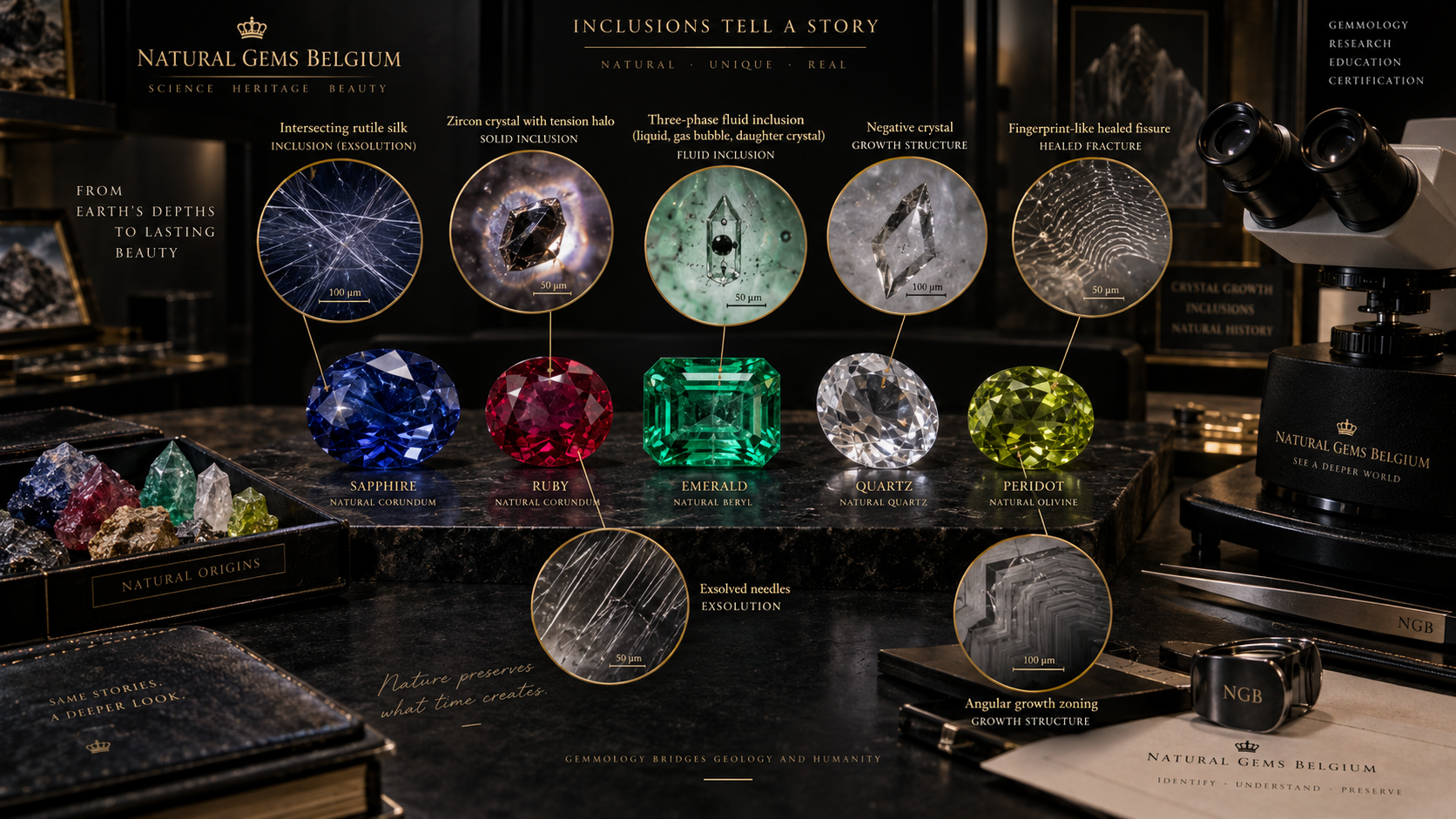
A tiny crystal may sit beneath the table facet.
Fine needles may cross one another in precise crystallographic directions.
A microscopic cavity may contain liquid, a gas bubble and a solid crystal.
An old fracture may have partially healed, leaving a fingerprint-like network behind.
Colour zoning may record changes that occurred while the host crystal was growing.
To someone interested only in flawless appearance, these features may seem like imperfections.
To a gemmologist, they can be evidence.
Gemstone inclusions can preserve part of a gemstone’s geological history.
They may help reveal:
- how the crystal grew;
- which minerals formed around it;
- whether geological fluids were present;
- whether a fracture formed before or after crystal growth;
- whether the gemstone was heated;
- whether fissures were filled;
- whether a gemstone is natural or laboratory-grown;
- and, in some cases, which geological source is most consistent with the evidence.
But inclusions must be interpreted carefully.
One needle does not automatically prove a gemstone species.
One fluid inclusion does not automatically prove geographic origin.
A natural-looking fingerprint does not always prove natural growth.
And the absence of inclusions does not prove that a gemstone is synthetic.
Professional gemmology therefore treats inclusions as part of a larger body of evidence.
This guide explains what inclusions actually are, how they form, what major types exist and what they can—and cannot—tell us.
Table of Contents
1. What Is a Gemstone Inclusion?
In its broadest mineralogical sense, an inclusion is foreign material or a cavity enclosed within a host mineral.
Gemstone inclusions can include:
- mineral crystals;
- liquid;
- gas;
- solidified melt;
- microscopic particles;
- exsolved minerals;
- cavities;
- healed fracture systems.
They can range from features clearly visible with a 10× loupe to structures at submicroscopic scales requiring advanced analytical instruments.
GIA notes that inclusions may range from larger than one millimetre down to nanoscale dimensions and can reveal information about both the host gem and its geological environment.
2. Not Every Internal Feature Is a Foreign Crystal
When people hear the word inclusion, they often imagine a small crystal trapped inside a larger gemstone.
That is only one category.
A gemstone may also contain:
- cavities shaped by the host crystal;
- fluids trapped during growth;
- gas bubbles;
- solidified droplets of ancient melt;
- networks left by healed fractures;
- minerals that separated from the host after growth.
Some gemmologists therefore use the broader term:
internal features
when discussing everything observable inside a gemstone.
3. Inclusions Are Geological Records
A mineral grows inside a geological environment.
That environment can contain:
- other minerals;
- molten rock;
- water-rich fluids;
- gases;
- chemical components.
As the host crystal grows, tiny portions of this environment can become trapped.
The finished gemstone can therefore preserve microscopic samples of conditions that existed:
- millions;
- hundreds of millions;
- occasionally billions
of years ago.
Transparent gems can function as tiny geological time capsules.
4. Solid Inclusions
A solid inclusion is a solid material enclosed within another mineral.
Often it is another mineral species.
Examples can include:
- zircon in sapphire;
- rutile in corundum;
- mica in emerald;
- garnet in diamond;
- hematite in quartz.
The exact minerals present depend strongly on the rocks and fluids associated with gemstone formation.
5. A Crystal Inclusion Can Be Older Than the Host
Imagine a small mineral crystal already present in a rock.
A new gemstone begins growing around it.
Eventually the older crystal becomes completely enclosed.
This type of age relationship is called:
protogenetic.
The inclusion existed before the host crystal.
6. Protogenetic Inclusions
Protogenetic inclusions can sometimes show:
- irregular shapes;
- partially dissolved surfaces;
- rounded edges.
This can happen because the older inclusion reacted with the chemical environment while the host gemstone formed around it.
However, appearance alone does not always establish the precise age relationship.
Inclusion timing must be interpreted carefully.
7. Syngenetic Inclusions
An inclusion that forms at approximately the same time as the host mineral is:
syngenetic.
As a gemstone grows, another mineral may crystallise nearby or directly on its growing surface.
The host then encloses it.
Syngenetic inclusions may preserve well-formed crystal shapes.
They can provide particularly useful information about the conditions under which the host gemstone crystallised.
8. Epigenetic Inclusions
Some inclusions form:
after the host crystal has already grown.
These are called:
epigenetic
or secondary inclusions.
A common example involves a gemstone developing a fracture after initial crystal growth.
Fluid later enters the fracture.
If the fracture partially heals, tiny portions of that fluid can become sealed inside.
The gemstone now contains a secondary inclusion system.
GIA distinguishes protogenetic, syngenetic and epigenetic relationships as fundamental inclusion categories.
9. Why Timing Matters
The relative age of an inclusion can tell a geological story.
A protogenetic crystal tells us about material present:
before host growth.
A syngenetic inclusion tells us about conditions:
during growth.
A secondary healed fracture records an event:
after initial crystallisation.
The gemstone may therefore preserve several chapters of its geological history.
10. Fluid Inclusions
Some of the most scientifically valuable gemstone inclusions contain:
fluid.
The term geological fluid can include:
- water-rich liquid;
- carbon dioxide;
- dissolved salts;
- gases;
- other volatile compounds.
A tiny trapped fluid inclusion can preserve a sample of the environment in which the gemstone formed or later recrystallised.
11. One-Phase Fluid Inclusions
A fluid inclusion may appear to contain only:
one visible phase.
For example, it may consist primarily of liquid.
Whether additional phases are present can depend on:
- temperature;
- pressure;
- composition.
Very small solid phases may also be difficult to observe.
12. Two-Phase Inclusions
A common two-phase inclusion contains:
liquid + gas bubble.
The gas bubble may move when the gemstone is tilted.
Two-phase inclusions occur in numerous gemstones.
Their presence alone is usually not diagnostic of one species or locality.
13. Three-Phase Inclusions
Some inclusions contain:
liquid + gas + solid.
These are often called:
three-phase inclusions.
Emerald provides famous examples in which a cavity may contain:
- liquid;
- gas bubble;
- cubic daughter crystal.
These microscopic systems can preserve remarkable geological information.
14. Three-Phase Does Not Automatically Mean Colombia
Historically, three-phase inclusions in emerald were strongly associated with Colombian origin.
Modern research changed that rule.
Similar multiphase inclusions have been documented in emeralds from:
- Afghanistan;
- China;
- Zambia;
as well as Colombia.
Professional emerald-origin determination therefore combines detailed inclusion morphology with spectroscopy and trace-element chemistry rather than relying on the number of phases alone.
15. Daughter Crystals
A solid crystal inside a fluid inclusion may not have been present as a solid when the inclusion was originally trapped.
Imagine a hot fluid containing dissolved chemical components.
The fluid becomes sealed inside the gemstone.
As it cools, some dissolved material crystallises.
The resulting small solid is called a:
daughter crystal.
Thus one microscopic cavity can record both fluid entrapment and later cooling.
16. Negative Crystals
Some inclusions look like tiny geometric crystals but are actually:
cavities.
They are called:
negative crystals.
Instead of being a foreign crystal enclosed in the host, they are empty or fluid-filled spaces whose shape reflects the crystallography of the host gemstone.
They can contain:
- liquid;
- gas;
- daughter crystals.
GIA notes that fluid inclusions often adopt angular geometric forms controlled by the host crystal and are therefore commonly called negative crystals.
17. A Negative Crystal Is Not Necessarily Empty
The name can be misleading.
A negative crystal may contain:
- water-rich fluid;
- CO₂;
- gas;
- salts;
- several phases.
Its defining characteristic is primarily its cavity shape rather than the absence of contents.
18. Fluid Inclusions Can Change with Temperature
A fluid inclusion that appears to contain two phases at room temperature can change when heated or cooled.
Carbon dioxide provides a remarkable example.
In suitable inclusions, CO₂ can separate into:
- liquid;
- gas
below a critical temperature and become a single fluid phase above it.
GIA has documented this behaviour in negative-crystal inclusions in topaz.
19. Fluid Inclusion Microthermometry
Geologists can deliberately heat and cool fluid inclusions under controlled laboratory conditions.
They observe temperatures at which phases:
- appear;
- disappear;
- homogenise;
- freeze;
- melt.
This technique is:
fluid inclusion microthermometry.
It can provide information about the temperature and composition of geological fluids involved in gemstone formation.
20. Melt Inclusions
Some gemstones crystallise directly from magma.
During growth, a tiny droplet of molten silicate material may become trapped.
When the host cools, the melt inclusion may solidify into:
- glass;
- tiny crystals;
- sometimes a gas bubble.
This microscopic droplet is effectively a preserved sample of ancient magma.
21. Melt Inclusions Can Reveal Magmatic Origin
GIA documents glassy melt inclusions in gems formed from magmatic systems, including:
- ruby;
- sapphire;
- peridot.
Their presence can strongly support an igneous geological environment.
This is an excellent example of an inclusion revealing not merely gemstone identity, but the process by which the host formed.
22. Needles
Needle-like inclusions are among the most recognisable gemstone features.
They may consist of minerals such as:
- rutile;
- hematite;
- other phases.
Their appearance can vary from:
- isolated straight needles;
- dense clouds;
- parallel arrays;
- intersecting systems.
Needles should be described before their mineral identity is assumed.
23. Rutile Silk
Fine oriented rutile needles are particularly famous in:
ruby and sapphire.
When abundant, they are commonly called:
silk.
Rutile silk can provide clues about:
- natural crystal growth;
- treatment;
- optical phenomena;
- sometimes geographic origin.
24. Why Silk Is Oriented
Rutile needles do not necessarily occur randomly.
Their orientation can be controlled by the crystal structure of the host corundum.
This produces elegant intersecting patterns under magnification.
The microscopic geometry therefore reflects crystallography.
25. Silk Can Produce Asterism
When suitable oriented inclusions are sufficiently abundant and the gemstone is cut correctly as a cabochon, reflected light can form a:
star.
This phenomenon is:
asterism.
Star ruby and star sapphire demonstrate how an inclusion can become not a defect, but the very reason the gemstone is valued.
26. Chatoyancy Can Also Depend on Inclusions
A parallel arrangement of fine inclusions or internal structures can create a moving band of reflected light.
This is:
chatoyancy
or the cat’s-eye effect.
Again, internal features can generate the gemstone’s most desirable optical characteristic.
27. Exsolution
Some needle-like inclusions form differently from crystals trapped during growth.
A gemstone may initially contain certain elements dissolved within a homogeneous crystal structure.
As conditions change, a second mineral phase can separate from the host.
This process is:
exsolution.
28. Exsolution Lamellae and Needles
The new phase may form as:
- needles;
- plates;
- lamellae.
Rutile silk in corundum can form through exsolution of titanium-bearing components during cooling.
This means the inclusion was not necessarily trapped as a separate rutile crystal when the sapphire first grew.
The host itself separated into distinct phases.
29. Clouds
Large numbers of extremely small particles can create:
clouds.
Clouds may consist of:
- minute crystals;
- exsolved particles;
- tiny cavities.
They can reduce transparency or create a soft visual effect.
Their pattern and density can sometimes provide information about growth history or origin.
30. Particle Clouds in Sapphire
Blue sapphire frequently contains microscopic particle clouds and rutile silk.
GIA’s geographic-origin research shows that the overall character of such inclusion scenes can contribute to origin determination.
But significant overlap exists between sources.
Therefore silk and clouds are usually supporting evidence rather than automatic geographic labels.
31. Colour Zoning Is Not a Foreign Inclusion
Not every feature seen under magnification is technically an inclusion.
Colour zoning records variations in colouring elements or defects as a gemstone grew.
It may appear as:
- straight bands;
- angular zones;
- growth sectors;
- alternating colourless and coloured regions.
Although not necessarily foreign material, zoning is an extremely important internal feature.
32. Growth Zoning Records Changing Conditions
A crystal grows over time.
The surrounding fluid or melt may change chemically.
Temperature and pressure may vary.
Trace-element availability can change.
Each new growth layer may therefore preserve a slightly different composition.
The gemstone becomes a record of changing geological conditions.
33. Curved Growth Structures and Synthetic Gems
Growth structure can also help distinguish natural from laboratory-grown material.
Some flame-fusion synthetic corundum displays:
curved growth lines.
Their geometry reflects the artificial growth process.
Natural corundum generally develops very different crystallographic growth structures.
This is one reason microscopy remains important in synthetic detection.
34. Hydrothermal Synthetic Growth
Hydrothermal synthetic gems can preserve yet another inclusion environment.
GIA shows chevron-type growth features in hydrothermal synthetic aquamarine as evidence of artificial growth.
Synthetic emerald can also contain:
- growth structures;
- seed-related features;
- nailhead spicules.
Laboratory-grown gems therefore have their own microscopic histories.
35. Flux-Grown Synthetic Gems
Flux-grown synthetic gemstones can contain:
- trapped flux;
- veils;
- metallic particles;
- growth structures.
Some can look surprisingly similar to natural fingerprints or fluid systems.
This is why:
one natural-looking inclusion does not automatically prove natural origin.
The complete inclusion environment must be examined.
36. Synthetic Ruby and Fingerprint-Like Features
Laboratory-grown ruby can contain or be modified to display features resembling natural healed fractures.
A beginner looking for a single “natural fingerprint” can therefore be misled.
Professional interpretation compares:
- morphology;
- associated inclusions;
- growth structure;
- spectroscopy;
- chemistry.
37. Inclusions and Natural-versus-Synthetic Identification
Inclusions are one of the most powerful tools for separating natural and laboratory-grown gemstones.
GIA notes that natural gems commonly contain features such as:
- crystals;
- needles;
- clouds;
- fluids;
whereas synthetic gems often preserve features specific to their manufacturing method.
But the crucial word is:
often.
Not every specimen contains diagnostic inclusions.
38. Clean Stones Can Be More Difficult
A gemstone with very few visible inclusions may actually be more difficult to classify using microscopy.
GIA notes that even diamonds may lack diagnostic microscopic features and require advanced analytical testing to establish natural, laboratory-grown or treated origin.
The absence of inclusions is therefore not proof of synthetic growth.
39. Inclusions and Heat Treatment
Heat can modify natural inclusions.
This creates one of the most useful treatment-detection tools in gemmology.
Possible changes include:
- dissolved needles;
- altered mineral crystals;
- expanded fractures;
- recrystallisation;
- residue.
Ruby and sapphire provide classic examples.
40. Rutile Dissolution in Sapphire
High-temperature heating can partially dissolve rutile silk in sapphire.
Titanium released from the rutile can interact with iron in the corundum and contribute to blue coloration.
GIA documents internal blue diffusion around partially dissolved rutile as evidence of heat treatment.
The inclusion has therefore become a record of human intervention.
41. Heat-Altered Crystal Inclusions
Mineral inclusions and the host gemstone can expand differently when heated.
This can create:
- tension cracks;
- discoid fractures;
- melted-looking surfaces;
- recrystallised areas.
Such features can be strong evidence of high-temperature treatment.
But their absence is not always proof of no heat.
42. Low-Temperature Treatment Is Harder
Some modern heat treatments operate below the temperatures that strongly alter classic inclusions.
Silk may remain relatively intact.
Crystals may appear largely natural.
Therefore:
natural-looking inclusions do not automatically prove unheated status.
Treatment determination may require spectroscopy and specialised laboratory analysis.
43. Fracture Filling
Surface-reaching fractures can be filled with foreign substances to reduce their visibility.
Examples include:
- oils and resins in emerald;
- glass in some ruby and sapphire.
Under magnification, evidence can include:
- flattened bubbles;
- flash effects;
- flow structures;
- filler residue.
44. Emerald Filler Evidence
GIA’s emerald inclusion research documents features such as:
- flattened gas bubbles;
- flash effects
as evidence of clarity enhancement in surface-reaching fissures.
These features reflect a post-mining treatment rather than natural geological growth.
45. Healed Fracture Versus Filled Fracture
The distinction is important.
Natural Healed Fracture
The fracture partially closed during geological history.
Tiny fluid cavities may remain along the healed zone.
Artificially Filled Fracture
A surface-reaching crack remains structurally present but contains a foreign substance introduced after mining.
Both may reduce the optical visibility of a fracture.
Their histories are fundamentally different.
46. Fingerprint Inclusions
Partially healed fractures often form beautiful networks of tiny cavities.
These are traditionally called:
fingerprints.
Their patterns may resemble:
- feathers;
- nets;
- brush strokes;
- fingerprints.
They occur in many gemstone species.
They are not unique identifiers of ruby, sapphire or any one locality.
47. Inclusions and Geographic Origin
Some inclusions can contribute to identifying where a gemstone formed.
A particular locality may produce characteristic combinations of:
- mineral crystals;
- fluids;
- silk;
- particle clouds;
- growth structures.
But geographic origin is one of the areas where oversimplification is especially dangerous.
48. An Inclusion Can Be Diagnostic—or Merely Suggestive
Some inclusions are highly restricted geographically.
Others occur in many deposits.
GIA distinguishes between:
diagnostic evidence
and
supporting evidence.
For example, some rare mineral inclusions can strongly indicate a source, while common rutile silk patterns may merely support a broader interpretation.
49. Sapphire Origin Is a Good Example
Rutile silk occurs in sapphires from several geological sources.
Some silk patterns may resemble typical Sri Lankan, Myanmar, Madagascar or Kashmir material.
But overlap is substantial.
Modern sapphire-origin work therefore combines:
- microscopy;
- trace-element chemistry;
- spectroscopy;
- reference collections.
A silk pattern is not a country label.
50. Emerald Origin Provides the Same Lesson
Three-phase inclusions were once treated as a shortcut for Colombian emerald.
That shortcut failed when visually similar inclusions were documented in:
- Afghanistan;
- Zambia;
- China.
Modern origin determination uses inclusion morphology together with:
- UV-Vis-NIR spectroscopy;
- FTIR;
- LA-ICP-MS trace-element chemistry.
This is a textbook example of gemmology becoming more precise as new deposits are discovered.
51. Inclusions Can Even Be Dated
Certain mineral inclusions contain elements useful for radiometric dating.
Zircon is particularly important because it can incorporate uranium while excluding much initial lead.
Uranium isotopes decay to lead over geological time.
By measuring these isotope systems, scientists can calculate an age.
52. Zircon Inclusions in Sri Lankan Sapphire
Researchers have dated zircon inclusions enclosed within Sri Lankan sapphires using:
U-Pb geochronology.
A published study obtained ages of approximately:
549 million years
for suitable zircon inclusions from sapphires associated with Ratnapura and Balangoda.
These results linked sapphire crystallisation to ancient high-grade metamorphic events.
A microscopic inclusion can therefore become a geological clock.
53. Inclusions Can Reveal Formation Temperature
Fluid inclusions can sometimes preserve enough information for scientists to estimate:
- trapping temperatures;
- fluid composition;
- geological pressure relationships.
Microthermometry and spectroscopy can turn a microscopic bubble into quantitative geological evidence.
Gem inclusion research therefore overlaps directly with:
- mineralogy;
- petrology;
- geochemistry.
54. Inclusions and Deep-Earth Science
Diamond provides one of the most dramatic examples.
Some diamonds contain inclusions derived from Earth’s mantle.
Others contain trapped fluids.
Because diamond is exceptionally resistant to chemical change, it can preserve materials from extreme depths and pressures.
Diamond inclusions therefore contribute not only to gemmology but also to our understanding of Earth’s deep interior.
55. Inclusions Can Affect Durability
Not every inclusion is purely scientific.
A fracture reaching the surface can reduce structural reliability.
A mineral crystal surrounded by tension fractures may create a vulnerable region.
When evaluating durability, ask:
- Is the feature internal or surface-reaching?
- Does it cross a thin area?
- Is it near a corner?
- Does it create structural weakness?
Inclusion position can matter as much as inclusion size.
56. Inclusions and Faceting
A faceter must evaluate inclusions before cutting.
A crystal inclusion may be harmless.
A feather or open fracture may determine the entire cutting plan.
The cutter may orient the rough to:
- remove a dangerous fracture;
- keep an attractive inclusion away from the table;
- preserve an optical phenomenon;
- avoid cleavage-related risk.
Inclusions directly influence usable yield.
57. Some Inclusions Should Be Preserved
Not every inclusion should be removed.
Asterism requires oriented inclusions.
Chatoyancy requires aligned structures.
A fascinating mineral crystal may make a collector stone more interesting.
Scientific specimens may be more valuable educationally with inclusions intact.
The faceter’s goal is therefore not always:
maximum clarity.
58. Inclusions and Clarity
Inclusions affect transparency and beauty differently.
A small transparent crystal may have almost no face-up impact.
A dense cloud can reduce transparency strongly.
A surface-reaching fracture can be structurally important despite being visually subtle.
Clarity evaluation should consider:
- size;
- position;
- relief;
- quantity;
- visibility;
- structural significance.
59. Diamond Clarity Is a Special Case
Diamond clarity grading uses a formal system based on features evaluated at 10× magnification.
Coloured gemstones generally should not be forced into the same framework.
Ruby, emerald, sapphire and other gems have very different natural inclusion environments.
An emerald with visible jardin may still be commercially fine.
Clarity expectations are species-specific.
60. Inclusion Relief
Some inclusions stand out much more strongly than others.
One reason is:
relief.
If the refractive index of an inclusion differs greatly from that of the host gemstone, its boundary can appear highly visible.
If their refractive indices are similar, the inclusion may nearly disappear.
Visibility therefore depends on optical contrast, not simply physical size.
61. Lighting Changes What You See
An inclusion can look completely different depending on illumination.
Useful microscopy techniques include:
- darkfield;
- brightfield;
- diffused transmitted light;
- reflected light;
- fibre-optic illumination;
- crossed polarizers.
GIA recommends examining inclusions under several lighting environments and from multiple viewing directions because each method can reveal different information.
62. Darkfield
Darkfield often makes inclusions appear:
bright against a dark background.
It is excellent for locating:
- crystals;
- needles;
- fractures;
- particles.
But it is not universally best.
63. Brightfield
Transmitted brightfield can reveal:
- colour zoning;
- silhouettes;
- internal growth structures.
A feature almost invisible in darkfield may become obvious in transmitted illumination.
64. Fibre-Optic Illumination
A directional fibre-optic light can reveal:
- reflective crystal faces;
- fractures;
- fillers;
- thin-film interference.
Changing the light angle can make an inclusion flash dramatically.
The inclusion has not changed.
The illumination has.
65. Crossed Polarizers
Polarized light can reveal:
- strain;
- twinning;
- oriented inclusions;
- hidden crystals in fluid inclusions.
It can also help determine whether small daughter crystals are singly or doubly refractive.
The microscope therefore does far more than simply magnify.
66. Photomicrography
Photomicrography records inclusion scenes through a microscope.
It has several important uses:
- documentation;
- research;
- education;
- treatment comparison;
- specimen recognition.
GIA researchers have developed extensive photomicrographic archives showing how inclusions relate to identity, origin, treatment and synthetic growth.
67. Photomicrographs Are Evidence—but Not the Whole Stone
A photograph captures:
- one orientation;
- one focal plane;
- one lighting environment;
- one moment.
It may hide information visible from another angle.
Professional microscopy therefore involves examining the physical gemstone dynamically before relying on a photograph for interpretation.
68. Build a Visual Library
One of the best ways to improve inclusion interpretation is to examine stones of known identity.
Study confirmed examples of:
- natural ruby;
- heated ruby;
- synthetic ruby;
- natural sapphire;
- synthetic sapphire;
- natural emerald;
- hydrothermal emerald;
- flux-grown emerald.
Over time, patterns become familiar.
GIA specifically recommends building a personal visual library of inclusion types.
69. Describe Before Identifying
Suppose you see a small transparent crystal inside sapphire.
Do not immediately write:
zircon inclusion.
First write:
small transparent angular crystal with surrounding tension fracture.
That observation remains valid.
The exact mineral identity may later require:
- Raman spectroscopy;
- chemistry;
- other analysis.
Observation should come before interpretation.
70. Inclusion Shape Does Not Always Prove Mineral Identity
Several minerals can form similar-looking:
- needles;
- plates;
- crystals.
A microscopic crystal’s appearance may suggest possibilities.
It does not necessarily prove composition.
Advanced analytical methods such as Raman spectroscopy can identify many inclusions without physically removing them.
71. One Inclusion Should Rarely Carry the Whole Conclusion
An inclusion may support:
- natural origin;
- treatment;
- locality.
But professional interpretation asks:
What does the complete inclusion scene show?
Then it compares this with:
- optical properties;
- spectroscopy;
- chemistry;
- known reference samples.
A gemstone should not be identified through one dramatic photograph alone.
72. Common Misconceptions
Myth 1 — “Inclusions are just defects.”
Incorrect.
They can provide important geological and gemmological information and sometimes create desirable optical phenomena.
Myth 2 — “A natural gemstone must contain visible inclusions.”
Incorrect.
Some natural gems are exceptionally clean.
Myth 3 — “A clean gemstone must be synthetic.”
Incorrect.
Absence of diagnostic inclusions proves neither natural nor synthetic origin.
Myth 4 — “Every needle in sapphire is rutile.”
Incorrect.
Needle morphology should be interpreted carefully.
Myth 5 — “Three-phase inclusions mean Colombian emerald.”
Incorrect.
Similar inclusions occur in several countries.
Myth 6 — “A fingerprint proves natural origin.”
Incorrect.
Synthetic materials can display deceptive fracture and growth features.
Myth 7 — “Intact silk proves a sapphire is unheated.”
Incorrect.
Some lower-temperature treatment may preserve apparently natural inclusions.
Myth 8 — “An inclusion always lowers value.”
Incorrect.
Some inclusions cause stars, cat’s-eye effects or add collector interest.
Myth 9 — “One geographic-looking inclusion proves origin.”
Incorrect.
Origin usually requires converging evidence.
Myth 10 — “If I can see an inclusion, I can identify its mineral.”
Incorrect.
Exact identification may require Raman or chemical analysis.
73. Evidence Classification
| Statement | Classification |
|---|---|
| Gemstones can contain solid, liquid and gaseous inclusions | Established mineralogical fact |
| Inclusions can form before, during or after host-crystal growth | Established mineralogical framework |
| Fluid inclusions can preserve geological fluids | Established geological fact |
| Negative crystals are cavities whose morphology is controlled by the host crystal | Established mineralogical concept |
| Melt inclusions can record magmatic growth environments | Established geological evidence |
| Oriented inclusions can create asterism and chatoyancy | Established optical principle |
| Inclusions can provide evidence of heat treatment and filling | Established gemmological practice |
| Inclusion scenes can help distinguish natural and synthetic gemstones | Established gemmological practice |
| Some inclusions contribute to geographic-origin determination | Established laboratory practice |
| One inclusion automatically proves geographic origin | Incorrect |
| A clean stone is automatically synthetic | Incorrect |
| Natural-looking inclusions always prove untreated status | Incorrect |
| Every visible crystal can be identified by appearance alone | Incorrect |
| Zircon inclusions can sometimes be radiometrically dated | Established geochronological method |
74. A Practical Inclusion Examination Workflow
Use a systematic sequence.
Step 1 — Naked-Eye Observation
Record:
- colour;
- transparency;
- zoning;
- visible fractures.
Step 2 — 10× Loupe
Locate obvious internal features.
Step 3 — Microscope at Low Magnification
Establish the overall inclusion scene.
Step 4 — Darkfield
Search for:
- crystals;
- needles;
- fissures;
- particles.
Step 5 — Brightfield
Examine:
- zoning;
- growth structure;
- fluid inclusions.
Step 6 — Fibre-Optic Light
Investigate:
- reflective surfaces;
- fractures;
- fillers;
- interference effects.
Step 7 — Polarized Light
Study:
- strain;
- twinning;
- orientation;
- daughter crystals.
Step 8 — Rotate and Tilt
View the same feature from several directions.
Step 9 — Describe Neutrally
Record what you see before naming it.
Step 10 — Escalate When Needed
Use:
- Raman;
- FTIR;
- UV-Vis-NIR;
- chemical analysis;
- professional laboratory comparison
when microscopy cannot establish the conclusion.
75. The Four Questions Every Inclusion Should Trigger
When an interesting internal feature appears, ask:
What Is It?
Crystal?
Fluid?
Gas?
Cavity?
Growth feature?
When Did It Form?
Before the host?
During growth?
After growth?
What Does It Tell Us?
Identity?
Geology?
Treatment?
Synthetic growth?
Origin?
How Certain Is the Interpretation?
Diagnostic?
Strongly supportive?
Merely consistent?
Unknown?
These four questions prevent observation from becoming speculation.
Conclusion
A gemstone inclusion is much more than something trapped inside a stone.
It can be:
a fragment of another mineral;
a droplet of ancient geological fluid;
a bubble of gas;
a tiny sample of frozen magma;
a mineral phase that separated from the host during cooling;
a fracture that broke and healed millions of years ago;
or a feature changed by a furnace only recently.
These microscopic structures create an extraordinary bridge between:
geology and gemmology.
They can tell us how crystals grew.
They can preserve evidence of the rocks and fluids that surrounded them.
They can reveal that rutile dissolved during heat treatment.
They can expose foreign filler inside an emerald fracture.
They can distinguish a synthetic growth process from a geological one.
They can contribute to geographic-origin determination.
A zircon inclusion can even carry enough isotopic information to help date an ancient geological event.
Yet the greatest lesson of inclusion study is not that inclusions provide easy answers.
It is that they provide:
evidence.
Rutile silk may support one interpretation without proving it.
A three-phase inclusion may suggest a geological environment without naming a country.
A fingerprint may be natural—or deceptive.
A clean stone may still be natural.
One microscope image may show only one part of a much larger story.
Professional gemmology therefore follows a disciplined progression:
observe → describe → compare → analyse → conclude.
Use the loupe.
Change the microscope illumination.
Rotate the gemstone.
Study the entire inclusion environment.
Use spectroscopy or chemistry when necessary.
Compare the evidence with documented reference material.
And never force an inclusion to say more than it actually can.
To the unaided eye, a fine gemstone may appear almost perfectly transparent.
Under the microscope it becomes a geological archive.
Learning to read that archive is one of the most powerful skills in gemmology.
References & Further Reading
Shigley, J. E., Palke, A. C., Koivula, J. I. & Renfro, N. D. — “Inclusions in Gemstones.” Gems & Gemology, Summer 2022, Gemological Institute of America.
The principal scientific reference for this guide. It covers solid, fluid, gas and melt inclusions; protogenetic, syngenetic and epigenetic relationships; negative crystals; geological significance; treatment evidence and geographic-origin applications.
GIA — Inclusions in Gemstones
Gemological Institute of America — “Insights From Inclusions.”
Practical introduction to inclusion examination, natural-versus-synthetic clues and the importance of using multiple illumination environments and viewing angles.
GIA — Insights From Inclusions
Renfro, N. D. — “Digital Photomicrography for Gemologists.” Gems & Gemology, Summer 2015.
Detailed guide to recording gemstone inclusions and using controlled lighting, focus and photographic techniques to document microscopic evidence accurately.
GIA — Digital Photomicrography for Gemologists
Renfro, N. D. et al. — “Chart: Inclusions in Natural, Synthetic, and Treated Sapphire.” Gems & Gemology, Summer 2017.
Visual reference comparing natural sapphire inclusions with synthetic-growth and treatment-related features, including heat-altered rutile and internal diffusion.
GIA — Inclusions in Natural, Synthetic and Treated Sapphire
Renfro, N. D. et al. — “Chart: Inclusions in Natural, Synthetic, and Treated Ruby.” Gems & Gemology, Winter 2017.
Extensive visual reference to natural ruby inclusions, synthetic growth features and treatment-related microstructures.
GIA — Inclusions in Natural, Synthetic and Treated Ruby
Renfro, N. D. et al. — “Chart: Inclusions in Natural, Synthetic, and Treated Emerald.” Gems & Gemology, Winter 2016.
Important comparison of geological emerald inclusions, synthetic flux/hydrothermal features and clarity-enhancement evidence such as flash effects and flattened bubbles.
GIA — Inclusions in Natural, Synthetic and Treated Emerald
Saeseaw, S., Pardieu, V. & Sangsawong, S. — “Three-Phase Inclusions in Emerald and Their Impact on Origin Determination.” Gems & Gemology, Summer 2014.
Essential research demonstrating why three-phase inclusions cannot automatically be equated with Colombian origin and why microscopy must be combined with spectroscopy and chemistry.
GIA — Three-Phase Inclusions in Emerald
Palke, A. C. et al. — “Geographic Origin Determination of Blue Sapphire.” Gems & Gemology, Winter 2019.
Major reference showing how rutile silk, clouds and other inclusions contribute to sapphire-origin determination while often requiring trace-element and spectroscopic confirmation.
GIA — Geographic Origin Determination of Blue Sapphire
Groat, L. A. et al. — “A Review of Analytical Methods Used in Geographic Origin Determination of Gemstones.” Gems & Gemology, Winter 2019.
Broad review explaining why geographic origin determination relies on microscopy together with spectroscopy, trace-element chemistry and documented reference collections.
GIA — Analytical Methods for Geographic Origin Determination
Karampelas, S. et al. — “U-Pb Ages of Zircon Inclusions in Sapphires from Ratnapura and Balangoda (Sri Lanka) and Implications for Geographic Origin.” Gems & Gemology, Spring 2019.
Study demonstrating how zircon inclusions enclosed within sapphire can be dated geochronologically, producing ages of approximately 549 million years for suitable Sri Lankan samples.
GIA — U-Pb Ages of Zircon Inclusions in Sapphire
Raynaud, V. & Vertriest, W. — “Negative Crystals in Sapphires.” Gems & Gemology, Spring 2017.
Accessible microscopic study illustrating fluid-filled negative crystals and their scientific significance in sapphire.
GIA — Negative Crystals in Sapphires
Renfro, N. D. & Koivula, J. I. — “Complex Fluid Inclusion in Topaz.” Gems & Gemology, Spring 2022.
A remarkable example of a multi-phase negative crystal containing carbon dioxide and aqueous fluid whose visible phase relationships change with temperature.
GIA — Complex Fluid Inclusion in Topaz
Smith, E. M. — “The Liquids Lurking Inside Your Diamonds.” Gems & Gemology, Fall 2022.
Scientific discussion of primary and secondary fluids preserved within diamond and what they reveal about deep-Earth formation and later healed fractures.
GIA — The Liquids Lurking Inside Your Diamonds
Gemological Institute of America — “The Hidden Beauty of Gemstones.”
GIA photomicrography resource demonstrating how inclusions can document natural, synthetic and treated gemstones while preserving evidence of geological formation.
GIA — The Hidden Beauty of Gemstones