Table of Contents
Introduction: The Most Important Decisions Happen Before Cutting Begins
Every beautifully faceted gemstone begins as a piece of natural mineral material.
Some rough gemstones display well-developed crystal faces.
Others appear as irregular fragments, rounded pebbles or broken pieces of larger crystals.
Their surfaces may be dull, fractured or covered with remnants of surrounding rock.
Yet within these apparently unremarkable pieces of rough, a skilled lapidary may recognise the potential for an exceptional finished gemstone.
The transformation from rough material into a polished gem is not simply a process of removing unwanted stone.
It requires a series of carefully considered decisions.
The cutter must determine which parts of the rough should be preserved.
They must identify the most favourable crystal orientation.
They must evaluate colour distribution, transparency and internal characteristics.
They must also understand the physical properties of the mineral.
Some gemstones are vulnerable to cleavage.
Others contain colour zones that can dramatically affect their final appearance.
Certain materials display optical phenomena that require very specific cutting orientations.
Even the shape of the rough crystal can influence the finished design.
A long, narrow crystal may naturally lend itself to an elongated gemstone.
A compact crystal may provide greater flexibility.
An irregular fragment containing a valuable transparent region may require substantial material removal before a suitable gemstone can be produced.
Throughout this process, the cutter faces an important balance.
Should the priority be maximum carat weight, maximum visual beauty, minimum cutting risk or the highest potential finished value?
These objectives do not always lead to the same result.
Understanding how professional lapidaries make these decisions provides valuable insight into the relationship between natural rough gemstones and the finished jewels we admire.
1. What Is Gemstone Cutting Planning?
Gemstone cutting planning is the process of evaluating rough material and determining how it should be transformed into one or more finished gemstones.
The planning stage normally takes place before irreversible cutting begins.
It involves examining the rough, identifying important physical characteristics and comparing possible finished designs.
The cutter considers several interrelated factors.
These include the mineral species, rough shape, dimensions, transparency, colour, inclusions, crystal orientation, cleavage, expected cutting yield and intended finished appearance.
The purpose is not simply to find a design that fits inside the rough.
It is to identify a cutting strategy that produces the most appropriate result for that particular material.
For example, a transparent sapphire crystal may be suitable for faceting.
However, its colour zoning could require a specific orientation.
A heavily included chrysoberyl might be unsuitable for conventional faceting but exceptionally attractive as a cat’s-eye cabochon.
A fractured emerald may require a smaller finished design to avoid an unstable internal feature.
A fine natural crystal specimen may be more desirable left uncut.
These examples demonstrate an important principle.
The best cutting decision depends on the individual gemstone rather than a universal formula.
2. Understanding the Difference Between Rough Shape and Finished Shape
Natural gemstones develop within geological environments.
Their external forms reflect crystal structure, growth conditions and subsequent geological processes.
Some minerals produce characteristic crystal habits.
Quartz commonly develops elongated prismatic crystals.
Tourmaline frequently forms elongated crystals.
Garnets may develop equant crystal forms.
Corundum can occur in several crystal habits, including barrel-shaped and tabular forms.
However, not every rough gemstone preserves its original crystal shape.
Mining, geological fracturing, weathering and transport can modify its appearance.
A rough gemstone recovered from an alluvial deposit may have a rounded or irregular shape.
A fragment extracted from a primary deposit may preserve only part of its original crystal.
The cutter must therefore evaluate the actual geometry of the available material.
A naturally elongated piece of rough may offer good weight retention when fashioned into an oval, emerald cut or another elongated design.
A compact crystal may be suitable for a cushion or round outline.
An irregular fragment may require a more unusual shape to preserve the best material.
Nevertheless, the natural shape should not dictate the finished shape without considering optical performance.
A design that follows the rough closely may retain considerable weight but produce an unattractive finished gemstone.
This is one of the fundamental compromises in lapidary work.
3. The First Examination: What Can the Rough Reveal?
Before cutting begins, the lapidary examines the gemstone from several directions.
The initial evaluation focuses on the material’s visible characteristics.
Colour is observed under suitable lighting.
Transparency is assessed.
The cutter looks for fractures, cavities, inclusions and other internal features.
The external shape is recorded.
Where possible, crystal faces and growth directions are identified.
The cutter also considers whether the rough has been previously modified.
Some rough gemstones have already been partially polished or sawn.
Others may contain exposed surfaces that reveal their internal structure.
These areas can provide valuable information.
However, surface appearance does not always accurately represent the interior.
A rough gemstone may appear relatively transparent when viewed through a small natural window while containing significant internal fractures elsewhere.
Conversely, a dull or weathered surface may conceal attractive transparent material.
This is why experienced cutters examine the rough from multiple directions rather than relying on one attractive view.
The objective is to build a three-dimensional understanding of the gemstone before removing material.
4. Why Correct Mineral Identification Comes First
Different gemstone species possess different physical and optical properties.
These differences directly influence cutting decisions.
For example, quartz and topaz have different refractive indices.
They also differ in cleavage behaviour.
Tourmaline can display pronounced pleochroism.
Garnet is generally singly refractive and does not exhibit ordinary pleochroism.
Some feldspar gemstones display optical phenomena that are particularly attractive in cabochon form.
Consequently, a cutting design suitable for one material may not be ideal for another.
Correct mineral identification is therefore an important foundation for cutting planning.
A cutter should not assume that two visually similar rough gemstones will respond identically to the same design.
The material’s identity helps determine which optical principles, durability considerations and cutting techniques are relevant.
When identification remains uncertain, further examination is preferable to making irreversible decisions based on assumptions.
This is particularly important when working with valuable or fragile rough.
5. Crystal Orientation: Why Direction Matters
One of the most important aspects of gemstone cutting is crystal orientation.
Many minerals are optically anisotropic.
This means that their optical properties vary with direction through the crystal.
Certain gemstones display different colours when viewed along different crystallographic directions.
This phenomenon is called pleochroism.
The effect can be especially pronounced in tourmaline, iolite, tanzanite and some other gemstones.
The orientation selected by the cutter influences which colours become prominent in the finished stone.
For example, a piece of tourmaline may appear attractive when viewed through its side but extremely dark when viewed along its length.
If the cutter selects an unfavourable orientation, the finished gemstone may appear much darker than expected.
The opposite situation can also occur.
A relatively pale crystal may display stronger colour when oriented appropriately.
Research published in Gems & Gemology by Richard W. Hughes explains how pleochroism affects the appearance of faceted gemstones.
The relationship is more complicated than simply selecting the direction that appears darkest or brightest in the rough.
Light entering a faceted gemstone follows different paths.
The pavilion facets redirect light through the crystal.
Consequently, the final face-up appearance depends on both crystal orientation and facet geometry.
The cutter must consider these effects together.
6. A Practical Example: Cutting Tourmaline
Tourmaline provides an excellent example of why orientation matters.
Many tourmalines exhibit strong pleochroism.
In certain green tourmalines, the colour viewed along the crystal’s length can be much darker than the colour viewed perpendicular to that direction.
A dark green tourmaline may appear almost black when viewed along its longitudinal axis.
If the cutter positions the gemstone incorrectly, this dark appearance can dominate the finished stone.
For such material, the cutter may orient the table facet approximately parallel to the crystal’s c-axis to reduce the contribution of the darker ordinary ray.
However, lighter-coloured tourmalines may benefit from a different orientation.
In some cases, placing the table perpendicular to the c-axis can strengthen the apparent colour.
These are general optical tendencies, not universal instructions.
The actual decision depends on the individual rough, its colour distribution, internal features and intended facet design.
This illustrates why cutting planning requires more than memorising one preferred orientation for each gemstone species.
A professional cutter evaluates the actual specimen.
7. Colour Zoning: When Colour Is Unevenly Distributed
Many natural gemstones contain uneven colour distributions.
These are commonly called colour zones.
Colour zoning can occur when trace elements or other colour-producing characteristics vary during crystal growth.
In some sapphires, colour may be concentrated in distinct bands or regions.
A rough crystal may contain areas of strong blue colour alongside much paler material.
The cutter must determine how these zones will influence the finished gemstone.
Sometimes a relatively small area of concentrated colour can contribute significantly to the face-up appearance.
GIA research describes examples in which cutters position a concentrated colour region near the culet to distribute the visual impression of colour through the finished stone.
Other designs position colour zones approximately parallel to the girdle.
The purpose is to create an attractive and balanced appearance when the gemstone is viewed from above.
However, these strategies do not work equally well for every piece of rough.
The location, thickness and intensity of the colour zones matter.
The cutter must also consider the optical behaviour of the selected facet arrangement.
Removing too much of a strongly coloured region can produce a finished gemstone that appears considerably paler than expected.
Preserving too much dark material can have the opposite effect.
The finished stone may become excessively dark.
Colour zoning therefore introduces another important compromise between weight retention and visual appearance.
8. Colour, Tone and Saturation
The appearance of a coloured gemstone depends on more than its basic hue.
Three important colour characteristics are hue, tone and saturation.
Hue describes the general colour family.
Tone describes relative lightness or darkness.
Saturation describes the strength or intensity of the colour.
These characteristics interact with gemstone cutting.
A deeply saturated rough gemstone may become excessively dark if cut with substantial depth.
A pale gemstone may benefit from a design that increases the optical path length through the material.
A cutter may therefore choose different proportions for two gemstones of the same species.
This is particularly relevant when working with materials such as aquamarine, kunzite, sapphire and tourmaline.
However, deeper cutting does not automatically improve colour.
Excessive depth can reduce brightness or produce unattractive dark areas.
Similarly, a shallow cut may preserve a large face-up diameter while weakening the apparent colour.
The objective is to achieve a balanced appearance.
The most attractive result depends on the particular gemstone and the preferences of its intended market.
9. Evaluating Inclusions Before Cutting
Natural gemstones frequently contain inclusions.
These may include mineral crystals, fluid inclusions, growth features, fractures or other internal characteristics.
From a cutting perspective, their location is often as important as their presence.
A small inclusion near the edge of the rough may be removed during preforming.
A similar inclusion near the centre may remain visible in the finished gemstone.
Some inclusions affect transparency.
Others create localised reflections.
Fractures may weaken the material and increase the risk of breakage.
The cutter must therefore evaluate inclusions in three dimensions.
A fracture that appears small from one direction may extend much farther into the rough than expected.
A mineral inclusion may be harmless when fully enclosed but problematic if exposed during cutting.
An attractive transparent region may be separated from the rest of the crystal by a significant fracture.
In such cases, producing a smaller finished gemstone may be preferable to preserving a larger but structurally compromised stone.
However, not all inclusions are undesirable.
Some contribute to distinctive optical effects.
Others are accepted as characteristic features of particular gemstone varieties.
The appropriate cutting decision depends on the type, location and consequences of the inclusion.
10. When Inclusions Become an Advantage
Certain gemstones owe their most distinctive visual effects to inclusions.
Cat’s-eye gemstones provide an important example.
Chatoyancy can occur when light interacts with numerous parallel needle-like inclusions or hollow channels.
When the gemstone is cut and oriented appropriately, these features produce a concentrated band of reflected light.
The effect is usually displayed in a cabochon.
The orientation of the inclusions relative to the cabochon’s base is particularly important.
GIA research explains that the base should generally be positioned parallel to the aligned inclusions to display the phenomenon effectively.
Asterism is another example.
In star gemstones, several sets of oriented inclusions can produce intersecting light bands.
The resulting star may be visible across the curved surface of a cabochon.
A gemstone containing such inclusions might be unsuitable for producing a transparent, conventionally faceted stone.
Yet the same material could become an exceptional phenomenal cabochon.
This demonstrates why inclusions should not automatically be treated as defects.
The correct cutting style can transform certain natural internal characteristics into the gemstone’s principal attraction.
11. Cleavage: A Critical Durability Consideration
Some minerals possess preferred directions along which their crystal structures can split.
This property is called cleavage.
Cleavage differs from ordinary surface scratching.
It concerns the tendency of a mineral to separate along particular crystallographic planes.
Topaz provides an important example.
Although topaz has a Mohs hardness of 8, it possesses perfect basal cleavage.
This creates particular challenges during cutting and polishing.
A cutter must consider the relationship between the intended table facet and the cleavage plane.
Research published in Gems & Gemology in 2023 explains that faceters working with Texas topaz may position the table slightly away from the cleavage plane to reduce the risk of damage while preserving attractive colour.
The publication describes an orientation of approximately seven degrees away from the cleavage plane in the particular cutting approach discussed.
This should not be interpreted as a universal numerical requirement for every topaz crystal or every cutting design.
It illustrates the importance of balancing colour and mechanical stability.
Kunzite presents another example.
This pink-to-violet variety of spodumene possesses pronounced pleochroism and perfect cleavage.
GIA research documenting the cutting of an exceptionally large kunzite crystal describes the challenges created by these characteristics.
The cutter had to consider fragility, internal fractures, crystal orientation and the practical limitations of the cutting process.
These examples demonstrate why hardness alone is not sufficient for evaluating gemstone durability.
12. Faceting or Cabochon: Which Is the Better Choice?
Not every natural gemstone should be faceted.
The choice between faceting and cabochon cutting depends on the material’s optical characteristics, transparency, inclusions and intended appearance.
Faceting is generally most effective when the gemstone can transmit sufficient light to produce attractive internal reflections.
A transparent sapphire, garnet or tourmaline may benefit from a carefully designed facet arrangement.
Cabochon cutting is often appropriate for translucent or opaque materials.
It can also be particularly effective for gemstones displaying optical phenomena.
Moonstone is a familiar example.
Its characteristic adularescence can be displayed attractively through a properly proportioned cabochon.
Certain labradorites benefit from orientation that reveals their strongest labradorescence.
Cat’s-eye chrysoberyl is another classic example.
The curved cabochon surface helps display the concentrated light band.
Opal often requires a cutting approach that preserves and displays its play-of-colour.
Consequently, selecting a cutting style should be based on what the material can display most effectively.
A gemstone is not automatically inferior because it is fashioned as a cabochon rather than a faceted stone.
The two styles serve different optical and artistic purposes.
13. Refractive Index and the Design of Facets
The refractive index of a gemstone influences how light travels through it.
This property is important when selecting facet angles and proportions.
A design that produces attractive light return in one gemstone species may perform poorly in another.
For example, quartz has a substantially lower refractive index than diamond.
The same facet arrangement will therefore not necessarily produce comparable optical performance in both materials.
GIA research on coloured gemstone cutting explains how refractive index affects the proportions needed to manage windowing.
Windowing occurs when light passes through parts of the gemstone without being redirected effectively toward the observer.
The result may be a transparent-looking area, often near the centre of the stone.
The background behind the gemstone can become visible through this area.
Excessive windowing can weaken the appearance of colour and brilliance.
However, the opposite problem can also occur.
Certain facet arrangements create large dark areas.
Some darkness provides attractive contrast.
Excessive darkness may reduce the gemstone’s visual appeal.
The cutter must therefore balance light return, contrast, colour and overall proportions.
There is no single universal facet angle that produces optimal results for every coloured gemstone.
14. Understanding Cutting Yield
Cutting yield describes the proportion of the original rough gemstone’s weight retained in the finished stone or stones.
It is commonly expressed as a percentage.
The basic calculation is:
Cutting yield (%) = Finished gemstone weight ÷ Original rough weight × 100
Consider a hypothetical rough gemstone weighing 12 carats.
After cutting and polishing, the finished gemstone weighs 3.6 carats.
The cutting yield is:
3.6 ÷ 12 × 100 = 30%
The finished gemstone therefore retains 30% of the original rough weight.
The remaining 70% was removed during the cutting process.
However, this calculation does not explain whether the cutting decision was successful.
A 30% yield may represent an excellent result for one piece of rough.
For another, it may indicate unnecessary material loss.
Yield depends on the rough’s shape, internal quality, cutting style and desired proportions.
GIA research indicates that coloured gemstone cutting yields can vary enormously, from only a few percent to approximately 50% in uncommon favourable circumstances.
These figures should not be treated as universal expected yields.
They demonstrate the substantial variation encountered in real gemstone cutting.
15. Why Maximum Yield Does Not Always Mean Maximum Value
Consider a hypothetical 10-carat rough gemstone.
A cutter evaluates two possible designs.
Option A: Maximum weight retention
The rough could produce a finished gemstone weighing approximately 4 carats.
However, the design would be relatively shallow.
The finished gemstone would display a noticeable window and uneven colour.
Option B: Improved optical appearance
The same rough could produce a finished gemstone weighing approximately 3 carats.
The smaller design would allow more favourable proportions.
The gemstone would display better light return and more balanced colour.
Which option is preferable?
The answer depends on the material, the market and the expected value of each finished gemstone.
The larger stone may retain greater weight.
However, its lower visual quality could reduce its value per carat.
The smaller stone may command a higher price per carat because of its superior appearance.
Nevertheless, this outcome is not guaranteed.
Some gemstone markets place substantial premiums on exceptional size.
In other cases, a particular shape or calibrated dimension may be more desirable.
Professional cutting planning therefore considers the expected value of the entire finished result rather than weight retention alone.
The objective is not necessarily maximum carat weight.
It is to make the most appropriate use of the available material.
16. One Large Gemstone or Several Smaller Stones?
Another important decision concerns whether a piece of rough should produce one gemstone or several.
A large crystal may contain multiple regions suitable for cutting.
However, these regions may differ in colour, transparency or inclusion content.
Producing one large gemstone could preserve an impressive finished size.
Yet it might also require retaining less desirable material.
Alternatively, dividing the rough could produce several smaller stones with better individual quality.
The cutter must consider the expected combined result.
This includes the weight and quality of each potential gemstone.
It also includes the risk of cutting through fractures or valuable colour zones.
A particularly large finished gemstone may possess collector appeal that is not captured by simple weight calculations.
Conversely, several smaller gemstones may offer greater total commercial value.
The decision should therefore be based on a realistic assessment of the rough rather than an assumption that one large stone is always preferable.
17. The Special Challenge of Cutting Emerald
Emerald demonstrates how colour, inclusions and durability interact during cutting planning.
Emerald is the green variety of beryl.
Many natural emeralds contain visible inclusions and fractures.
These characteristics influence the choice of cutting design.
GIA explains that emerald cutters must consider the rough’s colour, durability and internal features.
The familiar emerald cut can offer practical advantages.
Its truncated corners reduce the vulnerability associated with sharp corners.
However, not every emerald is best suited to a rectangular step cut.
The optimal design depends on the individual crystal.
Some emeralds contain colour concentrated near their surfaces.
Removing too much of this material can produce a finished gemstone that appears considerably paler.
Other emeralds contain fractures that must be avoided.
The cutter may therefore sacrifice weight to preserve a more attractive or stable transparent region.
Emerald provides a particularly clear example of why cutting planning cannot be reduced to simple geometric optimisation.
The material’s internal structure and colour distribution are fundamental to the decision.
18. The Special Challenge of Cutting Opal
Opal requires a different approach from many transparent crystalline gemstones.
Its visual attraction may depend on play-of-colour.
The distribution of this phenomenon within the rough can be highly irregular.
Some precious opals contain relatively thin layers of material displaying strong colour.
These are commonly called colour bars.
The cutter must identify their location and orientation.
Removing too much material may destroy an important colour bar.
Leaving too much material above it may weaken the visible effect.
A detailed study published in Gems & Gemology describes the cutting of a remarkable 3,019-carat rough opal from Australia.
The cutter evaluated several possible approaches.
These included preserving the rough, producing multiple finished gemstones or creating one exceptionally large collector-quality stone.
The final decision was to produce a single finished opal weighing 1,040 carats.
The example demonstrates that cutting planning involves more than selecting a shape.
It can require evaluating artistic objectives, geological structure, commercial considerations and the risks associated with irreversible material removal.
19. Preforming: Establishing the Basic Shape
Once the cutting plan has been selected, the lapidary can begin preforming.
Preforming establishes the approximate outline and proportions of the intended gemstone.
It normally involves removing unwanted material before detailed faceting or cabochon shaping.
The cutter may remove damaged sections.
They may also adjust the outline to accommodate the selected design.
For faceted gemstones, preforming prepares the material for subsequent facet placement.
For cabochons, it establishes the approximate base and dome geometry.
The process requires care because excessive material removal cannot be reversed.
An incorrect preform may leave insufficient depth for the intended facet design.
It may also remove an important colour zone or expose an internal fracture.
This is why the cutting plan should be established before substantial preforming begins.
20. Why the First Cut Is Often the Most Difficult Decision
The first major cut can determine which finished designs remain possible.
A rough gemstone may offer several attractive alternatives before cutting begins.
Once material has been removed, some of those alternatives disappear.
This makes the initial decision especially important.
The cutter may need to choose between preserving a large transparent region and removing a fractured section.
They may need to decide whether to divide the rough.
They may also need to establish the orientation of the future table facet.
These decisions can influence every subsequent stage.
Experienced lapidaries therefore invest considerable time in evaluating valuable rough before beginning irreversible work.
The amount of planning should be proportionate to the complexity and potential significance of the material.
For inexpensive practice rough, a relatively simple evaluation may be sufficient.
For a rare or exceptional crystal, detailed planning can be essential.
21. Workshop: Evaluate a Rough Gemstone Before Cutting
The following exercise demonstrates the reasoning involved in professional cutting planning.
It is designed as an observational workshop.
No cutting equipment is required.
Use a suitable natural rough gemstone that can be handled safely.
Step 1 — Record the basic characteristics
Identify the gemstone material as reliably as possible.
Record its weight and dimensions.
Describe the external shape.
Note whether the rough is transparent, translucent or opaque.
If the mineral identity is uncertain, record it as unconfirmed rather than assigning a definite name.
Step 2 — Examine the rough from several directions
Rotate the gemstone slowly under consistent lighting.
Observe whether its colour changes with viewing direction.
Look for regions of stronger or weaker colour.
Identify any areas that appear unusually dark.
Step 3 — Identify visible internal features
Look for fractures, inclusions and other characteristics.
Record their approximate positions.
Consider whether they extend into areas that might become part of the finished gemstone.
Avoid assuming that a feature is shallow simply because it appears small from one direction.
Step 4 — Consider the crystal orientation
If the mineral species is known, consider whether pleochroism or cleavage may influence cutting.
Record any visible changes in colour.
Do not assign crystallographic axes solely from colour appearance unless sufficient evidence is available.
Step 5 — Compare possible cutting styles
Consider whether the material is more suitable for faceting or cabochon cutting.
A transparent region may offer faceting potential.
A translucent material with an attractive optical phenomenon may favour a cabochon.
A specimen with significant natural crystal features may be worth preserving.
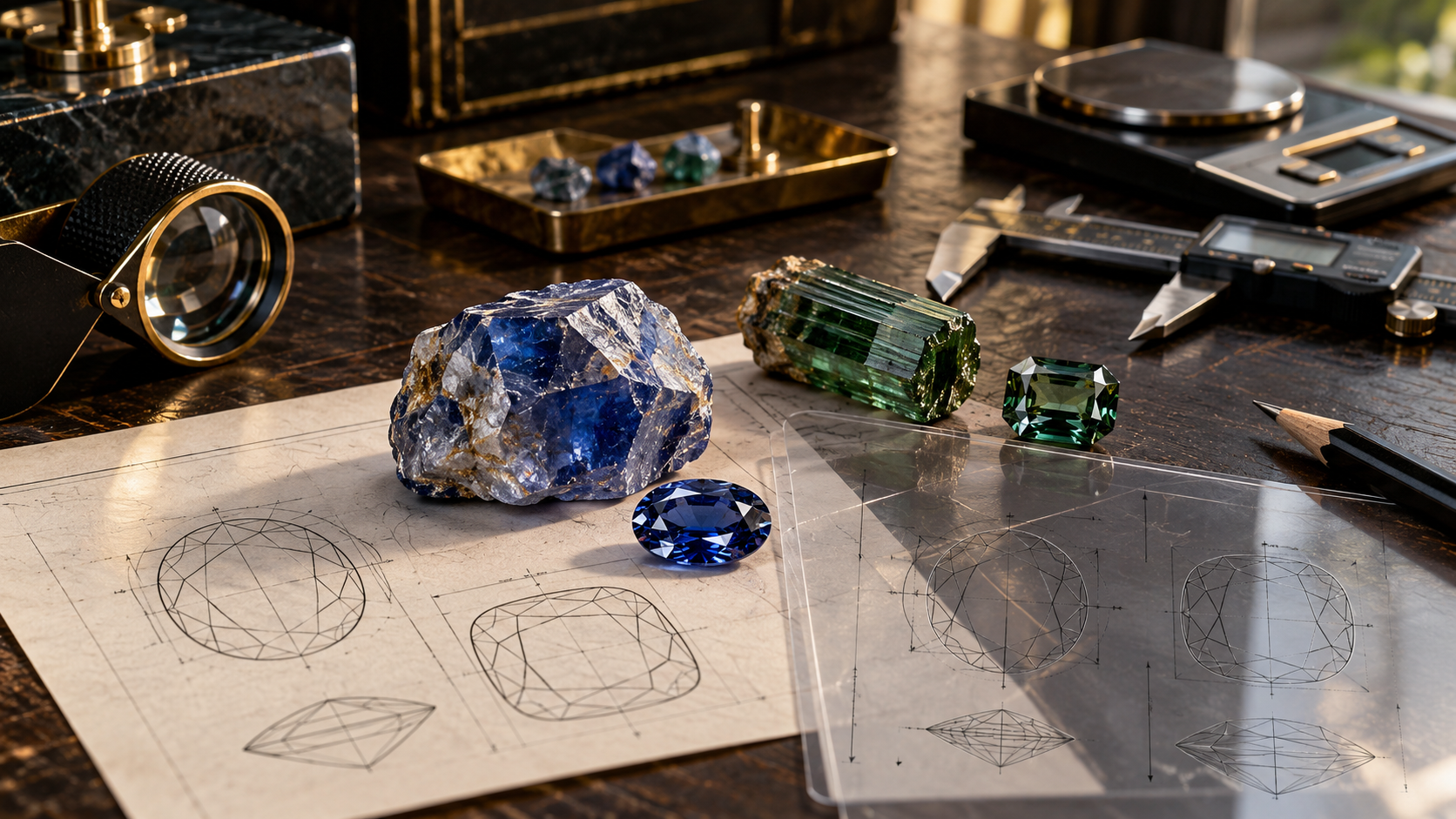
Step 6 — Sketch two possible finished designs
Draw the rough outline from at least two directions.
Sketch two possible finished shapes.
For each design, identify the material that would need to be removed.
Consider whether important inclusions or colour zones would remain.
Step 7 — Compare the alternatives
Evaluate the likely advantages and disadvantages of each design.
Consider colour, transparency, optical appearance, durability and estimated weight retention.
At this stage, a precise yield calculation may not be possible.
A rough estimate is sufficient for understanding the decision-making process.
Step 8 — Record the preferred option
Select the design that appears most appropriate.
Explain why it was chosen.
The objective is not to prove that one design is universally correct.
It is to develop a reasoned cutting plan based on observable evidence.
22. A Practical Cutting-Planning Comparison
Consider three hypothetical rough gemstones.
Example A: Transparent Garnet
The rough is relatively compact.
It displays attractive colour and few visible inclusions.
The material may be suitable for faceting.
The cutter can compare several facet designs.
The principal considerations include shape, proportions, optical performance and expected yield.
Because garnet is generally singly refractive, ordinary pleochroism is not a cutting-orientation concern.
However, refractive index and the actual rough geometry remain important.
Example B: Strongly Pleochroic Tourmaline
The rough is elongated.
Its colour varies significantly with viewing direction.
One direction appears considerably darker than another.
The cutter must consider crystal orientation before selecting the finished shape.
An elongated design may preserve weight.
However, an unfavourable orientation could produce a gemstone that appears excessively dark.
The cutter must balance colour and yield.
Example C: Translucent Chrysoberyl with Parallel Inclusions
The rough contains numerous aligned internal features.
These may create the potential for chatoyancy.
Conventional faceting could reduce the visual importance of the phenomenon.
A correctly oriented cabochon may provide a more attractive result.
The cutter must determine how the inclusions should be positioned relative to the cabochon base.
These examples demonstrate why identical cutting strategies should not be applied indiscriminately to different gemstones.
23. Common Mistakes in Rough Gemstone Evaluation
Several recurring mistakes can lead to disappointing cutting results.
Mistake 1 — Choosing a shape before examining the rough
The intended design should follow an evaluation of the material.
Mistake 2 — Prioritising weight above every other factor
Maximum weight retention does not guarantee attractive optical performance.
Mistake 3 — Ignoring crystal orientation
Pleochroism and cleavage can significantly influence cutting decisions.
Mistake 4 — Underestimating fractures
Internal fractures may extend farther than their surface appearance suggests.
Mistake 5 — Assuming every inclusion is undesirable
Certain inclusions produce valuable optical phenomena.
Mistake 6 — Using the same facet proportions for every mineral
Different refractive indices require different optical considerations.
Mistake 7 — Assuming deeper cuts always improve colour
Excessive depth can produce unattractive darkness.
Mistake 8 — Assuming all transparent rough should be faceted
Some material may display better overall appeal in another cutting style.
Mistake 9 — Applying universal yield percentages
Actual cutting yield varies with material, rough geometry and the intended result.
Mistake 10 — Cutting valuable rough before establishing a plan
Irreversible material removal can eliminate better alternatives.
24. Workshop Safety: An Essential Consideration
Gemstone cutting can generate fine mineral dust.
Certain materials contain crystalline silica.
Quartz and chalcedony are important examples.
Grinding or cutting silica-containing materials can release respirable crystalline silica particles.
According to the United States Occupational Safety and Health Administration, inhalation of respirable crystalline silica can cause serious occupational disease.
Appropriate dust-control measures are therefore essential.
These may include suitable wet-working methods, local exhaust ventilation and other controls selected for the material and equipment.
Wet cutting reduces dust generation but does not automatically eliminate exposure.
Eye protection, equipment guarding and appropriate training are also important.
Different gemstone materials can present additional hazards.
Consequently, practical cutting should take place only with suitable equipment, material-specific safety procedures and appropriate supervision.
The observational workshop in this guide is intended to develop evaluation skills without requiring cutting operations.
25. What Professional Cutting Planning Teaches Gemstone Buyers
Understanding rough gemstone evaluation can also improve the way collectors assess finished stones.
A finished gemstone’s proportions may reflect deliberate decisions about the original material.
A relatively deep gemstone may have been cut to preserve colour.
An unusual outline may reflect the geometry of the rough.
A small inclusion may have been retained to avoid excessive weight loss.
A cabochon may have been selected to display an optical phenomenon.
However, these explanations should not automatically be used to justify poor cutting.
A finished gemstone still needs to be evaluated according to its actual appearance and quality.
The presence of a plausible cutting compromise does not establish that the result is optimal.
Collectors should therefore distinguish between understanding why a cutter made a decision and evaluating whether that decision produced an attractive gemstone.
This distinction is particularly important when assessing transparency, colour distribution, symmetry and optical performance.
26. The Relationship Between Rough Quality and Finished Quality
The quality of a rough gemstone and the quality of its finished result are related but not identical.
A rough gemstone may possess exceptional colour yet contain difficult fractures.
Another may have excellent transparency but an unfavourable shape.
A third may offer strong faceting potential but require substantial material removal.
These characteristics influence the range of possible finished results.
However, cutting skill remains important.
Two lapidaries working with similar rough may produce different outcomes.
One may prioritise weight retention.
Another may prioritise optical performance.
A third may select a different cutting style entirely.
The finished gemstone reflects both the natural properties of the material and the decisions made during cutting.
This is why rough gemstone evaluation and finished gemstone grading should be treated as distinct processes.
Rough evaluation considers the potential of the material.
Finished gemstone grading assesses the result that was actually achieved.
27. Why Some Rough Gemstones Should Remain Uncut
Not every attractive natural gemstone should be transformed into jewellery.
Certain rough crystals possess significant mineralogical or collector appeal.
Well-developed crystal faces can reveal the natural growth characteristics of a mineral.
Distinctive inclusions may provide scientific interest.
Rare crystal habits or unusual associations with other minerals may increase specimen significance.
Cutting such material would permanently remove some of these characteristics.
In certain cases, preserving the original specimen may be the most appropriate decision.
This is particularly relevant for collectors interested in crystallography, geology and natural mineral specimens.
The value of a natural crystal is not necessarily determined by the weight of gemstones it could produce.
Its natural form may be an essential part of its appeal.
28. The Professional Cutting-Planning Principle
The central lesson of gemstone cutting planning is that no single characteristic determines the best result.
Colour matters.
Transparency matters.
Inclusions matter.
Crystal orientation matters.
Durability matters.
Weight retention matters.
Optical performance matters.
The intended purpose of the finished gemstone also matters.
These characteristics interact.
Improving one may require compromising another.
A successful cutting plan recognises these relationships before irreversible work begins.
The objective is not to produce the largest possible gemstone at any cost.
Nor is it necessarily to produce the most complicated facet design.
The objective is to create the most appropriate finished result from the available natural material.
Conclusion: The Art of Recognising Potential
The transformation of rough gemstone material into a finished jewel begins long before the first facet is polished.
It begins with observation.
A skilled lapidary examines the crystal’s shape, colour, transparency, inclusions and physical properties.
They consider how light will behave within the finished gemstone.
They evaluate the risks associated with fractures and cleavage.
They compare different shapes and cutting styles.
They estimate how much material can be preserved.
They also recognise that the greatest weight retention does not necessarily produce the greatest beauty.
These decisions require scientific understanding, practical experience and artistic judgement.
The resulting gemstone is therefore more than a polished mineral.
It is the outcome of a deliberate process in which natural geological characteristics are interpreted and transformed through craftsmanship.
For gemstone collectors, understanding this process provides a deeper appreciation of both rough and finished stones.
It explains why two pieces of apparently similar rough can produce very different results.
It also reveals why some of the most important decisions in gemstone cutting are invisible in the finished jewel.
The true skill of a lapidary begins with recognising what the rough gemstone can become — and knowing which possibilities are worth preserving.
References & Further Reading
The following references have been selected from gemmological research, scientific publications and official occupational safety resources.
They support the guide’s explanations of gemstone cutting planning, optical performance, pleochroism, colour zoning, weight retention, cleavage, inclusions, cabochon phenomena and workshop safety.
All links lead to educational or scientific resources rather than commercial gemstone product pages.
1. Gemological Institute of America – Colored Gemstone Value Factors
Author: Al Gilbertson
Published: 9 August 2018
Publication: GIA Research News
Series: Value Factors, Design, and Cut Quality of Colored Gemstones — Part 1
A comprehensive educational explanation of the relationship between rough gemstone characteristics, cutting decisions, colour, clarity, shape and weight retention.
The article discusses why cutting yield can vary considerably and why maximising weight does not always produce the most valuable finished gemstone.
2. Gemological Institute of America – Factors in Colored Stones that Interact to Affect Value
Author: Al Gilbertson
Published: 9 August 2018
Publication: GIA Research News
Series: Value Factors, Design, and Cut Quality of Colored Gemstones — Part 4
An important explanation of colour zoning and the relationship between colour distribution and cutting orientation.
The article includes examples of rough sapphire and explains how cutters may position concentrated colour zones to improve face-up appearance.
https://www.gia.edu/gia-news-research-some-factors-that-interact-to-affect-value
3. Gemological Institute of America – Colored Stone Darkness & Brightness
Author: Al Gilbertson
Published: 9 August 2018
Publication: GIA Research News
Series: Value Factors, Design, and Cut Quality of Colored Gemstones — Part 3
A detailed explanation of windowing, extinction, absorption, brightness and gemstone proportions.
The publication discusses how refractive index influences the optical performance of faceted gemstones and why different materials require different cutting considerations.
https://www.gia.edu/gia-news-research-colored-stone-darkness-and-brightness
4. Gemological Institute of America – Colored Stone Cut Quality: What to Look For
Author: Al Gilbertson
Published: 9 August 2018
Publication: GIA Research News
Series: Value Factors, Design, and Cut Quality of Colored Gemstones — Part 5
An educational guide to evaluating the craftsmanship of finished coloured gemstones.
The publication discusses outline, symmetry, table placement, proportions and the relationship between cutting precision and gemstone appearance.
https://www.gia.edu/gia-news-research-colored-stone-cut-quality-what-to-look-for
5. Hughes, Richard W. – Pleochroism in Faceted Gems: An Introduction
Publication: Gems & Gemology
Volume: 50, Number 3
Published: Fall 2014
Institution: Gemological Institute of America
A peer-reviewed technical study explaining how pleochroism influences the appearance of faceted gemstones.
The article examines crystal orientation, optical directions and the cutting of materials such as tourmaline, sapphire and tanzanite.
https://www.gia.edu/gems-gemology/fall-2014-introduction-pleochroism-faceted-gems
6. Bassoo, Roy; Eames, Diane; Hardman, Matthew F.; Befus, Kenneth; Sun, Ziyin – Topaz from Mason County, Texas
Publication: Gems & Gemology
Volume: 59, Number 4
Published: Winter 2023
Institution: Gemological Institute of America
A scientific study of natural Texas topaz, including its mineralogical characteristics and cutting considerations.
The publication explains the importance of basal cleavage and describes how cutting orientation can balance durability with attractive colour.
https://www.gia.edu/gems-gemology/winter-2023-texas-topaz
7. Tuzlukov, Victor; Kaewchaijaroenkit, Patcharee; Sturman, Nicholas – The “Fragility of the Eternal” Kunzite: Origin, Cutting, and Identification
Publication: Gems & Gemology
Volume: 56, Number 2
Published: Summer 2020
Institution: Gemological Institute of America
A documented case study examining the challenges of cutting an exceptionally large kunzite crystal.
The article discusses pleochroism, perfect cleavage, internal fractures, cutting strategy and the practical difficulties of working with fragile rough material.
https://www.gia.edu/gems-gemology/summer-2020-gemnews-fragility-of-the-eternal-kunzite
8. Gemological Institute of America – Emerald Quality Factors
Institution: Gemological Institute of America
Resource: Gemstone Quality Factors
An educational reference explaining how colour, inclusions, fractures and durability influence emerald cutting.
The resource discusses the advantages of the emerald cut, the importance of crystal orientation and the potential consequences of removing strongly coloured regions of rough.
https://www.gia.edu/emerald-quality-factor
9. Gemological Institute of America – Optical Effects of Phenomenal Cabochons
Author: Sharon Bohannon
Published: 11 November 2016
Institution: Gemological Institute of America
An educational explanation of optical phenomena displayed by cabochon gemstones.
The article discusses chatoyancy, asterism, adularescence, labradorescence and play-of-colour.
It also explains the importance of correctly orienting inclusions when cutting cat’s-eye and star gemstones.
https://www.gia.edu/gia-news-research/optical-effects-phenomenal-cabochons
10. Grussing, Theodore – The Challenges of Cutting a Large Gem Opal Rough
Publication: Gems & Gemology
Volume: 52, Number 2
Published: Summer 2016
Institution: Gemological Institute of America
A detailed practical case study documenting the cutting of a 3,019-carat Australian rough opal into a 1,040-carat finished gemstone.
The publication examines colour-bar distribution, cutting risk, planning alternatives and the relationship between commercial considerations and exceptional collector specimens.
https://www.gia.edu/gems-gemology/summer-2016-challenges-cutting-large-gem-opal-rough
11. Gilbertson, Al – Optimizing Face-Up Appearance in Colored Gemstone Faceting
Publication: Gems & Gemology
Volume: 49, Number 2
Published: Summer 2013
Institution: Gemological Institute of America
A technical research article examining brightness, contrast, facet arrangement and the visual interpretation of light patterns in coloured gemstones.
The study explains how cutting designs can be evaluated and adjusted to improve face-up appearance.
https://www.gia.edu/gems-gemology/optimizing-face-up-appearance-in-colored-gemstone-faceting
12. Occupational Safety and Health Administration – Crystalline Silica: Overview
Institution: United States Department of Labor
Resource: Occupational Safety and Health Administration
An official occupational safety resource explaining the hazards associated with respirable crystalline silica.
The publication discusses exposure during cutting, grinding and other stone-working operations, together with the importance of appropriate exposure-control measures.
https://www.osha.gov/silica-crystalline
Scientific Interpretation and Practical Limitations
Gemstone cutting planning requires consideration of the specific material being evaluated.
The examples and numerical calculations presented in this guide are educational illustrations rather than guaranteed cutting outcomes.
Expected yield depends on rough geometry, transparency, internal characteristics, mineral properties and the selected cutting design.
No universal yield percentage or facet arrangement is appropriate for every gemstone.
Likewise, general cutting-orientation recommendations should not replace specimen-specific evaluation.
Pleochroism, cleavage, colour zoning and inclusions may influence the optimal orientation in different ways.
The relationship between cutting quality and commercial value also depends on gemstone species, size, colour, market preferences and other factors.
Practical cutting operations require suitable equipment, training and appropriate safety controls.
The observational workshop is intended to develop evaluation skills without requiring potentially hazardous cutting or grinding procedures.