

Table of Contents
When a Stone Becomes Part of a Sacred Journey
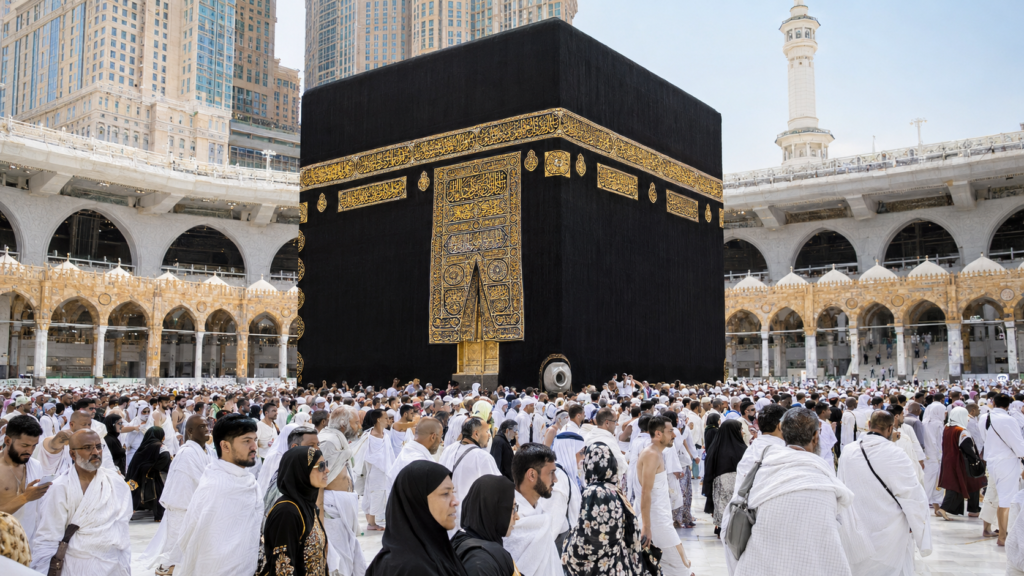
In the Grand Mosque of Mecca stands the Kaaba, the most important sanctuary in Islam.
Its simple cubic form, covered with a black cloth embroidered with Qur’anic inscriptions, is recognised throughout the Muslim world.
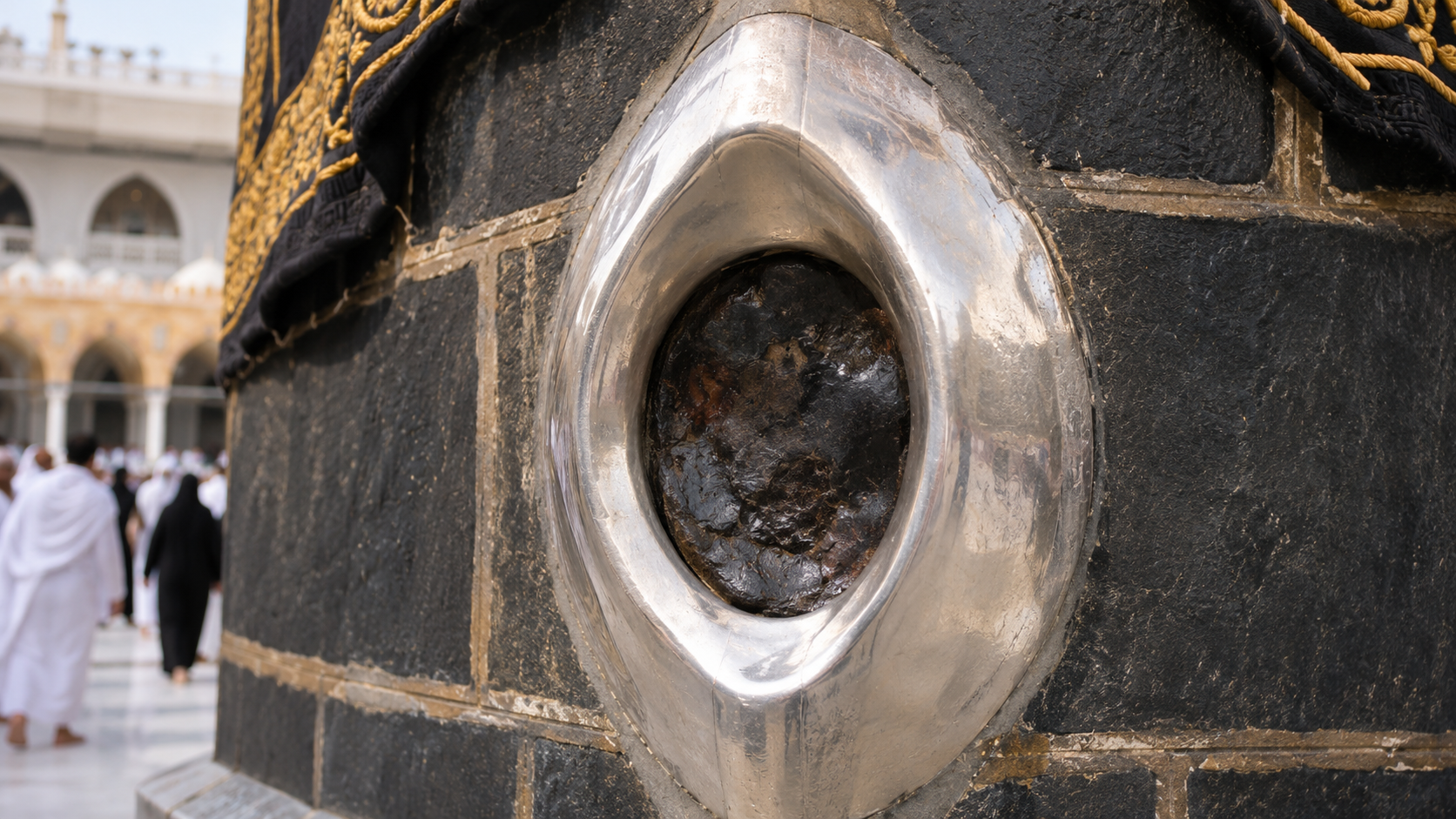
Set into its eastern corner is a remarkable object: the Black Stone of the Kaaba, known in Arabic as al-Ḥajar al-Aswad.
For centuries, Muslim pilgrims have approached this corner during the rites of Hajj and Umrah.
Some have been able to touch or kiss the stone. Others acknowledge it from a distance while continuing their circumambulation of the Kaaba.
The Black Stone of the Kaaba occupies a distinctive place in Islamic religious practice.
Yet its significance differs fundamentally from the modern idea that gemstones possess intrinsic healing frequencies or supernatural vibrations.
The stone is revered within a religious tradition because of its association with sacred history, prophetic practice and pilgrimage.
This reverence for the Black Stone of the Kaaba is deeply rooted in Islamic tradition.
Its importance is not dependent upon laboratory measurements of its physical properties.
The Black Stone demonstrates how a natural object can acquire profound religious significance through tradition and ritual without becoming an object of worship in itself.
Its history also raises fascinating questions about the relationship between material evidence, religious belief and scientific uncertainty.
What Is the Black Stone?
The Black Stone is a dark-coloured object set into the eastern corner of the Kaaba.
It is surrounded by a silver mounting.
The visible surface consists of several dark fragments held together within the setting.
Historical accounts describe damage and repairs over time.
The precise geological identity of the stone has not been conclusively established through modern scientific examination.
Various hypotheses have been proposed, including meteorite material, impact-related glass and terrestrial rock.
However, none should be presented as a confirmed identification.
The object has not been subjected to the type of comprehensive, publicly documented analytical programme normally required for reliable gemmological classification.
This uncertainty is important.
The Black Stone is unquestionably significant as a religious and historical object.
Its mineralogical composition remains a separate scientific question.
The Kaaba and the Direction of Prayer
The Kaaba is located within the Masjid al-Haram, the Grand Mosque of Mecca.
Muslims throughout the world orient their formal prayers towards the Kaaba.
This direction is known as the qibla.
The Qur’an refers to the Sacred Mosque in connection with the direction of prayer.
Surah al-Baqarah 2:144 instructs believers to turn towards the Sacred Mosque.
This establishes the religious importance of the sanctuary within Islamic practice.
However, facing the Kaaba does not mean worshipping the building or the Black Stone.
Islamic monotheism directs worship to God alone.
The Kaaba functions as a sacred focal point and shared direction of prayer.
The Black Stone occupies a particular position within this wider religious setting.
The Black Stone and Tawaf
One of the central rituals of Hajj and Umrah is tawaf.
During tawaf, pilgrims circumambulate the Kaaba seven times.
The movement takes place in an anticlockwise direction.
The Black Stone marks the traditional starting and ending point of each circuit.
Pilgrims may acknowledge the stone as they pass.
When conditions permit, some may touch or kiss it.
However, the enormous number of pilgrims often makes direct physical contact impractical.
Acknowledging the Black Stone from a distance is an established alternative.
The religious significance of tawaf lies in the prescribed act of worship.
The stone serves as a recognised point within that ritual.
It should not be interpreted as a device that emits a measurable spiritual energy field.
The Prophetic Tradition of Kissing the Black Stone
The practice of kissing the Black Stone is associated with the example of the Prophet Muhammad.
One of the most important historical religious texts concerning this practice appears in Sahih al-Bukhari.
The collection records a statement attributed to the second caliph, Umar ibn al-Khattab.
According to the report, Umar acknowledged that the stone itself could neither harm nor benefit him independently.
He explained that he kissed it because he had seen the Prophet Muhammad do so.
This account is particularly significant.
It establishes a distinction between reverence for a religious practice and belief that the physical stone possesses autonomous divine power.
The act is understood within the framework of prophetic example.
It is not presented as gemstone worship.
Reverence Is Not Worship
The distinction between reverence and worship is essential to understanding the Black Stone.
In Islamic theology, worship belongs to God alone.
A sacred object may be respected because of its religious associations.
But the object itself is not regarded as a deity.
The report concerning Umar provides an especially clear illustration.
His statement rejects the idea that the stone independently controls benefit or harm.
The act of kissing it follows religious tradition.
This distinction prevents an important misunderstanding.
The Black Stone should not be described as a magical gemstone worshipped by Muslims.
Such a description would misrepresent Islamic belief.
Its significance belongs to the religious history and ritual practice of Islam.
The Black Stone in Islamic Sacred History
Islamic tradition associates the Kaaba with the Prophet Ibrahim, known in English as Abraham, and his son Ismail, or Ishmael.
The Qur’an refers to Abraham and Ishmael raising the foundations of the House.
Surah al-Baqarah 2:127 records this tradition.
The Black Stone is also connected with accounts of the sanctuary’s early history.
However, it is important to distinguish Qur’anic statements from later religious narratives.
The Qur’an discusses the Kaaba and its sacred role.
It does not provide a modern geological explanation of the Black Stone.
Later hadith and historical traditions contain additional accounts concerning the stone.
These sources belong to different literary and historical categories.
Responsible interpretation should not combine them without distinction.
The Tradition of the Stone’s Heavenly Origin
Some Islamic traditions describe the Black Stone as having descended from Paradise.
One widely cited report appears in Jami’ al-Tirmidhi.
The narration describes the stone as originally white and subsequently darkened.
Within religious interpretation, this account has been associated with human sin.
However, the narrative should be understood as a religious tradition.
It does not establish the stone’s geological origin.
A statement that the stone came from Paradise is not equivalent to scientific evidence that it is a meteorite.
The two ideas belong to different explanatory frameworks.
One concerns sacred history and theological meaning.
The other concerns physical origin and mineral composition.
Confusing them can produce misleading claims about both religion and science.
Was the Black Stone Originally White?
The tradition describing an originally white stone is significant within Islamic religious literature.
It offers a symbolic account of transformation.
However, the visible dark colour of the present stone cannot be used to confirm the narrative scientifically.
Many natural materials darken through different geological or environmental processes.
Surface alteration, chemical changes and accumulated deposits can affect appearance.
But without reliable analytical evidence, the precise causes of the Black Stone’s colour cannot be established.
The religious account should therefore be presented as tradition rather than mineralogical fact.
This distinction allows the narrative to be discussed respectfully without making unsupported scientific claims.
The Black Stone Before Islam
The Kaaba existed as a sanctuary before the emergence of Islam in the seventh century.
Historical accounts describe its role within the religious environment of pre-Islamic Arabia.
The Prophet Muhammad’s religious reforms transformed the sanctuary’s significance within Islamic monotheism.
However, reconstructing the exact early history of the Black Stone is difficult.
Later written sources preserve accounts of earlier events.
These accounts must be interpreted with attention to their dates, purposes and religious contexts.
It would be misleading to claim that the stone’s complete pre-Islamic history is securely known.
Its present religious significance is well documented.
Its earliest physical history remains less certain.
The Story of the Black Stone and Muhammad’s Mediation
Islamic biographical traditions recount an episode in which the Kaaba was rebuilt before Muhammad’s prophetic mission.
According to the narrative, different groups disputed who should have the honour of placing the Black Stone.
Muhammad is said to have proposed placing it on a cloth so that representatives could lift it together.
He then positioned the stone.
The story is commonly interpreted as illustrating wisdom, cooperation and the peaceful resolution of conflict.
However, it should be identified as a traditional biographical account rather than an independently verified archaeological event.
Its importance lies in its place within Islamic historical memory.
It also demonstrates how the Black Stone became associated with questions of honour, community and reconciliation.
The Silver Setting and the Fragmented Stone
The Black Stone is not displayed as one large, freely accessible mineral specimen.
Its visible fragments are held within a mounting.
Historical damage and subsequent repairs contributed to its present appearance.
The silver frame serves a practical role in securing and protecting the visible material.
It also creates a distinctive visual boundary around the stone.
The contrast between dark fragments and polished silver is striking.
However, the mounting should not be interpreted as evidence of a particular mineral composition.
The frame is a historical and functional component.
It does not establish whether the stone is terrestrial or extraterrestrial.
The Black Stone and the Qarmatian Seizure
One of the most dramatic episodes in the stone’s recorded history occurred in the tenth century.
In 930 CE, the Qarmatians attacked Mecca.
Historical accounts describe the removal of the Black Stone from the Kaaba.
It was eventually returned in 951 CE.
This episode demonstrates the extraordinary religious and political importance attached to the object.
The seizure was not merely the theft of an unusual stone.
It involved a sacred object central to the symbolic geography of Islamic pilgrimage.
However, historical narratives concerning the precise details of the seizure, damage and return vary.
The broad event is well established in historical scholarship.
Individual details require careful source evaluation.
Why the Black Stone’s Physical Identity Remains Uncertain
The Black Stone has attracted geological speculation for centuries.
Its dark appearance and religious importance have encouraged numerous theories.
Some writers have suggested that it may be a meteorite.
Others have proposed impact glass or terrestrial materials.
However, appearance alone cannot establish mineral identity.
Meteorites can be dark.
So can basalt, obsidian, certain iron-rich minerals and many other substances.
A reliable identification would require appropriate scientific investigation.
Depending on the material and permitted methods, this might include spectroscopy, microscopy, elemental analysis or other non-destructive techniques.
Such investigation would also need to respect the object’s religious significance and conservation requirements.
Until sufficient evidence is available, its composition should remain classified as uncertain.
Is the Black Stone a Meteorite?
The meteorite hypothesis is widely repeated in popular writing.
However, it has not been conclusively demonstrated.
The religious tradition that the stone descended from Paradise does not constitute scientific evidence of extraterrestrial origin.
Likewise, the stone’s dark colour does not prove that it came from space.
Many meteorites contain characteristic minerals, textures and chemical signatures.
These properties require examination.
Without reliable analytical data, a meteorite identification remains speculative.
For gemmological accuracy, the Black Stone should not be described as a confirmed meteorite.
Is the Black Stone a Gemstone?
The word gemstone is commonly used for natural materials valued for beauty, rarity or ornamentation.
However, the Black Stone does not fit neatly into conventional gemmological categories.
Its mineralogical identity is uncertain.
Its religious significance is not based upon conventional gemstone grading.
It is not valued according to cut, clarity, carat weight or optical brilliance.
Its importance derives from its position within Islamic sacred history and pilgrimage.
Therefore, it is more accurate to describe it as a sacred stone or religious object than as a commercially classified gemstone.
This distinction is particularly important for educational writing.
The Meaning of Black in the Black Stone
The stone’s dark colour is one of its most recognisable characteristics.
However, it should not automatically be assigned the symbolism used in modern crystal-healing systems.
Black gemstones are sometimes associated with grounding, protection or the absorption of negative energy.
Such interpretations are not an adequate explanation of the Black Stone’s role in Islam.
Its religious significance derives from scripture, prophetic tradition and pilgrimage practice.
The colour may participate in particular religious narratives.
But it does not establish a universal system of black-stone energy.
Historical context is essential.
The Difference Between the Black Stone and Modern Crystal Healing
Modern crystal-healing practices frequently attribute specific energetic properties to minerals.
Black tourmaline may be described as protective.
Obsidian may be associated with grounding.
Onyx may be linked with emotional strength.
These interpretations belong to contemporary metaphysical traditions.
They should not be projected onto the Black Stone.
Islamic reverence for the Black Stone is not based upon the same conceptual system.
Its role is connected with tawaf and prophetic practice.
The distinction matters because treating all sacred stones as interchangeable examples of crystal energy obscures the diversity of religious traditions.
Does the Black Stone Possess Healing Energy?
There is no reliable scientific evidence that the Black Stone emits a supernatural healing field.
Its religious significance does not require such a claim.
The physical composition of the stone has not been conclusively established.
Even if its composition were identified, that would not demonstrate medical or supernatural effects.
Religious devotion may influence personal experience, emotion and spiritual interpretation.
However, these experiences should not be confused with scientifically established therapeutic properties of the stone itself.
The Black Stone should not be promoted as a medical treatment or as a source of measurable healing radiation.
The Role of Intention in Pilgrimage
The significance of pilgrimage extends beyond physical movement.
Within Islamic practice, intention and religious obligation are important.
Tawaf is not simply walking around a building.
It is an act of worship performed within a religious framework.
The Black Stone marks a recognised point in that ritual.
Its importance therefore depends upon the meaning of the action.
The stone itself does not independently determine the pilgrim’s spiritual condition.
This distinction is consistent with the emphasis on monotheism expressed in the report concerning Umar.
The object is respected because of its religious associations.
Worship remains directed towards God.
Physical Contact Is Not Essential to Reverence
During busy pilgrimage periods, many people cannot approach the Black Stone directly.
The enormous number of pilgrims makes crowd management essential.
Acknowledging the stone from a distance is an established practice.
This demonstrates that the religious meaning of the ritual does not depend exclusively upon physical contact.
The act can be performed without touching the object.
That distinction is particularly relevant when comparing Islamic practice with modern claims that gemstones must physically contact the body to transmit energy.
The Black Stone’s role belongs to ritual observance, not a scientifically established mechanism of energy transfer.
A Sacred Object and the Ethics of Conservation
The Black Stone is both a religiously important object and a historical material artefact.
Its conservation requires exceptional care.
Any scientific investigation would need to respect religious sensitivities, physical integrity and the requirements of the custodians responsible for the sanctuary.
Non-destructive methods may offer possibilities for material study.
However, scientific curiosity does not automatically justify intrusive examination.
The object’s significance extends beyond its composition.
This illustrates a broader principle in heritage conservation.
Sacred objects cannot always be treated as ordinary geological specimens.
Their religious and cultural contexts matter.
Why the Black Stone Matters to Gemstone Education
The Black Stone provides an unusual but valuable case study.
It demonstrates that the significance of a natural object may be independent of its gemmological classification.
Its religious importance is well established.
Its geological identity remains uncertain.
Its physical appearance has inspired speculation.
Its history includes episodes of damage, removal and restoration.
Its role in pilgrimage is connected with prophetic tradition.
And its sacred meaning should not be confused with modern crystal-energy claims.
These distinctions are essential to responsible educational writing.
They show why geology, history and religious studies must sometimes be considered together.
What Is Historically Documented – and What Is Not?
Several conclusions can be stated with confidence.
The Black Stone is set into the eastern corner of the Kaaba in Mecca.
It marks the traditional starting and ending point of tawaf.
Its veneration is connected with Islamic prophetic tradition.
The stone is not regarded as an independent deity within Islamic monotheism.
Historical sources document its removal by the Qarmatians in the tenth century.
Its present visible form includes dark fragments within a silver setting.
However, its exact mineralogical identity has not been conclusively established.
Claims that it is a confirmed meteorite are unsupported.
Claims that it emits healing energy are likewise unsupported.
Religious narratives concerning its heavenly origin belong to Islamic tradition rather than modern geological science.
Conclusion: Sacred Meaning Beyond Mineral Composition
The Black Stone of the Kaaba is one of the most recognisable sacred stones in the world.
Its significance is rooted in Islamic religious history.
It is connected with pilgrimage, prophetic example and the sacred geography of Mecca.
Its physical composition remains scientifically uncertain.
Yet that uncertainty does not diminish its religious importance.
The Black Stone demonstrates that a natural object can be deeply meaningful without requiring a confirmed gemstone identity.
It also shows that reverence for a sacred object does not necessarily imply worship of the object itself.
The significance of the Black Stone lies in its place within Islamic faith, ritual and historical memory – not in scientifically demonstrated supernatural properties of its material.
For Natural Gems Belgium, this subject offers an important lesson in the study of gemstones and spirituality.
Mineralogy investigates what a stone is.
History examines how it has been treated and understood.
Religious studies explores the meanings attached to it.
Science evaluates claims about physical effects.
These perspectives can coexist without being confused.
The Black Stone remains a powerful example of the distinction between sacred tradition and material science.
References & Further Reading
1. Encyclopaedia Britannica – Black Stone of the Kaaba
https://www.britannica.com/topic/Black-Stone-of-Mecca
Source description: Authoritative reference on the Black Stone’s location, religious significance, historical traditions and relationship with Islamic pilgrimage.
2. Encyclopaedia Britannica – Kaaba
https://www.britannica.com/topic/Kaaba
Source description: Historical and religious overview of the Kaaba, its role in Islam, its architecture and its significance as the direction of Muslim prayer.
3. Encyclopaedia Britannica – Hajj
https://www.britannica.com/topic/hajj
Source description: Reference explaining the Islamic pilgrimage, its principal rites and the role of circumambulation around the Kaaba.
4. Qur’an – Surah al-Baqarah 2:127
Source description: Primary Islamic religious text referring to Abraham and Ishmael raising the foundations of the House. Relevant to Islamic sacred history associated with the Kaaba.
5. Qur’an – Surah al-Baqarah 2:144
Source description: Primary religious text concerning the direction of prayer towards the Sacred Mosque.
6. Sahih al-Bukhari – Hadith 1597
https://sunnah.com/bukhari:1597
Source description: Primary hadith report recording Umar ibn al-Khattab’s statement concerning the Black Stone and the prophetic example of kissing it. Essential for distinguishing religious reverence from belief in autonomous material power.
7. Jami’ al-Tirmidhi – Hadith 877
https://sunnah.com/tirmidhi:877
Source description: Primary hadith text containing the tradition that the Black Stone descended from Paradise and was originally white. Presented as religious tradition, not scientific evidence of geological origin.
8. Encyclopaedia Britannica – Qarmatians
https://www.britannica.com/topic/Qarmatians
Source description: Historical reference concerning the Qarmatian movement and its role in the tenth-century attack on Mecca and removal of the Black Stone.
Historical, Religious and Scientific Distinctions
Historically documented: The Black Stone is located in the eastern corner of the Kaaba in Mecca.
Religious practice: The stone marks the traditional starting and ending point of tawaf during Hajj and Umrah.
Islamic tradition: Kissing or acknowledging the Black Stone is associated with the example of the Prophet Muhammad.
Theological distinction: Islamic monotheism does not treat the Black Stone as an independent deity.
Religious narrative: Some hadith describe the stone as descending from Paradise and originally being white.
Historically documented: The Black Stone was removed by the Qarmatians in 930 CE and returned in 951 CE.
Scientific uncertainty: The precise geological identity of the Black Stone has not been conclusively established.
Unconfirmed hypothesis: Claims that the stone is a meteorite remain speculative.
Modern metaphysical comparison: Contemporary ideas about black gemstones absorbing negative energy should not be projected onto Islamic pilgrimage traditions.
Scientific limitation: There is no reliable evidence that the Black Stone emits supernatural healing energy or possesses independently measurable protective powers.
The Black Stone demonstrates the importance of distinguishing religious significance from physical composition.
Its sacred role belongs to Islamic faith and pilgrimage.
Its history belongs to the study of religious and political events.
Its material identity remains an unresolved scientific question.
Its alleged supernatural physical effects are not scientifically established.
Related Products
-

18K Yellow Gold Rope Chain Bracelet · Adjustable 15 · 18 cm · Luxury NGB Jewelry
$251.21 -

Baltic Amber Chip Bracelet 10 mm · Natural Dark Honey Amber Bead Bracelet
$32.67 -

Bead Bracelet with bridge · Rose Quartz · 8mm · pink charm bracelet
$36.86 -

Beaded Bracelet · Agate · 6 mm beads · Blue lace agate
$22.10