Table of Contents
Introduction: The Geological Environments Behind Extraordinary Crystals
Some of the world’s most remarkable mineral specimens come from a distinctive type of igneous rock known as pegmatite.
A single pegmatite may contain feldspar crystals several metres long, enormous masses of quartz, large sheets of mica and impressive crystals of beryl or spodumene.
Yet the most valuable gem-quality material is not necessarily found in the largest crystals.
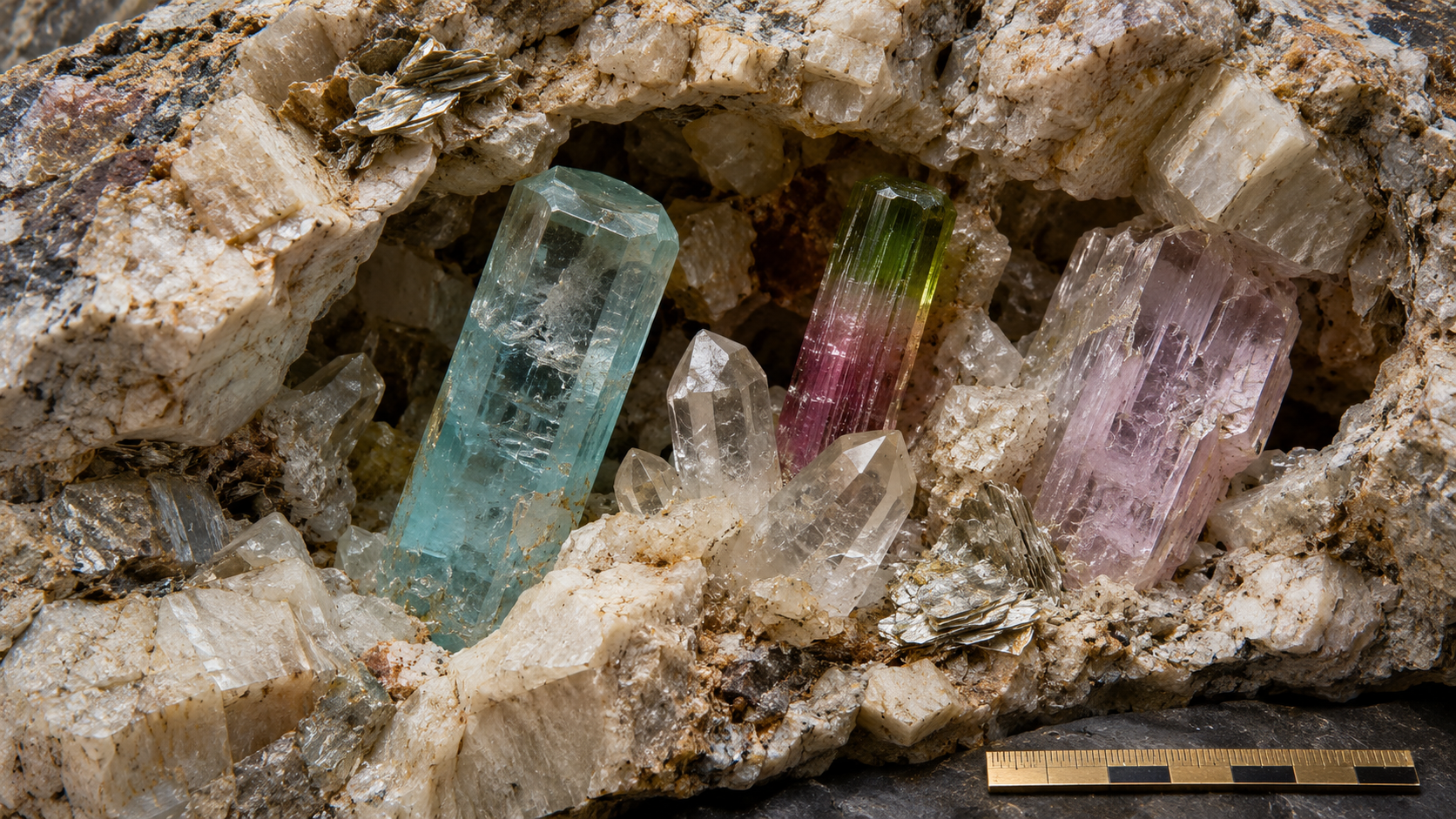
Within some pegmatites, relatively small cavities can contain beautifully formed, transparent crystals of tourmaline, aquamarine, topaz, quartz or other minerals.
These cavities are commonly called pegmatite pockets or miarolitic cavities.
They are among the most important geological environments for certain coloured gemstones and exceptional mineral specimens.
Their formation involves the interaction of magma, dissolved water, chemical components, crystal growth and evolving geological conditions.
Understanding pegmatite pockets helps explain a fascinating contrast: why the same geological system can produce both enormous opaque crystals and smaller, highly transparent gemstones.
1. What Is a Pegmatite?
Pegmatite is an exceptionally coarse-grained igneous rock.
Most gem-bearing pegmatites are granitic in composition.
They commonly contain quartz, feldspar and mica, together with variable quantities of accessory minerals.
The US Geological Survey describes pegmatites as intrusive bodies that may occur as dikes, lenses or veins within surrounding rocks.
Their most distinctive characteristic is often the size of their constituent crystals.
Some crystals grow to dimensions far beyond those normally encountered in ordinary granite.
However, crystal size alone does not fully define the geological complexity of pegmatites.
Many also display unusual chemical enrichment, internal zoning and distinctive mineral assemblages.
The 2025 GIA review Gem Granitic Pegmatites identifies these rocks as important sources of tourmaline, beryl, spodumene, topaz, garnet and other gemstones.
2. How Do Granitic Pegmatites Form?
Many granitic pegmatites form from evolved silicate melts associated with granitic magmatism.
As a granitic magma crystallises, minerals remove particular chemical components from the remaining liquid.
The residual melt may become enriched in components that were not readily incorporated into the earlier minerals.
These can include water, boron, fluorine, phosphorus, lithium, beryllium and other elements.
Under suitable conditions, the evolved melt may enter fractures in the surrounding rock.
It then crystallises to form a pegmatite body.
However, not every pegmatite follows an identical formation pathway.
Some pegmatitic melts may be produced through partial melting of crustal rocks rather than simply representing the final liquid remaining from a large granite intrusion.
The geological origin must therefore be evaluated for each deposit.
3. Why Are Pegmatite Crystals So Large?
The enormous crystals found in some pegmatites have fascinated geologists for generations.
A common explanation is that they simply cooled very slowly.
However, this is incomplete.
Research indicates that pegmatite crystal growth is strongly influenced by the chemistry and physical properties of the crystallising system.
Water and other fluxing components can lower crystallisation temperatures and affect the transport of chemical species.
They may promote the movement of material toward growing crystal surfaces.
Under favourable conditions, large crystals can develop relatively rapidly.
The USGS deposit model for lithium-cesium-tantalum pegmatites describes crystallisation at approximately 350–550°C in certain systems and indicates that some pegmatites may crystallise over surprisingly short geological timescales.
These values should not be applied universally to every pegmatite.
The essential principle is that giant crystal size does not necessarily prove extremely slow cooling.
Crystal growth depends on the combined effects of melt chemistry, nucleation, transport and crystallisation conditions.
4. Nucleation and Crystal Growth
Before a crystal can grow, a stable crystalline nucleus must form.
This process is called nucleation.
Once a nucleus develops, additional atoms or ions can become incorporated into its structure.
The final crystal size depends partly on how many crystals begin growing and how much material is available to each.
If many nuclei form, the available material may be divided among numerous crystals.
If fewer nuclei develop, individual crystals may grow much larger.
However, nucleation density is only one factor.
Chemical transport, temperature, crystallisation kinetics and available space also matter.
Pegmatites provide unusual conditions in which some minerals can develop extremely large crystals.
Their textures reflect a complex interplay of these processes rather than a single universal growth mechanism.
5. The Role of Water and Fluxing Components
Water plays an important role in many granitic pegmatite systems.
It may initially be dissolved in the silicate melt.
As crystallisation proceeds, the remaining melt can become increasingly enriched in water and other components.
Under suitable conditions, a separate aqueous fluid phase may develop.
The interaction between melt and fluid can influence mineral growth and chemical transport.
Other components, including boron, fluorine and phosphorus, can affect melt properties and mineral stability.
The USGS identifies these components as important in the formation of lithium-cesium-tantalum pegmatites.
However, the precise roles of melt, fluid and crystallisation processes remain subjects of scientific investigation.
It would be misleading to describe every gem pocket as a simple bubble of water inside cooling granite.
The actual geological processes can be substantially more complex.
6. What Is a Pegmatite Pocket?
A pegmatite pocket is a cavity within a pegmatite that provides open space for crystal growth.
Such cavities are often called miarolitic cavities.
They may contain well-formed crystals projecting from the cavity walls.
Unlike crystals growing within a tightly packed rock mass, crystals growing into open space can develop more complete external faces.
This is particularly important for mineral specimens.
A tourmaline crystal growing freely into a pocket may develop an attractive prismatic shape and termination.
A quartz crystal may grow as a distinct point rather than as an irregular mass.
A beryl crystal may develop relatively clean external faces.
However, pocket formation does not guarantee gemstone quality.
Some pocket crystals are heavily included, fractured or opaque.
Others are exceptionally transparent.
7. Why Gem-Quality Crystals Often Occur in Pockets
GIA’s classic 1984 review of gem-bearing pegmatites distinguishes large crystals embedded in massive pegmatite from smaller transparent crystals found in cavities.
Large crystals in massive quartz or feldspar may be fractured or clouded by inclusions.
Pocket crystals can grow into available space with fewer physical constraints.
In some environments, the later stages of crystallisation may produce material with improved transparency.
The 2020 study Temperatures and Duration of Crystallization Within Gem-Bearing Cavities of Granitic Pegmatites documents distinct mineral-forming stages in pegmatite cavities.
These can include gem-quality growth, later zeolite deposition and clay formation.
However, pocket growth does not always produce flawless gemstones.
Internal fractures, fluid inclusions, growth tubes and other features may still be present.
The distinction between a well-formed crystal and a facetable crystal remains essential.
8. Internal Zoning Within Pegmatites
Some pegmatites display internal mineralogical zoning.
Different regions of the same pegmatite body may contain different mineral proportions or crystal textures.
A simplified zoned pegmatite may include:
- A border zone near the surrounding rock
- A wall zone
- One or more intermediate zones
- A core or central region
However, this arrangement is not universal.
Some pegmatites are relatively homogeneous.
Others display complicated, irregular or incomplete zoning.
USGS mapping of the Crystal Mountain district in Colorado documented both zoned and unzoned pegmatites.
The internal distribution of minerals depends on the evolution of the crystallising system.
Importantly, pegmatite zoning is not identical to colour zoning inside an individual gemstone.
One describes the arrangement of minerals across a rock body.
The other describes variations within a crystal.
9. Quartz in Pegmatites
Quartz is one of the principal minerals of many granitic pegmatites.
It may occur as large irregular masses within the rock.
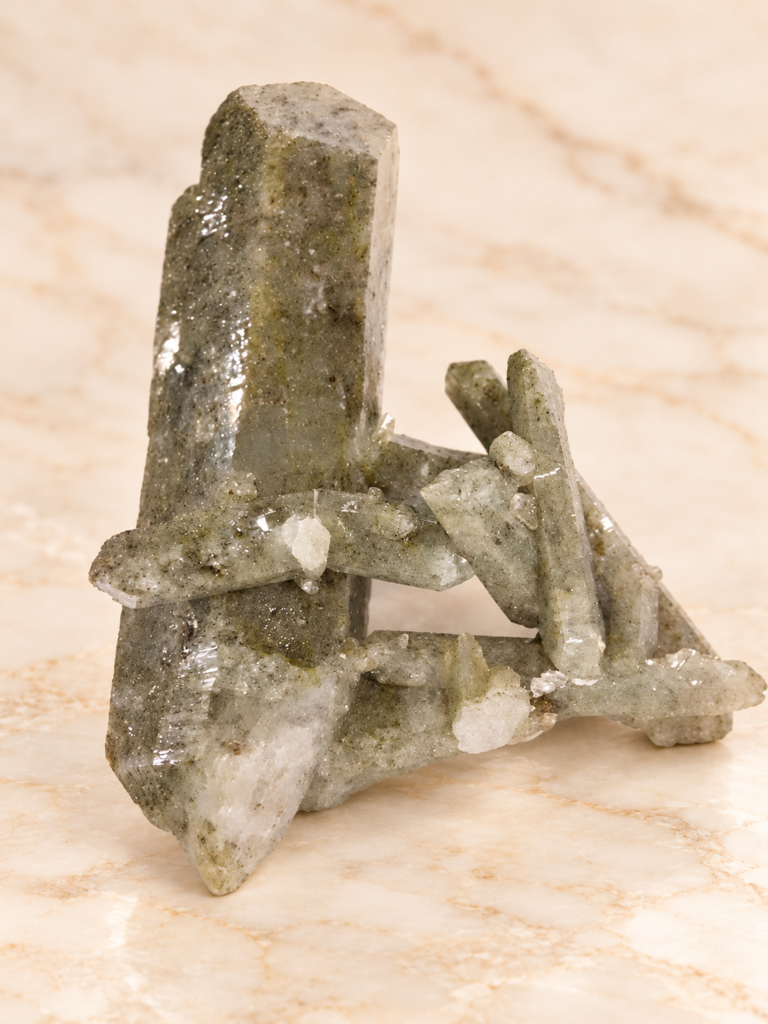
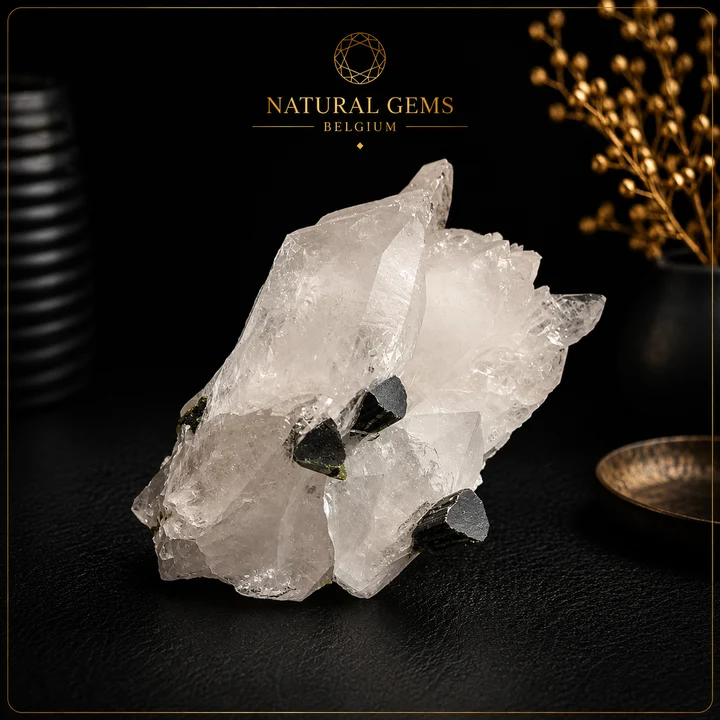
In pockets, it can form well-developed crystals.
Some pocket quartz is colourless and transparent.
Other varieties may display smoky or amethyst coloration, depending on the relevant chemical defects and irradiation history.
However, the presence of quartz alone does not indicate that a pegmatite contains valuable gemstones.
Quartz is widespread in many geological environments.
Its association with other minerals and the overall geological setting are more informative.
For collectors, pegmatite quartz can be attractive because of its crystal form, transparency, inclusions or associations with other minerals.
10. Beryl: Aquamarine, Morganite and Other Varieties
Beryl has the chemical formula Be₃Al₂Si₆O₁₈.
It crystallises in the hexagonal crystal system.
Several important gemstones belong to the beryl mineral species.
Aquamarine is the blue to greenish-blue variety.
Morganite is the pink to orange-pink variety.
Heliodor refers to yellow to golden-yellow beryl.
Beryl can form substantial crystals within pegmatites.
However, not all beryl is transparent or suitable for faceting.
Large crystals may contain fractures, inclusions or opaque regions.
Gem-quality portions may occupy only a small part of the original crystal.
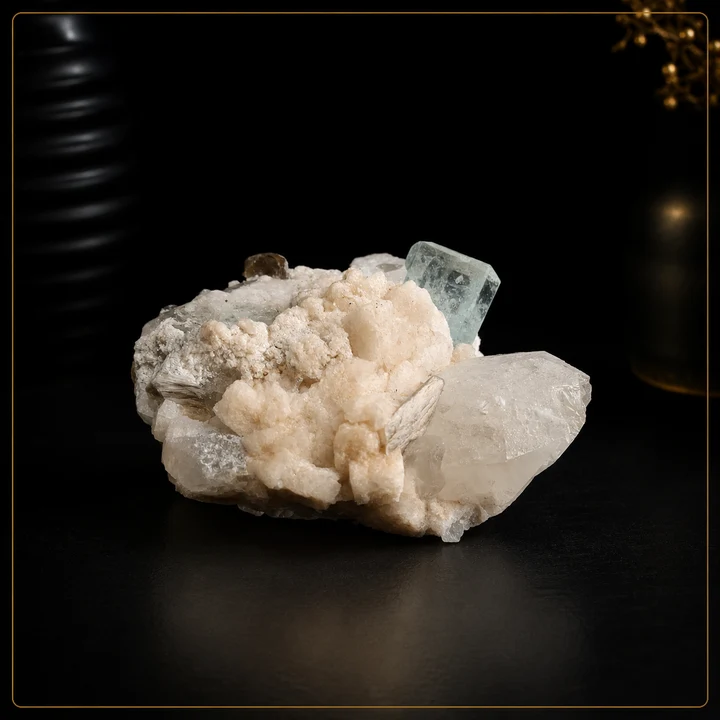
Some of the most attractive aquamarine specimens occur as well-formed crystals associated with quartz, feldspar or other pegmatite minerals.
Beryl illustrates the distinction between mineral abundance, crystal size and gem quality.
11. Tourmaline: A Chemically Complex Pegmatite Gemstone
Tourmaline belongs to a mineral supergroup with considerable chemical diversity.
Several gem-quality tourmalines form in evolved granitic pegmatites.
Elbaite is particularly important in many gem-bearing pegmatite environments.
Tourmaline may develop elongated prismatic crystals with characteristic longitudinal striations.
Some crystals contain multiple colour zones.
Others display complex internal features.
GIA’s 2024 research on tourmaline micro-features documents inclusions associated with pegmatite environments, including feldspar, lepidolite and other minerals.
Tourmaline can preserve evidence of changing chemical conditions during growth.
However, colour zoning alone cannot determine the exact geological origin of a specimen.
Tourmaline also occurs in metamorphic and other geological environments.
Its presence does not automatically establish a pegmatite origin.
12. Spodumene: Kunzite and Hiddenite
Spodumene is a lithium aluminium silicate with the formula LiAlSi₂O₆.
It belongs to the pyroxene group.
Gem varieties include kunzite, typically pink to violet, and hiddenite, commonly associated with green chromium-bearing material.
Spodumene is an important mineral in certain lithium-rich pegmatites.
It can form exceptionally large crystals.
The USGS documents a reported spodumene crystal reaching approximately 14 metres in length.
However, giant spodumene crystals are not necessarily gem quality.
Spodumene possesses pronounced cleavage, which can complicate cutting and handling.
Its colour and transparency may vary within the crystal.
The relationship between crystal size and usable gemstone yield must therefore be evaluated carefully.
13. Topaz and Other Pegmatite Minerals
Topaz is an aluminium fluorosilicate mineral with the formula Al₂SiO₄(F,OH)₂.
It can occur in certain granitic pegmatites and related geological environments.
Some pocket specimens display well-developed crystal faces and attractive transparency.
Topaz may be associated with quartz, feldspar, mica and other minerals.
However, not every topaz deposit is a pegmatite deposit.
Topaz also occurs in other fluorine-rich geological settings.
Pegmatites may additionally contain garnet, apatite, chrysoberyl and a variety of rare minerals.
The exact assemblage depends on the chemical evolution of the deposit.
A pegmatite’s mineral diversity is therefore a geological characteristic, not a guarantee that every desirable gemstone species will occur.
14. Lithium-Cesium-Tantalum Pegmatites
Lithium-cesium-tantalum pegmatites, commonly abbreviated LCT pegmatites, are an important geochemical subgroup of granitic pegmatites.
They are enriched in particular elements associated with evolved granitic systems.
Common major minerals include quartz, potassium feldspar, albite and muscovite.
Accessory minerals may include tourmaline, garnet, apatite and other species.
Some LCT pegmatites contain lithium minerals such as spodumene, petalite or lithium-bearing micas.
Others contain minerals rich in tantalum or cesium.
The USGS mineral-deposit model describes the geological characteristics and economic significance of these deposits.
However, not every gem-bearing pegmatite belongs to the LCT family.
Other geochemical pegmatite families exist.
Classification should be based on geological and chemical evidence rather than the presence of one attractive mineral.
15. Giant Crystals: Exceptional but Not Necessarily Valuable
Pegmatites have produced some of the largest known mineral crystals.
The USGS reports exceptional examples including beryl crystals approximately 18 metres long and potassium feldspar crystals reaching approximately 49 metres.
These are extraordinary geological occurrences.
However, their size does not imply equivalent gemstone value.
A giant feldspar crystal may be industrial or scientific material rather than a transparent gemstone.
A large beryl crystal may be opaque.
A massive spodumene crystal may contain extensive cleavage and fractures.
Gemstone value depends on factors such as colour, transparency, internal characteristics, durability and usable cutting yield.
For mineral specimens, external crystal form, completeness, aesthetics and documented provenance may be more important than faceting potential.
16. What Happens After Pocket Crystals Form?
A pocket’s geological history may continue after its principal gem crystals have developed.
Later fluids may deposit additional minerals.
Some crystals may experience partial dissolution.
Others may develop overgrowths.
Clay minerals can accumulate within the cavity.
GIA’s 2025 review describes pockets containing secondary clays and evidence of multiple mineral-forming stages.
The 2020 Lithos study also discusses later zeolite and clay formation within gem-bearing cavities.
These processes can alter the appearance and preservation of the original crystals.
A crystal recovered from clay-filled material may have formed much earlier than the clay surrounding it.
Therefore, the material filling a pocket at the time of discovery does not necessarily represent the original growth medium of every crystal inside it.
17. Why Some Pegmatite Crystals Are Fractured
Large pegmatite crystals may contain internal fractures.
These can develop during or after crystal growth.
Changes in temperature, mechanical stress, tectonic deformation and other geological processes may contribute.
Cleavage can also influence how particular minerals break.
Spodumene and topaz, for example, have important cleavage characteristics.
A crystal may appear complete externally while containing significant internal damage.
Conversely, a broken crystal may retain transparent regions suitable for cutting.
The presence of fractures must therefore be assessed individually.
A specimen’s large size or attractive crystal habit does not establish internal quality.
18. How Pegmatite Gemstones Reach the Surface
Pegmatites form underground.
For their minerals to become accessible, geological processes must expose them.
Uplift and erosion can remove overlying rock.
Fractures and weathering may expose pegmatite bodies.
Some crystals remain within their original host rock.
Others are released as the surrounding rock breaks down.
Durable minerals may eventually become concentrated in sediments or stream gravels.
The USGS notes that tourmaline, beryl and other gemstones can be transported from their original geological settings into secondary deposits.
Therefore, a gemstone found in river gravel may originally have crystallised in a pegmatite.
Its present location is not necessarily its formation environment.
19. Pegmatite Mining and Specimen Recovery
Gem-bearing pockets can be difficult to locate.
They may be irregularly distributed within a pegmatite body.
Some pockets contain exceptional specimens.
Others contain only common minerals or fractured material.
Professional recovery requires geological knowledge, careful excavation and attention to specimen preservation.
Fragile crystals may be damaged by uncontrolled extraction.
Associated minerals and host-rock relationships can also be scientifically valuable.
For important specimens, documenting the original position and geological context is preferable to removing the crystal without recording its surroundings.
Responsible collection must respect land ownership, permits, environmental requirements and site safety.
Unsupported excavation or entry into abandoned workings can be dangerous.
20. Pegmatites and Geographical Provenance
Important gem-bearing pegmatites occur in several parts of the world.
Brazil is well known for pegmatite-related gemstones.
Afghanistan and Pakistan have produced notable tourmaline, beryl and other mineral specimens.
Madagascar contains significant pegmatite deposits.
Parts of Africa, Europe, Asia and North America also contain pegmatite systems.
However, a gemstone’s appearance alone does not establish its country of origin.
Similar mineral species and crystal habits may occur in different regions.
Chemical analysis and inclusions can sometimes provide useful evidence, but origin determination requires appropriate reference data and geological context.
A statement such as “pegmatite origin” is not equivalent to a verified geographical provenance.
21. How Inclusions Reveal Pegmatite Growth Conditions
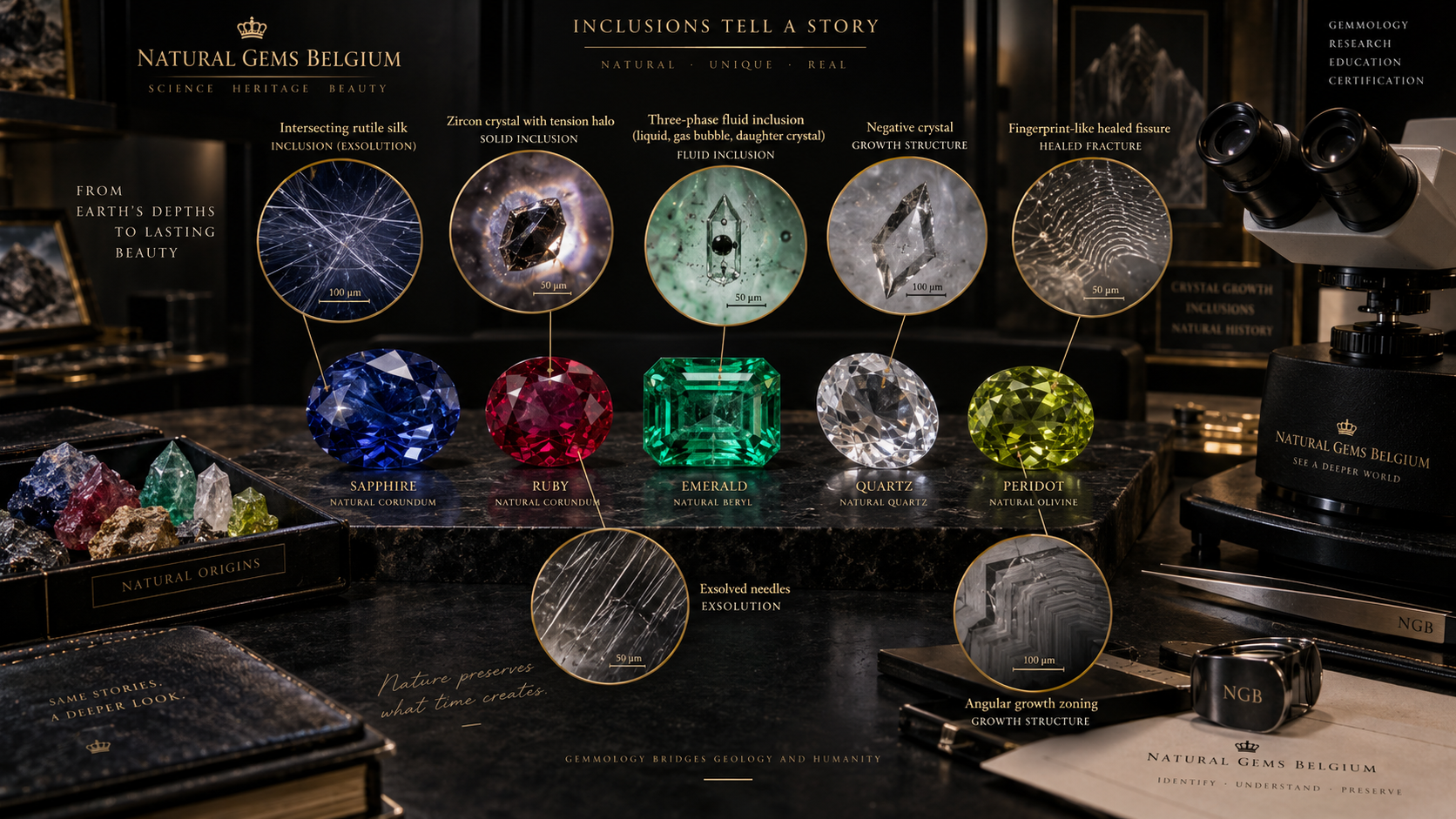
Gemstones may preserve inclusions that formed during crystal growth or later geological events.
These can include solid mineral inclusions, fluid inclusions and growth-related structures.
GIA’s research on tourmaline describes inclusions of minerals associated with pegmatite environments.
Such inclusions can help reconstruct aspects of the growth environment.
However, they must be interpreted cautiously.
A particular inclusion mineral may occur in several geological settings.
Fluid inclusions may also be modified by later heating or deformation.
Inclusion assemblages are most informative when considered alongside mineral chemistry, growth structures and geological context.
They are not universal fingerprints of one specific mine.
22. Pegmatite Crystals Versus Faceted Gemstones
The evaluation of a natural pegmatite crystal differs from that of a finished gemstone.
For a collector specimen, external morphology and mineral associations may be central to its appeal.
For faceting rough, internal transparency, colour distribution, fractures and cutting orientation become particularly important.
For a finished gemstone, colour, clarity, cut quality and optical appearance are evaluated.
A spectacular crystal specimen may be more valuable preserved intact than divided into faceting rough.
Conversely, an externally damaged crystal may contain excellent gem-quality material.
The intended use must therefore guide the evaluation.
Natural crystal beauty and faceted gemstone quality are related but distinct considerations.
23. Common Misconceptions About Pegmatites
Pegmatites form only because magma cools extremely slowly.
Incorrect. Chemical composition, nucleation and transport processes are also important.
Every pegmatite contains valuable gemstones.
Incorrect. Many pegmatites contain no commercially significant gem material.
The largest crystals are always the best gemstones.
Incorrect. Large crystals may be opaque, fractured or heavily included.
Every gem pocket contains flawless crystals.
Incorrect. Pocket crystals can still contain inclusions and fractures.
All tourmaline comes from pegmatites.
Incorrect. Tourmaline occurs in several geological environments.
Every pegmatite is an LCT pegmatite.
Incorrect. LCT represents one important geochemical subgroup.
Pocket clay is necessarily the material from which the original crystals grew.
Incorrect. Clay can form or accumulate after the principal gem crystals.
A gemstone’s crystal shape proves its country of origin.
Incorrect. Similar crystal forms can occur in different localities.
A large crystal must have taken millions of years to grow.
Incorrect. Some pegmatite systems may crystallise over much shorter periods.
24. Practical Workshop: Examining a Pegmatite Specimen
This non-destructive workshop is intended for mineral collectors and gemstone enthusiasts.
Step 1 – Identify the major minerals
Look for quartz, feldspar and mica.
Do not rely on appearance alone for uncertain minerals.
Step 2 – Observe grain size
Record whether the rock contains unusually large crystals relative to typical granite.
Step 3 – Look for internal mineral associations
Document the relationships between quartz, feldspar, mica and accessory minerals.
Step 4 – Examine possible crystal growth into open space
If a natural cavity is present, observe whether crystals project inward from its walls.
Step 5 – Record crystal habit
Describe prismatic, tabular or other visible forms.
Step 6 – Note inclusions and fractures
Avoid interpreting every internal feature as evidence of a particular formation event.
Step 7 – Photograph the specimen
Use several viewing angles and include a scale reference.
Step 8 – Record provenance
Keep any reliable locality or collection information.
Do not assign a geographical origin from appearance alone.
Step 9 – Preserve the material
Avoid breaking, scratching or chemically cleaning valuable specimens.
Step 10 – Seek expert identification when appropriate
Unusual or scientifically significant material may require professional mineralogical analysis.
The purpose is careful observation and documentation rather than destructive testing.
25. Why Pegmatites Matter for Scientific Gemstone Descriptions
Pegmatites demonstrate how complex natural gemstone formation can be.
A crystal may have grown within a massive rock zone.
Another may have developed freely inside a cavity.
A third may have experienced later dissolution or mineral overgrowth.
These differences can influence crystal habit, inclusions, transparency and preservation.
However, the presence of a pegmatite-related mineral does not automatically establish its exact geological history.
A tourmaline crystal cannot be assigned confidently to one pocket environment solely from its colour.
A large aquamarine crystal does not prove slow cooling.
A transparent spodumene specimen does not automatically reveal its formation temperature.
Responsible descriptions should distinguish observed characteristics from geological interpretations.
This approach allows natural gemstones to be presented accurately without diminishing their scientific or aesthetic appeal.
Conclusion: Pegmatites Are Exceptional Crystal-Forming Systems
Granitic pegmatites are among the most remarkable geological environments for crystal growth.
Their unusual textures and mineral assemblages reflect the interaction of evolved melts, chemical components, water and crystallisation processes.
Some pegmatites produce enormous crystals.
Others contain cavities where exceptionally attractive mineral specimens and gem-quality crystals develop.
Quartz, beryl, tourmaline, spodumene and topaz are important examples.
However, crystal size, transparency and gemstone value are not interchangeable.
A giant crystal may be opaque.
A small pocket crystal may be exceptionally transparent.
A well-formed specimen may be more desirable as a collector mineral than as cutting rough.
The central scientific principle is:
Pegmatites can produce extraordinary crystal sizes and gem-bearing cavities because of their distinctive chemical and crystallisation environments, not simply because they cool slowly.
Understanding these environments connects mineralogy, geology and gemmology.
It also provides a deeper appreciation of the natural processes responsible for some of the world’s most remarkable gemstones and mineral specimens.
References & Further Reading
The following references are authoritative, non-commercial educational and scientific publications. They include research from the Gemological Institute of America, the US Geological Survey and peer-reviewed geological literature.
1. Palke, A. C., and Shigley, J. E. (2025) – Gem Granitic Pegmatites
Gems & Gemology, Summer 2025, Volume 61, Number 2.
A modern scientific overview of granitic pegmatite formation, classification, gem minerals, pocket development and geological significance.
https://hongkong.gia.edu/gems-gemology/summer-2025-colored-stones-unearthed
2. Bradley, D., McCauley, A. D., and Stillings, L. L. (2017) – Mineral-Deposit Model for Lithium-Cesium-Tantalum Pegmatites
US Geological Survey, Scientific Investigations Report 2010–5070–O.
A detailed deposit model covering pegmatite chemistry, geological settings, fluxing components, mineral assemblages and exceptional crystal sizes.
https://doi.org/10.3133/sir20105070O
3. Shigley, J. E., and Kamp, A. R. (1984) – Gem-Bearing Pegmatites: A Review
Gems & Gemology, Summer 1984, Volume 20, Number 2.
A foundational gemmological review discussing gem-bearing pegmatites, cavity formation, crystal growth and the occurrence of gem-quality minerals.
https://www.gia.edu/gems-gemology/summer-1984-pegmatite-shigley
4. US Geological Survey – Natural Gemstones: Geologic Environment
An educational reference explaining pegmatites as gemstone-forming environments and the movement of gemstone minerals into secondary deposits.
https://pubs.usgs.gov/gip/gemstones/environment.html
5. Jahns, R. H., and Burnham, C. W. (1969) – Experimental Studies of Pegmatite Genesis: I. A Model for the Derivation and Crystallization of Granitic Pegmatites
A foundational experimental study discussing water-rich granitic melts, melt-fluid interactions and the formation of coarse pegmatite textures and pocket minerals.
6. Thurston, W. R. (1952) – Pegmatites of the Crystal Mountain District, Larimer County, Colorado
US Geological Survey, Trace Elements Investigations 139.
A detailed geological mapping study documenting mineral assemblages, beryl-bearing pegmatites and the distinction between zoned and unzoned pegmatite bodies.
https://doi.org/10.3133/tei139
7. London, D. (2020) – Temperatures and Duration of Crystallization Within Gem-Bearing Cavities of Granitic Pegmatites
Lithos.
A peer-reviewed investigation of crystallisation stages in gem-bearing cavities, including primary gem minerals and later zeolite and clay assemblages.
https://doi.org/10.1016/j.lithos.2020.105417
8. Gemological Institute of America (2024) – Micro-Features of Tourmaline
Gems & Gemology, Summer 2024.
Research on natural tourmaline inclusions, growth structures and mineral associations, including features linked to pegmatite environments.
https://www.gia.edu/gems-gemology/summer-2024-micro-features-tourmaline
9. US Geological Survey – Beryl-Bearing Pegmatites in the Ruby Mountains and Other Areas in Nevada and Northwestern Arizona
USGS Bulletin 1082-D.
A geological investigation documenting beryl-bearing pegmatite dikes, associated minerals, internal zoning and mineral distribution.
https://pubs.usgs.gov/publication/b1082D
Scientific Interpretation and Limitations
Pegmatite formation is a complex geological subject involving melt evolution, fluid behaviour, nucleation, chemical transport and crystallisation kinetics.
Not all pegmatites originate through identical processes.
Not all pegmatites are lithium-cesium-tantalum enriched.
Giant crystal size does not independently establish slow cooling or a particular crystallisation duration.
Gem-bearing pockets do not necessarily contain transparent or valuable crystals.
The presence of tourmaline, beryl or another pegmatite-associated mineral does not independently establish geographical origin.
Mineral inclusions and growth structures require appropriate geological and analytical context.
The practical workshop is non-destructive and intended for educational observation.
Detailed geological interpretation, mineral identification and provenance determination may require professional laboratory investigation.