Table of Contents
Introduction: When Geological Alteration Creates New Minerals
A mineral deposit does not necessarily remain unchanged after its original formation.
Deep underground, copper-bearing minerals may crystallise from hot hydrothermal fluids. Chalcopyrite and other sulfides can become concentrated within fractures, veins or large mineralised rock systems.
Over geological time, erosion may expose these deposits to the Earth’s surface.
Rainwater enters fractures. Oxygen becomes available. Chemical reactions begin.
Some original minerals dissolve or become unstable.
Copper can be released into groundwater and transported through the surrounding rock.
Under suitable conditions, new minerals precipitate.
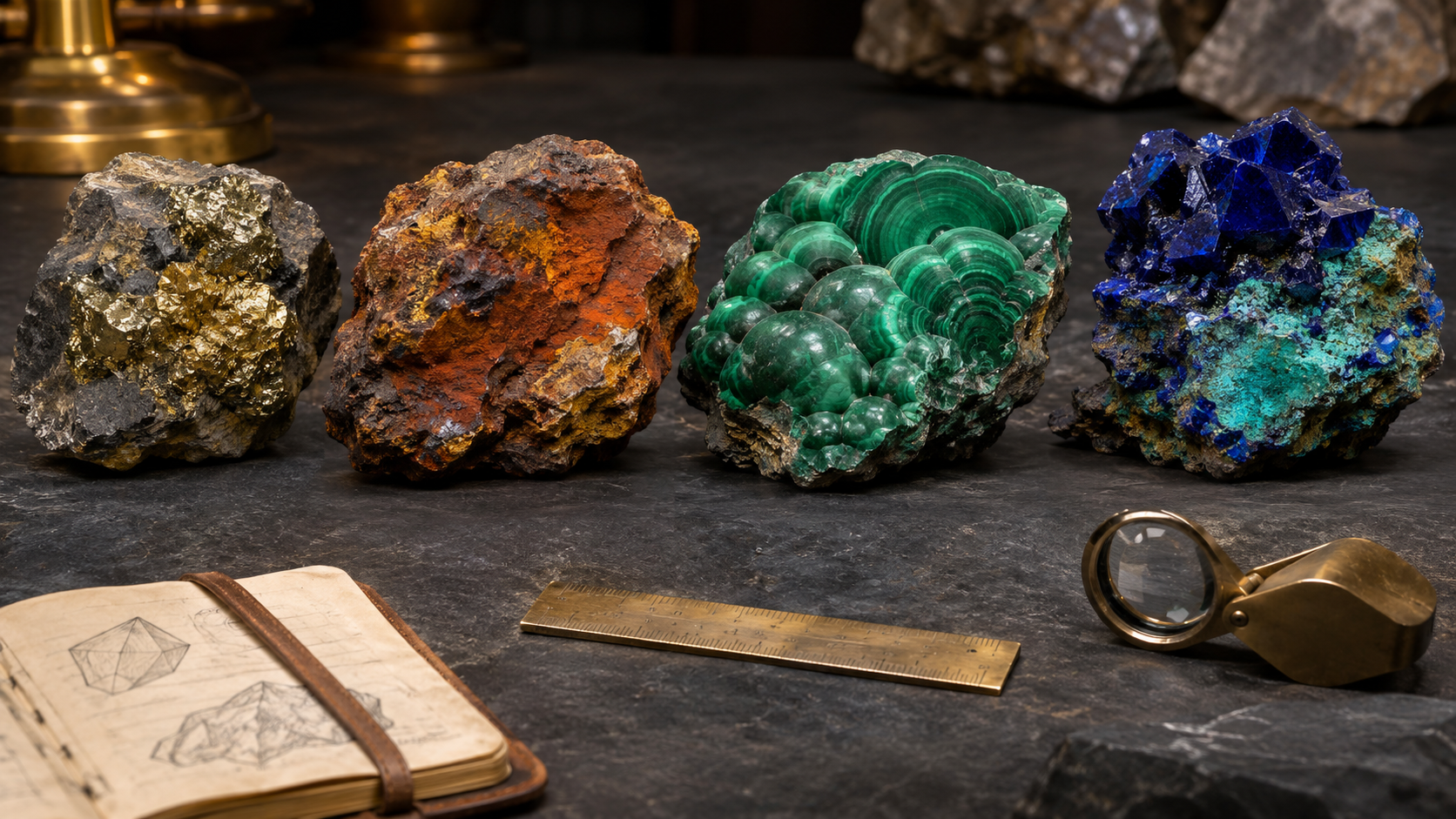
Green malachite may develop along fractures.
Deep-blue azurite may crystallise in cavities.
Blue-green chrysocolla-bearing material may accumulate in altered zones.
Iron-bearing sulfides may weather into brown, yellow or red iron oxides and oxyhydroxides.
These products are known as secondary minerals because they formed through alteration or redistribution of earlier mineral material.
They are not necessarily less natural, less valuable or less scientifically important than primary minerals.
In many cases, secondary mineral formation creates some of the most visually striking specimens found in mineral collections.
Understanding these processes requires examining the relationships between weathering, groundwater chemistry, oxidation and geological environment.
1. What Is Mineral Weathering?
Weathering is the alteration or breakdown of rocks and minerals at or near the Earth’s surface.
The British Geological Survey distinguishes between physical, chemical and biological weathering.
Physical weathering changes the size or condition of rock material without necessarily changing its chemical composition.
Chemical weathering involves reactions that alter mineral composition or structure.
Biological activity can contribute to either physical or chemical alteration.
These processes often operate together.
Water can enter a fracture created by mechanical stress.
Dissolved oxygen may then react with exposed mineral surfaces.
Microorganisms may influence chemical reactions.
The resulting products can differ substantially from the original minerals.
Weathering is therefore not merely the gradual destruction of rocks.
It can also generate new minerals.
2. Physical Weathering Versus Chemical Weathering
Physical weathering includes processes such as freeze-thaw action, thermal expansion, abrasion and mechanical fracturing.
These processes can increase the surface area exposed to water and air.
Chemical weathering includes oxidation, hydrolysis, dissolution and other reactions.
For example, a sulfide mineral may react with oxygen and water.
Some chemical components can enter solution.
Other components may remain locally and form secondary minerals.
Physical and chemical weathering are closely connected.
A fractured rock provides more pathways for groundwater.
Increased surface exposure can accelerate chemical reactions.
However, the rate of weathering varies greatly.
Climate, rock permeability, mineral composition, microbial activity and groundwater chemistry all influence the outcome.
3. What Are Primary and Secondary Minerals?
A primary mineral forms during an earlier geological mineralisation or rock-forming event.
In a hydrothermal copper deposit, chalcopyrite may be one of the primary copper-bearing minerals.
A secondary mineral forms through subsequent alteration, redistribution or precipitation.
Malachite and azurite commonly develop in oxidised portions of copper deposits.
However, the distinction between primary and secondary is contextual.
A mineral species can form in more than one geological environment.
Chalcocite, for example, may occur as a secondary enrichment mineral or form through other geological processes.
Therefore, identifying a mineral species does not automatically establish its complete formation history.
The geological setting and mineral relationships must also be considered.
4. Why Groundwater Is So Important
Groundwater acts as both a chemical reactant and a transport medium.
Rainwater naturally contains dissolved gases, including oxygen and carbon dioxide.
Dissolved carbon dioxide can make water mildly acidic.
When water interacts with sulfide-bearing rocks, additional chemical reactions may increase acidity.
Under suitable conditions, metals can dissolve and move through fractures and pores.
Groundwater may carry copper, iron and other elements away from their original mineral positions.
If the water later encounters different chemical conditions, dissolved components may precipitate as new minerals.
The transport distance can vary.
Some secondary minerals form close to the original material.
Others develop after dissolved elements have moved through a larger portion of the deposit.
This is one reason why mineral assemblages can change with depth.
5. Oxidation: A Major Driver of Mineral Transformation
Oxidation involves the loss of electrons by a chemical species.
In near-surface mineral deposits, oxygen-bearing water can promote oxidation reactions.
Iron sulfides are particularly important.
Pyrite, FeS₂, can undergo oxidation when exposed to oxygen and water.
These reactions may release sulfate and acidity.
The acidity can influence the dissolution and transport of other minerals.
Copper-bearing sulfides can also undergo oxidative weathering.
Chalcopyrite, CuFeS₂, is an important example.
The USGS identifies chalcopyrite weathering as a process capable of releasing dissolved copper and contributing to acid rock drainage.
However, not every weathering environment becomes strongly acidic.
Carbonate-bearing rocks and other minerals may neutralise acidity.
The balance between acid generation and neutralisation strongly influences which secondary minerals form.
6. Chalcopyrite: From Primary Copper Mineral to Secondary Assemblages
Chalcopyrite is a copper iron sulfide with the formula CuFeS₂.
It is an important copper ore mineral in many geological deposits.
In suitable near-surface environments, chalcopyrite can become chemically unstable.
Oxidation may release copper into solution.
Iron can become incorporated into secondary iron minerals.
Sulfur-bearing components may enter groundwater as sulfate.
The released copper may later form carbonates, oxides, silicates or secondary sulfides.
However, there is no single universal sequence in which chalcopyrite must transform into one particular mineral.
The outcome depends on the surrounding chemistry.
Carbonate availability can favour copper carbonate formation.
Silica-rich conditions may contribute to copper silicate assemblages.
Different oxidation-reduction conditions may favour secondary copper sulfides.
The final mineral assemblage reflects the interaction between the original ore and its later geological environment.
7. The Oxidation Zone of a Copper Deposit
Many copper deposits develop a weathered upper zone.
This region may contain secondary copper minerals, iron oxides and other alteration products.
The original sulfide minerals may be partly or extensively altered.
Malachite and azurite can form where suitable copper-bearing solutions encounter carbonate-compatible chemical conditions.
Cuprite may occur in some oxidised copper environments.
Chrysocolla-bearing material may develop in silica-influenced alteration zones.
However, oxidation zones are not identical everywhere.
Some deposits contain abundant carbonate minerals.
Others are dominated by silicates or iron oxides.
Climate and groundwater history can produce substantial differences.
Therefore, the presence of one secondary mineral should not be interpreted as proof that every other typical oxidation-zone mineral must also be present.
8. Malachite: The Green Product of Copper Alteration
Malachite is a copper carbonate hydroxide with the formula Cu₂CO₃(OH)₂.
It is characteristically green.
Malachite commonly forms in oxidised copper-bearing environments.
It may occur as crusts, botryoidal masses, fibrous aggregates or banded material.
Under suitable conditions, malachite can develop through precipitation from copper-bearing solutions.
It may also replace earlier copper minerals, including azurite.
Its appearance can vary considerably.
Some specimens display intense green bands.
Others contain irregular green patches or compact masses.
The USGS identifies malachite as a secondary mineral associated with oxidised copper deposits.
However, malachite’s colour alone cannot establish its precise geological origin.
Its occurrence must be interpreted together with the surrounding minerals and host rock.
9. Azurite: The Deep-Blue Copper Carbonate
Azurite has the formula Cu₃(CO₃)₂(OH)₂.
It is another important secondary copper carbonate mineral.
Azurite commonly displays a deep blue colour.
It may form well-defined crystals, aggregates or coatings.
Azurite and malachite frequently occur together.
Their relative stability depends on chemical conditions, including the activity of carbon dioxide and water.
Azurite may alter to malachite under suitable circumstances.
However, this transformation is not inevitable in every specimen or environment.
A blue azurite crystal can remain preserved for long periods under appropriate conditions.
Azurite’s geological significance lies in its relationship with copper-bearing fluids and secondary mineral formation.
Its presence may indicate a particular alteration environment, but it does not independently establish a mine or country of origin.
10. Chrysocolla: Blue-Green Material in Altered Copper Deposits
Chrysocolla is commonly described as a hydrated copper silicate material.
Its composition and structural characteristics can be variable.
It frequently occurs in blue-green masses, coatings or compact aggregates.
Chrysocolla-bearing material is associated with secondary copper mineralisation.
The USGS documents chrysocolla in oxidised copper deposits, commonly alongside malachite, azurite and other copper minerals.
However, not every blue-green specimen sold as chrysocolla consists of a single homogeneous mineral phase.
Some material contains mixtures of chrysocolla-bearing phases, quartz, chalcedony or other minerals.
This matters for gemmological identification.
A polished blue-green cabochon may have different hardness, stability and internal characteristics depending on its actual mineral assemblage.
The trade description should not automatically be treated as a complete mineralogical analysis.
11. Turquoise and Secondary Mineral Formation
Turquoise is a hydrated copper aluminium phosphate mineral.
Its formation commonly involves the interaction of copper-bearing solutions with suitable aluminium- and phosphate-bearing materials.
Turquoise frequently occurs in weathered geological environments.
Its blue-to-green colour reflects its chemical and structural characteristics, including copper and iron-related influences.
However, turquoise does not form in every copper oxidation zone.
Suitable chemical components and environmental conditions must be available.
The presence of copper alone is insufficient.
Turquoise illustrates the importance of local chemistry in secondary mineral formation.
Two copper-bearing deposits may experience similar weathering processes but produce very different secondary minerals.
12. Iron Oxides and Oxyhydroxides
Iron-bearing minerals frequently undergo alteration near the Earth’s surface.
Secondary iron minerals include goethite and hematite.
Goethite has the formula FeO(OH).
Hematite has the formula Fe₂O₃.
Their formation depends on oxidation-reduction conditions, water availability and other chemical factors.
Goethite commonly contributes yellow-brown to brown colours.
Hematite may contribute red or reddish-brown colours.
However, colour is not a definitive identification method.
Natural iron-rich alteration products may contain several mineral phases.
The traditional term limonite is often used descriptively for mixtures of hydrated iron oxides and oxyhydroxides.
It should not be treated as one precisely defined mineral species.
Professional identification may require mineralogical analysis.
13. What Is a Gossan?
A gossan is an iron-rich weathered zone or outcrop commonly associated with the oxidation of sulfide-bearing mineralisation.
It may contain iron oxides, oxyhydroxides and other alteration products.
Gossans can develop when sulfide minerals are exposed to oxidising groundwater and near-surface conditions.
Iron may remain in secondary minerals while other components are dissolved and transported.
The resulting rock can display rusty brown, yellow or red colours.
Historically, gossans have attracted attention in mineral exploration because they can indicate altered sulfide-bearing systems.
However, not every rusty rock is a gossan.
Iron staining can occur in many geological environments.
Nor does every gossan necessarily overlie an economically valuable ore deposit.
Its significance depends on the broader geological context.
14. Leaching: When Metals Move Away from the Surface
Leaching occurs when soluble components are removed from a rock or mineral assemblage by moving fluids.
In an oxidised copper deposit, copper may dissolve and move downward with groundwater.
This can leave an upper zone depleted in some copper minerals.
Iron-rich alteration products may remain.
However, the degree of leaching depends on fluid chemistry, permeability, climate and geological history.
Some deposits retain substantial copper in their oxidised zones.
Others develop strongly leached upper sections.
The USGS has documented the importance of leaching in the development of supergene copper systems.
These processes demonstrate that the present mineral distribution may differ substantially from the original deposit.
15. Supergene Enrichment: When Weathering Concentrates Copper
Weathering does not always disperse valuable metals.
Under suitable conditions, it can redistribute and concentrate them.
This process is known as supergene enrichment.
In a classic copper system, oxidising groundwater may dissolve copper from upper parts of the deposit.
The copper-bearing fluid moves downward.
Where the chemical environment becomes more reducing, copper may precipitate as secondary sulfide minerals.
Chalcocite is an important example.
Covellite may also occur.
The resulting enrichment zone can contain higher copper concentrations than portions of the original mineralisation.
However, this is not a universal feature of every copper deposit.
The formation of a significant supergene enrichment blanket depends on geological and hydrological conditions.
16. The Water Table and Redox Boundaries
The water table can influence the distribution of oxidation and reduction environments.
Above the water table, oxygen-bearing groundwater may promote oxidation.
At greater depths, more reducing conditions may favour different mineral reactions.
However, the boundary is not always simple or fixed.
Groundwater levels can change over geological time.
Fractures may carry oxygenated fluids to greater depths.
Local chemical conditions may differ from the regional pattern.
Consequently, secondary mineral zones can be irregular or discontinuous.
The USGS has documented how changing groundwater levels contributed to the development of supergene copper enrichment at La Escondida in Chile.
This illustrates the importance of geological history in shaping present-day ore distributions.
17. A Simplified Copper Deposit Weathering Profile
A classic supergene copper system may contain several broad zones.
| Geological zone | Typical characteristics |
|---|---|
| Surface weathering and gossan | Iron-rich alteration products, possible leaching of copper |
| Oxidised copper zone | Secondary minerals such as malachite, azurite, cuprite and chrysocolla-bearing material |
| Supergene enrichment zone | Secondary copper sulfides, potentially including chalcocite and covellite |
| Primary mineralisation | Earlier sulfide assemblages, potentially including chalcopyrite and pyrite |
This is a conceptual model rather than a universal geological sequence.
Some deposits lack one or more zones.
Others display overlapping or repeated alteration stages.
Local geology may produce a more complicated arrangement.
18. The Role of Climate
Climate influences weathering through temperature, rainfall, evaporation and groundwater movement.
In humid environments, substantial water movement may promote chemical alteration and leaching.
In arid environments, limited rainfall and evaporation can produce different patterns of mineral precipitation and preservation.
However, the relationship is not as simple as assuming that dry climates always preserve minerals and wet climates always destroy them.
Geological time, uplift, erosion, permeability and changes in climate all matter.
Some modern desert deposits preserve evidence of earlier wetter conditions.
The present climate may therefore differ from the climate under which a mineral assemblage originally formed.
A secondary mineral should not be assigned a precise climatic history solely from its appearance.
19. Why Fractures and Porosity Matter
Groundwater needs pathways through rock.
Fractures, faults, pores and other permeable structures can provide these pathways.
Mineral alteration may therefore become concentrated along particular zones.
Copper-bearing solutions can precipitate secondary minerals in fractures.
Iron-rich fluids may create coatings along exposed surfaces.
Cavities may provide space for crystal growth.
This helps explain why secondary minerals sometimes form veins, crusts, cavity linings or irregular patches.
The distribution of these minerals reflects both chemistry and fluid movement.
A colourful mineral vein may therefore record where fluids travelled rather than the original location of all the metal-bearing material.
20. Secondary Minerals and Pseudomorphs
Secondary mineral formation can produce pseudomorphs.
A pseudomorph preserves an external form inherited from an earlier mineral.
For example, goethite may preserve the shape of an earlier pyrite crystal.
Malachite may preserve the form of azurite.
However, not every secondary mineral is a pseudomorph.
Malachite can precipitate as new crystals or aggregates without preserving an earlier mineral shape.
A chrysocolla-bearing coating may develop on a rock surface without replacing the material beneath it.
A gossan can form through complex alteration involving several minerals.
Pseudomorphism is therefore one possible result of weathering, not a synonym for secondary mineralisation.
21. Secondary Minerals and Gemstone Quality
Secondary minerals can be suitable for ornamental use, jewellery, carvings and mineral collections.
Malachite is widely appreciated for its green banding.
Azurite is admired for its intense blue colour and crystal forms.
Chrysocolla-bearing material can be attractive in cabochons and decorative objects.
Turquoise is valued as an ornamental gemstone.
However, these materials differ in hardness, toughness, porosity and chemical stability.
Some specimens contain fractures or multiple mineral phases.
Others may be treated or stabilised.
Consequently, the term secondary mineral does not establish quality or durability.
Each specimen must be evaluated according to its mineralogical characteristics and intended use.
22. How Weathering Influences Natural Mineral Specimens
Weathering can both enhance and damage mineral specimens.
It may produce attractive new colours and crystal forms.
It may also create fractures, porosity, unstable surfaces or loose alteration products.
A partially altered pyrite crystal may be scientifically interesting but mechanically fragile.
An azurite specimen may contain delicate crystals that require careful handling.
A malachite aggregate may have a stable polished surface but remain sensitive to acids.
A chrysocolla-bearing specimen may contain soft or porous material.
For collectors, understanding alteration history helps establish realistic preservation requirements.
The aim is not to remove every sign of weathering.
Natural alteration can be an important part of a specimen’s identity.
23. Can Colour Reveal the Mineral’s Geological Origin?
Colour can provide useful clues.
Green and blue minerals in a copper-rich geological environment may suggest secondary copper mineralisation.
Rusty brown and red alteration products may suggest iron oxidation.
However, colour alone cannot identify the mineral species conclusively.
Different minerals may have similar colours.
Mixtures can produce complex appearances.
Artificial coatings and treatments can also affect colour.
Furthermore, a colour associated with an oxidation zone does not identify a specific geographical location.
Reliable origin determination requires geological context, documented provenance or appropriate analytical evidence.
A green mineral is not automatically malachite.
A blue mineral is not automatically azurite.
And a rusty outcrop is not automatically evidence of a valuable copper deposit.
24. Environmental Consequences of Sulfide Weathering
The same reactions that create secondary minerals can also affect the environment.
Oxidation of sulfide-bearing rock may generate acidic drainage.
Under some conditions, the resulting water can mobilise metals.
This process is particularly relevant to mine waste, exposed sulfide deposits and disturbed mineralised rock.
The USGS documents the relationship between chalcopyrite weathering, dissolved copper and acid rock drainage.
However, environmental impacts depend on the complete geological and chemical system.
Carbonate minerals and other materials may neutralise acidity.
Not all sulfide-bearing rocks produce equally severe drainage.
Environmental assessment requires measurements of water chemistry, mineral composition and reaction conditions.
For mineral collectors, the practical lesson is to avoid unnecessary disturbance of unknown mineralised materials and to handle potentially hazardous specimens responsibly.
25. Practical Workshop: Observing Secondary Mineral Assemblages
This workshop is designed for collectors and gemstone enthusiasts.
It is observational and non-destructive.
Step 1 – Identify the specimen’s geological context
If available, record the locality, host rock and associated minerals.
Do not invent missing provenance.
Step 2 – Observe colour variations
Record green, blue, red, yellow or brown areas.
Treat colour as an observation rather than a definitive identification.
Step 3 – Examine mineral relationships
Look for coatings, veins, cavity linings and partial alteration.
Step 4 – Identify possible primary minerals
If metallic sulfides remain visible, document their appearance and position.
Avoid assuming identification solely from metallic colour.
Step 5 – Look for possible replacement textures
Record inherited crystal shapes or partial replacement boundaries.
Step 6 – Observe surface condition
Note powdery, porous, cracked or unstable areas.
Do not scrape or grind the material.
Step 7 – Photograph the specimen
Use consistent lighting and include a scale reference.
Step 8 – Record uncertainty
Use descriptions such as “green secondary copper mineral, identification unconfirmed” when appropriate.
Step 9 – Preserve the specimen safely
Avoid acids, aggressive cleaning, unnecessary water exposure and abrasive methods.
Wash hands after handling mineral specimens, especially when their composition is uncertain.
Step 10 – Seek professional identification
For valuable or scientifically important material, qualified mineralogical analysis may establish the mineral phases and alteration history.
The objective is accurate documentation without damaging the specimen.
26. Common Misconceptions About Secondary Minerals
Secondary minerals are artificial or less natural than primary minerals.
Incorrect. Secondary minerals form through natural geological processes.
All green copper minerals are malachite.
Incorrect. Several copper-bearing minerals can appear green.
Azurite always transforms into malachite.
Incorrect. Transformation depends on environmental conditions.
Every blue-green copper specimen is pure chrysocolla.
Incorrect. Some materials contain several mineral phases.
A rusty rock proves that copper ore exists beneath it.
Incorrect. Iron oxidation occurs in many geological settings.
All copper deposits develop a supergene enrichment zone.
Incorrect. Significant enrichment requires suitable geological and hydrological conditions.
A secondary mineral always formed directly where it is found.
Incorrect. Dissolved components may have been transported before precipitation.
A pseudomorph and a secondary mineral are the same thing.
Incorrect. Pseudomorphism describes preservation of an inherited form; secondary mineralisation describes later mineral formation.
Weathering only destroys minerals.
Incorrect. Weathering can generate entirely new mineral assemblages.
27. Why Scientific Transparency Matters
Secondary minerals are often marketed primarily through their colours and decorative appearance.
However, their geological histories are more complex.
A malachite specimen may represent precipitation from copper-bearing groundwater.
An azurite crystal may have grown in a cavity within an oxidised deposit.
A chrysocolla-bearing cabochon may consist of several mineral phases.
A goethite pseudomorph may preserve the form of an earlier pyrite crystal.
These characteristics can be described accurately without making unsupported claims about exact age, temperature, mine or formation sequence.
Scientific transparency requires distinguishing what is visible from what has been analytically established.
This approach is particularly important when a commercial name does not fully describe the specimen’s mineralogical composition.
Conclusion: Weathering Can Create New Mineral Beauty
Mineral weathering is one of the major processes that transform geological deposits near the Earth’s surface.
Water, oxygen, dissolved carbon dioxide and other chemical components interact with existing minerals.
Primary sulfides may become unstable.
Metals can dissolve and move through groundwater.
New minerals may precipitate in fractures, cavities and altered rock.
Malachite, azurite, chrysocolla-bearing material and turquoise demonstrate the diversity of secondary copper mineralisation.
Goethite and hematite illustrate the importance of iron oxidation.
Gossans can preserve evidence of sulfide weathering.
Supergene enrichment demonstrates that near-surface alteration can redistribute and sometimes concentrate valuable metals.
However, no single weathering sequence applies to every deposit.
Mineral formation depends on chemistry, climate, groundwater history, rock permeability and geological time.
The central scientific principle is:
Weathering does not simply destroy minerals. It can transform, redistribute and create new mineral assemblages through natural geological reactions.
For mineral collectors, this explains the remarkable diversity of secondary specimens.
For gemmologists, it highlights the importance of accurate mineral identification and treatment assessment.
For geologists, secondary minerals provide evidence of fluid movement, oxidation and the changing chemical history of mineral deposits.
Understanding these processes adds scientific depth to the appreciation of natural gemstones and mineral specimens.
References & Further Reading
The following sources are authoritative geological publications, government research reports and peer-reviewed scientific studies. They explain weathering, secondary mineral formation, copper oxidation, groundwater transport and supergene enrichment. All links are educational or scientific rather than commercial gemstone product pages.
1. British Geological Survey – Weathering
An educational explanation of physical, chemical and biological weathering, including the role of water, dissolved carbon dioxide and mechanical rock breakdown.
https://earthwise.bgs.ac.uk/index.php/OR/12/032_Weathering
2. US Geological Survey – Porphyry Copper Deposit Model
Scientific Investigations Report 2010–5070–B.
A comprehensive geological reference explaining primary copper mineralisation, weathering, supergene processes, oxidation zones, leaching and secondary sulfide enrichment.
https://pubs.usgs.gov/sir/2010/5070/b/pdf/SIR10-5070B.pdf
3. US Geological Survey – Chalcopyrite: Bearer of a Precious, Non-Precious Metal
Author: Bryn E. Kimball
Publication: Geology Today, 2013.
Discusses chalcopyrite as an important copper mineral, its weathering behaviour and the environmental consequences of sulfide oxidation.
https://www.usgs.gov/publications/chalcopyrite-bearer-a-precious-non-precious-metal
4. US Geological Survey – Assessment of the Geoavailability of Trace Elements from Minerals in Mine Wastes: Selected Copper Minerals
Scientific Investigations Report 2011–5211.
A detailed scientific investigation of azurite, malachite, bornite and chalcopyrite, including mineralogical characteristics, chemical behaviour and weathering-related processes.
https://pubs.usgs.gov/sir/2011/5211
5. US Geological Survey – Gem Stones
USGS Bulletin 1042-G.
A historical geological reference describing malachite, azurite and chrysocolla, including their occurrence in oxidised copper-bearing deposits and their ornamental properties.
https://pubs.usgs.gov/bul/1042g/report.pdf
6. Alpers, C. N., and Brimhall, G. H. – Paleohydrologic Evolution and Geochemical Dynamics of Cumulative Supergene Metal Enrichment at La Escondida, Atacama Desert, Northern Chile
Economic Geology, 1989.
A peer-reviewed study of gossans, iron-oxide mineralogy, groundwater history and supergene copper enrichment.
https://pubs.usgs.gov/publication/70015390
7. Origins of Chalcocite Defined by Copper Isotope Values
Geofluids, 2018.
A peer-reviewed study investigating different geological origins of chalcocite and the geochemical processes involved in supergene copper enrichment.
https://doi.org/10.1155/2018/5854829
8. British Geological Survey – Rock Information Sheets
A collection of educational geological reference sheets explaining rock characteristics and geological processes.
Scientific Interpretation and Limitations
Secondary mineral formation depends on the interaction between existing minerals, water chemistry, oxidation-reduction conditions, temperature, climate and geological structure.
The presence of a secondary mineral does not independently establish the precise geological age, temperature, pressure or geographical origin of a deposit.
Copper oxidation zones do not all follow one universal vertical sequence.
The term chrysocolla may describe compositionally variable material, and some commercial specimens contain several mineral phases.
The term limonite is descriptive and does not refer to one precisely defined mineral species.
Not all chalcocite is supergene in origin.
Visual colour alone is insufficient for definitive mineral identification.
Environmental effects of sulfide weathering depend on the complete geochemical setting.
The practical workshop is non-destructive and intended for educational observation. Definitive identification, environmental assessment and detailed geological interpretation may require professional laboratory analysis.