

Table of Contents
Introduction: Can a Natural Gemstone Lose Its Colour?
A natural gemstone may have spent millions of years beneath the Earth’s surface before being discovered, cut, polished or placed in a collection.
Yet some gemstones can change appearance after exposure to light, heat or particular environmental conditions.
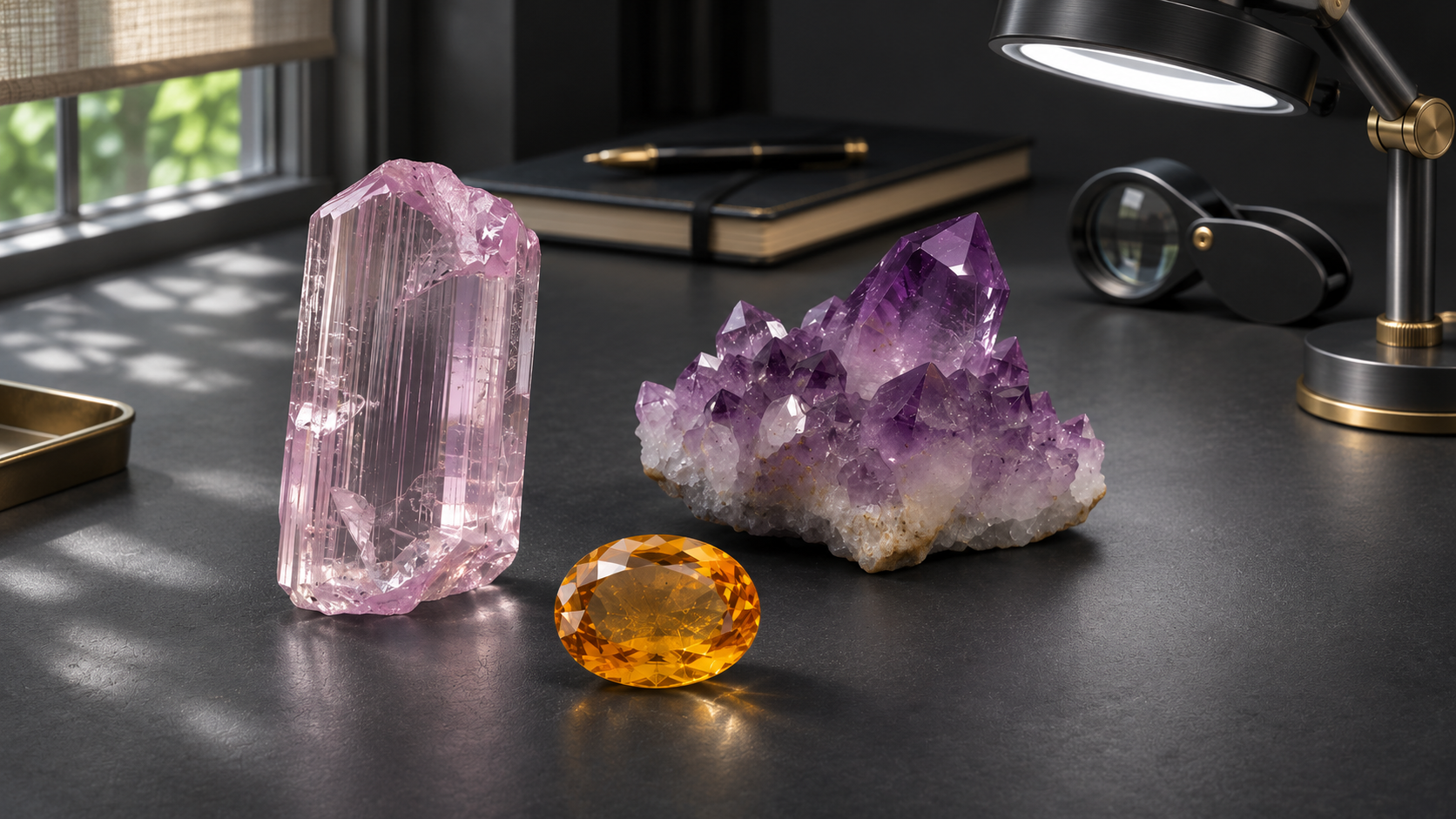
A pink kunzite may gradually lose colour under prolonged intense illumination.
Certain sapphires can temporarily change colour through light-activated processes.
Some treated gemstones contain dyes or irradiation-related colour centres that are less stable than their appearance initially suggests.
Other gemstones remain remarkably stable under normal display and wearing conditions.
The important question is not simply whether a gemstone is natural.
It is what produces its colour and how that colour-producing mechanism responds to the environment.
Colour stability is a scientific property that varies between gemstone species, varieties, treatments and sometimes individual specimens.
This guide examines the causes of gemstone colour, the difference between permanent and reversible changes, and the practical measures collectors and jewellery owners can take to preserve their stones.
1. What Is Gemstone Colour Stability?
Gemstone colour stability describes the ability of a gemstone to retain its colour under particular environmental conditions.
These conditions may include visible light, ultraviolet radiation, temperature, humidity and exposure duration.
A colour that remains unchanged during ordinary indoor display may respond differently to prolonged direct sunlight.
A gemstone that tolerates normal room temperatures may change when subjected to jewellery-repair heat.
Some changes develop gradually.
Others occur rapidly.
Certain changes are reversible, while others are effectively permanent under normal conditions.
Colour stability should therefore not be confused with general gemstone durability.
A gemstone may have excellent resistance to scratching while possessing relatively unstable colour.
Conversely, a softer gemstone may have colour that remains stable under ordinary illumination.
The Mohs hardness scale measures resistance to scratching. It does not measure colour stability, fracture resistance or tolerance to heat.
GIA’s educational guidance on gemstone durability emphasises that hardness is only one component of long-term gemstone preservation.
2. Why Gemstones Have Colour
Gemstone colour originates from the interaction between light and the material’s electronic structure.
When light enters a gemstone, particular wavelengths may be absorbed while others are transmitted or reflected.
The remaining light contributes to the colour perceived by an observer.
Different mechanisms can produce colour.
Trace elements
Small quantities of particular elements can influence gemstone colour.
Chromium contributes to the red colour of ruby.
Chromium and vanadium are important colouring elements in emerald.
Manganese contributes to the pink and violet colours of kunzite.
However, the presence of a trace element alone does not determine the final colour.
Its electronic state and position within the crystal structure also matter.
Charge-transfer processes
In some gemstones, colour involves electronic interactions between neighbouring ions.
Blue sapphire provides a well-known example involving iron and titanium.
Colour centres
A colour centre is a defect-related electronic configuration within a crystal that absorbs particular wavelengths of light.
Some colour centres can be altered by radiation, light or heat.
This makes them especially important when discussing colour stability.
Structural optical effects
Not all gemstone colour arises solely from selective absorption.
Precious opal’s play-of-colour, for example, results from the interaction of light with appropriately ordered microscopic silica structures.
Understanding the colouring mechanism helps explain why different gemstones respond differently to environmental exposure.
3. What Is a Colour Centre?
A colour centre involves an electronic state associated with a defect or impurity in a crystal.
The defect may influence how the material absorbs visible light.
Radiation can sometimes create or modify these electronic states.
Heat or illumination can sometimes change them again.
This does not mean that every irradiated gemstone is unstable.
Some radiation-related colours are durable under ordinary conditions.
Others are temporary.
The stability depends on the particular defect, mineral and environmental conditions.
GIA’s research on yellow sapphire demonstrates that visually similar gemstones can possess different colouring mechanisms and respond differently to light and heat.
Two stones with nearly identical appearances may therefore have different long-term colour behaviour.
This is one reason why colour stability cannot always be established from visual inspection alone.
4. Sunlight: More Than Visible Light
Sunlight contains a range of electromagnetic radiation.
At the Earth’s surface, it includes visible light, infrared radiation and ultraviolet radiation.
These components can affect gemstones in different ways.
Visible light may influence certain colour centres.
Ultraviolet radiation can activate particular electronic processes.
Infrared radiation and absorbed sunlight can contribute to heating.
The effect depends on the gemstone.
A light-sensitive material may fade under prolonged exposure.
Another material may temporarily intensify in colour.
Some stones may show little measurable change.
Direct sunlight can also raise the temperature of a gemstone and its surroundings.
Consequently, an observed change after sunlight exposure does not automatically prove that ultraviolet radiation alone caused it.
Professional investigations may need to separate the effects of light and temperature.
5. Kunzite: A Well-Documented Light-Sensitive Gemstone
Kunzite is the pink-to-violet variety of spodumene.
Its colour is associated with manganese.
Kunzite is valued for its delicate colours, transparency and often impressive crystal sizes.
However, its colour can be sensitive to prolonged exposure to strong light and heat.
GIA specifically advises protecting kunzite from intense illumination and storing it in a closed jewellery box or case when not in use.
This applies to naturally coloured material as well as some enhanced specimens.
The practical implication is straightforward.
Kunzite jewellery should not be stored permanently on a sunny windowsill.
Collectors should avoid displaying valuable kunzite crystals under intense illumination for extended periods.
Ordinary occasional wearing is different from continuous high-intensity exposure.
The objective is not to avoid all light but to reduce unnecessary cumulative exposure.
Kunzite also has pronounced cleavage, making protection from mechanical shock important.
Its colour sensitivity and structural durability are separate considerations.
6. Amethyst: Does Sunlight Really Cause Fading?
Amethyst is the purple variety of quartz.
Its colour involves iron-related defects and natural irradiation processes.
Amethyst is frequently described online as a gemstone that always fades in sunlight.
That statement is too broad.
GIA identifies amethyst among gemstones whose colour can be affected by prolonged exposure to light or heat.
However, susceptibility varies with the material and exposure conditions.
A short period of ordinary daylight does not establish that an amethyst will visibly fade.
Nor should every colour difference observed between photographs be interpreted as fading.
Lighting conditions, camera settings, colour balance and viewing direction can change the apparent colour of a gemstone.
For long-term preservation, avoiding continuous direct sunlight is a sensible precaution, especially for valuable or personally important amethyst specimens.
High temperatures should also be avoided.
Heating can alter amethyst colour and is used commercially to produce certain yellow-to-orange quartz materials.
Such controlled treatment conditions should not be confused with ordinary room temperature or brief sunlight exposure.
Practical recommendation: Display amethyst in bright but indirect light, away from prolonged intense sunlight and substantial heat.
7. Rose Quartz: Why Generalisations Can Be Misleading
Rose quartz provides an important counterexample.
It is often included in broad online lists of gemstones supposedly damaged by any sunlight exposure.
However, GIA’s rose quartz care guidance states that rose quartz is generally stable when exposed to light and heat.
This does not mean that rose quartz is indestructible.
It can still be fractured, scratched or damaged through inappropriate cleaning.
Treated material may also require additional consideration.
Nevertheless, the scientific evidence does not support treating every rose quartz specimen as highly light-sensitive.
This distinction matters for collectors.
Gemstone care should be based on documented properties rather than automatically applying the same warning to every quartz variety.
Amethyst and rose quartz share the same basic chemical composition, but their colour-producing mechanisms differ.
Consequently, their colour stability need not be identical.
8. Sapphire: When Colour Changes Are Reversible
Sapphire is generally regarded as a durable gemstone.
However, some sapphires contain colour centres that respond to light or heat.
This is especially relevant to certain yellow, orange, pink and padparadscha-coloured sapphires.
GIA research has documented stones whose apparent colour changes after illumination or controlled heating.
Some develop stronger yellow or orange components under ultraviolet-containing light.
Others lose those components under different lighting conditions.
The change may be reversible.
In a 2026 GIA laboratory report, a heat-treated Sri Lankan sapphire temporarily changed from very light blue to light yellow following short-wave ultraviolet exposure.
The yellow colour subsequently faded, and the stone returned toward its original appearance.
This demonstrates that reversible colour changes are not limited to untreated gemstones.
It also shows why colour stability must be investigated on an individual basis.
Not every sapphire behaves this way.
The phenomenon should not be presented as a general property of all sapphires.
9. Photochromism and Tenebrescence
Photochromism describes a change in colour caused by exposure to light.
Some photochromic changes are reversible.
Tenebrescence is a term commonly used in gemmology for reversible photochromic behaviour, particularly in materials such as hackmanite.
Hackmanite is a variety of sodalite that can develop or intensify colour following ultraviolet exposure.
The induced colour may subsequently fade under visible light or over time.
The process depends on light-sensitive electronic defects within the mineral.
A specimen can therefore appear different after ultraviolet exposure without having undergone a permanent chemical transformation.
However, this should not be confused with fluorescence.
Fluorescence is light emitted by a material while it is being excited by suitable radiation.
A fluorescent gemstone may appear brighter or display another colour under ultraviolet illumination without retaining that appearance after the light source is removed.
Photochromism involves a change in the material’s absorption behaviour that can persist beyond the activating exposure.
The distinction is important when describing UV-reactive gemstones.
10. Fluorescence Is Not the Same as Colour Instability
Many gemstones and minerals fluoresce under ultraviolet light.
Examples include certain fluorites, rubies, diamonds and other minerals.
Fluorescence can be visually impressive.
However, fluorescence alone does not mean that a gemstone is fading or permanently changing colour.
A mineral may emit visible light under ultraviolet illumination and return immediately to its normal appearance when the ultraviolet source is removed.
This is an optical response, not necessarily a change in its underlying body colour.
A fluorescent amethyst specimen, for example, should not automatically be described as having unstable colour.
Similarly, a gemstone that appears different under daylight and incandescent lighting may be displaying a lighting-dependent colour appearance rather than undergoing permanent alteration.
Accurate terminology helps prevent misleading descriptions.
11. Heat: A Different Cause of Colour Change
Heat can affect gemstone colour through several mechanisms.
It may alter defect-related electronic states.
It may change the oxidation state or environment of colouring elements.
It may modify inclusions or other internal features.
At sufficiently high temperatures, mineral structures or phases may also change.
Some effects are reversible.
Others are permanent.
The temperature required depends strongly on the material and process.
Professional heat treatment of gemstones often involves carefully controlled temperatures and atmospheres.
These conditions should not be equated with ordinary household warmth.
Nevertheless, jewellery-repair torches, steam cleaning and abrupt temperature changes can present risks to certain gemstones.
GIA’s gemstone durability guidance identifies thermal shock as a separate concern from colour change.
A gemstone may crack because of rapid temperature variation even if its colour remains unchanged.
Collectors should therefore distinguish thermal colour stability from thermal structural durability.
12. Natural Colour Versus Treated Colour
A natural gemstone can possess unstable colour.
A treated gemstone can possess stable colour.
This is a crucial distinction.
It is incorrect to assume that untreated gemstones always retain their colour permanently.
It is equally incorrect to assume that every treated gemstone will fade.
The stability of a treatment depends on the material and the process used.
For example, many commercially irradiated blue topaz gemstones have stable colour under ordinary wearing conditions.
However, certain irradiation-related colours in other gemstones can fade under strong light or heat.
Some dyed gemstones are sensitive to sunlight, solvents or cleaning chemicals.
GIA’s treatment guidance explains that the stability of dyes depends on their composition and the material in which they are introduced.
Consequently, treatment disclosure and colour stability are related but separate questions.
A responsible gemstone description should disclose known treatments without automatically implying that all treatments produce unstable colour.
13. Dyed Gemstones: Why the Colouring Material Matters
Dyeing introduces colouring substances into a gemstone or other gem material.
The stability of the resulting appearance depends partly on the dye.
Some dyes are relatively durable.
Others can fade after prolonged ultraviolet exposure.
Certain dyes may be affected by solvents.
Porous materials and materials containing surface-reaching fractures can be particularly relevant.
GIA notes that some dyed gemstones should be protected from prolonged sunlight and chemicals such as acetone or alcohol.
However, these precautions depend on the material and treatment.
A dyed stone should not automatically be cleaned using the same methods recommended for an untreated specimen of the same mineral.
The safest approach is to establish whether treatment is known or suspected and follow appropriate care guidance.
14. Irradiated Gemstones: Stability Depends on the Material
Irradiation can modify gemstone colour by changing electronic states within the material.
The resulting colour may be stable or unstable.
Blue topaz is a familiar example of commercially irradiated gemstone material.
GIA describes the colour of most irradiated blue topaz as stable under ordinary conditions, although high-temperature exposure can be problematic.
Other irradiated materials may behave differently.
GIA’s research on grossular garnet documented yellow-green colour produced by irradiation that faded rapidly in sunlight and more slowly in darkness.
This is an important scientific example.
It demonstrates that irradiation-induced colour is not one uniform category.
Different minerals and different defect systems can respond in very different ways.
The presence of irradiation treatment therefore does not, by itself, establish the likely rate or permanence of colour change.
15. Can a Gemstone Become Darker Instead of Fading?
Yes.
Not every colour change involves a loss of saturation.
Some gemstones can become darker or develop additional colour after exposure to particular radiation.
Photochromic materials may intensify in colour under ultraviolet illumination.
Certain sapphire colour centres can produce stronger yellow or orange components after activation.
However, these changes may be temporary.
A darker appearance may also result from different lighting conditions rather than a change within the gemstone.
For example, strongly pleochroic gemstones may display different colour intensity depending on viewing direction.
Colour-change gemstones may appear different under daylight-equivalent and incandescent illumination.
Neither observation necessarily indicates damage.
Before concluding that a gemstone has darkened permanently, the lighting and viewing conditions should be standardised.
16. Permanent, Reversible and Apparent Colour Changes
Gemstone colour changes can be divided into three practical categories.
| Type | Meaning | Example |
|---|---|---|
| Permanent or effectively irreversible | The original colour does not return under normal conditions | Certain high-temperature colour alterations |
| Reversible | Colour changes under one condition and returns under another | Photochromic sapphire or hackmanite |
| Apparent | Colour looks different without a lasting material change | Colour-change gemstones under different light sources |
The distinction is essential.
A sapphire that temporarily changes after ultraviolet exposure is not necessarily damaged.
A gemstone photographed under warm lighting may look different from the same stone photographed under daylight.
A dyed gemstone that has genuinely lost colour through prolonged exposure may require a different assessment.
Collectors should avoid interpreting every visual difference as permanent fading.
17. How to Recognise a Possible Colour-Stability Problem
A suspected colour change should be evaluated systematically.
Begin by comparing the gemstone under similar lighting conditions.
Use the same approximate viewing direction.
Avoid comparing photographs made under different white-balance settings.
Consider whether the stone has recently been exposed to strong light, heat or ultraviolet radiation.
Check whether its appearance changes after returning to ordinary indoor conditions.
Look for changes that remain visible under consistent observation.
If the gemstone is valuable or the cause remains uncertain, professional gemmological examination may be appropriate.
Do not attempt to restore colour by heating, irradiating or exposing the stone to intense ultraviolet light.
Such experiments can damage the material or produce additional changes.
Laboratory colour-stability testing uses controlled procedures and should not be reproduced casually at home.
18. Safe Display of Gemstones and Mineral Specimens
Long-term display conditions can influence gemstone preservation.
For most collections, stable indoor conditions are preferable to direct sunlight and excessive heat.
Light-sensitive gemstones should receive particular protection.
Kunzite is a strong example.
Amethyst can also benefit from avoiding prolonged intense exposure.
Other materials should be assessed individually.
Practical precautions include positioning display cabinets away from windows receiving strong direct sunlight.
Avoid placing gemstones near radiators, heating vents or high-temperature lighting equipment.
Use appropriate low-heat illumination.
For especially light-sensitive materials, limit unnecessary display time.
A closed storage box or cabinet can provide additional protection when specimens are not being viewed.
However, storage requirements vary.
Opal, amber, pearls and other materials may have environmental sensitivities beyond colour stability.
A completely sealed or extremely dry environment is not automatically appropriate for every gemstone.
19. Jewellery: Everyday Wearing Versus Long-Term Exposure
Gemstone jewellery is normally designed to be worn.
The objective of gemstone care is not to prevent ordinary use.
It is to avoid unnecessary conditions that may damage the material.
A kunzite ring should not be left in direct sunlight for extended periods when it is not being worn.
An amethyst pendant should be protected from excessive heat.
A dyed gemstone may require special care around solvents and cleaning products.
A treated emerald may require precautions concerning ultrasonic cleaning, steam and heat.
Jewellery repair should also be approached carefully.
The jeweller should know the gemstone identity and any relevant treatment information before applying heat or cleaning procedures.
A gemstone’s resistance to scratching does not guarantee that it can withstand every jewellery-repair process.
20. Gemstone Storage: A Practical Preservation Guide
For most gemstone jewellery and small mineral specimens, sensible storage begins with separation and environmental stability.
Individual stones should be protected from scratching one another.
Fragile crystals should not be stored loosely with harder materials.
Light-sensitive specimens should be kept away from continuous strong illumination.
Avoid high-temperature locations such as windowsills above radiators.
Do not assume that a tightly sealed container is suitable for every mineral.
Some materials require additional consideration of humidity, porosity or existing fractures.
A labelled storage system is particularly useful for collectors.
Records can include mineral identity, known treatments, acquisition information and any special care requirements.
For valuable specimens, consistent photographs taken under controlled lighting can provide useful documentation.
These records help distinguish genuine long-term changes from differences in photographic conditions.
21. A Practical Gemstone Colour-Stability Comparison
| Gemstone or material | Relevant colour-stability consideration | Sensible precaution |
|---|---|---|
| Kunzite | Can fade under prolonged intense light or heat | Store away from strong light |
| Amethyst | Some material may change with prolonged light or substantial heat | Avoid continuous direct sunlight |
| Rose quartz | Generally stable under ordinary light and heat | Normal protective storage |
| Certain yellow/orange sapphires | Some contain reversible unstable colour centres | Seek laboratory advice for unusual changes |
| Hackmanite | Reversible photochromic colour behaviour | Recognise that colour changes can be normal |
| Irradiated blue topaz | Generally stable under ordinary conditions; high heat can affect colour | Avoid jewellery-repair heat |
| Some dyed gemstones | Dye may fade or react to solvents | Avoid excessive sunlight and inappropriate chemicals |
| Certain irradiated grossular garnets | Experimentally documented unstable induced colour | Do not assume irradiation-related colour is permanent |
| Opal | Heat and environmental conditions may affect physical stability | Avoid heat and abrupt environmental changes |
This table describes documented material-specific considerations, not a guarantee for every individual specimen.
22. Common Myths About Gemstone Fading
All gemstones fade in sunlight.
Incorrect. Colour stability varies substantially between materials.
Natural gemstones never change colour.
Incorrect. Some natural gemstones contain unstable colour centres.
All treated gemstones fade.
Incorrect. Many treatments produce colours that are stable under ordinary conditions.
Rose quartz must always be kept in complete darkness.
Not supported by GIA’s general care guidance.
Every amethyst will visibly fade after a few hours of sunlight.
Unsupported as a universal claim.
A gemstone that changes colour has been damaged.
Not necessarily. Some changes are reversible or caused by viewing conditions.
Fluorescence proves that a gemstone has unstable colour.
Incorrect. Fluorescence and lasting body-colour change are different phenomena.
Hard gemstones are always heat-resistant.
Incorrect. Hardness does not measure thermal stability.
A gemstone’s original colour can always be restored.
Incorrect. Some changes are permanent or cannot be safely reversed.
All irradiation treatments produce the same stability.
Incorrect. Stability depends on the mineral and colouring mechanism.
23. Workshop: How to Document Gemstone Colour Safely
Collectors can document gemstone appearance without deliberately exposing specimens to potentially damaging conditions.
Step 1 – Establish the specimen’s identity
Record the mineral species or variety.
Include known treatment information where available.
Step 2 – Select consistent lighting
Use moderate, neutral, diffuse illumination suitable for gemstone photography.
Avoid intense ultraviolet sources or high-temperature lamps.
Step 3 – Record the viewing conditions
Note the light source, approximate colour temperature, camera settings and viewing direction.
Step 4 – Photograph the gemstone
Use consistent framing and exposure.
Include a neutral reference where appropriate.
Step 5 – Store the specimen correctly
Follow material-specific recommendations.
Avoid unnecessary sunlight or heat exposure.
Step 6 – Compare only under similar conditions
Future photographs should use comparable illumination and camera settings.
This reduces the risk of mistaking photographic differences for actual gemstone colour changes.
Step 7 – Seek professional assessment when needed
If a valuable gemstone appears to have changed permanently, consult a qualified gemmologist or laboratory.
Do not perform experimental heating, irradiation or aggressive light exposure.
This workshop is intended for documentation, not for inducing or reversing colour changes.
24. Why Colour Stability Matters in Gemstone Evaluation
Colour stability is relevant to both scientific identification and responsible commercial description.
A gemstone may display attractive colour at the time of sale.
However, its long-term appearance may depend on the colouring mechanism and any treatments.
Known instability should be considered when evaluating the material.
This does not mean that colour stability should replace ordinary quality assessment.
Colour, clarity, cut and overall appearance remain important.
However, the presence of a documented stability concern can be relevant to disclosure and care recommendations.
GIA’s research on unstable sapphire colours demonstrates why laboratory observations can be necessary for certain materials.
A gemstone’s colour should be described accurately, with appropriate attention to any known instability.
Claims of permanent colour stability should not be made without supporting evidence.
25. The Importance of Scientific Transparency
Gemstone care information is often oversimplified.
Some sources suggest that all crystals must be protected from sunlight.
Others imply that natural gemstones are permanently stable because they formed underground.
Neither approach is scientifically satisfactory.
The correct explanation depends on mineral identity, colouring mechanism, treatment history and environmental conditions.
A scientifically responsible gemstone description should distinguish established facts from general precautions.
For example, kunzite’s light sensitivity is well documented.
Rose quartz is generally considered stable under ordinary light and heat.
Certain sapphires can exhibit reversible colour changes.
Some dyed materials may fade through ultraviolet exposure.
These are specific observations.
They should not be transformed into universal rules for unrelated gemstones.
Accurate care guidance protects the customer and strengthens confidence in gemmological information.
Conclusion: Preserving Colour Begins With Understanding It
Natural gemstones possess colour through a remarkable variety of physical and chemical mechanisms.
Some colours arise from trace elements.
Others involve charge-transfer processes or defect-related colour centres.
Certain optical effects depend on microscopic structures.
These mechanisms respond differently to light, heat and other environmental conditions.
Kunzite demonstrates the importance of protecting light-sensitive material.
Amethyst illustrates why sensible precautions are appropriate without exaggerating the risk of ordinary daylight.
Rose quartz shows that closely related gemstone varieties can possess different stability characteristics.
Sapphire demonstrates that some colour changes are reversible and may require laboratory investigation.
Dyed and irradiated gemstones show why treatment stability must be evaluated individually.
The most important principle is straightforward.
Gemstone colour stability is a property of the particular material and colouring mechanism—not a simple distinction between natural and treated stones.
For collectors, jewellery owners and gemstone buyers, preservation begins with accurate identification, appropriate care and realistic expectations.
Protect sensitive gemstones from unnecessary exposure.
Avoid excessive heat and inappropriate cleaning methods.
Document valuable specimens under consistent lighting.
And when unusual colour changes occur, seek evidence before assuming that permanent damage has taken place.
A natural gemstone’s beauty is best preserved through informed care rather than unsupported rules.
References & Further Reading
The following references are scientific, educational and institutional resources from the Gemological Institute of America and its journal Gems & Gemology. They address gemstone colour stability, colour centres, irradiation, light sensitivity, photochromism, thermal effects and treatment durability.
1. Gemological Institute of America – More Than the Mohs Scale: Understanding Gem Durability
Explains why gemstone durability includes more than hardness and discusses damage caused by heat, light, temperature changes and environmental conditions.
https://4cs.gia.edu/en-us/blog/more-than-mohs-scale-gem-durability
2. Gemological Institute of America – Kunzite Quality Factors
Documents kunzite’s colour, pleochroism, cleavage and sensitivity to prolonged intense light and heat.
https://www.gia.edu/gia-website/kunzite-quality-factors
3. Gemological Institute of America – Rose Quartz Care and Cleaning
Provides material-specific care guidance and states that rose quartz is generally stable when exposed to light and heat.
https://www.gia.edu/rose-quartz-care-cleaning
4. Gemological Institute of America – An Introduction to Gem Treatments
A comprehensive educational reference on gemstone treatments, including irradiation, dyeing, heat treatment, treatment durability and special care requirements.
https://www.gia.edu/gem-treatment
5. Nassau, Kurt, and Valente, G. Kay – The Seven Types of Yellow Sapphire and Their Stability to Light
Gems & Gemology, Winter 1987, Volume 23, Number 4.
A foundational scientific study examining different colouring mechanisms in yellow sapphire and their responses to light, heat and irradiation.
https://origin.prod.author.gia.edu/gems-gemology/winter-1987-yellow-sapphire-nassau
6. Gemological Institute of America – An Update on Sapphires with Unstable Color
GIA Research News, 12 December 2022.
Explains unstable colour centres in certain yellow, orange, pink and padparadscha sapphires, including reversible changes under different lighting conditions.
https://www.gia.edu/gia-news-research/unstable-color-sapphires
7. Hughes, E. Billie – Yellow Sapphires with Unstable Color
Gems & Gemology, Summer 2022, Volume 58, Number 2.
Documents laboratory observations of sapphire colour changes and explains the importance of distinguishing light effects from heating effects.
https://www.gia.edu/gems-gemology/summer-2022-gemnews-yellow-sapphires-unstable-color
8. Semapongpan, Aprisara – Reversible Photochromism in a Heat-Treated Sri Lankan Sapphire
Gems & Gemology, Summer 2026, Volume 62, Number 2.
A laboratory case study documenting reversible ultraviolet-induced colour change in a heat-treated natural sapphire.
https://www.gia.edu/gems-gemology/summer-2026-lab-notes-reversible-photochromism
9. Nassau, Kurt, and Rossman, George R. – Unstable Radiation-Induced Yellow-Green Color in Grossular Garnet
Gems & Gemology, Fall 1992, Volume 28, Number 3.
An experimental study demonstrating that certain irradiation-induced garnet colours can fade rapidly in sunlight and more slowly in darkness.
https://www.gia.edu/gems-gemology/fall-1992-radiation-induced-garnet-nassau
10. Gemological Institute of America – UV-Reactive Opal
Gems & Gemology, Spring 2014, Volume 50, Number 1.
Documents reversible photochromic behaviour in treated opal and discusses the distinction between natural phenomena and introduced colour-changing substances.
https://www.gia.edu/gems-gemology/spring-2014-labnotes-uv-reactive-opal
11. Gemological Institute of America – Unusual Optical Effect in Blue Sapphire
Gems & Gemology, Summer 2014, Volume 50, Number 2.
A laboratory report describing unusual reversible colour behaviour in a sapphire following ultraviolet exposure.
https://www.gia.edu/gems-gemology/summer-2014-gemnews-optical-effect-blue-sapphire
12. Gemological Institute of America – Laboratory-Grown Diamonds: An Update on Identification and Products Evaluated at GIA
Gems & Gemology, Summer 2024.
Discusses laboratory-grown diamond identification and documents reversible photochromic and thermochromic colour effects in certain CVD-grown diamonds.
https://www.gia.edu/gems-gemology/summer-2024-gia-update-on-laboratory-grown-diamonds
Scientific Limitations and Care Disclaimer
Colour stability varies between gemstone species, varieties, individual specimens and treatments.
The presence of a colour centre does not automatically mean that a gemstone will fade under ordinary conditions.
Laboratory experiments involving ultraviolet radiation, intense light or heat should not be reproduced without suitable expertise and equipment.
The examples in this article describe documented material-specific behaviour and should not be interpreted as universal predictions for every specimen.
Gemstone care recommendations depend on identity, treatment history, physical condition and intended use.
Suspected permanent colour changes in valuable gemstones should be assessed by a qualified gemmologist or appropriate laboratory.
This article provides educational and preventive care information rather than specimen-specific laboratory identification or treatment instructions.
[…] Colour is the first characteristic most people notice in an emerald. […]